Alexandria C Mesa. Forms of Patient Empowerment in an Anxiety Discussion Forum. A Master’s Paper for the M.S. in L.S degree. April, 2016. 72 pages. Advisor: Dr. Barbara Wildemuth
The U.S. Department of Health and Human Services defines health literacy as “the degree to which individuals have the capacity to obtain, process, and understand basic health information and services needed to make appropriate health decisions”. One of the antecedents of health literacy, patient empowerment, has seen an increase from the
participation of patients in online health communities. In this study, 4367 group forum posts from 215 users of Anxiety Connect, a moderated online health community, were analyzed using the patient empowerment processes and outcomes of Bartlett and Coulson. Patient empowerment was evident in the forum posts. Every post contained evidence of at least one empowerment process; X% of the posts contained evidence of at least one empowerment outcome. The empowerment process most prominent in the Anxiety Connect forum was sharing experiences, included in 57.6% of Total Posts. The empowerment outcome most prominent was increased acceptance, included in 5.1% of Total Posts, closely followed by optimism and hope for the future and increased social well-being, included int 4.5% and 4.7% of the Total Posts respectively. These findings have implications for the design of moderated online health communities.
Headings:
Social media
Mental health
Health literacy
Disclosure of information
FORMS OF PATIENT EMPOWERMENT IN AN ANXIETY DISCUSSION FORUM
by
Alexandria C Mesa
A Master’s paper submitted to the faculty of the School of Information and Library Science of the University of North Carolina at Chapel Hill
in partial fulfillment of the requirements for the degree of Master of Science in
Library Science.
Chapel Hill, North Carolina
April 2016
Approved by
_______________________________________
Acknowledgement:
To Dr. Barbara Wildemuth, for reading so many versions of this paper, your time and
advice was sincerely appreciated. And to Matthew Jansen, for filling in your expertise
with Python where I had none, you saved me so much time. And finally to my sister,
Table of Contents
Introduction ... 2
Literature Review ... 7
Health Literacy ... 7
Basic Literacy ... 7
Health Literacy ... 9
Consequences of Inadequate Health Literacy ... 11
Health Literacy Movement ... 12
Online Health Communities ... 13
Online Communities ... 13
Online Health Communities ... 16
Moderators in Online Communities and Online Health Communities ... 17
Patient Empowerment ... 21
Patient Compliance ... 21
Patient Empowerment... 22
Patient Empowerment Through Online Health Communities ... 24
Moderators and Patient Empowerment in Online Health Communities ... 26
Methods ... 27
Sample Selection ... 28
Coding the Data ... 31
Results ... 33
Discussion... 41
Conclusion ... 45
Bibliography ... 48
Appendices ... 57
I. Coding Manual ... 57
II. User Data: Empowerment Processes ... 58
Introduction
Health is defined by the U.S. Department of Health and Human Services as the
“state of physical, mental, and social well-being and not merely the absence of disease
and infirmity” (p. 7-28). This definition encompasses a broader viewpoint for the
American population than being free of obvious signs of disease or ill health. The status
of human health affects the quality of everyday life.
American adults constantly make decisions that affect their health in everyday,
health situations. However, use of health information is difficult unless health literacy is
adequate. Health literacy is defined in Healthy People 2010 by the U.S. Department of Health and Human Services as the “degree to which individuals have the capacity to
obtain, process, and understand basic health information and services needed to make
appropriate health decisions” (p. 7-28). Nine out of ten adults have difficulty using the
health information made available to them and the U.S. Department of Education states
the percentage of adults in the United States with proficient health literacy is as low as
12% (Rudd, Anderson, Oppenheimer, & Nath, 2007; Kutner, Greenberg, Jin, & Paulsen,
2006, p. 10). Even well-educated adults can face health literacy challenges. These can
include a lack of familiarity with medical terms or anatomy, uncertainty when
interpreting numbers or risks when making a healthcare decision, and feeling scared or
confused upon diagnosis with a serious illness or upon facing complex conditions that
In the 2003 National Assessment of Adult Literacy only 12% of American adults
were considered proficient in health literacy and 35% of American adults had either basic
or below basic health literacy (U.S. Department of Health and Human Services,
2008). In the latest assessment conducted in 2011-2012, the Program for the
International Assessment of Adult Competencies (PIAAC), 12% of American adults
performed at the highest level of proficiency (Levels 4/5) for literacy on the PIAAC scale
and 9% on the numeracy scale, and this percentage dropped to 6% on the problem
solving PIAAC scale (Goodman, 2013, p. 5). American adults who had excellent health
performed much higher on the PIAAC scale for problem-solving in technology-rich
environments than their peers who self-reported having fair, poor, or good health (p. 6).
Health literacy is particularly important to the delivery of “cost-effective, safe, and
high-quality health services” as discussed by the U.S. Department of Health and Human
Services (2010) in the National Action Plan to Improve Health Literacy (p. 3). Additionally, Angel Gurría, Secretary General of the Organisation for Economic
Co-operation and Development (OECD), stated that those with “low skills proficiency face a
greater risk of economic disadvantage, a higher likelihood of unemployment, and poor
health” (2013, p. 3). With better health literacy comes more effective use of health
information by the individual, more cost-effective health services and, eventually,
improved health outcomes to the patient (U.S. Department of Health and Human
Services, 2010).
Traditional healthcare approaches, such as accessing health information solely
through a healthcare physician, have lessened due to both rising healthcare costs,
health information available on the Internet (Huber, Shapiro, & Gallipsy, 2012; Hordern
et al., 2011). Internet access is more common and the barrier to access has been lowered
due to advances in technology. There is a lot of information available online and many
benefits to seeking health information online, but there is also concern about potential
misinformation (Hordern et al., 2011). According to the Pew Research Center’s Internet
and American Life Project, one in three American adults have gone online to figure out a
medical condition that they or someone else they know may have (Fox & Duggan, 2013).
Seventy percent of U.S. adults got their information or support from medical
professionals when they last had a serious health issue, 60% from friends or family, and
24% from others who have the same health condition. Peer-to-peer support remains a
strong part of health information exchanges whether online or offline (Fox & Duggan,
2013).
Trends in recent years include searching for health information from other people
on social media and in online communities, often termed online health communities.
Individuals use online health communities for both information support and emotional
support from peers (Preece, 2000). These online health communities often have a role of
a moderator who can affect personal empowerment, a factor influencing health literacy.
Personal empowerment is often called patient empowerment when it comes to health.
The terms are often used interchangeably but refer to the same concept (Johnston, et al.,
2013, Mancuso, 2008).
Chronic diseases are defined as “long-lasting conditions that usually can be
controlled but not cured” (Center for Managing Chronic Diseases, University of
2015), chronic diseases are responsible for 7 out of 10 deaths each year, and treating
people with chronic diseases accounts for 86% of the United States’ health care costs.
Chronic diseases require more than an annual doctor’s visit and involve a lot of
self-management by the patient. According to Aujoulat, d’Hoore, and Deccache (2007),
“being chronically ill is a total experience influencing all facets of life” (p. 13). Online
health communities provide information and emotional support while not costing any
money to the participant and have the benefit of lacking geographic boundaries due to
their online format (van Uden-Kraan et al., 2009).
Stress has a strong, negative influence on health in the United States. The
American Psychological Association started a nationwide survey conducted by Harris
Poll asking Americans questions about their stress and factors of their stress. Using data
from 2007 to 2015, they found that high levels of stress have profound effects on health
and longevity. They also found that the top four stressors of Americans are money, work,
family, and health concerns, and that these stressors are easier to cope with and better
managed when the individuals have emotional support (Anderson et al., 2015).
Anxiety, a subset of mental health and also a chronic illness, requires
self-management techniques. There is a prevalence of stress and anxiety in the American
population, as shown by Anderson et al. (2015). For this research study, the online
forums of an online health community will be studied to look for the presence of patient
empowerment. The online forum to be studied is focused around anxiety as a major
chronic illness that affects our health. Americans and other global patients reach out to
these online health communities for both health information and emotional support that
and emotional exchange, patient empowerment can occur and theoretically leads to
greater health literacy, as patient empowerment is a factor in health literacy. Moderation
has been seen in the literature to lead to increased patient empowerment due to a decrease
Literature Review
The pertinent literature is divided into sections on health literacy, online health
communities and patient empowerment in online communities.
Health Literacy
Basic Literacy
Before addressing the question of health literacy, the question, ‘what is basic
literacy?’ must be addressed first. The most basic literacy is the ability to read and write.
In 1991, the National Institute for Literacy expanded the definition to mean “an
individual’s ability to read, write, and speak in English and compute and solve problems
at levels of proficiency necessary to function on the job and in society, to achieve one’s
goals, and to develop one’s knowledge and potential” (p. 7). In the International Adult
Literacy Survey,literacy is defined as a constellation of skills including reading, writing,
basic mathematical calculations, and speech and speech comprehension skills (Kirsch,
2001). The Centre for Literacy of Quebec defined literacy in 1989 (revised in 2014) as
“a complex set of abilities needed to understand and use the dominant symbol systems of
a culture for personal and community development” (Centre for Literacy, 2014). Kindig,
Panser and Nielsen-Bohlman (2004) broke literacy down into multiple components of
oral literacy, print literacy, and functional literacy in his interpretation of National
Assessment of Adult Literacy. From these early definitions, one can see that the concept
encompass more than just the ability to read and write, but also to include information
processing and to recognize the context of culture, language, etc.
From 1 August 2011 to 31 March 2012 the OECD Programme for the
International Assessment of Adult Competencies (PIAAC) conducted its first Survey of
Adult Skills in 22 OECD member countries and 2 partner countries, including the United
States. The target population was adults aged 16 to 65, with 166,000 adults surveyed,
and the goal was to assess and compare the basic skills and competencies necessary to
function in the 21st century (OECD, 2013; Goodman, 2013). These assessments of skills
include literacy, numeracy and problem solving. These three are defined as follows,
“Literacy: the ability to understand, evaluate, use and engage with written texts to participate in society, achieve one’s goals, and develop one’s knowledge and potential.
Numeracy: the ability to access, use, interpret and communicate mathematical information and ideas in order to engage in and manage the mathematical demands of a range of situations in adult life.
Problem solving in technology-rich environments: the ability to use digital technology, communication tools and networks to acquire and evaluate
information, communicate with others and perform practical tasks” (OECD, 2013, p. 4).
The PIAAC uses five proficiency levels for literacy and numeracy (Below level 1, Level
1, Level 2, Level 3, and Level 4/5) and four levels for problem solving (Below level 1,
Level 1, Level 2, and Level 3) (Goodman 2013). In all but one participating country, at
least one in ten adults was found to be proficient only at or below Level 1 in literacy or
numeracy, which are the most basic information-processing skills needed to succeed in
the modern world (OECD, 2013). In the United States, 4% of adults were Below level 1,
14% were Level 1, 34% were Level 2, 36% were Level 3, and 12% were Level 4/5 for
the literacy assessment (Goodman, 2013, p. 10). Only 2% of American adults were
were Level 1, 34% were Level 2, 27% were Level 3, and 9% were Level 4/5 for the
numeracy assessment (p. 11). In the United States, 20% of adults were below level 1,
41% were Level 1, 33% were Level 2, and 6% were Level 3 for the assessment of
problem solving in technology-rich environments (p. 12).
Health Literacy
Health literacy is more complicated than basic literacy. An individual could be
considered literate but not adequately health literate at the same time. This is why the
consideration of the many components of health literacy is important (Huber, Shapiro, &
Gallipsy, 2012). ‘Health literacy’ was first used as a term by Simonds (1974) in a paper
about health education as a means of social change. The Joint Committee on National
Health Education Standards (1995) defined health literacy as “the capacity of individuals
to obtain, interpret and understand basic health information and services and the
competence to use such information and services in ways which enhance health” (p. 5).
In 1999, the Ad Hoc Committee on Health Literacy of the American Medical Association
defined health literacy as a “constellation of skills, including the ability to perform basic
reading and numerical tasks required to function in the healthcare environment”, and
everyday health functions were further defined as the “ability to read and comprehend
prescription bottles, appointment slips, and other essential health-related materials” (p.
553). These two early definitions can be seen in the later definition included in Healthy People 2010: “the degree to which individuals have the capacity to obtain, process, and understand basic health information and services needed to make appropriate health
decisions” (U.S. Department of Health and Human Services, 2000, p.7-28). The
literacy “simply as the ability to read, understand, and act on health information” and
states a correlation between low reading skill and poor health (p. 2). These definitions
have their limitations but health literacy is the bridge between the literacy skills and
abilities of the individual and the specific health context. Healthy People 2020 built upon the earlier work of Healthy People 2010 and previous editions. One of the objectives of
Healthy People 2020 is to “Improve the health literacy of the population” (Committee on Leading Health Indicators for Healthy People, 2011, p. 31).
Mancuso (2008) elaborates on the concept of health literacy by looking at all
aspects, including the antecedents, attributes, and consequences of health literacy, to form
a multidimensional definition. The antecedents are the skills and abilities of the
individual patient in relation to health literacy and include operational, interactive,
autonomous, informational, contextual, and cultural skills and abilities. Operational
competence is the ability to meet everyday basic health needs by utilizing tools,
procedures, and techniques for handling language proficiently. Interactive competence
is the ability of the patient to collaborate with others for individual improvement and
enhancement through self-management, which includes decisions and actions taken by
the individual to improve health. Autonomous competence, also known as personal
empowerment, is the self-awareness that aids the patient to effectively assume
responsibility for health-related decisions and thus be able to judge and use information
in the context of one’s own life, resulting in greater control over health. Informational
competence is the ability to determine the authority and the currency of health
patient. Cultural competence is the ability to interpret the meaning system of social
practices (Mancuso, 2008).
The attributes of health literacy (i.e., the components that make up the patient’s
level of health literacy) are capacity, comprehension, and communication. Capacity is
the innate potential of the individual in health literacy. Comprehension is the process of
the interaction of logic, language, and experience necessary to accurately interpret
information. Communication is how the thoughts, messages, or information are
exchanged, particularly important in the health environment. The consequences of
inadequate health literacy, discussed in further depth later, are far-reaching and include
greater health-care costs, less knowledge of their disease or illness, fewer
self-management skills, medication errors, poor compliance, etc. (Mancuso, 2008).
Consequences of Inadequate Health Literacy
Health literacy is a recognized problem in the U.S. and is why, in an era of
increasing healthcare costs, the health literacy movement was constructed top down by
policy makers at the top. The 2012 estimate of the cost of limited health literacy was
between $1.6 trillion and $3.6 trillion annually with future costs included. The cost to the
economy annually was estimated to be between $106 billion and $236 billion. The focus
on health literacy was an attempt to address more effective healthcare delivery,
healthcare cost containment, and improved health outcomes of patients (Huber, Shapiro,
& Gallipsy, 2012). Inadequate health literacy is often associated with poor health status.
Berkman (2004) reports low literacy as being associated with a “poor understanding of
written or spoken medical advice, adverse health outcomes, and negative effects on the
inadequate health literacy have “increased health-care costs, less knowledge of their
diseases and treatments, fewer self-management skills, less ability to care for chronic
conditions, poor compliance, more medical or medication treatment errors, a lack of the
skills needed to successfully negotiate the care system, and less access to
health-care” (p. 51).
Costs of inadequate health literacy may include economic costs to society and the
healthcare system as well as costs of humans in relation to disease. There is a
relationship between hospitalization rates and inadequate health literacy. Those with
inadequate health literacy are significantly more likely to have been hospitalized,
according to Kindig, Panser, and Nielsen-Bohlman (2004), and thus have higher
hospitalization or emergency services’ healthcare costs. Those with inadequate health
literacy also self-report as having poor or worse health status compared to those with
adequate health literacy. They are also associated with a lower use of preventative
health services such as getting the influenza and pneumococcal vaccinations,
mammograms, or Pap smears. Preventative health services keep healthcare costs lower.
However, many adults overestimate their knowledge and understanding of health
information and thus their own health literacy. If they do realize their poor health
literacy, they may feel shame. Both are barriers to improving the health literacy of U.S.
adults (2004).
Health Literacy Movement
The health literacy movement started in the 1970s with the realization that if
individuals understood more about their bodies and their healthcare, they would take
Interest in this movement from the top waxed and waned. Concurrently in the 1960s and
beyond, the consumer health movement demanded more access to health information.
The previously passive patient at the bottom of the system began to take a more active
role in the healthcare environment, but even as this access to information increased
throughout the decades, the barrier of low literacy and low health literacy remained.
Throughout the last decades of the 20th century, the healthcare system has become more
complicated and requires a higher education level to access it in meaningful ways
according to Huber, Shapiro, and Gallipsy (2012). For several decades the U.S.
Department of Health and Human Services has been concerned with the health literacy of
the population and one of the objectives of Healthy People 2020, the latest edition, is to “improve the health literacy of the population” (Committee on Leading Health Indicators,
2011, p. 31). The consumer health movement focused on providing access to health
information, but the ultimate goal of the consumer health movement requires these same
consumers to be health literate (Huber, Shapiro, & Gallipsy, 2012). Nutbeam (2005)
posits that health literacy is critical to empowerment and that the ultimate goal for health
literacy is “to promote greater independence and empowerment among the individuals
and communities” (p. 267). Individuals who actively seek health information are
empowered by their acquisition of knowledge (Huber, Shapiro, & Gallipsy, 2012)
Online Health Communities
Online Communities
Online communities are used for many Internet social interactions. ‘Online
communities’ are online social gatherings and ‘online communities’ is a term coined by
aggregations that emerge when enough people bump into each other often enough in
cyberspace” (Rheingold, 1994, p. 57). Dosani, Harding, and Wilson (2014) have a
similar definition of online communities, seen as simply the digital or online medium
allowing members to interact with one another using the Internet. Members may also
have to ‘sign up’ and be expected to abide by certain rules and behaviors to interact as a
part of the community, whether it is by forums, chat rooms, or subscribing to email lists.
Barak (2008) lists the forums as the overriding technology and clear choice for their
asynchronicity, easy access, opportunity for archival search, use of emoticons and links,
and user-friendly design. Preece (2000) is an authoritative, early source on online
communities. Her working definition of an online community consists of four
components: people, a shared purpose, policies, and computer systems. These
components all form together to influence social interaction in the community. These
criteria are also stated as “the collective purpose of a community, the goals and roles of
the individuals in a community, and policies generated to shape social interaction” (p. 7).
Dosani, Harding, and Wilson (2014) also list similar characteristics of an online
community. These include virtuality, shared goals, media richness, a support network,
lack of physical co-location, computer connection, more openness to talking, and relief
from telling anecdotal stories and the support they feel.
Agnew (2001) looks at the positive and negative attributes of online communities.
Some of the positive ones include convenience and accessibility of the groups, that typing
out feelings online in itself is therapeutic, a frequent exchange of resources and
information, a shared interest rather than shared social characteristics, and the ability to
information, that individuals’ privacy may be at greater risk, that non-verbal cues are lost
in typed conversations, and that participants must have access to a computer and the
Internet to access the online communities (2001). Online communities are designed to
foster many psychological factors including well-being, a sense of control,
self-confidence, feelings of more independence, social interactions, and improved
feelings. Barak (2008) states the overall purpose of online communities focused on
support is to offer relief and improved feelings for the participants. A few of the negative
factors include developing dependence, distancing from in-person contacts, and exposure
to unpleasant experiences online. Many online communities may operate largely without
a professional leader or administrator and, as open forums, participants can come and go
at any point, leading to a constantly fluctuating population.
The common thread in online communities, versus other information found
online, is the human connection. Online communities need people; without participants
there would be no community. Each person has a different reason for joining the
community; they have different goals and different needs to satisfy. However they need
to have an overall, collective purpose or the community and the discussion will not be
successful (Preece, 2000). The community policies help with this shared purpose. If the
community purpose and related policies are clearly stated, it will attract participants with
relatively similar needs for its membership and will help with the ease of conversation in
regards to sociability. The computer systems are concerned with usability in that they are
pleasant and effective to use for participants, so that they keep coming back. Some
communities endure over time and some are here today and gone tomorrow (Preece,
Online Health Communities
Preece (2000) also explored the beginning of online health communities. The
general public began to go online to find information for a health-related problem as
health information became more accessible online in the mid to late 1990s. They would
want to find information about diseases and treatments and to understand their individual
problem better but also to get emotional and informational support from others and to
reciprocate for others who were suffering in a health manner (2000). From the consumer
perspective, the Internet offers almost limitless health information, with multiple
perspectives, and the ability to communicate with others when a health care provider
would not be available (Willis, Yang, & Rodgers, 2012). In the Health Online 2013
report, one in three American adults have gone online to figure out a medical condition
that they or someone else they know may have and the peer-to-peer support remains a
strong part of this (Fox & Duggan, 2013). With the use of the Internet, health
information is easier to access than ever. Patients can quickly connect with vast content,
the up-to-date information, and expertise. Patients and health care professionals
potentially have access to the same healthcare information and guidelines through the
tool of the Internet and proponents argue that this has “the capability to improve patient
care, and provide efficiency, ease of access, and savings” (Gurak & Hudson, 2006, p. 31).
Online health communities are a specialized subset of online communities
(Johnston et al., 2013). van der Eijk et al. (2013) studied the use of online health
communities as a tool for future generations to generate high-quality and affordable
healthcare. Online health communities are an Internet-based platform that unites a group
of patients, a group of professionals or a mix of both and they interact using blogs, chats,
exchange pertinent knowledge, and increase disease-specific expertise. Online health
communities also can bridge geographical distance to connect more people together and
can be used to empower patients to self-manage their diseases (2013). In other words,
online health communities share many similarities with online communities as a format
but are focused on a specific health topic. Patients can also receive information plus
support from online health communities, and sharing with other patients may support
needs that physicians cannot. Similarly websites can offer health information but lack the
human connection of support or more personal resources. Face to face health
communities may be available in these cases, but involve matching a patient’s time and
place to the convenience of the physical community. Online health communities allow
patients to share experiences with one another and relate to each other’s problems
whenever time of day or night and wherever they may be geographically. However, one
potential downfall of online health communities that physicians are concerned about is
the potential for misinformation passed back and forth among patients (Preece, 2000).
Beaudoin (2007) conducted an online survey of cancer patients and found positive
health outcomes in terms of stress, depression, and coping. This was from a method of
asynchronous online communication on the part of the patients, which lead to social
interaction, then social support, and then the positive health outcomes.
Moderators in Online Communities and Online Health Communities
Moderators and mediators help to govern communities. These roles varyaccording to the policies of the specific community but Preece explains how they both try
to ensure that people behave reasonably and help to guide activity in the community. The
settle disputes, while moderators are more heavily involved in the community (Preece,
2000). There is the human element in online communities and they often have an open,
honest, and intimate nature. With these can come aggressive and unpleasant attacks;
moderators try to prevent these attacks as well as spam. Other tasks can include
facilitating, managing the list, filtering messages, being the expert, editing messages,
opening questions to generate discussion, marketing the list to others, and helping people
with general needs. However keeping out flaming and attacks are high on the list of
moderator tasks as they can be devastating, particularly in online health communities
(Preece, 2000).
A number of studies have investigated the role of moderators in online
communities. Edwards (2002) looked at the role of the moderator in five Dutch Internet
discussions about public issues. In these discussions the moderators were independent
third party moderators with importance placed on transparency and negotiableness of
moderation. The common view of the role of the moderator in Internet discussions is that
the moderator is a filter, but in this study the filter function of moderation appeared to be
of minor importance. Moderators did have a lot of other functions such as contribution to
the interactivity and openness of discussions and the accessibility of the community
topic. Berge (2000) reports on a probabilistic survey about list moderators’ perceived
roles, responsibilities and tasks. These included filter, firefighter, helper, facilitator,
editor, discussion leader, manager, content expert, helper, and marketer. Reported
reasons for moderation were keeping the signal to noise ratio high, keeping the discussion
focused on the topic, keeping down ‘flames’ or negative posts, and digesting/editing
be highly triggering to patients if not moderated. The moderators focused on negating
negative interactions to avoid negative outcomes for its users. Huh et al. (2013) analyzed
480 patient and moderator posts from six communities to better understand how
moderators fulfill patients’ information needs. Patients used the community as an
integral part of their health management practices and moderators played a unique role in
supporting patient care. Huh also addressed monitoring and the discouraging of asking
clinical questions in the community by moderators. Huh et al. (2015) examined posts where moderators redirected patients to see their health care providers instead of
consulting the community. Huh found that community members provided constructive
tips and persuaded patients to see doctors, but moderators’ posts were associated with no
more follow up replies or essentially ending the conversation in the community. Bartlett
and Coulson (2011) surveyed 33 patient moderators using an online questionnaire with a
series of open-ended questions. Three thematic themes included emergence,
empowerment and nurturing, and moderators described needing to nurture their group
and to make it a safe space for members of the community. Essential elements included
clear rules of engagement, trust, organization skills, compassion and kindness (2013).
Matzat and Rooks (2014) studied the acceptance and effectiveness of different
moderation styles. Matzat used two experimental scenario studies and results showed that direct forms of control were not accepted and were regarded as ineffective. More
indirect forms such as those that rely on relational interests and normative obligations,
were more accepted and considered more effective. Positive or rewarding moderation
styles were also more effective than negative or punishing styles. Negative moderation
the online health community. Lander (2015) studied moderators’ strategies using a
discourse analytical approach informed by systemic functional linguistics. Moderator
strategies supported online learning communities. Highlights of moderator strategies
include that interpersonal strategies are implicit and muted, instructions are downplayed
and opportunities for divergent views are maximized. Wise, Hamman, and Thorson
(2006) compared how moderation, response rate, and message interactivity affected
people’s intent to participate in an online community, comparing one moderated
community and one unmoderated community. Sixty-two participants observed one or the other and were asked questions about their intent to participate afterwards. Wise,
Hamman, and Thorson found that people were more likely to participate in a moderated
community than an unmoderated community. Lindsay, Smith, Bellaby, and Baker (2009)
conducted a study to assess whether an online closed heart care support group and
accompanying information resource would have any changes with the withdrawal of
moderator support. In the randomized control trial half of the patients with heart
problems received access to the password-protected site and half did not. After the first
three months, the online health community was no longer moderated and the same group
had significantly more healthcare visits than the control group.
These studies all found moderator roles to vary greatly. Wise, Hamman, and
Thorson (2006) found patients were more likely to participate in a moderated community
and Lindsey, Smith, Bellaby, and Baker (2009) found that patients were more likely to
see a positive health outcome from a moderated community versus an unmoderated
community. One of the common roles of the moderator was as a filter, as well as to
Dosani 2014). Bartlett and Coulson (2011) reiterated that the moderator was to help keep
the community a safe space for nurturing and learning. However, Huh (2015) found that
too much moderator interaction can stop the conversation occurring in the community.
Similarly Matzat and Rooks (2014) found that a moderation style that was too direct was
not effective and both they and Lander (2015) recommended a less direct and more
implicated and muted approach on the part of a moderator.
Patient Empowerment
Patient Compliance
The role of the patient in healthcare is often considered in terms of compliance or
empowerment. According to Wentzer and Bygholm (2013), patient compliance is
whether the patient adheres to the recommendations of the medical authorities or the
extent to which their behavior complies with medical advice. The term compliance was
coined in the 1970s and in more recent years the preferred term has swayed towards
adherence. Compliance implies behavioral characteristics of the individual are at fault in
not complying, while adherence takes into account behavioral attitudes and the patient’s
social and economic situational factors. Both imply treatment problems are the fault of
the patient for not complying or adhering to the doctor’s prescribed regimen.
The compliance approach is the traditional approach and aligns with the
traditional doctor-patient relationship (2013). This approach has an emphasis on learning
and skills that are needed to carry out the prescribed healthcare regimen and the
recommendations made by the health care professionals. According to Feste and
autonomy and constrain a patient’s freedom of choice, while an empowerment-oriented
approach increases patient autonomy and expands freedom of choice.
Patient Empowerment
In early literature patient empowerment was defined by its opposite such as
alienation, victim-blaming, learned helplessness or powerlessness. Instead Wallerstein
and Berstein (1988), early authorities on empowerment, defined empowerment “as a
social action process that promotes participation of people, organizations, and
communities in gaining control over their lives in their community and larger society” (p.
380). Another early source on empowerment, Rappaport (1987) defined empowerment
as a process “by which people, organizations, and communities gain mastery over their
affairs” (p. 122). Empowerment for individuals is a very personal outcome and includes
the ability to make personal decisions, to exercise critical thinking, and to access relevant
resources (Wallerstein, 1992). Empowerment also refers to “experiencing personal
growth as a result of developing skills and abilities along with a more positive
self-definition” (Staples, 1990, p. 29) and “an individual’s inherent capacity to be responsible
for their own life” (Wentzer & Bygholm, 2013, p. e387). Feste and Anderson (1995)
discuss an educational empowerment approach “to help patients develop the knowledge,
skills, attitudes and degree of self-awareness necessary to effectively assume
responsibility for their health-related decisions” (p. 139) and argue that such education
leads to a more autonomous empowerment outcome. Empowerment is not specific to a
disease or treatment but can affect all of an individual’s health decisions. Rather than
being seen only as the recipients of medical decisions and prescriptions, the
responsible for their choices and the consequences of their choices (Aujoulat, d’Hoore, &
Deccache, 2007).
Personal empowerment is also one of Mancuso’s (2008) antecedents of health
literacy. “Autonomous competence is personal empowerment” (p. 249). Personal
empowerment is defined as a self-awareness that helps the individual in assuming
responsibility for their healthcare-related decisions. Ultimately, the individual takes
greater control over their own health situations and grows in their ability to take action to
change factors of their environment that might affect their health. Personal
empowerment as an antecedent of health literacy also links it to the improved health
outcomes of a higher health literacy (Mancuso, 2008).
Online health communities can be leveraged to promote both the health and
well-being of the participants (Johnston et al., 2013). Aujoulat et al. (2007) looked at some of
the health outcomes from empowerment in online health communities with patients with
chronic diseases. These health outcomes were most frequently found to relate to the
patient’s disease and its treatment, the patient’s self-determination of health and
treatment-related goals made through participation and negotiation, and the patient’s
increased self-efficacy regarding their disease and treatment-related behaviors. Other
outcomes included enhanced knowledge regarding the patient’s disease and treatment, an
enhanced quality of life as a result, an enhanced capacity to deal with negative feelings
about the patient’s disease and healthcare situation, a personal transformation of the
patient’s self in relation to their environment, and a better psychosocial adaptation in
patient’s empowerment included decision and implementation of behavior changes,
enhanced control, personal satisfaction, and responsibility (2007).
Patient Empowerment Through Online Health Communities
A number ofstudies have investigated the effects of online communityparticipation that may foster patient empowerment. Johnston et al. (2013) looked at how
patient empowerment outcomes were gained through participation in online health
communities by surveying 153 patients from 18 online health communities. The two
main factors suggested were the exchanging of information allowing for a collective
wisdom among the community, which can be adopted for personal benefit, and the
emotional support and self-development allowed by the informal online community
support structure. These unique benefits often exist solely in the online health
community. Thus information utility and social support of the online health community
may ultimately lead to patient empowerment. The amount of participation in the online
health community can also affect how much information utility and social support the
patient is receiving and therefore also the level of patient empowerment. Willis (2014)
looked at the information utility aspect as a part of the self-management program of the
online health community. The self-management behaviors were encouraged in the online
health community by the exchange of health information and disease experience. The
health literacies of the online health community members were ultimately improved.
Santana et al.’s (2011) investigation into patient use of the Internet for health information
agreed with the positive view of online health communities for patient empowerment.
More inquisitive and autonomous, ‘empowered’ patients were seen with greater
evidence of the empowerment processes and outcomes present in online health
communities from an online questionnaire with 246 participants across 33 online health
communities. The empowerment processes are indicators that patient empowerment is
occurring. The outcomes included “feeling more informed, increased confidence with
physician, increased acceptance of illness, increased confidence in treatment, increased
optimism and hope for the future, enhanced self-esteem, enhanced social well-being” (p.
116). The majority of the study participants had discussed this information found online
with their healthcare professionals. Similarly the earlier study that Barlett and Coulson
drew from, van Uden-Kran et al. (2009), found empowerment from participating in
online health communities. The 528 participants felt empowered by ‘being better
informed’ and ‘enhanced social well-being’. van Uden-Kraan et al. concluded that
participation in online support groups can contribute to the empowerment of patients.
Barak, Boniel-Nissim, and Suler (2008) found that other possible generators of “personal
empowerment” are the impact of writing, expressions of emotions, collecting information
and relatedly improving understanding and knowledge, developing social relationships,
and enhancing decision-making skills and behavioral actions. All of these were
accelerated by an online disinhibiting effect. Mo and Coulson (2014) added additional
generators on empowering and disempowering processes including exchanging
information, sharing experiences, connecting to others, encountering emotional support,
finding recognition and understanding, and helping others. Six empowering outcomes
that they identified were increased optimism, emotional well-being, social well-being,
being better informed, improved disease management, and feeling confident in the
where they also looked at patient empowerment in online health communities. In the first
study (Mo & Coulson, 2010) with 340 individuals, they measured satisfaction with online
support groups, empowering processes, self-care self-efficacy, loneliness, optimism,
coping, depression, and health-related quality of life. The measures of satisfaction
showed that lurkers, who only read the posts and do not interact directly with others,
scored lower in social support, useful information, and satisfaction with group members,
but showed no significant differences in self-care efficacy, loneliness, depression or
optimism compared to posters. The second study (Mo & Coulson, 2013) again surveyed
340 online health community users and showed that higher levels of online health
community participation had higher levels of empowerment and better psychological
health. Their studies highlighted the lurker who may be empowered but also will not
show up in certain types of studies. Their results also suggest that the interaction in the
online health communities is a large part of the empowerment process to get to the
empowerment outcomes. Petrovčič and Petrič (2014) also showed similar results from a nonprobability sample of 616 users of online health communities. They found that
posters scored higher in empowerment when it came to interacting but did not show a
difference in intrapersonal empowerment.
Moderators and Patient Empowerment in Online Health Communities
Online health communities in particular support the development of patientempowerment in participants by creating and disseminating information to further the
understanding of a patient’s health condition. Implications for moderators include
ensuring a high level of engagement among the participants to allow information utility
positive experience. Information utility and social support are part of what raises the
level of patient empowerment but the moderator plays a large role in encouraging those
Methods
The research question being explored in this study is, “How is patient
empowerment expressed in a moderated online forum of an online health community?”
This study is focused on analyzing data from forum posts in an online health community
centered on anxiety. A sample of 4367 forum posts of repeat, multiple users were coded
for patient empowerment processes and outcomes using Bartlett and Coulson’s coding
scheme (see Appendix I Coding Manual).
Sample Selection
Several online health communities that were moderated were considered for
inclusion in this study. Ultimately the online health community needed to have a forum
post section that was open to the public with or without a login and to have terms of
service that were amenable to academic research. The online health communities that
were considered also were focused around the mental health topic of anxiety. Anxiety
Connect, an online health community of the large Alliance Health community, fit these
criteria, and responded favorably with the emailing of one of the moderators, Abbey
Crandall, from January 20th to January 28th 2016. The community moderators are called
community managers or advocates for Anxiety Connect. More information was
requested about the project and upon receipt of the information permission was given by
Anxiety Connect is an online health community specifically focused on helping
people who suffer with anxiety. As mentioned before, it is a small part of the larger
community, Alliance Health and the Social Networks for Health Conditions. Alliance
Health has more than 25 social networks with more than 1.5 million registered members.
The goals for all of the communities include connecting patients to patients, tracking
important health data, providing reminders, and helping patients save money on
healthcare costs. All of this aims to help consumers more actively manage their care in
their chronic illness (Alliance Health, 2016). The structure of Anxiety Connect includes
discussions, news articles, product reviews, and videos. This information is largely
viewable without joining or registering for the community. Nonetheless registration is
encouraged for more active participation and extra features such as private messaging
with other patients or earning ‘badges’ for participation in the site. The discussion
section is where the online forums are located. Anxiety Connect is a moderated online
community with moderators termed ‘community advocates’ or ‘community managers’
who are available for contact. There are also general guidelines or rules for new
members, of which the general and the discussion guidelines are the most relevant.
“General Guidelines Be respectful and kind.
Realize that sarcasm and joking will often be misunderstood. Typing in ALL CAPS is considered shouting.
Be careful about giving out medical advice—sharing your own experience is fine, but don't tell others what they should do.
Know that abusive or offensive behavior is not tolerated. Discussion Guidelines
Discussions are a great place to interact with and learn from others. Here are a few tips to help you get the most out of your experience in the discussion boards. Discussions with specific titles will receive more responses and better
participation.
Beware of telling others how to use the site—it's better to share any concerns directly with the community managers.
Use the discussions for topics of general interest and the inbox for private conversations.”
(http://www.anxietyconnect.com/about#KLX65M4d8SWK1TOo.97)
The data being accessed on Anxiety Connect is composed of individual posts on
the Anxiety Connect group discussion forum. The group discussion forum on Anxiety
Connect is made up of multiple conversations in the form of individual posts. For this
study the individual post is the unit of analysis. The data being accessed was posted
between 1 January 2014 and 31 March 2014. The target timeframe was chosen for
several reasons. First, three months of individual posts seemed sufficiently numerous for
the purposes of this study. Second, the beginning of the year was chosen with New
Year’s and New Year’s resolutions in mind. It seemed likely that the target timeframe
would be more active in posting due to the essence of New Year’s resolutions, self-help
resolutions of change for the better and actions for the New Year. Third, the year 2014
was chosen rather than 2015 due to the lower level of individual posting activity in forum
posts in 2015 in general. In the three months of data, there were 932 Main Posts and
3911 Comments, or 4843 Total Posts. This amounts to a little under 5000 individual
forum posts in total available before data cleanup.
For research purposes, only repeat, multiple posters were included. Patient
empowerment was more likely to be shown in multiple posts and the users who only
posted a few times were much closer to the lurker category in the community. This also
means anonymous posters were removed as it is unclear whether they were repeat,
multiple posters or not. A user must have posted at least five times to count as a repeat,
multiple poster. After cleanup, the three-month data had 782 Main Posts and 3585
The forum posts were accessed and scraped with the assistance of Matthew
Jansen, a librarian at the University of North Carolina Chapel Hill Walter Royal Davis
Library. The forum was manually examined to determine the structure of the URLs,
which were found to be the following format:
http://www.anxietyconnect.com/discussions/<post number>. The post numbers were chronological and ran from 13951-14989 for the target timeframe. Next, the html
underlying each post was manually inspected to identify the structures holding the post
text, comment text, usernames, and times. A Python (2.7) script was developed to read
the html code for each page in the target timeframe, using the urllib package; to parse the
html to find and extract the relevant information, using the BeautifulSoup package; and to
structure the data as two tables and export them. The two resulting tables were
MainPosts.csv, which contained each main thread post, the post number, the username,
and the time of the post and Comments.csv, which contained each reply comment, thread
number, username, and time of the post.
Coding the Data
To explore how patient empowerment was presented in the Anxiety Connect
group discussion forum, the Bartlett and Coulson (2011) coding scheme was used. Also
considered was the coding scheme of Mancuso (2008), which was rejected as too
complicated to interpret reliably. Bartlett and Coulson’s coding scheme (see Appendix I
for the Coding Manual), focused on patient empowerment processes and outcomes, was
adapted from an earlier study by van Uden-Kraan et al. (2009). The five patient
empowerment processes and the seven outcomes are very similar but the Bartlett and
posts and thus was a better fit for the current study. The Bartlett and Coulson coding
scheme includes both empowerment processes and empowerment outcomes. The
empowerment processes include exchanging information, exchanging social support,
comparison with other members, helping others, and sharing experiences. The
empowerment outcomes include feeling informed, increased confidence with physician,
increased acceptance, increased optimism and hope for the future, enhanced self-esteem,
enhanced social well-being, and increased confidence in the treatment.
The coding was tested for reliability. One hundred posts were set aside from the
Main Posts and 250 posts were set aside from the Comment Posts. The posts were
selected by formatting the Excel spreadsheets by time of day so that the individual posts
could be any user or any date and the first 100 and first 250 were selected. Once a
familiarity was reached with the coding scheme, the investigator and an independent
party coded the 350 posts independently. The latter was given a brief training and
examples of each of the empowerment processes and outcomes. The reliability data was
gathered in Excel with the Processes and Outcomes analyzed as two separate columns,
particularly as Processes were found to be much more prevalent than Outcomes. The two
sets of coding were reviewed manually with a 1 for agreement or a 0 for nonagreement
across all the codes of each type assigned to each post. The Processes had an agreement
of 80% with a disagreement of 20% (70 posts). The disagreements were found largely to
be confusion over the difference between two of the Processes: exchanging social support
and helping others. The disagreements were reconciled through additional review by the
author and agreement increased to 90% and disagreement decreased to 10% (35 posts).
codes assigned by the second coder. The empowerment outcomes had an agreement of
91.4% and a disagreement of 8.6% (30 posts). The disagreements were reconciled in
the same way as for the Processes disagreements; again, half the final codes were initially
assigned by the author and half by the second coder. Agreement increased to 95.7% and
disagreement decreased to 4.3% (15 posts). Important to note is that there were a lot less
Outcomes present and while the two coders were largely in agreement over whether the
outcomes were present or not, disagreement was largely over the exact combination of
outcomes due to a higher difficulty of interpretation for the outcomes.
Analysis of the Codes
The frequency of occurrence of each of the Processes and Outcomes codes were
tallied. In addition, the content of the posts were analyzed qualitatively, to better
understand the ways in which empowerment processes and outcomes were expressed in
Results
There were 782 Main Posts and 3585 Comment Posts analyzed, combining for
4367 Total Posts in the three-month set of data (see Table 1). Empowerment processes
were present in all of the posts. Empowerment outcomes, however, were present in only
723 of the posts or 16.6% of the data. Often multiple empowerment processes or
outcomes were present in a single post, leading to a greater number of processes or
outcomes than there were individual posts. For example, there were a total of 7162
empowerment processes compared to 4367 Total Posts and 1113 empowerment outcomes
compared to the 723 individual posts that showed empowerment outcomes. The total
combined empowerment processes and outcomes were 8275, almost double the amount
of individual posts.
Table 1. Number of posts analyzed
Number of posts analyzed
Codes for empowerment
processes
Codes for empowerment
outcomes
Total codes assigned
Main Posts 782 1353 129 1482
Comments Posts 3585 5809 984 6793
Total Posts/Codes 4367 7162 1113 8275
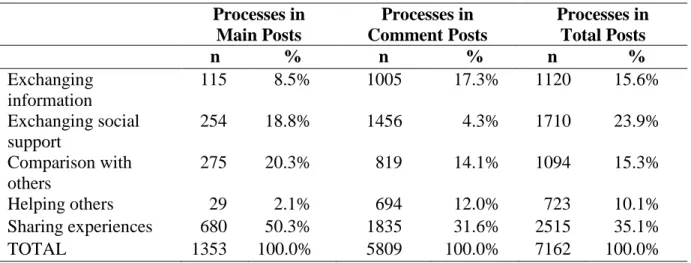
The frequency of expression of each empowerment process is reported in Table 2.
Sharing experiences was the empowerment process that occurred most frequently, appearing over 2500 times overall, most of which were in Comment Posts. Comparison with others and exchanging support were also frequently expressed processes in Main Posts, and exchanging social support and exchanging information were frequently expressed in Comment Posts.
Table 2. Frequency of expression of empowerment processes
Processes in Main Posts
Processes in Comment Posts
Processes in Total Posts
n % n % n %
Exchanging information
115 8.5% 1005 17.3% 1120 15.6%
Exchanging social support
254 18.8% 1456 4.3% 1710 23.9%
Comparison with others
275 20.3% 819 14.1% 1094 15.3%
Helping others 29 2.1% 694 12.0% 723 10.1%
Sharing experiences 680 50.3% 1835 31.6% 2515 35.1%
TOTAL 1353 100.0% 5809 100.0% 7162 100.0%
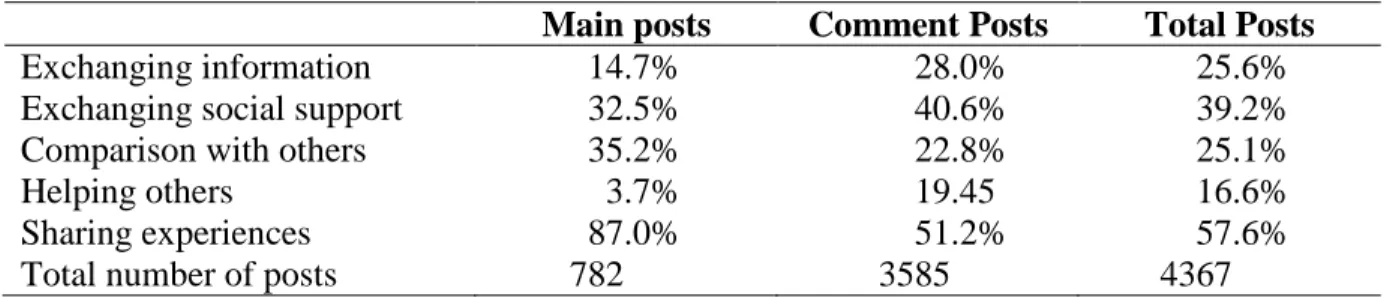
Another way to consider the prevalence of each type of empowerment process is
by examining the proportion of posts that included an expression of each type. The
results of this type of analysis are shown in Table 3. Sharing experiences was the
empowerment process that occurred most frequently in the both the Main Posts at 87.0%
and in 57.6% of all posts. Exchanging social support was also expressed in a high
proportion of all posts (39.2%), but was slightly more common in Comment Posts than in
Table 3. Proportion of posts including expressions of empowerment processes
Main posts Comment Posts Total Posts
Exchanging information 14.7% 28.0% 25.6%
Exchanging social support 32.5% 40.6% 39.2%
Comparison with others 35.2% 22.8% 25.1%
Helping others 3.7% 19.45 16.6%
Sharing experiences 87.0% 51.2% 57.6%
Total number of posts 782 3585 4367
Note: The percentages are calculated using the frequencies from Table 2 as the numerator and the Total number of posts from this table as the denominator.
Exchanging information involved giving or asking for factual information such as general information about anxiety, drug symptoms, treatment information, or articles,
books or audio that could be of help to ease anxiety. Examples of this include: “How
normal is this? Is it normal for it to last all day?” and “Read the Linden method…He was
a sufferer for over 20 years and attempted suicide as well.” Exchanging social support
involved giving or asking for emotional support. Examples of this include: “Hang in
there”, “You got this!”, “Good luck”, “I hope you feel better”, and “Please help me”,
“I’m scared”, “Glad I’m not alone.” Comparison with other members involved
comparing their feelings, symptoms, situation, etc. to others and often involved words.
Examples of this include: “I have that too”, “I’m the same way”, “I know how you feel”,
and “Does anyone else…?” Helping others involved giving advice to others such as, “Talk to a doctor about it. Study your life and live for something better, something new.
Tell yourself that you’ll overcome it.”, “Get a notebook and write down everything you
know about your anxiety and anger and PTSD, write down how it makes you feel and
how it has changed your life, explain how much it is affecting you and making you hurt
and feel bad.”, and “Try reading a book or magazine until you get tired! Distract your
Examples of this include: “I have 3 friends who swear by it. I've been put on a low dose
of hormone birth control pill. One month down & I do feel a little better.”, “I have
completely stopped driving for 3 years now, and mine is just not even 5 miles away- I
can't even think about getting on the freeway.”, and “Sweetie my daughter is 8 months
old and I've had absolutely horrible anxiety since I had her.”
The empowerment outcomes included feeling informed, increased confidence with physician, increased acceptance, increased optimism and hope for the future,
enhanced self-esteem, and enhanced social well-being, and increased confidence in the treatment (see Table 4). Those outcomes expressed most frequently were increased acceptance, increased social well-being, and increased optimism and hope for the future. In the Main Posts, increased optimism and hope for the future was expressed most frequently; in the Comment Posts, increased acceptance and increased social well-being
were expressed most frequently.
Table 4. Codes of Empowerment Outcomes
Empowerment Outcomes Main Posts Outcome / Main Posts (%) Comment Posts Outcome / Comments Posts (%) Total Posts Outcome / Total Posts
(%)
Feeling informed 8 6.2% 101 10.23% 109 9.8%
Increased confidence in physician
7 5.4% 124 12.6% 131 11.8%
Increased acceptance 26 20.2% 196 20.0% 222 19.9%
Increased optimism and hope for the future
39 30.2% 156 15.9% 195 17.5%
Increased self-esteem 21 16.3% 70 7.1% 91 8.2%
Increased social well-being
28 21.7% 177 18.0% 205 18.4%
Increased confidence in treatment
0 0.0% 160 16.3% 160 14.4%
The proportion of posts that included empowerment outcomes was fewer than
with the empowerment processes. Increased optimism and hope for the future was the highest in the Main Posts at 5.0%; increased acceptance was the highest in the Comment Posts at 5.5%, and was also the highest overall at 5.1% in the Total Posts. These
empowerment outcomes were most evident when expressed by users in gratitude to
another user or to support another user. With the exception of increased optimism and hope for the future and increased-self-esteem, the proportion of empowerment outcomes increased from the Main Posts to the Comment Posts. An analysis by user is shown in
Appendix III.
Table 5. Proportion of posts including expressions of empowerment outcomes
Main posts Comment Posts Total Posts
Feeling informed 1.0% 2.8% 2.5%
Increased confidence in physician 0.9% 3.5% 3.0%
Increased acceptance 3.3% 5.5% 5.1%
Increased optimism and hope for the future 5.0% 4.4% 4.5%
Increased self-esteem 2.7% 2.0% 2.1%
Increased social well-being 3.6% 5.0% 4.7%
Increased confidence in treatment 0.0% 4.5% 3.7%
Total number of posts 782 3585 4367
Note: The percentages are calculated using the frequencies from Table 4 as the numerator and the Total number of posts from this table as the denominator.
Increased optimism and hope for the future was the empowerment outcome that occurred most frequently in the Main Posts at 5.0%, while increased acceptance, closely followed by social well-being, was the empowerment outcome that occurred most frequently in the Comment Posts at 5.5% and 5.0%. Feeling informed involved feeling informed from giving advice or feeling informed from receiving advice. Examples of
this include: “I’ve just read up on breathing exercises…you’re not dying, it’s just
advice…I will look into it.” Increased confidence with physician involved increased confidence with or willingness to see a physician, therapist, etc. Examples of this
include: “I will definitely talk to my doctor about the citalopram”, “It's really not as scary
as you think…You'll be ok and most probably feel better just by seeing someone”, “My
therapist told me about …I can tell a difference all ready”, and “Go to the doctor if your
concerned to put your mind at ease.” Increased acceptance involved acceptance with their situation or their feelings over anxiety. Examples of this include: “I feel content and
life's manageable again”, “It’s all in our heads”, “Once you start realizing that everything
you feel is due to anxiety things will be so much easier… I am doing much better now &
just know that things will go back to normal” and “I try not to worry about the bad days
and try to look positive for the good.” Increased optimismand hope for the future
involved feelings of positivity for the future. Examples of this include: “Positive attitude
will be positive results!” and “there's light at the end of the tunnel”. Enhanced self-esteem involved some kind of positive feelings about themselves or their situation, often from a success or from social support. Examples of this include: “I did really good
today!”, “I have recovered from hypochondria!”, “I'm crying because of how happy your
comments have made me”, and “Having you relate will help me have a brighter day.”
Enhanced social well-being involved feelings of being a part of the online health community. Examples of this include: “This forum makes me feel better most of the
times…great people”, “It’s comforting seeing I’m not the only one”, “You aren’t alone.”,
and “It feels so good to be understood.” Finally, increased confidence in treatment
involved greater confidence in medication, lifestyle modifications, alternative medicine,
good course of action”, “if you need to take a tablet a day to feel better than so be it”, and
“GABA and Rescue Remedy has helped me.”
There were 215 multiple, repeat posters in the online forum discussion group.
Forty only commented on others’ Main Posts, while the other 175 both commented and
posted. The majority of these were patients and fellow sufferers of anxiety. However,
there were two that could be confirmed as community managers or advocates. One user,
#68, was a self-professed health professional whose username included the prefix “Dr.”
He was included under the “What Our Advocates Are Saying” section and is thus
verifiable as a community advocate. Another user, #90, was identified as a community
advocate or community manager due to the administrative content of the user posts. The