M. Elizabeth Davidson. Twitter in journalism: Journalists’ personal voice and the use of Twitter as a news-sharing platform. A Master’s Paper for the M.S. in L.S degree.
November, 2011. 57 pages. Advisor: Zeynep Tufekci
The profession of journalism is changing as microblogs and blogs emerge as crucial sources of news. Twitter has recently become an important addition to the ecology in which journalism is practiced. However, Twitter does not merely replicate the practice of traditional journalism; rather, it opens up new avenues and creates new challenges. Twitter allows for direct interaction with the public, inserting of opinions alongside news and observations, “retweeting,” and linking to audiovisual materials. This study examines the Twitter feeds of reporters Ayman Mohyeldin, Jack Shenker, and Ben Wedeman during the Egyptian Revolution (January-February 2011) and compares them to the transcripts and articles that the reporter formally produced. The results show that a journalist is more likely to use a personal voice in a Twitter feed in comparison to the “professional” product and that journalists on Twitter interact directly with the public to a
significant degree.
Headings:
Twitter (Web site)
Content Analysis
Journalism
TWITTER IN JOURNALISM: JOURNALISTS’ PERSONAL VOICE AND THE USE OF TWITTER AS A NEWS-SHARING PLATFORM
by
M. Elizabeth Davidson
A Master’s paper submitted to the faculty of the School of Information and Library Science of the University of North Carolina at Chapel Hill
in partial fulfillment of the requirements for the degree of Master of Science in
Library Science.
Chapel Hill, North Carolina
November 2011
Approved by
_______________________________________
TABLE OF CONTENTS
List of Screengrabs 2
Introduction 3
Literature Review 11
Methodology 21
Results 25
Discussion 29
Notes 35
References 36
Appendix A: Distribution of Tweet Origins for Mohyeldin, Shenker and Wedeman 39 Appendix B: Distribution of Tweet Content for Mohyeldin, Shenker and Wedeman 40 Appendix C: Distribution of Link Destinations for Mohyeldin, Shenker and
Wedeman 41
Appendix D: Distribution of Transcript and Article Content for Mohyeldin, Shenker and
Wedeman 42
Appendix E: Transcripts for Mohyeldin’s Reports 43
List of Screengrabs
Screengrab # Page # Retrieved from URL
Screengrab 1 4 https://twitter.com/#!/RawyaRageh/status/98724006823342080 Screengrab 2 5 https://twitter.com/#!/AJEnglish/status/128803100302655488 Screengrab 3 6 https://twitter.com/ on 12 November, 2011
Screengrab 4 8 https://twitter.com/#!/jkrums/status/1121915133
INTRODUCTION
When the Internet came into the hands of the public in the 1990s, it would have
been difficult to envision the changes it would make in the world of information. A little
over two decades have passed since the first commercial provider of dial-up Internet, a
company called “The World,” came online. (Zakon, 2010) We have moved from a world
of online websites jostling for attention in their roles as billboards for the interests of their
designers (or platforms for selling the products of their inventors) in the ‘90s to today’s
Web 2.0. Web 2.0 has come to signify the evolution of the web toward more participatory
platforms in which user-generated content within highly-interactive environments
becomes the main product. (O’Reilly, 2005) Twitter is a Web 2.0 platform that has
become increasingly important for journalism. In this paper, I will analyze the voice of
journalists on Twitter as a news-sharing platform and compare their Tweets with their
traditional products, such as filed reports or broadcasts.
Twitter is a microblogging service that allows users to post short 140 character
“tweets” which are shared with anyone who chooses to “follow” them. Its 140-character
limit makes each message easy to digest for other readers or “followers,” as well as easy
to circulate by Internet or text message, as it stays well within the limits of SMS
guidelines. Twitter conventions allow for conversations as well as “retweeting” of
messages, which makes it suitable for a variety of information sharing applications.
permits users to access Twitter not only via computer but also through portable electronic
devices like mobile phones, tablets, and PSP devices. Twitter posts, or “tweets,” are also
findable by Internet search engines.
Once a user name is created, the interface presents the user with a front page. The
page displays the latest updates of the groups or individuals the user has elected to
follow, as selected during the user registration process. Above the list, or “feed,” is locate
a text entry box above which Twitter asks, “What’s happening?” To those who were
around and online during the development of Facebook, it is strongly reminiscent of the
Facebook status update.
However, Twitter’s real strength comes from the ability of its population to create
what Lotan, et. al. (2011) refer to as “information flows.” Information flows are rapid
information exchanges that move along a pathway of connected users. Twitter has
several tools that facilitate such information exchanges. The most basic is a user’s home
screen, which lists in reverse chronological order the tweets of other Twitter users that
the user follows. If a user wishes to see older tweets, they need only scroll down. If they
wish to view only the tweets of a specific individual or group, they need only select their
name or title from the feed. The user can also select a tweet that they wish to share and,
with the click of their cursor, can “retweet” it. Retweeting another user’s tweet is sharing
it with one’s own followers; the tweet appears on the feed of the user who retweeted it,
citing the original Twitterer as the source. The retweeted message is then visible to
Screengrab 1
Another powerful tool for information sharing is the hashtag. A hashtag is a word
or phrase (typed without spaces) preceded by the ‘#’ sign. If a hashtag is created for a
subject, it is possible for a user to search for that subject, using the word or phrase behind
the ‘#’ symbol, and pull up every tweet in which it is used. Selecting the hashtag in a
tweet also draws up a reverse chronological list of every tweet that contains the hashtag.
Often individuals who want to gather information create a hashtag specifically for the
purpose of amalgamating subject-relevant statements from the site. Al Jazeera English,
for example, can use the hashtag #WhenMusharrafReturnsToPakistan to collect the
tweets of users who have made statements detailing their thoughts of what will happen
once Musharraf returned to Pakistan from his exile.
Screengrab 2
Twitter also provides users with quick access to the most popular subjects on the
site. It amalgamates both popular hashtags and popular phrases to create a list of the top
‘Trending’ topics of the moment. It also allows Twitter users focus on global, national or
regional trends based on their preference. Users can then use these phrases in their own
tweets, adding their opinions or statements to those already in existence and expanding
the pool of commentators further. They can also select a topic from the list and view a
Screengrab 3
Twitter users can also use one of the many Twitter platforms like Tweetdeck to
further organize their lists of followers and hashtags of interest. Along with multi-device
accessibility, Twitter’s simple but flexible platform allows for rapid sharing of
information as well as conversations among its users.
Twitter and Journalism
Twitter provides a platform that journalists can use in multiple ways. Journalists
can use the service to publicize their observations and stories, engage in conversations, or
to harness news from “citizen-journalists” or experts around the world who are tweeting
about newsworthy events. A journalist at the scene of an event can tweet about their own
observations, retweet those of people as they decides their comments are relevant to the
story, provide links to other news stories, ask questions to their followers and engage
them in conversations, or express opinions or make personal remarks.
Two additional tools for journalists are hashtags and trends. Rather than keeping
an eye on the stories run by competing news agencies, or trying to ascertain where public
interest lies based on editorials and opinion pieces, journalists now have an international
pool of constantly contributing informants to draw from. The blogging and
little-heard in the past a louder voice. Those who have been able to benefit from the
program have found that their voice is more prevalent and permanent than it might have
been in the past, in conversations overheard and points raised at town hall meetings.
Groups that are able to successfully utilize Twitter are able to spotlight issues they view
as important, and to share their concerns with larger populations. The more popular and
shared the concern, the more visible it becomes in Twitter’s trends and individual tweets.
Journalists on Twitter are also able to pick individuals and groups to follow. They
can create a pool of experts with a focus on their own field of reporting, which could
include activists, relevant organizations, and subject authorities. This is especially useful
in situations that involve developing international news, that are in locations journalists
may not be able to immediately access, or in situations where overtly interviewing
participants or witnesses is difficult or dangerous.
While Twitter has the ability to enable journalistic improvement, it may compete
with journalism’s formal final product, the news story. In a world where print journalism
is rapidly losing subscribers and journalists and reporters are fighting to hold public
attention in the face of free resources online, Twitter and other blogs and microblogs
have the power to act as news sources of their own. An argument for the continued need
for journalists in the face of the thousands of on-the-minute updaters online is that
information provided by journalists is better, “more factual,” and “more objective” than
what can be found on personal information feeds. (Jones, 2009) Journalists also use these
tools to share data, which brings into question their role on sites like Twitter. Also,
information sources on Twitter can be overwhelming and hard to accurately judge for the
Twitter in Crisis Situations
Twitter has been used by journalists and citizen journalists as a tool for providing
updates during fast-breaking and crises situations several times in the recent past. In
2009, Twitter users were posting updates on the protests that followed the Iranian
election. Also in 2009, Twitter was the first platform that reported on U.S. Airways Flight
1549’s landing in the Hudson, as tweeted by ferry passenger Janis Krums.
Screengrab 4
In 2010, it was used for updates, collaboration and crisis mapping during the
Haitian earthquake and its fallout. In 2011, Twitter users followed closely and reported
situations is not Twitter’s character limitations, which keep updates short, but the easy
accessibility of the program itself, which makes it simple for anyone to post updates and
subsequently results in a flooding of the site with data. It can be difficult for a user who
wants to peruse Twitter for news to ascertain what information is the most important.
Again, this brings into question the role of the blogs and microblogs that are
maintained and written by journalists. While both journalists and news organizations
have access to the information pool of Twitter, information feeds posted by news
organizations are often links to or abstracts of articles or reports on their main website.
(Holcomb, Gross and Mitchell, 2011) Journalists who tweet in first person are more
likely to conduct conversation through their profiles, respond to comments, elicit
information and answer questions. This overlap of journalistic sharing of data and
individualized social interaction does not fit easily into journalism’s ascribed formats and
raises new questions about standards of impersonality and the lack of “authorial”
personal-voice which dominates traditional journalism.
The 2011 Egyptian Revolution can be considered a watershed movement for the
use of Twitter for journalism. In many ways, the Egyptian uprising was well-suited to
Twitter’s strengths. It was fast-developing, and in a non-US location where it was
difficult or dangerous to personally attend and/or interview participants. When protesters
took to the streets on January 25th, many of the journalists that would later arrive on the
scene were still in Tunisia, reporting on the fallout of its revolution. Twitter gave them
access to events on the ground as reported by citizens with cell phones and laptops before
This paper aims to qualitatively compare a reporter’s tweets and his or her formal
journalistic “finished” product through three separate case studies, involving Ayman
Mohyeldin of Al Jazeera English1, Jack Shenker of The Guardian and Ben Wedeman of
CNN. Each reporter’s tweets between the beginning of the protests on January 25, 2011
to former President Mubarak’s resignation on February 11, 2011 have been examined,
categorized and compared to the official reports the journalists produced for their news
LITERATURE REVIEW
While the changing field and future of journalism has been debated since the 90s
(Cross, 2009; Sicha, 2009), Twitter has only recently come into the spotlight, because it
is a recent platform. Because of this, many of the works discussed here involve not so
much definitive statements and empirical studies of the network, but instead the
perspectives represented in the debate. In this section I review articles about the role of
journalism as related to Twitter, what role journalists play as actors on the Twitter
platform and the steps that journalistic organizations are taking to regulate the use of
Twitter by journalists.
Twitter and Journalism
While there have yet to be any studies on the effect of Twitter on trends in
journalism, there has been an plenty written debating the potential benefits and
detriments of online social networks (OSNs). Cizek (2009) argues that technological
advances, including OSNs like Twitter, are enforcers of better and more accurate
journalism. He claims that they advance the voice of the people in the face of the desires
of wealthy organizations or oppressive governments. The Egyptian Revolution provides
one example where the use of Twitter by activists and protestors enabled them to
organize and facilitate knowledge sharing about what was happening in Cairo.
(Naughton, 2011)
In The Twitter Revolution (2009), Farhi warns against the hazards of journalists
tweeting unconfirmed “scoops,” using Washington Post book critic Ron Charles as an
example. In March 2009, Charles tweeted that a source had informed him of a change in
Yorker is considering switch biweekly or monthly. Recession pains.” Minutes later, when
Charles was reliably informed via email that no such consideration was in the works, it
was too late. He states that “within 10 minutes … ‘it seemed like the whole Internet went
crazy. It was terrifying.’” (31) Because Charles’ followers believed him to be a reliable
source, they treated his tweet as though it were fact, and the Chicago City Paper and the
New York Observer both reported on the story. Ultimately, the New Yorker had to make
an official statement to put an end to the rumor.
Twitter’s own structure and design contribute to the risk of spread of inaccurate
information. While there are ways to identify “good” sources online, particularly those
which provide users with a bibliography of sources referenced, the tactics which can be
used on tweets are still emerging and are not necessarily standardized or available to the
wider public in an accessible manner. Clemmitt (2008) discusses the ways in which
Internet users can assess websites in his article on Internet accuracy. Bibliographies and
extensive source citations are impossible with the tweets’ 140-character limit. Evaluating
the professionalism of the site’s design, another way in which Internet users assess
content, is not reliable when page formatting on Twitter is frequently based entirely on
the site’s defaults. There are also ways for users to gauge source accuracy that simply
don’t apply to Twitter. The “.com” URL is not indicative of informational accuracy in the
way in which a message posted on a “.gov” or “.org” site would be. Checking for typos is
an exercise in futility because of the necessary use of text-speak. The flood of
information makes it more difficult to filter through in order to find relevant and accurate
The issue is, as Clemmitt states, not that Internet users are intentionally spreading
falsehoods, but instead that they make statements that contain small errors that escape
notice. If an individual is using a source they trust (following either a favored
organization or an individual they respect and view as knowledgeable) they are unlikely
to cross-check the statements that their source makes.
Because of fear of repeat situations like Charles’, some have suggested that
Twitter should be used like a microphone, with organizations tweeting only confirmed
information. Briggs discusses the new word of mouth (“word of link”) that is developing
on OSNs like Twitter. (2011) He suggests that this tendency to share links to articles and
resources can be better for news organizations in the long run because it makes them
think long-term about how to build a loyal audience. In so doing, the organizations are
more likely to produce dependable, interesting resources, particularly with studies
indicating that users who follow links posted by their network tend to linger on the web
page longer than those who are browsing news sources of their own inclination.
The detriment of using Twitter solely as a source for link sharing is that by
limiting tweets to links to edited and approved articles, the advantages provided by its
speed, interactivity and currency are hobbled. Farhi (2009) points out that Twitter is
excellent for publishing breaking news or “scoops” because of the speed and brevity with
which posts can be made. Quoting Stoltz, he states that Twitter
… works best in situations where the story is changing so fast that mainstream media can’t assemble all the facts at once … the kinds of stories where time is important and facts are scattered. (27)
Multiple voices (Craighenry, 2011; Hermida, 2010; Ludtke, 2010; Sylvester,
arena for a progression of “snapshots” of events that change quickly over time or
develop with great rapidity. While court cases and political debates are both discussed
examples where Twitter can be useful, revolutions are another situation where the site,
which Hermida describes as lightweight, real time, and asynchronous, can be useful.
Ludtke even goes so far as to note that journalists can feel as though even reporting
moment-to-moment via Twitter can be too slow for the public’s vociferous appetite for
up-to-the-minute updates on subjects of their interest.
Overholser (2009) approaches the debate from a different angle, arguing that
viewing social media as a “tool” is an incorrect assessment of its role in journalism.
Instead she describes it as part of the environment in which journalism exists, in which
journalism is participating in it because it must. Her assertions provide a lense through
which to consider the opinions of other debaters, because it does appear that increased
engagement with OSNs is an unavoidable decision for news organizations.
Journalists and Twitter
While news organizations tend to use Twitter as a microphone for their products,
posting news without any real conversation with their followers, journalists play a
different role on Twitter. (Holcomb et al., 2011) They are more likely to have individuals
and organizations that they follow, from which they can pull news. Farhi (2009) asserts
that Twitter can be used as a type of information network, one which journalists can use
for inquiries or as a real time tip sheet. If a feed is “pruned” to include experts, field
leaders and peers, the OSN can act as a pool of information.
Crawford (2011) discusses the use of Twitter by news professionals in her News
Twitter as a one-way street for information dissemination by referring to the 2009 Iranian
elections and the riots it incited. Despite a strong shift of attention to these events by their
Twitter audience, CNN failed to sufficiently cover the story. There was such an obvious
discrepancy between audience interests and CNN’s reporting that a new hashtag,
‘#CNNfail,’ was created to refer to the lack of coverage. If CNN had followed some of its
followers, it might have been quicker to recognize the interests of the populous.
Journalists, unlike the organizations that employ them, are more likely to maintain a
two-way information pathtwo-way between themselves and their followers. Crawford asserts that
there are even benefits to conversational exchanges on Twitter in addition to
news-specific exchanges, in that they cement the social bonds on the OSN between journalists
and their followers. Quoting Shirky,
[The model of] a group of accredited professionals deciding what becomes news and what doesn’t … has now been set aside in favor of a much more soft-focus, kind of permeable membrane-oriented way of handling or thinking about the news. (Juskalian, ‘Interview with Clay Shirky, part II’, 2009)
The implication is that news itself is changing to include the audience in the conversation
as to what qualifies for media attention.
Lewis (2011) takes a closer look at the changing role of journalists. Because
Twitter users can skim tweets to gain something of a birds-eye view of the occurrences of
the day, it is no longer necessary to be on the site of an event to grasp what is happening.
This can be particularly useful when dealing with breaking or international news. He
asserts that we should consider new identities for the journalists who absorb, process, and
disseminate information that they find online, condensing and simplifying the muddle of
which the public has found online but has yet to be confirmed as factual by mainstream
media. Lewis’s post raises but does not answer the question as to whether or not this
means that news, which we have so long depended on to be trustworthy, is no longer as
dependable a source as once it was.
In Bloggerati, Twitterati, Cross (2011) outlines the line that journalists walk when
competing with and participating in Twitter news announcements. She states that Twitter
is better than mainstream media for following “breaking news and fast-moving,
up-to-the-minute content,” while they draw an “active, interested audience” with more intimate,
subjective perspectives on the news. (83) At the same time, Twitter-based journalism
can’t necessarily match the in-depth coverage and longer-term investigative reporting
provided by mainstream media.
The broader range of information shared on Twitter, along with the existence of
conversational flows between the journalists and other users and the addition of personal
updates creates new questions in terms of journalists and Twitter. As Ron Charles posed
the question the most concisely: “Am I reporter [when tweeting]? Am I an editor? Am I a
critic? Or am I just talking among friends?” (Farhi, 31, 2009) Overholser believes that
“being there and being accurate” are keys to professional journalism that journalists are
no longer achieving. She asserts that the duty of a journalist who uses social media is to
bring the journalistic features of accuracy, proportionality, fairness, and emphasis on a
broad range of voices to a conversation where “everybody in the debate sounds like a
19-year-old privileged male.” She suggests that in the face of “everybody,” journalism
students must be better educated to confront these new challenges:
geopolitical implications of social networks’ role belong in that
discussion. In lessons revolving around entrepreneurial journalism, there needs to be woven into the conversation the issue of how journalists handle their personal engagement in social networks. Along with this would come the discussion of how to ‘brand’ themselves for a future that is likely to include a lot of independent activity. (6)
Changes in the education of journalism students seem an increasingly likely scenario,
with the development of more classes like DePaul University’s course, ‘Digital editing:
From breaking news to tweets.’ (Tweet U, 2009)
Overholser’s assertions highlight the necessity of considering the traditional role
of the ‘impersonal’ voice of journalists in light of Twitter. When one has followers that
may agree with one’s personal leanings, it is arguably easier to promote news that is
well-received by one’s followers. Jones (2009) discusses the need for impartiality, stating that
a journalist must act as “an honest broker of the news.” He outlines the existing debate
over the origin of the ideal of objectivity, and touches on the question of its definition
inside the field. “As a group,” he argues, “journalists probably have more opinions than
most.” This argument is necessary to consider when assessing the risk of publishing
inaccurate or biased information under a trusted name, and the damage to the reputation
of the journalist and their employer that might result. However, Jones argues “objectivity
does not require that journalists be blank slates free of bias. In fact, objectivity is
necessary precisely because [sic] they are biased.” (87) He acknowledges that his
argument opposes those who believe that journalists must be without bias in order to be
objective, and takes a stand against those like Jeff Jarvis, who believes objectivity to be
“a false high standard that we could not help but fail,” (83) or who argue that people no
A recent work on a journalist’s role in news making on Twitter during the
Egyptian revolution is the study ‘The revolutions were tweeted.’ (Lotan et. al., 2011) The
study involved an examination of data flows on Twitter during one week each of the
Tunisian and the Egyptian revolution. Twitter is examined “as a key source for real-time
logistical coordination, information and discussion among people both within the Middle
East and North Africa … and across the globe.” (1377) The study asserts that mainstream
journalists tend to cater toward an audience of “friendly critics” rather than the public as
a whole, while networked news or news extracted from or posted on OSNs like Twitter
tends to draw from a networked set of actors.
The article discusses some of the issues faced by actors using Twitter for news.
Journalists on Twitter do not segregate personal tweets and news-related, making the
microblogging stream more complex for the casual reader. It can also be difficult for the
online population to discern authority figures or professionals in the microblog’s
environment. At the same time, Twitter enables “information cascades,” or shared
information without contribution by the user, via retweets. The Trending Topics section
of a user’s homepage also makes it easier for information cascades to occur by drawing
the attention of a user to the top stories of the moment. It is these information cascades
that the study focused on, in an attempt to ascertain the role that Twitter played in sharing
information during the revolutions.
Of the information cascade samples taken from the Egyptian revolution in Lotan
et. al. (2011), journalists made up 14% of the contributing actors, and were one of the top
three groupings of actor-types to contribute to information flows. They also had a large
words, journalists were active participants in spreading information during the Egyptian
revolution. They showed a higher tendency to retweet data from other journalists than
from other actors, perhaps indicating implied trust in individuals that they viewed as
professional peers. Finally, the data showed that journalists, along with other individual
actives, were more likely to be information disseminators than organizations (including
mainstream media organizations).
What this indicates is that not only are journalists acting as information
disseminators on Twitter, but they may play a greater role in information flows during
crises than mainstream media organizations that also use Twitter to share news. This may
be because they tend to follow field experts and activists, while organizations are less
likely to attend to or retweet the tweets of their followers. (Holcomb et al., 2011) It may
be because journalists are able to cultivate relationships with their followers on an
individual basis, making their followers more inclined to share information which they
have tweeted.
Social Media Guidelines in Journalism
Issues of objectivity, already debated in the world of journalism, are complex
when dealing with journalism on Twitter. The OSN creates an environment where there
is a constant feed of information from users, and the identity of the journalist on an OSN
is, as Ron Charles noted, can be unclear as to whether it is that of an individual or a
professional. The differentiating opinions on the matter became clear in the backlash over
the Associated Press’s recent change in their Social Media Policy (2011, November 3).
The policy already included a section requesting that staff members:
declaring their views on contentious public issues in any public forum and must not take part in demonstrations in support of causes or movements. (2)
In the update, it had been expanded to include a section dealing with retweets:
Retweets, like tweets, should not be written in a way that looks like you’re expressing a personal opinion on the issues of the day …we can
judiciously retweet opinionated material if we make clear we’re simply reporting it, much as we would quote it in a story. … These cautions apply even if you say on your Twitter profile that retweets do not constitute endorsements. (2-3)
While journalists reacted with a mixture of criticism and acceptance (Sonderman,
2011), Ingram (2011) and Watling (2011) spoke out from the opposing schools of
thought about the need for such restrictions. Watling argues that the policy should be
helpful, because “[i]t’s offering advice to avoid the appearance of bias, [sic] which
(hopefully) all journalists can tell you is nearly as important as actually avoiding bias to
begin with.” Ingram, however, argues that journalists have opinions and should not be
expected to pretend otherwise, and that implying that it is necessary to deliver news
without bias is insulting to the intelligence of an audience that is capable of perceiving
what contains an opinion and what does not. “Given that kind of treatment,” he states,
“many of those looking for news are likely to migrate to sources that admit they have
views on events.” These different lines of thought emphasize the need to understand how
METHODOLOGY
For this study, the Twitter feeds of Mohyeldin, Shenker and Wedeman, between
the dates of January 24, 2011 and February 11, 2011 were downloaded from Twitter’s
website. Each tweet was categorized based on its origin (a direct tweet to followers,
retweet, or reply), its content, and the type of content that any links included in the tweet
led to. While every tweet was categorized for origin and content, a tweet was only
marked for links if a link was included in the text of the message.
The three categories for which tweets were marked for origin were: ‘Statement,’
‘Retweet,’ and ‘@’. ‘Statements’ were tweets posted by the reporter and addressed to the
Twitter public rather than one particular recipient. ‘Retweets’ were messages in the feed
that originated from another user. ‘@’ tweets were public tweets posted by the reporter
and directed at another Twitterer, as indicated by ‘@username’ typed in the front of the
tweet.
The second categorization set, ‘Content,’ was used to designate the nature of each
tweet. There were eight separate labels used: ‘News,’ ‘News and Opinion,’ ‘Opinion,’
‘Personal,’ ‘Factual Question,’ ‘Opinionated Question,’ ‘Address to Populous’ and
‘Response.’ ‘News’ was the label used to encompass factual updates: changes in the
situation the journalist was reporting, news that the journalist had become aware of, and
observations about their surroundings or the events occurring.
The ‘News and Opinion’ category was used for tweets that contained news, but
Screengrab 5
A tweet labeled ‘Opinion’ expressed only the opinion of the user.
Screengrab 6
‘Personal’ tweets were statements that were not news or event related.
Screengrab 7
‘Factual Question’ and ‘Opinionated Question’ were used to categorize tweets
that addressed the journalist’s followers, either in an open-question format that invited
response, or in a closed-question format that invited agreement or implied a point.
Screengrab 8 – Opinionated Question
Tweets categorized as ‘Address to the Populous’ were tweets meant to inspire the
reporter’s followers to react in a certain way.
Finally, ‘Response’ tweets were labeled to indicate tweets either written by the
journalist or to the journalist, with a message that did not relate to the news in any
ascertainable way but were clearly responses to statements or questions made by the user
to whom they were addressed.
The third set of categories dealt with the destinations of links posted in tweets.
The three divisions were ‘Article,’ ‘Audio/Video,’ and ‘Photo.’ These categories were
applied regardless of the origin or content of the tweet.
Before any assessment was done, two tweets were removed from consideration
because they appeared to have been posted in error. One tweet was dated January 27 from
Mohyeldin’s feed, and the other was dated February 6 from Wedeman’s feed.
Screengrabs of the tweets are visible in Appendix F.
After the tweets were categorized, samples were taken from the final professional
reports produced by each journalist between January 24, 2011 and February 11, 2011.
Transcripts of news broadcasts were used for Wedeman and Mohyeldin, while articles
authored by Shenker were used for his part in the study. Because there were no published
transcripts available from Al Jazeera English, broadcasts by Mohyeldin were harvested
from the web and transcribed. The transcriptions can be found in Appendix E.
Of the thirty articles Shenker authored and co-authored in the given time period,
twenty were randomly selected for testing by numbering them one through thirty and
selecting using a random number generator. Wedeman had twenty transcriptions
available, and they were all assessed. Searches for recordings of Mohyeldin’s broadcasts
during the revolution resulted in only five available recordings, and they were all
divided by sentence, and each sentence was assessed using the same categories of content
that were used for the tweets. There were two additional categories considered in this
portion of the assessment. The category for ‘Conversation and Inaudible’ was added in
order to handle sentences in transcriptions that were marked as partially inaudible and
therefore not possible to accurately assess, or which were a conversational exchange
between reporter and news anchor. The second category added was ‘Quotes,’ used to
RESULTS
Tweets
Mohyeldin Shenker Wedeman
Statement 67.92% 72.22% 62.88%
Retweet 14.72% 21.43% 35.16%
‘@’ 17.36% 6.35% 1.96%
Figure 1. Distribution of Tweet Origins
As is visible in Figure 1, the majority of tweets for each journalist were
statements, with Shenker, Mohyeldin, and then Wedeman with the highest to lowest
percentages. Mohyeldin was the only journalist of the three to address other users more
than he retweeted, and Wedeman was the most likely to retweet another user’s message, a
full 13.69% more of his tweets made up of retweets than Shenker, the runner-up. Graphic
representations of these values can be found in Appendix A.
Mohyeldin Shenker Wedeman
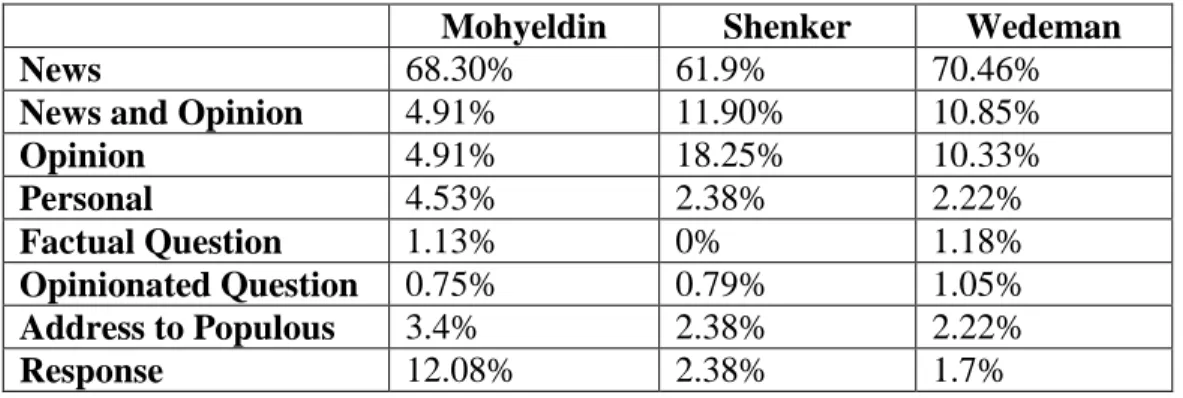
News 68.30% 61.9% 70.46%
News and Opinion 4.91% 11.90% 10.85%
Opinion 4.91% 18.25% 10.33%
Personal 4.53% 2.38% 2.22%
Factual Question 1.13% 0% 1.18%
Opinionated Question 0.75% 0.79% 1.05%
Address to Populous 3.4% 2.38% 2.22%
Response 12.08% 2.38% 1.7%
Figure 2. Distribution of Tweet Content
Figure 2 represents the divisions of content in each journalist’s feed. ‘News’
tweets, which contain news, direct observations or statements made about ongoing
events, made up the majority of each feed, with both Mohyeldin and Wedeman tweeting
more direct observations than Shenker. More than a quarter of Shenker’s feed was made
Wedeman was second most likely of the three to use his feed to tweet or retweet
‘Opinion’ and ‘News and Opinion.’ None of the journalists had strong showings in
asking questions of their audience, though Wedeman was more inclined to ask
opinionated questions than his cohorts. Shenker asked no factual questions at all.
Mohyeldin was almost twice as likely to tweet ‘Personal’ messages as either Shenker or
Wedeman. He was by far the most active journalist to use his feed to respond to his
audience, with a full 12.08% of tweets dedicated to that purpose. Graphic representations
of these values can be found in Appendix B.
Mohyeldin Shenker Wedeman
Article 4.53% 20.63% 4.18%
Audio/Video 3.77% 0.79% 1.31%
Photo 1.51% 0.79% 0.26%
Total 9.81% 22.21% 5.75%
Figure 3. Distribution of Links in Tweets
Figure 3 represents the percentage of tweets in each journalists’ feed that contains
links. While all Shenker and Wedeman have low percentages of links to audio and video,
Mohyeldin linked to audio/video almost as much as he did articles. Wedeman linked to
articles more frequently than any other media. Shenker, on the other hand, tended to link
to articles twenty times more than either ‘Audio/Video’ or ‘Photos.’ He has the highest
ratio of links to tweets of the three journalists, with 22.21% of his tweets containing links.
This is more than double Mohyeldin’s ratio, and just less than four times as high as
Wedeman’s ratio.
Mohyeldin Shenker Wedeman
Article 46.15% 92.86% 72.73%
Audio/Video 38.46% 3.57% 22.73%
Photo 15.38% 3.57% 4.55%
Figure 4 represents ratio of link destinations to the number of links for each
journalist. While links to articles make up the majority of link destinations for each of
them, Mohyeldin linked to audio and video nearly as frequently. Wedeman linked to
articles more frequently than audio and video, but still has a strong showing in that
category. Alternately, Shenker’s use of links shows clear tendencies to linking to articles
more than any other type of media. Of the categories, photos are least linked to for each
journalist. Graphic representations of the distribution of link destinations for each
journalist can be found in Appendix C.
Tweets: Anomalies
While categorizing the feeds, it became apparent that there were tweets in each
feed (11 tweets out of 265 for Mohyeldin, 2 tweets of 126 for Shenker and 12 of 765 for
Wedeman) that were closely related to more than one category of Content. In these
situations, close scrutiny was awarded each of the tweets in question and they were
subsequently marked as belonging to the group that they seemed to be more related to.
Transcripts and Articles
Mohyeldin Shenker Wedeman
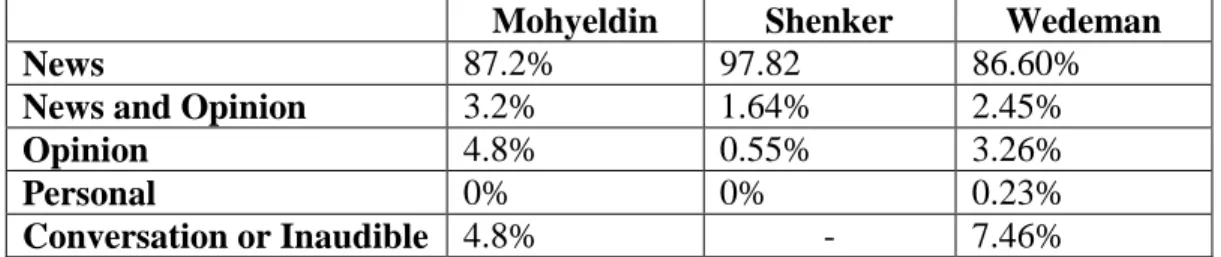
News 87.2% 97.82 86.60%
News and Opinion 3.2% 1.64% 2.45%
Opinion 4.8% 0.55% 3.26%
Personal 0% 0% 0.23%
Conversation or Inaudible 4.8% - 7.46%
Figure 5. Distribution of Transcript and Article Content
The work of all three journalists consisted mainly of News, though Shenker had
the highest ratio of sentence which were coded as news, with less than 3% of the
Wedeman’s results were similar to one another, with small portions of their work used
for ‘News and Opinion,’ (respectively 3.2% and 2.45%) ‘Opinion,’ (4.8% and 3.26%) or
‘Conversational or Inaudible’ (4.8% and 7.46%) exchanges with other anchors.
Wedeman was the only journalist to use any ‘Personal’ information in his reports.
Graphic representations of these values can be found in Appendix D.
Mohyeldin Shenker Wedeman
Quotes 0% 44.98% 10.37%
Non-Quotes 100% 55.02% 89.63%
Figure 6. Distribution of Quotes in Transcripts and Articles
The final aspect of the reports that was examined was the presence of direct
quotations, which needed closer inspection mainly due to the different parameters
Shenker’s medium of print journalism and Mohyeldin and Wedeman’s medium of
broadcasts. Figure 6 displays the results. There are distinct differences between the
journalists in this section, with Mohyeldin using no quotes, and Shenker using quotes for
nearly half of his material. Wedeman used quotes in a portion of his reports, as the
DISCUSSION
Results
Using Mohyeldin, Shenker and Wedeman as case studies, we are provided with a
glimpse of how journalists use their Twitter feeds. While all three feeds were made up of
a majority of news-related tweets and retweets, each had a strong presence of personal
opinion. Mohyeldin expressed his opinion the least of the three, with 10.57% of his
tweets involving his personal feelings, while this portion for Shenker and Wedeman’s
feeds 30.94% and 22.23%, respectively.2 This is despite the higher tendency that
Mohyeldin displayed for responding to his audience, with a slightly higher propensity for
addressing his audience, and a significantly higher use of tweets for responding to
questions. Interestingly, this is also despite Mohyeldin’s employment by Al Jazeera, a
media producer which is recognized as having a more opinionated voice and a more
visible point-of-view than The Guardian or CNN, which both subscribe more closely to
the traditional model of journalism with no explicit point-of-view.
Alternately, both Shenker and Wedeman were more inclined to retweet, and
therefore share, the tweets of other users. Wedeman displayed the strongest tendency to
retweet, with more than a third of his feed consisting of such posts. Despite retweeting
less than Wedeman, Shenker was still more than twice as likely to retweet as Mohyeldin.
While Mohyeldin appears to be more communicative in the Twitter community, Shenker
and Wedeman seem more inclined to use the community as a pool of sources.
When comparing the journalists’ feeds to their professional work, the results
become more complex. Shenker, by far the most likely journalist to express opinion in his
their opinion in their transcripts. The difference between the Shenker’s articles and the
other two journalists’ broadcast transcripts may be caused mainly by the medium in
which they are reporting. While Shenker is a print journalist with the ability to draft and
edit what he produces before it is published, Mohyeldin and Wedeman were reporting,
often live, on events that were taking place around them. They were also asked by the
anchors with whom they were communicating to express their impressions and
understanding of the situation on which they were reporting.
The percentage of quotes used by Shenker in comparison to the amount he
retweets is also worth consideration. While nearly half of his articles consist of quotes,
Wedeman retweets considerably more in his Twitter feed. It is possible that this indicates
that Shenker filters retweets closely, sharing tweets only of those he depends on as being
reliable sources, as he cannot cite identities in the same manner he does in his articles.
Mohyeldin and Wedeman, on the other hand, often reporting in live, contentious
situations, are either disinclined or less able to quote individuals in the same way that
they retweet on their Twitter feeds. Wedeman’s higher tendency to use quotes in his
transcript arises from two uses of pre-recorded reports, which were taped and then
discussed live, rather than quotes made while broadcasting live.
Implications
While significant portions of the journalists’ feeds were dedicated to reporting the
news, none of them came close to the percentages of news related in their professional
reports, and there were significant contributions of opinion in each feed. It is clear that on
instead identify as a combination of citizen and professional with their own voice as part
of the mix.
Concerns have been expressed about how personal tweets will be received by the
journalist’s audience as well as the possibility of inaccurate tweets, retweeting
contentious opinions and interacting with broad sections of the population about the
content of a particular news story. If the audience expects the journalist have only an
impersonal voice, then it is clear that they will not find this on Twitter. More
complicated, perhaps, are the tweets that included a combination of factual news reports
and the opinions of the journalist on the event, as these do not have a correspondence in
traditional journalism where news desks and editorial/op-ed pages are more strictly
divided. It is possible that a reader might find it difficult to separate what is the opinion of
the reporter and what is the actual report. If an audience feels misled or that its
expectations have been violated, it is possible that the employer of the journalist in
question might suffer from the reactions thereof.
There is also an issue of with the effect of the strength of the opinions expressed.
While we could not go into details in this study, Shenker, who was most likely to insert
his opinions in his feed, was often commenting on what he thought of a news article he
was linking while Wedeman was more inclined to express his thoughts and emotions
regarding how the protest and the government’s reactions were being handled, and tended
to use stronger wording than did Shenker.
There does not seem to be a direct correlation between a journalists’
communication with his audience and the increase of non-impersonal tweets. Mohyeldin
with individual users more frequently than did Shenker or Wedeman, but he was also the
least likely to express his opinion in his posts. Conversational tendencies do not,
therefore, by necessity decrease the ‘impersonal voice’ of reporting. Neither does it imply
that the journalist is ignoring the thoughts of users on Twitter: Wedeman, the least likely
to address other users on his feed, was the most likely to retweet the updates of other
Twitter users.
Limitations
This study contained several limitations. Only three journalists were selected for
study out of the hundreds that use Twitter’s platform. Only one journalist of the three was
a print journalist, and no journalists who specialized in radio broadcast were examined.
While all of the articles and transcripts by Shenker and Wedeman were available for
assessment, only a portion of Mohyeldin’s recordings could be accessed. For Mohyeldin
and Wedeman, the use of transcripts makes it difficult to ascertain if their opinions were
expressed in their professional reports through tonal quality or facial expressions. It is
also difficult to examine whether or not the choice of wording in the journalists’
professional reports and their Twitter feeds indicated a personal bias. Neither does this
study indicate whether the articles, audio and video, and photographs which each
journalist linked had a bias. While Shenker was the most likely of the three journalists to
insert opinion into his message, it was noted earlier that Wedeman’s opinions were
stronger. This could represent a stronger non-impersonal voice, or it could mean that it is
easier for Wedeman’s followers to separate his opinion from news. In depth examination
of these gaps would provide increased understanding of the non-impersonal voices
Opportunities for Further Study
It would be beneficial to look into the strength of the opinions expressed in the
tweets. A study of the perception of the feed by its followers would better indicate how
many of the tweets that they perceived as being impersonal versus non-impersonal. A
survey of the journalists as to how they perceive their own identities on Twitter in
comparison to their identities as professionals would provide further insight into the role
of Twitter as a communications tool. Further studies dealing with the nature of the
opinions expressed in journalists’ feeds, comparison of more nuanced expressions of
non-impersonal voice in both feeds and professional reports, the perception of journalists of
Twitter as a tool for news and the perception of Twitter followers of journalists’ Twitter
feeds would all provide a better understanding of the platform as a tool for sharing news.
Conclusion
Twitter provides journalists with a new platform for sharing information. As a
tool for communication, the amount of information available can be overwhelming
during breaking news and emergencies. It can also provide interested users with a
front-row seat to events like the Egyptian Revolution, which to many Twitter users was a
personally unreachable event, foreign and fast-paced. For those following journalists like
Mohyeldin, Shenker and Wedeman, updates were easier to access. The nature of Twitter
also allowed those followers to communicate with the journalists, and the journalists to
communicate with the public.
However, as the study of their Twitter feeds shows, it is necessary for those
followers to acclimatize to a new environment in which journalists have a personal voice
from nowhere” is encouraged. (Rosen, 2011) While many of the tweets posted by the
journalists were factual updates, a significant portion of them were personal or
NOTES
1
At the time this paper was written, Ayman Mohyeldin was a foreign correspondent for
NBC. However, at the time he made the tweets and reports discussed in this article, he
was a correspondent for Al Jazeera English, and will be referred to as such throughout the
work.
2
This calculation was made by combining the percentages of in each feed of the
REFERENCES
Associated Press. (2011, November 3). Social media guidelines for AP employees. Retrieved from
http://www.ap.org/pages/about/pressreleases/documents/SocialMediaGuidelinesN ov.2011.pdf
Briggs, M. (2011). Start spreading the news. Nieman Reports, 65(2), 7-9. Retrieved from http://www.nieman.harvard.edu/reports/article/102624/When-Community-and-Journalism-Converge.aspx
Cizek, K. (2011). When community and journalism converge. Nieman Reports, 65(2), 9-12. Retrieved from http://www.nieman.harvard.edu/reports/article/102624/When-Community-and-Journalism-Converge.aspx
Clemmitt, M. (2008, August 1). Internet accuracy. CQ Researcher, 18, 625-648. Retrieved from http://library.cqpress.com/cqresearcher/
Craighenry. (2011, September 20). Why do journalists love Twitter and hate blogging? [Web log post]. Retrieved from http://leadandgold.blogspot.com/2011/09/why-do-journalists-love-twitter-and.html
Crawford, K. (2011). News to me: Twitter and the personal networking of news. In G. Meikle & G. Redden (Eds.), News online: Transformations & Continuities (pp. 115 – 131) New York: Macmillan.
Cross, M. (2011). Bloggerati, Twitterati. Santa Barbara: Praeger.
Farhi, P. (2009) The Twitter explosion. American Journalism Review, 31(3), 26-31. Retrieved from EBSCOhost.
Gordon, R. (2009). Social media: The ground shifts. Nieman Reports, 63(3), 7-9. Retrieved from http://www.nieman.harvard.edu/reports/issue/100058/Fall-2009.aspx
Hermida, A. (2010). Twittering the news. Journalism Practice, 4(3), 297-308. Doi:10.1080/1751281003640703
Holcomb, J., Gross, K. and Mitchell, A. (2011, November 14) How mainstream media outlets use Twitter. [Web log post]. Retrieved from:
Ingram, M. (2011). Twitter and journalism: It shouldn’t be that complicated. GigaOm. Retrieved from http://gigaom.com/2011/11/08/twitter-and-journalism-it-shouldnt-be-that-complicated/
Jones, A. S. (2009). Losing the news: The uncertain future of the news that feeds democracy. Retrieved from
http://site.ebrary.com.libproxy.lib.unc.edu/lib/uncch/docDetail.action?docID=103 17665
Lewis, P. (2011, September 27). The rise of the anchor journalists. [Web log post]. Retrieved from
http://www.wired.com/cs/promo/blogs/changeaccelerators/2011/09/29/the-rise-of-the-anchor-journalists/#more-74
Lotan, G. , Ananny, M., Gaffney, D., Pearce, I. & boyd, d. (2011). The revolutions were tweeted: Information flows during the 2011 Tunisian and Egyptian revolutions. International Journal of Communication, 5, 1375 – 1405.
Ludtke, M. (2010). The beat goes on. Nieman Reports, 64(4), 4. Retrieved from http://www.nieman.harvard.edu/reports/article/102497/Introduction.aspx
Naughton, J. (2011, February 5). How Twitter engineers outwitted Mubarak in one weekend. The Guardian. Retrieved from www.guardian.co.uk
O’Reilly, T. (2005) What is web 2.0? Retrieved from:
http://oreilly.com/pub/a/web2/archive/what-is-web-20.html?page=1
Overholser, S. (2009). What is journalism’s place in social media? Nieman Reports, 63(3), 5-6. Retrieved from
http://www.nieman.harvard.edu/reports/issue/100058/Fall-2009.aspx
Rosen, J. (2011, November 10). The view from nowhere: Questions and answers. [Web log post]. Retrieved from http://pressthink.org/2010/11/the-view-from-nowhere-questions-and-answers/
Sicha, C. (2009, October 26). A graphic history of newspaper circulation over the last two decades. [Newsgroup post]. Retrieved from
http://www.theawl.com/2009/10/a-graphic-history-of-newspaper-circulation-over-the-last-two-decades
Sonderman, J. (2011, November 3). Reaction to AP retweet guidelines. Poynter.
Retrieved from http://www.poynter.org/latest-news/mediawire/152016/ap-issues-staff-guidelines-on-retweets-no-personal-opinions-allowed-or-implied/
Sylvester, R. (2011). A community watches a story unfold. Nieman Reports, 65(2), 17-18, Retrieved from
Tweet U. (2009). Public Relations Tactics, 16(10), 14. Retrieved from EBSCOhost.
Watling, M. (2011, November 3). AP updates social media guidelines to address retweets. 10,000 Words. Retrieved from
http://www.mediabistro.com/10000words/ap-updates-social-media-guidelines-to-address-retweets_b8179
Zakon, R. H. (2010). Hobbes’ Internet Timeline. Retrieved from http://www.zakon.org/robert/internet/timeline/
Appendix A: Distribution of Tweet Origins for Mohyeldin, Shenker and Wedeman
Statement 67.92% Retweet
14.72% @ 17.36%
Mohyeldin Tweets: Origin
Statement 72.22% Retweets
21.43%
@ 6.35%
Shenker Tweets: Origins
Statement 62.88% Retweet
35.16% @ 1.96%
Appendix B: Distribution of Tweet Content for Mohyeldin, Shenker and Wedeman News 68.30% News and Opinion 4.91% Opinion 4.91% Personal 4.53% Factual Question 1.13% Opinionated Question 0.75% Address to Populus 3.40% Response
12.08%
Mohyeldin
Tweets:
Content
News 61.90% News and Opinion 11.90% Opinion 18.25% Personal 2.38% Opinionated Question 0.79% Address to Populus2.38% Response 2.38%
Shenker
Appendix C: Distribution of Link Destinations for Mohyeldin, Shenker and Wedeman
Photo 15.38%
Audio/Video 38.46% Article
46.15%
Mohyeldin Tweets: Links
Photo
3.57% Audio/Video
3.57%
Article 92.86%
Shenker Tweets:
Links
Photo
4.55% Audio/Video
22.73%
Article 72.73%
Appendix D: Distribution of Transcript and Article Content for Mohyeldin, Shenker and Wedeman
News 87.20% News and Opinion 3.20% Opinion 4.80% Conversation or Inaudible 4.80%
Mohyeldin
Transcripts:
Content
News 97.82% News and Opinion1.64% Opinion 0.55%
Shenker
Articles:
Content
News 86.60% News and Opinion 2.45% Opinion 3.26% Conversation or Inaudible7.46% Personal
0.23%
Wedeman
Transcripts:
Appendix E: Transcripts for Mohyeldin’s Reports
Transcript: January 28, 2011, Update from Ayman Mohyeldin.
Retrieved from http://www.youtube.com/watch?v=3iSgFADXXcM
MOHYELDIN: …Seems to be, we’re just trying to make sense, Laura, just one second, because it seems that they have been able to push the pro- the riot police back … it seems, it seems right now that some of the protestors are ordering other protestors, they’re telling other protestors to halt throwing rocks. I can’t see from the vantage point of where I’m standing right now I’m just gonna stick my head out the window, one second.
Ok, there’s, there’s one – Can you hear me?
ANCHOR (unnamed): Yes we can, Ayman, we’re watching.
A now. I don’t’ know if our camera’s are-are capturing that. But what we are told is that it’s prayer time and that the protestors are trying to organize another prayer like they were earlier this afternoon. Ok – ok. Also, I just wanted to give you some news that’s happening in our building right now. We are told that state security, state security has entered the building from which we are broadcasting a live signal. They’re probably making their way, we are, making their way through the floors. This is a building that is concentrated with a lot of news agencies and media organizations, we’re one of them, but we are told that state security is now in our building here in the heart of Cairo. So it is an attempt, obviously, by the government to try and restrict these images that are being broadcast around the world from getting out. What we do know is right outside the building you can see the protestors trying to assemble for what we understand is evening prayer time.
ANCHOR: Ayman, stay with us while you can.
MOHYELDIN: I will, I will, I’m here.
You can see, you can see one of the protestors there standing, he’s giving his back, he’s now turned, he’s giving his back to the riot police, he’s trying to organize the protestors in prayer in front of the riot police. From some very historic images that you’re seeing there. We saw this earlier when it was just afternoon prayers, after Friday prayers there was a impromptu prayer, and you can the protestors once again lining up to perform the sunset prayers. Just a few dozen feet away from them are the riot police watching. Just really unprecedented images. I can’t see if you can see the riot police from our angle, but just a few feet away from them, it seems that the riot police right now have stopped firing at them, allowing them, giving them a chance at least to perform the prayer just in front of them.
pray, giving everyone, indeed, a much-needed breather in these clashes that have been going on for well over four hours now on the streets of Cairo. Really, astonishing scenes there, from downtown of the capital, Cairo, in Egypt.
Ayman, update us on-on what’s happening, you told us before that security forces you understood had entered the Al Jazeera Bureau. Tell us what you know there.
MOHYELDIN: All right, Laura, let me just be very - give you the latest up to date, be very careful here. Yes, we can confirm that state security has entered the building. There are they, there are rumors going around that there may have been activists or protestors who also entered the building, and it’s very possible that the state security chased them into the building trying to actually arrest them or detain them. We don’t know yet if state security is attempting to shut down any of the other news organizations, no one has come to our office just yet, but we do know that at one point a short while ago they did enter, the state security forces did enter the Al Jazeera building with shields and batons.
Transcript: February 7, 2011, Ayman Mohyeldin on his Detention, with Folly Bah Thiabault.
Retrieved from: http://www.youtube.com/watch?v=UBNLYet_NEQ
THIABAULT: Let us now speak to our correspondent Ayman Mohyeldin who joins us live from Cairo. Ayman, we were watching pictures earlier of the protest today in Tarhir Square and the symbolic funeral of this journalist who was killed in this
(INDESCIPHERABLE). I know that you more than anyone else know the pressure that journalists have been in under – under – in these last two weeks. You were detained for several hours yesterday, on Sunday. Tell us about your experience, Ayman.
MOHYELDIN: Well you know, as we have been for the past several weeks, we’ve been reporting daily from Liberation Square, and yesterday as I was making my way into Liberation Square I was essentially stopped by the Egyptian military, and there was a young recruit there, I guess, who asked me for my identification, and when I presented him with my identification he asked me ‘What you are coming to do?’ And I simply said that I was a journalist. I didn’t really have any, you know, major equipment on me, just a small camera and my cell phones, and immediately it seemed like he was taken aback, a little bit surprised by it, perhaps because of my identity.
At that time they didn’t know who I was working for and they didn’t ask me, really, it was just the mere fact that I was a journalist who was trying to go into Liberation Square seemed to be enough for them to take me for further questioning, so they immediately removed me from the entrance to Liberation Square and took me to a holding area not too far away from the National Museum, which is where they’ve kind of set up, the military at least has set up their operational command. And when we were there I had everything really taken off of me. I was, handcuffed, with, you know, plastic wire, I was blindfolded, and I was made to sit on the pavement for about five hours or so with several other people including other journalists who were there, as well as people who, you know, were simply being taken by the military for various reasons or sorts. And you know, over the course of the nine hours that I was essentially in custody I was interrogated a few times, I was asked by people, you know, who I worked for, what I did. And then they started asking me slightly more, you know, intimidating questions like what did I think of the protest, what do I think the military’s doing, who was I with, and you know, they were ultimately saying to me what I was doing in Egypt, why didn’t I just go back to the United States where I came from, and why I was trying to project a negative image of Egypt to the outside world. And, so it was a bit of a long ordeal, and certainly you know, what I saw that was a bit difficult, compared to what, you know, the other people that were going through was a lot worse.
THIABAULT: So again, just to reiterate, Ayman, this was the military interrogating you yesterday.
me, blindfolded me, and tied my hands and you know, I guess sat me down on the pavement. And throughout the course of the day I was interrogated on more than one occasion, in fact, I was told I was going to be transferred over to military intelligence by the end of the evening. That didn’t happen because of the intervention that helped, you know, get me released, but no doubt that even throughout the course of the day I was interrogated by plain clothed police officers, or at least members of the military in plain clothes, in civilian clothes.
THIABAULT: Tell us more, Ayman, about what you saw there. Who were some of the people who had been arrested with you? Were they just foreign journalists, were they egyptians? And, and, under what conditions were they? Were they treated, being mistreated by the military there?
MOHYELDIN: Well, you know, when I actually was taken to the location, there was a cameraman from Reuters who happened to be from Gaza, ah, from the Gaza Strip, who was also on assignment, he had also been taken. There was a reporter who I believe worked for the New York Times, and he was there, but he was immediately released, he was not of Arab descent, he was clearly a foreign national, but he was immediately questioned and turned around and let go. So there were at least at one point by my count three journalists.
The other people that were there were individuals mostly from inside the protestors, from inside Liberation Square, and as I understood it from their interrogations, ‘cause this was happening in an open area, many of these people were either people who had lost some form of identification, people that the military was not happy with the way they were behaving. Supposedly one guy arrived to Liberation Square and had with him a small pocket knife so he became a person of suspicion for them and he was detained.
I can tell you from what I saw and from what I heard, a lot of these people were beaten up. They were very, the military was dealing with them in a very aggressive manner, they were slapped, they were kicked. The military was trying to essentially subdue them. I don’t think it was a matter of trying to coerce them for information, but in essence the military was dealing with these people as prisoners of war. These were individuals who were trying to plead for their safety, for their innocence. Many of them were crying, saying that they were just simply caught up in the wrong moment, but the military
showed no mercy, and in a few occasions, they really roughed them up pretty badly. They kicked them in the back of their heads. One of the soldiers that was there had with him a small taser gun. He was instantly, you know, instigating that taser to try to scare the prisoners, or the detainees, really, into submission and behaving. Many of them had their shirts taken off of them. And many of them were also, you know, severely whipped and slapped and essentially pushed around in a way to kind of control them, even though they weren’t doing anything that was very disobedient but merely just trying to plead to the military that they had been caught up and they had taken by mistake, and they wanted to be released.