Sharif University of Technology
Scientia IranicaTransactions B: Mechanical Engineering www.scientiairanica.com
A nite element formulation for bending analysis of
isotropic and orthotropic plates based on two-variable
rened plate theory
J. Rouzegar
and R. Abdoli Sharifpoor
Department of Mechanical and Aerospace Engineering, Shiraz University of Technology, Shiraz, P.O. Box 71555-313, Iran. Received 28 July 2013; received in revised form 10 March 2014; accepted 31 May 2014
KEYWORDS Finite element method;
Two-variable plate theory;
Rectangular plate element;
Orthotropic plate.
Abstract. A nite element formulation based on two-variable rened plate theory has been developed in this paper and has been implemented for bending analysis of isotropic and orthotropic plates. The two-variable rened plate theory can be used for thin and thick plates and predicts parabolic variation of transverse shear stresses across the plate thickness. In this theory the zero traction condition on the plate surfaces is satised without using shear correction factor. The governing equations have been derived using the principle of minimum potential energy. After constructing weak form equations, a new 4-node rectangular plate element with six degrees of freedom at each node has been used for discretization of the domain. The nite element code is written in MATLAB and some benchmark problems have been solved. Comparison of results with exact solution and other common plate theories shows the accuracy and eciency of presented nite element formulation.
© 2015 Sharif University of Technology. All rights reserved.
1. Introduction
Classical Plate Theory (CPT) is the simplest plate theory that gives good results for bending analysis of thin plates but it does not take into account shear deformation eects [1]. The eect of shear deformation is important in bending analysis of thick plates and also for thin plates vibrating at higher modes; so numerous researchers have attempted to rene the CPT. Reissner proposed First order Shear Deformation Theory (FSDT) based on stress approach [2] and another form of FSDT was proposed by Mindlin [3] based on displacement approach. The FSDT predicts the constant transverse shear stress along the plate thickness, and, hence, the shear correction factor is required for satisfying the free stress conditions on the plate surfaces. To avoid the use of shear correction
*. Corresponding author. Tel./Fax: +98 711 7264102 E-mail address: [email protected] (J. Rouzegar)
factor, the Higher-order Shear Deformation Theories (HSDTs) were developed. Second-order shear deforma-tion theory of Whitney and Sun [4], third-order shear deformation theory of Hanna and Leissa [5], Reddy [6], Reddy and Phan [7], Bhimaraddi and Stevens [8], Kant [9] and Lo et al. [10] are the most famous HSDTs. Recently, some new higher order shear deforma-tion theories such as trigonometric shear deformadeforma-tion theory [11], hyperbolic shear deformation theory [12] and two-variable rened plate theory [13] have been developed. The two-variable plate theory is a simple and ecient theory that contains only two unknown variables which are bending and shear components of transverse displacement. This theory satises the condition of free stress at the plate surfaces without using shear correction factor. It was introduced by Shimpi [13] for isotropic plates and then extended to orthotropic plates by Shimpi and Patel [14] and Thai and Kim [15]. The analysis of laminated composite plates was done by Kim et al. [16] and the vibration
and buckling analysis of plates were performed by Shimpi and Patel [17] and Kim et al. [18], respectively. Analysis of free vibration of FGM plates rested on elastic foundation performed by Thai and Choi [19].
Previous researchers have adopted the two-variable plate theory and presented analytical solu-tions for some plate problems with specic geometry, loading and boundary conditions. In practice, it is too dicult to solve many engineering problems
by common analytical methods. Using numerical
approaches such as Finite Element Method (FEM), the complicated problems could be simulated in an approximate manner. Finite element analysis became quick, precise and popular by the advancements in computer science. Recently a new shear deformation plate nite element formulation was introduced by Patel and Shimpi [20]. They represent a C1continuity element with complete bicubic Hermite interpolation function. Katori and Okada [21] developed a nite element formulation based on rened plate theory using triangular and quadrilateral elements for discretization of the domain.
In this study a new nite element formulation based on two-variable rened plate theory has been developed for bending analysis of thin and thick or-thotropic plates. A new 4-node rectangular plate element with six degrees of freedom at each node has been introduced. The developed formulation has been validated by some benchmark problems in the literature.
2. Two-variable plate theory
The two-variable rened plate theory is constructed based on following assumptions:
1. The in-plane displacements (u in x-direction, v in y-direction and w in z-direction) are negligible relative to the plate thickness. So the strain-displacement relations can be expressed as:
8 > > > < > > > :
"x=@u@x; xy= @v@x+@u@y; "y= @v@y; yz =@w@y +@v@z; "z= @w@z; zx= @w@x +@u@z:
(1)
2. The transverse displacement w has two compo-nents: the bending and shear component (wb and ws):
w(x; y; t) = wb(x; y; t) + ws(x; y; t): (2) 3. The stress normal to the middle plane, z, is small compared with the other stress components and may be neglected in the stress-strain relations. Consequently, the stress-strain relations for an or-thotropic plate can be written as:
8 > > > < > > > :
x=(1 E12121)"x+(1 1212E221)"y; xy=G12xy; y=(1 E12221)"y+(1 2112E121)"x; yz=G23yz;
z= 0; zx= G31zx;
(3) where E1 and E2 are elastic modulus, G12, G23 and G31 are shear modulus, and 12 and 21 are Poisson's ratios.
4. The displacements in x and y directions consist of bending and shear components:
u = ub+ us; v = vb+ vs: (4)
The bending components of displacement play the same roles as u and v in classical plate theory. So we can write:
ub= z@w@xb; vb= z@w@yb: (5)
Based on the above assumptions, the displacements can be calculated as:
u(x; y; z) = z@w@xb + h 1 4 z h 5 3 z h
3@ws @x ;(6) v(x; y; z) = z@wb
@y + h
1 4 z h 5 3 z h
3@ws @y ;(7) w(x; y; t) = wb(x; y; t) + ws(x; y; t): (8) The strain eld is obtained by substituting Eqs. (6)-(8) in Eq. (1):
"x= z@ 2w
b @x2 + h
1 4 zh
5
3 zh
3@2w s
@x2 ; (9)
"y= z@ 2w
b @y2 + h
1 4 z h 5 3 z h
3@2w s
@y2 ; (10)
"z= 0; (11)
xy= 2z@ 2w
b
@x@y + 2h
1 4 zh
5
3 zh
3@2w s @x@y;(12) yz= 5 4 5 z h
2@w s
@y ; (13)
xz = 5 4 5 z h
2@ws
@x : (14)
Substituting strains from Eqs. (9)-(14) in constitutive Eqs. (3), the expressions for stresses can be obtained as:8 > > > > < > > > > : x y xy yz zx 9 > > > > = > > > > ; = 2 6 6 6 6 4
Q11 Q12 0 0 0
Q12 Q22 0 0 0
0 0 Q66 0 0
0 0 0 Q44 0
0 0 0 0 Q55
3 7 7 7 7 5 8 > > > > < > > > > : "x "y xy yz zx 9 > > > > = > > > > ; ; (15)
where: 8 > > > < > > > :
Q11=1 E12121; Q12= 1 1212E221 = 1 2112E221; Q22=1 E12221;
Q44= G23; Q55= G31; Q66= G12: (16) Using principle of minimum potential energy, the governing equations and boundary conditions will be obtained. Total potential energy of the plate can be written as: U = Z z=h=2 z= h=2 Z y=b y=0 Z x=a x=0 1
2[x"x+ y"y+ xyxy + yzyz+ zxzx]dxdydz +
a Z 0 b Z 0 qwdxdy; (17) where q is the intensity of distributed load in z-direction. Substituting stress and strain elds into Eq. (17) and taking into account the independent variations of wb and ws, the governing equations can be obtained, as follows:
D11@ 4wb
@x4 +2(D12+2D66) @4wb @x2@y2+D22
@4wb @y4 = q;
(18) 1
84
D11@ 4w
s
@x4 +2(D12+2D66) @4w
s @x2@y2+D22
@4w s @y4
A55@ 2ws @x2 + A44
@2ws @y2
= q; (19)
where D11, D22, D12, D66, A44 and A55 are plate material stiness, expressed by:
8 > > > < > > > :
D11= Q1112h3; D22= Q2212h3; D12=Q1212h3; D66= Q6612h3;
A44= 5Q644h; A55= 5Q655h:
(20) As seen in Eqs. (18) and (19), the governing equa-tions for bending of orthotropic plates consist of two uncoupled forth-order dierential equations. Dierent possible boundary conditions are discussed in [14]. 3. Finite element formulation
3.1. Weak form equations
For a plate element with volume ve and mid-plane e, the principle of minimum potential energy can be written as:
Z ve
(xx"xx+yy"yy+xyxy+xzxz+yzyz)dv
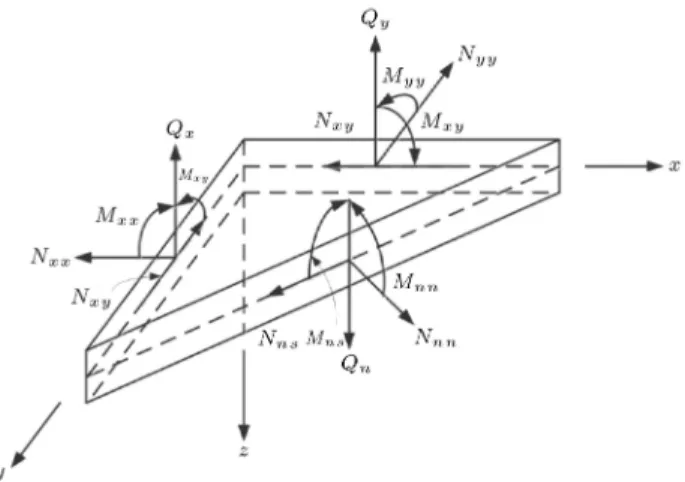
Figure 1. Bending moments and shear forces on a plate element. Z e qwdxdy I e
Mnn@w@n +Vnw
ds=0; (21) where Mnn and Vn denote the bending moment and eective shear force, respectively, as shown in Figure 1. The eective shear force can be dened as:
Vn = Qn+@M@sns: (22)
Substituting the stress and strain elds into Eq. (21), we obtain: = Z e 0 B B B B B B @
D11@@x2w2b + D12@ 2w
b
@y2
@2w
b
@x2
+D12@@x2w2b+ D22@ 2w
b
@y2
@2w
b
@y2
+4D66@@x@y2wb@@x@y2wb
1 C C C C C C A dxdy + Z e 1 84 0 B B B B B B @
D11@@x2w2s+D12@ 2w
s
@y2
@2w
s
@x2
+D12@@x2w2s+D22@ 2w
s
@y2
@2w
s
@y2
+4D66@@x@y2ws@@x@y2ws
1 C C C C C C A +
A44@w@xs@w@xs+ A55@w@ys@w@ys !
dxdy Z
e
q(wb+ ws)dxdy
+ I
e
Mnn@(w@nb+ws)+Vn(wb+ws)
ds: (23) Equating variation of potential energy to zero, the weak form of governing equations is found as:
Z e
"
(D2wb)TD(D2wb)+
1
84(D2ws)TD(D2ws) + (D1ws)TA(D1ws)
dxdy Z
e
(wb+ ws)Tqdxdy I
e
" (@(w b+ ws) @n
T Mnn
+ ((wb+ ws))TVn #
ds = 0; (24)
where A, D, D1 and D2 are dened as: A =
A44 0
0 A55
; D =
2
4DD1112 DD1222 00
0 0 D66
3 5 ;
D1= 8 < : @ @x @ @y 9 =
; ; D2=
8 > > > > > < > > > > > : @2 @x2 @2 @y2
2 @2
@x@y 9 > > > > > = > > > > > ; : (25)
3.2. Discretized equations
The bending and shear transverse displacement elds can be determined by interpolating the nodal Degrees Of Freedom (DOFs) over the elements domain:
wb(x; y) = n X j=1
b
j'j(x; y) = NTb;
ws(x; y) = n X j=1
s
j'j(x; y) = NTs; (26)
where band sare bending and shear DOF vectors in each element, 'jand N are interpolation functions and shape functions, respectively. Substituting Eq. (26) in Eq. (24), the nite element equations based on two-variable rened plate theory are obtained as:
K11 0
0 K22 bs
= F F ; (27) where: K11=Z
e
(BT
2DB2)dxdy; (28)
K22=Z e
1
84BT2DB2+ B1TAB1 dxdy; (29) F = Z e Nqdxdy I e @N
@nMnn+ @N
@sMns+NQn
; (30) where B1and B2are:
B1= D1N; B2= D2N: (31)
If the eect of shear deformation is ignored and just bending degrees of freedom, b, are considered, the nite element formulation for classical plate theory will be obtained as
[K11]f
bg = fF g: (32)
This formulation was presented by many researchers in the literature [22].
3.3. Element design
According to Eq. (24), bending and shear components of transverse displacements and their normal deriva-tives can be chosen as the primary variables. Because @=@n is related to global derivatives @=@x and @=@y, the degree of freedoms will be:
DOFs :nwb @w@xb @w@yb ws @w@xs @w@ys o
: (33)
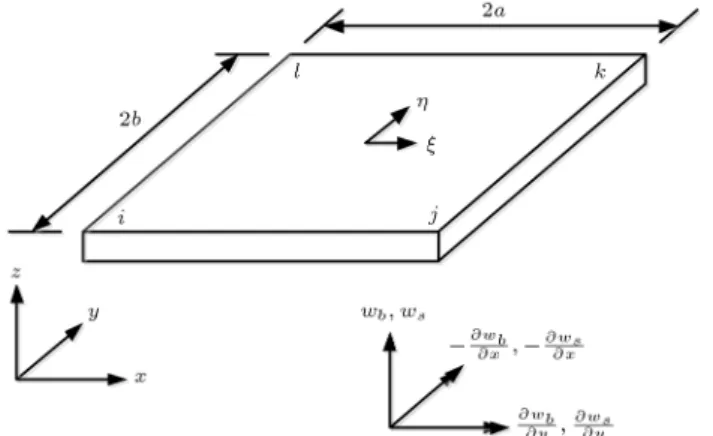
In order to complete the development of nite element formulation of two-variable plate theory, an element including bending and shear properties is required. For this purpose a 4-node rectangular plate element with six degrees of freedom at each node is introduced. Regarding Eq. (26), the elemental bending and shear DOFs will be:
bT=hwb 1 @wb @y 1 @wb @x
1 @w@xb
4 i
; (s)T=hws
1 @ws @y 1 @ws @x
1 @w@xs
4 i
: (34) Thus each element has 24 degrees of freedom. If the shear and bending nodal DOFs are dened as ab
i and as
i, respectively, and the elemental shear and bending DOFs are dened as ab
e and ase, we will have:
ab e= 8 > > > > > < > > > > > : ab i ab j ab k ab l 9 > > > > > = > > > > > ;
; ab
i = 8 < :
wb @wb=@y
@wb=@x 9 = ; ; as e= 8 > > < > > : as i as j as k as l 9 > > = > >
;; a
s i = 8 < : ws @ws=@y
@ws=@x 9 =
; : (35)
The shape functions used in this study had been de-rived by Melosh [23]. According to shear and bending
Figure 2. Rectangular plate element.
nodal DOFs, ab
i and asi, the shape functions in terms of normalized coordinates are dened as:
NT
i =18(1+0)(1+0) 8 > > < > > :
(2+0+0 2 2) bi(1 2)
ai(1 2) 9 > > = > > ;;
= (x xc)=a; = (y yc)=b; 0= i;
0= i; (36)
where 2a and 2b are the width and length of rectangular element as shown in Figure 2.
4. Results and discussion
A FE code based on presented formulation is generated using MATLAB software. Some benchmark problems are solved by the code and the obtained results are compared with exact values and analytical solutions. Example 1. A Simply supported isotropic square plate (of length and width, a, and thickness, h) subjected to uniformly distributed transverse load, q0, is considered. This problem is simulated by presented nite element code based on two-variable rened plate theory (in short FE-RPT) considering dierent number of elements in mesh structure. The eect of number of elements on obtained normalized deection of center of the plate (x = a=2, y = b=2) is shown in Figure 3. By increasing number of elements, obtained results converge to the value having 0.2% relative error with respect to exact solution. Using 16 elements in each plate side, the normalized transverse deection, normal and shear stresses are obtained for various thicknesses to side ratio. The results are compared with some ana-lytical solutions of common plate theories in Table 1. It is seen that the results of presented formulation are in good agreement with the exact values and other plate theories. The dierences between CPT results and
Figure 3. Convergence study for isotropic square plate subjected to uniform loading (h=a = 0:1).
Figure 4. Simply supported rectangular plate subjected to linearly distributed load.
exact values are increased by increasing the thickness to side ratio because of ignoring the shear deformation eect in this theory; but the presented formulation has excellent capability in simulation of both thin and thick plates.
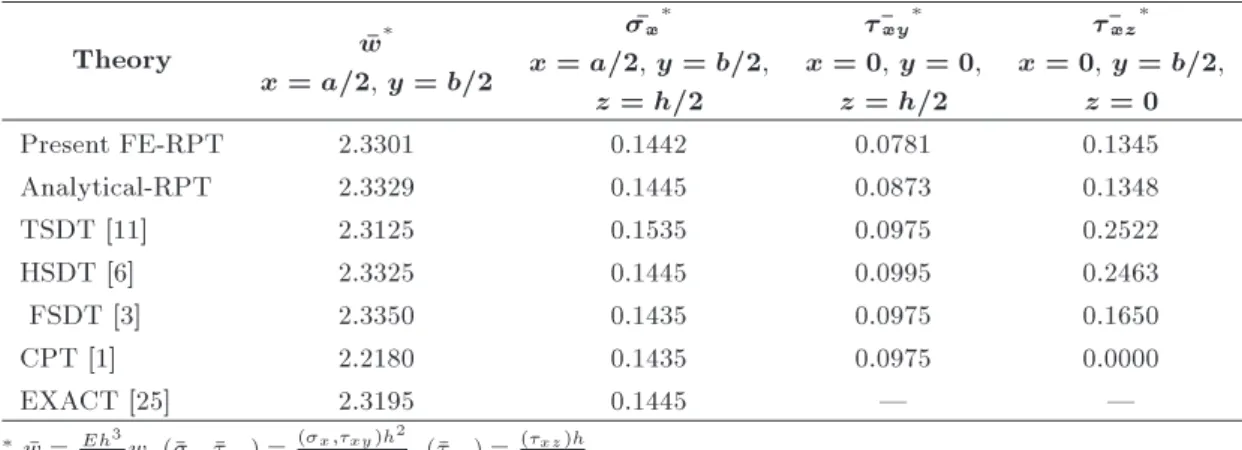
Example 2. A Simply supported isotropic square plate (of length and width, a, and thickness, h) subjected to linearly distributed load, as shown in Figure 4, is considered. As illustrated in Figure 5, by increasing number of elements, the normalized deections converge to the value having 0.4% relative error with respect to exact solution. In Table 2, the transverse deections and normal and shear stresses are compared with the exact values, analytical solu-tions of two-variable theory and other common the-ories. The obtained deections and normal stresses are very close to exact values and other plate theories. Though the shear stresses obtained by FE-RPT are in good agreement with analytical solutions of two-variable plate theory, both FE-RPT and Analytical-RPT present lower shear stresses with respect to other theories.
Table 1. Comparison of deections and stresses for a simply supported isotropic square plate subjected to uniformly distributed load.
h=a Source w*
x = a=2, y = b=2
x*
x = a=2, y = b=2, z = h=2
xy*
x = 0,y = 0, z = h=2
xz*
x = 0, y = b=2, z = 0
0.2
FE-RPT 0.0535 0.2939 0.2083 0.4695
HSDT [24] 0.0535 0.2944 0.2112 0.4840
FSDT [24] 0.0536 0.2873 0.1946 0.3928
CPT [24] 0.0444 0.2873 0.1946 0.0000
0.1
FE-RPT 0.0465 0.2883 0.1971 0.4718
HSDT [24] 0.0467 0.2890 0.1990 0.4890
FSDT [24] 0.0467 0.2873 0.1946 0.3928
CPT [24] 0.0444 0.2873 0.1946 0.0000
EXACT [24] 0.0464 | | |
0.05
FE-RPT 0.0449 0.2869 0.1941 0.4715
CPT [24] 0.0444 0.2873 0.1946 0.0000
EXACT [24] 0.0449 | | |
0.01
FE-RPT 0.0443 0.2865 0.1931 0.4702
HSDT [24] 0.0444 0.2873 0.1947 0.4909
FSDT [24] 0.0444 0.2873 0.1946 0.3928
CPT 0.0444 0.2873 0.1946 0.0000
w = Eh3
q0a4w, (x; xy) =
(x;xy)h2
q0a2 , (xz) =
(xz)h
q0a .
Table 2. Comparison of deections and stresses for a simply supported isotropic square plate subjected to linearly distributed load (h=a = 0:1).
Theory w*
x = a=2, y = b=2
x*
x = a=2, y = b=2, z = h=2
xy*
x = 0, y = 0, z = h=2
xz*
x = 0, y = b=2, z = 0
Present FE-RPT 2.3301 0.1442 0.0781 0.1345
Analytical-RPT 2.3329 0.1445 0.0873 0.1348
TSDT [11] 2.3125 0.1535 0.0975 0.2522
HSDT [6] 2.3325 0.1445 0.0995 0.2463
FSDT [3] 2.3350 0.1435 0.0975 0.1650
CPT [1] 2.2180 0.1435 0.0975 0.0000
EXACT [25] 2.3195 0.1445 | |
w = Eh3
q0a4w, (x; xy) =
(x;xy)h2
q0a2 , (xz) =
(xz)h
q0a .
Table 3. Material properties of orthotropic plate. E2=E1 G12=E1 G13=E1 G23=E1 12 21
0.525 0.26293 0.15991 0.26293 0.44026 0.23124
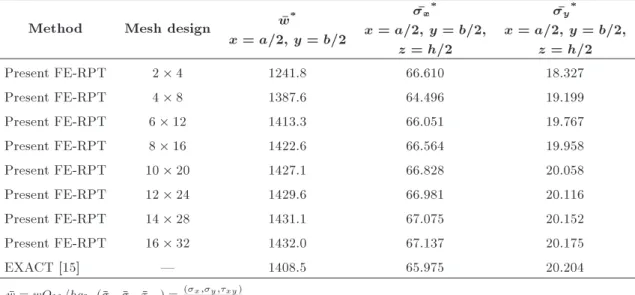
Example 3. A simply supported orthotropic rectan-gular plate with material properties listed in Table 3 is subjected to a uniformly distributed transverse load, q0. Considering dierent mesh designs, the problem is simulated by presented FE-RPT code, and the obtained transverse deections and in-plane stresses are listed in Table 4. As it is observed, by increasing number of elements, the results converge
to values which are in good agreement with exact solutions.
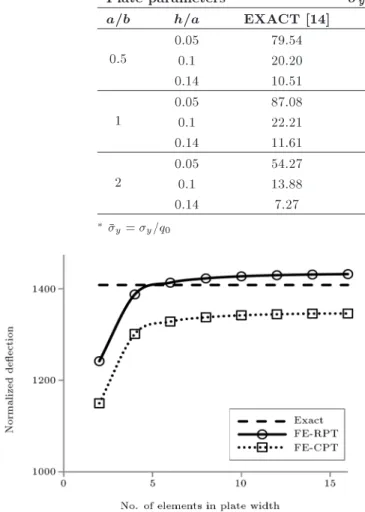
As discussed in Eq. (32), the CPT formulation is achieved by neglecting the shear component of transverse deection. Results for central transverse deection of the plate, obtained by FE-CPT and FE-RPT formulations, are compared with the exact values in Figure 6. As illustrated in this gure, in comparison to FE-CPT formulation, the normalized transverse deections extracted from FE-RPT formu-lation are more accurate. By increasing number of elements, FE-RPT deections converge to the value with only 1.6% relative error respect to exact solution,
Table 4. Normalized transverse deections and in-plane normal stresses for simply supported orthotropic rectangular plate subjected to uniformly distributed loading (a=b = 0:5, h=a = 0:1).
Method Mesh design w*
x = a=2, y = b=2
x*
x = a=2, y = b=2, z = h=2
y*
x = a=2, y = b=2, z = h=2
Present FE-RPT 2 4 1241.8 66.610 18.327
Present FE-RPT 4 8 1387.6 64.496 19.199
Present FE-RPT 6 12 1413.3 66.051 19.767
Present FE-RPT 8 16 1422.6 66.564 19.958
Present FE-RPT 10 20 1427.1 66.828 20.058
Present FE-RPT 12 24 1429.6 66.981 20.116
Present FE-RPT 14 28 1431.1 67.075 20.152
Present FE-RPT 16 32 1432.0 67.137 20.175
EXACT [15] | 1408.5 65.975 20.204
w = wQ 11=hq0, (x; y; xy) = (x;y;xy)
q0 .
Table 5. Comparison of Normalized transverse deection for simply supported orthotropic plate. Plate parameters w*(x = a=2; y = b=2)
a=b h=a EXACT [14] Analytical-RPT [14] FE-RPT 0.5
0.05 21542 21513 21889
0.1 1408.5 1402.2 1432.0
0.14 387.23 384.2 393.81
1
0.05 10443 10413 10802
0.1 688.57 688.37 709.44
0.14 191.07 191.02 196.09
2
0.05 2048.7 2047.9 2098.4
0.1 139.08 138.93 142.4
0.14 39.79 39.75 40.81
w = wQ 11=hq0
Figure 5. Convergence study for isotropic square plate subjected to linear loading (h=a = 0:1).
whereas this error for FE-CPT formulation is about 4.4%.
In Tables 5-8 normalized transverse deections and normal and shear stresses obtained by FE-RPT code are compared with the exact values and the results obtained by analytical solution of two-variable plate theory. As it is seen, the presented formulation has good capability in estimation of these parameters. Also the eects of aspect ratio (a=b) and thickness to side ratio (h=a) on the results are investigated and it is seen that the dierences between FE-RPT results and exact values are increased by increasing the aspect ratio. The normalized transverse shear stresses xz for dierent values of (a=b) and (h=a) are listed in Table 8. It is observed that the stresses obtained by FE-RPT are in good agreement with analytical solution of two-variable plate theory but have considerable dierences with respect to exact value. In the other word, both
Table 6. Comparison of normalized in-plane normal stress x for simply supported orthotropic plate.
Plate parameters x*(x = a=2; y = b=2; z = h=2)
a=b h=a EXACT [14] Analytical-RPT [14] FE-RPT
0.5
0.05 262.67 262.78 266.86
0.1 65.97 66.07 67.07
0.14 33.86 33.96 34.49
1
0.05 144.31 144.68 149.90
0.1 36.02 36.36 37.67
0.14 18.34 18.68 19.37
2
0.05 40.65 40.98 41.85
0.1 10.02 10.33 10.55
0.14 5.03 5.32 5.41
x= x=q0
Table 7. Comparison of normalized in-plane normal stress yfor simply supported orthotropic plate.
Plate parameters y*(x = a=2; y = b=2; z = h=2)
a=b h=a EXACT [14] Analytical-RPT [14] FE-RPT
0.5
0.05 79.54 79.30 80.18
0.1 20.20 19.94 20.15
0.14 10.51 10.25 10.36
1
0.05 87.08 86.68 89.84
0.1 22.21 21.80 22.61
0.14 11.61 11.21 11.63
2
0.05 54.27 54.04 55.36
0.1 13.88 13.65 14.00
0.14 7.27 7.06 7.25
y= y=q0
Figure 6. Convergence study of normalized transverse deection of orthotropic rectangular plate obtained by FE-RPT and FE-CPT codes (a=b = 0:5, h=a = 0:1).
nite element modeling and analytical solution of two-variable plate theory give rise to lower transverse shear stresses with respect to exact values. This issue is related to the features of two-variable plate theory and was reported by previous researchers [14].
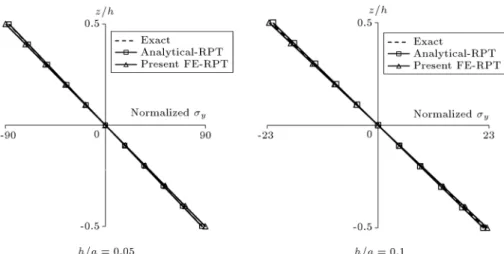
In Figures 7 and 8, the in-plane normal stresses are plotted across thickness of orthotropic plate for h=a = 0:05 and h=a = 0:1. These gures show that the in-plane normal stresses obtained by present FE formulation are in good agreement with the analytical solution and the exact values. Also the transverse shear stress is plotted in Figure 9 and as expected it varies parabolically across thickness of the plate. As previously mentioned, the transverse shear stresses obtained by both FE and analytical solution of two-variable plate theory have noticeable dierences with respect to exact solution of orthotropic plate.
The most important challenge of plate theories is how to deal with transverse shear deformation eects. Because of dierent assumption adopted in common plate theories, the results of shear stresses for all theories have noticeable dierences with each other and exact values. For example, as seen in Table 1, the shear stresses of isotropic plates predicted with dierent plate theories have dierences with each other. In comparison to conventional higher order plate theories, the main feature of two-variable plate theory is its simplicity. This theory contains only two unknown pa-rameters and it was adopted in various analyses such as
Table 8. Comparison of normalized transverse shear stress xz for simply supported orthotropic plate.
Plate parameters xz*(x = 0; y = b=2; z = 0)
a=b h=a EXACT [14] Analytical-RPT [14] FE-RPT
0.5
0.05 14.04 12.67 12.01
0.1 6.92 6.31 6.01
0.14 4.87 4.47 4.25
1
0.05 10.87 8.04 7.62
0.1 5.34 4.02 3.80
0.14 3.73 2.84 2.71
2
0.05 6.24 4.15 3.75
0.1 2.95 2.03 1.86
0.14 1.99 1.41 1.31
xz= xz=q0
Figure 7. The variation of xacross thickness of orthotropic square plate.
Figure 8. The variation of yacross thickness of orthotropic square plate.
bending, vibration and buckling problem easily [13-19]. For achieving a simpler and more ecient formulation, it is logical to lose some precision.
Parametric study. In this section, a
paramet-ric study on simply supported and fully clamped orthotropic square plates considering various aspect
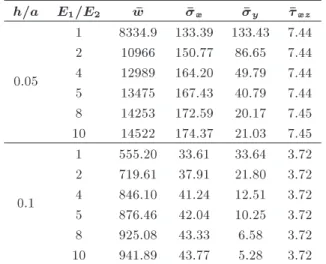
ratios has been performed and the obtained normalized transverse deections, in-plane normal stresses and transverse shear stresses at the plate center are listed in Tables 9 and 10. The material properties except E1=E2 are chosen according to Table 3. As seen for both simply supported and clamped plates, by increasing E1=E2 ratio, the normalized transverse deection and
Figure 9. The variation of xz across thickness of orthotropic square plate.
Table 9. Normalized transverse deections and in-plane normal stresses at the plate center for simply supported orthotropic square plates.
h=a E1=E2 w x y xz
0.05
1 8334.9 133.39 133.43 7.44 2 10966 150.77 86.65 7.44 4 12989 164.20 49.79 7.44 5 13475 167.43 40.79 7.44 8 14253 172.59 20.17 7.45 10 14522 174.37 21.03 7.45
0.1
1 555.20 33.61 33.64 3.72 2 719.61 37.91 21.80 3.72 4 846.10 41.24 12.51 3.72 5 876.46 42.04 10.25 3.72 8 925.08 43.33 6.58 3.72 10 941.89 43.77 5.28 3.72 Table 10. Normalized transverse deections and in-plane normal stresses at the plate center fully clamped
orthotropic square plates.
h=a E1=E2 w x y xz
0.05
1 2682.8 63.038 63.07 6.19 2 3491.7 72.34 39.81 6.19 4 4094.5 79.56 21.52 6.19 5 4232.9 81.30 17.10 6.19 8 4444.3 84.08 10.30 6.19 10 4512.8 85.05 8.00 6.19
0.1
1 200.85 16.02 16.05 2.51 2 251.61 18.30 10.09 2.52 4 289.43 20.08 5.44 2.53 5 298.12 20.51 4.34 2.53 8 311.40 21.20 2.61 2.53 10 315.72 21.44 2.03 2.53
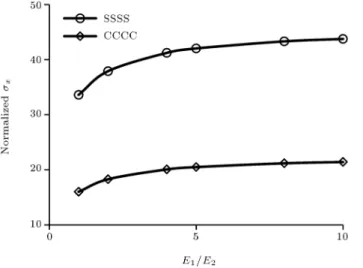
stress xare increased and the normalized stress y is decreased; but the normalized out of plane shear stress xz is almost independent of E1=E2. As expected, the obtained deections and stresses of simply supported plates are higher than clamed plates. This issue
Figure 10. Comparison of normalized central deection obtained for simply supported and fully clamped orthotropic square plate (h=a = 0:1).
is illustrated in Figures 10 and 11 for normalized deection w and stress x, respectively.
5. Conclusion
In this study, a nite element formulation based on two-variable rened plate theory is developed. Unlike Classical Plate Theory (CPT), the presented formula-tion can be used for both thin and thick plates and predicts parabolic variation of transverse shear stresses across the plate thickness. Presented nite element formulation is free from shear locking and zero traction condition on the plate surfaces is satised without using shear correction factor. After constructing weak form equations using the principle of minimum potential energy, a new 4-node rectangular plate element with six degrees of freedom at each node has been introduced
for discretization of the domains. The eciency
and accuracy of the presented formulation has been proved by solving of some benchmark isotropic and orthotropic plate problems. The obtained results are in good agreement with exact values and analytical solutions of common plate theories. The convergence of obtained results is conrmed by increasing the number
Figure 11. Comparison of normalized central stress x
obtained for simply supported and fully clamped orthotropic square plate (h=a = 0:1).
of elements in mesh design. Also the eects of aspect ratio, thickness to side ratio, material properties and type of boundary conditions on obtained results are investigated. Consequently, using presented nite ele-ment formulation, the thin and thick, and isotropic and orthotropic plate problems with arbitrary geometries and loadings can be simulated.
References
1. Kirchho, G. \ Equilibrium and motion of an elas-tic disc" [ A Uber das gleichgewicht und die bewe-gung einer elastischen scheibe], J. ReineAngew. Math., 1859(40), pp. 51-88 (1850).
2. Reissner, E. \The eect of transverse shear deforma-tion on the bending of elastic plates", J. Appl. Mech., 12(2), pp. 69-77 (1945).
3. Mindlin, R.D. \Inuence of rotary inertia and shear on exural motions of isotropic elastic plates", J. Appl. Mech., 18(1), pp. 31-8 (1951).
4. Whitney, J.M. and Sun, C.T. \A higher order theory for extensional motion of laminated composites", J. Sound Vib., 30(1), pp. 85-97 (1973).
5. Hanna, N.F. and Leissa, A.W. \A higher order shear deformation theory for the vibration of thick plates", J. Sound Vib., 170(4), pp. 545-555 (1994).
6. Reddy, J.N. \A simple higher-order theory for lam-inated composite plates", ASME. J. Appl. Mech., 51(4), pp. 745-752 (1984).
7. Reddy, J.N. and Phan, N.D. \Stability and vibration of isotropic, orthotropic and laminated plates according to a higher-order shear deformation theory", J. Sound Vib., 98(2), pp. 157-170 (1985).
8. Bhimaraddi, A. and Stevens, L.K. \A higher order theory for free vibration of orthotropic, homogeneous,
and laminated rectangular plates", J. Appl. Mech., 51(1), pp. 195-198 (1984).
9. Kant, T. \Numerical analysis of thick plates", Comput. Methods Appl. Mech. Eng., 31(1), pp. 1-18 (1982). 10. Lo, K.H., Christensen, R.M. and Wu, E.M. \A
high-order theory of plate deformation, Part 1: Homo-geneous plates", J. Appl. Mech., 44(4), pp. 663-668 (1977).
11. Ghugal, Y.M. and Sayyad, A.S. \A static exure of thick isotropic plates using trigonometric shear deformation theory", J. Solid. Mech., 2(1), pp. 79-90 (2010).
12. El Meiche, N., Tounsi, A., Ziane, N., Mechab, I. and Adda Bedia, E.A. \A new hyperbolic shear deforma-tion theory for buckling and vibradeforma-tion of funcdeforma-tionally graded sandwich plate", Int. J. Mech. Sci., 53(4), pp. 237-47 (2011).
13. Shimpi, R.P. \Rened plate theory and its variants", AIAA J., 40(1), pp. 137-146 (2002).
14. Shimpi, R.P. and Patel H.G. \A two variable rened plate theory for orthotropic plate analysis", Int. J. Solids Struct., 43(22), pp. 6783-6799 (2006).
15. Thai, H.T. and Kim, S.E. \Analytical solution of a two variable rened plate theory for bending analysis of orthotropic Levy-type plates", Int. J. Mech. Sci., 54(1), pp. 269-276 (2012).
16. Kim, S.E., Thai, H.T. and Lee, J. \A two variable rened plate theory for laminated composite plates", J. Compos. Struct., 89(2), pp. 197-205 (2009). 17. Shimpi, R.P. and Patel, H.G. \Free vibrations of plate
using two variable rened plate theory", J. Sound Vib., 296(4-5), pp. 979-999 (2006).
18. Kim, S.E., Thai, H.T. and Lee, J. \Buckling analysis of plates using the two variable rened plate theory", Thin Wall. Struct., 47(4), pp. 455-462 (2009). 19. Thai, H.T. and Choi, D.H. \A rened shear
deforma-tion theory for free vibradeforma-tion of funcdeforma-tionally graded plates on elastic foundation", J. Compos. Eng., 43(5), pp. 2335-2347 (2012).
20. Patel, H. and Shimpi, R.P. \A new nite element for a shear deformable plate", 47th AIAA/ASME/ASCE/ AHS/ASC Structures, Structural Dynamics, and Ma-terials Conf., Newport, Rhode Island, USA (2006). 21. Katori, H. and Okada, T. \Plate element based on a
higher-order shear deformation theory", Transactions of the Japan Society of Mechanical Engineers Series A, 72(716), pp. 412-418 (2006).
22. Reddy, J.N., An Introduction to Finite Element Method, 3rd Edn., McGraw-Hill International edition, Texas (2006).
23. Melosh, R.J. \Structural analysis of solids", J. Struct. Div. ASCE, 89(4), pp. 205-223 (1963).
with shear and normal strain deformations", Int. J. Numer. Meth. Eng., 24(9), pp. 1971-1695 (1987). 25. Srinivas, S., Joga C.V. and Rao, A.K. \Bending,
vibration and buckling of simply supported thick orthotropic rectangular plate and laminates", Int. J. Solids Struct., 6(11), pp. 1463-1481 (1970).
Biographies
Seyyed Jafar Rouzegar is currently an assistant pro-fessor at the Department of Mechanical and Aerospace Engineering of Shiraz University of Technology, Iran. He received his BSc in Mechanical Engineering from
Shiraz University, Iran, in 2002. He also received his MSc and PhD in Mechanical Engineering from Tarbiat Modares University, Iran, in 2004 and 2010, respectively. His research interests include: FEM and XFEM, Fracture Mechanics and Theories of Plates and Shells.
Reza Abdoli Sharifpoor received his BSc in Me-chanical Engineering from Bu Ali Sina University, Hamedan, Iran, in 2011. He also received his MSc in Mechanical Engineering from Shiraz University of Technology, Iran, in 2014. His research interests in-clude: FEM, theories of plates and shells and composite materials.