Karin Levinsen and Rikke Ørngreen
Research LAB: IT and Learning Design, Department of Philosophy
and Learning, Aalborg University, Copenhagen, Denmark
Introduction
In this issue we present 6 papers. Anders Nordby, Kristine Øygardslia, Ulrik Sverdrup and
Harald U. Sverdrup talk about gamification in a case of teaching the subject sustainability in
elementary school. Their intention was to teach sustainability to 5
thand 7
thgraders through
system thinking, and the paper presents the research methodology used, the development
of the game, and how the children played the game.
In the following paper by Jamie Costley and Christopher Lange the research question of
whether instructors can have an impact upon satisfaction and perceived learning through
various instructional design decisions is raised. The study investigates this by looking at
three different online environments and the degree of instructor control made possible in
these environments. It then analyzes whether the level of instructor control has an impact
upon satisfaction and perceived learning. Though no significant difference was found in
regard to level of satisfaction, the results showed that increased instructor control lead to
an increase in perceived learning.
On the same point, the effectiveness of instructor-personalized and formative feedback is
investigated in the paper by Dolors Planar and Soledad Moya. The paper is a review of
formative feedback in higher education in the period from 2000 to 2014, in order to find
answers as to which aspects are relevant, when wanting efficiently to implement
personalized feedback prepared by the teacher in classes with a high student-staff ratio in
virtual higher education.
Mugenyi Justice Kintu and Chang Zhu provide a contextual case study from the Ugandan
University, investigating student characteristics and learning outcomes in a blended learning
environment. They examine if learner characteristics and background are significant factors
for learning outcome. Students from three schools and one directorate form part of the case
study, who were involved in a face-to-face set up in the first part of a seventeen-week
semester and in an online set up in the second part. The data consist of a background
questionnaire survey (270 respondents), the examination results and an online
self-regulated learning questionnaire for data on students’ self-regulation, the intrinsic
motivation inventory for data on motivation and other self-developed instruments to
measure the other constructs.
The next paper explores the relationship between an online synchronous learning
environment and knowledge acquisition skills and traits, and suggest viable ways forward in
order to enhance this relation. The case is the Blackboard platform, and the authors, John D.
Politis and Denis J. Politis, collected data from 84 learners who studied online courses in a
Higher Education Institution in the United Arab Emirates. The method applied the Analysis
of Moment Structures (AMOS) and the statistical software to determine the factor structure
of the examined variables.
ISSN 1479-4403 150 ©ACPIL
Reference this paper as Levinsen K and Ørngreen R, “Editorial for EJEL Volume 14 Issue 3” The Electronic Journal of e-Learning Volume 14 Issue 3 2016, (pp152-168) available online at www.ejel.org
Finally, in a case study from an Asian university, Choosri Banditvilai discusses enhancing
students’ language skills through blended learning. The context is a course in “English for
Specific Purposes” in Thailand in which e-learning strategies are used in parallel with
traditional classroom language teaching methods. The achievements and attitudes of
students were compared between the control group and the experimental group to
measure the potential of available technology to develop language skills and learner
autonomy. The findings from this study show that online practice is directly beneficial to
enhance the four language learning skills as well as autonomous learning and learner
motivation.
We hope you’ll enjoy reading these six papers.
Karin Levinsen & Rikke Ørngreen
Thinking by Pervasive Game Development
Anders Nordby
1, Kristine Øygardslia
2, Ulrik Sverdrup
3and Harald Sverdrup
41
Department of Fine Arts and Computer Science,Hedmark University College, Norway
2Institute for digital media and computer science, Norges Tekniske og Naturvitenskaplige
Universitet, På Toppen av Haugen, Trondhjem, Norge
3
Lund University, Sweden
4
Industrial Engineering, University of Iceland, Iceland
[email protected]
[email protected]
[email protected]
[email protected]
Abstract: In 2013 Hedmark University College conducted a research project where students from a game development project/study program developed and tested a Pervasive Game for learning as part of a class in System Thinking. The overall game goal was to teach Sustainability through System Thinking, and to give the students a real world experience with their game;. It was tested on 5th and 7th graders in elementary school, spending one school day in each of the classes. This article focuses on the design of the project: how the game was developed, how the children played it and how research was designed and data collected.
Keywords: Gamification, game development, pervasive games, games and learning, pedagogy, system thinking, sustainability
1
Introduction
Making and modifying games have been a large part of children’s and young people’s lives in recent years due to the many game engines made available to the public for free. During the process of modifying games, and even making totally new games, the children learn about making graphics, animations, programming, game design, system thinking, collaboration, creativity and even pedagogy and psychology when they strive to make their games fun.
Tapscott (2011), the writer of the book on The Net Generation, has some thoughts on what this generation wants. He claims they want to have fun and that 58% of them say that having fun with a product or service is just as important as what that thing actually does. He further claims that if you employ any of these people, you must realize that they also want to have fun at work. They want to collaborate and have relationships. They want innovation and creativity. They want speed. They want to customize everything. Whether it’s designing their own t-shirts on Threadless.com, or selecting which widgets to put on their desktop, this group wants to do things their own way.
Of course, these claims and facts have not gone by unnoticed by researchers and learning designers. Researchers like Gee (2004, 2007, 2010) and Schaffer (2008) argue that games can be a powerful learning environment. They point out that when young kids are playing or modifying games while having fun, learning comes naturally, while in traditional schools the children have to study theoretically and accumulate knowledge for a long time before they can practice. Gee describes how he experienced learning in games with his son, and how he tried to read the game manual first and found he didn’t understand the game at all. Then he tried the other way around, playing the game first, and then reading the manual. And then everything was very clear. That’s what kids do - play first and then read the manual to understand what is necessary to know to solve the game. This is “learning by doing” (Dewey, 1916) and “learning just in time” (Gee, 2007).
Using games for learning is basically about gamification: applying game design and game technology to “serious” learning to bring back the motivation and fun (Deterding et al. 2011). However, although the word “gamification” is quite new, games have always been seen as a useful tool to increase fun and motivation in
ISSN 1479-4403 152 ©ACPIL
Reference this paper as Nordby A, Øygardslia K, Sverdrup U and Sverdrup H, “The art of Gamification; Teaching Sustainability and System Thinking by Pervasive Game Development” The Electronic Journal of e-Learning Volume 14 Issue 3 2016, (pp152-168) available online at www.ejel.org
Anders Nordby et al
learning. During the last 10 years we have seen rapid advances in digital technology that allow children to interactively “experience” and solve “real world problems” virtually in simulations that contains advanced 3D environments, animations, pictures, film, and sound simultaneously. Furthermore, these environments work in real-time over the Internet and let the children share their experience with other children from all over the world in a way that has never before been possible. By gamifying school topics in these virtual environments we can not only bring back the fun factor and create motivation, but also drill skills, do assessment automatically and create virtual social societies where the children can practice their theory in a fun way (Gee, 2010). Examples of such environments that “accidentally” also work as virtual learning environments are many; for example Minecraft, which teaches young people to design and build 3D environments, Moviestar Planet, which teaches the children how to make movies, how to create new identities or how to handle fame and fortune, or virtual worlds like Club Penquin, Habbo or Stardoll, which teach young children responsibility for their pets, or how to earn and save money. In all these environments the players learn collaboration, teamwork and how to handle peer comments/reviewing from kids all over the world. Today these games and virtual environments have hundreds of millions of users who are from 5-15 years old (KZero, 2011), and they serve as an informal learning environment for children of all ages. Gamification is also about formalizing these informal “learning environments”, and using them beneficially in traditional learning and class environments. System thinking goes hand in hand with game development; games are systems. Through games and system thinking the students and children can learn how events in the real world are connected and influence each other in a causal way. System thinking can also be used to construct games and teach the students how different parts of the game interact and perform. It can even let the students construct and simulate systems that would usually require a deep mathematical understanding of differential equations without knowing the mathematics. In the K12 education in the US system thinking is an important topic; recent research shows that children that are taught System thinking think more critically, express thoughts more clearly and understand more complex problems than children who don’t learn system thinking (Lyneis and Stuntz, 2007).
Sustainability is an increasingly important topic in schools, and its cross-disciplinary nature involves many of the important topics in school. Topics about sustainability are therefore usable as “environments” for teachers to embed stories that involve many important school topics at the same time. While it in itself is a competency aim and a goal in the curriculum, it naturally leads both game developers and players into problems that force them to learn mathematics or physics, which for many children are seen as “serious” and “boring” topics. While developing digital games that incorporate all the above is very time consuming and requires special skills teachers usually don’t have, pervasive games is about creating simple games in real-world environments that use common digital tools, internet, pre-made simple games and virtual environments that schools and teachers already have access to in schools. In our project the development of the pervasive game was done by students studying game development, but this type of game is so simple to make that ordinary schoolteachers could equally well have made it. So the project then also served as a learning project for the teachers involved.
2
Scope and Objectives
There are clearly two groups of learners in this project: the students who make the game and the children who play the game. The main goal for the children was to learn sustainability and to understand how system thinking could be used to see how things in the world were connected. The main goal of the game then was to motivate the children to learn the sustainability and system thinking content in the game as well as trigger their interest to learn more about the topics the game presented to them.
The main goal for the students was to learn system thinking, and the game development task and the game playing done with the children was implemented to motivate them in this.
This article mainly focuses on the design of the project: the theory foundation, the game design and the research design and data collected. The article does not contain a thorough data analysis of the learning outcome or the motivation, but has a discussion in the end where we loosely discuss observations and thoughts during the implementation of the project.
2.1
Theoretical points of departure
A working hypothesis for the project was that the combination of game development, in this case pervasive
game development, and teaching and facilitating based on the principles of problem-based learning (PBL), would create a working environment which would enhance the students’ motivation to learn system thinking and enhance their operative and innovation skills in this particular area. Furthermore, their learning was expected to proceed more efficiently in such an environment than in traditional teaching environments, such as lectures. In addition to the game development tasks, another prerequisite of the course was that the students should experience the children playing their game to get a feel for how emergent their game was compared to commercial games for entertainment, and how the children understood the sustainability issues presented in the game and their links through system thinking. This approach would hopefully maintain a sense of ‘fun’ as well as linking students’ outside-of-school experiences to their educational reality.
The course design was then theoretically inspired by the ideas found in the sociocultural theories of situated learning (Lave and Wenger, 1991; Wenger, 1998; Wenger, 2006), but also by cognitive theories such as experiential learning (Kolb, 1983) and the more modern approach of situated cognition studies suggested by James Paul Gee (Gee, 2010). Situated cognition theories bring in theory from other disciplines such as physics, psychology, brain research etc., and emphasize the conviction that thinking is connected and that it changes across actual situations, where thinking is not a process of applying abstract generalizations, definitions and rules, but rather dynamic images tied to our perception of the world and our bodies, feelings and internal states (Churchland, 1986; Damasio, 1994). Cognitive activities are tied to experiences of goal-oriented action in the material and social world and we think at our best abilities when we use previous experiences to prepare ourselves for future action. Gee (Gee, 2010) uses so-called connectionist or networked computers that search for and store patterns from the outside world as an analogy; humans look for patterns in their experience, and as they grow and their experience accumulates, they will discover deeper and more subtle patterns, which will help them predict what might happen in the future when they act to accomplish their goals.
Situated learning builds on the idea that participation in a community of practice with a common content, goal and mutual engagement stimulates and facilitates learning. In our project the game development class or the game playing community constitutes such a community of practice. While the students or children are busy designing or playing a game they learn system thinking or sustainability, almost without noticing. The main impact of the situated learning theories to the system thinking course-design came through acknowledging the situatedness of knowledge and the need to create learning situations in which theoretical ways of knowing were deeply connected to complex practices in which the students were expected and wished to participate. Problem-based learning originates from the medical school in the 1960s and was first implemented by Howard Barrows and colleagues (Barrows 1980). The students were organized in small groups, usually 6-10 persons led by a tutor. The focus of the groups was to solve problems from the real world they were about to enter, and to study the theory they needed to solve these task themselves. The tutors’ roles were more supervisors and facilitators than a traditional teacher. Problem-based learning has since then become an independent pedagogical concept often used in all levels of education. The principles of problem-based learning can be described as follows (Pettersen, 2005, p. 127):
The study builds on practice-related case descriptions, reports and studies
The students – both individually and in groups – receive support, assistance and monitoring from a tutor Students should develop practical ways of working and develop learning strategies for studying along with
practical problem solving and logical reasoning
Students have the responsibility for their own learning in collaboration with their tutor, with the emphasis on self-regulation and student autonomy
The teaching, the curriculum and the actual courses are organized in ways that maintain cross- and interdisciplinary approaches
The study program should facilitate authentic tasks and challenges, which qualify for the students’ future professional lives.
The PBL model will in addition usually follow the steps below (based on the 7-step Maastricht model (Maastricht University, 2013) where the first 5 steps are put into one):
Brainstorm and analyze the problem and define goals and learning objectives. Self-study period
Anders Nordby et al
Debriefing and post discussion.
Step 1 is the initial phase where the students clarify the problem, define the learning goals and identify the theory they will study to solve the problem. Step 2 is the phase where they work alone, while step 3 is the presentation and the debriefing session.
2.2
System thinking and system analysis, a short primer
System Thinking is a common concept for understanding how causal relationships and feedback work in an everyday problem. It has two parts: System Analyses and System Dynamics. System analyses are an easy-to-understand language that describes the connection and causalities in the system, while System Dynamics is the numerical simulation of the system. System Analyses includes group modeling, where we ask the initial questions of the problem and create a mental model structure, using Causal Loop Diagrams. While System Dynamics goes beyond the scope of this paper, we have included a simple primer to understand the basics of System Analyses below.
The basic method in this study is system analysis using causal loop diagrams as defined by Senge (1990), Sterman (2000), Haraldsson and Sverdrup (2004) and Sverdrup and Svensson (2002a,b) Because of the unsustainable path of world society outlined in the introduction, the scope of this study is to investigate a commercial activity that is recognized as unsustainable at present, and explore how to transform it to a sustainable activity. We will further investigate how that activity connects to society and policy planning. It is outside the scope of this study to create numerical simulations models; the discussion remains at the qualitative causal level. Our working hypothesis is that a free market needs both freedom to operate but also distinct and clear rules of engagement, as well as the provision of a market arena. We postulate that the state, business and customer each have necessary roles to play to make a sustainable system out of these essential components. The problem is analyzed using system analysis methods, and clarified using causal loop diagrams. The main tool is called the causal loop diagram:
What this says is that the CAUSE is the causality creating the effect. And the plus on the arrow says that the more cause we have, the more effect we get. It is not sufficient that CAUSE and EFFECT are correlated; there must be a real casualization. The next key issue is, does EFFECT have any feedback on CAUSE? If it does, we need to draw an arrow, and add a + if more of the EFFECT gives more CAUSE or a – if more EFFECT gives less CAUSE.
When this is done, we ask again, is there something else that is affected? Normally there is. And then we draw an arrow from CAUSE to SOMETHING ELSE. And we ask more or less and put the – or the +. And if SOMETHING ELSE has any effect on the EFFECT parameter we draw a signed arrow there too. It could be as shown in the figure above. In the Causal Loop Diagram (CLD) we have two closed loops, one called B and one called R. If we walk a round the loop called R, starting at CAUSE, then because of an even number of -, an increase in CAUSE will come back and cause more increase in CAUSE. We call this a Reinforcing loop (R). Another way to see this reinforcing loop is as a positive feedback loop where the increase of “Something Else” leads to an indirect
increase to “Cause” through the mediation of “Effect”, and only because a decrease in “Effect” leads to an increase in “Cause”. In the other loop, there is an increase in CAUSE which will cause an increase in EFFECT, but an increase in EFFECT will cause a decrease in CAUSE. And increase comes back as a decrease; it is a Balancing loop (B) (Sterman 2000, Senge 1990, Haraldsson and Sverdrup 2004, Haraldsson 2004, Sverdrup et al., 2014).
2.3
A short definition of sustainability
There are different ways to define sustainability, and some even make a point of saying it is not definable. We think there are basically two ways: the difficult one with all the details, and the simple one. The simple definition is quite old; it was given by the emperor Augustus of the Roman Empire in relationship to the engineering of the future Imperial Roman road network. He defined a sustainable plan to be “a plan that could be followed forever, without ruining the functions of the Empire”. He thus recommended the road construction to be done according to principles that would allow them to be used and kept up “forever”. In a vision of a sustainable society, we would like to have a similar vision. There are several names for sustainability out there, and we need to consider which of those are adequate, inadequate, sufficient or necessary. We should discuss the following central concepts:
Sustainable society Sustainable growth Sustainable development
In the items below, each one of these will be assessed and commented on. Sustainable society. This is a society that can go on for as long as we can reasonably foresee. It is not dependent on growth, but may persist and prevail on a steady level. It is achievable under certain conditions. In a sustainable society there will be growth within the sustainability limits, but also de-growth of what is in excess of the sustainability limits. Growth and de-growth will be in a long-term balance with each other, like waves that rise and sink, as at sea. Overall, the resource use stays within the sustainability limits. There are sustainability limits for the biophysical system, the social system and their interface - the economic system. Sustainability in all aspects will be required for a sustainable system, as defined in the Tripple Bottom Line (John Elkington, 1997), which is emblematic to the importance of system thinking in problem areas of Sustainability. Sustainable growth is more problematic. There is no real consensus on how this concept is to be uniquely understood. Sustainable growth was the focus of the Bruntland commission, and very useful in getting the discussion started and focusing on the fact that the present civilization is not sustainable. The Bruntland Commission defined sustainable growth as “the growth that sustains the needs of the present without compromising the welfare of future generations”. It allows for perpetual growth in a finite world, and does not deal with several goal conflicts built into the definition. The present generation should have everything they want and the future generations will have that too. The Bruntland definition was important because it made the necessity of sustainability research evident and pointed towards the need to come up with solutions. But the definition itself is no more than a starting point. It is not sufficiently stringent, it is flavored by political correctness, it allows unlimited growth. However, sustained mass growth forever is a thermodynamic impossibility, and thus a dangerously unsustainable approach. Sustainable development is about developing within the sustainability frames that exist for society. It implies that there are quantifiable limits to physical consumption and to material use losses, limits to natural system acceptable damage, and that development must be understood under such conditions. Sustainable development implies development within the sustainability boundaries. It may mean material and energy consumption contraction and convergence, and for societies in resource overshoot, contraction for all. It means that for some situations, we may be wise to consider supplying sufficiency for the many before affluence for the few. Sustainable development concerns not only physical aspects, but also involves development of the social sphere and of society’s structures (Costanza and Daly 1992, Costanza et al., 1992, Sverdrup and Svensson 2002, 2004, EU 2008, 2014).
3
Project Design
The methodology should bring together the 4 major fields into one unity - System thinking, Sustainability, Game development and Adaptive learning - and describe how this was designed and consepted.
The frame for the project was a 6-weeks full-time course in system thinking for second year undergraduate students in a bachelor course in Game Technology and Simulation in the game technology studies at Hedmark University College. In the first 3 semesters of their education these students had studied game design, 3D
Anders Nordby et al
modeling, game programming, animation and project-based game development, and had the basic knowledge in game production. System thinking and Sustainability were new to them and were taught through projects in this class. So was the basic theory for making the pervasive game.
The first half of the course was used to teach them system thinking, system analyses and system dynamics in a traditional way through lectures and sustainability assignments (Meadows.et al., 1972; Forrester, 1971; Senge, 1990; Sterman, 2000; Schlyter et al. 2012; Sverdrup et al. 2014; Haraldsson and Sverdrup, 2004). The last part of the course (3 weeks) was used to teach and develop the various aspects of the pervasive game.
During a brainstorming process with the whole class, it was decided that the game should be based on core curriculum goals from elementary school, and that the pervasive game should include three digital mini-games also developed on themes from the core curriculum. It should be possible to play the game in one school day, which essentially means 5,5 hours.
The students were divided into four groups with three to six students in each group. The largest group was responsible for the overarching pervasive game, while the three smaller groups made the digital mini-games. Every day in the development period, the class had a meeting to discuss the overall game design, the development progression, and how to solve challenges that arose during the design- and development process.
Due to the short development time for the game and the students’ relatively little practice in system thinking, we decided to provide the students with basic system CLDs (Causal Loop Diagrams) of the mini-games. These CLDs gave them a broad overview of the system for which they were to create the games. The students would have to pick a part of these large systems and modify the CLDs so they reflected their own game design. The CLD for the main pervasive game had to be developed from scratch. Several system thinking sessions were also held in this period, which ensured that the students really used system thinking in their game development, and the game became consistent in terms of the sustainability content. The system models were programmed in Stella and the three digital mini-games in the Unity game engine. To preserve the sustainable solutions simulated in Stella, equations and results from Stella were programmed directly into Unity.
The students had to perform two internal design reviews. These were basically playtests with the aim of revealing and mending flaws in the game design. The students should conduct the first playtest alone, while the second was more thorough and used SurveyMonkey to plan, define and store the results.
Project management was to be in focus every day too; each group was to continually maintain project plans and time estimates, and every student was required to write personal blogs from the development every day. These blogs served as notes for the mandatory research report each student had to file after the course and project were finished. This report should focus on their own learning, motivation, creativity and collaboration skills as well as their reflections on the system thinking used in the game. They were also to write about the implementation phase and the game play done by the children.
4
Methods and Research design
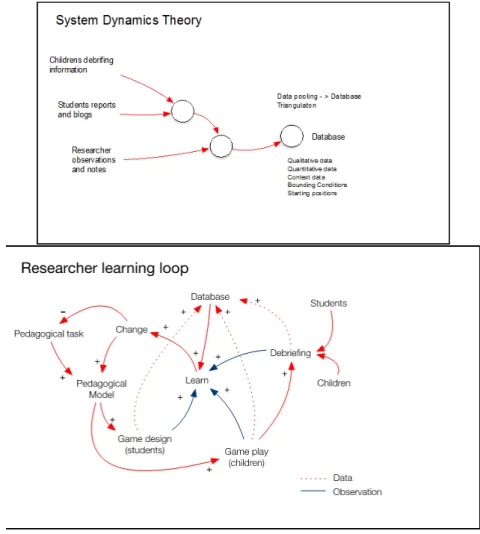
The Research design includes several research methods and could be described as Practitioner Inquiry as stance (Cochran-Smith & Lytle, 2009). According to Cochran-Smith and Lytle practitioner includes action research, teacher research, self-study, the scholarship of teaching and using practice as a site for research. Practitioner inquiry intentionally blurs boundaries between teaching, practice and inquiry and research data is systematically collected throughout the process. The design also draws on methods from system dynamics theory such as system analyses and causal loop wrapping and loop analyses in order to understand system dynamics (Senge, 1990; Sterman, 2000; Haraldsson and Sverdrup, 2004). System analysis is used to map causalities involved in the processes studied. These causal loop diagrams constitute knowledge-maps for the system, and these are iteratively tested against data, experiences and qualitative information in a “learning loop mode” as illustrated in Figure 1. The system analysis process becomes an iterative adapting learning process (Senge 1990). When non-researcher are present, such as stakeholders or students, then these are included in the process, the term for this is an adaptive social learning process, a powerful participatory pedagogical tool.
Figure 1: System Dynamics Theory and the Researcher learning loop for the project.
Research data were collected from all parts of the project. The researchers took notes and pictures during the game development process with the students as well as in the game playing with the children. They also made meeting resumes from the many meetings during the game development process.
The students supplied research data in the form of their report (se above). They also had a 4-hour system thinking exam after the course which hopefully would give us some data about their learning. Finally they filled in a thorough course evaluation where they could anonymously give their views on the course.
The children filled in a 17-page diary that summed up learning from game experience, and had an hour-long system thinking session in the end of the day that was documented thoroughly by the researchers. The children’s teacher, who knew the children well, also observed the game playing and gave the research team valuable background information about the children playing the game.
5
The game
As mentioned above it was decided that the theme of the game should be based on core curriculum goals from elementary school, and we selected “explain how production and consumption can destroy ecosystems and pollute earth, water and air, and discuss how this can be prevented and repaired” to be the main theme of the game.
Further, the game should be cross mediated, meaning that it should contain a well-written narrative that should be told through actors, webpages, videos, clues on different locations and the digital mini-games. Taking the core curriculum as inspiration the students decided to implement the following digital mini- games:
Anders Nordby et al
a digital game showing the relationship between human consumption and the ecosystem, and how we can prevent and repair the pollution of earth, water, and air.
a digital game showing refugees what they can expect their lives will be like as refugees. a game showing ecological principles from the perspective of an earthworm.
To create a coherent and logical structure, both the digital games and the overarching pervasive game should be designed and analyzed using system thinking. The picture below shows an overview of the project.
Figure 2: The overall pervasive game.
The picture shows how the overall pervasive game includes 3 digital games; the island game, the refugee game and the earthworm game. Below, the 3 digital games and the overall pervasive game are described in more detail.
6
The Island game
The Island game focus was to show the relationship between human consumption and the ecosystem, and how we can prevent and repair the pollution of earth, air and water. The goal was to build, balance and trade the recourses of an island. It was designed to teach the children about the balance in nature; how we need factories and products, but also that we can make things in a more sustainable way than we currently do. We showed them that we need to think about where food comes from, that production and consumption create waste and CO2, and that this waste can ruin nature and make living there in these conditions unpleasant or impossible. Hopefully the children will learn that an island can prosper if they have fugitives come to their place, but also that the fugitives will need the island to adjust to their new situation.
Figure 3: The Island game screen, the initial CLD and the students CLD.
Anders Nordby et al
The CLD shows how an increasing population leads to the production of more products and consumables, and to more pollution and waste. The amount and quality of water and food suffers and leads a race for resources and even war. Mining of materials and the production of fertilizers can increase the production of food but they require more mining of metals. Recycling can also increase the availability of minerals and metals, but increases the amount of waste.
6.1.1 Gameplay
When the game starts the players have many workers, but very little food to give them. The children will have to build factories and fishing boats and farms to feed the workers. They will quickly run out of workers, and to gain more of them they will have to play the Fugitive Game where, upon completion, they get a color code that will give them more workers. But, with more workers they need more food, and they have to go play the Earthworms game to be able to grow food more efficiently. They now have food and workers and can start building factories. However, factories and power plants pump out harmful chemicals and CO2, so they have to find a way to stop the CO2 level from getting too high. The solution is finding some money in one of the other game storylines. They can also trade goods and services with the actors to earn more money. When they have collected enough money they get a code for solar panels and a code for trade. They will then be able to build factories that run on solar power and use half of the energy without exceeding the dangerous CO2 level. Finally, they can use the extra food they have to trade with other islands, making their island balanced and prospering.
6.2
The Earthworm game
While the previous game showed the larger picture, depicting how different components in the world were linked together, we also wanted to include a game focusing on the small details. This was to show that small things in nature also had an impact on the larger system. We therefore included an assignment to make a game showing soil ecology and fertility from the perspective of an earthworm. From that perspective we decided to include a digital game showing ecological principles from the perspective of an earthworm.
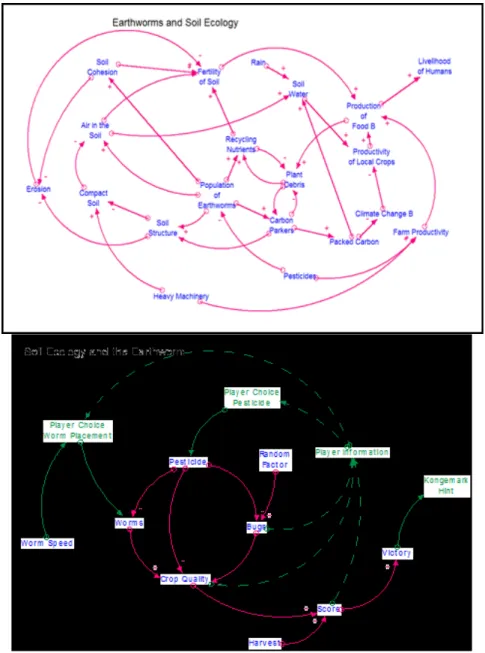
The core goal of the Earthworm game is to get the best possible harvest. The player can achieve that by moving earthworms to the different parts of the soil (see picture below) and use as little pesticide as possible.
Figure 4: The Worm Game screen, the initial CLD and the students CLD.
The CLDs shows how a greater population of Earthworms gives a less compact soil structure and lets air, water and nutrients flow into the soil and give the soil better fertility. The farm productivity may increase both with the use of heavy machinery and pesticides and lead to a larger food production, but the CLD also shows how the heavy machinery leads to a more compact soil and that fertilizer kills the earthworms. Lastly the CLD shows how soil with a healthy population of earth worms leads to a better soil structure, which is less exposed to erosion.
The gameplay is very simple- it’s all about making the corn grow as fast as possible. To do that the children will have to move the earthworms to the parts of the soil that need it the most, and keep the amount of pesticides as low as possible (to avoid killing the worms). The more worms you have in the soil, the better becomes the crop. If bugs come to eat your crop, you may have to use pesticide to not lose the crop, but the more you use of them, the more you kill the worms, which in turn impacts your crop. The game goes faster and faster which makes it harder and harder to place the worms in the right place.
6.3
The Refugee game
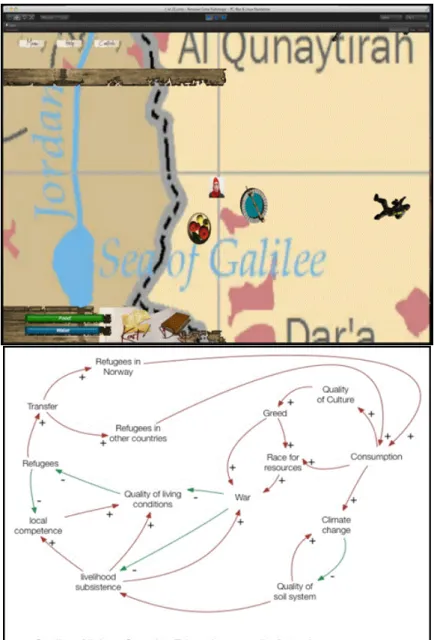
The Refugee game is a bit different from the other two games in that it doesn’t necessarily focus on the larger system, but more about identification andunderstanding how it feels to be a refugee.
Anders Nordby et al
Figure 5: The Refugee game screen, the original CLD and the student CLD.
The CLD shows how poor quality of living and war leads to more refugees and how more refugees leads to higher consumption, greed and a race for resources, possibly war, climate change, and lower quality of the soil system and livelihood subsidence.
The gameplay in this game is also very simple; the children have to avoid danger and collect enough food to survive during their escape from their war-torn land to another country to apply for asylum. When they survive and get to a new country their application for asylum is tried with regards to the probability of getting asylum in that country (based on the real numbers). The children very often felt it was unjustified that their applications for asylum in the new country were not accepted after all their struggles and hardships.
6.4
The Pervasive Game
The fourth and largest student group were to create the overarching pervasive game. The focus here was on making a good story that integrated the smaller digital games in a consistent way.
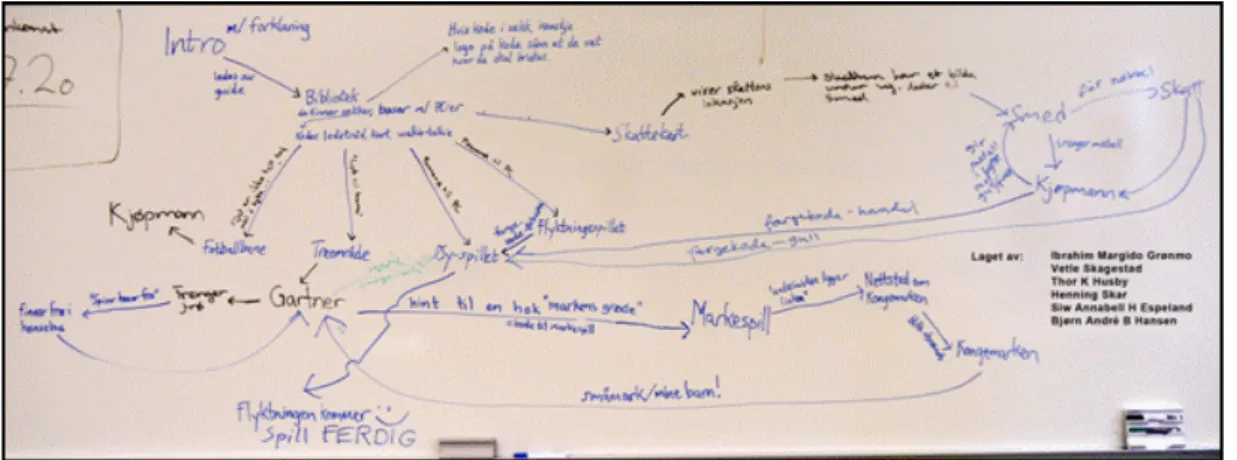
The game started with a video of a refugee who had to flee his country because of famine and war as a consequence of pollution and climate change. The children find his video blog, and a request to find out what has happened to the environment in his country and how pollution and climate change there can be prevented. The players will then be divided into teams, and each team will receive a backpack with a pair of walkie-talkies, riddles and clues, a treasure map, computer passwords and a notebook. They will then have to solve the clues at different locations around the school, and talk to actors about sustainability-related subjects to be able to proceed in the game.
Figure 6: Blackboard sketch of the final game. 6.4.1 Pervasive game actors
The game contains several characters, and the students took the roles of actors. These characters were: The gardener: The gardener talks to the children about ecology, biological diversity and pollution. The
children will help him plant vegetables and in return he will give them new quests related to trading. The King of Earth Worms: According to the legends, this mythical creature is about the size of a man
residing in the area around the school. This character talked to the children about the importance of the small creatures in the ecosystem.
The locksmith: This character will help the children create a key for the treasure chest they had found, by using recycled metal. This character talked to the pupils about the importance of recycling.
The merchant: The merchant will give the players trade-related quests, and teach them about fair-trade and resources.
The guides: Each team was appointed one student guide that they could request help from if needed. The refugee: The refugee will first appear in the video that is shown to the children, and will return
towards the end of the game to talk to the players and discuss their experiences.
Below are a flow chart and the CLD for the game. The CLD shows how the mini-games are integrated with each other and the pervasive game. For example, the Worm game has to be played and won to have food
Anders Nordby et al
resources for the island game, and the Refugee game has to be resolved to have a workforce for the factories and the power plants, also in the Island game. The treasure in the Pervasive game has to be found to be able to buy things in the Island game. The CLD also shows how the pollution, war and food/resources are the bases for the refugee escape, and how earthworms are needed to make food grow.
Figure 7: The Pervasive game CLD is shown as developed by the students. This shows the overall system causal loop diagram with all the small games inside the large.
An action flow chart is shown in Figure 8.
Figure 8: Game flow chart. The different action is color coded in the following way: Yellow – Actors, Green – The codes needed to solve the game, Magneta – Hints and passwords, Purple– Mini-games, Dark blue – Locations and actions.
6.5
The aftermath
After the game was completed, the children were given the refugee’s diary. This 17-page diary has two functions. First, it was a way to summarize the main principles they had learned from the game in a way that was closely related to the narrative of the game. Secondly, the diary included several written assignments that the pupils have to solve, related to the game they have played.
After the children had filled in the diary they were gathered in the classroom to conduct a system thinking debriefing session. This session was led by one of the teachers who asked the children questions about the different parts of the game, and how they were connected. Another teacher drew a system CLD on the blackboard from the children’s answers and made connections and signs in the way the children wanted them.
7
Discussion
This section discusses briefly some of the thoughts after the game playing in the elementary school.
Firstly, the energy, enthusiasm and creativity the children put into playing the game was impressive. They exhausted the assigned student helpers in 30 minutes, and the children basically solved the game that was meant to last the whole day in 2,5 hours. It was very clear that they considered the game playing fun; one child later enthusiastically called the day the “best school day ever”. We could also see some of the same enthusiasm during the work with the diary and the system thinking session and some children went to the library to borrow books to read more about the things they had learned in the game.
The diary was designed in a way so that we should be able to check how much of the sustainability-related topics from the game they had learned, and also if they understood the related connections between them. All the children filled in this diary, and when we later studied them we found that the majority of the children summed up their sustainability knowledge in a thorough and good way, which indicates that there was a good learning outcome from the game.
The system thinking debriefing session enabled us to check further how much of the connectivity between the events they had understood. Within an hour the blackboard contained a fairly complex CLD, which impressed both the students and the research group. This leads us to believe that games are a good way to teach system thinking. We believe the system thinking sessions could be even longer and more thorough without boring the children.
The children’s elementary school teacher pointed out that the children who normally didn’t like the traditional school teaching excelled while playing the game. They paid attention, they progressed quickly, and they showed leadership skills. This shows that teaching through pervasive game playing in school also can help to activate those children who do not so easily fit into the traditional school system.
Observations indicated that the students also had fun both when they developed the game and when they observed how the children played it. They also wrote the same in their reports; below are some of their comments:
“It has been very fun to participate in this project, with the best part being the playtest with the 5th graders. I am satisfied with the whole project, and although it was hard to see how everything would turn out when we started the project, we managed to finish, and we finished with bravura.”
“I see the pervasive game part of this course as an interesting experience where we learned a lot, and comments like “The best school day ever”, indicate that the 5th- and 7th graders felt the same”.
“This was an enjoyable and rewarding assignment to work with, and although we’re neither actors or have developed a game like this before, I felt it was a very successful project for us students, and I hope the teachers feel the same”.
“To summarize, I’ll say this project has been a joy to work on. I’ve both learned from it, and gained many very nice memories. This has been nothing but fun!”
They also describe the project as stealth learning due to the short development frame, but with a big reward at the end - the implementation of the games for the children. Since both the fun factor and the learning outcome for the children seemed to be good, the game playing in itself indicated that the gamification of this project worked well. Regarding the learning outcome for the students – to learn system thinking, the CLDs made by the students’ during the game development, the reports and the exam indicated that that they had learned at least as much as previous classes in system thinking done with traditional teaching methods. However, we didn’t compare the students’ learning in this project in detail with traditional teaching, so we can not say the learning outcome in this setting were better than doing it the traditional way. We believe, and the students also say so in their reports, that learning through making games is more fun and more thorough than
Anders Nordby et al
traditional learning due to ‘learning by doing’, and ‘learning just in time’; the need to learn pops up when they need it for the game. And of course, the implementation with the children is an event they will remember for a long time and tie their learning to this event.
Although the overall project was successful, the game development part had some limitations.
We found the students didn’t have enough experience in system thinking and sustainability to make their own CLDs on the games. The overall CLDs we made for the mini-games helped, but ideally they should make all CLDs themselves. We believe more time should be used on teaching them system thinking and sustainability ‘just in time’ during the development process of the pervasive game.
The time to develop the games was probably too short. This caused some frustration and several of the students felt that they could have made the game better with some additional time. Several students also pointed out that using CLDs and simulations to check game logic and debug the code proved to be very beneficial; they found the bugs much faster than with traditional tests. Thus they found another use of system thinking in game development not explicitly pointed out to them.
While the students saw a clear need for system thinking in sustainability, they questioned the use of system thinking when developing the small mini-games. The systemic challenges were just too small to “waste” time on developing system CLDs or simulations. However, it was a clear understanding that if the games grew more complex, the system thinking would be a very useful tool both in the game design phase and as a debugging tool.
The game was also solved faster than we expected by the children. This was not a major problem because the time we could use on the diary and the session with System Thinking was increased. This turned out to be both interesting and effective and probably added to the children’s learning. However, when we do this next time, the games should be more difficult to solve. The diligence, creativity and energy the children put into solving these games were truly amazing, and we believe the playing time and level of difficulty could easily be increased without them being bored or exhausted.
8
Conclusions
Without more thorough analyses of the research data in the project, it is hard to draw any conclusions. However, we believe that the combination of system analysis, sustainability, game development or game playing and learning is a good one. Its quite clear that both the school children and the students found the project fun, and the submitted reports, exam and debriefing sessions all indicate that the learning outcome for both were at least as good as with traditional methods. As stated above, we also believe the learning process is more thorough than traditional learning due to the “learning by doing” aspect of the project.
The interest from the schools in trying out this concept was also exceptional; after sending out a one-page request to schools to implement the game only 4 weeks before we planned the actual test, we got answers from 15 schools and more than 1500 children wanting us to implement the game in their school. Bearing this in mind, we will most definitely implement the project again
References
Barrows, H. S., & Tamblyn, R. (1980). Problem-based learning: An approach to medical education. New York: Springer. Churchland, P.S. (1986). Neuophilosophy: Towards a Unified Science of the Mind/Brain., Cambridge, MA:MIT Press. Cochra-Smith M. & Lythle S.L. (2009). Inquiry as Stance. Practitioners Research for the next generation, New York: Teachers
College Press
Costanza, R., Daly, H.E.. Natural capital and sustainable development. Conservation Biology 1992; 6:1-10
Costanza, R., Daily, G and Ehrlich, P. 1992. Population, sustainability and the earths carrying capacity. A framework for estimating population sizes and lifestyles that could be sustained without undermining future generations. Journal of Bioscience 1-19.
Damasio, A.R. (1994). Decartes’ Error: Emotion, Reason and the Human Brain, New York: Avon
Deterding, S., Dixon, D., Khaled, R., & Nacke, L. (2011). From game design elements to gamefulness: Defining
“gamification”. MindTrek ’11. Proceedings of the 15th International Academic MindTrek Conference: Envisioning Future Media Environments (pp. 9-15).
Dewey, J. (1916). Democracy and education: An introduction to the philosophy of education. New York: Macmillan.
Elkington, J. (1997). Cannibals with forks – Triple bottom line of 21st century business. Stoney Creek, CT: New Society Publishers.
EU sustainability policies 2008. Annexes to impact assessments guidelines. Revised version 2008. Public website with downloadable policy documents.
http://ec.europa.eu/smart-regulation/impact/commission_guidelines/commission_guidelines_en.htm
http://ec.europa.eu/smart-regulation/impact/consultation/docs/ia_guidelines_draft_annexes_final_en.pdf. Accessed 2008, 2010, 2013, 2014, 2015.
EU sustainability policies 2014. WEB public sites: http://ec.europa.eu/environment/eussd/,
http://europa.eu/legislation_summaries/environment/sustainable_development/l28117_en.htm,
http://www.bmub.bund.de/en/topics/europe-international/europe-and-environment/eu-strategy-for-sustainable-development/, http://www.sd-network.eu/?k=basics%20of%20SD%20strategies
Forrester, J. (1971). World Dynamics, Pegasus Communications, Waltham MA.
Gee, J. P. (2004). Situated language and learning: A critique of traditional schooling. London: Routledge.
Gee, J. P. (2007). Good Video Games and Good Learning: Collected Essays on Video Games, Learning and Literacy (New Literacies and Digital Epistemologies) .
Gee, J. P. (2010). New digital media and learning as an emerging area and "worked examples" as one way forward. Cambridge, Mass., The MIT Press.
Haraldsson, H. V. (2004). Introduction to systems thinking and causal loops diagrams. Reports in ecology and environmental engineering. Report 1:2004. 49pp
Haraldsson, H.V., Sverdrup, H. ( 2 0 0 4 ) . Finding Simplicity in Complexity in Biogeochemical Modelling. J. Wiley and Sons Ltd., Chichester, pp. 211-223.
Kolb, D. A. (1983). Experiential Learning: Experience as the Source of Learning and Development. Prentice Hall KZero. (2011). Universe chart Q4 2011: Avg User Age 10 to 15. Retrieved from
http://www.kzero.co.uk/blog/universe-chart-q4-2011-avg-user-age-10-15/
Lave, J., & Wenger, E. (1991). Situated learning. Legitimate peripheral participation. Cambridge: Cambridge University Press.
Lyneis D., Stuntz L. (2007). System Dynamics in K-12 Education:Lessons learned. The creative Learning Exchange, v17, n2, spring 2008.
Maastricht University. (2013). Problem based learning preparatory website. Retrieved from http://www.umpblprep.nl/ Meadows, D.H., Meadows, D.L., Randers, J. , Behrens W. (1972). Limits to Growth, Universe Books, New York.
Pettersen, R. C. (2005). Kvalitetslæring i høgere utdanning: Innføring i problem- og praksisbasert didaktikk [eng: Quality learning in higher education: A primer in problem- and practise based didactics]. Oslo: Universitetsforlaget, Retrived from: http://www.universitetsforlaget.no/nettbutikk/kvalitetslaering-i-hoyere-utdanning-uf.html.
Schlyter, P., Stjernquist, I., Sverdrup, H., ( 2012). Handling complex environmental issues—Formal group modelling as a deliberative platform at the Science-Policy-Democracy interface, Proceedings of the 30th International Conference of the System Dynamics Society, Switzerland.
Senge, P., (1990). The fifth discipline, the art and practice of the learning organisation, Century Business, New York. Shaffer, D. W. (2008). How Computer Games Help Children Learn.
Sverdrup H. (Ed.), Haraldsson, H., Koca, D., Belyazid, S. 2014 System Thinking, System Analysis and System Dynamics: Modelling Procedures for Communicating Insight and Understanding by Using Adaptive Learning in Engineering for Sustainability. Háskolaprent Reykjavik. 310pp.
Sverdrup, H., Svensson, M. 2002 Defining sustainability. In: Developing principles for sustainable forestry, Results from a research program in southern Sweden. Sverdrup, H. and Stjernquist, I. (Eds.) Managing Forest Ecosystems 5:21-32 Kluwer Academic Publishers, Amsterdam.
Sverdrup, H., Svensson, M. 2004. Defining the concept of sustainability, a matter of systems analysis. In: M. Olsson; G. Sjöstedt (Eds.); Revealing Complex Structures -- Challenges for Swedish Systems Analysis, 122-142. Kluwer Academic Publishers.
Sterman, J.D., (2000). Business Dynamics, System Thinking and Modeling for a Complex World, Irwin McGraw-Hill, New York.
Tapscott, D., (2011). The Net Generation is the smartest generation, Interview Daily Education online database (2010). Wenger, E. (1998). Communities of practice: Learning, meaning, and identity. Cambridge: Cambridge University Press. Wenger, E. (2006). Learning for a small planet: A research agenda. Retrieved from
http://learning-affordances.wikispaces.com/file/detail/Learning+for+a+small+planet.doc
The Effects of Instructor Control of Online Learning Environments
on Satisfaction and Perceived Learning
Jamie Costley
1and Christopher Lange
2 1Kongju National University, Gongju, South Korea
2Joongbu University, Geumsan, South Korea
[email protected]
Abstract: Instructional design is important as it helps set the discourse, context, and content of learning in an online environment. Specific instructional design decisions do not only play a part in the discourse of the learners, but they can affect the learners’ levels of satisfaction and perceived learning as well. Numerous studies have shown the value that both student satisfaction and learning have on learner achievement. For this reason, the question of whether instructors can impact satisfaction and perceived learning through various instructional design decisions is important. This study looked at broad-based instructor decisions to see if online environments with higher levels of instructor control lead to higher levels of student satisfaction and/or perceived learning. Three different online environments were used, with each one containing progressively more instructor control. The results show that there were no significant differences in regards to mean levels of satisfaction between the three environments. However, there were significant differences among mean levels of perceived learning based on the differing instructor-controlled environments. This study shows that increasing the levels of instructor control within online environments leads to an increase in perceived learning.
Keywords: computer mediated communication; instructor control; instructional design; online learning; perceived learning; satisfaction
1
Introduction
Within education, the importance of computer mediated communication (CMC) has become evident because of its use in facilitating the learning experience. This is done through interaction not only between students, but between students and instructors as well (Rourke, Anderson, Garrison and Archer 1999). CMC has helped to create a shift from a teacher-centered environment to a student-centered one. Although this shift has become apparent, students still need proper guidance to ensure effective interaction, regardless of the shift. This is because teachers need to be able to make appropriate learner-centered design decisions for use in instruction (Berge & Collins 1995).
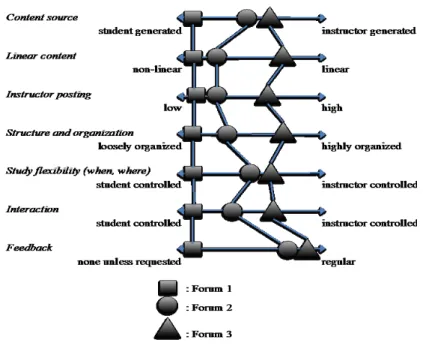
Previous research has indicated that aspects of instructional design used to facilitate interaction within an online community have had a significant impact on both student satisfaction and perceived learning (Garrison 2007; Swan & Shih 2005; Wu & Hiltz 2004). The pedagogical significance of this is student satisfaction and perceived learning have been linked to successful implementation of E-learning and student achievement respectively (Sun, Tsai, Finger and Yeh 2008). An overarching theme within previous studies that look at the effect that instructional design has on satisfaction and perceived learning have focused on a form of instructor-control that dictates the amount of interaction that is to take place within a specific online environment. In addition to its influence on interaction levels, instructional design can be used to control other aspects such as the content of the class, the feedback given to learners, task structure, and theorganization of the online learning environment.(Puzziferro & Shelton 2008; Siragussa, Dixon and Dixon 2007; Ertmer, Richardson, Belland, Camin, Connolly, Coulthard & Mong 2007; Lim, Morris & Kupritz 2014). These aspects of design should be addressed so that effective methods for promoting satisfaction and learning can be fully implemented. Research which has measured the effect that instructor-control has on student satisfaction and learning has done so through surveying students to see how much instructor control they perceived (Sher 2009; Swan 2001; Sun et al. 2008). The perceived levels of instructor-control were then compared to students’ perceived levels of learning and satisfaction to determine the level of effects (Sher 2009; Swan 2001; Sun et al. 2008). The current study manipulates various online learning environments, in which the participants experience varying levels of instructor control. The differing levels of instructor control are based on a modification of Siragussa, Dixon and Dixon’s (2007) IDOL model of instructional design. More specifically, this paper examines
ISSN 1479-4403 169 ©ACPIL
Reference this paper as Costley J and Lange C “The Effects of Instructor Control of Online Learning Environments on Satisfaction and Perceived Learning” The Electronic Journal of e-Learning Volume 14 Issue 3 2016, (pp169-180) available online at www.ejel.org
the effects of broad-based design decisions that manipulate the amount of instructor control and how that control affects levels of learning and satisfaction.. This research looks at two main questions:
How do the differing levels of instructor control affect student satisfaction? How do the differing levels of instructor control affect student learning?
2
Theoretical Background
2.1
CMC in Education
The popularity of CMC within education has brought forward ideas of interaction within online learning communities. Swan, Garrison, and Richardson (2009) claim that the biggest question within these communities has been whether they can actually be sustained in the form of text-based, asynchronous environments. The answer to this question can be found within online learning environments that use asynchronous forums as a means of communication between instructors and learners. Asynchronous online forums have proven sustainable as a form of CMC because of their success in removing barriers to participation and allowing learners to communicate with each other “anytime” and “anywhere” (Wu & Hiltz 2004). Another benefit of asynchronous online forums is that students have been shown to favor this form of online learning over face-to-face communication because it allows users to communicate at their own pace and in their own way (Callan 2006; O’Neill, Duplock and Willis. 2006; Wang and Woo 2007). Furthermore, claims have been made that asynchronous forums are more effective in terms of producing a greater quality of work, as responses are well thought out, longer, and more detailed when compared to face-to-face learning environments (Hara, Bonk and Angeli 2002).
3
Instructional Design Online
When designing instruction online, teachers need to take into account the various aspects that will support learners. Chen (2007) explains that the four components needed for effective support-based instructional design online are 1) technology, 2) course content, 3) participants, and 4) goals/activities. Goals and activities form the heart of the online learning process. Chen (2007) argues that these four components need to be used in the following ways in order to provide the best support for students in the learning process: Technology should be user-friendly and used to support the facilitation of learning tasks. Course content should be presented through the use of scaffolding to support engagement and achievement. Effective interaction and collaboration should be promoted by the instructor through the design of a social support system. Properly structured learning tasks should be implemented to achieve pre-determined learning goals. Like Chen (2007), Janicki and Liegle (2001) focus on effective instructional processes along with the use of technology in order to effectively design instruction online. In respect to technology, they propose that consistent layout, ease of navigation, and the availability of help screens are important components that support design in online learning. From an instructional process perspective, they promote the following: instructors acting as facilitators, use of a variety of presentation styles, use of multiple exercises, solving hands-on problems, allowing learner-control of pacing, testing learners frequently, and providing clear feedback.
Anderson, Rourke, Garrison and Archer (2001) look at instructional design as part of teaching presence, which they define as the design, facilitation and direction of social and cognitive processes used to create meaningful student outcomes. Based on their work, teaching presence is divided into three categories: facilitating discourse, direct instruction, and design and organization. Facilitating discourse involves the guidance of the learner by the instructor in a meaningful way to make certain that students stay focused on the task (Anderson, et al. 2001). Direct instruction involves the direct intervention of the instructor in order to “correct misconceptions, provide relevant information, summarize the discussion and/ or provide some metacognitive awareness” (Swan and Garrison 2009, p. 13). Design and organization not only involves the design and implementation of individual and group learning activities (Akyol & Garrison 2011), but it also includes setting the curriculum, designing methods, establishing group norms (netiquette), and utilizing the medium effectively by keeping students focused and providing encouragement (Anderson, et al. 2001). The teacher in the role of instructional designer is also responsible for setting clear expectations with respect to the type of discourse that is desired within the online environment. This includes teacher actions such as stating the desired message length, structuring the discourse through instructor comments, and establishing time parameters for learners to post within the online environment (Anderson, et al. 2001).
Jamie Costley and Christopher Lange
Within the design and organizational aspects of online learning, instructors may need to control aspects of engagement to reduce the difficulty learners have interacting within the online community. Such control can come in the form of checking understanding at frequent intervals and providing immediate feedback to the learners when necessary (Lim, Morris & Kupritz 2014). It is important to note that the need for various levels of instructor control within a specific online environment may lead to different outcomes for the learners. Anderson et al. (2001) focus on these aspects to ensure that specific, desired student outcomes are obtained. They believe that instructional design should be used to provide students with guidelines, model appropriate posts, and assist the learners when communication breakdowns occur (Anderson, et al. 2001). Furthermore, they believe that design and organizational aspects implemented by the instructor should follow a narrative path through mediation and interaction in which the students have a clear idea of what is expected of them (Anderson, et al.2001). Such interaction is obtained through making instructional design decisions in such a way that they create an overlap between content interaction and participant interaction to create a sense of community within an online learning environment (Swan 2002).
In an older model, Reeves and Reeves (1997) introduce ten dimensions that are used to explain instructional design within online environments. These dimensions are pedagogical philosophy, learning theory, goal orientation, task orientation, source of motivation, teacher role, metacognitive support, collaborative learning, cultural sensitivity, and structural flexibility. These dimensions vary along a continuum and learning environments can be described according to how differing aspects of those dimensions vary within those environments. Using a modified version of Reeves and Reeves’ (1997) model, Siragussa, Dixon and Dixon (2007) developed a method of understanding instructional design elements that consist of a set of instructor-initiated decisions that are separated into categories that include content, structure and organization, study flexibility, interaction, and feedback. These decisions can vary in the online environment based on the needs of the students. According to Siragusa, et al. (2007), the amount of content provided in the online environment by the instructor can vary from being “totally provided and linear” to being “completely student-constructed and non-linear”. For example, undergraduate students may benefit from content being totally provided to them so they can get a complete understanding of the underlying principles of a topic, while post-graduate students may benefit from student-constructed content to help them build on their own ideas of a specific topic (Glaser 1987). Varying levels of structure and organization may be useful as well, as providing more structure helps students gain a deeper understanding of the material presented to them (Chen 2007). Siragusa, et al. (2007) state that structure and organization ranges from teacher-proof to easily modifiable within the online learning environment. Teacher-proof means that the learning materials are represented in appropriate learning steps and additional learning materials are added when a deeper understanding is needed. Easily modifiable structure and organization gives more flexibility to what learning materials are given and how they are presented. In regards to study flexibility in online learning, teachers may control the amount of autonomy the students have when it comes to the pace at which they post. The pace at which students can post ranges from teacher-determined to student-controlled (Siragusa et al. 2007). In a fully online course, teachers may need to control the pace at which students post more than they would in a blended learning class. This is because the students in a blended learning course have a chance to participate in class, while students in a fully online course do not have this option. Interaction refers to the amount of control the teacher has on the interaction on the forum. Teacher decisions can range from “teacher-guided” interaction to “student-guided interaction” Siragusa, et al. 2007). Teacher-guided interaction may be used if teachers are looking to guide students in a certain direction to achieve specific outcomes. Student-guided interaction may be used for more abstract outcomes, where students may be required to come to their own conclusions through knowledge construction. Siragusa, et al. (2007) claim that the feedback that students require will vary depending upon student needs and level of engagement with the learning materials. Feedback can range from teacher-controlled to student-controlled. This model shows that the amount of instructor control in online learning environments such as asynchronous online forums can and will vary based on student needs. It cannot only give insight, but it is also useful to investigate if these variations in instructor control have any effect on student satisfaction and/or learning.
3.1
Effects of Instructional Design on Satisfaction
Delon and Mclean (1992) make the claim that student satisfaction is one of the most important factors when it comes to implementing e-learning. An increase in student satisfaction is positively correlated with retention as well as its influence on student motivation (Astin 1993; Edwards & Waters 1982; Bailey, Bauman, & Lata 1998; Chute, Thompson, & Hancock 1999; Donohue & Wong 1997). Additionally, students’ satisfaction with their