International Journal of Research in Engineering & Applied Sciences Email:- [email protected], http://www.eur oasiapub.org
An open access scholarly, online, peer-reviewed, interdisciplinary, monthly, and fully refereed journals
16
STUDY OF APPLIED KINEMATICAL VARIABLES AND THE CORRELATIONAL
PERFORMANCE IN SET SHOT
Dr. Mandeep Singh Nathial
Keywords:
Abstract
Set Shot, Kinematics,
Moment of stance and Moment of release.
To purpose of the study was to correlation the selected kinematical variables with the performance of the subjects in set shot at the moment of stance and at the moment of release of ball in basketball. Sixty National level male basketball players were selected for the study. The data was obtained from two given positions (i) Moment of stance in set shot and (ii) Moment of release of ball in set shot. kinematical variables chosen in set shot were height of center of gravity of the shooter at moment stance, height of center of gravity of the shooter at moment of release of ball, angle at right ankle joint, angle at left ankle joint, angle at right knee joint, angle at left knee joint, angle of right hip joint, angle of left hip joint, angle at right shoulder joint, angle at left shoulder joint, angle at right elbow joint, angle at left elbow joint, angle at right wrist joint and angle at left wrist joint at both positions. Total ten attempts were given and the successful shots marked as score out of ten as criterion measure of performance. Four Digital Video cameras Sony 2100 series were used in order to register the technique of set shot while attempting set shot. The films were analyzed by using standard motion analyzer. With regard to purpose of the study techniques of product moment correlation was applied. The study revealed that the selected variables have no significant relationship with the performance in set shot at moment of stance. Results also found that angle at right ankle joint, angle at left ankle joint, angle at right knee joint, angle at left knee joint, angle at right shoulder joint, and angle at right wrist joint have significant relationship with the performance in set shot at moment of release.
2395-7492© Copyright 2016 The Author. Published by International Journal of Engineering and Applied Science. This is an open access article under the
All rights reserved.
International Journal of Research in Engineering & Applied Sciences
Email:- [email protected], http://www.euroasiapub.org
An open access scholarly, online, peer-reviewed, interdisciplinary, monthly, and fully refereed journals
17
INTRODUCTION
The most powerful nations of the world namely USA, Russia, France, Australia, China etc are strong enough not only in world economics, arm-forces or in science technology but these are also advanced in the field of sports, therefore it is quite apparent that to exist strongly on world map nation has to be advance in the field of sports also. To achieve the same adoption of new techniques and methodology is highly required in sports sciences and physical education.
As we know that for enhancement in game and sport its techniques should be mastered. For improving the techniques or to work upon it, it is very important to analyze it, so as to know what are the motor and mechanical variables of the techniques which must be given due attention for improving that particular technique. This study had been taken to co-relational analysis of the technique of set shot while attempting free throws with the performance, so that those effective variables could be known which contributes to the effectiveness of the technique in male categories. Depending upon those contributing variables, effective training can be given to players .
The science of biomechanics is concerned with the forces, which act on a human body and the effects, which these forces produce. It is that branch of Biomechanics i.e. concerned with describing the motion of body. Thus, Kinematics deals with such things as how far a body moves, and how consistently it moves. It is not concerned at all with what causes a body to move in the way it does. Kinematics analysis motion in terms of time, displacement, velocity or acceleration.Physical educators and coaches work, is concerned with forces and effects. Their ability to teach basic techniques of a sport or physical activities depends very largely on their understanding of scientific principles.
Basketball is a team sport in which two teams of 5 active players each try to score points against one another by placing a ball through a 10 foot (3.048 m) high hoop (the goal) under organized rules. Basketball is one of the most popular and widely viewed sports in the world. Points are scored by throwing (shooting) the ball through the basket from above, the team with more points at the end of the game wins. The ball can be advanced on the court by bouncing it or passing it between teammates.
OBJECTIVES OF THE STUDY
1. To find out the correlation between the selected kinematical variables and the performance of the players in set shot.
2. The present study will be designed to prepare an ideal model for the technique of the skill of set shot in basketball.
METHODOLOGY
Selection of subjects and collection of data
Sixty National level male basketball players were selected as subjects for the study. It was ascertained that subjects possess reasonable level of technique. Most of the selected subjects were senior national players and had performed in the National basketball championships.
International Journal of Research in Engineering & Applied Sciences
Email:- [email protected], http://www.euroasiapub.org
An open access scholarly, online, peer-reviewed, interdisciplinary, monthly, and fully refereed journals
18
two given positions of any successful attempt:(a) Moment of stance in set shot.
(b) Moment of release of ball in set shot.
Variables
Following kinematical variables were chosen for the two mentioned positions in set shot. i. Height of center of gravity of the shooter at moment stance.
ii. Height of center of gravity of the shooter at moment of release of ball. iii. Displacement of center of gravity
iv. Angle at right ankle joint. v. Angle at left ankle joint. vi. Angle at right knee joint. vii. Angle at left knee joint. viii. Angle at right shoulder joint. ix. Angle at left shoulder joint. x. Angle at right hip joint xi. Angle at left hip joint xii. Angle at right elbow joint. xiii. Angle at left elbow joint. xiv. Angle at right wrist joint. xv. Angle at left wrist joint.
Criterion Measure
The criterion measure for this study was the performance of the subjects in set shot in basketball. Total of ten attempts were given to each subject and the successful shots marked as score out of ten. The performance of each trial was judged accurately and total score was recorded.
PROCEDURE
Players were videographed in the indoor and outdoor basketball ground with systematic filming method as required. The shooter was asked to take a position behind the free throw line and attempt for the goal. Subjects were asked to attempt ten shots and after every attempt the ball was supplied to him for next attempt. For the purpose of analysis two moments were selected i.e. Moment of stance in set shot and Moment of release of ball in set shot. The performance of each subject was obtained as mentioned in criterion measure. Sufficient numbers of practice trials were also given. Subjects were also asked to go for complete movement of set shot i.e., from initial position to execution and then follow-through.
Reliability of Data
International Journal of Research in Engineering & Applied Sciences
Email:- [email protected], http://www.euroasiapub.org
An open access scholarly, online, peer-reviewed, interdisciplinary, monthly, and fully refereed journals
19
researcher under the expert’s guidance. The digital video cameras sony 2100 series wereoperated by expert’s professional videographers. So the data collected by using these instruments and software were considered reliable for the purpose of this study.
Filming Protocol
Four Digital Video cameras Sony 2100 series were used in order to register the technique of set shot while attempting free throw in Basketball. For the purpose of analysis two moments were selected i.e.
1. Moment of stance in set shot.
2. Moment of release of ball in set shot.
All the four advanced digital video cameras were used in filming the two selected moments. Each video camera was specifically placed for more accurate filming.
Analysis of film and collection of data
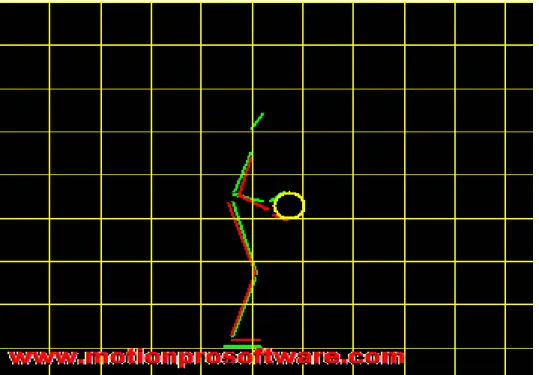
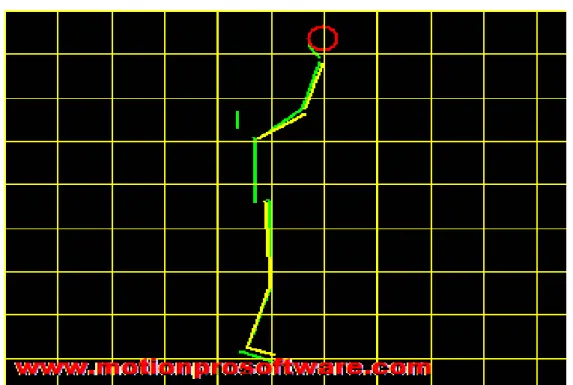
Video graphic technique was used in this study. The films were analyzed by using standard motion analyzer software (Motion Pro-Advanced Coach Edition) approved by Human kinetics. Only two selected moments were analyzed. Quick snap shots under motion pro software for analysis of selected variables presented in Figure 1 & 2.
International Journal of Research in Engineering & Applied Sciences
Email:- [email protected], http://www.euroasiapub.org
An open access scholarly, online, peer-reviewed, interdisciplinary, monthly, and fully refereed journals
20
Figure 2: Segmentation shot of moment of release of ball in set-shot taken through Motion Prosoftware.
STATISTICAL ANALYSIS OF DATA
With regard to purpose of the study product moment correlation was calculated between selected kinematical variables with the performance of subjects in set shot in basketball. In order to check the significance, level of significance was set at 0.05.
RESULTS
Product moment correlation was used to find out the relationship of the selected Kinematical variables with the performance of Basketball players in set shot.
International Journal of Research in Engineering & Applied Sciences
Email:- [email protected], http://www.euroasiapub.org
An open access scholarly, online, peer-reviewed, interdisciplinary, monthly, and fully refereed journals
21
o.
1 Angle at right ankle joint. 0.022
2 Angle at left ankle joint.
+
0.021
3 Angle at right knee joint. 0.093
4 Angle at left knee joint. 0.091
5 Angle at right shoulder joint. -0.086
6 Angle at left shoulder joint. -0.020
7 Angle at right hip joint 0.067
8 Angle at left hip joint 0.070
9 Angle at right elbow joint. -0.053
10 Angle at left elbow joint. -0.071
11 Angle at right wrist joint. 0.083
12 Angle at left wrist joint. 0.205
13 Height of center of gravity
of the shooter at moment stance.
-0.074
Note: All values are not significant at 0.05 level
Table-1: Showing coefficient of correlation of selected kinematical variables with the performance in set shot at the moment of stance (N=60)
International Journal of Research in Engineering & Applied Sciences
Email:- [email protected], http://www.euroasiapub.org
An open access scholarly, online, peer-reviewed, interdisciplinary, monthly, and fully refereed journals
22
Sl.No. Variables Coefficient of Correlation
1 Angle at right ankle joint. 0.382**
2 Angle at left ankle joint. 0.379**
3 Angle at right knee joint. 0.375**
4 Angle at left knee joint. 0.360**
5 Angle at right shoulder joint. 0.306*
6 Angle at left shoulder joint. -0.054
7 Angle at right hip joint 0.162
8 Angle at left hip joint 0.166
9 Angle at right elbow joint. 0.012
10 Angle at left elbow joint. -0.039
11 Angle at right wrist joint. 0.348**
12 Angle at left wrist joint. 0.184
13 Height of center of gravity
of the shooter at moment of
release of ball.
0.013
Note: ** - Significant at 0.01 level * - Significant at 0.05 level
Table-2: Showing coefficient of correlation of selected kinematical variables with the performance in set shot at the moment of release of ball (N=60)
Out of the selected variables the values of coefficient of correlation of the variables namely angle at right ankle joint, angle at left ankle joint, angle at right Knee joint, angle at left Knee joint, angle at right shoulder joint, and angle at right wrist joint found significantly related with the performance in set shot at the moment of release. However, all the significant variables at the moment of release have shown positive correlation with the performance in set shot at the moment of release in basketball. Rest of the selected variables namely angle at left shoulder joint, angle at right hip joint, angle at left hip joint, angle at right elbow joint, angle at left elbow joint, angle at left wrist joint and height of center of gravity of the shooter at moment of release of ball were found not significantly related with the performance in set shot at the moment of release of the ball.
International Journal of Research in Engineering & Applied Sciences
Email:- [email protected], http://www.euroasiapub.org
An open access scholarly, online, peer-reviewed, interdisciplinary, monthly, and fully refereed journals
23
relationship with the performance in set shot at the moment of release of ball.As shown in table 2 the values of coefficient of correlation of angle at left shoulder joint (-0.054), angle at right hip joint (0.162), angle at left hip joint (0.166), angle at right elbow joint (0.012), angle at left elbow joint (-0.039), angle at left wrist joint (0.184) and height of center of gravity of the shooter at moment of release of ball (0.013) for 58 degree of freedom were not more than the required value (.250) for 0.05 level of significance, therefore the selected variables have shown no significant relationship with the performance in set shot in basketball at moment of release of ball. In the present case this can be stated that there is no significant relationship between the selected kinematic variables and the performance of set shot in basketball.
DISCUSSION OF THE FINDINGS
The results of the study have shown that none of the kinematical variables i.e. height of center of gravity of the shooter, angle at right ankle joint, angle at left ankle joint, angle at right knee joint, angle at left knee joint, angle at right shoulder joint, angle at left shoulder joint, angle at right hip joint, angle at left hip joint, angle at right elbow joint, angle at left elbow joint, angle at right wrist joint and angle at left wrist joint exhibited significant relationship with the performance of set shot at moment of stance. Though it is generally assumed that the stance plays an important role in good execution of any skill, but in this investigation it was found that kinematical variables at the moment of stance of set shot put no impact on the performance. It was also found that the kinematical variables i.e. height of center of gravity of the shooter, angle at left shoulder joint, angle at right hip joint, angle at left hip joint, angle at right elbow joint, angle at left elbow joint and angle at left wrist joint at moment of release of ball have no significant relationship with the performance of set shot at moment of release of the ball. It was also found that the displacements of center of gravity of the shooter have no relationship with the performance of set shot in basketball. Previous study with the purpose to investigate the pattern of motion of the striking arm and muscular/joint activities responsible for it during the arm swing phase of the volleyball spike [13].also showed that the elbow muscles and joint contains no significant value in strengthening respective arm rotation and performance directly. Previous research to develop suitable and feasible criteria for the evaluating different variations of seoi nege and to find out the contributing biomechanical, anthropometric flexibility and motor fitness factors for effective execution of different variation of seoi nage (S. Dhananjoy, 1992) also shown that (i) left elbow joint, right knee joint and center of gravity at the basic stances prefer no correlation with the seoi nege perfecton and (ii) the angle at the ankle joint found not to be significantly correlated with total time as it was less effective too.
International Journal of Research in Engineering & Applied Sciences
Email:- [email protected], http://www.euroasiapub.org
An open access scholarly, online, peer-reviewed, interdisciplinary, monthly, and fully refereed journals
24
performance. In Previous research on the kinematic analysis of Basketball three point shoot afterhigh intensity program (Chi-Yang, 2006) found that Improvement in the power for the shot exhibited to be dependent on knee and ankle joint to much extent. Previous research on kinematical analysis of the flight phase in the long jump (Kim L., 1993) also confirmed that many kinematical variables like knee and elbow joint contributes in gaining good flight phase in long jump. Mr. Muralitharan’s spin bowling action was analyzed in the biomechanical laboratory of the school of Human movement and exercise sciences of Wester Australia (The Hindu, 2015) and it was finalized by the experts that that wrist abduction was seemed to be the major reason for production of impressive ‘Dusra’. In another previous research study on the relationship of kinematic variables with the performance of standing broad jump (Ruhal A.S. and Ruhal G.S, 2015) it was found that the angle at knee joints and angle at ankle joints were significantly related with the performance in broad jump.
CONCLUSIONS
Based on the analysis and within the limitations of the study following conclusions were drawn: 1. It was observed that there was no significant relationship between selected Kinematical variables at the moment of stance and the performance of set shot in basketball.
2. There was no significant relationship between the variables i.e. height of center of gravity of the shooter, angle at left shoulder joint, angle at right hip joint, angle at left hip joint, angle at right elbow joint, angle at left elbow joint and angle at left wrist joint at moment of release of ball and the performance of set shot of different height group players in basketball.
3. The selected biomechanical variable i.e. angle at right ankle joint, angle at left ankle joint, angle at right knee joint, angle at left knee joint, angle at right shoulder joint and angle at right wrist joint at moment of release of the ball were found significantly related with the performance of set shot of different height group players in basketball.
REFERENCE
Abdoddaleh, Asal and Mohammad (2014), “Equilibrium Studying and Comparison Old Athletes
and No Athletes”, Abstract Book: III International Congress on Sports Medicine, Exercise
Science, Physical Education and Yoga Sciences, L.N.I.P.E-Gwalior, 12-15 Feb. 2014 ,p.199.
Andrzej W. and Elisaz J. (2016), “Kinematic Analysis of Handball Throws”, Annual
Publishing-Poland Polish Air Force Institute of Medicine-II,p.37.
Clarke, YH. Harrison and Clarke, David H. (1972), Advanced Statistics with Applications to
Physical Education, Englewood Cliffs, N.J.: Prentice Hall, Inc.
Degaray, A.L., Levine, L. and Carter, J.E.L. (1974), Genetic and Anthropological Studies of
Olympic Athletes, New York: Academic Press Inc.
Deol, N.S., S. Mandeep and Gill, M. (2014), “Physical Education for Special People: A Kinematical
Analysis”, HPE Forum Bi-annual Professional Journal, Vol. 08, p.47-50.
Hebbeflinck, M. and Ross, W.D. (1974), Kinanthropometry and Bio- mechanics, Biomechanics IV,
Ed. Nelson, Richard C. and Morehouse, Chauncey A., Baltimore: University Park Press.
Ishikawa, Takashiko and Draeger, Donn F. (2016), Judo Training Methods, Tokyo: Charles E.
Tuttle Company.
International Journal of Research in Engineering & Applied Sciences
Email:- [email protected], http://www.euroasiapub.org
An open access scholarly, online, peer-reviewed, interdisciplinary, monthly, and fully refereed journals
25
Publications.Lega Sushil (2016) “A Comparative Study Of Selected Motor Abilities Of Football And Handball
Players” www.ijobsms.in, Vol.03,No.o4
Mandeep Singh Nathial. Analysis of Set Shot in Basketball in Relation with Time to Perform the
Course and Displacement of Center of Gravity. American Journal of Sports Science. Vol. 2,
No. 5, 2014, pp. 122-126. doi: 10.11648/j.ajss.20140205.13
Mandeep Singh Nathial.A Study of Adjustment and Emotional Intelligence of University Coaches in
India. American Journal of Applied Psychology. Vol. 3, No. 6, 2014, pp. 122-126. doi:
10.11648/j.ajap.20140306.11
Mathews, D.K. (1978), Measurement in Physical Education, 5th ed., Philadelphia: W.B. Saunders Co.
Nathial M.S. (2016), “Kinematical Comparison of Technique of Male and Female Sprinters by Using
Motion Analyzing Software”, ICLIST Proceeding, Pattaya, Thailand,24-26 Feb. 2016, p.244-247.
Singh Mandeep (2012), Movement technology of an inclusive case through kinematic technology, International Journal of Behavoral Social and Movement Science,Vol.01, Issue01 Jan2012, pp40-44
Winter, D.A. (1974), “Measurement and Reduction of Noise in Kinematics of Locomotio”, Journal
of Biomechanics, Vol. 7, p.157-159.
Wood, J.A. and Jennings, L.S. (1979), “One the Use of Spline Function for Data Smoothing”,
Journal of Biomechanics, Vol. 12, p.477-479.
Yokobori, Sakae and Suzuki F. (1957), “Studies on the Appraisal of Body types by Sheldon’s
Triangula Scheme Method - Part 3 on the Body Types of Sports Students in American Football, Karate, Tennis, Ping-pong, Judo and Gymnastics”, The Japanese Journal of Physical Fitness, Vol. 6, p.52-57.
Biography of Authors
Dr. Mandeep Singh is Physical Director, Department of Higher Education, Govt. of Jammu