6665
A MULTI-AGENT ARCHITECTURE FOR EVACUATING
PILGRIMS IN PANIC AND EMERGENCY SITUATIONS
:
THE HAJJ SCENARIO
ABDALLAH NAMOUN, AABID MIR, AHMAD B. ALKHODRE, ALI TUFAIL, AHMED ALREHAILI, MOHAMMAD FARQUAD, MAJID ALWAQDANI, TURKI ALGHAMDI,
MOHAMED BENAIDA
Faculty of Computer and Information Systems, Islamic University of Madinah, Madinah, Saudi Arabia E-mail: [email protected]
ABSTRACT
This paper proposes and presents the details of an agent-based architecture that has the capacity to model, simulate the movement of, and guide crowds with panic behavior in highly-dense areas in the events of man-made and natural threats. The most populated human gathering in the world, the Muslim pilgrimage event (also known as Hajj) which attracts more than two million people in six days is chosen to guide the identification of the requirements and main concepts of the agent simulation. The inferred requirements are used to guide the selection of an appropriate simulation tool following an extensive survey of potential simulation tools. The architecture uses software agents to represent groups of people along with their real time characteristics such as density, movements and panic levels, collected from various data sources. Support vector machine is combined with the fuzzy logic theory to predict pilgrims' behaviors and movements in case of panic situations. Initial simulation tests and results of the SVM model demonstrated that it is feasible to minimise the problem of modelling large crowds by selecting the best representative crowds that best reflect pilgrims’ behaviors. Furthermore, the implications of this architecture and a future plan are presented.
Keywords: Multi-agent Architecture, Crowd Modeling and Simulation, Crowd Management, Support Vector Machine, Fuzzy Set Theory, Behavior Prediction.
1. INTRODUCTION
Several incidents have been documented in the Muslim annual pilgrimage (Hajj) with the deadliest stampede occurring in 2015 resulting in approximately 2400 human causalities [26], [27]. The Muslim pilgrimage is a yearly event that takes place in Makkah (Kingdom of Saudi Arabia) where millions of Muslims gather from around the globe to perform the pilgrimage rituals, e.g. 1.9 million pilgrims in 2016 [13]. Whilst Hajj pilgrims are trained for the pilgrimage rituals and spiritual activities extensively, very little or no training is provided for any other activities such as how to avoid crowdedness, how to act in emergency or panic situations, and what are the entry and exit points. People tend to behave differently in panic situations [12], and different factors influence such behaviors of the pilgrims including cultures and customs [10]. Human behavior is an important factor in the analysis of problems related to overcrowding.
Crowdedness and emergency evacuation in the Hajj scenario [3] is a very interesting yet challenging research problem to investigate, for it involves complex structures (streets, buildings, tents, mosques … etc.) and a huge number of players (humans and vehicles) [16] introducing high risk factors (as depicted in Figure 1 and Figure 2).
6666 Figure 1.Mina Pathways Crowded with Pilgrims
during Hajj (Adopted from [39])
Figure 2.Mina Physical Structures Such as the Buildings, Tents, Roads and Pathways (Adopted from
[40])
Crowd disasters are known to be caused by non-adaptive behaviors (e.g. pushing, stampede, etc.) and replicating these disasters in reality is impractical, mainly because it exposes people to real dangers and it is difficult for people to mimic real panic situations. Various crowd modelling and simulation tools [37] that exist in the literature represent a viable alternative, and are indeed applied to a range of scenarios in different fields, including architectural design, traffic flow, military training, and digital entertainment [31]. These tools generally enable researchers and practitioners to study the dynamics of crowds in both normal situations and panic situations with the aim of designing more efficient and safer structures and buildings [15]. However, most of the existing crowd simulation models in emergency situations do not take into account potential future behaviors of crowds. This paper proposes to use the multi-agent paradigm with a particular focus on predicting potential actions and behaviors within highly-dense structures and thereby helping controlling crowds in emergency situations. Agent-based models enable the simulation and development of complex ecosystems especially
where distribution, unpredictability dynamicity and heterogeneity are major concerns.
This research is motivated by the pressing need for a specialized agent based simulation tool for the Hajj scenario. In our argument, the current crowd simulation tools are too generic to be used to satisfy the specific needs of the pilgrimage situations (e.g. structures, crowds, behaviors … etc.). Moreover, pilgrimage attracts millions of Muslims each year. The interesting challenge is how the simulation problem can be reduced to a reasonable size to overcome computational complexities such as optimizing the performance, the processing of large amount of data, distribution of software agents, and the modelling of representative samples.
This research, therefore, proposes to combine support vector machine (SVM) [9] with fuzzy set theory [35] to select the best representative crowd groups and predict their behaviors in emergency situations, thereby enabling appropriate decision-making and evacuation strategies of pilgrims to safety.
The contributions of this paper are two fold as follows:
1. This paper contributes an agent-based architecture for simulating and evacuating crowds with panic behavior. The architecture promises to employ Support Vector Machine’s ability to yield sub-sample of available training data (e.g., movement patterns, human density, etc...) in the form of Support Vectors. Later, the proposed architecture utilizes the fuzzy set theory for fuzzy rule generation using the sampled data obtained from SVM to predict and thereby guide crowd movements when man-made or natural disasters occur. 2. This paper contrasts multiple simulation
[image:2.612.99.299.264.403.2]6667 most appropriate tool to satisfy the identified requirements. Section six highlights the implications of guiding crowds and sets a future research plan for implementing and testing the MAS architecture.
2. RELATED WORKS
Multi-agent systems are composed of intelligent agents that are able to make autonomous actions to achieve particular desires. Generally, these agents exist in a common environment where they perceive, through sensors, the current state and act accordingly, through actuators, in the environment [23]. The ability to act independently makes distribution a possibility. In addition, agents are social entities that interact with others allowing cooperation and negotiation in order to reach agreements when interests differ. Another important aspect of agents is learning. It is far more effective for agents to use learning and adapt their behaviors instead of relying on pre-programmed behaviors for this satisfies the changing circumstances of the environment over time [5], [22]. Multi-agent systems empower, through abstraction, the modeling and simulation of large scale problems, such as traffic and crowd management, that are otherwise difficult to implement and test in real life, given the complexity and required resources.
Various agent-based systems were proposed to tackle the overarching issue of controlling and guiding large crowds [31]. Studying crowd reactions during danger situations is a challenging task since it needs to introduce real agents to a real threat surrounding them. To overcome such difficulty, computer models and software tools have been deployed. Such deployment requires illustrating a collection of agents while taking into consideration agent motion, speed variation, and collision management. Typically, agent behaviors may vary depending on their deployed modules from normal reactions to panic reactions.
Evaluating normal pedestrian behavior has been documented easily through different means such as time-lapse videos, photos and survey [29], [30], [33]. Other evaluations were carried out during social experiments where experts observe agent reactions to some obstacles. Ideally, agents share some attributes, such as calmness and least effort principle, when making their decisions to overcome obstacles. As the agent nervousness increases with panic situations, there is less interest in the "least effort principle" where it is replaced by the safest appeared route principle. Furthermore, agents tend to increase
their speed and lose the power of orienting themselves within the environment [33].
Overall, crowd simulation models fall into three categories, specifically macroscopic, microscopic, and mesoscopic [31]. Macroscopic models presume that crowds mimic the movement of fluid and thus focus on simulating the global characteristics of huge-sized crowds as a whole. Microscopic models, however, focus on simulating the distinctive behavior (e.g. speed, social links) of each individual in the crowd and consider the interactions between individuals. Lastly, mesoscopic models fall between the macroscopic and microscopic modeling approaches with a particular emphasis on simulating small to medium sized crowds at a high of level of detail whilst specifying the behavior and interactions at a lower level.
Data sources are very crucial to acquire accurate information about the crowd and later guide them in emergency and panic situations. Most of the previous work done in crowd management relies on multiple sources of data for accuracy and reliability of data [11], [14], [25]. In crowd management four main sources can be reliably used to gather data 1) Mobile Networks 2) Smart Phones 3) Personal/Wearable Devices and 4) Sensors [14]. In [11], the authors suggest the use of smart phone application to get the location information. Big data analytic techniques can play a pivotal role to analyze the data gathered from various sources and help in prediction of crowd behavior. In [32], authors survey various big data techniques that are currently being deployed for big data sensing and analytics. For example, they discuss the use of [11] prediction models to improve geometric monitoring framework and 2) cloud-based big data architecture for supporting sensor services. In [28], the authors present a model "NoizCrowd" that includes techniques to create large amounts of data by combining crowdsourcing, data generation models, mobile computing, and big data analytics.
In respect to crowd management, Dell’Orco et al [34] developed a fuzzy-based microscopic crowd simulation which incorporates factors related to human perception and reasoning and demonstrated ability to reproduce evacuation like situations. Li et al [36] embedded fuzzy logic within a crowd simulation tool where behavior rules were obtained from crowd videos and added to pre-defined rules of the agents.
6668 incidents in sacred places in the upcoming years, and thereby suggested to classify pilgrims into groups and allocate an optional time for each group to perform the ritual of stoning. Al-Badawi et al. [2] suggested ‘Almhakah’ system to monitor and regulate the pathways in various regions where the pilgrims are present. Moreover, Sharif et al. [21] proposed to educate and inform the pilgrims, through awareness programs, in their countries before coming to the pilgrimage with a focus on teaching the pilgrims evacuation procedures in emergency situations in the usual areas of crowdedness.
Once the evacuation plan has been modeled, the next step will be to disseminate the evacuation path guidelines to the crowd. Three types of evacuation path guideline schemes have been investigated in the literature: wireless sensor networks, visual displays and smartphones [6]. The increased usage and availability of faster communication mechanisms with the smartphones (for example, 3g/4G, WiFi …etc.) makes smartphones one of the best choices for the path evacuation guidelines. Chittaro and Nadalutti demonstrated how evacuation guidelines can be provided through smartphones as 3D view [6]. Other related work can be found in [7] and [24].
3. THE PILGRIMAGE CASE AND RELEVANT REQUIREMENTS
3.1.Description of the Pilgrimage Case
Hajj is one of the largest gatherings in the world with over two million people from about 180 countries participating yearly [13]. Hajj rituals are performed in the city and suburbs of Makkah from 8 to 13th of DulHija (the 12th lunar month) every year.
However, people start gathering in Makkah well in advance (almost 45 days prior to Hajj) and similarly the crowd takes almost 40 - 45 days to get diluted after the Hajj. This huge crowd with extremely complex nature, containing people from variety of ages, ethnicities, and cultures, makes it one of the hardest and challenging crowd management tasks. Table 1 summarizes the key characteristics of the sacred places of Hajj, including the number of pilgrims they attract.
3.2.Relevant Requirements for the Multi-Agent System
Agents provide ample opportunity to create flexible systems that can model and simulate complex scenarios. This section focuses on identifying the functions and features required to realize our Hajj-dedicated multi-agent system
architecture. Thus, the architecture proposed has to consider the following requirements and properties that were inferred from the pilgrimage scenario.
REQ1: The system architecture should support macroscopic modelling where group flow, behavior and attributes (e.g. travel time, human density and flow) are modelled and investigated instead of individual persons’ attributes. In this type of modelling individuals of the same crowd are assumed to behave similarly.
REQ2: The architecture should be scalable to accommodate varying and complex infrastructure and large number of pilgrims.
REQ3: The architecture should simulate the physical structures and the properties of the environment. Initially, the architecture will simulate the physical environment at a very high level, as a two dimensional grid composed of nodes. However, as this research progresses more specific structures including buildings, mosques, bridges, tents, hallways, and streets will be featured in the simulation. Some properties that the architecture has to address include the area, capacity, location of exit points. Each node in the grid could hold crowds if it is free and is not an obstacle.
REQ4: In case of threats, the architecture should detect these incidents instantly and react to them in a timely manner. Execution speed is an important aspect here.
REQ5: When panic situations occur, the agents should communicate, negotiate and reach mutual agreements to realise effective evacuation strategies. REQ6: The ability to predict crowd behavior under uncertainty and emergency situations, especially when pilgrims are expected to show non-adaptive and destructive behavior. The architecture should incorporate machine learning theories, such as the fuzzy set theory, to estimate dangerous crowd behavior (e.g. herding and flocking behavior).
6669
Table 1. Hajj Sacred Places and their Characteristics
Sacred Place Total Days of Crowdedness Characteristics of Place
The Grand Mosque, Mecca
12 days (1-12 DulHija-the 12th lunar month)
Area: 1470,000 square meters Number of pilgrims: 2 million (approx.)
Facility type: buildings
Mina, Mecca 5 days (8-13DulHija)
Area: 20 square kilometres Number of pilgrims: 2 million (approx.)
Facility type: 45,000 Air-conditioned tents, streets, vehicles
Arafat, Mecca 1 day (9 DulHija)
Area: 18 square kilometres Number of pilgrims: 2 million (approx.)
Facility type: Air-conditioned tents and open spaces, streets, vehicles
Muzdalifah, Mecca 1 day (10 DulHija)
Area: 18 square kilometres Number of pilgrims: 2 million (approx.)
Facility type: Air-conditioned tents and open spaces, vehicles
Jamaraat, Mecca 3 days (10-13 DulHija)
Area: Part of Mina
Number of pilgrims: 2 million (approx.)
Facility Type: bridge, and open spaces
4. A MULTI AGENT ARCHITECTURE FOR HAJJ
4.1 Overview of the Multi-Agent System
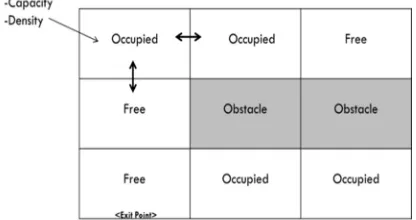
The general purpose of this simulation is to model both the physical infrastructure, representing the environment, and crowds, along with their properties, and efficiently evacuate people to safe zones when emergency situations are triggered. This requires knowledge of current status of the environment at all times and ability to estimate human behaviors and reactions to such threats using fuzzy set theory. Crowd agents model the physical structure as a grid of cells, with each cell representing an area in the environment. The cell takes either of the three states, free, occupied, or obstacle. Free cells are areas with zero human occupancy but can host crowds according to their capacity. Occupied cells are areas that already hold crowds with a particular density at a particular time. Obstacle cells are impassable areas that cannot be used to host crowds. Possible directions of crowd flow from one cell to another are represented using the arrows. Exit point locations are also specified in the environment.
[image:5.612.325.533.605.715.2]Nowadays, crowdsourced data is prevalent through different sources such as surveillance cameras, mobile phones, sensors, RFID readers and tags which provide real time information about the crowds in the form of GPS coordinates, human count and spatial dispersion. These statistics enable accurate identification of human densities and movement patterns in the environment which could be examined to anticipate potential threats (e.g. stampedes). The system will act based on the gathered intelligence and generate guidance to be delivered to various devices, including mobile phones (through text messages and smartphone applications) and large screen displays.
6670 The guidance will rely on the results of a safety function which, given various variables, would calculate the safety level of each potential evacuation route in the environment. To this end, the environment will be divided into interconnected nodes, with each node representing a typical area that hosts a number of people. Each node is characterized by constants (type, size of area, capacity, and neighboring nodes) and real-time variables (e.g. human density per square meter, and human traffic flow per second) as depicted in Figure 3. It is well-known that non-adaptive crowd behaviors highly contribute to the destructive actions (e.g. stampede) in emergency situations. This multi-agent system simulation will incorporate non-adaptive crowd behaviors (e.g. pushing).
4.2 The Proposed MAS Architecture
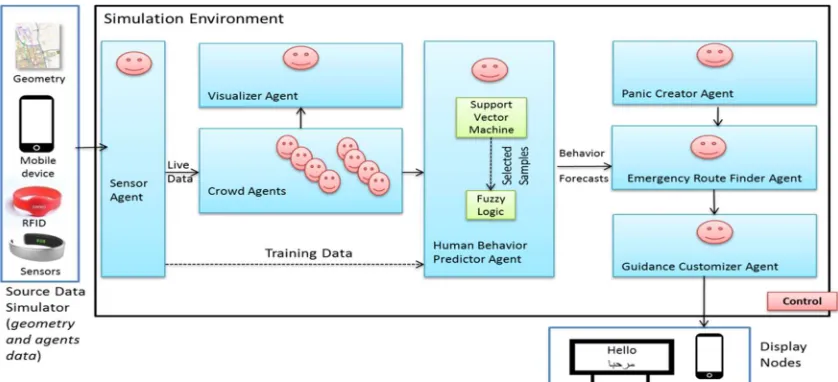
To realize the above requirements, we propose a system architecture comprising agents of different roles, namely: a sensor agent, crowd agents, panic creator agent, human behavior predictor agent, emergency route finder agent, guidance customizer agent, and visualizer agent (See Figure 4). Each of those agents has a dedicated role and communicates with the other agents to enable effective control and management of crowds with panic behavior.
The simulation environment hosts all living agents, and leads the tasks of instantiating, starting, pausing, and killing the agents as required. For the purpose of this research, synthetic data about both geometric (e.g. grid dimension, types of cells and capacity) and crowd information (e.g. population density, real-time behaviors and movements) are generated using a standalone simulation (source data
simulator). These data are sensed and collected by the sensor agent at the beginning of the simulation and at regular intervals (e.g. every minute). The sensor agent forwards this information to the crowd agents in order to update their real-time status. The crowd agents are instantiated to model and simulate the physical structure of the environment in the form of nodes, groups of crowd and their properties (e.g. density, panic level).
[image:6.612.100.519.518.709.2]At the beginning of the simulation, the human behavior predictor agent receives historical data about crowd distribution, their pre-defined ritual routes and their behaviors which are used first to train the prediction model and select the best representative groups to simulate, as depicted in Figure 4. Subsequently, the model estimates future behaviors and movements under normal circumstances and under panic situations. To this end, support vector machine classifies the data into a specific category using a non-probabilistic binary linear approach. The outputs of SVM will be fed into a fuzzy set theory-based engine to predict crowd behaviors and trajectories. These predictions, along with the current state of the crowds, serve as input to the emergency route finding agent whose main task is to calculate the safest evacuation routes based on an accumulative safety function. Unpredicted emergency situations are incorporated into the simulation through the panic creator agent. Once evacuation patterns are found, a guidance customizer agent customizes the evacuation instructions according to the type of devices and language of crowds. Finally, the visualizer agent renders the simulation results, including the environment, crowds and evacuation routes.
6671 4.3 Crowd Evacuation using Behavior Forecasts
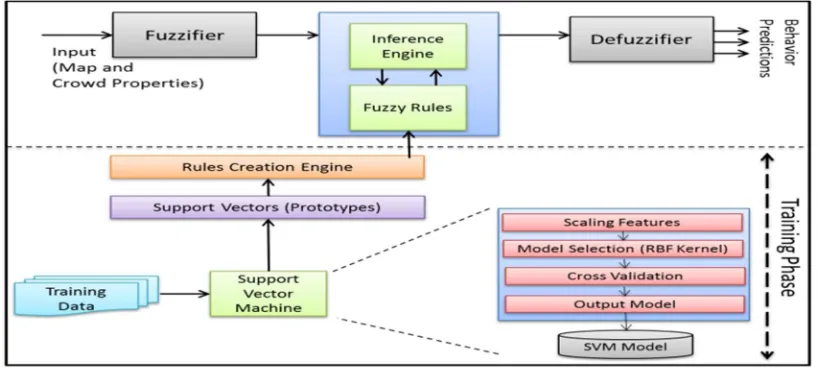
In emergency cases, the emergency route finder agent will calculate evacuation routes for the crowds based on movement and behavior predictions estimated by the human behavior predictor agent. This agent encompasses a behavior prediction engine comprising support vector machine and fuzzy set theory as illustrated in Figure 5.
A support vector machine (SVM) is an algorithm that learns by examples to predict the class of future instances [8]. SVM employs a novel form of learning and prediction compared to other machine learning algorithms. For classification problems, SVM aims to obtain a maximal margin hyperplane that separates the points of two classes as far as possible, by minimizing the risk of misclassifying the training samples and unseen test samples. Unlike other machine learning algorithms, only the training points that are closest to the optimal separating hyperplane are treated as most important for prediction purposes, and these are called support vectors. The number of support vectors extracted is very little compared to the actual training data. Indeed, support vector machine has shown superior performance when finding a global optimum solution for a given problem in many applications [17]. For example, learning of Naïve Bayes tree using support vectors as training set yielded improved accuracy than the accuracy yielded using the complete training set. To deal with non-linear problems, SVM first projects the data into higher dimensional feature space and finds the linear margin in the newly generated feature space.
During training, SVM first scales the available features to a higher feature level using kernel
function i.e. Radial Basis Function Kernel, and subsequently validates the learned hyper-plane with available test set and optimizes the hyper-plane to generate the final SVM model. Given the characteristics of the environment and crowds, such as human densities, current movement patterns, panic levels, SVM will select the best representative sample of pilgrims from the crowds to model. In the Hajj scenario, the outcome of SVM is a sample of crowd that best represents the real-time properties and behaviors of pilgrims in order to reduce the computational cost. In the next phase, this SVM sample is used to create the rules of the fuzzy logic engine.
Fuzzy logic is an extension of classical logic that enables human reasoning through the consideration of all intermediate possibilities between true and false values [35]. A fuzzy-based system calculates the output by providing the system with a set of rules formulated in natural language. The output is obtained in three steps [35]. The first step, referred to as fuzzification, translates digital values (e.g. real-time data about crowds' panic level, behaviors and trajectories) into linguistic variables by comparing it with standard values and using specific functions. The second step, represented by an inference engine, applies inference rules (if-then rules about situations and expected movements) on the inputs. These inference rules represent the knowledge that one has of the system as a result of human expertise. The third step, referred to as defuzzification, merges various commands generated by the inference engine and transforms the output linguistic variable into a scalar value (e.g. forecasted panic level, forecasted flow).
[image:7.612.102.511.524.708.2]
6672 5. THE RESULTS OF USING SVM TO
REDUCE THE SIMULATION COMPLEXITY
Initial simulation tests were conducted to examine the usefulness of SVM in reducing the computational complexity of modelling all crowds in a Hajj scenario. To this end, synthetic data about potential crowd behaviour such as human density, velocity and flow were generated randomly and used to train the proposed SVM model. The main goal of the model was to predict the representative crowds that should be simulated when aiming to anticipate potential human incidents and suggest evacuation plans accordingly.
A simulation study was performed to verify the possibility of predicting the best representative pilgrims for the modelling purpose using SVM. Synthetic Hajj data comprising 6 variables (e.g. human flow, speed ... etc.) were generated about the training examples with pilgrims belonging to two main classes: representative and non-representative. The training datasets, as a csv file, were fed into RapidMiner to train the SVM model. The output model was then applied to the unsupervised datasets.
[image:8.612.315.528.174.314.2]Considering the synthetic input training data with six input features and a target feature (representativeness), it has been observed that SVM yielded high accuracy of the classifier with 98.77% accuracy and the number of support vectors that are considered very important for prediction purposes are almost 12 percent of the total input objects (Table 2).
Table 2. Average Prediction Accuracy of SVM Model (98.77%)
True non rep
True rep Class precision Pred. non
rep 238 0 100.00%
Pred. rep 6 244 97.60%
Class recall 97.54% 100.00%
Table 3. Data Used to Train the SVM Model
Data Total
points
Rep points
Non Rep points
Training 1140 570 570
Support
Vectors 162 94 68
Test 488 244 244
It is also observed that the learnt SVM has the ability to predict representative objects without any
[image:8.612.312.525.343.471.2]error (100%) but failed to predict non-representative objects by 2.4% only. Confusion matrix and the information about the input objects and support vectors extracted are presented in Table 2 and Table 3 subsequently.
Figure 6: SVM Model Learnt using the Input Objects
Figure 7: Accuracy results of the SVM model learnt using the input objects
The plot below (Figure 6) represents the hyper-plane learnt by SVM during training using input training data with binary classes of representative objects (blue dots) and non-representative objects (red dots). It can be observed that the data points which are near to the hyper-plane, either blue or red (hyper-plane is yellow in color), are support vectors and considered important for prediction purposes by SVM. Several tests were conducted and accuracy results averaged 97.43%, exceeding 94% in all tests (Figure 7).
6. A SYSTEMATIC REVIEW OF SIMULATION TOOLS
[image:8.612.94.304.521.701.2]6673 requirements, seven of them have been summarised previously in section 3.2. We have added three more simulation related requirements, namely visualisation, modelling language, and open source. Visualisation refers to the ability to draw and display the agents on a graphical user interface. Modelling language refers to whether the tool utilises a dedicated language to model agents’ capabilities and features. Open source indicates whether the tool’s source code is freely available for other developers which enables customisation and enhancements as per the needs of the Hajj scenario.
[image:9.612.97.532.288.745.2]A total of thirteen tools have been studied and evaluated from the literature [37], [38] and the results are shown in Table 4. Based on our analysis and comparison, ‘repast symphony’ emerges as a clear choice. Simulating a complex mobility pattern, like people circumambulating around ‘the Kaaba’ in Mecca, is undoubtedly a challenging task and needs a scalable simulation tool that has the ability to simulate tens of thousands of agents in a short span of time. Repast Simphony has an extensive library for implementing machine learning theories and algorithms which will constitute a key aspect of the simulation. Moreover, Repast Simphony is open source and enjoys a good online community support.
Table 4. A Comparison of the Simulation Tools Against the Hajj Requirements
Simulation Tool R Q 1: M ac ro sc op ic m od el in g R Q 2: Sc al ab il ity R Q 3: Ph ys ic al en vi ro nm en t R Q 4: Sp ee d R Q 5: A ge nt ne go ti at io n R Q 6: Pr ed ic ti on / m ac hi ne le ar ni ng R Q 7: E va cu at io n ro ut in g R Q 8: V is ua liz at io n R Q 9: M od el in g la ng ua ge R Q 10 : O pe n So ur ce
NetLogo ✔ X ✔ X ✔ ✔ ✔ ✔ ✔ ✔
MASS MOTION ✔ ✔ ✔ X ✔ ✔ ✔ ✔ ✔ X
ABLE ✔ ✔ ✔ X ✔ ✔ ✔ ✔ ✔ ✔
Repast Simphony ✔ ✔ ✔ ✔ ✔ ✔ ✔ ✔ ✔ ✔
MASON ✔ ✔ ✔ ✔ ✔ ✔ ✔ ✔ ✔ ✔
MASSIVE ✔ ✔ ✔ X ✔ ✔ ✔ ✔ ✔ X
JADE ✔ ✔ ✔ X ✔ ✔ ✔ ✔ ✔ ✔
Cougaar ✔ ✔ ✔ ✔ ✔ ✔ ✔ X ✔ ✔
Breve ✔ X X X ✔ ✔ ✔ ✔ ✔ ✔
Swarm ✔ ✔ X X ✔ ✔ ✔ ✔ ✔ ✔
6674
StarLogo ✔ X X X X ✔ X ✔ ✔ ✔
Crowd
Master
✔ X ✔ X X ✔ ✔ ✔ ✔ ✔
7. CONCLUSION AND A FUTURE PLAN
Managing crowd and studying their behavior in emergency in particular is a challenging task. A careful study of behaviors would require creating a real life panic situation and exposing people to danger. Therefore, researchers have followed an alternative approach of using computer simulations to address the issue [23]. There are different approaches to simulate and manage the crowd. One of the approaches is the use of multi agent system (MAS). MAS is a favourable approach in comparison to other available approaches like mathematical formulation, cellular automata and system dynamics [20]. MAS can help to simulate individual behaviors targeted to specific entities and allows simulating dynamic scenarios. Moreover, MAS approach enables us to model at group, individual and cluster level [20]. Since Hajj is the largest gathering of individuals, aforementioned characteristics of MAS perfectly addresses the pilgrimage needs and requirements. Our main motivation is to apply real life panic situations to simulate and study the behavior of pilgrims, and thereby find appropriate evacuation models to decrease the chances of major catastrophes.
Modelling every single pilgrim, although may sound rewarding, requires huge computational and processing power. An alternative solution is to identify the most representative pilgrims in each group of pilgrims and model their attributes and behaviors and attempt to predict their future behavior based on past actions. Our solution utilizes Support Vector Machines, which is a form of supervised learning model that helps classify pilgrims into representative or non-representative agents reducing the simulation computational needs.
Moreover, the paper introduces a new architecture that utilizes the characteristics of software agents to help model and simulate the Hajj scenario and suggests an appropriate simulation tools that researchers may leverage to create their Hajj simulations. This reduces the need to buy proprietary simulation tools which are rather expensive to acquire and maintain.
The suggested MAS would allow us to progress from a macroscopic analysis to a microscopic analysis in the future, and thus investigate and represent the behavior of pilgrims in a more realistic manner.
This work is focused to implement an agent based crowd simulation platform allowing various agents to be modelled easily. Future work involves the simulation of hundreds of thousands of agents on a single platform, which is why ‘scalability’ is a key aspect in the simulation process. Moreover, the crowd-size, inter-agent relationships and the environment can have significant influence on crowd behavior. Our research intends to extend further towards several directions. Socio-psychological factors such as, culture, language, personality, play a vital role into modelling of the Hajj scenario. The effect of the group structures and the environmental conditions on the crowd-behavior, in case of emergency evacuation, would be studied during the implementation phase.
REFERENCES:
[1] Aborzizah O, “Proposed solutions to solve the problem of overcrowding in the Hajj season”, The Two Holy Mosques Institute for Hajj and Umrah Research Umm Alqura University Kingdom of Saudi Arabia, 1997.
[2] Al-BadawiI, Kamel, MashatM, Albarhatushi H, “Evaluation of measuring system density of pilrims on bridge of Jamarat”, The Two Holy Mosques Institute for Hajj and UmrahResearch,UmmAlquraUniversity, Kingdom of Saudi Arabia, 2016
[3] Aljohani AM, “Pilgrim crowd dynamics”, University of Birmingham, 2015
[4] Al-Kodmany K, “Crowd management and urban design: New scientific approaches”,
Urban Design International, vol 18, no 4, 2013, pp 282-295
6675
Applications and Reviews, vol 38, no 2, 2008, pp 156–172
[6] Chittaro L, Nadalutti D, “Presenting evacuation instructions on mobile devices by means of location-aware 3D virtual environments”,
MobileHCI '08 Proceedings of the 10th international conference on Human computer interaction with mobile devices and services, 2008, pp 395-398
[7] Chu L, “A RFID-based hybrid building fire evacuation system on mobile phone Intelligent Information Hiding and Multimedia Signal Processing (IIH-MSP)”, Sixth International Conference, IEEE Xplore, 2010, pp 155-158. [8] Cortes C, Vapnik V, “Support-vector
networks”, Machine Learning. 20 (3), 1995, pp. 273–297.
[9] Cristianini N, Shawe-Taylor J, “An introduction to Support Vector Machines and Other Kernel-Based Learning Methods”, Cambridge University Press, NY, USA, 2000.
[10]Edward, HT, “The Hidden Dimension”, Anchor Books, New York, 1982
[11]Franke T, Lukowicz P, Blanke U, “Smart crowds in smart cities: real life, city scale deployments of a smartphone based participatory crowd management platform”,
Journal of Internet Services and Applications, vol 6. Number 1, 2015
[12]Freedman H, Jonathan L, “Crowding and Behavior. Books in Psychology”, Ed. Jonathan Freedman Richard C. Atkinson, Gardner Lindzey and Richard F. Thompson, San Francisco: W.H. Freeman and Company, 1975. [13]General Authority for Statistics 1437 H 2016,
https://www.stats.gov.sa/sites/default/files/hajj _1437_en.pdf
[14]GSMA Smart Cities Guide: Crowd Management,
http://www.gsma.com/connectedliving/gsma-smart-cities-guide-crowd-management/ [15]Helbing D, Farkas I, Molnar P, Vicsek T,
“Simulation of Pedestrian crowds in normal and evacuation situations”, Pedestrian and evacuation dynamics, 21, 2002, pp. 21 - 58. [16]Idris M, “The organization of pedestrian traffic
on the roads leading to the Mount of Mercy (jabalalrahma)”, The Two Holy Mosques Institute for Hajj and Umrah Research, Umm Alqura University, Kingdom of Saudi Arabia, 2003.
[17]Farquad MAH, Ravi V, RajuSB, “Churn prediction using comprehensible support vector
machine: An analytical CRM application”,
Applied Soft Computing, Vol 19, 2014, pp 31-40.
[18]Mantoro T, Ayu M, Mahmud M, “Hajj Crowd Tracking System in a Pervasive Environment”,
International Journal of Mobile Computing and Multimedia Communications (IJMCMC), vol 4, no 2, 2012, pp 11-29.
[19]Mohandes, M, “An RFID-based pilgrim identification system (a pilot study)”, In: Optimization of Electrical and Electronic Equipment. OPTIM. 11th International Conference on, Transilvania University of Brasov, Romania, 2008, 22 – 24.
[20]Moulin B, Larochelle B, “Crowdmags: Multi-Agent Geo-Simulation of Crowd and Control Forces Interactions, Modelling, Simulation and Identification”, Azah Mohamed (Ed.), InTech, 2010.
[21]Sharif M, Jahin M,AlabdelliS, “The role of awareness in the reduction of problems and accidents in carrying out the rituals”, The Two Holy Mosques Institute for Hajj and Umrah Research,UmmAlquraUniversity, KSA, 2009. [22]Sharma S, Otunba S, Ogunlana K, Tripathy T,
“Intelligent agents in a goal finding application for homeland security”, Southeascon, 2012, pp 1-5. IEEE Xplore.
[23]Shoham Y, and Leyton-Brown K, “Multiagent Systems: Algorithmic, Game-Theoretic, and Logical Foundations”, Cambridge University Press, New York, NY, USA, 2008.
[24]Soni A, Sharma A, Kumar P, VermaV, Sutar, S, “Early disaster warning & evacuation system on mobile phones using google street map”,
International Journal of Engineering and Technical Research, vol 2, no 4, 2014, pp 1-3. [25]Talasila M, Curtmola R, Borcea C, “Mobile
Crowd Sensing. Chapter in the Handbook of Sensor Networking: Advanced Technologies and Applications”, CRC Press, 2015.
[26]The Daily Telegraph,
http://www.telegraph.co.uk/news/worldnews/m
iddleeast/saudiarabia/12044550/Hajj- stampede-killed-three-times-Saudi-Arabias-official-number.html
[27]The guardian,
https://www.theguardian.com/world/2015/sep/ 24/timeline-of-tragedies-in-mecca-during-hajj [28]Wisniewski M, Demartini G, Malatras A,
6676
Conference Mobile Web Information Systems, Paphos, Cyprus, 2013 .
[29]Yuen JKK, Lee EWM, Lam WWH, “An intelligence-based route choice model for pedestrian flow in a transportation station”,
Applied Soft Computing, vol 24, 2014, pp 31-39. [30]Zainuddin Z, Aik LE, “Intelligent exit-selection behaviors during a room evacuation”, Chinese Physics Letters, vol 29, no 1, 2012, pp 018901. [31]Zhou S, Chen D,Cai W, Luo L, Low M, Tian
V, Tay D, Ong B, Hamilton D, “Crowd modeling and simulation technologies”, ACM Transaction on Modeling and Computer Simulations, New York, NY, USA vol 20, issue 4, 2010.
[32]Zhu T, Xiao S, Zhang Q, Gu Y, Ping Y, Li Y, “Emergent Technologies in Big Data Sensing: A Survey”, International Journal of Distributed Sensor Networks. vol 11, Issue 10, 2015. [33]Almeida, J. E., Rosseti, R. J., & Coelho, A. L.,
“Crowd simulation modeling applied to emergency and evacuation simulations using multi-agent systems”, arXiv preprint arXiv:1303.4692, 2013.
[34]DellOrco M, Marinelli M, Ottomanelli M., “Simulation of crowd dynamics in panic situations using a fuzzy logic-based behavioural model”, Computer-based Modelling and Optimization in Transportation, 2014, pp. 237-250.
[35]Ross, T.J., “Fuzzy logic with engineering application”, John Wiley & Sons, Ltd., 3rd edition, 2010.
[36]Li M, ShiLei L, and JiaHong L., “A fuzzy logic based approach for crowd simulation. Advances in electronic commerce, web application and communication”, Springer Berlin Heidelberg, 2012, pp. 29-35.
[37]Rob, A., “Survey of Agent Based Modelling and Simulation Tools”, STFC Daresbury Laboratory, Daresbury, Warrington WA4 4AD, 2009.
[38]Allan, R. J., “Survey of agent based modelling and simulation tools”, Science & Technology Facilities Council, 2010, pp. 1362-0207. [39]
http://ilmfeed.com/walking-with-the-pilgrims-a-look-at-the-days-of-hajj/, 05/06/2018 [40]
![Figure 1. Mina Pathways Crowded with Pilgrims during Hajj (Adopted from [39])](https://thumb-us.123doks.com/thumbv2/123dok_us/8901635.955119/2.612.99.299.264.403/figure-mina-pathways-crowded-pilgrims-hajj-adopted.webp)