Decision Making within the Firm
Daniel Metzger
Dissertation submitted for the degree of
Doctor of Philosophy in Economics at
The London School of Economics and Political Science
Declaration
I certify that the thesis I have presented for examination for the PhD degree of the London School of Economics and Political Science is solely my own work other than where I have clearly indicated that it is the work of others. The first chapter draws on work that was carried out jointly by Claudia Custodio and me (25% and 75% respectively). The second chapter draws on work that was carried out jointly with equal share by Daniel Ferreira, Tom Kirchmaier, and me.
The copyright of this thesis rests with the author. Quotation from it is permitted, provided that full acknowledgement is made. This thesis may not be reproduced without the prior written consent of the author.
I warrant that this authorization does not, to the best of my belief, infringe the rights of any third party.
Abstract
This thesis analyzes the market for executive and non-executive directors of firms with particular emphasis on the role of human capital such as industry expertise.
The first chapter analyzes how the human capital of CEOs affects corporate decision making and ultimately corporate performance. Analyzing diversifying mergers and acquisitions, it shows that CEO characteristics matter for the bidders’ performance in takeovers. When the bidding CEO has experience in the target’s industry, the abnormal announcement returns are between two and three times higher than those generated by a CEO who is new to that industry. We provide evidence that this performance is mainly driven by an experienced CEO’s ability to capture a larger fraction of the surplus. Industry experts redistribute surplus in favor of their share-holders by negotiating better deals and by paying a lower premium. We also find that industry expert CEOs select low surplus deals on average. We argue that this evidence is consistent with industry experts having superior negotiation ability.
The second chapter analyzes the determinants of the board structure (including human capital, such as industry expertise) in banks. We show that country charac-teristics explain most of the cross-sectional variation in bank board independence. In contrast, country characteristics have little explanatory power for the fraction of outside bank directors with experience in the banking industry. Exploiting the time-series dimension of the sample, we show that changes in bank characteristics are not robustly associated with changes in board independence, while changes in board experience are positively related to changes in bank size and negatively re-lated to changes in performance. The evidence suggests that country-specific laws and regulations affect the composition of boards of banks mainly through require-ments for director independence.
Acknowledgements
Reflecting on whom I want to thank, I come to realise that completing the PhD leaves me indebted to many people. It is a comfortable feeling that so many people have helped and supported me during the past years.
Firstly, I am greatly indebted to my supervisors, Oriana Bandiera and Daniel Fer-reira. They have supported me throughout the past years, provided guidance and encouragement when necessary and showed a level of trust and belief in me. I have learned a great deal from them and they have shaped my understanding of our discipline and beyond. I will keep a dear memory of the many discussions and I am grateful for their support. I am also very thankful to Luis Garicano and other participants of our discussion group on ’organizational economics’.
Many individuals have provided feedback and support on the different chapters of this thesis and the PhD in general. First, I would like to thank Ulf Axelson who also supported me on the job market. This thesis also benefitted from many discussions with Vicente Cunat, Dong Lou, Steve Pischke, Andrea Prat, and Daniel Sturm.
My time at LSE has been an extraordinarily inspiring and enjoyable experi-ence. I would also like to thank my colleagues at the Financial Markets Group (FMG) and fellow PhD students and in particular, Miguel Anton, Abhisek Baner-jee, Michael Boehm, Nelson Camanho, Claudia Custodio, Tom Kirchmaier, Ana Damas de Matos, Ziad Daoud, Vincent Fardeau, Yoona Lee-Wakiwaka, Alexander Lembcke, Victor Ortego-Marti, Thomas Schelkle, Christian Siegel, Oliver Vanden Eynde, and Yanhui Wu.
I gratefully acknowledge financial support during my PhD from the ESRC and the department of economics of LSE.
Contents
Abstract 3
Acknowledgements 6
Contents 8
List of Figures 11
List of Tables 12
Preface 14
1 How do CEOs matter? 16
1.1 Introduction . . . 16
1.2 Data and Key Variables . . . 24
1.2.1 CEO Data . . . 24
1.2.2 M&A Data . . . 25
1.2.3 Outcome Data . . . 26
1.2.4 Control Variables . . . 27
1.2.5 Summary Statistics . . . 27
1.3 CEO Industry Experience and Merger Performance . . . 28
1.3.1 Identification Strategy . . . 28
1.3.2 Baseline Results. Do Industry Experts Perform Better? . . . 29
1.3.3 Identification Concern I: CEO Unobserved Heterogeneity . . . 30
1.3.4 Identification Concern II: Endogenous CEO-company Matching 33 1.3.5 Alternative Specifications . . . 34
1.4 Value Capture or Value Creation? . . . 36
1.4.1 Potential Channels . . . 36
1.4.2 Premiums Paid to the Target and Relative Gains . . . 38
1.4.3 Combined Announcement Returns . . . 39
1.4.4 Accounting Performance . . . 40
1.4.5 Interpretation . . . 40
1.5 Heterogenous Effects . . . 41
1.5.1 Public Status . . . 41
1.5.2 R&D Intensive Industries and Intangibles . . . 41
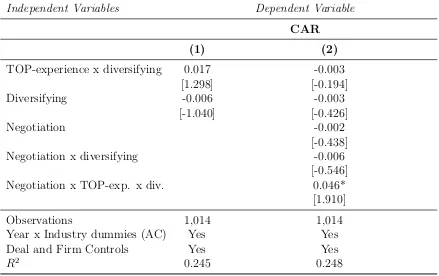
1.5.3 Auction vs. Bargaining . . . 42
1.6 Interpretation of the Findings . . . 43
1.6.1 Summary . . . 43
1.6.2 Ex-ante vs. Ex-post Effect . . . 43
1.7 Conclusion and Outlook . . . 44
A Appendix . . . 46
A.1 Tables . . . 46
A.2 Data . . . 59
A.3 Robustness . . . 61
A.4 Mechanism - Analytical Framework . . . 66
2 Boards of Banks 71 2.1 Introduction . . . 71
2.2 Related literature . . . 76
2.3 Data and Sample . . . 78
2.4 The Cross-Section of Board Independence and Board Experience . . . 82
2.4.1 Explaining Variation in Bank Board Structure: Countries ver-sus Firm Characteristics . . . 82
2.4.2 Estimating Country Effects . . . 86
2.4.3 Why do countries matter so much for bank board independence? 89 2.5 The Evolution of Board Structures . . . 93
2.5.1 Trends in Board Independence and Experience: The Impor-tance of Year Effects . . . 93
2.5.2 Changes in Bank Characteristics and Changes in Board Struc-ture . . . 94
2.6 Final remarks . . . 96
A Appendix . . . 97
A.1 Tables . . . 97
A.2 Figures . . . 105
3 The Labour Market for Executives 108 3.1 Introduction . . . 108
3.2 Literature Survey . . . 110
3.2.1 CEO Characteristics and Experience . . . 110
3.2.2 Turnover . . . 111
3.2.3 Careers . . . 111
3.3 Data . . . 112
3.3.1 Data Sources . . . 112
3.3.2 Construction of Variables . . . 113
3.4 CEO backgrounds and Turnover . . . 115
3.4.1 Companies . . . 115
3.4.2 CEO backgrounds . . . 116
3.4.3 CEO Turnover . . . 118
3.5.1 The Identification Problem . . . 124
3.5.2 Exogenous Shocks and Executive Careers . . . 125
3.6 Conclusion . . . 128
A Appendix . . . 130
A.1 Tables . . . 130
List of Figures
1 Time Trends in Board Characteristics - 2000-2008, full sample . . . . 105 2 Time Trends in Board Characteristics in Percentages- 2000-2008, full
List of Tables
1 Descriptive Statistics . . . 47
2 Experience in Target’s Industry - Effects on Diversification . . . 48
3 CEO Fixed Effects and General Cross-Industry Experience . . . 49
4 Merger Waves . . . 50
5 Probability of Experienced Merger by Appointment Date . . . 51
6 Merger Performance by Appointment Date . . . 52
7 Relatedness of the Industry . . . 53
8 Relevance of the Position . . . 54
9 Recency and Tenure . . . 55
10 Mechanism Results I: Premium . . . 56
11 Mechanism Results II: Synergies . . . 56
12 Informational Asymmetries . . . 57
13 Auction vs. Bargaining . . . 58
14 Definition of variables . . . 60
15 Conglomerates . . . 63
16 11 Days Event Window . . . 64
17 Diversifying Acquisitions . . . 64
18 Descriptive Statistics: Companies . . . 65
19 Number of Observations per Country over Time . . . 97
20 Summary Statistics . . . 98
21 Summary Statistics of Bank Board Characteristics in 2006 . . . 99
22 Regressions of Board Characteristics on Bank Characteristics and Country Dummies in 2006 . . . 99
23 Regressions of Board Characteristics on Bank Characteristics and Country Dummies in 2006, with Ownership Controls . . . 100
24 Bank Board Independence Gaps in 2006 . . . 101
25 Bank Board Experience Gaps in 2006 . . . 102
26 Regressions of Board Characteristics on Bank Characteristics and Country Characteristics . . . 103
27 Bank Fixed Effects Regressions of Board Characteristics on Bank Characteristics . . . 104
28 Fama-French 12 industries . . . 131
29 CEO Demographics . . . 132
30 Past Positions (Firms and Industries) . . . 133
31 Past Positions (Tenure) . . . 134
32 First position . . . 135
33 Turnovers across industries and time . . . 135
35 Tenure of CEOs (Internal Turnovers) . . . 137
36 Last positions of hired CEO (dataset) . . . 137
37 Last positions of hired CEO . . . 138
38 Industry ED changes after external turnover - Transition Matrix . . . 138
39 Industry ED changes after external turnover . . . 139
40 Fraction of inside industry hires . . . 139
41 Future Positions after CEO Turnover . . . 140
42 Forced vs. Voluntary Turnover . . . 141
43 Identification Concern . . . 142
44 Cohort Statistics . . . 142
45 Cohort Analysis: CEO Promotions . . . 143
Preface
This thesis comprises three independent chapters, spanning the range of my interests.
The first chapter deals with the industry-specific expertise of CEOs and how it affects corporate decision making and ultimately corporate performance. Analyzing diversifying mergers and acquisitions from 1990 to 2007, it shows that CEO charac-teristics matter for the bidders’ performance in takeovers. When the bidding CEO has experience in the target’s industry, it finds that the abnormal announcement returns are between two and three times higher than those generated by a CEO who is new to that industry. In dollar terms, this corresponds to a difference of more than $100 million on average. It provides evidence that this performance is mainly driven by an experienced CEO’s ability to capture a larger fraction of the surplus. Industry experts redistribute surplus in favor of their shareholders by negotiating better deals and by paying a lower premium. It also finds that industry expert CEOs select low surplus deals on average. This evidence is consistent with industry experts having superior negotiation ability.
The second chapter investigates the human capital of non-executive directors of banks around the world. It shows that country characteristics explain most of the cross-sectional variation in bank board independence. In contrast, country charac-teristics have little explanatory power for the fraction of outside bank directors with experience in the banking industry. Exploiting the time-series dimension of the sam-ple, it shows that changes in bank characteristics are not robustly associated with changes in board independence, while changes in board experience are positively re-lated to changes in bank size and negatively rere-lated to changes in performance. The evidence suggests that country-specific laws and regulations affect the composition of boards of banks mainly through requirements for director independence.
1
How do CEOs matter? The
Ef-fect of Industry Expertise on
Ac-quisition Returns.
1
1.1
Introduction
Many studies show that chief executive officers (CEOs) have an impact on corpo-rate policies and corpocorpo-rate value.2 However, we still know very little about how
CEOs create value. This paper provides new evidence of how CEOs influence firm performance. Our evidence comes from corporate takeovers. Employing a novel dataset on the career paths of CEOs, we first establish that, in takeovers, CEOs with previous work experience in the industry of the target outperform CEOs who are new to the target industry. We find that the bidders’ abnormal announcement returns are between two to three times larger if the CEOs come from the indus-try of the target. Second, analyzing the mechanism, we differentiate between the CEOs’ ability to create higher surplus and their ability to capture a larger fraction of the surplus for their shareholders in the bargaining and price setting process. We provide evidence that CEOs with experience in the target industry perform better mainly because they negotiate better acquisition prices. We also show that industry experts engage in low surplus acquisitions on average. This finding is consistent with CEOs rationally anticipating that they will secure a larger fraction of the surplus during negotiations with the target company.
Scholars in the business strategy literature have attached great importance distin-guishing betweenvalue creation andvalue capture (see for instance, Porter 1980 and Brandenburger 2002). We borrow this terminology and apply it to CEO activity. CEOs can create value by fostering innovation, providing training to employees or optimizing processes. They can also capture value through negotiation. For exam-ple, CEOs could negotiate with suppliers for better prices on input goods3, with
1The work in this chapter was carried out jointly with equal share by Claudia Custodio and
me.
2For instance, Bertrand and Schoar (2003) show that CEOs have different styles regarding
cor-porate policies. Graham, Li, and Qiu (2009) use manager-specific heterogeneity for explaining variation in executive pay. Adams, Almeida, and Ferreira (2005) as well as Bennedsen, Perez-Gonzalez, and Wolfenzon (2007) show that CEOs matter for corporate performance. Malmendier and Tate (2008), Kaplan, Klebanov, and Sorensen (2009) as well as Malmendier, Tate, and Yan (2010) show that CEO characteristics and experience are related to corporate decisions and per-formance.
labor4 for lower wages or with the (local) government for subsidies.5 Such actions do not necessarily create value overall but change its distribution in favor of the shareholders. Hence, both sets of activities might increase shareholder value. We provide evidence that value capture is an important component of shareholder value. Theoretical research has stressed the importance of bargaining and negotiation for economic outcomes (Williamson 1971, Myerson and Satterthwaite 1983). However, we have little evidence on the extent to which top decision makers such as CEOs can affect the bargaining outcomes. Our contribution is to show that experience in the target industry increases the CEO’s ability to capture value when bargaining with the target firm. Other things being equal, having a higher bargaining ability allows a CEO to secure a larger fraction of the surplus. Here, we measure bargaining ability directly by analyzing how surplus is split and what price is paid.
Mergers and acquisitions (M&As) provide a suitable setting for our study. First, takeovers typically represent the largest investments that companies will undertake. The market for corporate control is also significant from an economic point of view: U.S. firms spent more than $3.4 trillion on over 12,000 transactions over the last two decades6, which is about 6.6 percent of US stock market capitalization.7 Second, many empirical studies document that mergers create surplus. Most of this surplus seems to be captured by the target shareholders. Indeed, the announcement returns to the bidding shareholders are usually around zero on average or even slightly neg-ative.8 We find a significant amount of CEO-specific variation in merger outcomes.9
This finding suggests that the bargaining abilities of CEOs vary and that they have an effect on M&A outcomes.
Our analysis proceeds in three steps. First, we establish that industry-specific ex-perience allows CEOs to perform better in diversifying mergers and acquisitions. Second, we develop a theoretical model of two mechanisms - value creation and value capture - that could explain our findings. We show that our findings are con-sistent with the value capture mechanism by testing the model’s predictions directly, using offer premium data and proxies for the value that is created by the acquisition. Third, we show that CEO experience is particularly valuable in situations of high informational asymmetries. For identification, we exploit variation in the
industry-4Simintzi, Vig, and Volpin (2010) analyze labor bargaining power on firms’ choice of debt.
5Spiegel and Spulber (1994) analyze the price, investment strategy, and capital structure of
regulated firms where firms use debt and equity strategically.
6See Malmendier and Tate (2008).
7According to Wilshire Associates, the total U.S. market cap is approximately $15.35 trillion
(May 23, 2007).
8Betton, Eckbo, and Thorburn (2008) as well as Andrade, Mitchell, and Stafford (2001) provide
excellent summaries of the empirical findings.
9This is consistent with Ahern (2010) who shows that there is variation in merger outcomes
specific experience of the bidding CEOs. Over their lifetime, most CEOs work in different industries. This industry-specific experience may have an impact on how well they perform in M&As. For instance, industry experts might be better at run-ning the combined companies, or at negotiating with the target. The variation in industry-specific experience helps us in three ways. First, industry experience might affect both value creation and value capture. Second, since we observe the complete past experience profile of CEOs, we can differentiate between general cross-industry and industry-specific effects. Third, industry experience also varies within CEOs. This variation allows us to control for unobserved CEO heterogeneity, ruling out many alternative explanations.
First, we start by establishing a novel empirical finding: CEOs with prior work experience in the industry of the target perform significantly better in diversifying M&As. Using U.S. data on 4,844 announcements of acquisitions from 1990 to 2007, we find that the stock market reacts more favorably to diversifying mergers when the bidding CEO has prior work experience in the target industry. After controlling for firm and deal characteristics, as well as for time and industry fixed effects, we find that three-day abnormal announcement returns to the bidder are 1.3 percent-age points higher for CEOs with top manpercent-agement experience in the target industry. Given an average abnormal return of 0.5 percentage points for diversifying acqui-sitions and an average market value of about $8,000M, this effect is large in both relative and absolute dollar terms. There is indirect evidence that industry exper-tise might be important when buying (or investing into) a company. Professional expert networks such as GLG Research or innosquared match industry experts and corporate clients for mergers and acquisititions. These experts are used to do ”more objective diligence of specific acquisition targets. The expert network can quickly and confidentially assess the assumptions behind management teams’ presentations and investment bankers’ offering memoranda.”10 Moreover, Kaplan and Stromberg (2009, p.132) discuss the role on industry experts in provate equity. They argue that ”in addition to hiring dealmakers with financial engineering skills, private eq-uity firms now often hire professionals with operating backgrounds and an industry focus. For example, Lou Gerstner, the former chief executive officer of RJR and IBM is affiliated with Carlyle, while Jack Welch, the former chief executive officer of GE, is affiliated with Clayton Dubilier.” Bottazi et al. (2008) also stress the importance of industry experience in the context of venture capital.
A key concern might be that the measure of industry experience is correlated with omitted CEO heterogeneity that biases our findings. To address this concern we exploit the fact that a fraction of the CEOs in our sample engage in multiple acquisitions with (at least) one acquisition in an industry in which they have prior
work experience and (at least) one in an industry that is unknown to them. This allows us to include CEO fixed effects that help us identify the causal effect of indus-try experience on acquisition performance. We are also concerned about endogenous CEO-firm matching as CEOs and firms are not randomly assigned to each other. Exploiting merger waves and analyzing the timing of the acquisitions, we provide evidence that endogenous matching is not driving our results.
Second, we develop a simple theoretical model of takeovers. The purpose of the model is to derive testable predictions that allow us to get insights into the mech-anism through which industry-experience operates. We model a simple two-stage game where, in the first stage, a company gets a random draw of potential targets and decides to whom to make an offer. The surplus is split in the second stage. This framework allows us to model the effect of CEOs’ industry experience on company value through two different channels. On the one hand, industry experience might increase the value that is created in a merger. CEOs with experience may be better at integrating assets or at running the merged company. They may also be better at identifying high-surplus targets in the pre-merger stage. On the other hand, in-dustry experience might be advantageous in the bargaining process. For instance, industry insiders might possess information that allows them to estimate the true value of the target more accurately. Moreover, coming from the same industry might also be helpful for assessing the targets’ outside options and hence strengthening the bidding CEOs’ bargaining positions. Additionally, corporate culture is likely to be different in different industries (for example, in mining vs. in advertising) and that is why industry-specific experience may also affect negotiating styles. The model’s predictions on outcome variables for the two competing mechanisms allow us to dis-tinguish them empirically. Moreover, the model illustrates that the two mechanisms have different implications for the welfare. Beyond the direct effect of industry ex-perience on value creation or capture, there is also an indirect effect that has an impact on the composition of acquisitions observed in the economy.11 We refer to
this as the ”selection effect”. Using the model’s predictions, we show that industry experience helps CEOs negotiating better terms. Specifically, industry insiders pay a lower price for the target and get a larger fraction of the surplus. We directly show that industry experts pay a significantly lower premium for the target shareholders’ shares - both when measured as offer price premiums as well as final price premiums. We also find that the relative dollar gains of the target are lower if the bidding CEO comes from the target industry. When we look at the value created by the acquisi-tion, we do not find evidence that industry experts perform better. Instead, we find a weak negative effect. We use combined abnormal announcement returns to bidders
11Note that the ability of creating a higher surplus would change the composition of mergers as
and targets as a proxy for synergies. As abnormal returns reflect the expectations of the market, we also look at an ex-post measure of profitability: return-on-assets (ROA). In line with results on the combined announcement returns, we do not find that experienced CEOs perform better in terms of profitability as we find a negative effect. These findings suggest that industry experts do better when negotiating with the target, allowing them to secure a greater fraction of the surplus or to pay less. Moreover, bargaining also explains the – at first sight – counter-intuitive finding of a negative effect of industry experience on surplus creation. Having a stronger posi-tion in the bargaining stage directly affects the sharing rule of the surplus between bidder and target. In addition, it indirectly affects the composition of deals that are announced, and are therefore in our sample. In other words, the negative effect is likely not causal but due to selection. CEOs who anticipate securing a larger frac-tion of the surplus are willing to engage in acquisifrac-tions with a lower total surplus at first. Indeed, the returns to bidding shareholders increase -other things being equal-both in the surplus and in the fraction they can secure. CEOs therefore substitute higher surplus with higher bargaining power. The selection effect also shows that bargaining ability impacts the allocation of resources, like corporate control, within the economy.
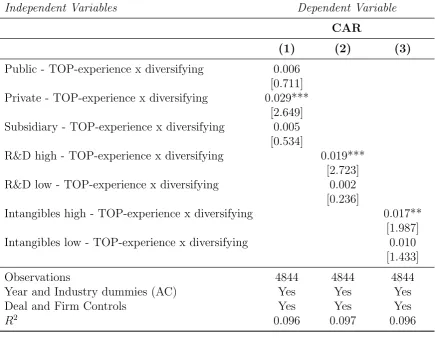
Third, in the last part of our analysis, we aim to provide further evidence for the bargaining channel by identifying situations or environments in which indus-try experience is likely to affect the bargaining power of CEOs. As suggested, one potential explanation for industry experience increasing bargaining ability is infor-mation based. Being an industry insider might help to better estimate the true value of the takeover which might strengthen the bargaining position of the bidder. Fol-lowing this intuition, we expect the value of being an industry insider to be higher in scenarios with greater informational asymmetries. We, first compare public and private targets. Private companies face less obligations to disclose information and consequently, information asymmetries are arguably higher between such companies and potential buyers. Exploiting the variation of interaction between CEO industry experience and the public status of the target, we find that experienced CEOs are able to generate about 2.9 percentage point higher abnormal returns if the target is a private company. This evidence supports our interpretation of experienced CEOs being better at bargaining. Moreover, we exploit heterogeneity across target indus-tries. Using different proxies for informational asymmetries at the industry level such as R&D intensive industries and industries with a high level of intangibles, we confirm our prior findings. Experience is particularly valuable in settings of high information asymmetries (1.7 percentage points to 1.9 percentage points higher).
investigate what CEOs do and how they add to shareholder value. We show that CEOs, and in particular CEO industry experience, matter for M&As. Moreover, we show that the industry experience helps bidding CEOs to capture value in the bargaining and price setting process. Our findings suggest that value capture is an important dimension of CEO activity. This finding has wider implications as the existing literature on CEOs either explicitly or implicitly assumes that CEOs create value (e.g. Gabaix and Landier 2008, Edmans and Gabaix 2011). We also contribute to the literature on CEO characteristics (e.g. Malmendier and Tate 2008, Kaplan, Klebanov, and Sorensen 2009, and Malmendier, Tate, and Yan 2010) by showing that CEOs differ in their ability to bargain and that this ability might depend on the CEO’s history. Second, we add to the literature on mergers and acquisitions by highlighting the importance of the bargaining process in general and CEOs’ bargaining ability in particular. Third, our results are complementary to results in empirical industrial organization literature on bargaining (e.g. Ho 2009 and Grennan 2010). Using a different and non-structural approach, we confirm the finding that parties differ in their bargaining abilities.
Our study is related to three strands of literature. First, we contribute to the literature on what CEOs do and how they generate shareholder value. Second, our findings are closely related to empirical research on the performance of M&As. Third, we contribute to the empirical literature that analyzes bargaining power.
char-acteristics of CEO candidates in LBO and VC transactions. Ang, de Jong, and Van der Poel (2008) as well as Huang (2010) show that CEOs are more likely to divest divisions they are less familiar with. Xuan (2009) analyzing the career paths across companies’ divisions and Malmendier, Tate, and Yan (2011) looking at Depression experience or military experience, show that past experience affects corporate deci-sions. Our findings are complementary. We show that industry-specific experience in general, and bargaining power in particular are important determinants for cor-porate performance and corcor-porate decision making. Our findings also speak to the current debate on general vs. specialist CEOs. Lazear (2002, 2004), Murphy and Zabojnik (2007), and Frydman (2007) document an increased importance of general skills. Cremers and Grinstein (2011), however, show that managerial talent pools are industry-specific, suggesting that industry-specific experience is important to firms. Industry-specific bargaining ability can be interpreted as one dimension of industry-specific skills. Our results are consistent with both views. We show that in-dustry experience affects corporate performance. However, we do not find evidence that industry experience creates higher value in acquisitions; it directly affects how the surplus is split between the bidder and the target.
A broader implication of our analysis is that CEO skills and characteristics affect the way resources like corporate control, are allocated in the economy. We show that CEO bargaining power affects the set of acquisitions that are implemented in the economy. Our findings suggest that selection itself is of interest, and that the way in which selection affects outcomes is important, even beyond interpreting correlations. This interpretation is consistent with results in related studies that document simi-lar effects for other CEO characteristics - though not explicitly stated. For instance, Bertrand and Schoar (2003) show that CEOs differ in their taste for diversifying ac-quisitions, and Malmendier and Tate (2008) show that overconfident CEOs engage in more acquisitions.
Second, we contribute to the empirical research on M&As. Our findings provide new insights into the determinants of acquisition success.12 (i) We show that CEOs
in general, and their bargaining abilities in particular, are key drivers of the suc-cess of M&As. This is consistent with Malmendier and Tate (2008) who provide evidence that overconfident CEOs do worse acquisitions. Aktas, de Bodt, Bollaert, and Roll (2010) also show that narcissism has an impact on many dimensions of the takeover process, such as performance, or who is initiating an acquisition. Yim (2009) shows that young CEOs are more likely to announce acquisitions and per-form worse. This might be due to lower quality of the acquisitions, also reflected in a lower likelihood of closing the deals. Our results might also provide a different
12See Andrade, Mitchell, and Stafford (2001) as well as Betton, Eckbo, and Thorburn (2010) for
explanation for Yim’s findings as on average young CEOs are less experienced than older ones. Our paper is also complementary to Ishii and Xuan (2010) who look at social ties between acquirers and targets. They find that if the boards of the bidder and the target are connected, decision making is poorer and lower shareholder value is created. In contrast, we find a positive effect of industry-specific experience. This suggests that we do not proxy for board connections with our measure. However, we are generally sympathetic to the idea that being connected or knowing the right people is an important dimension of a CEOs’ human capital. (ii) We show that the stage at which prices are determined and negotiation is carried out, is important for the performance of an acquisition. This is consistent with recent research on merger bidding by Betton, Eckbo, Thorburn (2009) as well as Aktas, de Bodt, and Roll (2010) who highlight the importance of the negotiation process. Pan, Baker, and Wurgler (2009) stress the existence of anchor points (a 52-week high) for the valuation of the target, emphasizing the importance of the price setting mechanism. Moreover, Ahern (2010) shows that there is significant variation in the division of takeover gains and that customer-supplier relations partly explain this division in vertical mergers. Our findings are consistent and complementary as first, we also find variation in the division of the gains and second, we show that this division is related to the bargaining ability of the bidding CEO.
Third, our study is related to a body of research mainly in empirical industrial organization that uses structural models in order to analyze how surplus is split and how prices are negotiated. Our question is most similar to Ho (2009) who shows that some types of hospitals are able to capture higher mark-ups when bargaining with health insurers. Grennan (2010) estimates bargaining abilities in the context of the medical devices industry. Our results are consistent with their findings in the sense that they also document that parties differ in their bargaining abilities. Our study is complementary from a methodological point of view. Ho and Grennan both use structural models for first estimating the surplus to share and then the bargaining abilities. We use a direct measure for the surplus created in the process of bargaining.
1.2
Data and Key Variables
We are interested in identifying the effect of CEOs’ industry experience on different outcome measures of M&As. Our key explanatory variable is therefore the industry experience profile of the bidding CEOs in relation to the industry of the target. Our dependent variables are either market measures for merger performance (abnormal announcement returns), real measures for the profitability, or the premium paid to the target.
1.2.1 CEO Data
We construct a manager-firm matched panel that allows us to observe a CEOs’ employment history. Our initial sample is the Executive Compensation database (COMPUSTAT ExecuComp) with over 2500 companies. The universe of firms covers the S&P 1500 from 1992 onwards, including companies that were once part of that index. For each firm-year, ExecuComp reports the identity of up to 9 executives and their positions, allowing us to identify the current CEO. We are interested in the employment history of this CEO. As ExecuComp keeps track of S&P 1500 companies and the highest paid executives only, we supplement the data with information from the BoardEx database. This database collects information on job history (including company roles and positions), age, and other activities (for instance social activities) of top executives and non-executives in the US and Europe, which allows us to track the complete work history of CEOs.
We merge the two datasets by CEO name, company, position/role and year, and construct a CEO-firm-year panel. Due to different spellings and abbreviations, we manually validate the entire panel. To construct measures of experience, we are interested in characteristics of the previous positions of the CEOs. These character-istics include the firms’ industries, the role, and the exact period of each position. To identify the firms’ industries, we match the list of CEOs’ past companies with different data sources that file information on their lines of business. We obtain information on quoted firms from COMPUSTAT and information on private firms from ICARUS.13
We construct our key explanatory variable of interest, the industry experience of a CEO, as follows: for a given deal, we identify the industries of the bidder and the target, as well as the identity of the CEO. In our analysis, we want to ensure that we separate the experience of the CEO and the business expertise of his company;
13Sometimes company names are spelled differently in the datasets or the company in the
that is, we want to make sure that an acquisition is really diversifying. Therefore, we use a very broad classification (Fama-French 12) in order to define a diversifying acquisition. We then compare the CEO’s previous industry experience with the in-dustry of the target. We set a dummy variable ExpT A (”experience in the target industry”) equal to 1 if the CEO has worked in at least one company in that indus-try. As the provision of segment level data varies across data sources, we restrict our analysis of the past positions to the primary industry of the company.14 Note
that this approach is conservative as, by using this broad classification, we might only add noise to our measure when classifying unrelated experience as relevant. We refine this broad measure of experience by taking the previous roles of the CEO into account. We define a measure of top management experience that is equal to 1 if the CEO worked in at least one company in the target’s industry as a top manager. Top management positions/roles include CEO, CFO, COO, Chairman, President, Division CEO, Division CFO, Division Chairman, Division COO, Division Presi-dent, Head of Division, Regional CEO, Regional CFO, and Regional President. We expect top experience to matter more, as non-top level experience might also include positions that are unrelated to a firm’s line of business (for example, being a web programmer in the automotive industry), or positions that do not allow the worker to obtain industry-specific skills or knowledge.
1.2.2 M&A Data
The M&A data come from the Thomson Financial SDC Platinum database. The initial sample contains all completed M&As in the US stock market over 1990 - 2008. A deal has to meet the following criteria to be included in our final sample:
• (Shares Acquired) We only include transactions in which the control is trans-ferred. Specifically, the share of the acquirer in the target firm has to be below 50 percent before the transaction and above 50 percent after it. Alternatively, the acquirer has to buy 50 percent of the shares outstanding during the merger process.
• (Absolute Transactions Size) Following Harford (2005) the transaction value of the merger has to be at least US$50M.
• (Region) Both the acquirer and the target firm are US corporations. Moreover, the acquirer is listed on the US stock exchanges. We exclude international (Item MATYPE IMA) and overseas mergers.
14For roles that were in consulting, we do not assign a particular industry as industry experience
• (Price and Accounting Data) The stock price and accounting data must be available in the Center for Research in Security Prices (CRSP) and in COM-PUSTAT in the year before the merger.
We classify a merger to be diversifying using a dummy variable if the acquirer and target differ in their Fama-French 12-Industries (FF12) classification. Using this broad classification ensures that industries of the two companies in diversifying mergers are unrelated.
1.2.3 Outcome Data
Our main measure of performance is the abnormal announcement returns to the bid-ders’ shareholders. We use the Fama-French 3-factor model as the return-generating process to estimate cumulative abnormal returns (CAR). We estimate the model over a 255-day estimation window ending twenty-one days prior to the announce-ment date, using the CRSP value-weighted index as our market proxy. In most specifications we report the CARs to the acquiring firm’s stock over a symmetric three-day window around the announcements. Moreover, we also analyze a longer event window (eleven days) considering potential information leakage. We obtain data on the offer price premium as well as on the final agreed price premium from SDC. The offer price premium is defined as the ratio of the price that is initially offered to the stock price of the target one day (or one week) before the announce-ment. We define the final price premiums accordingly. Note that the premiums are only available for publicly listed targets. Officer (2007) estimates premiums for unlisted targets by building portfolios of comparable acquisitions of publicly traded targets. As we are interested in the idiosyncratic component of the premium (the effect of the bidding CEO’s experience), we cannot apply this method here.
1.2.4 Control Variables
We supplement the data with various financial items from the COMPUSTAT database.15
Following Masulis, Wang, and Xie (2007), a transaction is defined to be a ”stock deal” with a dummy variable if the acquirer pays a positive fraction of the trans-action value with its stocks. If the transtrans-action is fully paid in cash we set the ”all cash” dummy equal to 1. Public target, private target and subsidiary target are dummies that classify the public status of the target company. In order to include an intercept we choose subsidiary targets as our base category in the regression analysis. We measure the relative size of acquirer and the target as the ratio of the deal value to the market capitalization of the acquirer.16 Finally, we measure the
age (in years) of CEOs at the announcement of the merger as well as their tenure in the current company (in years).
1.2.5 Summary Statistics
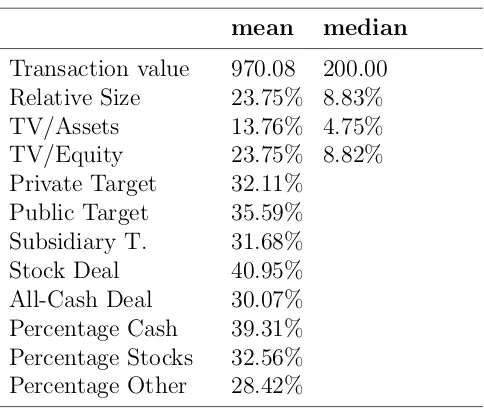
After combining the CEO-company panel with the deal sample, we obtain a final data sample of 4,844 M&As between 1990 and 2007. The takeovers are conducted by 1,854 different CEOs. Table 1 shows summary statistics. Panel A summarizes CEO statistics. We observe that most CEOs undertake multiple acquisitions. The average number of deals per CEO is 2.61, with a median of 2. We will later exploit this fact in order to exclude some alternative explanations by estimating CEO fixed effecs. The key variable in our analysis is industry experience. In our sample, the average CEO has worked for 2.61 different companies in a top management position before joining his current company (the bidder), on average. Analyzing the industry experience of CEOs, we find that a CEO worked in 1.67 different industries (using the Fama-French 12 classification) on average. The very large majority of CEOs in our sample is male (more than 99 percent) - that is why we take the liberty of using ”he” when referring to a CEO. The average age is 62 years (as of 2008) and the average tenure 13.8 years within the company.
Panel B presents descriptive statistics for implemented deals. The fraction of diversifying mergers remains quite stable over the years (about 75 percent non-diversifying and 25 percent non-diversifying). Panel C shows that out of all non-diversifying acquisitions, about 16.5 percent are conducted by CEOs who have previously worked in the industry of the target.17 We observe most of the companies buying other
companies multiple times (panel D).
Panel E presents summary statistics on deal specific characteristics. In most cases the relative size of the target is less than 9 percent of the acquirer’s size
15See data appendix for the definition of all variables.
16A large fraction of the targets is private and data on market value are not available.
17Considering all positions (not only top-management positions), about 35 percent of the CEOs
measured as market capitalization (on average about 24 percent). The fraction of the target’s public status (public, private, and subsidiary) is about even for these categories. About 40 percent of the bids are considered to be stock deals, that is, payments where some equity was used to pay off the target. About one third (30 percent) of the deals were exclusively paid in cash.
More detailed information on financial information on the buyer is provided in table 18 in the appendix.
1.3
CEO Industry Experience and Merger Performance
1.3.1 Identification Strategy
In our analysis, we compare diversifying acquisitions where the CEO has prior ex-perience in the industry of the target with diversifying acquisitions where a CEO is new to the industry of the target. We exploit variations in the industry-specific experience of bidding CEOs. Most CEOs in our sample work in more than one industry over their careers. A CEO’s industry-specific experience may impact his performance in M&As. For instance, industry experts might be better at running the combined companies, or negotiating with the target. We will discuss potential channels in detail in Section 1.4. The variation in industry-specific experience helps us in three ways. First, industry experience might affect both value creation and value capture in the merger process. Second, as we observe the full past experi-ence profile of the CEOs, we can differentiate between general cross-industry effects and industry-specific effects. Third, industry experience also varies within CEOs. This allows us to control for unobserved CEO heterogeneity and to rule out many alternative explanations.
As we only observe mergers that are announced, the estimated effect of CEO industry experience on merger performance could be due to selection. This means, that CEOs with experience might choose only ”good” targets for instance. Indeed, industry experience not only has a direct but also an indirect effect on the outcome of the acquisitions. These two effects are part of our analysis and explicitly integrated in our framework. In our analysis, we show that industry experience affects the composition of deals that are implemented.
1.3.2 Baseline Results. Do Industry Experts Perform Better?
Analyzing diversifying acquisitions by CEOs with and without top-level experience shows that experienced CEOs perform better on average (0.012 vs. 0.004) though the CARs are only weakly statistically different from each other (at the 10% level). Most of the control variables are not statistically distinguishable for the two groups. Exceptions are the performance measure, stock payment, the relative deal size, and the tenure of the CEO. Bidders with CEOs that are experienced in the target’s industry tend to have a lower profitability (0.291 vs. 0.359). They tend to use more stock payment (36.9% vs. 29.2%) and the targets are relatively larger (33.1% vs. 19.0%). In addition, the CEOs’ tenures in their current positions are shorter (5.85 years vs. 14.84 years).
We start our multivariate analysis by investigating whether industry experience helps CEOs perform better when diversifying. Specifically, we compare the average abnormal returns of diversifying acquisitions for CEOs with prior work experience in the industry of the target with the average abnormal returns of otherwise similar acquisitions where the CEO has no experience in the target industry. In order to assess the effect of CEOs’ industry experience, we estimate the following regression equation:
CARijk=α1+α2ExpT Aik∗divjk +α3divjk +α4Xjk +α5Yjk +α6Zijk+εijk, (1)
CARijk stands for the three-day cumulative abnormal returns18 of the merger
be-tween bidder j and target k conducted by CEO i. The dummy div is equal to 1 if the transaction is diversifying and ExpT A is the measure of experience in the target’s industry defined above. Note that by construction ExpT a is only defined for diversifying mergers. Therefore, we only include ExpT afor diversifying mergers in our regression equation by interacting it with the dummy for diversifying acqui-sitions. This also means that we cannot include the main effect of experience in our regression as it is perfectly collinear to the constant, the diversification dummy, and ExpT A.
The coefficient of interest is the interaction termα2 between diversifying mergers
and experience. If industry-specific experience in the target’s industry is beneficial for diversifying mergers, we expect the coefficient to be positive.
We retain non-diversifying acquisitions in our analysis as they help us estimate
18In table 16 in the appendix, we conduct a robustness check by using a larger event window of
the coefficients of the control variables.19 The variables Xjk, Yjk, Zijk used in cross
sectional merger analyses are deal, company, and CEO-related controls respectively. The set of controls Xjk includes the relative size of the acquirer and the target,
method of payment, as well as the public status of the target. Firm specific charac-teristics Yjk control for the size of the acquirer, Tobin’s Q, free cash flow, leverage,
and profitability. Since experience is correlated with age, we control for age, age squared, tenure, and tenure squared in the set of variables Zijk as in the empirical
literature on wages. Harford (2005) shows that mergers occur in waves and they are clustered within industries. Therefore, we include year, industry, and year-industry dummies in all of our specifications. Finally, we account for cross-sectional correla-tion of stock returns by allowing for clustering at the level of the announcement date.
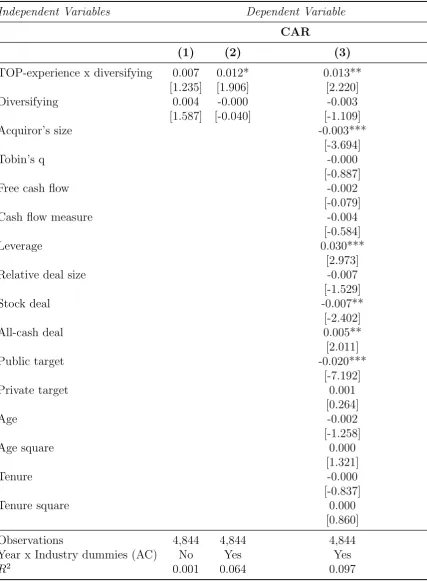
In column (1) of table 2, we estimate the model without any controls. The dif-ference between acquisitions with and without top-management experience in the target industry is 0.7 percentage points.20 In column (2) we include only
year-industry dummies but no further controls. Having a CEO with top management experience in the target’s industry is associated with 1.2 percentage points higher abnormal returns on average compared to a CEO without experience in the target’s industry. The coefficient on the experience-diversifying interacted term is significant at a 10% level. The coefficient on diversifying is small and not different from zero. In column (3) we repeat this exercise by including bidder, deal, and CEO controls. The effect of experience is slightly higher (1.3 percentage points) and significant at a 5% level. Given an average abnormal return of 0.5 percentage points for diversi-fying acquisitions and an average market value of about $8,000M, this effect is large both in relative and in absolute terms. The controls in the cross-sectional analysis have expected signs but most of them are not significantly different from zero (con-firming earlier studies). The three consistently significant controls are the type of payment, size, leverage, and having a publicly listed target. Paying with equity and being large are, on average, viewed less favorably by the market. These results are consistent with previous empirical studies.21
1.3.3 Identification Concern I: CEO Unobserved Heterogeneity
In our analysis, we are interested in the causal effect of industry experience on merger performance. Ideally, we would like to compare outcomes for the same CEO, once
19In table 17 in the appendix, we conduct a robustness check by using a sub-sample of only
diversifying acquisitions. In section A.3, we also estimate the models for specialized firms and conglomerates separately in order to address misclassification concerns.
20The coefficient is of similar size as an unreported univariate comparison of only diversifying
acquisitions with a difference of 0.8 percentage points.
21Shleifer and Vishny (2003) build a model where overvalued bidders lock in real assets which
with and once without experience in the target industry. Our closest counterfactual is to observe the same CEO undertaking two acquisitions: one acquisition without experience in the target industry, and one with experience. This allows us to include CEO fixed effects controlling for some unobserved CEO heterogeneity and hence, to rule out many alternatives. A key concern might be that the measure of industry experience is correlated with omitted CEO characteristics that bias our findings. For instance, only CEOs who are less talented might buy companies in industries in which they never worked before. Moreover, having industry experience in the target industry when diversifying means that the CEO has worked in at least one other sector before. Hence, we might capture the effect of general skills. By this we understand skills that are transferable across different industries, but not specific to the industry of the target. Both alternative hypotheses would imply that we might just capture a spurious effect in our analysis or estimate a biased effect.
CEO Fixed Effects An advantage of our setting is that we are able to observe within-CEO variation. This means, we observe CEOs acquiring multiple firms, some in industries in which they have prior work experience in, and others from industries that are unknown to them. This allows us to include manager fixed effects that help identify the causal effect of industry experience on acquisition performance. Indeed, the fixed effects control for unobserved but fixed heterogeneity across CEOs such as general ability, generic managerial skills or the talent for diversifying acquisitions. In order to absorb unobserved CEO characteristics that might be correlated with experience we estimate a model where CEO-specific effects fi measure unobserved
CEO heterogeneity:
CARijk =α1+α2ExpT Aik∗divjk +α3divjk +α4Xjk +α5Yjk+α6Zijk+fi+εijk, (2)
Note that the CEO related variables inZijk, namely, age at the day of the
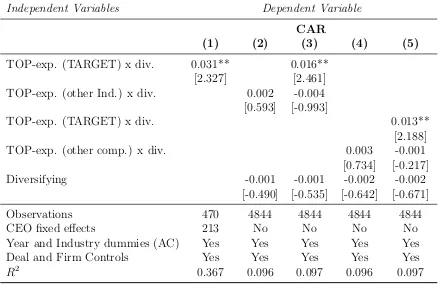
announce-ment and tenure in the current firm, are time-varying and therefore not dropped in this estimation. We restrict our sample to CEOs who conducted at least two diversifying acquisitions. Further, we require that the CEOs have experience in the target industry in one of the acquisitions, but not in the other. Applying these filters narrows the sample to 470 acquisitions conducted by 213 different CEOs. Table 3 column(1) presents the results of our regression analysis.
management skills, and the ability to run diversifying companies as discussed in the motivation for this fixed effect specification. Moreover, it also addresses the concern that CEOs with experience in the industry of the target have a higher general tal-ent for diversifying acquisitions or better financial experience that allows them to perform better. Running the fixed effects regression is the closest substitute for an experimental setting and therefore, it is the test that gives us the highest confidence. A drawback of this test is that it restricts the sample size as it allows us to run the test only on a subsample.
However, in the following paragraphs we aim to exclude some of the competing explanations exploiting the complete sample. We test for general management skills (across industries and firms).
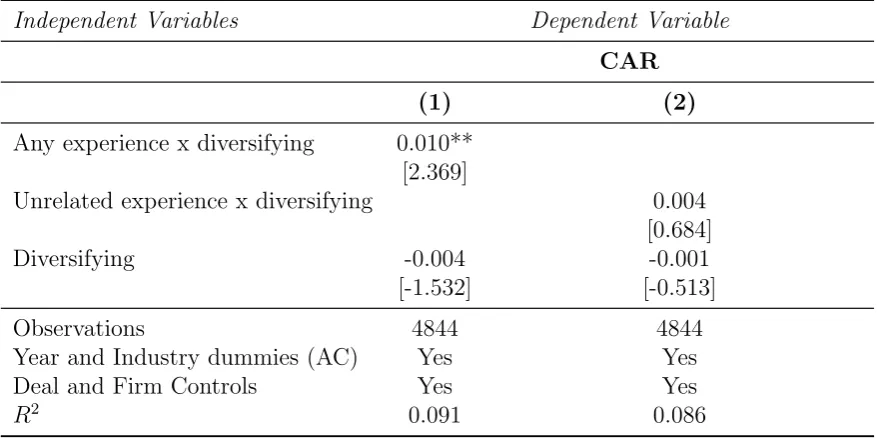
General Cross-Industry Skills The positive effect of experience in the target industry may merely be capturing the effect of having work experience in multiple industries. Being experienced in the target industry in a diversifying merger neces-sarily means that the CEO has worked in at least two different industries including the current one. Skills beneficial for successfully diversifying might be therefore related to general cross-industry skills and not necessarily to the industry of the target. In order to discriminate between the benefits of experience related to the target industry and general experience in different industries, we estimate two al-ternative models. First, we analyze whether experience in any other industry has a similar positive impact on abnormal returns for acquiring shareholders. Second, we include experience in any other industry to our original regression as a further con-trol (equation 2) and check whether the effects of experience in the target’s industry persist. Table 3 presents the results.
Column (2) shows the sole effect of having top-level experience in multiple indus-tries when undergoing a diversifying merger. The effect is small in absolute terms and it is statistically not distinguishable from zero. This means that work experi-ence in industries unrelated to the target industry does not explain our results. In column (3) we add the variable top experience in the target industry as a further control. The effect of having experience in the target industry on the acquisition performance is still large and consistent with the previous results. The average abnormal return of a CEO with experience in the target’s industry compared to a CEO who is generally experienced in different industries is 1.6 percentage points. The effect is significant at a 5% level. Overall, these results suggest that it is expe-rience in the particular industry of the target that matters for the performance and not more general cross-industry experience.
for other companies in the past generates abnormal returns for the acquirer. Column (5) shows the results for top experience in the target’s industry as a further control. Similarly to our main specification, industry experience increases cumulative ab-normal returns around the merger announcement by approximately 1.3 percentage points. The coefficients are precisely estimated (at a 5% level) and are similar to the effects when controlling for general industry experience.
1.3.4 Identification Concern II: Endogenous CEO-company Matching CEOs and companies are not matched randomly. Instead, CEOs are chosen by the board of directors. Industry experience might be a criterion for the appointment of a particular CEO. A concern is that endogenous matching could potentially ex-plain our results or at least bias the findings. In the following, we provide several pieces of evidence supporting the view that endogenous matching isnot driving our findings. The main arguments can be summarized as follows: First, we exploit the fact that mergers occur in waves clustered by industry. We use merger waves as quasi-exogenous events triggering acquisitions (see table 4). Second, under the se-lection hypothesis one would expect the transaction to occur shortly following the CEO’s appointment. We do not find that the likelihood of a CEO with experience in the target industry doing an acquisition is higher for more recently hired CEOs (see table 5). We also find no evidence that recently hired CEOs outperform CEOs who have been in a company for longer (see table 6).
within a wave (2.4 vs. 1.1 percentage points) suggesting that experience is more valuable in unexpected situations.
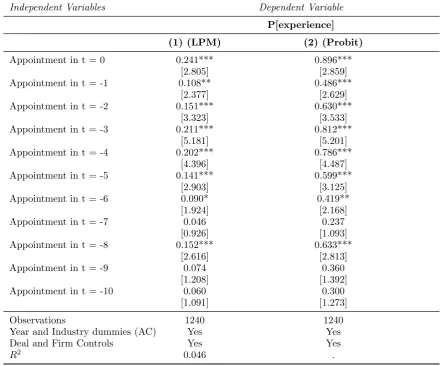
Timing and Acquisitions with Experience If a company hires an experienced CEO to conduct an acquisition, we would expect an announcement about the intent to acquire shortly after the appointment. We therefore estimate the probability of making a diversified acquisition and having an experienced CEO as a function of CEO tenure. The dependent variable is a dummy that is equal to 1 if the CEO has previous experience in the target’s industry. Our covariates consist of a set of dummy variables for different years of the CEO’s tenure. If companies appoint experienced CEOs in order to execute an acquisition for them we would expect to observe higher coefficients on the dummies for recent hires. We use OLS as well as probit estimation. Column (1) and (2) of table 5 present the results using OLS and probit respectively. There is no monotonic relationship between the probability of observing an experienced acquisition and the appointment of the experienced CEO. These findings support the view that industry-experience in connection with acquisitions considerations play a minor role when appointing a CEO.
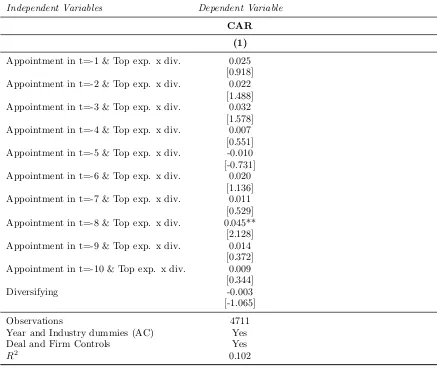
Timing and Returns As a further robustness check we analyze returns directly. If selection is driving the results we would expect the positive abnormal returns to be generated by recently appointed CEOs. We therefore interact the experience measure with dummies reflecting the relative year of the appointment. Table 6 shows that there is no monotonic relationship between the appointment of experienced CEOs and abnormal returns. When precisely estimated, the returns are positive and at similar levels (between 2.7 and 3.9 percentage points for CEOs appointed 3, 6, or 8 years before the acquisition). The coefficients on other years are not statistically different from zero. Overall, the findings suggest that selection cannot explain the positive returns of experienced CEOs, reinforcing the view that industry experience is generating them.
1.3.5 Alternative Specifications
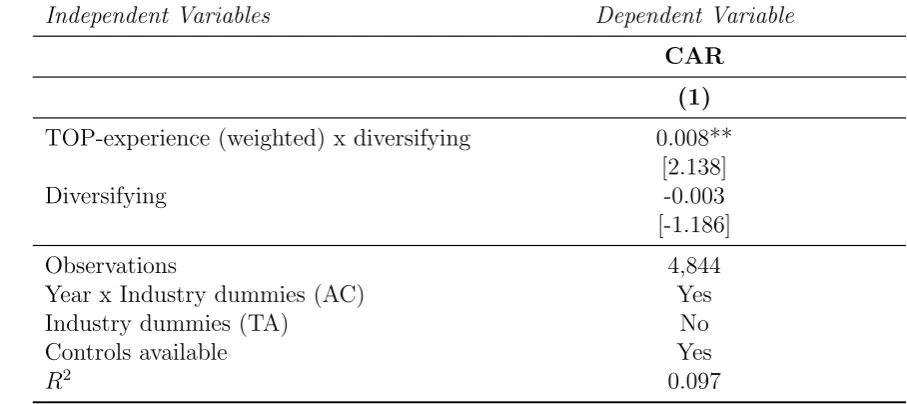
Relatedness of the Industry In our baseline setting, we use the same level of industry classification (Fama French 12) to define diversifying acquisitions and in-dustry experience of the bidding CEOs. While we would like to have a very broad measure to classify a diversifying takeover, we actually want to have a precise mea-sure for experience. However, using the broad classification on experience delivers a fraction about 16 percent of the deals where the CEOs are experienced. The nar-rower we are when defining experience, the smaller the number of observations of acquisitions conducted by industry expert CEOs. Consequently, we do not observe enough variation anymore. We therefore define a weighted measure of experience as follows:
ExpT A(weigthed) =
4, for CEO has experience in the same FF48 industry 3, for CEO has experience in the same FF30 industry 2, for CEO has experience in the same FF17 industry 1, for CEO has experience in the same FF12 industry 0, for CEO has no experience in the target industry
(3)
The results of the corresponding regression are reported in table 7. In line with our previous results, the coefficient is positive (0.8%) and significant. The magnitudes are similar to our previous findings and suggest an effect of 0.8-3.2 percentage points depending on the narrowness of experience.
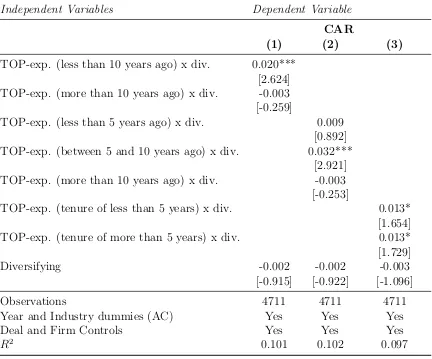
Recent Experience and Tenure As industries adapt to technology or changes in the market, it is interesting to analyze how the value of experience changes with the recentness of experience. Therefore, we look at two alternative measures of expe-rience that incorporate a time component. We consider an expeexpe-rience to be ’recent’ if it was gained in the last 10 years before the merger was announced, and to be ’old’ otherwise. Second, we refine this measure by sub-classifying the recent experience into experience gained within the last 5 years and experience gained between 6 and 10 years before the announcement of the acquisition. Table 9 reports the results. Columns (1) and (2) show the effect of top-level experience for the two alterna-tive measures. The results suggest that experience diminishes over time and only rather recently gained experience helps to perform better when diversifying. The first specification shows very strong and statistically significant effects of having experience (2.0 percentage points) in the 10 years before the acquisition. The coeffi-cient of old experience is small and not distinguishable from zero. The finer measure of recentness in specification (2) yields similar results. Recent experience matters more; the impact peaks for experience gained between 5 and 10 years before the acquisition. However, the two coefficients on recent experience are not statistically distinguishable from each other. In column (3) we are interested in whether having more experience (in terms of tenure) matters. We split the experience dummy by tenure, distinguishing between tenure of less than 5 years and more than 5 years. The estimated coefficient are exactly of the same magnitude (1.3 percentage points) suggesting that there is no linear effect in tenure.
1.4
Value Capture or Value Creation?
1.4.1 Potential Channels
When buying a company, relevant industry experience of a CEO may add value in different ways.
1. Target selection: In the selection process of a potential target, an experienced CEO might have a superior overview of the market environment including competitors, customers, and suppliers. Moreover, industry-specific knowledge of financial statements, being important inputs to the decision making process, might be important.
is. Here, the level of experience might affect the bargaining power of both parties.
3. Integration: Experience might be beneficial in the post-deal stage when in-tegrating and running the two companies. This is particularly true if the organizational design and the operations are specific to each of the industries. Knowledge of both industries could facilitate coordination of the two orga-nizational designs. Moreover, experience in the target’s industry might be beneficial for running the company in case management is partly industry-specific.
We formalize these mechanisms through which industry-specific experience po-tentially operates. We differentiate between two main channels: value creation and value capture. We aim to derive testable hypotheses that allow us to discriminate between the different mechanisms of how industry experts add value for their share-holders. We employ a simple two-stage game theoretic framework that captures the main steps of the acquisition process: the choice of the target and the bargaining between bidder and target. We nest the two channels through which experience might operate within our model. We show that these channels lead to different pre-dictions for the effect of industry experience on announcement returns to different shareholders (bidder and bidder-target combined), and the size of the premium paid. In our regression analysis, we look at the impact of CEO industry experience on the performance of acquisitions. We compare the returns (that go to different share-holders) of acquisitions where the CEOs has experience in the target industry with those of acquisitions where the CEO is new to the target industry. In other words, we look at the difference between the averages of acquisitions with and without CEO experience in the target industry. In the analysis, using the analytical framework, we aim to reproduce the regression setting. Therefore, we define the differences in the returns between industry expert CEOs and CEOs that are new to the target industry to the acquiring (AC) shareholders ∆AC, to the target (TA) shareholders
∆T A, and to both acquiring plus target shareholders (AC+TA) as ∆AC+T A.
Theorem 1 Consider that industry experience is operating through V and β, i.e. V and β are increasing functions of ExpT A.
1. ∆AC is positive and increasing in the value creation ability V and in the value
capturing ability β of an industry expert CEO.
2. ∆T Ais increasing (decreasing) in the value creation abilityV (value capturing
ability β) of an industry expert CEO.
3. ∆AC+T A is increasing (decreasing) in the value creation ability (value
Intuition First, both value creation and value capture ability are beneficial for the bidding company. However, depending on the draws from the two groups, it might be still beneficial to go for a company that does not come from the set of expertise of the CEO. This means that we observe both, acquisitions with and without CEO experience in the target industry.
Second, both value capture and value creation have non-negative effects for the acquiring shareholders. This is trivially given as in both cases the bidding CEO is maximizing shareholder value of the acquirer.
Third, the negative effect of experience on the average surplus is non-causal but due to the selection of a different set of deals. Having a stronger position in the bargaining stage directly affects the sharing rule of the surplus between bidder and target, but it also indirectly affects the composition of deals that are announced, and which are therefore in our sample. CEOs who anticipate securing a higher fraction of the surplus are willing to engage in acquisitions with a lower total surplus. Indeed, the returns to bidding shareholders increase -other things equal- both in the surplus and in the fraction they can secure. The CEOs therefore substitute higher surplus with higher bargaining power. Value creation also leads to a different set of implemented acquisitions. However, as the CEO adds value, there is no negative net-effect.
1.4.2 Premiums Paid to the Target and Relative Gains
About one third of the targets in our sample are publicly listed companies, allowing us to analyze the mechanism by looking directly at the premium paid. The offer premium is defined as the premium of the offer price over the share price of the target one day or one week before the announcement. In most cases the final price corresponds to the offer price but in some cases the price has to be adjusted. We therefore also look at the final price premium which is the premium of the final paid price.22
Table 10 shows the results. The effect of experience on the premiums is negative. In all of our four specifications we observe a significant negative effect of experience on the premium between 7.4 percent and 9.7 percent. This effect is large as the average premiums are between 34 percent and 39 percent. This means that a CEO with industry experience is paying a lower premium compared to a CEO who is new to the industry. This finding is consistent with allowing industry experts to extract a larger fraction of the surplus. Part of this effect might be also attributed to experienced CEOs undergoing lower value acquisitions on average.
Last, we analyze directly the relative gain of the target versus the acquirer for
22Note that Officer (2007) proxies for the premium/discount for unlisted targets by
each dollar of the market value. We would like to compare the percentages of the total dollar returns of an experienced CEO with a CEO who is new to the industry. As announcement returns can be negative, we follow Ahern (2010) and construct the measure as follows. We calculate the difference in dollar gains between the target and the bidder, normalized by the sum of the acquirer’s and target’s market cap 50 trading days before the announcement date. Column (3) shows that the target’s relative gains relative to the acquirer decrease with the industry experience of the bidding CEO. This finding is consistent with the hypothesis that experienced CEOs bargain better and secure a larger fraction of the surplus for their shareholders than CEOs who are new to the target industry.
1.4.3 Combined Announcement Returns
1.4.4 Accounting Performance
As announcement returns only reflect expectations of the market we also look at an ex-post measure of performance. The ratio of earnings before interest and taxes to total assets (EBIT/assets) is used as a measure of operating performance (ROA). Since the ROA may be affected by industry-wide factors, it is industry-adjusted by subtracting the median value of the same measure for all firms in the same primary Fama-French F12 industry as the bidding firm. We then estimate an AR(1) model using the post-merger industry-adjusted three-year average ROA as the left-hand-side variable, with the pre-merger corresponding measure as the right-hand-left-hand-side variable. The AR(1) model takes into account the possibility that pre-merger op-erating performance may predict post-merger opop-erating performance. The residual from the above regression is our measure of the abnormal change in ROA (∆ROA). As reported in table 11 in column (3) we find the effect of experience on the prof-itability to be (weakly) negative. The negative coefficient is of a similar magnitude as the coefficient on the combined returns though not significant again.
1.4.5 Interpretation
The analytical framework shows that returns to both bidder and bidder plus target are increasing in the value creation ability. However, this is no longer true for the value capturing ability. While the returns to the bidder are increasing in β, the combined returns are decreasing in the bargaining power. We conclude that the existence of value capturing is necessary for explaining our findings.
In general, the effects of value capture and value creation are not mutually ex-clusive. It is possible that experienced CEOs increase surplus and, at the same time, negotiate better terms. However, by analyzing the combined return to bidder and target, as well as accounting performance, we do not find evidence that experi-enced CEOs are better at creating surplus. Instead, the average effects are negative. Moreover, we find that experienced CEOs pay a smaller premium.
Bargaining also provides a rationale for the - at first sight - counter-intuitive finding of the negative effect of industry experience on the proxies for the surplus creation. Anticipating securing a higher fraction of the surplus makes an experienced CEO to engage in acquisitions with a lower total surplus at first.
1.5
Heterogenous Effects
In this section, we would like to provide further supportive evidence for the bar-gaining channel. We do so by identifying situations or environments where industry experience is more likely to affect the bargaining power of CEOs but less their abil-ity to create value. Exploiting heterogeneabil-ity along that dimension we then analyze whether industry experience is indeed more valuable in these situations. As already suggested, one potential reason why industry experience increases bargaining abil-ity is based on information. Being an industry ins