An Exploratory Study of Primary Pupils’
Experiences of Reading to Dogs
Hazel Davison
A thesis submitted in partial fulfilment of the requirements of the University of East
London for the degree of Professional Doctorate in Educational Psychology
ii
Abstract
Reading to Dogs is an animal-assisted intervention (AAI) programme used to support primary school children’s reading. AAI is an emerging area with an extremely limited evidence base. The purpose of this research was to explore current practice within primary schools in the local authority regarding Reading to Dogs, and to generate a theoretical explanation of Reading to Dogs.
A sequential, two phase, mixed methods design was employed from a
pragmatic stance. The first phase consisted of structured telephone interviews with nineteen primary schools from the local authority to audit current practice. Anonymised reading scores for 89 children to have participated in the
programme were also obtained from schools. The second phase employed a classic grounded theory methodology. Data from the first phase, together with ten individual interviews, was analysed using the constant comparative method to generate a substantive theory of Reading to Dogs.
The audit established that a small minority of primary schools within the local authority currently run Reading to Dogs with children displaying emotional needs. Children’s baseline and post-measure reading ages increased by an average of five months following their participation in Reading to Dogs, with an average ratio gain of two months’ reading age for each month of participation.
iii
Acknowledgements
A number of people have contributed to my ability to complete this thesis and I am extremely fortunate to be surrounded by such wonderful people.
I am immensely grateful to all of my friends and family, for tolerating my
absence at various social events throughout this research, for their meticulous proofreading, and for their ongoing love and support, without which I would have been utterly overwhelmed long ago.
I would like also like to take this opportunity to express my particular thanks to Dr Mark Fox, my university supervisor, for his wisdom and enduring patience. I would like to thank my EP colleagues, both from my UEL cohort and in the Educational Psychology Service where I work, for helping me to retain a sense of perspective.
iv
Table of Contents
1. Introduction ... 1
1.1 Primary School Children’s Reading ... 1
1.1.1 National Strategies... 1
1.1.2 Researching Effective Interventions ... 4
1.1.3 Attitudes to Reading ... 5
1.1.4 Creative Solutions ... 7
1.2 Animal-Assisted Interventions ... 7
1.2.1 Terminology ... 7
1.2.2 Review of Relevant Literature ... 9
1.2.3 Historical Overview of Animal Assisted Interventions ... 9
1.2.4 Animals in Therapeutic Settings ... 11
1.2.5 Animal Assisted Interventions in Educational Contexts ... 13
1.2.6 Animal Assisted Interventions and Reading ... 18
1.2.7 Reading Education Assistance Dogs (R.E.A.D.) ... 25
1.2.8 R.E.A.D. in the Local Authority ... 25
1.2.9 Summary ... 26
1.3 Theoretical Frameworks for Reading to Dogs ... 27
1.4 The Present Research ... 28
1.4.1 Research Rationale ... 288
1.4.2 Researcher’s Position ... 30
1.4.3 Research Aims ... 31
2. Methodology ... 32
2.1 Purpose of Research ... 32
2.1.1 Research Aims ... 33
v
2.2.1 Positivist Paradigm ... 34
2.2.2 Constructionist Paradigm ... 35
2.2.3 Critical Realist Paradigm ... 36
2.2.4 Pragmatism... 37
2.3 Research Design ... 40
2.3.1 Grounded Theory Methodology... 42
2.4 Phase 1: Audit of current practice ... 46
2.4.1 Phase 1: Research Design ... 46
2.4.2 Phase 1: Participants ... 46
2.4.3 Phase 1: Data Collection ... 47
2.4.4 Phase 1: Data Analysis ... 48
2.4.5 Phase 1: Ethical Considerations ... 49
2.4.5.1 Phase 1: Informed Consent ... 49
2.4.5.2 Phase 1: Withdrawal ... 50
2.4.5.3 Phase 1: Anonymity & Confidentiality ... 50
2.5 Phase 2: Grounded Theory Induction ... 52
2.5.1. Phase 2: Research Design ... 52
2.5.2 Phase 2: Interview Participants ... 53
2.5.3 Phase 2: Interview Procedure ... 53
2.5.4 Phase 2: Data Collection & Analysis ... 55
2.5.4.1 Open Coding... 56
2.5.4.2 Theoretical Sampling ... 58
2.5.4.3 Memo Writing ... 60
2.5.4.4 Integrating Categories ... 61
2.5.4.5 Writing the Theory ... 62
2.5.5 Phase 2: Ethical Issues ... 68
2.5.5.1 Phase 2: Informed Consent ... 68
2.5.5.2 Phase 2: Withdrawal ... 68
vi
3. Findings: Phase 1 Structured Telephone Audit Interviews ... 71
3.1 Background to the Programme ... 72
3.1.1 Summary ... 78
3.2 Operation of the Programme ... 78
3.2.1 Summary ... 87
3.3 Behaviours in Programme Sessions ... 87
3.3.1 Child Led Behaviours ... 88
3.3.2 Adult Led Behaviours ... 91
3.3.3 Dog Related Behaviours ... 93
3.3.4 Summary ... 96
3.4 Impact of the Programme ... 96
3.4.1 Summary ... 103
4. Findings: Phase 2 Theory of Playful Reading ... 105
4.1 Playful Reading ... 106
4.1.1 Developmental Stages of Reading ... 106
4.1.2 Reading Levels ... 107
4.1.3 Reading as a Chore ... 108
4.1.4 Novelty ... 109
4.1.5 Reframing reading as playful ... 110
4.2 Child’s Best Friend ... 112
4.2.1 Emotional Connection ... 113
4.2.2 Human-Animal Bond ... 115
4.2.3 Power Balance ... 116
4.2.4 Animal Magnets ... 117
4.3 Happy Capital ... 118
4.3.1 Reciprocal Soothing ... 119
4.3.2 Positive Experiences ... 122
4.4 Genuine Listening ... 124
vii
4.4.2 Non-Judgemental ... 126
4.4.3 Qualified Dogs ... 127
4.5 Real Reading ... 130
4.5.1 Making Progress ... 130
4.5.2 Motivation ... 131
4.6 Summary ... 133
5. Discussion ... 136
5.1 Commentary on Findings ... 136
5.1.1 Phase 1: Structured Telephone Audit Interview Findings ... 136
5.1.1.2 Scale of Reading to Dogs in the Local Authority ... 136
5.1.1.2 Reading to Dogs Sessions ... 137
5.1.1.3 Targeting Emotional Aspects of Reading ... 138
5.1.1.4 Reading Ages ... 139
5.1.2 Phase 2: Theory of Playful Reading ... 140
5.1.2.1 Fit ... 141
5.1.2.2 Work ... 143
5.1.2.3 Relevance ... 145
5.1.2.4 Modifiability ... 147
5.1.3 Summary of Commentary on Findings ... 149
5.2 Implications of Research ... 150
5.2.1 Implications for Research Area ... 150
5.2.1.1 Reading to Dogs within the UK ... 150
5.2.1.2 Relationships with Reading Dogs ... 151
5.2.1.4 Animals in AAI ... 152
5.2.2 Implications for Practice ... 153
5.2.2.1 Formalising Reading ... 153
5.2.2.2 Educational Psychologists’ Practice ... 154
5.2.3 Dissemination of Research Findings ... 156
viii
5.2.3.2 Educational Psychologists ... 157
5.2.3.3 Authors, Researchers and Others Interested in AAI ... 157
5.3 Reflections on Research ... 159
5.3.1 Researcher Position & Power ... 159
5.3.2 Challenges of Research ... 161
5.4 Conclusions ... 164
References ... 166
Appendices ... 179
Appendix 1: Search criteria used in structured literature review ... 179
Appendix 2: Email inviting schools to participate ... 180
Appendix 3: Research Information Sheet ... 181
Appendix 4: Structured interview schedule ... 183
Appendix 5: Email requesting tracking data ... 187
Appendix 6: Example spreadsheet for school tracking data ... 189
Appendix 7: Email requesting interview participants ... 190
Appendix 8: Participant invitation letter ... 191
Appendix 9: Consent form ... 192
Appendix 10: Example interview transcript – Adam ... 193
Appendix 11: Example Annotated Transcript - Adam ... 205
ix
List of Figures
Figure 2.3: Graphical representation of sequence and weighting of research ... 40
Figure 2.4.1: Graphical representation of sequence and weighting of phase 1 research elements ... 46
Figure 2.5.1: Graphical representation of sequence and weighting of phase 2 research elements ... 52
Figure 1.5.4.5a: Sorting memos related to Playful Reading (core category) ... 63
Figure 2.5.4.5b: Sorting memos related to Child's Best Friend (subcategory) ... 64
Figure 3.5.4.5c: Sorting memos related to Happy Capital (subcategory) ... 65
Figure 4.5.4.5d: Sorting memos related to Genuine Listening (subcategory)... 66
Figure 5.5.4.5e: Sorting memos related to Real Reading (subcategory) ... 67
Figure 3.1a: Graph depicting school responses to question 4 in ranked order ... 72
Figure 3.1b: Graph depicting school responses to question 6 ... 74
Figure 3.1c: Graph depicting school responses to question 7 ... 75
Figure 3.1d: Graph depicting school responses to question 9 ... 76
Figure 3.1e: Graph depicting school responses to question 1 in ranked order ... 77
Figure 3.2a: Graph depicting school responses to question 8 in ranked order ... 79
Figure 3.2b: Scattergram depicting correlation between children’s chronological age and baseline reading age (months) ... 81
Figure 3.2c: Histogram showing frequency of differences in chronological ages and reading ages in 6 month intervals ... 82
Figure 3.2d: Graph depicting school responses to question 10 in ranked order ... 83
Figure 3.2e: Matrix depicting school responses to question 11 ... 84
x
Figure 3.2g: Graph depicting school responses to question 14 ... 86
Figure 3.3: Categorisation of reported behaviours ... 88
Figure 3.3.1a: Graph depicting total school responses for child led behaviours during a typical session, presented in ranked order ... 89
Figure 3.3.1b: Graph depicting total reported child led behaviours at different time points in a session ... 90
Figure 3.3.1c: Total school responses for child led behaviours at different time points in a session ... 90
Figure 3.3.2a: Graph depicting total school responses for adult led behaviours during a typical session, presented in ranked order ... 91
Figure 3.3.2b: Graph depicting total reported adult led behaviours at different time points in a session ... 92
Figure 3.3.2c: Total school responses for adult led behaviours at different time points in a session ... 93
Figure 3.3.3a: Graph depicting total responses for dog related behaviours included in a typical session, presented in ranked order ... 94
Figure 3.3.3b: Graph depicting total reported dog related behaviours at different time points in a session ... 95
Figure 3.3.3c: Total school responses for dog related behaviours at different time points in a session ... 95
Figure 3.4a: Graph depicting school responses to question 2 in ranked order ... 97
Figure 3.4b: Graph depicting school responses to question 5 in ranked order ... 98
Figure 3.4c: Descriptive statistics for baseline and post-measure reading ages .. 100
Figure 3.4d: Frequency of ratio gain in reading age ... 101
Figure 3.4e: Histogram showing frequency of ratio gains in reading ages ... 102
1
1. Introduction
1.1 Primary School Children’s Reading
Recent decades have seen increasing numbers of Government initiatives designed to raise primary school children’s attainment in literacy, with a particular focus on reading.
At the end of Key Stage 2, children are expected to achieve National
Curriculum level 4 or above in reading. The present research is situated within a large, rural authority area comprising almost 600 schools. In 2014, over fifteen thousand children were eligible for the Key Stage 2 National Curriculum assessments in this authority area. Eighty-nine percent of these children attained level 4 or above in reading, the same percentage as the national average for England (Department for Education, 2014).
These statistics indicate that, in this authority area alone, over one and a half thousand children were leaving primary school without attaining the required standard for reading.
1.1.1 National Strategies
2
develop children’s reading skills, teaching phonological skills and awareness in Key Stage 1 and moving more toward contextual and grammatical cues in Key Stage 2 (Department for Education and Skills, 2006).
The recommendations and guidance of the NLS sparked a rise in attainments at Key Stage 2 and by 2000 75% of children were obtaining level 4 in English, with 83% attaining level 4 in reading (Department for Education, 2014). This progress was not however sustained and national assessment results
plateaued for four years, with 17% of children persistently achieving below level 4 in reading.
A review of research related to the NLS (Beard, 2000) asserted that whilst 80% of children could increase their attainment through high quality teaching, as described in the NLS, a further 18% would need targeted support and the remaining 2% would likely need additional and specialised support to develop their reading. The review also recognised that in order to be effective in raising children’s literacy attainment, schools need to be informed of best practice and how to implement it, adding that the most effective interventions were adapted from established, existing programmes rather than locally developed, bespoke schemes (Beard, 2000).
The 2006 Rose Review subsequently reviewed the teaching of reading and its findings emphasised the significant role of a systematic approach to phonics in teaching children to read (Rose, 2006). Although the teaching of phonics was included in the NLS, the Rose Review cited reports from Her Majesty’s
3
schools required more information about how best to embed phonics across their teaching practice.
The Every Child a Reader (ECaR) programme was introduced in 2005 with the aim of providing reading support and interventions to 30,000 children each year until 2011 (Department for Children, Schools and Families, 2009). ECaR described a layered approach to reading interventions, focussing initially on whole class quality teaching (Wave 1), then small group interventions to accelerate children’s progress in line with their peers (Wave 2), finally to more individualised, intensive reading interventions (Wave 3). The ECaR programme recommended a number of evidence based reading interventions for Wave 2, based on a range of phonics approaches and explicit teaching of reading strategies. Reading Recovery was promoted as the main Wave 3 intervention of ECaR (Tanner, et al., 2011).
Reading Recovery is an early intervention programme, designed to support children who, at the start of their school education, are struggling to learn to read through individual, intensive sessions with a trained Reading Recovery teacher (Tanner, et al., 2011). Introduced to the UK in 1990, government
funding for Reading Recovery training between 1992 and 1995 saw widespread adoption of the scheme however this lapsed until the funding was reinstated in 2005 as part of ECaR (Brooks, 2007). By the end of 2010, there were over 2,250 accredited Reading Recover teachers in the UK (Department for Education, 2011).
4
phonetic decoding skills used in reading. Solity and Vousden (2009) argue teaching should focus on explicit instruction of the phonic skills most useful to children in learning to read i.e. the most generalisable skills (rather than those which emerge first) presented in a range of genuine contexts (i.e. ‘real’ books instead of preconceived text extracts and reading scheme books).
Solity has published a number of comprehensive research projects investigating the benefits of applying instructional psychology to teaching reading, such as Early Reading Research (Solity, Deavers, Kerfoot, Crane, & Cannon, 1999) and the application of the simplicity principle (Vousden, Ellefson, Solity, & Chater, 2011). Despite the evidence to support these assertions, it is unclear whether these research findings have impacted on classroom practice or the extent to which schools have implemented the recommended instructional psychology principles.
1.1.2 Researching Effective Interventions
In 2007 the National Foundation for Educational Research commissioned a review of the effectiveness of literacy interventions currently in use throughout the UK (Brooks, 2007). The report outlined 41 intervention schemes aimed at targeting reading at primary school level and analysed the evidence base for each, to establish their effectiveness and to inform practice. Brooks noted the influence of the Rose Review in approaches to teaching reading, as
demonstrated by the substantial increase in phonics-based interventions in comparison to a previous review in 2002 (Brooks, 2002).
The majority of interventions designed to target reading focussed on a
5
Brooks concluded that the majority of phonological schemes were effective, particularly when incorporated into a broader, language-rich curriculum. In addition, he emphasised the importance of training and ongoing support for partnership readers in order to appropriately manage children’s reading
difficulties, while commenting that children using ICT-based schemes needed to be carefully supervised to ensure they accessed material effectively.
In 2013, the Dyslexia-SpLD Trust commissioned another review (Brooks, 2013) which acknowledged at least 80 currently available literacy intervention
schemes. To keep the review manageable, Brooks applied more stringent inclusion criteria (e.g. the scheme must be currently available and shown to have an effect size of at least 0.5). The resulting report reviewed 32
interventions in detail with Brooks commenting that “very little of the new evidence in this fourth edition has led me to revise the conclusions reached in
the third edition; nor has the dropping of some evidence from that edition” (Brooks, 2013, p. 13).
1.1.3 Attitudes to Reading
The national strategies have predominantly focussed on the mechanics of reading, explicitly teaching phonemic decoding skills and similar reading strategies, however they gave little consideration of the emotional aspects of reading. Reading aloud is acknowledged to be a stressful activity, with research findings demonstrating increases in children’s blood pressure and heart rate when reading at school (Thomas, et al., 1984).
6
support the development of children’s reading (Lawrence, 1988). Lawrence completed a series of research projects, combining self-esteem interventions with reading interventions, which yielded promising results suggesting his ideas had some substance.
In his review of the research, Brooks noted that the benefits of combining
reading and self-esteem interventions had not been substantially explored since Lawrence’s original studies in the 1970’s, commenting:
“Even though no further comparable studies seem to have been done for over 20 years, working on self-esteem and reading in parallel would seem to have definite potential”
(Brooks, 2007, p.27)
The Progress in International Reading Literacy Study (PIRLS) (Twist, Sizmur, Bartlett, & Lynn, 2012) is an international review of children’s reading
achievement which explores reading attainment and attitudes to reading among Key Stage 2 children in a number of countries. Nearly four thousand children from the UK participated in the 2011 PIRLS.
The main findings of the 2011 PIRLS were that England had a very broad range of reading achievement, with some children scoring extremely high on
assessments, and also a greater proportion of low scores than other high attaining countries (Twist, Sizmur, Bartlett, & Lynn, 2012). In addition, 10% of children rated themselves as ‘not confident’ in reading, whilst 20% responded they ‘do not like reading’. Negative attitudes toward reading such as these were also correlated with lower attainment in reading.
7
likely to read above their age-expected level than peers who did not enjoy reading.
1.1.4 Creative Solutions
Despite the repeated national initiatives, as described above, which addressed both whole class teaching practice and more targeted interventions, national assessments of reading at Key Stage 2 in 2014 found 11% of children were still not attaining level 4.
Few of these national initiatives have addressed the emotional aspects of reading, despite research which shows significant numbers of children who report not enjoying reading (Clark, 2014) and lack confidence in their abilities (Twist, Sizmur, Bartlett, & Lynn, 2012).
In an effort to meet these emotional needs and support children in developing their reading abilities, schools are looking to increasingly creative ways to raise attainment. One such alternative approach is through animal-assisted
interventions.
1.2 Animal-Assisted Interventions 1.2.1 Terminology
Animal-assisted interventions (AAI) deliberately involve the use of animals in a number of activities for a range of recreational, therapeutic and assistive purposes.
8
a wide range of intervention programmes, not all of which are therapeutic (Kruger & Serpell, 2010).
Animal Assisted Interventions International (AAII), a non-profit organisation specialising in animal-assisted interventions in professional healthcare and social service settings, published the following definitions of AAI in an attempt to create a more standardised use of terminology:
Animal-assisted therapy (AAT): An AAT intervention is formally goal-directed and designed to promote improvement in physical, social, emotional and/or cognitive functioning of the person(s) involved and in which a specially trained animal-handler team is an integral part of the treatment process.
Animal-assisted education (AAE): An AAE intervention is formally goal-directed and designed to promote improvement in cognitive functioning of the person(s) involved and in which a specially trained
animal-handler team is an integral part of the educational process.
Animal-assisted activity (AAA): An AAA intervention is less
goal-directed as specific objectives may not be planned. These interventions are more spontaneous, often no notes are taken nor records kept.
(Animal Assisted Intervention International, 2010)
Assistance animals (e.g. guide dogs, hearing dogs) are excluded from the definitions of AAI. The Equality Act 2010 (Great Britain, 2010) provides the following definition of an assistance dog:
“Assistance dog” means—
(a) a dog which has been trained to guide a blind person;
(b) a dog which has been trained to assist a deaf person;
(c) a dog which has been trained by a prescribed charity to assist a disabled person who has a disability that consists of epilepsy or otherwise affects the person's mobility, manual dexterity, physical co-ordination or ability to lift, carry or otherwise move everyday objects;
(d) a dog of a prescribed category which has been trained to assist a disabled person who has a disability (other than one falling within paragraph (c)) of a prescribed kind.
9 1.2.2 Review of Relevant Literature
The present research is concerned with the use of AAI to support the
development of children’s reading. A systematic review of published literature in this area conducted in January 2014, using the search terms “child”, “read” and “animal”, returned 168 results from peer-reviewed journals. An
examination of these results identified only a single published research paper and two anecdotal articles relevant to this topic. Full details of the search criteria are provided in Appendix 1 to this thesis.
A subsequent hand search of other literature in the wider area of AAI identified further relevant research papers, with additional research found by examining cited references in these articles.
It is interesting to note that while there is very limited published research into the use of AAI to support reading, five doctoral theses have been completed in this area, two in the last five years. Most of this unpublished work focuses on international students with learning disabilities and emotional needs.
As AAI is an emerging area of research with such a limited evidence base in regard to children’s reading, rather than the typical literature review, a narrative overview of key thinking and publications in the wider area of AAI is presented here. A brief critical overview of each doctoral thesis is also included, with an expanded discussion of more relevant papers.
1.2.3 Historical Overview of Animal Assisted Interventions
10
For several centuries vulnerable individuals, particularly children and those with mental health difficulties, have been encouraged to interact with animals
(Parshall, 2003). In 1699 philosopher John Locke advocated children look after small animals to foster a sense of responsibility and tenderness toward others (Serpell, 2010). In the eighteenth century psychiatric inpatients at the York Retreat were encouraged to care for small domestic animals as it was believed this would elicit social and benevolent feelings (Levinson, 1997).
Since the nineteenth century, the Bethel institution in Germany has
incorporated horse-riding, a working farm and various small companion animals into therapeutic support for inpatients experiencing a range of mental and physical difficulties (Serpell, 2010). A report by British Charity Commissioners in the 1830s recommended a number of small animals and birds be introduced to both the men and women’s wards at Bethlem Hospital in order to create a less punitive, oppressive atmosphere (Serpell, 2010). In 1860 Florence Nightingale’s notes on nursing included a note that medical patients benefited from the companionship of a small animal (Beck & Katcher, 2003).
In 1944-45 at a Red Cross rehabilitation centre for soldiers in New York, dogs were introduced primarily as a recreational support however many residents reportedly experienced therapeutic benefits from caring for the dogs. This resulted in widespread dog adoption amongst the soldiers and dog training sessions becoming incorporated into the centre’s rehabilitation programme (Levinson, 1997).
In recent years researchers have investigated physical responses to
11
ended, with a significantly greater decrease seen for children receiving AAT than a comparison visit (Tsai, Friedmann, & Thomas, 2010).
A similar research project (Kaminski, Pellino, & Wish, 2002) also completed with hospitalised children found, however, that heart rates were increased after attending an AAT group as compared to a play therapy group. The authors explain the higher heart rate may be due to the children’s excitement, as although heart rate was not monitored during the session, heart rates were higher both before and after in AAT group, suggesting anticipatory excitement. Kaminski et al. (2002) also noted that a ‘stressful event’ was typically introduced in other research which found relationships between decreased heart rate and animals. In Tsai et al.’s (2010) study however there was no stressor for heart rate to respond to, suggesting that the experience of AAT can be beneficial for heart rate and blood pressure even when children are not experiencing stress as a response to a specific event.
1.2.4 Animals in Therapeutic Settings
In 1953 Boris Levinson, an American Child Psychotherapist, discovered the unplanned presence of his pet dog Jingles encouraged a previously reluctant child to engage in conversation (Levinson, 1997). Levinson continued to
deliberately include his dog in future psychotherapy sessions which he reported facilitated the development of several client relationships and supported
children to speak more openly during therapy sessions.
When Levinson shared his experiences at the American Psychological
12
psychological or therapeutic sessions (Levinson, 1997). These experiences suggest that the deliberate incorporation of animals into therapeutic contexts was more widespread in practice than might be thought, given the lack of reference to the therapeutic benefits of animals in psychological literature at the time.
Levinson wrote widely on the subject of ‘pet therapy’, referring to his dog as a ‘co-therapist’ and citing numerous psychological benefits of animals both as pets and therapeutic aids (Levinson, 1997). Much of Levinson’s writing was reflective or anecdotal in nature, and lacked scientific rigour. In addition, as the animal involved was Levinson’s own companion animal (pet), it is likely his perception of these benefits may have been biased. Nonetheless, Levinson is widely credited as the founder of modern animal-assisted interventions (AAI), as his work revived interest in the field and led to the development of multiple AAI programmes and related research.
Other researchers began to investigate the potential benefits of animals in therapeutic settings and of companion animals (i.e. pets).
By 1986 there was sufficient interest in research into AAI and human-animal interactions that the peer-reviewed academic journal Anthrozoös was launched, dedicated to publishing research in human-animal interactions. The formation of the International Society for Anthrozoology followed in 1999, a worldwide organisation supporting the scientific and academic study of human-animal interactions.
The field of AAI remained a marginal topic for many decades, however it is gaining recognition in some professional realms. In 2011 the American
13
2011). The publication of this book from the APA indicates that research into AAI and human-animal interactions is gaining recognition within the field of psychology.
An increasing number of AAI programmes are practiced throughout the UK, predominantly through non-profit and charitable organisations such as Pet Partners, the Society for Companion Animal Studies and Intermountain Therapy Animals (Society for Companion Animal Studies, 2010).
These include: animal visitation schemes to care homes for the elderly (The Mayhew Animal Home, 2014), augmented social support for children with autism (Dogs for the Disabled, 2010), residential rehabilitation programmes for young offenders (Paws for Progress, 2014) and even equine-facilitated
corporate networking opportunities (HorseSense, 2011).
Overall, media coverage of AAI is very positive, portraying AAI as beneficial if somewhat unconventional (Fine and Beck, 2010). The increasing use of AAI in the UK has been met with media interest in newspapers and bulletins (e.g. BBC News, 2010; Yeadon, 2011), television documentaries (e.g. Horsepower with Martin Clunes, 2010; BBC Horizon: Secret life of dogs, 2010; The wonder of dogs, 2013) and professional publications (e.g. Priestly, 2011; Wells, 2011). Recently AAI programmes in educational settings, especially those involving children reading to dogs, have been of particular media interest (e.g. Ward, 2010).
1.2.5 Animal Assisted Interventions in Educational Contexts
14
(Liptak, 2005), children (Serpell, 1999) and individuals with autism (Pavlides, 2008). Many animal-assisted education (AAE) programmes have targeted similar populations (Anderson and Olson, 2006), although not always within a traditional classroom environment (Ewing et al., 2007).
In the UK, Limond (1998) investigated the effect of animal-assisted activities (AAA) on the behaviour of children with special educational needs (SEN) who were attending specialist provision for severe learning disabilities. She carried out a series of small scale research projects.
Limond established that the involvement of a live dog during activities was superior to a stuffed toy dog in drawing children’s attention and prompted an increase in the quality of these children’s interactions (i.e. more appropriate communicative responses) although the overall number of interactions did not increase. She replicated these results among a group of children and young adults with severe and profound needs in the Czech Republic, suggesting the effect of the dog’s presence was not culturally specific.
One of her research projects demonstrated that, during an obstacle course, a dog increased enthusiasm and motivation in high cognitive ability children with SEN (experiencing physical disabilities but without learning disabilities),
however this effect was only noted when the tasks directly involved the dog, suggesting the dog was not seen as a reward for good performance.
15
In addition, Limond explored the impact of a dog on children’s behaviour during educational tasks, comparing groups of children with severe learning disability and either high or low cognitive ability. The involvement of a dog in writing and maths tasks encouraged cooperative behaviours and evoked a greater number of appropriate physical responses to adult questions among SEN children with high cognitive ability, while increased involvement of the dog correlated to a greater impact on behaviour.
Limond concluded that AAA appear to be beneficial to children with a range of SEN. The findings indicate individual’s needs resulted in a range of responses and any intervention should therefore be carefully planned and adapted to reflect the requirements of specific populations. Specifically, children with higher levels of cognitive ability and adaptability appeared to experience the greatest benefits from working with a dog. Limond also acknowledged the role of interactions between the dog, child and therapist in influencing the impact of the dog on children’s behaviour.
The inclusion of a dog in educational activities provided a positive focus for attention and activities among children with SEN, although this focus was prompted by adults (Limond, 1998). In Limond’s study the number of communicative instances initiated by children overall was not affected by involving the dog, however the dog did prompt initiations from the children about and toward the dog. Contrastingly, a smaller scale research project (Esteves & Stokes, 2008) found the presence of a dog increased the number of both verbal and nonverbal positive behaviours among developmentally disabled children.
16
Pre-school children’s performance following instructions for motor tasks was improved when a dog modelled the task first, even in comparison to a human modelling the same task (Gee, Sherlock, Bennett, & Harris, 2009). However when tasks were performed in tandem, rather than modelling or competing, the children followed instructions best with a human or stuffed toy dog companion. The researchers suggest that copying would be harder alongside the real dog as dog’s behaviours can be unpredictable. This finding somewhat undermines their claim that this research demonstrates that dogs act as a salient stimulus, gaining children’s attention.
In a simple memory task, pre-school children needed fewer instructional
prompts when in the presence of a familiar dog than when a toy dog or familiar human was present (Gee, Crist, & Carr, 2010), suggesting the children
attended better to the task when the dog was present. These results were replicated with the same children after a gap of a few months, with fewer cues needed for the children to attend to the task or give a response when working with the real dog. The researchers deliberately selected a very simple object recognition task, easily achievable for all participants, in order that difficulty level did not affect children’s adherence to the task. It is possible that the presence of a dog during a more challenging task might have served to distract the children.
17
researchers found children chose fewer ‘irrelevant’ pictures in the presence of a real dog, there is a clear subjective element to this task and it is possible the children made connections unknown to the researchers e.g. picture colours, similar sounding names, preference for chosen picture.
None of the studies involved a sample population greater than 12 children, and approximately half of participants in each research project were identified as having severe or moderate needs with regard to language, social skills or learning. Generalising findings from such small-scale research projects, involving very young children, many of whom were known to have Special Educational Needs, to the wider school population is therefore questionable. Lieber (2002) completed a multiple case study of two children with emotional behavioural difficulties, examining the impact of AAT on the children’s
behaviour and emotional states in an unpublished doctoral thesis. Interviews were completed with the children, their parents and school staff following the AAT intervention. Behaviour rating checklists were also completed by adults as pre- and post- measures.
The results of these case studies were mixed, finding little change in the children’s emotional states however during interviews the children commented on their relationship with the therapy dog (Lieber, 2002). Staff with a pastoral role (e.g. counsellor, special education teacher) and parents each identified several positive changes in the children’s behaviour including improvements in peer relationships, communication with others and overall behaviour. In
contrast, class teachers did not report the AAT as having a significant impact on the children’s behaviour.
Somervill et al. (2009) measured the physiological response of 17
18
were recorded at 3 five-minute intervals when interacting with a dog and without the presence of the dog. A significant increase in blood pressure was shown both during and after handling the dog. In contrast, heart rate significantly decreased after holding the dog. Somervill et al. (2009) suggest increased blood pressure indicates the dog was experienced as a positive stimulus, rather than negative or stressful, whilst the decrease in heart rate is suggested as indicative of the child’s orientation toward this new stimulus, i.e. the dog. As fifteen of the children had previously or currently owned a dog, the authors think it unlikely the observed effects were due to novelty, however interacting with a live dog during school hours is a relatively novel event for most children. 1.2.6 Animal Assisted Interventions and Reading
Intermountain Therapy Animals (ITA) is one of many organisations which promote the use of AAI, aiming to “enhance quality of life through the human-animal bond” (Intermountain Therapy Animals, n.d.). In 1999 ITA extended the principles of AAT to children’s reading and launched Reading Education
Assistance Dogs (R.E.A.D.), an AAT programme in which children practice reading to a dog. R.E.A.D. was the first AAI of this type, creating a programme which used AAT dogs in a reading intervention.
On their website, ITA claim that children can become nervous when speaking or reading aloud to others and attribute stress-buffering properties to the presence of the dog during R.E.A.D. (Intermountain Therapy Animals, n.d.). There are research findings to support this assertion.
19
an adult when an unfamiliar dog was present and absent. Whilst reading, children’s blood pressure and heart rate increased, suggesting this was indeed a stressful task.
As children read, the presence of the dog reduced their heart rate and blood pressure. Furthermore, the same children’s resting measures of blood pressure and heart rate were lower when the dog was present. Friedmann et al. (1983) concluded that the dog’s presence mediated the stressful experience of reading for children and modified their perception of the adult as less threatening.
AAE reading programmes are themselves a relatively recent phenomenon and there is a significant lack of research into this new area. While an increasing number of articles in educational magazines (e.g. Friesen, 2013; Shaw, 2013; Lane & Zavada, 2013) have enthusiastically advocated AAE reading
programmes, claiming a range of benefits and citing experiential ‘evidence’, few are based on systematic or methodical research or include any real data:
An article by Newlin (2003) cited increases of two grade levels in reading for low achieving children paired with a reading dog, however it was unclear what constituted a grade level and no information was provided as to how this was measured nor was any data included in the article. Similarly, Bueche (2003) reported children participating in R.E.A.D. gained between two and four grade levels over a 13 month period although no further details were reported.
In a more comprehensive article, including an overview of reading research and how AAE programmes might fit with such findings, Jalongo (2005) outlined the results from an ITA study of ten children who participated in R.E.A.D.
20
described as significant, Jalongo (2005) neglected to state the amount of increase.
Articles such as these are repeatedly cited by AAI enthusiasts as evidence for the efficacy of animal-assisted reading programmes however such claims are misleading due to the lack of data, overreliance on anecdotal testimonies and the brevity of these reports. Fortunately, a handful of papers are now emerging, employing robust research approaches to examine the involvement of animals in children’s reading.
An American study compared children’s scores for reading and behaviour before and after the introduction of a class therapy dog with which children read and interacted in multiple ways (Booten, 2011). No significant difference was found in the children’s pre and post scores, nor was there a significant
difference when scores were compared to a control group.
In a doctoral thesis research project, a summary of which was subsequently published (Bassette & Taber-Doughty, 2013), Bassette compared the effect of a reading intervention with and without the presence of a dog on four students, aged 10-13 years, experiencing emotional and behavioural difficulties
(Bassette, 2011). All four participants experienced increases in measures of their reading accuracy, fluency and comprehension and some were able to maintain these improvements for some weeks after the intervention. The presence of the dog was not found to significantly impact on reading scores however there was marginally less variance in participant scores when reading in the presence of the dog.
21
family pets (for the three participants with pet dogs), seen in all of the students. Three of the four students reported they preferred reading with the dog present to reading without the dog (the fourth student reportedly enjoyed both
conditions equally), and all four indicated their desire to continue reading with the dog after the completion of the intervention.
At the start of the intervention, one of the three students was a little hesitant about reading with the dog however he became more comfortable throughout the intervention and could be seen to enjoy stroking the dog and feeding her treats. This student was the youngest participant by two years and was also the only participant not to have a pet dog at home, perhaps explaining his initial uncertainty.
Bassette (2011) acknowledges the small scale of the research, together with the difference in environment for the reading conditions and the unaccredited status of the dog as limitations.
22
As a humane educator, Kaymen was professionally involved in persuading children and adults to invest in the natural world. While openly acknowledging her initial scepticism about the use of AAI to support children’s reading, Kaymen (2005) details how observing a child engaging in reading to a dog substantially altered her views. As her decision to research the AAI programme immediately followed this persuasive experience, it could be suggested that Kaymen
approached this research predisposed to discover positive views from those involved.
An unpublished thesis (Griess, 2010) examined the impact of reading with a therapy dog, as compared to reading with the researcher, on the reading
progress of three primary-aged children with learning disabilities. In a repeated measures design, children spent two weeks reading in each condition for a total of thirteen weeks. Reading progress was assessed following each session in both conditions.
Griess (2010) initially used the Informal Reading Inventory (an informal
diagnostic reading assessment) to measure children’s reading comprehension, which involves increasingly complex reading passages, however this was felt to mask the progress made by children in their reading ability. The children’s learning disabilities were also reported to impact on their ability to respond appropriately to comprehension questions, resulting in erratic performance. As a consequence, Griess used the amount of time children were engaged in reading in each condition to assess their progress.
Following the intervention, the children were asked to recall their experiences and comment on each reading condition. Although several positive comments were made by the children, relating to their enjoyment of reading with the
23
that her dual role (of reading adult and researcher) caused some confusion for the children in distinguishing reading sessions, likely due to their learning disabilities.
While statistically significant increases were found in the time children spent reading with the dog, compared to with the adult, Griess (2010) acknowledges this restricted measure of reading progress as a further limitation of the study. In another doctoral thesis (Paradise, 2007) compared the reading performance of 117 American primary school children who were either assigned to a reading intervention with a reading therapy dog (C.A.R.E. To Read) or received
individual reading instruction without a therapy dog. The Canine Assisted Reading Education (C.A.R.E. To Read) programme is a Florida based reading intervention using trained therapy dogs.
Three aspects of children’s reading comprehension performance were
measured before and after receiving the appropriate reading intervention: their ability to describe, identify and explain; their ability to apply, predict and
summarise; and their ability to analyse and infer.
Both groups of participants demonstrated an increase in their reading skills with regard to describing, identifying and explaining a text, although the mean
scores for children who had read with a therapy dog were higher in this skillset. In addition the skills of applying, predicting and summarising, as well as
24
In school measures of reading level, all children in the research made significant progress, likely a reflection of their regular teaching input. It is however interesting to note that the majority of children who participated in the C.A.R.E. programme also made significantly greater progress through school reading levels than children who received reading instruction without a dog. By the end of their participation in the C.A.R.E. programme, almost all children were at the reading level expected for their age group.
Paradise (2007) also collected data in relation to other academic behaviours, such as attendance and attitude to reading, through teacher questionnaires, in order to investigate the impact of the C.A.R.E. To Read programme on other aspects of children’s behaviour and attitudes. Teacher responses indicated positive changes in attitudes toward reading, school work and homework, as well as a positive impact on children’s self-esteem and confidence.
Paradise’s research found that children who participated in an AAI intervention, namely the C.A.R.E. To Read programme, made significant improvements in their reading skills and progressed to age-expected levels of reading in school. These children also experienced increased confidence, engagement, motivation and attitude to schoolwork following their participation in the programme.
25
1.2.7 Reading Education Assistance Dogs (R.E.A.D.)
R.E.A.D. was introduced by Intermountain Therapy Animals (ITA) in 1999 as a library based intervention in Salk Lake City, Utah. Schemes are now run in both libraries and schools by over 3,500 teams throughout the United States, Canada and Europe (Intermountain Therapy Animals, n.d.). In a library context R.E.A.D. is an informal activity in which children can spontaneously choose to participate, matching the description of AAA.
In school settings, R.E.A.D. fits the classification of AAT as children work toward specific goals with adults documenting and recording progress. ITA emphasise the importance of an individual environment where children can develop their reading skills without criticism from peers. A typical R.E.A.D. session is described as approximately 30 minutes, with the child greeting and getting to know the dog, then reading to the dog, ending with some informal play and possibly a treat for the dog. The adult dog handler is encouraged to use the dog as a tool for asking the child about what they have read e.g. ‘can you tell Jimmy what that means?’ (Intermountain Therapy Animals, n.d.).
R.E.A.D. was introduced to the UK in 2009 by a handful of volunteers who attended the training in America and there are now several established R.E.A.D. programmes across the country (Intermountain Therapy Animals, n.d.). Some local authorities have embraced this creative practice and are encouraging the introduction of R.E.A.D. in primary schools.
1.2.8 R.E.A.D. in the Local Authority
26
authority although this ended in 2012. Some schools, keen to continue providing Reading to Dogs, made alternative arrangements, improvising with untrained volunteers and available dogs. Consequently, it is not known how many schools continue to offer Reading to Dogs within the local authority, nor how this is being delivered.
While ITA, the developers of the programme, describe R.E.A.D. as a
therapeutic intervention, literature published by the local authority for schools focuses on the educational benefits. Clearly the original R.E.A.D. programme was intended to achieve therapeutic goals and would thus be categorised as an AAT intervention, however, within the local authority, Reading to Dogs is
promoted as an AAE intervention addressing educational goals, albeit through targeting emotional aspects of learning to read.
It is uncertain whether schools who provide Reading to Dogs are implementing this as an AAT or AAE programme and what impact this has on both the
selection of children to participate and the benefits they receive. 1.2.9 Summary
In the last two decades the UK Government has introduced a number of national initiatives targeting the mechanical skills of reading, intended to raise children’s attainment in reading. Statistics indicate that a large number of children continue to struggle to learn to read (Department for Education, 2014), often disliking reading and lacking confidence in their reading skills (Clark, 2014).
27
Animals have been used to support vulnerable populations for many years. While several authors have written enthusiastically about the benefits of AAI in various contexts, robust research in this area is still emerging. Recent
developments in the field of AAI have included the use of animals to achieve educational goals.
R.E.A.D. uses dogs to support children in developing their reading skills by addressing their emotional needs. A number of local authorities in the UK have introduced R.E.A.D. however it is unclear how R.E.A.D. is currently working within the local authority area and there appears to have been no systematic attempt to audit practice.
1.3 Theoretical Frameworks for Reading to Dogs
While ITA asserts that R.E.A.D. is an AAT intervention which helps children to relax and enjoy reading (Intermountain Therapy Animals, n.d.), no theoretical explanations have been proposed for AAI in specific relation to Reading to Dogs. Based on the researcher’s own knowledge of psychology, however, some theoretical approaches could be useful in understanding Reading to Dogs.
Many authors have written about the close bond formed between humans and their companion animals (i.e. pets) (Fine, 2010; Serpell, 1986). Attachment theory (Bowlby, 1969) discusses the development of secure emotional
relationships between an infant or child and their primary caregiver. Elements of attachment theory could arguably be applied to describe relationships between humans and companion animals. It is, however, unclear whether the relationship between an AAT reading dog and child would differ from a
28
As previously mentioned, researchers have noted that children can experience reading as a stressful event (Thomas, et al., 1984) and found that the presence of a dog can reduce physiological responses to stress (Friedmann, Katcher, Thomas, Lynch, & Messent, 1983). Whilst this biological calming effect could assist children during a Reading to Dogs session, it is not clear how this occurs. Psychodynamic models discuss the projection of undesirable emotions onto animals through the anthropomorphism of animals. Levinson (1997) repeatedly refers to young children using his dog to safely express their own thoughts and feelings in the context of psychotherapy sessions, i.e. “Jingles says…” The presence of a dog whilst reading could conceivably provide children with an external being onto which they can project their anxieties.
Positive psychology is another field which could contribute to our understanding of AAI generally and Reading to Dogs more particularly. The AAI literature is filled with references to the positive emotions that animals can elicit (Fine, 2010). Reading interventions deliberately targeting children’s self-esteem have been shown to have potential (Brooks, 2007). It is therefore reasonable to propose that Reading to Dogs could foster positive emotional states in children, supporting the development of their reading.
1.4 The Present Research 1.4.1 Research Rationale
Within the UK and America, animals permeate children’s lives through
29
“If interactions with animals are as attractive and important to children as they appear to be, then it is the height of adult arrogance to assume that child-animal relations are somehow irrelevant.”
(Serpell, 2010, p. 92)
An internet posting on an Educational Psychology forum in 2011 generated several responses including requests for more information about the theoretical and evidence base for AAI (Davison, 2011). Graham (1999, cited in
Nathanson, 2007) believes the number of AAI programmes will inevitably
increase over time. The practice of AAI programmes within the UK is becoming more widespread (Society for Companion Animal Studies, 2010) with increasing numbers of schools introducing AAE interventions.
The present research project is situated in a large rural local authority in England, comprising twelve smaller boroughs. A volunteer from a charitable organisation previously provided the Reading to Dogs programme in a number of schools within the local authority however it is not known how many schools were running the Reading to Dogs programme or how children were
experiencing its benefits.
This research aimed to uncover current practice and implementation of one AAT intervention and to develop a theoretical understanding of children’s experiences of this programme.
As previously outlined, there is no consensus on a theoretical approach to explain Reading to Dogs, nor is there a clear description of the mechanisms at work in such an intervention.
30
themselves (Fine, 2010). Several authors move from critical discussions of research findings and theoretical perspectives, to emotional appeals for greater consideration of animal welfare and environmental issues.
In his book ‘pet-oriented child psychotherapy’ Levinson describes his dog as a ‘co-therapist’ and expands his ideas about the importance of interactions with animals, attributing many of emotional disorders to society’s disconnection with the natural world (Levinson, 1997).
Others neglect to acknowledge their personal investment in the success of a programme; for example, while the class teacher in Bassette’s (2011) study was reportedly impressed by students’ increases in motivation following reading with a dog, Bassette carefully points out the teacher’s pre-existing belief in the benefits of children becoming familiar with animals and comments that the dog used in the intervention belonged to the teacher.
1.4.2 Researcher’s Position
I first became aware of AAI when a regional news bulletin in 2010 showed coverage of an animal-assisted intervention whereby primary school children within the local authority were encouraged to read to dogs as a school based intervention (BBC News, 2010). I was immediately curious to examine the evidence base and theoretical rationale for such an approach, and my interest in AAI was further fuelled upon discovering the apparent lack of robustliterature in this area.
31
ensuring that children enjoy the experience of learning. In addition, I have found positive psychology to be very useful as both a framework for
understanding and tool for facilitating positive change in my own work as a psychologist.
In conducting this research I intend to simply explore current practice and children’s perspectives of the Reading to Dogs programme in order to add to the knowledge base and understanding of AAI.
I am currently employed as a Trainee Educational Psychologist within the local authority Educational Psychology Service (EPS) in which this research is situated. I am not personally involved in the Reading to Dogs programme. The EPS, while supportive of my research thesis, has no involvement in the Reading to Dogs programme and no investment in its success or any lack thereof.
1.4.3 Research Aims
The purpose of this research is to explore current practice of the Reading to Dogs programme in primary schools in the local authority and to develop a theoretical explanation of this phenomenon. More specifically, the main aims of this research are:
• To audit current practice with regard to the Reading to Dogs programme in primary schools within the local authority.
32
2. Methodology
2.1 Purpose of Research
The present research concerns an investigation of the Reading to Dogs programme, as delivered in primary schools within the local authority.
As outlined in Chapter One, current research into this area is limited, with few researchers employing a robust methodology. Given the emergent nature of this research area, the present research is exploratory.
Very little is known with regard to current deployment of the Reading to Dogs programme within the local authority. Intermountain Therapy Animals (ITA) who originally developed the programme, based Reading to Dogs on a
therapeutic approach, highlighting the emotional aspects of learning to read and implying therapeutic goals. Literature published by the local authority however presents Reading to Dogs as an intervention with educational goals, i.e. to raise primary children’s reading attainment. There is currently no consensus with regard to an explanation of what may be helpful about AAI in general, or Reading to Dogs in particular.
The first purpose of this research is to explore how the Reading to Dogs
programme is being used in schools. An audit of current practice will establish the number of schools running the programme, the intended focus of the programme (i.e. therapeutic, educational) as well as details of how the programme is administered within the school.
33
examined using a grounded theory methodology to advance our understanding of why children may find the programme helpful.
2.1.1 Research Aims
As stated in Chapter One, the aims of this research are:
• To audit current practice with regard to the Reading to Dogs programme in primary schools within the local authority.
• To generate a grounded substantive theory of the Reading to Dogs programme.
2.2 Research Philosophy
The particular philosophical stance adopted by the researcher reflects my beliefs about the nature of reality and knowledge, which in turn affects the approach and design of the research that I deemed appropriate to investigate this particular phenomenon.
The philosophical paradigms outlined present fundamentally different
perspectives on this topic, with significant implications for applicable research methods and design. The various conceptualisations of this research are briefly explored, together with an explanation of the philosophical stance adopted in the present research.
Before any research activity could be planned I had to first consider my
34 2.2.1 Positivist Paradigm
Scientists traditionally adopted a positivist stance in which an objective, measurable and single reality is said to exist (Robson, 2002). Research conducted within a positivist paradigm emphasises validity and reliability to discover ‘truth’. The existence of an objective reality necessitates the
requirement for researchers to remain objective and unbiased, controlling for external influences, in order to obtain the same findings as any other researcher measuring the same reality (Penn, 2008). Positivism has been subject to much criticism in this regard, with post-positivism arising as an alternative which recognises that the experiences and knowledge of the researcher will influence their observations of reality (Robson, 2002).
The Reading to Dogs programme would be conceptualised as an objective entity, existing outside individual experience, experienced and understood the same by everyone (Robson, 2002). This distinction between reality and the individual is fundamental to the positivist perspective, with objective facts and empirical data highly valued.
Research into the Reading to Dogs programme within a positivist paradigm would likely adopt an experimental approach and collect quantitative data, for example measuring the impact of the programme on aspects of children’s attainment or conducting randomised control trials.
35
the theoretical basis for AAI generally, and Reading to Dogs specifically, warrants a more detailed exploration of individual experiences of this phenomenon.
2.2.2 Constructionist Paradigm
In recent years, constructionist and relativist paradigms have argued against a single reality, asserting that reality is subjective and consequently multiple, simultaneous realities exist (Kelly, 2008). The social constructionist paradigm describes the creation of reality through interactions between people, each ascribing their own and shared meanings to the experience (Creswell, 2009). Adhering to constructionism’s assertion that reality is subjective, rather than attempting to uncover ‘facts’ research focusses on exploring individual
perceptions of reality, as each individual experiences their own ‘truth’ (Robson, 2002). This paradigm views the researcher as inextricably linked to the
research area, co-constructing reality and meaning through their research: “There is, then, no distinction between ‘subject’ and ‘object’, or ‘knower’ and ‘known’”
(Hibberd, 2005, p.76)
36
exist, with an objective reality outside human consciousness (Brewer & Hunter, 2006).
The application of a constructionist stance to researching Reading to Dogs would require a non-experimental and purely qualitative approach, for example in depth interviews or case studies. Such an approach would capture the rich detail of individual children’s experiences however the field of AAI has been widely criticised for its overreliance on case studies and often anecdotal reports. 2.2.3 Critical Realist Paradigm
The critical realist paradigm finds a middle ground between these perspectives, positing the existence of an objective reality in which an individual’s
experiences are constructed and mediated by their chronological, cultural, social and contextual environment (Sayer, 2000).
Reality is seen by critical realism as a combination of objective, natural entities and subjective, social constructs, all embedded in context (Kelly & Woolfson, 2008). Knowledge is therefore considered in terms of explanations of
mechanisms and processes affecting observed events (Sayer, 2000). Experimental techniques can be used to investigate definite natural entities however exploring social concepts requires an approach that acknowledges the interactive link between researcher and researched (Robson, 2002). Tailoring research approaches to the topic being studied in this way could be considered pragmatic however this should not be confused with pragmatism.
37
explore the interaction between ‘real’ objects (e.g. the child, dog and, if applicable, adult volunteer) and contextual factors (e.g. school setting, child’s age, dog behaviours) to identify the mechanisms affecting behaviour and outcomes in the Reading to Dogs programme (Brewer & Hunter, 2006). Critical realism is argued to be the most appropriate paradigm for the work of Educational Psychologists (Kelly, 2008), combining an efficacious and robust research approach with a recognition of the complex realities in which children live (Mertens, 2010). Furthermore, given the lack of an agreed theoretical framework, focussing on the mechanisms underpinning interactions in the Reading to Dogs programme would also contribute to the existing
understanding and knowledge base of AAI.
Processes and mechanisms identified as supporting positive outcomes can also be shared with schools, professionals and children. In this way, critical realism has the capacity to be an emancipatory paradigm, empowering vulnerable groups (Dickson-Swift, James, & Liamputtong, 2008).
2.2.4 Pragmatism
An interesting alternative to this debate is provided in the form of pragmatism, which claims such philosophical postulations as those outlined above are unproductive and instead researchers should focus on the suitability of particular approaches to a given research issue (Robson, 2002).
Pragmatism shares many common principles with critical realism, recognising the importance of both the objective physical world, subjective social constructs and inner human experiences. Pragmatism however rejects mainstream
38
suitability of a particular approach (Robson, 2002). Regarding these philosophical deliberations, as Rorty (1983, p.xiv, cited Creswell, 2009) summarises, pragmatists “would simply like to change the subject”.
Pragmatism explains that we ascribe something as true by creating rules for ‘truth’ and labelling it as such:
“The reasons why we call things true is the reason why they ARE true, for 'to be true' MEANS only to perform this marriage-function.”
(James, 2013).
The practical use and application of a particular ‘truth’ or theory determines its value in pragmatism. Ideas are only relevant so far as they are useful; just as perspectives and knowledge change with time, so do values and principles. Pragmatism acknowledges the evolving nature of reality, encouraging researchers to embrace a more fluid approach.
Pragmatism inverts traditional philosophical debates of research, suggesting that predetermining the ‘best’ approach for a particular piece of research based upon a philosophical stance and independent of the actual aim or question the research intends to address is inappropriate. Mertens (2002, cited Robson, 2002) warns against completely ignoring philosophical paradigms with regard to research, cautioning such actions could lead to the researcher inadvertently adopting others’ values (e.g. research commissioners or stakeholders) and thus influence the research.
Pragmatism argues that research should be designed for purpose and
39
argues such an approach to research reflects the reality of many real-world research studies.
While the ontological stance adopted in the present research is congruent with both the critical realist and pragmatic paradigms, the approach adopted here is a pragmatic one as the research design was developed in order to best address the research aims rather than to match a philosophical standpoint.
40
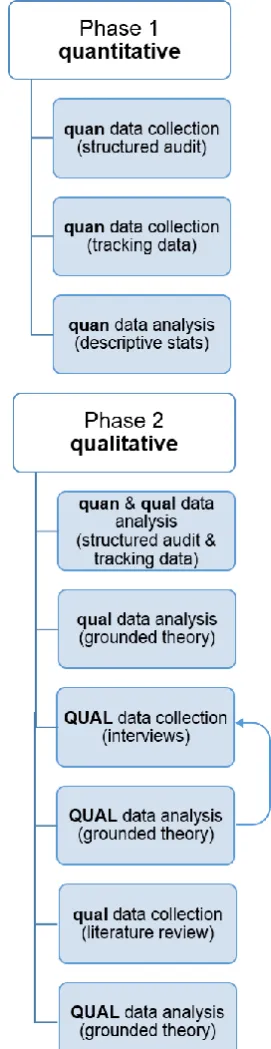
2.3 Research Design This is a sequential, two phase, mixed methods project. The sequence and weighting of each element of the two research phases are presented in Figure 2.3.
The first phase gathered quantitative data via structured telephone interviews and anonymised tracking data, to audit current practice in schools. The second phase employed a grounded theory methodology to generate a substantive theory of Reading to Dogs.
Quantitative and qualitative data collected from schools during the audit, qualitative data from individual interviews with children who have
experienced the Reading to Dogs programme, and relevant literature on theoretical concepts were all analysed using the grounded theory constant comparative method (Glaser & Strauss, 2008). The first and second phases of the research were analysed and discussed separately.
In order to address the two research aims, a mixed methods research design was adopted.
[image:50.595.397.533.149.675.2]Robson (2002) argues that the debate regarding the relative benefits of quantitative and qualitative research designs was resolved some decades
Figure 2.3: Graphical representation of sequence and