English Theses Department of English
Fall 12-20-2012
Readings of Zwelethu Mthethwa's South African Photographs:
Readings of Zwelethu Mthethwa's South African Photographs:
Postcolonialsim, Abjection, and Cultural Studies
Postcolonialsim, Abjection, and Cultural Studies
Dusty K. Ross
Georgia State University
Follow this and additional works at: https://scholarworks.gsu.edu/english_theses
Recommended Citation Recommended Citation
Ross, Dusty K., "Readings of Zwelethu Mthethwa's South African Photographs: Postcolonialsim, Abjection, and Cultural Studies." Thesis, Georgia State University, 2012.
https://scholarworks.gsu.edu/english_theses/140
This Thesis is brought to you for free and open access by the Department of English at ScholarWorks @ Georgia State University. It has been accepted for inclusion in English Theses by an authorized administrator of
POSTCOLONIALISM, ABJECTION, AND CULTURAL STUDIES
by
DUSTY KATHLEEN ROSS
Under the Direction of Pearl McHaney and Renée Schatteman
ABSTRACT
South African painter turned photographer, Zwelethu Mthethwa, was born in Durban during
Apartheid. In 1980 Mthethwa began taking his photographs in the shanty towns on the outskirts
of Cape Town and later took pictures in Mozambique and New Orleans. His work has global
significance. Using art and literary theory and criticism, I expand upon the significance of his
photographs in the contemporary world. I do “readings” of eight photographs from eight
different series of Zwelethu Mthethwa’s work using postcolonial theory, abjection, and cultural
studies as theoretical constructs to provide three different angles for interpreting his work.
POSTCOLONIALISM, ABJECTION, AND CULTURAL STUDIES
by
DUSTY KATHLEEN ROSS
A Thesis Submitted in Partial Fulfillment of the Requirements for the Degree of
Master of Arts
in the College of Arts and Sciences
Georgia State University
Copyright by Dusty Kathleen Ross
POSTCOLONIALISM, ABJECTION, AND CULTURAL STUDIES
by
DUSTY KATHLEEN ROSS
Committee Chairs: Pearl McHaney
Renée Schatteman
Committee: Calvin Thomas
Electronic Version Approved:
Office of Graduate Studies
College of Arts and Sciences
Georgia State University
ACKNOWLEDGEMENTS
I would like to thank Pearl McHaney for keeping me centered. She is a wonderful mentor
who always provides constructive criticism, sound advice, motivation, and inspiration. I
appreciate all the opportunities that she has provided, from taking me to my first literary
conference in New Orleans to sending me to France to study abroad. She restored my faith in the
education system. I am also very appreciative to my other committee members from Georgia
State University, Renée Schatteman who inspires me to push myself and Calvin Thomas who
inspires me to push boundaries. My mentors at Appalachian State University, Katie Adams,
Elizabeth Wilson, and John Crutchfield all played integral roles in developing and nurturing my
love of literature. In addition, I would like to thank Thomas McLaughlin who introduced me to
literary theory and criticism and Jim Toub who simultaneously introduced me to art theory and
criticism, a pairing that inevitably became my passion. I would like to thank Zwelethu Mthethwa
whose photography has always captivated me. I appreciate his willingness to assist with my
research, for offering to let me interview him, and for granting me permission to use his images
in my thesis. I would like to thank my family and friends who now know much more about
South African photography and art and literary theory and criticism than they ever asked to
know. Last but not least, I would like to thank Jason Isaacs who offered support and
TABLE OF CONTENTS
ACKNOWLEDGEMENTS ... v
LIST OF FIGURES ... vii
1 INTRODUCTION: EMPTY BEDS ... 1
2 POSTCOLONIALISM: INTERIORS AND WOMEN IN PRIVATE SPACES 13 3 ABJECTION: BRICK WORKERS AND CONTEMPORARY GLADIATORS ... 27
4 CULTURAL STUDIES: SUGAR CANE AND GOLD MINERS ... 36
5 CONCLUSION: COMMON GROUND ... 47
WORKS CITED ... 54
APPENDIX ... 58
LIST OF FIGURES
Figure 1.1: Untitled, from Empty Beds series, 2002 ... 8
Figure 2.1: Untitled, from Interiors series, 1995-2005 ... 17
Figure 2.2: Untitled, from Women In Private Spaces series, 2005 ... 24
Figure 3.1: Untitled, from Brick Workers series, 2008 ... 29
Figure 3.2: Untitled, from Contemporary Gladiators series, 2008 ... 33
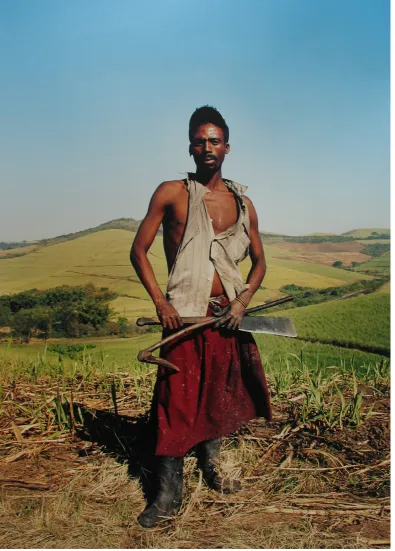
Figure 4.1: Untitled, from Sugar Cane series, 2003 ... 37
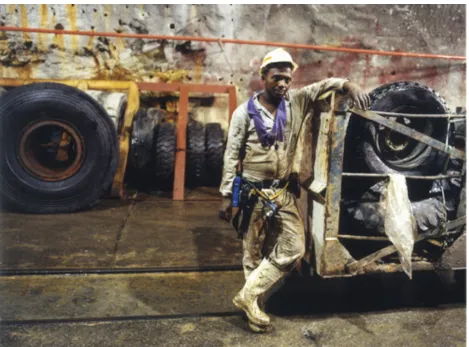
Figure 4.2: Untitled, from Gold Miners series, 2006 ... 43
1 INTRODUCTION
As I turned the corner of Hirshhorn Museum of Contemporary Art in Washington, D.C., I
was immediately drawn to the large six-foot by four-foot color portrait of a worker standing in a
field. The life size man filling the borders of the image looked as if he could step into the room.
The bright colors popped against the white walls. The eyes of the subject of the photograph
pierced the empty room. I was instantaneously captivated. South African painter turned
photographer, Zwelethu Mthethwa, was born in Durban during Apartheid. In 1980, Mthethwa
began taking his large format bold color pictures in the shanty towns on the outskirts of Cape
Town and later took pictures in Mozambique and New Orleans. Mthethwa continues to travel
and take photographs all over the world. He currently lives and works in Cape Town, South
Africa. His work carries global connotations. Using art and literary theory and criticism, I will
expand upon the significance of his portraits in the contemporary world. I do “readings” of eight
photos from eight different series of Zwelethu Mthethwa’s work using postcolonial theory,
abjection, and cultural studies as theoretical constructs to provide three different angles for
interpreting his work. Postcolonial concepts of boundaries, the idea of the other, and authenticity
shed light on the significance of Mthethwa’s photographs. By reading the images with abjection
theory, one can understand the importance of borders, subject/object, and darkness in his images.
Reading the photographs with a cultural studies lens will help the viewer understand the
relationship of the photographer and the photographed, identity, the narrative nature of
Mthethwa’s work, and the significance of creating a new history, a new language.
Zwelethu Mthethwa was born in 1960 in Durban in the KwaZulu-Natal region of South
Africa. In 1979, he received his BA in pre-med from the University of Zululand. Mthethwa
Abangani Open School. In 1981, Mthethwa transferred to the Michaelis School of Fine Art at the
University of Cape Town (UCT), which at the time was an all white school. In order for
Mthethwa to take classes at UCT he had to major in an area that was not available in the all black
universities. This is when Mthethwa chose to move from a concentration in painting to
photography, as photography was not available at the all black universities. Mthethwa was one of
two black students taking classes at UCT at this time. He received his Fine Arts degree in 1984
from UCT.
Apartheid was met with opposition from the people of South Africa since inception, but
in the 1980s South Africa’s political and social environment was particularly tense due to
massive uprisings and the resistance campaigns. Internal resistance was married with
international criticism/activism as several nations refused to trade with South Africa in
opposition to Apartheid. International boycotting further intensified an already weakened
economy. With the economy crumbling people were forced to break Pass Laws that limited
non-white mobility through various regions, in search of work. This heightened political environment
fueled protests and demonstrations. In 1985, a State of Emergency was declared, making it
illegal for people to meet in large groups. Furthermore, people were being detained without due
process or the ability to appeal to the courts. During this time, Mthethwa received a Fulbright
scholarship to study imaging art at the Rochester Institute of Technology in New York. He
received his MFA in 1989. In 1994, South Africa had its first democratic elections and Mthethwa
returned to South Africa to continue his photography and to be a professor. From 1994-98
Mthethwa taught photography at the Michaelis School of Fine Art at UCT. He now concentrates
full time on his artwork and occasionally serves as a senior guest lecturer teaching photography
had numerous solo and group exhibitions throughout the world and has won several awards for
his artistic endeavors. Mthethwa aims to reinvent the image of his people. His work is in direct
opposition to a haunted history of photographs of South Africans.
The earliest photographs produced in South Africa date from 1842. Photography in South
Africa is stained by a colonial presence. John Peffer, Professor of Contemporary/Nonwestern Art
History, addresses the complicated history of South African photography in his book, Art and the
End of Apartheid. Peffer states, “In Africa, as in Europe, a cult of likeness was stimulated by the
accessibility of portrait photography during the second half of the nineteenth century” (242).
Upon the introduction of the medium to Africa in the mid-nineteenth century, it was the
colonizer’s instrument. Photographers such as F. Heldzinger, Wilhem Bleek, and Lucy Lloyd
captured images of the whites and natives alike. Photography in Africa was used as a means of
identifying the “other,” of documenting the colonizer and the colonized. In the archives of the
images from this time the settler is represented in his best clothes and is surrounded by luxury
goods, whereas the native is depicted barefooted, half naked, and carrying savage weapons or
rustic tools. The native is represented anthropologically. There is also the image of the reformed
savage, of the savage in the western clothes of the colonizer, saved from barbarianism. Peffer
elaborates on the constructed image of the native, “While white subjects would have been able to
negotiate the terms and setting of their pictures as well as to control the distribution of their
images, black subjects had little or no control over the process or use of their depiction” (246).
Black South African’s initially had less control over their representation in photos. Whites were
creating the images.
With the discovery of the Eureka Diamond, found in South Africa in 1867, many
generated by the African diamond rush. Duggan-Cronin, who was employed by De Beers
Consolidated Mines, took hundreds of photographs of southern Africans and Europeans
throughout the southern African states. John Peffer comments that Alfred Martin Duggan-Cronin
compiled 6000 images for the “native types” archive and that his work is “situated awkwardly
between studio portraiture and natural science” in the library (248). This physical location of the
images between art and science illuminates the intention of the work and the problematic
categorization. It wasn’t until much later that the camera became a tool that non-whites could
manipulate.
In 1955, Peter Magubane, a black South African, began manipulating the camera to
expose Apartheid and its atrocities. He took black and white pictures for the anti-Apartheid
magazine Drum. Later, as a freelance photographer, he was imprisoned on several occasions and
at one point was banned from taking photographs for five years. Magubane is well known for his
1976 Soweto Riot pictures; he was the first non-white to win a photographic award in South
Africa. Another revolutionary black South African photographer is Ernest Cole. In 1967, Cole
depicted the subhuman living conditions in the shanty towns in his book House of Bondage. His
work serves as a political commentary on the horrific conditions of apartheid. Following in
Magubane and Cole’s footsteps, in the 1980s, several South African photographers known as the
struggle photographers were documenting political issues framed by apartheid.
Exhibitions/projects such as The Cordoned Heart (1986) that included 136 black and
white photos taken by 20 South African struggle photographers such as Omar Badsha and Paul
Weinberg, attempted to shed light on the hostile environment in which many South Africans
were living. Badsha and Weinberg went on to form Afrapix, a collective group focused on
produced photojournalistic images of the struggle with immediate impact” (Peffer 254).
Afrapix’s images can be seen as representing a positive struggle. The struggle photographers
wanted to encourage positive change in their society, but they were using a photojournalistic
documentary approach to achieve this goal.
This history of South African documentary photojournalistic photography is the exact
type of image against which Mthethwa’s photography works. Zwelethu Mthethwa does not
consider himself a documentary photographer. Peffer clarifies this distinction, “Where
documentary photography sociologizes, art photography tends to aestheticize” (265). Mthethwa
does not attempt to sociologize the sitters of his photographs but rather focus on the aesthetic
beauty of their lives. South African photography of the shanty towns has a similar history to the
photography of other impoverished areas. The images are meant to inspire pity for the victims in
the picture, albeit this pity is meant to inspire change and serves as a message of protest.
Mthethwa actively chooses to disrupt this tradition. He does not want to generate pity but rather
highlight beauty and strength. He declares that he intentionally uses color photography, as
opposed to the traditional black and white, in order to restore dignity to the people of South
Africa who heretofore have been victimized in journalistic/documentary style photography. In an
interview with Isolde Brielmaier, chief curator at the Savannah College of Art and Design,
Zwelethu Mthethwa states, “I wanted to use color film to bring out the vibrancy of their lives and
the care and pride that they put into how they are living” (Zwelethu Mthethwa 93). The results
are stunning portraits showing proud people in their homes and at work. In addition, he lets the
people of his photographs arrange their rooms and choose their positioning in the picture to best
represent themselves, giving them the authority to convey the expression of their settings. This
accomplished in documentary photography. He uses natural light and attempts to capture an
image of the person and their surroundings that is representational of the owner. Mthethwa also
offers each of the sitters a copy of the image he creates. They become the owners of their images.
However, the sitter remains anonymous to the viewer. The sitter and Mthethwa are the only
viewers of the photo that know the history and the story behind the image. The person is part of a
larger community represented in the series of photographs that Mthethwa compiles but at the
same time the individual has authority over that singular image.
Another choice that Mthethwa makes that changes the reception of his images is the
decision to leave his works untitled, the subjects unnamed. This choice allows the picture to
speak for itself. Furthermore, an untitled image gives authority to the sitter of the photograph, as
he or she has not been named by the artist. Mthethwa asserts, “by calling my works ‘untitled,’ I
was trying to offer the basic narrative and then allow viewers to embellish the story with their
own experiences and place the people whom they are looking at within an environment which
they can relate to” (Zwelethu Mthethwa94). By identifying the people by the group they are
affiliated with as opposed to naming them individually, he is magnifying this cultural
importance. By leaving his works untitled, he allows the viewers to bring their own
interpretations to the work. By titling the series, Mthethwa gives a context or narrative for the
work but leaves a space for the viewers to incorporate their own experiences.
In 1996, Mthethwa began photographing the inhabitants of Crossroads and Paarl shanty
towns on the outskirts Cape Town. These shanties were constructed against government
regulations and were intended to be temporary abodes. They are made of ephemeral elements
and go through a process of entropy. As seen throughout Mthethwa’s work each photograph
composition of image. Later he created series that were focused on relationships between
mothers and their children. He also did a series of photographs of empty bedrooms in hostels.
Mthethwa chose to title the series by the common thread or bond that appears throughout the
collection. These series are titled Interiors (1995-2005), Sacred Homes (1999), Mother and
Child (2000), Empty Beds (2002), and Women in Private Spaces (2005). The bond of the
community is the linking factor that the title highlights. These abodes and the people in them tell
a story. Mthethwa’s work has a strong narrative aspect that speaks to a universal audience.
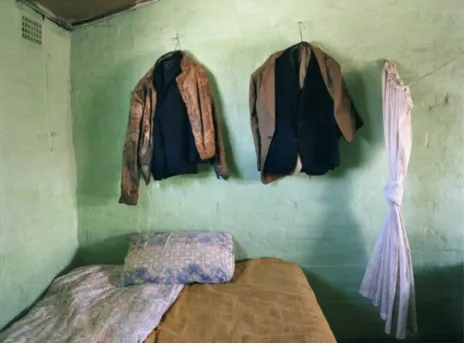
Figure 1.1, Untitled from the Empty Beds series, depicts the narrative nature of
Mthethwa’s work. Although no bodies occupy the frame, the details of the photograph give the
viewer a glimpse of the inhabitants. The picture is of a bed in a hostel that houses men who are
displaced from their families looking for work. Two men live in this room. Due to lack of
furniture to house their clothing the men have hung their jackets neatly on the wall. They are
displayed as if they are art. This is a common custom in hostels in this area. The sea foam green
brick walls corner the gentleman’s bed. The curtain is tied back. Once the men return the curtain
will be closed to separate the two sides of the room. The ghosts of these men linger in their
absence as their jackets stand watch over their space.
The history of South Africa plays a large role in the understanding of these photographs.
The space the people occupy, whether a hostel, a public work place, or a private home, tell a
story. The walls of the private homes are often plastered in cover pages of magazines that show
pristine white women and luxury products the inhabitants of the shanty could never afford. And
yet the way the people build their homes and reappropriate the colonizer’s images to decorate
their homes provides a commentary for the viewer. I expand on this commentary by using
Figure 1.1: Untitled, from Empty Beds series, 2002
This image is used with the permission of the artist. The reproductions in this thesis are being
used for research consultation and scholarly purposes only. Further distribution and/or any
commercial use of the works from this thesis are strictly forbidden without the permission of
[image:17.612.73.537.90.435.2]Lazarus, and Octavio Paz, I do a postcolonial reading of an image from Interiors and one from
Women in Private Spaces, concentrated on people and their homes.
Mthethwa contends that he would like to restore dignity to the people of his photographs.
Restoring dignity involves creating an identity and Bhabha’s postcolonial theory on identity can
be used to further interpret Mthethwa’s work. In Location of Culture, Bhabha extrapolates on the
importance of identity and the ways in which culture frames that identity. Furthermore,
Mthethwa makes an effort to un-other the subjects of his photos. Mthethwa gives the people in
his photographs a platform to establish and define their own identities within the context of their
communities. Similarly, Lazarus’s theory on postcolonial identities and authenticity can be used
to better understand Mthethwa’s images. The effects of colonization are discussed in depth by
Lazarus and offer a means of deciphering Mthethwa’s work. Paz’s writings dealing with space
and appearance are also applicable to Mthethwa’s images. Each of these theoretical ideologies
provides a language to discuss the significance of these pictures. When paired with the narrative
nature of the images and the history of the area in which they were created, the viewer is better
equipped to interpret the photographs.
Brick Workers and Contemporary Gladiators are two series that Mthethwa completed in
2008. The Contemporary Gladiator series is photographed in Mozambique, reminding viewers
that the southern African countries share many similarities. He states, “There is a phenomenon in
African politics where people speak of ‘south African countries.’ The borders have become very
loose and more fluid” (Zwelethu Mthethwa 95). The idea of borders and the marginalized are
themes that similarly appear in the Brick Workers series photographed in South Africa. I do a
close reading of two photographs, one from each of the series Brick Workers and Contemporary
Grosz, and John Lechte, to discuss abjection within the context of Mthethwa’s photographs. The
people and homes represented in these images have been discarded; they are living on the
margins of society. By reading these photographs through the abject lens, I can offer the viewer a
better understanding of the universal and global importance of Zwelethu Mthethwa’s
photography.
Julia Kristeva’s theories on abjection, which incorporate studies of subject, object,
borders, the marginalized, the cast off, and identity, are extremely applicable to Mthethwa’s
useful in understanding Mthethwa’s photographs. The brick workers, the boys living in the
landfill, are being abjectified, not by Mthethwa but rather by society. They are the people that
civilization wants to ignore and, therefore, they live on the margins, on the borders, on the
outside. John Lechte discusses the relationship between culture, art, and abjection. Each of these
theorists offers a different perspective linked by the common theme of abjection and expands
upon the ways in which abjections affects identity.
In 2003, Mthethwa created his series of photographs Sugar Cane, and in 2006 he created
the Gold Miners series. Both of these collections focus on laborers in South Africa and
Mozambique. The men in these pictures work in excruciatingly uncomfortable and dangerous
conditions. Rather than showing a people that are victims of their environment, Mthethwa hoped
to once again restore dignity to his people. I will do a cultural studies reading of a photograph
from each of these series to elaborate on the conditions and community that allow for the
creation of such images. By referencing work from scholars such as, John Fiske, Homi Bhabha,
Ian Chambers, and Victor Burgin, I will interpret and dissect the photos to incorporate the ideas
of cultural studies. Political, economic, and social structures play key roles in the context of
Mthethwa’s photographs, I will elaborate on the connotations of his work not only in the South
African environment but in the global framework as well.
I use Bhabha and Chambers’ theories on culture and identity to frame my reading of
Mthethwa’s images taken of migrant laborers as I feel this area of theory offers a lens through
which to understand the connotations of the images and the people represented within the
borders of the photographs. In addition, Homi Bhabha’s book, Location of Culture, provides a
critical analysis of identity that is applicable to Mthethwa’s work. John Fiske writes
comprehensively on the cultural implications of everyday activities. His ideology is useful when
dissecting Mthethwa’s images and in particular when understanding the body in regards to its
place in culture.
By using postcolonial theory, abjection, and cultural study theoretical approaches to read
Zwelethu Mthethwa’s photographs I can display the universal nature of Mthethwa’s work. In
conclusion, I will reference a photograph from Mthethwa’s first series that was photographed
outside of Africa, Common Ground. The image was taken after hurricane Katrina and displays a
water damaged and abandoned house. This image fully embodies the universality of Mthethwa’s
body of work. His photographs tell a story that is interrelated with the lands within which those
works were produced and the history that precedes that moment in time. Furthermore, each of
the aforementioned ideological perspectives addresses identity and the image. I have set clear
parameters for each theoretical genre within the context of my research, but I am aware of the
interrelated nature of not only the topics of the various fields but of the scholars themselves.
Therefore one scholar’s cultural studies work can be applicable in the field of postcolonial theory
or abjection theory. I use this cross-disciplinary approach to expand on the interconnectedness of
applied to Mthethwa’s work, provides the audience with an additional lens through which to read
2 POSTCOLONIALISM: INTERIORS AND WOMEN IN PRIVATE SPACES
South Africa struggled with colonization starting with the Portuguese in the 1200s and
legally ending with the British in 1909, although racial discrimination is still alive today. The
Native Land Act of 1913 was the beginning of legalized segregation in South Africa. The
National Party institutionalized Apartheid in 1948. This further complicated an already tense
postcolonial environment. Mthethwa’s work attempts to provide a different lens through which
to see South Africans than has previously been available. Annie Coombes, Professor of Material
and Visual Culture at the Birbeck University of London, has published extensively on art and
culture in South Africa. In her book, History After Apartheid: Visual Culture and Public Memory
in a Democratic South Africa, she claims of Mthethwa’s work, “His photographs clearly
embrace the creative ways in which individuals extend the limited means at their disposal for
expressing individuality (limited through either the restrictions of social control or economic
constraints) by projecting an ideal personality via the small spaces that do remain in their
control—in this case their shacks” (189). With so many aspects of their lives dictated by laws,
decoration of a house was something that could not be controlled; it was one of the ways people
could express themselves freely. During the 19th century the British colonial rulers created Pass
Laws, which prohibited any non-white from entering certain areas and, furthermore, from
migrating between districts without a properly signed pass. The townships, located on the
margins of white urban cities, became small isolated communities where people had to create
their own identities within the boundaries that society had laid out for them. Their makeshift
homes became a means of expressing their individuality on the outskirts, on the borders, and on
Mthethwa’s representation of shanty town life restores dignity to the people that his
contemporaries typically victimize and dehumanize in their black and white
documentary/journalistic style photography, as previously mentioned in the introduction. The
sitters in Mthethwa’s pictures almost always directly face the camera and engage with the viewer
in a very unapologetic and dignified way. Coombes asserts, “They are neither defined primarily
as the ‘victims’ of apartheid, nor are they oblivious to the limitations of their environment”
(190). Mthethwa’s subjects are not the victims represented in the struggle photography era. His
various series of photographs, which usually are life-sized at about 6ft X 4ft, address class,
gender, race, and labor issues that exist in this postcolonial/post apartheid space. He allows for
the sitters in the photograph to redefine their place in their community.
The Interiors and Women in Private Spaces series are collections of photographs of
people in their makeshift homes. The subjects authoritatively gaze at the viewer. Their clothing
is usually just as colorful as the magazine and advertisement prints that substitute as wallpaper in
their improvised homes. Whereas these ads could be seen as a commentary on the poverty of the
subjects who cannot afford the items pictured on their walls, Mthethwa prefers to highlight the
bright color scheme that is so important to his people. The pattern and color scheme the people
chose to decorate their homes in is a significant cultural reflection of South African society’s
affinity for color. This is one of the many choices Mthethwa makes to disrupt the constraints of a
postcolonial society. Although the people in these images live in a postcolonial space they are
not defined by postcoloniality. Neil Lazarus, Professor of English and Comparative Literary
Studies, has written expansively on postcolonial literature and culture. He discusses the mark of
postcoloniality: “There has been a tendency to read postcolonial studies as mere ideology, as
members of postcolonial societies were itself a mark, or brand, of inauthenticity” (Lazaus 5).
What is the relationship between the postcolonial subject and the postcolonial practitioner and
what does this relationship say about both classes? Although Mthethwa is a South African
photographer, not an “outsider,” he still comes from a position of privilege, as he received an
American and European education and his art is exhibited throughout the world. He, unlike many
of the sitters of his portraits, has been able to see a much wider world, in spite of the limitations
of a postcolonial space. Mthethwa rather than being unauthenticated by his privilege has used his
position to shed a new and brighter light on South Africa’s people. Therefore, both he and the
sitters of his photographs defy the postcolonial mark and its limitations.
Postcolonial is seen as the period of time following colonialism. The postcolonial subject
comes from a history of colonization. Homi Bhabha, critical theorist and professor at Harvard
University, is predominately know for his work focused on hybridization, which can be seen as
an extension of Edward Said’s ideology on multiculturalism. Bhabha suggests that, “Colonial
discourse produces the colonised as a fixed reality which is at once an ‘other’ and yet entirely
knowable and visible” (“The Other Question” 41). In order for a subject to be “knowable,” the
viewer must feel that they are acquainted with or recognize and are familiar with the subject. The
people in Mthethwa’s images are not knowable, however they have now been made visible.
Mthethwa rejects a direct identification by refusing to interpret the subjects of his images with
titles. He dilutes the idea of the “other” and allows the sitters of his pictures to manifest their
own identities and representations. Although Mthethwa’s photographs are giving the outsider a
view of the effects of oppression on the “other,” he does so in way that defies the usual
limitations of journalistic photography. All of his images are untitled as if to create an identity of
although a person may be considered ‘the other,’ they are still knowable. Mthethwa’s portraits
refute this claim.
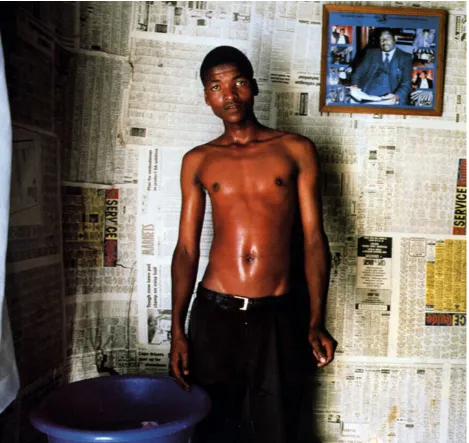
Figure 2.1, Untitled, from Mthethwa’s Interiors series (1995-2005) depicts a young man
standing in his home next to a blue water basin. The walls of his home are plastered with
newspapers. The newspapers are not arranged so that the text can be read. Instead it appears that
the newspaper has been arranged to highlight the pattern the text creates. Rather than running left
to right like traditional text, the print is upside down and sideways. Hovering over the young
boy’s left shoulder, in a blue frame, is the portrait of a dignitary. The blue photo in the upper
right hand corner and the blue water basin in the bottom left hand corner create a strong
diagonal. The boy is at the center of the diagonal, therefore, implying the connectivity of the
main focal points of the image. Mthethwa informed me that man in the framed photo on the wall
is Barnabas Lekganyane, the bishop of the Zion Christian Church (ZCC). He also informed me
that many people in South Africa have framed photographs of Lekganyane in their home to show
their affiliation with the ZCC. Mthethwa does not alter the homes of the people. They arragnge
their belongs in a way that they feel best represents them. The words “SERVICE Group” are
written in black and surrounded in yellow and red. This is the only other color on the black and
white newspapered walls. Cassie Wu in her article published in the Journal African Arts, “What
Is This Place?: Transformations of the Home in Zwelethu Mthethwa's Portrait Photographs,”
claims there is an inauthenticity to the photograph because Mthethwa has photographed other
people in the same room. Therefore, she implies this space does not belong to this young man. I
argue that his presence in the space gives him ownership of the room, ownership of the image,
and therefore representational ownership, just as the other people who have been photographed
Figure 2.1: Untitled, from Interiors series, 1995-2005
This image is used with the permission of the artist. The reproductions in this thesis are being
used for research consultation and scholarly purposes only. Further distribution and/or any
commercial use of the works from this thesis are strictly forbidden without the permission of
[image:26.612.73.542.98.541.2]encounter with identity occurs at the point at which something exceeds the frame of the image, it
eludes the eye, evacuates the self as a site of identity and autonomy and—most important—
leaves the self a resistant trace, a stain of the subject, a sign of resistance” (Location of Culture
49). Bhabha implies there is authority for the sitter of the image. The subjects have left their
mark on the photograph and the room in which they are depicted. There is ephemerality in the
construction of these homes that lends itself to a communal presence. This is the sitter’s space.
To better understand the space in which the sitters exists, one must understand the history
that envelopes that space. Robert Thornton, a professor of Anthropology at University of
Witwatersrand in the Johannesburg area of South Africa, studies photography and ethnographic
methodology. In his essay, “The Potentials of Boundaries in South Africa: Steps Towards a
Theory of the Social Edge,” Robert Thornton makes the claim that apartheid was a modern and
postcolonial construct and therefore post-apartheid is a postmodern reality (136). The sitters of
Mthethwa’s images directly work against modern, postcolonial, and apartheid constructs.
Therefore, the postmodern subject is defying the superstructural establishments previously
mentioned. This young postmodern boy occupying the frame is represented as an individual that
contradicts the limitations of modernism, colonialism, and apartheid. He is not simply a product
of modernism or colonialism any more than he is simply a product of apartheid. Modernity
changed his experience and he had to deal with colonial presence and live in shadow of
apartheid, but these facts do not define him. His life consists of many other stories. He is a boy,
someone’s son, a member of his community, and a citizen of his country. Most importantly, he is
an individual within these larger superstructures. He is telling his story through the image and
stepping out of the confines of the frame, unlike the dignitary who is static in the frame above his
Theory, Culture and Society. He has researched extensively on postcolonialism, psychology, and
social relations. Venn observes that, “Narrative has a recognition effect, since subjects recognize
themselves in the stories they tell about themselves. Furthermore, each narrative identity is
entangled with those of others, since the story of a person’s life is a ‘segment’ of other people’s
life stories” (271). This young man’s story is intertwined with that of his history and his
community. The image has layers of complexity that require the viewer to accept that the sitter,
although visible, is not wholly knowable. The viewer has been given a glimpse of the subject and
therefore only a glimpse of his story.
The boy’s flesh shimmers either from the water in the basin or sweat caused by the heat.
His left hand is closed as if it could be holding onto a pamphlet to give to the viewer. The boy is
proud and standing tall as he directly confronts the observer. He has a look of intensity and his
mouth is slightly open as though he may ask a question. Mthethwa has given this young man an
opportunity to represent himself as anything but a victim. He is writing a new history for himself
in the image Mthethwa has created. Mthethwa’s work could be seen, as Aijaz Ahmad suggests,
as ‘postcolonial writing.’ Ahmad is a Marxist literary theorist who has written on the importance
of a movement against imperialism/colonialism. Ahmad implies that, “‘Colonialism’…becomes
a transhistorical thing, always present and always in process of dissolution in one part of the
world or another, so that everyone gets the privilege, sooner or later, at one time or another, of
being coloniser, colonised, and postcolonial” (283). Mthethwa’s photography is an example of
this dissolution, and it also incorporates references to the colonial presence and the decolonized
body persevering in spite of a history of oppression. This young man has reclaimed his space and
yet he is still marked by colonialism. The presence of English print on the newspapers plastered
gives a new life to the oppressor’s tool. Furthermore the framed portrait of the suited dignitary
hanging on the wall acts as a new headliner for the paper. The colonizer’s newspaper therefore
becomes secondary.
Mthethwa strives to bring a sense of equality and universality to his photographs. It is
almost as if his images allow the sitter of the picture to look directly at the viewer and say, I am
here and I am just like you; I am human. Although, the subjects of Mthethwa’s photographs live
in their own space, a space that is undoubtedly different from the space in which you, the reader,
live in, or the space in which someone living in Papua New Guinea lives, or someone living in
Switzerland, all people exist in a realm that is no longer isolated. Simon Njami is a Cameroonian
art critic and writer who participated in the African Sniper Project (in which Mthethwa also
participated) and Africa Remix art exhibits. He wrote the chapter “The Next Flag” in the book
Next Flag: The African Sniper Reader. The African Sniper Project was a 2003 contemporary
African art exhibit that was organized with the intention of highlighting the fact that at the time
there were currently no museums of African art in African countries. The show aspired to bring
global recognition and local appreciation together. Njami suggests we are a human race that
shares similar experiences; “The world is a whole. A single entity. Humanity cannot be reduced
to different races, religions, or geographies. The history we have inherited is a delusion, and the
notions we have endowed it with are nonsensical” (16). Using Njami’s ideas on universality and
connectivity, the viewer can assess that the young boy in the photo is part of a whole, not only
the owner of his own space, a resident of his household, but also he is a member of his
community, possibly a member of the ZCC, a citizen of his country, and a participant in the
human experience. The individual history that is imagined is part of a much larger human
Although Mthethwa’s subjects are part of a much larger human experience this reality
does not deny them the authority of individuality. Colonial presence attempts to remove one’s
autonomy, to have them assimilate into the controlled masses. The people are alienated from
their identies. Bhabha elaborates on this sentiment introduced by postcolonial literary theorist
Franz Fanon and contends that, “The extremity of this colonial alienation of the person—this end
of the ‘idea’ of the individual—produces a restless urgency in Fanon’s search for a conceptual
form appropriate to the social antagonism of the colonial relation” (Location of Culture 41).
Mthethwa’s subjects unquestionably carry the stains of prejudice, discrimination, and stereotypes
that the colonial presence leaves on all of its victims, and yet Mthethwa attempts to give the
sitters of the photographs an alternative means of representing themselves as a new individual
unsullied by their pasts.
The walls of the room the young boy stands in are presumably made of plastic, plywood,
cardboard, and/or corrugated metal. They are covered with newspapers, newspapers written in
the language of the oppressor. The newspaper was surely put up in attempt to provide some
insulation. But the newspaper does more than insulate. The reappropriation of the text as
decoration for the boy’s provisional home gives the newspaper new meaning. John Fiske,
Professor of Communications at the University of Wisconsin-Madison, currently researches
popular and mass culture. In his article, “Cultural Studies and the Culture of Everyday Life,” he
strongly argues that, “Oppression is always economic. Yet the everyday culture of the oppressed
takes the signs of that which oppresses them and uses them for its own purposes” (Fiske 157).
The newspaper (the oppressor’s tool) is not displayed in a manner that highlights the content of
as insulation and decoration focusing on the color and pattern that the paper now creates as
wallpaper.
This young boy’s home was meant to be impermanent, but it is seen as worthy of
decoration. It stands on the outskirts of the city. It likely does not have electricity and surely does
not have running water. This home almost certainly sits in a community that does not have a fire
department or police station nearby further emphasizing the impermanency and entropic state of
the living establishment. This home was built out of necessity, out of the need to be close to
one’s place of work. If you cannot live inside the city where you work, living on the margins is
the second best option. Regardless of the temporariness of the materials, the owner of the home
has taken the effort and time to wallpaper the home. Ian Chambers is a history professor who
researches the significance of the mental and spatial elements of colonialism. In his book Culture
After Humanism: History, Culture, Subjectivity, he asserts that, “Everyone lives memory, but no
one possesses it. The house of memory is not simply our customs, rituals and traditions, our
bodies, institutions and monuments, nor even our innermost selves and individual unconscious. It
is ultimately that place of concentrated being that is the historical hum or our earthly habitat”
(Chambers 53). A home is the habitat of memories. The space the young boy occupies tells a
story of his existence. The dignitary floating over his shoulder stands there for a reason.
Barnabas Lekganyane as the current bishop of the ZCC is a highly respected individual. “Today
the paramount leader of the ZCC is the bishop, the only person to whom this title is given, and
whose hereditary office is for life” (Anderson 287). The ZCC believes in prophecies and the
healing powers of their spiritual leaders. The placement of this particular photograph on the wall
Saturated in color, Mthethwa’s 2005 series, Women in Private Spaces, once again reclaims the
home as a sacred space. Mthethwa asserts in an interview in the book Liberated Voices, “I do not
believe that poverty is equal to degradation. For me color restores people’s dignity. As does
acknowledging the spaces in which they live as worth recording” (65). Space and ownership of
space are important themes throughout Mthethwa’s work. Octavio Paz is a prolific Mexican
author who was awarded the Nobel Prize for Literature. He has written extensively on
colonialism and identity. According to Paz, “The act of spreading oneself out, of blending with
space, of becoming space, is a way of rejecting appearances, but it is also a way of being nothing
except Appearance” (14). In figure 2.2, the young child in the doorway is cocooned in the curtain
and appears to blend into the space with the ground beneath, shadowing the child’s feet. He is
rejecting appearances, and I argue that his presence in the photo, his story, defies the limitations
of being identified as only “Apperance.” The woman with her arm akimbo and her stern gaze
addressing the viewer creates a self-assured juxtaposition to the small child’s bashful innocence.
Although apartheid no longer legally exists, the housing issues created by segregation continue
to propose issues for the marginalized non-whites of South Africa. And yet, as Paz suggests,
these people have defined their space and become a part of it. Visually this idea is culminated in
the child’s blending into the room in which he/she stands.
Bright yellow labels cover the walls of the woman and her child’s home. The
advertisements have been arranged in a way that highlights the pattern. The labels lose their
originally intended potency, as did the newspapers in figure 1.1, once they have been
reappropriated as wallpaper. Okwui Enwezor is a Nigerian art curator, critic, and writer. In 2011,
Figure 2.2: Untitled, from Women in Private Spaces series, 2005
This image is used with the permission of the artist. The reproductions in this thesis are being
used for research consultation and scholarly purposes only. Further distribution and/or any
commercial use of the works from this thesis are strictly forbidden without the permission of
[image:33.612.73.541.89.455.2]Affairs at San Francisco Art Institute, has been a visiting professor at Colombia University and
the Institute of fine arts at New York University and is the founding editor and publisher of the
NKA: Journal of Contemporary African Art. Enwezor has written comprehensively on the
significance of contemporary African art and in particular Zwelethu Mthethwa’s work. He
discusses in detail the importance of the advertisements that often appear on the walls of
Mthethwa’s photographs, “The Pop-repetition of these repurposed ads saps away their corporate
impact, perhaps denaturing the myth of consumer pleasure that they tender” (Events of the Self:
Portraiture 3). The color and the pattern the labels create become the focal point of the walls.
The advertisements are not serving the purpose of luring people to buy a product. In the book
Visual Cultures and Critical Theory Patrick and Kelli Fuery argue, “A key element of visual
representation—from an advertisement to a painting, a film to a photograph—is the interplay
between what we see and how it relates to us” (111). The viewer does not see the label, unless
one is familiar with the product the label was intended to advertise, and therefore the label
becomes exactly what it is being used as, wallpaper. Furthermore, the photograph Mthethwa has
taken creates a relationship between the viewer and the subject. The viewers brings to the picture
their own personal experience and knowledge to interpret the meaning of the details in the
image. The photograph therefore has a different meaning for each observer.
In addition to the experiences the viewer brings to the image, one must consider the
experiences of the sitter of the image. The history of the subject plays a key role in interpreting
the image. Black, Coloured, and Indian women in South Africa were doubly discriminated
against during apartheid and colonial spheres as they were seen as inferior both in race and
gender. Women had very few rights. Usually they were not allowed to receive an education, and
subjugated, many people aligned with various community groups in attempt to maintain a sense
of self and national pride. Neil Lazarus states, “Many scholars active in postcolonial studies are,
indeed positively cynical about decolonization and national liberation” (33). Mthethwa, in
several artist statements, has declared his desire to show the successful decolonizing efforts of
South African people. Several of Mthethwa’s photographs are published in the book Liberated
Voices. The book is meant to be a collection of images that align with national liberation
endeavors. This liberation is a key element to Mthethwa’s work. He sees his photography as a
means of dismantling colonial power. Leela Gandhi, Professor of English at the University of
Chicago, is a renowned postcolonial theorist. She coedits the academic journal Postcolonial
Studies. Gandhi describes the way in which some people attempt to eradicate the colonial
presence from their personal history. She implies, “Principally, postcolonial amnesia is
symptomatic of the urge for historical self-invention or the need to make a new start—to erase
the painful memories of colonial subordination” (Gandhi 4). Although Mthethwa’s work
reaffirms his sitter’s authority of self, it inevitably incorporates elements of history. The subjects
are not trying to erase their past but rather reappropriate their past. Essentially they are creating a
3 ABJECTION: BRICK WORKERS AND CONTEMPORARY GLADIATORS
The forgotten, the rejected, the ones living on the margins, the discarded. These are the
abjectified people of civilization. Abjection can be understood as the disregard of a human by
society. Abjection theory addresses issues of culture, subject, object, marginalization, borders,
and identity of those who are cast off from society, relegated to the outside. Those who are
abjected are on the borders of social order; they are marginalized and exist on the outskirts of a
community. Elizabeth Grosz, an Australian academic who has written extensively on the work of
Julia Kristeva and Jacques Lacan, argues that, “[Abjection] is what disturbs identity, system and
order, disrupting social boundaries demanded by the symbolic. It respects no definite positions,
or rules, boundaries, or socially imposed limits” (90). Both the Brick Workers series and the
Contemporary Gladiators series shot in 2008 can be read with the abject lens.
Mthethwa photographed a group of a dozen women working on the edges of a small town
in Mozambique for the Brick Workers series. The women buy loads of bricks from local
businesses that have demolished buildings and they clean and resell those bricks to people who
are building from scratch. Mthethwa notes that, “People are forced to be creative in creating their
own jobs” due to the limited job availability in certain areas (“Interview with Okwui Enwezor”).
Resourcefulness is a way of life. Contemporary Gladiators depicts the lifestyle of a group of
young boys living off a landfill in Mozambique that is located next to the vacation resort,
Phemba Beach Hotel.Covered in dirt, both the brick workers and the young boys in the landfill
are taking advantage of their landscape, of the resources they have available. They exist and
thrive despite society’s attempt to discard them. They are resourceful.
The Brick Workers and Contemporary Gladiator series are similar to Empty Beds,
stoic figures filling the frames assertively. The Brick Workers and Contemporary Gladiator
series differ from the previously mentioned three series in two significant ways. The images are
not shot in the sitter’s home but rather in open space and they are not shot in South Africa.
Mthethwa feels that it was a natural progression to move from confined spaces to open spaces.
The significance of one’s home is equal to that of their working environment. The home is
typically a more private space whereas one’s job is more public, but both locations are important
to the subject’s livelihood. The message of dignity that Mthethwa captures in his previous
images is also represented here.
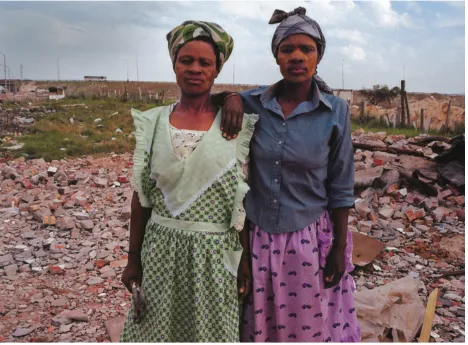
In figure 3.1, two women stand together with a graveyard of bricks littered around them.
White clouds fill a blue sky and bits of green grass grow on the margins of the piles of broken
bricks the color of Caucasian flesh with bits of red scattered throughout. The women both have a
firm gaze and mustard colored mud is smeared across their noses and cheeks. This appears to be
a method for deterring the sun. The woman on the left wears a light green dress patterned with a
dark purple and green print. There is a soft sheer pale green fabric making a V shape at her chest.
The dress has a soft country feel with flowers and lace. Ruffles frame her torso. She also wears a
cream-colored head wrap with a green circular print. She holds a tool in her right hand and the
tendons in her neck protrude as if she is tense and feels the need to return to work. Her mouth is
pulled in an interesting fashion. It is almost a smirk. “Zwelethu Mthethwa only enforces one rule
on his sitters: they must not smile. It’s the antithesis of what one would expect a photographer to
demand. This idea is founded in Mthethwa’s belief that smiles are rarely genuine. They’re a
knee-jerk response to awkwardness, he suggests” (Corigall 9). The woman on the right does not
smile either. She wears a purplish pink skirt with a black circular printed pattern and a blue
Figure 3.1: Untitled, from Brick Workers series, 2008
This image is used with the permission of the artist. The reproductions in this thesis are being
used for research consultation and scholarly purposes only. Further distribution and/or any
commercial use of the works from this thesis are strictly forbidden without the permission of
[image:38.612.74.542.99.444.2]Her right hand awkwardly drapes over the other woman’s shoulder and her left hand falls
naturally to her side. She has a bracelet on her right wrist and her mouth looks as if she is letting
a small puff of air escape. Debris surrounds the women: bricks, plastic, wood, cardboard. They
have stopped for a moment to be photographed and then surely will return to work. They are
taking the discarded bricks, the bricks that no one wanted, and they are turning that trash into
profit. They are sustaining life on others garbage.
These women have formed a community focused around their labor. This community
grows out of the job they have created in recovering discarded bricks and repurposing them.
Venn implies that, “The different devices that marginalized or subordinate groups have invented
or preserved for keeping alive memories of their past are crucial in sustaining the ‘identity’ of the
community and in informing resistance” (271). These women without a doubt are resisting the
limitations of their circumstances in addition to maintaining a sense of community. They are
reappropriating the bricks that once were the foundation of buildings that have ceased to be.
They are also creating an identity, that of the brick worker, from the materials that are at their
disposal.
Mthethwa has captured a picture of these women in their work environment. He has
created a piece of art by freezing this moment. The women in this photo become the center of the
work. Dr. John Lechte, Professor of Sociology at Macquarie University in Sydney, Australia,
wrote his dissertation under the supervision of Julia Kristeva. His current research is concerned
with society, culture, and problems of the image. Lechte claims that, “Kristeva views art less as
an object, and more as a process, or practice, which ‘creates’ the subject” (Lechte 24). The
women that pose in the brickyard for Mthethwa receive a copy of their likeness. They have been
as they confront the camera, knowing they will eventually hold that image, that frozen moment, a
representation of their identity. Mthethwa has given them a means of representation and in this
act the subject is created. The women are not being objectified. The process by which Mthethwa
creates his art is a shared process. The sitters of the photograph are asked to actively participate
in the representation of their image. Often the people in the photographs have actually asked
Mthethwa to take their picture. Mthethwa states that, “It’s very important for me to develop a
sense of trust between myself and the sitters” (“Interview with Okwui Enwezor”). The trust and
respect that are established and exchanged between the photographer and the photographed blurs
the lines of abjection. Though society has cast off these women, Mthethwa has brought them
back into the light.
There is an element of darkness that is associated with the idea of the abject. The dark
human relegated to the dark folds of society where they are not to be seen. Their filth kept away
from the white pristine cleanliness of an orderly and pretty society. They are hiding in the
shadows and living on the margins. Julia Kristeva, literary critic and current Professor of
Cultural Theory and Feminism at the University of Paris, Diderot, has written extensively on
abjection theory. She states in her book Powers of Horror: An Essay on Abjection that “There
looms, within abjection, one of those violent, dark revolts of being, directed against a threat that
seems to emanate from an exorbitant outside or inside, ejected beyond the scope of the possible,
the tolerable, and the thinkable” (1). The dark revolts of being can be seen as the revolt of society
against the castaways. Mthethwa brings the discarded subject into focus, into the light, albeit a
natural light. Mthethwa has made it very clear that he tries to refrain from using any type of flash
delicate subject matter of which he is taking pictures and wants to make sure the image is
produced in a way that is natural and real and assures respect of the subject.
The process of creating this image relies on both Mthethwa and the people in the
photograph. Lechte implies that, “Artistic endeavour, especially in its forms of literature and
painting, has always featured prominently in Julia Kristeva’s writing, because for Kristeva, as a
psychoanalyst, there is no fundamental discontinuity between the production of a work of art and
the life of the individual” (24). If both the artist and the subject participate in the creation of the
art then both the artist and the subject are equally affected by his or her relationship to the work.
Furthermore, Lechte claims that, “To say that the work of art has analytic effects is to imply that
it has the capacity for enlarging the symbolic (artistic, linguistic, religious) and imaginary
capacities of the subject who appreciates it” (33). The symbolic capacities are among the most
important elements of Mthethwa’s photographs. The identity of the artist and the subject are
created in that moment that the image is produced.
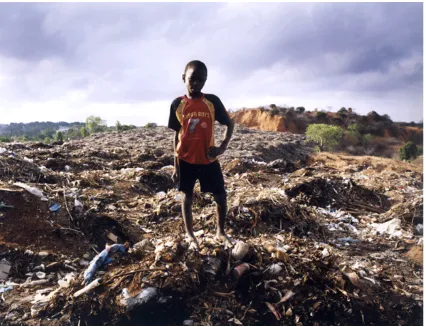
A moment, a snapshot, of the identity of the young boy, standing upon the heap of trash
in figure 3.2, is temporarily frozen for the viewer to observe. The boy stands in the center of the
image. The cloudy sky contrasts the dark pile of trash that is compacted beneath his bare feet.
There are layers of dirt, plastic bottles, sticks, scraps of paper, and cans littering the Mozambique
landfill. Unknown to the outside viewer, a hotel resort lies outside of the borders of this landfill.
Outside of the frame of this dirt and filth lies luxury and opulence. The boy’s arm is akimbo; he
wears a red t-shirt with “SUPER BOYS” written in yellow followed by a blue “7.” The shirt
appears to have a basketball or soccer ball on it. He has on dark colored shorts. He looks defiant
Figure 3.2: Untitled, from Contemporary Gladiator series, 2008
This image is used with the permission of the artist. The reproductions in this thesis are being
used for research consultation and scholarly purposes only. Further distribution and/or any
commercial use of the works from this thesis are strictly forbidden without the permission of
[image:42.612.73.499.88.415.2]fashion, and his knee slightly bent with his foot turned out. The boy does not smile and his face
is partially hidden by a shadow.
The viewer of the photograph must interpret the meaning of the boy, his environment, his
positioning inside the frame, his body language, and what each of these elements donates to the
creation and understanding of his identity. This young boy is literally living in trash. He has been
abjectified by a society that has thrown him away. With his hand on his hip and his sassy
interaction with the viewer, it is clear that the young boy is not intimidated by being observed. In
spite of the trash that monopolizes the ground, this young boy owns his space, he appears to own
his identity within in the space. Grosz claims:
The subject’s acquisition of a sense of self, of continuous identity, is the result of
the child’s ability to locate itself within a body in space, and thus have spatial
comportment. Incidentally, the mirror stage not only presents the subject with an
image of itself, it also duplicates in representational form the environment,
enabling real and virtual space to be directly compared. (84)
The mirror stage is a theoretical concept developed by French psychoanalyst Jacques Lacan. In
the mirror stage infants recognize themselves in the mirror. This mirror may be literal or
symbolic. This realization of self is seen as a moment of connection between the imaginary and
the real and the ego and the body. The mirror stage is also where the subject becomes alienated
from his or her self. Where is Lacan’s mirror stage for a young boy with no mirror? Could this
image serve as a mirror, although this young boy has outgrown infancy? The moment at which
children see their own likeness is a moment of self-awareness and simultaneously an
photographs to create their likeness. This collaboration perpetuates the manifestation of identity.
But what are the borders and margins of this identity?
Borders play an important role in the understanding of this image. The juxtaposition of
filth and poverty that is brought to the forefront of the image defies the pristine luxury that lies
outside the frame of the image. Kristeva asserts that, “We may call it a border, abjection is above
all ambiguity. Because, while releasing a hold, it does not radically cut off the subject from what
threatens it—on the contrary, abjection acknowledges it to be in perpetual danger” (9). The
viewer could interpret the landfill itself as a danger to the young boy. In addition, the boy is
ostracized from the resort that lies outside the walls of his space. He is just on the edge. He is
4 CULTURAL STUDIES: SUGAR CANE AND GOLD MINERS
Political, economic, and social structures are essential elements of Mthethwa’s work.
Cultural studies focus on the significance of activities of everyday life in addition to the
aforementioned superstructures. The Sugar Cane and Gold Miners series are centered on the
labor of African workers just as the aforementioned Brick Workers and Contemporary Gladiator
series focus on work. “Cultural studies has always been concerned to examine critically and to
restructure the relationship between dominant and subordinated cultures” (Fiske 164). By
looking at the superstructures in which these photographs exist—out of which they grow—the
viewer can better understand the significance of the images.
According to Mthethwa, there is one major difference of the Sugar Cane series in
comparison to the Gold Miners series. He states to the Jack Shainman gallery that:
Whereas the Sugar Cane Series dealt with open space and landscape, the Gold
Mine series almost moves back in the direction of the private spaces in that the
workers are working in a very confined space and although it is essentially public
in that it belongs to the mining company, it is also private because of the limited
space and close proximity in which the miners work. Going underground made
sense as a way of showing the contrast between inside/outside; private and
public/communal. (Jackshainman.com)
Mthethwa’s earlier series of photographs, which focused on private spaces, intersect with the
2008 series that focuses on public spaces.
In Mthethwa’s 2008 Sugar Cane series, he photographs the dangerous working
Figure 4.1: Untitled, from Sugar Cane series, 2003
This image is used with the permission of the artist. The reproductions in this thesis are being
used for research consultation and scholarly purposes only. Further distribution and/or any
commercial use of the works from this thesis are strictly forbidden without the permission of
[image:46.612.83.478.45.596.2]subject of the photograph faces the camera holding a machete and cane hook. These are the tools
of his trade. His arms are slightly bent as if he could swing either of his tools in the direction of
the viewer. He carries himself in a regal manner bearing his chest proudly. The center of his
chest carries a scar the remnants of an injury. He stoically sports his red skirt and black boots.
His sweat stained and tattered shirt hangs around his neck. Only two buttons are fastened on the
shirt that looks as if it might have once been a cream color with pinstripes. It has withered to a
dingy grey. A tattered hat sits atop the man’s head. His brow is slightly furrowed as he squints
his eyes in the sun. His gaze is turned directly towards the viewer and some facial hair frames his
unsmiling mouth. He is positioned against the rolling green cultivated landscape and cloudless
blue sky. There are cuts into the green grass behind his right shoulder that clearly show the
borders of crops. The cane stubbles at the man’s feet is trampled and compressed.
The composition of the picture and the subject’s unwavering presence in the photograph
do not allow the viewer to feel sympathy. There is almost an element of fear the image invokes
as the subject asserts his masculinity and strength as he stands before the viewer as though he
was a samurai. In an interview with Okwui Enwezor, Mthethwa states that the sugar cane
workers in their loose clothing and with their stoic positioning reminded him of samurai movies
he saw as a child (Vimeo.com). The weather is hot and humid and they wear layers of clothing
for protection so the sugar cane will not cut their skin. The clothing needs to be loose so that
their skin can get air and doesn’t become irritated. Like the inhabitants of the hostels in the
Empty Beds series the subjects in this series of photographs are displaced. The workers come
from rural areas to the farms looking for work. Mthethwa came to this particular farm for the
Sugar Cane series because he knows the owners. Mthethwa states that, “My sister-in-law and my