Journal of Chemical and Pharmaceutical Research, 2013, 5(9):135-141
Research Article
ISSN : 0975-7384
CODEN(USA) : JCPRC5
Development and validation of HPTLC method for the simultaneous analysis
of gatifloxacin and ketorolac tromethamine in eye drops
Vandana Patil*
1, Shital Phalke
1, Suwarna Kale
2, Rushikesh Patil
1and Smita Vithaldas
11
Department of Pharmaceutical Analysis, Yash Institute of Pharmacy, Aurangabad, India
2Department of Chemistry, Yash Institute of Pharmacy, Aurangabad, India
_____________________________________________________________________________________________
ABSTRACT
Gatifloxacin (GATI) and Ketorolac Tromethamine (KETO) are routinely used ophthalmic dosage forms. HPTLC promotes for higher separation efficiencies, shorter analysis time, lower amounts of mobile phase, and efficient data acquisition and processing. There are various analytical methods for their estimation of GATI and KETO but till date there is no HPTLC method for their simultaneous analysis. The paper presents the development and validation of a new HPTLC method for the simultaneous analysis of Gatifloxacin (GATI) and Ketorolac Tromethamine (KETO) in bulk drugs and eye drops. Separation was performed on silica gel 60F254 plates. The mobile phase is
comprised of n-butanol : toluene : tri ethyl amine (6.5:3:0.5, v:v:v). Densitometric evaluation of the separated zones was performed at 320 nm. The drugs were satisfactorily resolved with Rf values of 0.32±0.03 and
0.55±0.03 for GATI and KETO, respectively. The accuracy and reliability of the method was assessed by evaluation of linearity (200-1000 ng per spot for GATI and KETO), precision intra-day and inter-day RSD values were always less than 2 for the titled drugs, accuracy (99.45% ±5% for GATI and 99.1% ±5% for KETO) and specificity, in accordance with ICH guidelines. The proposed HPTLC method is new, accurate and precise. Therefore, it is suitable for determination of Gatifloxacin (GATI) and Ketorolac Tromethamine (KETO) in their binary mixtures for different analytical and pharmaceutical purposes.
Keywords: Gatifloxacin; Ketorolac Tromethamine; HPTLC; validation.
_____________________________________________________________________________________________
INTRODUCTION
Gatifloxacin(GATI) is chemically 1-cyclopropyl-6-Fluoro-8-methoxy-7-(3-methylpiperzin-1-yl)-4-oxo-1,4-dihydroquinoline-3-carboxylic acid (Fig. 1). GATI is mainly used to inhibit the bacterial enzyme DNA Gyrase and Topoisomerase IV[1-5].
N
O
O
OH O
F
N
[image:1.595.211.387.627.730.2]HN
Vandana Patil et al
J. Chem. Pharm. Res., 2013, 5(9):135-141
______________________________________________________________________________
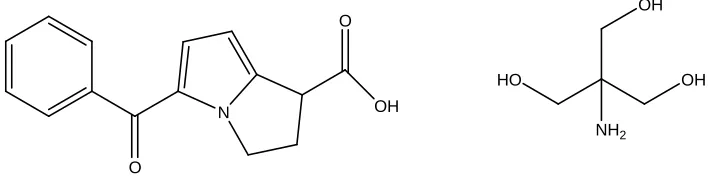
Many NSAIDs have been marketed, the one among is Ketorolac Tromethamine. Ketorolac Tromethamine (KETO) is chemically, 5-Benzoyl-2,3 -Dihydro-1H-Pyrolizine-1-Carboxylic Acid,2 Amino-2-(hydroxymethyl)-1,3-Propaneddiol (Fig. 2). When administered as eye drops demonstrated analgesic, anti-histaminic, anti-inflammatory and anti-pyretic activity. The mechanism of action is to inhibit prostaglandins biosynthesis and given systemically does not cause pupil constriction [6-8].
N
O
HO
NH2
OH OH
[image:2.595.120.476.176.264.2]OH O
Fig. 2: Structure of Ketorolac Tromethamine
Literature survey revealed that various analytical methods like spectrophotometric [9-13], HPLC [14-21], HPTLC [22-26] and SFC[27] have been reported for the determination of GATI and KETO either individually or combination with some other drugs. Gatifloxacin and Ketorolac Tromethamine are available in eye drops as combined ophthalmic dosage forms.
High-performance thin-layer chromatography (HPTLC) is a form of thin-layer chromatography (TLC) that provides superior separation power using optimized coating material, novel procedures for mobile-phase feeding, layer conditioning, and improved sample application. It promotes for higher separation efficiencies, shorter analysis time, lower amounts of mobile phase, and efficient data acquisition and processing. Most methods reported in the literature for the simultaneous determination of GATI and KETO in formulations by using UV -Sp ect ro s co p y an d HPLC. However none of the above method simultaneously determines GATI and KETO. To the best of author’s knowledge, there is no method for the determination of GATI and KETO simultaneously as the bulk drug and in Eye drops using high-performance thin-layer chromatography (HPTLC). Herewith a new, precise and accurate HPTLC method was developed and validated for the simultaneous determination of GATI and KETO in bulk drugs and Eye drops.
EXPERIMENTAL SECTION
Materials, chemicals and equipment:
GATI a n d KETO reference standards were obtained from Wockhart Pharmaceuticals Pvt. Ltd. (Aurangabad, India). Eye drops of GATI and KETO (Sun Pharma manufacturers) were p r o c u r e d from retail pharmacies, Aurangabad (Maharashtra, India). Toluene, n-butanol and tri ethyl amine were obtained from Merck and of analytical grade.
A Camag HPTLC system equipped with a sample applicator Linomat V, twin trough plate development chamber, TLC Scanner III, Reprostar and Wincats 4.02, integration software (Switzerland). Pre-coated silica gel 60 F254 TLC aluminium plates (0.2 mm thick) were obtained from E. Merck Ltd., Mumbai (India).
Method development and validation Preparation of standard solutions
Weigh accurately 10 mg reference standard GATI and KETO individually and was dissolved in methanol and made up to 10 ml in a volumetric flask separately to get the strength of 1 mg/ml. These solutions were used as Working Standard solutions for the analysis.
Method Development
Fig. 3: Chromatogram showing resolu
Fig. 4: Chromato
Development of the plate was carri plates were dried by hair dryer.
Densitometric scanning was done
esolution of Gatifloxacin (Rf = 0.32±0.03) and Ketorolac Tromethamine
ogram showing resolution of Gatifloxacin and Ketorolac Tromethamine
arried out by the ascending technique to a migration d
in absorbance mode at 320 nm using a deuterium lam
Ketorolac Tromethamine (Rf = 0.55±0.02)
Ketorolac Tromethamine
distance of 7 cm. Then the
Vandana Patil et al
J. Chem. Pharm. Res., 2013, 5(9):135-141
______________________________________________________________________________
were set at 6mm×0.30mm, the scanning speed at 20 mm/s and the data resolution at 100 m/step. Single wavelength detection was performed because we are dealing with main components analyses and not impurity determinations where scanning at the individual λ max values would be preferred.
These conditions were transferred to the HPTLC system and the results were evaluated with the aim of achieving an optimum separation between spots (Rs ≥2.0) and a migration of spots with Rf values between 0.32 and 0.55 in order to ensure separation reproducibility (Fig. 3 and Fig. 4).
Method Validation Linearity
[image:4.595.134.468.281.674.2]A stock standard solution with 1mg/ml of each GATI and KETO were prepared in methanol. A volume of 2µl of each solution was applied on the HPTLC plate to deliver 200, 400, 600, 800 and100 ng GATI and KETO per spot. This was done in triplicate and repeated for three days. For each concentration, the applied spot bands were evenly distributed across the plate to minimize possible variation along the silica layer. The linearity was evaluated visually by looking at the calibration curves of GATI and KETO in Fig. 5 and Fig. 6 respectively.
Fig. 5: Calibration curve of Gatifloxacin
Fig. 6: Calibration curve of Ketorolac Tromethamine
Precision
The repeatability and time-different intermediate precision were determined simultaneously. Intra-day assay precision was found by analysis of standard drug at three times on the same day. Inter-day assay precision was
y = 17.97x + 4142. r² = 0.998
0 5000 10000 15000 20000 25000
0 200 400 600 800 1000 1200
A
re
a
(
cm
2
)
Concentration (ng/spot)
Calibration of KETO
y = 11.05x + 3812. r² = 0.997
0 2000 4000 6000 8000 10000 12000 14000 16000
0 200 400 600 800 1000 1200
A
re
a
(
cm
2
)
carried out using at three different days and percentage relative standard deviation (%RSD) was calculated. The RSD was found to be less than two for both intra-day and inter-day precision. Repeatability of sample application was assessed by spotting 400, 600 and 800 ng of drug solutions, three times. From the peak areas, the percentage RSD was determined. The intra-day and inter-day accuracy and precision of GATI and K E T O were shown in Table 1 and 2 respectively.
Table 1 : Evaluation of intra-day and inter-day precision of Gatifloxacin
GATI taken (ng/spot) Intraday Precision Interday Precision GATI (ng/spot) % RE % RSD GATI (ng/spot) % RE % RSD
400 389 1.2 0.05 359 2.5 0.18
600 579 2.6 0.19 568 1.8 0.07
[image:5.595.124.471.189.314.2]800 786 1.8 0.07 767 1.4 0.06
Table 2: Evaluation of intra-day and inter-day precision of Ketorolac Tromethamine
KETO taken (ng/spot) Intraday Precision Interday Precision KETO (ng/spot) % RE % RSD KETO (ng/spot) % RE % RSD
400 391 2.8 0.20 364 1.4 0.06
600 582 1.9 0.08 559 1.2 0.04
800 779 1.4 0.06 751 1.5 0.06
Accuracy
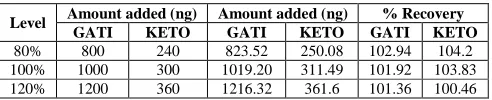
The accuracy of the method was assessed by determination of the recovery of the method at three different concentrations (80%, 100% and 120% concentration) by addition of known amount of standard to the placebo. Solutions were prepared in triplicate and analyzed. This procedure was repeated for three consecutive days. Calibration curves to estimate the concentration of drug per spot were measured daily on the same plates as the samples. The accuracy was determined and expressed as percentage recovery (Table 3).
Table 3: Recovery Data
Level Amount added (ng) Amount added (ng) % Recovery GATI KETO GATI KETO GATI KETO
80% 800 240 823.52 250.08 102.94 104.2
100% 1000 300 1019.20 311.49 101.92 103.83
120% 1200 360 1216.32 361.6 101.36 100.46
Analysis of Eye Drop samples
The method was used for quantisation of Gatifloxacin and Ketorolac Tromethamine in Eye drops procured from local pharmacy. For sample preparation, methanol was used as solvent for extraction and dilution. Twenty Eye drops were mixed well. Portions of mixture equivalent to 3 mg of GATI and 4 mg of KETO were accurately measured (2ml of Eye Drop) into a 10 ml volumetric flask. The mixture was diluted up to 10 ml volume with methanol. Further 1ml was diluted with 10 ml of methanol. Mixed well and filtered through Whattman filter paper no 41 to obtain the sample stock solution. Further 2 ml of the stock solution was diluted with 10 ml of methanol to get the concentration of 6 µg/ml GATI and 8 µg /ml KETO, used as test solution for quantitative analysis of Ketorolac Tromethamine from Gatilox PLUS Eye drop. 2µl of the test solution was applied on the pre-coated silica gel 60F254 plate and from the peak area obtained; the amount of Gatifloxacin and Ketorolac Tromethamine in formulation was simultaneously calculated using the respective calibration graph. The amount obtained per e ye d r o p and percentage label claim are shown in Table 4 . Chromatogram showing GATI(peak 1) and KETO (peak 2) from the solution of spiked Eye drop matrix (Fig. 4) Separation was performed on silica gel 60F254 plates. The mobile phase is comprised of N-butanol, toluene and Tri ethyl amine (6.5:3:0.5, v:v:v). Densitometric evaluation o f t h e separated z o n e s w a s p e r f o r m e d a t 5 7 0 n m . Chromatogram s h o w i n g resolution of Gatifloxacin (Rf = 0.32±0.03) and Ketorolac Tromethamine (Rf = 0.55±0.02) as shown in Fig 3 and
[image:5.595.176.422.419.469.2]Vandana Patil et al
J. Chem. Pharm. Res., 2013, 5(9):135-141
______________________________________________________________________________
Table 4 : Assay Results of Eye drop Dosage Form
Formulation Amount amount added (mg) Amount Found ± SD (mg)
% of Drug Found ± SD Eye Drops GATI KETO GATI KETO GATI KETO
0.6 2.5 0.59 2.48 98.3 ± 1.7 99.2 ± 1.5
For the determination of Gatifloxacin and Ketorolac Tromethamine, sample solutions were prepared in triplicate and analyzed according to the method procedure. Sample and standard solutions were spotted on the same plate.
Reproducibility:
Reproducibility is assessed by means of an inter-laboratory trial. Reproducibility should be considered in case of the standardization of an analytical procedure, for instance, for inclusion of procedures in Pharmacopoeias. These data are not part of the marketing authorization dossier.
Table 5: Reproducibility testing of the developed method (n=5) For GATI and KETO.
Compound Amount (ng/spot) Mean area S.D C.V GATI 400 8280.6 16.5 0.19
KETO 400 10854.5 21.4 0.23
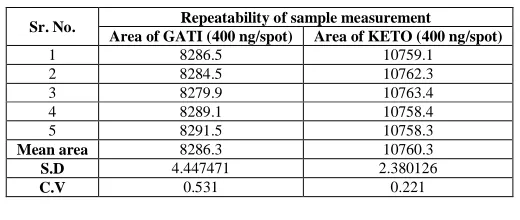
Repeatability
[image:6.595.168.428.377.487.2]Repeatability should be assessed using a minimum of 9 determinations covering the specified range for the procedure (e.g., 3 concentrations /3 replicates each);
Table 6: Repeatability testing of the developed method (n=6) For GATI and KETO.
Sr. No. Repeatability of sample measurement
Area of GATI (400 ng/spot) Area of KETO (400 ng/spot)
1 8286.5 10759.1
2 8284.5 10762.3
3 8279.9 10763.4
4 8289.1 10758.4
5 8291.5 10758.3
Mean area 8286.3 10760.3
S.D 4.447471 2.380126
C.V 0.531 0.221
RESULTS AND DISCUSSION
During the stage of method development different mobile phases were tried and the mobile p h a s e comprising o f n - b utanol, toluene and tri ethyl amine (6.5:3:0.5, v:v:v) was confirmed. A good linear relationship was obtained over the concentration range 200-1000 ng/spot with regression coefficient of 0.997 for Gatifloxacin (Fig. 5) and 0.998 for Ketorolac Tromethamine (Fig. 6). The LOD with signal/noise ratio were found to be 6.4 and 8.1 ng/spot for Gatifloxacin and Ketorolac Tromethamine respectively. The LOQ with signal/ noise ratio was found to be 22.6ng and 27.45 ng/spot for Gatifloxacin and Ketorolac Tromethamine respectively. The repeatability showed excellent % RSD less than 2 % after six applications (Table 1 and Table 2). The recovery was 102.94, 1 0 1 .9 2 and 101.36% for GATI and 104.2, 103.83 and 100.46% for KETO at 80% 100% and 120% levels (Table 3). Assay results show excellent label claim of 98.4 % for GATI and 100 % for KETO (Table 4). In conclusion, the method was considered to have an acceptable sensitivity, recovery and accuracy (Table 5 and Table 6).
CONCLUSION
REFERENCES
[1]Douglas, N. Pharmacotherapy. 2001, 21, 35-59.
[2]S Budavari, The Merck Index., Merck and Co. Inc., 13th Edition, White-house Station, NJ, 2001, 777.
[3]PM Sabale, P Kaur, Y Patel, J Patel, R Patel; Journal of Chemical and Pharmaceutical Research, 2012, 4(11):4921-4936.
[4]A Tiwari, RK Shukla; Journal of Chemical and Pharmaceutical Research, 2010, 2(3):348-355.
[5]S Muraraiah, R Kavitha, FU Rahman, Jayanthi; Journal of Chemical and Pharmaceutical Research, 2012, 4(2):1222-1230.
[6]USP; United States Pharmacopeial Convention; Vol. 1.; 2003; 1049.
[7]Tripathi KD. Essential of Medical Pharmacology, 5th Edition, Jaypee Brothers Medical Publishers (P) Ltd, New Delhi, 2004,178-179.
[8]R Narasimharao, S Somashekar, K Prakash; Journal of Chemical and Pharmaceutical Research; 2011,
3(1):360-381.
[9]KV Ilango, P. Lakshmi, KS Kiran; A Kumar; Indian Journal of Pharmaceutical Science 2006; 68(12):273-275. [10]Yarcli L. Guadalupe M. Waksman N. Caleoros M.; Analytical Letters; 2005; 38(14): 2355-2364.
[11]PB Nagrajan, G. Dinkar, A Rao, G. Hussain S; Der Pharmacia Lettre; 2011; 3(3): 62-68.
[12]G Kumarswamy, JMR Kumar, JVLN Sheshagirirao; International Journal of Chemistry Tech. Research; 2012; 4(2): 847-850.
[13]LR Gandhi, AD Dewani, RL Bakal, MR Shiradkar, AV Chanduwar; International Journal of Pharmacy
Research and Development ; 2011; 3(7); 21-26.
[14] R Nirogi, S Kota, S Vennila; V Kandikere and K Mudigonda; Journal of Cromatographic Science; 2010; 48(2): 100-103.
[15]HR Shalgado, CG Lopez; Journal of the Association of Official Analytical Chemistry; 2006; 89(3): 642-645. [16]L Rao, A Ravikumar, BNV Girijashankar; Journal of Pharmaceutical Research and Health Care; 2011; 3(3): 73-76.
[17] BG Tsevetkota, IP Enchena; Der Pharmacia Sinica; 2012; 3(4); 400-403.
[18] N Connor, M Geary, M Wharton, L Curtin; Journal of Applied Pharmaceutical science; 2012; 2(5); 15-21. [19]LF Sara, A Mario; Journal of Bioanalysis and Biomedicine; 2010; 2(6); 121-124.
[20]TI Chu, F Kaloostian, PM Anne; Journal of Chromatography and Related Tech.; 1996; 19(6); 957-967.
[21]G Kumarswamy, JMR Kumar, B Bikshapati, R Spandana; Journal of Drug delivery and Therapeutics; 2012; 2(3)284-288.
[22]SK Motwani, RK Khar, FJ Ahmad, S Chopra, K Kohli, J Iqbal; Analytical chim Acta; 2006; 576(2): 253-260. [23]B Pratap, G Nagarjun, C. Roosewett, V Gopal; Der Pharma letter; 2010; 2(3):163-167.
[24]BN Suhagia, SA Shah, IS Patel HM, DR Shah; Journal of Analytical Science; 2006; 22(5): 743-745. [25]PV Devarajan, SP Gore, SV Chavan; . J Pharm Biomed Anal. 2000; 22 (4):679-683.