University of South Carolina
Scholar Commons
Theses and Dissertations
2015
A Quantitative Examination of the Use of
Stand-Alone Courses and Infused Curricula on Middle
School Counselors' Perceptions of Preparedness
with Legal and Ethical Dilemmas
Angelica Greiner
University of South Carolina - Columbia
Follow this and additional works at:https://scholarcommons.sc.edu/etd
Part of theCounselor Education Commons
This Open Access Dissertation is brought to you by Scholar Commons. It has been accepted for inclusion in Theses and Dissertations by an authorized administrator of Scholar Commons. For more information, please [email protected].
Recommended Citation
A QUANTITATIVE EXAMINATION OF THE USE OF STAND-ALONE COURSES AND INFUSED CURRICULA ON MIDDLE SCHOOL COUNSELORS’ PERCEPTIONS OF
PREPAREDNESS WITH LEGAL AND ETHICAL DILEMMAS
by
Angelica Greiner
Bachelor of Arts John Carroll University, 2007
Master of Education John Carroll University, 2010
Submitted in Partial Fulfillment of the Requirements
For the Degree of Doctor of Philosophy in
Counselor Education
College of Education
University of South Carolina
2015
Accepted by:
Joshua Gold, Major Professor
Ryan Carlson, Committee Member
Moody Crews, Committee Member
Payal Shah, Committee Member
DEDICATION
This dissertation is dedicated to my Poppa, Mom, Gran Gran, Grandpa Charlie,
Daughter, and Husband. To my Poppa, I missed your little tokens of encouragement
throughout this journey, but I know you are smiling down on me from Heaven. To my
Mom, you’ve been there for me every step of the way—even when I faced roadblocks—
thank you for your unconditional love and support. To my Gran Gran, from a very young
age, you’ve taught me the importance of an education. You’ve taught me the importance
of never giving up and challenging myself. I truly cherish the conversations that we’ve
had throughout this journey. To my Grandpa Charlie, thank you for always believing in
me and helping me reach my dreams. I am forever grateful for your unconditional
support along the way. To my daughter Ella, I started writing this dissertation when I
was induced with you. You are now one year old, and I am beyond blessed for your
smiles, giggles, and cuddles throughout this past year—they’ve kept me going and
continue to keep me going in life. To my husband, Raymond, I am forever grateful for
your patience, encouragement, humor, and extra help throughout this journey. From
watching Ella so I could have weekend-long writing sessions, to making sure I balanced
family and school by setting up family dates, to “cooking” for me to make sure I had fuel
to write—you are one in a million. Thank you for being there for me every step of the
ACKNOWLEDGEMENTS
I would like to acknowledge my family, friends, coworkers, and professors that
have provided me with the strength and encouragement to make it through this journey.
In particular, I am truly grateful for the guidance and support from my chair, Joshua
Gold, for believing in me and being there for me every step of the way. After working all
day and night on a chapter or edits, it was always refreshing to see your feedback and
kind words in my inbox the following morning. I appreciate your honesty and high
expectations through this process. You made sure that no stone was left unturned as I
wrote my dissertation, which prepared me for my defense. Thank you for taking the time
and effort to help me grow as a counselor, counselor educator, and researcher throughout
ABSTRACT
As school counselors are at a heightened risk for facing litigation, it is imperative that
they are appropriately trained to effectively respond to legal and ethical issues they may
encounter in their daily work. The purpose of the current study was to investigate the
effects of stand-alone courses and infused curricula on middle school counselors’
self-described preparedness to effectively respond to legal and ethical dilemmas. Data was
collected from middle school counselors in South Carolina by using an electronic survey.
The researcher used the Ethical and Legal Issues in Counseling Self-Efficacy Scale as the
instrument to determine their preparedness to respond to legal and ethical issues.
Descriptive statistics were used to analyze the data. The results of this study may help
counselor educators advocate for curriculum changes that best meet the legal and ethical
training needs of their graduate students.
TABLE OF CONTENTS
DEDICATION ... iii
ACKNOWLEDGEMENTS ... iv
ABSTRACT ...v
LIST OF TABLES ... ix
LIST OF ABBREVIATIONS ... .xii
CHAPTER 1: INTRODUCTION ...1
PROBLEM STATEMENT ...6
NATURE OF STUDY ...8
PURPOSE OF STUDY ...12
BACKGROUND AND THEORETICAL BASIS ...13
OPERATIONAL DEFINITIONS ...15
ASSUMPTIONS,LIMITATIONS,SCOPE, AND DELIMITATIONS ...19
SIGNIFICANCE OF STUDY ...21
SUMMARY ...25
CHAPTER 2: LITERATURE REVIEW ...27
CONTENT AND ORGANIZATION OF REVIEW...27
STRATEGY USED FOR SEARCHING THE LITERATURE ...28
AN OVERVIEW OF THE LEGAL SYSTEM IN COUNSELING ...29
LEGAL AND ETHICAL ISSUES IN COUNSELING ...31
GRADUATE TRAINING PROGRAMS ...44
PRECEDENCE IN DEMOGRAPHIC DATA ...56
SUMMARY ...57
CHAPTER 3: METHODOLOGY ...59
RESEARCH DESIGN AND APPROACH ...59
SETTING AND SAMPLE ...61
INSTRUMENTATION AND MATERIALS ...64
THREATS TO INTERNAL AND EXTERNAL VALIDITY ...68
DATA COLLECTION ...69
DATA ANALYSIS ...69
PARTICIPANTS’RIGHTS ...75
SUMMARY ...76
CHAPTER 4: RESULTS ...77
SAMPLE ANALYSIS...77
DEMOGRAPHICS ...78
RESEARCH HYPOTHESES ANALYSIS ...80
POST HOC ANALYSIS ...114
SUMMARY ...139
CHAPTER 5: DISCUSSION ...141
OVERVIEW ...141
HYPOTHESES DISCUSSION ...142
IMPLICATIONS ...159
CONCLUSIONS ...167
REFERENCES ...170
APPENDIX A-ETHICAL AND LEGAL ISSUES IN COUNSELING SELF-EFFICACY SCALE ...176
LIST OF TABLES
Table 4.1 Frequencies of Participants by Gender ...78
Table 4.2 Frequencies of Participants by Years of Experience ...78
Table 4.3 Frequencies of Participants by Highest Degree Earned ...79
Table 4.4 Frequencies of Participants by Work Setting ...79
Table 4.5 Frequencies of Participants by Ethics Curriculum Structure ...80
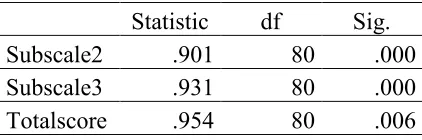
Table 4.6 Shapiro-Wilk Test for Normality ...81
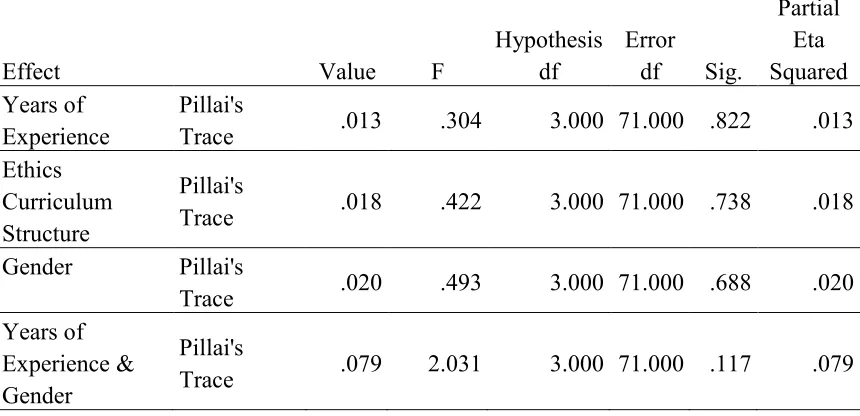
Table 4.7 MANOVA-ELICSES Main and Interaction Effects ...82
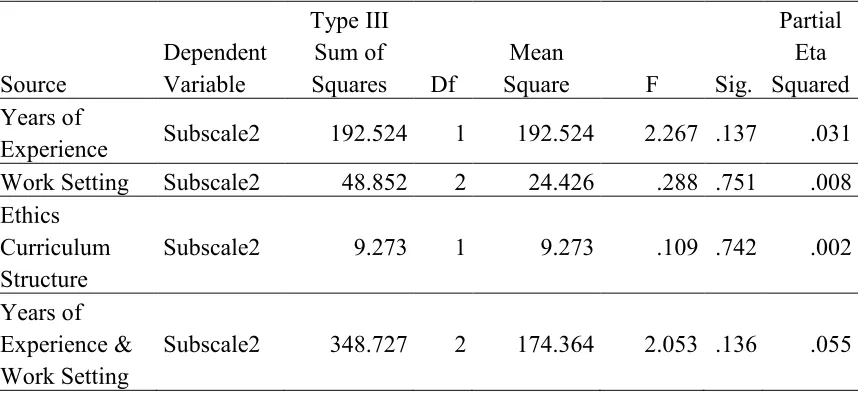
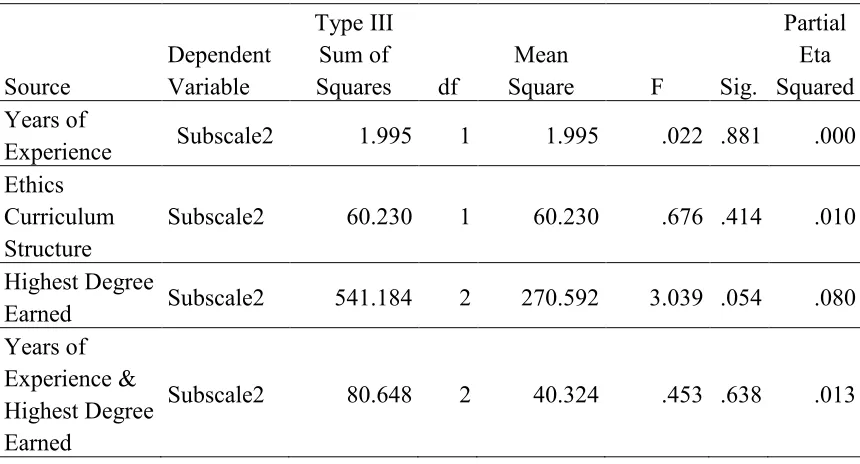
Table 4.8 Test of Between-Subject Effects-Subscale Two Main and Interaction Effects .84 Table 4.9 MANOVA-ELICSES Main and Interaction Effects ...85
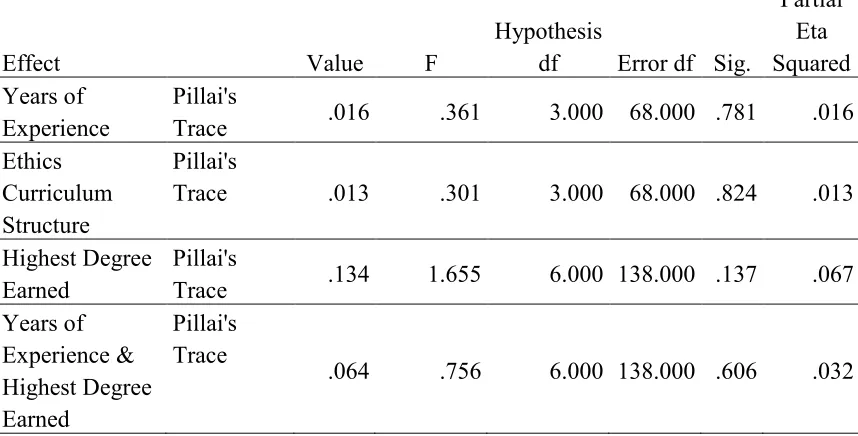
Table 4.10 Test of Between-Subject Effects-Subscale Two Main and Interaction Effects ...87
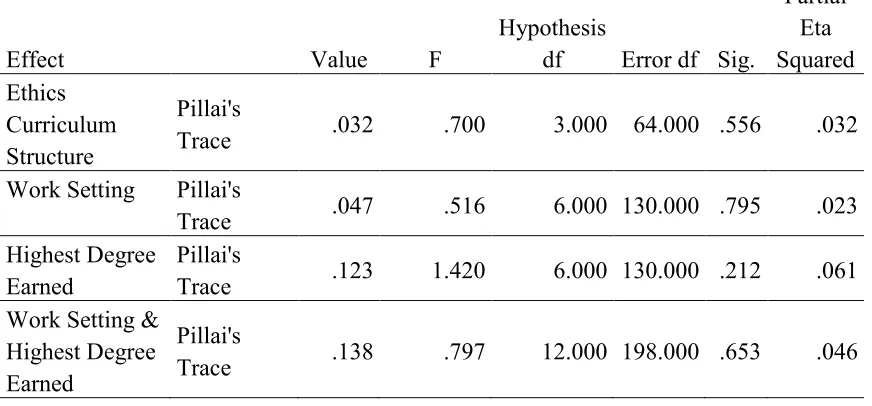
Table 4.11 MANOVA-ELICSES Main and Interaction Effects ...88
Table 4.12 Test of Between-Subject Effects-Subscale Two Main and Interaction Effects ...90
Table 4.13 MANOVA-ELICSES Main and Interaction Effects ...91
Table 4.14 Test of Between-Subject Effects-Subscale Two Main and Interaction Effects ...93
Table 4.15 MANOVA-ELICSES Main and Interaction Effects ...95
Table 4.16 Test of Between-Subject Effects-Subscale Two Main and Interaction Effects ...96
Table 4.18 Test of Between-Subject Effects-Subscale Two Main
and Interaction Effects ...100
Table 4.19 MANOVA-ELICSES Main and Interaction Effects ...101
Table 4.20 Test of Between-Subject Effects-Subscale Three Main
and Interaction Effects ...103
Table 4.21 MANOVA-ELICSES Main and Interaction Effects ...104
Table 4.22 Test of Between-Subject Effects-Subscale Three Main
and Interaction Effects ...106
Table 4.23 MANOVA-ELICSES Main and Interaction Effects ...107
Table 4.24 Test of Between-Subject Effects-Subscale Three Main
and Interaction Effects ...109
Table 4.25 MANOVA-ELICSES Main and Interaction Effects ...111
Table 4.26 Test of Between-Subject Effects-Subscale Three Main
and Interaction Effects ...112
Table 4.27 MANOVA-ELICSES Main and Interaction Effects ...114
Table 4.28 Test of Between-Subject Effects-Subscale Three Main
and Interaction Effects ...116
Table 4.29 MANOVA-ELICSES Main and Interaction Effects ...117
Table 4.30 Test of Between-Subject Effects-Subscale Three Main
and Interaction Effects ...119
Table 4.31 MANOVA-ELICSES Main and Interaction Effects ...121
Table 4.32 Test of Between-Subject Effects-Total Scores Main
and Interaction Effects ...123
Table 4.34 Test of Between-Subject Effects-Total Scores Main
and Interaction Effects ...126
Table 4.35 MANOVA-ELICSES Main and Interaction Effects ...127
Table 4.36 Test of Between-Subject Effects-Total Scores Main
and Interaction Effects ...129
Table 4.37 MANOVA-ELICSES Main and Interaction Effects ...130
Table 4.38 Test of Between-Subject Effects-Total Scores Main
and Interaction Effects ...132
Table 4.39 MANOVA-ELICSES Main and Interaction Effects ...134
Table 4.40 Test of Between-Subject Effects-Total Scores Main
and Interaction Effects ...135
Table 4.41 MANOVA-ELICSES Main and Interaction Effects ...137
Table 4.42 Test of Between-Subject Effects-Total Scores Main
and Interaction Effects ...138
LIST OF ABBREVIATIONS
ASCA ... American School Counselor Association
CACREP ... Council for Accreditation of Counseling and Related Educational Programs
ELICSES ... Ethical and Legal Issues in Counseling Self-Efficacy Scale
CHAPTER 1
INTRODUCTION
While the perception of school counseling is that of a profession focused solely
on client needs, its practice does entail attention to the domains that have been legally
enacted to guide that practice. Law can be defined as, “a body of principles, standards,
and rules that govern human behavior by creating obligations as well as rights, and by
imposing penalties” (Hudgins & Vacca, 1999). School counselors must abide by federal
and state laws, as well as state statutes; however these laws and statues lack practical
meaning until judges interpret them in the court of law (Hudgins & Vacca, 1999).
Therefore, the interpretations of laws and statutes influence the legal obligations school
counselors owe to their clients (Hudgins & Vacca, 1999). Moreover, case law in other
states can influence a judge’s decision in the counselor’s jurisdiction (Hudgins & Vacca,
1999). Accordingly, since the legal obligation of school counselors is multifaceted, they
are likely to face a number of legal issues.
When school counselors do not fulfill their legal obligations, they may be subject
to civil and/or criminal court proceedings (Remley & Herlihy, 2001). If a school
counselor violates a criminal law, the government may take action (Remley & Herlihy,
2001). Additionally, depending on the outcome of the case, the school counselor may
have to pay a fine or serve time in prison (Remley & Herlihy, 2001). In contrast, a
court determines that the school counselor was negligent, the school counselor may have
to pay damages to the plaintiff (Remley & Herlihy, 2001).
When clients feel that they have been harmed emotionally and/or physically by a
professional, they may file a malpractice lawsuit (Corey, Corey, & Callanan, 1998). In
order for a malpractice lawsuit to be successful, the client must establish: (1) the school
counselor had a duty to the client, (2) the school counselor breached the duty owed to the
client, and (3) the client was mentally and/or physically harmed by the professional
(Corey, Corey, & Callanan, 1998). Moreover, in order for professionals to be found
negligent, the court must determine that they did not, “exercise the knowledge, skill, and
judgment common to other members in the profession” (Corey, Corey, & Callanan,
1998). In today’s litigious society, school counselors are at a heightened risk for facing
malpractice lawsuits (Corey, Corey, & Callanan, 1998).
There are a number of ways school counselors can violate criminal and civil laws.
For example, if school counselors fail to report suspected child abuse, they may face
criminal penalties and civil liability (Lambie, 2005). Additionally, failure to maintain
confidentiality has also led to criminal and civil court proceedings for school counselors
(Glosoff, 2002). The duty to warn and protect has been an area that school counselors
have been found negligent (Isaasc, 1997). Moreover, school counselors have been found
liable for not protecting suicidal clients (Capuzzi, 2002). When school counselors
respond or fail to respond to a subpoena, they may face civil or criminal issues (Barsky,
2012). Lastly, school counselors may encounter civil and criminal court proceedings if
In addition to federal and state laws and statutes, school counselors must also
abide by standards and competencies set forth by the profession. The American School
Counselor Association (ASCA) has created standards and competencies as a guide for
professional school counselors. More specifically, ASCA’s competencies, “outline the
knowledge, abilities, skills, and attitudes that ensure school counselors are equipped to
meet the rigorous demands of the profession and the needs of pre K-12 students” (ASCA,
School Counselor Competencies, 2007). These competencies include:
• I-A-7. Knowledge of legal, ethical, and professional issues in pre K-12 schools
• I-B-1g. Demonstrates multicultural, ethical, and professional competencies in
planning, organizing, implementing, and evaluating the comprehensive school
counseling program
• II-A-7. Knowledge of legal and ethical standards and principles of the school
counseling profession and educational systems, including district and building
policies
• II-B-4. Applies the ethical standards and principles of the school counseling
profession and adheres to the legal aspects of the role of the school counselor
• II-B-4a. Practices ethical principles of the school counseling profession in
accordance with the ASCA Ethical Standards for school counselors
• II-B-4f. Resolves ethical dilemmas by employing an ethical decision-making
model appropriate to work in schools
• II-B-4g. Models ethical behavior
• II-B-4k. Understands and applies an ethical and legal obligation not only to
Additionally, the American Counseling Association (ACA) has created a Code of
Ethics as a guide for professional counselors. More specifically, ACA’s Code of Ethics,
“sets forth the ethical obligations of ACA members and provides guidance intended to
inform the ethical practice of professional counselors” (ACA Code of Ethics, 2014). The
ACA Code of Ethics speaks directly to the responsibility of counselor educators by
including the following standard in its Code of Ethics:
• F.7.e. Teaching Ethics: Throughout the program, counselor educators ensure that
students are aware of the ethical responsibilities and standards of the profession
and the ethical responsibilities of students to the profession. Counselor educators
infuse ethical considerations throughout the curriculum
Moreover, counselor training programs must adhere to particular standards and
competencies set forth by the Council for Accreditation of Counseling and Related
Programs (CACREP). This organization established a set of standards that will, “ensure
that students develop a professional counselor identity and master the knowledge and
skills to practice effectively” (CACREP, 2009). The standards that counselor educators
must ensure their students master include:
• G.1j. Ethical standards of professional organizations and credentialing bodies,
and applications of ethical and legal considerations in professional counseling
Since school counselors and counselor educators are required to abide by legal
and ethical standards and competencies set forth by the profession and the state of South
Carolina, it is imperative that graduate training programs adequately prepare graduate
students to handle legal and ethical issues they may encounter in the field (Colby &
ethics is during their graduate program. Although counselor educators prefer to utilize
lecture and discussion techniques as their primary modes of ethical instruction, they do
not follow a universal ethics curriculum (Downs, 2003; Hill, 2004; Patel, Hagedorn, &
Bai, 2013). While studies have been conducted to examine strategies and techniques
utilized by counselor educators to teach ethics to graduate students, they are limited in
that they do not take their investigations a step further by examining whether the chosen
strategies and techniques prepare counselors to effectively respond to legal and ethical
challenges. (Nelson & Neufeldt, 1998; Corey, Corey, & Callanan, 2005; Jordan &
Stevens, 2001; Colby & Long, 1994).
Although some programs offer stand-alone ethics courses, other programs infuse
ethics as a topic across their curriculum (Gibson & Pope, 1993; Neukrug & Milliken,
2011; Urofsky & Sowa, 2004). Graduate programs that offer stand-alone ethics courses
often heighten their students’ awareness of legal and ethical issues (Welfel & Lipsitz,
1983). Additionally, some counselor educators believe that infused programs are
ineffective in adequately training graduate students (Handelsman, 1986). Instead, they
believe that a stand-alone course in ethics should be offered to graduate students to
adequately prepare them to manage these types of issues in the field (Handelsman, 1986).
While CACREP does not require graduate programs to offer a stand-alone course in
ethics, literature suggests that graduates of CACREP-accredited programs are less likely
to face ethical misconduct sanctions compared to graduates from non-CACREP
accredited programs (Even and Robinson, 2013). While research explores the use of
stand-alone courses and infused curricula in counselor education programs (Neukrug &
Hill, 2004), few studies have investigated the effects of stand-alone courses and infused
curricula on counselors’ perceptions of preparedness to respond to legal and ethical issues
(Lambie, Hagedorn, & Ieva, 2010; Even & Robinson, 2013).
Although all school counselors are required to abide by legal and ethical standards
and competencies set forth by the profession and the state of South Carolina, there are
undoubtedly those school counselors who do not abide by them. For some school
counselors, they may be less prepared to effectively manage legal and ethical issues in
the field. In order to consider some of the reasons for the differences in preparedness, the
researcher was attempting the current study as a means for determining the preparedness
of middle school counselors to effectively manage legal and ethical issues.
Problem Statement
As school counselors are at a heightened risk for facing civil and criminal
liability, it is important they feel prepared to effectively handle legal and ethical issues
they may encounter in the profession (Hermann, 2002). There is a great deal of research
detailing the legal system as it relates to school counseling (Hudgins & Vacca, 1999;
Remley & Herlihy, 2001; Corey, Corey, & Callanan, 1998; Lambie, 2005; Glosoff, 2002;
Isaac, 1997; Capuzzi, 2002; Barsky, 2012; Boy & Pine, 1968), the types of legal and
ethical issues counselors face in their daily work (Beamish & Navin, 1994; Lawrence &
Kurpius, 2000; Remley, 2002; Hermann, 2002; Mullen, Lambie & Conley, 2014),
perceptions of counselors’ preparedness to respond to legal and ethical issues (Gibson &
Pope, 1993, Davis & Mickelson, 1994; Rawls, 1997; Remley & Huey, 2002; Hermann,
2002; Mullen, Lambie & Conley, 2014), strategies and techniques utilized by counselor
Callanan, 2005; Jordan & Stevens, 2001; Colby & Long, 1994), and the use of
stand-alone courses and infused curricula for teaching ethics and legal issues in counselor
educator programs (Neukrug & Milliken, 2011; Handelsman, 1986; Urofsky & Sowd,
2004; Agresti 1992; Downs, 2003; Hill, 2004). However, there are limited studies that
have investigated the effects of stand-alone courses and infused curricula on school
counselors’ perceptions of preparedness to respond to legal and ethical issues (Lambie,
Hagedorn, & Ieva, 2010; Even & Robinson, 2013).
As school counseling programs continue to allow graduates to enter the
profession, research has shown very little of their preparedness to handle legal and ethical
issues. Another area of research that is lacking in information is the influence of graduate
training programs on preparedness to manage legal and ethical issues. Although research
indicates that there are differences in the types of techniques and methods utilized by
counselor educators to teach ethics courses, there is limited research regarding the
influence of stand-alone courses and infused curricula. More specifically, the format of
ethics training may be an influencing factor in the preparedness of school counselors in
regards to handling legal and ethical issues.
The factors that may influence school counselors’ preparedness have seen very
little and inconsistent research (Hermann, 2002). As school counselors are at a
heightened risk for facing criminal and civil court proceedings, it is necessary to take a
serious look at school counselors’ preparedness to handle legal and ethical issues
(Remley, 2002). It is the belief of the researcher that there may be an effect of middle
school counselors’ graduate training (infused curricula versus stand-alone courses) and
intends to study preparedness of middle school counselors with regards to legal and
ethical issues and determine where gaps may lie within their perceptions of preparedness.
Nature of Study
The current study hoped to answer the following research question: What effect
do stand-alone courses and infused curricula have on middle school counselors’
perceptions of preparedness to effectively respond to legal and ethical issues? While
investigating these differences, the following hypotheses will be considered in regards to
graduate program preparation and perceptions of preparedness to handle legal and ethical
issues:
1. There will be a significant main effect for ethics curriculum structure (stand-alone
course versus infused curriculum), but no main effect or interaction effects for
years of experience or work setting on perceptions of preparedness to handle
suicide, violence, abuse, and neglect (subscale 2 scores) on the Ethical and Legal
Issues in Counseling Self-Efficacy Scale
2. There will be a significant main effect for ethics curriculum structure (stand-alone
course versus infused curriculum), but no main effect or interaction effects for
years of experience or gender on perceptions of preparedness to handle suicide,
violence, abuse, and neglect (subscale 2 scores) on the Ethical and Legal Issues in
Counseling Self-Efficacy Scale
3. There will be a significant main effect for ethics curriculum structure (stand-alone
course versus infused curriculum), but no main effect or interaction effects for
handle suicide, violence, abuse, and neglect (subscale 2 scores) on the Ethical and
Legal Issues in Counseling Self-Efficacy Scale
4. There will be a significant main effect for ethics curriculum structure (stand-alone
course versus infused curriculum), but no main effect or interaction effects for
work setting or gender on perceptions of preparedness to handle suicide, violence,
abuse, and neglect (subscale 2 scores) on the Ethical and Legal Issues in
Counseling Self-Efficacy Scale
5. There will be a significant main effect for ethics curriculum structure (stand-alone
course versus infused curriculum), but no main effect or interaction effects for
work setting or highest degree earned on perceptions of preparedness to handle
suicide, violence, abuse, and neglect (subscale 2 scores) on the Ethical and Legal
Issues in Counseling Self-Efficacy Scale
6. There will be a significant main effect for ethics curriculum structure (stand-alone
course versus infused curriculum), but no main effect or interaction effects for
gender or highest degree earned on perceptions of preparedness to handle suicide,
violence, abuse, and neglect (subscale 2 scores) on the Ethical and Legal Issues in
Counseling Self-Efficacy Scale
7. There will be a significant main effect for ethics curriculum structure (stand-alone
course versus infused curriculum), but no main effect or interaction effects for
years of experience or work setting on perceptions of preparedness to handle
counselor development and wellness (subscale 3 scores) on the Ethical and Legal
8. There will be a significant main effect for ethics curriculum structure (stand-alone
course versus infused curriculum), but no main effect or interaction effects for
years of experience or gender on perceptions of preparedness to handle counselor
development and wellness (subscale 3 scores) on the Ethical and Legal Issues in
Counseling Self-Efficacy Scale
9. There will be a significant main effect for ethics curriculum structure (stand-alone
course versus infused curriculum), but no main effect or interaction effects for
years of experience or highest degree earned on perceptions of preparedness to
handle counselor development and wellness (subscale 3 scores) on the Ethical and
Legal Issues in Counseling Self-Efficacy Scale
10.There will be a significant main effect for ethics curriculum structure (stand-alone
course versus infused curriculum), but no main effect or interaction effects for
work setting or gender on perceptions of preparedness to handle counselor
development and wellness (subscale 3 scores) on the Ethical and Legal Issues in
Counseling Self-Efficacy Scale
11.There will be a significant main effect for ethics curriculum structure (stand-alone
course versus infused curriculum), but no main effect or interaction effects for
work setting or highest degree earned on perceptions of preparedness to handle
counselor development and wellness (subscale 3 scores) on the Ethical and Legal
Issues in Counseling Self-Efficacy Scale
12.There will be a significant main effect for ethics curriculum structure (stand-alone
course versus infused curriculum), but no main effect or interaction effects for
counselor development and wellness (subscale 3 scores) on the Ethical and Legal
Issues in Counseling Self-Efficacy Scale
13.There will be a significant main effect for ethics curriculum structure (stand-alone
course versus infused curriculum), but no main effect or interaction effects for
years of experience or work setting on overall perceptions of preparedness to
handle ethical and legal issues (total score) on the Ethical and Legal Issues in
Counseling Self-Efficacy Scale
14.There will be a significant main effect for ethics curriculum structure (stand-alone
course versus infused curriculum), but no main effect or interaction effects for
years of experience or gender on overall perceptions of preparedness to handle
ethical and legal issues (total score) on the Ethical and Legal Issues in Counseling
Self-Efficacy Scale
15.There will be a significant main effect for ethics curriculum structure (stand-alone
course versus infused curriculum), but no main effect or interaction effects for
years of experience or highest degree earned on overall perceptions of
preparedness to handle ethical and legal issues (total score) on the Ethical and
Legal Issues in Counseling Self-Efficacy Scale
16.There will be a significant main effect for ethics curriculum structure (stand-alone
course versus infused curriculum), but no main effect or interaction effects for
work setting or gender on overall perceptions of preparedness to handle ethical
and legal issues (total score) on the Ethical and Legal Issues in Counseling
17.There will be a significant main effect for ethics curriculum structure (stand-alone
course versus infused curriculum), but no main effect or interaction effects for
work setting or highest degree earned on overall perceptions of preparedness to
handle ethical and legal issues (total score) on the Ethical and Legal Issues in
Counseling Self-Efficacy Scale
18.There will be a significant main effect for ethics curriculum structure (stand-alone
course versus infused curriculum), but no main effect or interaction effects for
gender or highest degree earned on overall perceptions of preparedness to handle
ethical and legal issues (total score) on the Ethical and Legal Issues in Counseling
Self-Efficacy Scale
Additional information on the nature of the study, including the research design,
survey instrument, and procedures of the study will be discussed at greater length in
chapter three.
Purpose of Study
The current study seeks to focus on middle school counselors in South Carolina
perceptions of preparedness to effectively respond to different types of legal and ethical
issues. Specifically, the researcher hoped to answer the following research question:
What effect do stand-alone courses and infused curricula have on middle school
counselors’ perceptions of preparedness to effectively respond to legal and ethical issues?
It was unknown by the researcher as to what degree middle school counselors feel
prepared to effectively respond to legal and ethical issues. The researcher wanted to
study this area as a means for gaining more insight into the factors that may determine
The information gained in this study may provide a number of implications for further
study into this topic. The assumption of the researcher was that the current study would
uncover a significant difference between the groups of middle school counselors. This
perceived difference may provide the researcher with the opportunity to present the need
for additional training among middle school counselors.
Background and Theoretical Base
After taking into account the information to be gained by this study, the
researcher opted to use a quantitative approach. Accordingly, the researcher utilized a
quantitative theoretical framework for the current research study. A qualitative approach
may have produced detailed results that could explain the research question in an
alternative way (Orcher, 2005). The researcher could decide to interview a few middle
school counselors and ask more comprehensive questions about their personal
perceptions and ability to effectively handle legal and ethical issues. By doing so, the
responses would be in-depth and solely pertain to the school counselors being
interviewed. However, the researcher considered the various implication of the research
study and decided to make the study’s results more generalizable to a greater population.
In deciding the research design for the study, the researcher contemplated the research
question to be answered and decided that a quasi-experimental design was appropriate
because no variables were being manipulated in the study (Orcher, 2005). Additionally,
the groups of school counselors participating in the study were not randomized.
The current study compared existing groups of school counselors; therefore, it
was a non-experimental study and the research was causal-comparative in nature
study because it does not manipulate the independent variables (Gay, Mills, & Airasian,
2006). This study will try to determine potential differences among the groups being
compared. Although several studies have been conducted to determine the types of legal
and ethical issues school counselors encounter while on the job (Beamish & Navin, 1994;
Lawrence & Kurpius, 2000; Remley, 2002; Hermann, 2002; Mullen, Lambie & Conley,
2014), there are only a few studies that examine counselors’ perceptions of their ability to
effectively respond to legal and ethical issues (Gibson & Pope, 1993, Davis & Mickelson,
1994; Rawls, 1997; Remley & Huey, 2002; Hermann, 2002; Mullen, Lambie & Conley,
2014).
This study sought to examine the effects of stand-alone courses and infused
curricula on middle school counselors’ perceptions of their ability to effectively respond
to legal and ethical issues by using the Ethical and Legal Issues in Counseling
Self-Efficacy Scale created by Mullen, Lambie, and Conley (2014). By using this survey, the
researcher was able to compare the responses of several middle school counselors.
Although a qualitative approach would have provided a snapshot into the perceptions of
school counselors who had a stand-alone course in ethics and legal issues and school
counselors who had ethics and legal issues infused in all of their course work, it would
not have been possible for the researcher to assume the perception of these counselors in
comparison to one another. Hence, a causal-comparative research design permitted the
researcher to compare the groups of middle school counselors without allowing her
potential bias to negatively impact the results of the study. Moreover, the use of the
Ethical and Legal Issues in Counseling Self-Efficacy Scale allowed the results to be
Operational Definitions
To account for variation in definitions throughout different disciplines that may
be used by the reading audience, the following terms and definitions will be used in the
study. To generate these operational definitions, the researcher utilized peer-reviewed
literature, published documents from the American School Counselor Association,
Merriam-Webster Online Dictionary, Wikipedia, and Encarta Online Dictionary. For the
purposes of this study, the following terms are defined as:
1. American School Counselor Association: The American School Counselor
Association (ASCA) supports school counselors’ efforts to help students focus
on academic, emotional/social and career development so they achieve
success in school and are prepared to lead fulfilling lives as responsible
members of society. (http://schoolcounselor.org).
2. Case Law: For the purposes of this study, case law refers to judges’ rulings
from previous cases.
3. Civil Law: For the purposes of this study, civil law refers to citizens’ private
rights and remedies.
4. Council for Accreditation of Counseling and Related Educational
Programs (CACREP) Accreditation: The Council for Accreditation of
Counseling and Related Educational Programs provides recognition that the
content and quality of a graduate training program has been evaluated and
meets all of the standards set forth by the profession (CACREP, 2009).
5. Criminal Law: For the purposes of this study, criminal law refers to statutes
6. Gender: The behavioral, cultural, or psychological traits that generally relate
to one sex.
7. Highest Degree Earned: For the purposes of this study, highest degree
earned will refer to the highest educational degree a participant has earned in
the field of counseling.
8. Infused Curricula: For the purposes of this study, an infused curriculum will
refer graduate training programs that integrate legal and ethics education into
the counselor curriculum.
9. Jurisdiction: For the purposes of this study, jurisdiction refers to the
geographic areas for which a court has authority.
10.Malpractice: For the purposes of this study, malpractice refers to civil
liability for failing to exercise a duty of care that other professionals would
have exercised in a same or similar situation.
11.Middle School Counselor: For the purposes of this study, a middle school
counselor will be defined as a school counselor who works in a public school
setting serving students in grades 6-8.
12.New School Counselor: Due to minimal literature available in defining new
school counselors, for the purpose of this study, the term “new school
counselor” will refer to those school counselors with five or less years of
experience as a professional school counselor.
13.Negligent: For the purposes of this study, negligent will be defined as
14.Participant: For the purposes of this study, a participant is considered to be a
middle school counselor who completed the Ethical and Legal Issues in
Counseling Self-Efficacy Scale and electronically submitted his or her survey
to the researcher. The term may be used interchangeably with the term
respondent.
15.Plaintiff: For the purposes of this study, a plaintiff will be defined as a
person who brings a lawsuit.
16.Preparedness to respond to legal and ethical issues: For the purposes of
the current study, preparedness to respond to legal and ethical issues will be
defined as the scaled score on the Ethical and Legal Issues in Counseling
Self-Efficacy Scale. The scale ranges from 0 (cannot do at all) to 100 (highly
certain can do).
17.Respondent: For the purposes of this study, a respondent is considered to be
a middle school counselor who completed the Ethical and Legal Issues in
Counseling Self-Efficacy Scale and electronically submitted his or her survey
to the researcher. This term may be used interchangeably with the term
participant.
18.School counselor: Professional school counselors are certified/licensed
educators with a minimum of a master’s degree in school counseling. The
school counselor supports a safe learning environment and works to safeguard
the human rights of all members of the school community and addresses the
19.Stand-alone course: For the purposes of this study, a stand-alone course will
refer to a separate and formal ethics course taken by school counselors during
their graduate training program. A course that focuses on critical issues in the
field of education or legal and policy issues in special education would not be
considered a separate and formal legal and/or ethics course in school
counseling. However, courses that focus on professional identity and ethics or
professional, legal, and ethical issues in school counseling would be
considered a separate and formal legal and/or ethics course in school
counseling.
20.Statute: For the purposes of this study, statute will be defined as law derived
from legislative enactments.
21.Veteran School Counselor: Due to minimal literature available in defining
veteran school counselors, for the purposes of this study, the term “veteran
school counselor” will refer to those school counselors with six or more years
of experience as a professional school counselor.
22. Work Setting: For the purposes of this study, working setting will refer to
the location of the school in which the professional school counselor is
employed. This may be defined as rural, urban, or suburban.
23.Years of Experience: The number of full years of experience a respondent
Assumptions, Limitations, Scope, and Delimitations
Assumptions
The assumption of the researcher was that key legal and ethical issues were
identified based on the literature. It was also assumed that the participants in this study
understood the survey instrument.
Another assumption was that the professional role of the researcher will not
contaminate this quantitative study because the researcher will not have personal and/or
direct contact with the participants. More specifically, since the researcher will solely be
analyzing data, the researcher’s professional role will not come into play. Instead, the
research will remain objective for this study.
The researcher identified the colleges and universities in South Carolina that offer
a school counseling program. Moreover, the researcher determined which colleges and
universities currently offer a stand-alone course or an infused curriculum in legal and
ethical issues. It was the assumption of the researcher that historically these schools have
either provided a stand-alone course or an infused curriculum in legal and ethical issues.
Limitations
One limitation of the study was the survey instrument. More specifically, since
the survey instrument utilized a Likert-type scale to evaluate the degree participants felt
prepared to effectively respond to legal and ethical issues, they were limited in their
responses that they could provide to each of the questions.
Another limitation of the study was the bias of the researcher. Presently, the
researcher is a full-time school counselor in South Carolina. Accordingly, the
A third limitation of the study was the truthfulness of the participants. Even
though the survey results will remain confidential, participants may not be honest when
reporting their perceptions of preparedness with legal and ethical issues. They may do
this for two reasons: (1) they believe their response may be socially undesirable, and (2)
they may respond the way they think the researcher will want them to respond (Agresti &
Finlay, 2009).
A fourth limitation of the study is the assumption that the colleges and
universities listed in the Demographic Data Questionnaire historically offered either a
stand-alone course or an infused curriculum in legal and ethical issues. The researcher
used the current course requirements to determine if the colleges and universities offered
a stand-alone course or an infused curriculum in legal and ethical issues. Accordingly, if
the course requirements have changed over the years, then the respondents may not be
put into the correct group.
Lastly, the researcher’s choice of instrumentation for the survey may be
considered a limitation. While the researchers tested the Legal and Ethical Issues in
Counseling Self-Efficacy Scale for reliability and validity, the instrument has yet to be
utilized for a research study because it was only recently created in 2014. The subscales
of the ELICSES reported on survey respondents’ suicide, violence, abuse, and neglect
self-efficacy and counselor development and wellness self-efficacy. Although these
subscales can infer one’s preparedness to handle legal and ethical issues, the scale did not
specifically measure ‘preparedness with legal and legal issues’. A different survey
Scope
The scope of the present study includes middle school counselors in a sixth
through eighth grade setting in South Carolina. Even though the scope of this study only
includes perceptions of middle school counselors in South Carolina, the results from this
study can provide insight into the legal and ethical training needs of middle school
counselors in the United States.
Delimitations
A delimitation of this study is that participation is limited to middle school
counselors in South Carolina. Moreover, this study only includes middle school
counselors. By not having feedback from high school and elementary school counselors
and limiting participants to those in South Carolina, the complete scope of the issue of
perceptions of preparedness with legal and ethical issues cannot be completely addressed.
Significance of the Study
The researcher determined that the following areas were significant to the study:
knowledge generation, professional application, and social change.
Knowledge Generation
This study aimed to broaden the knowledge of school counselors by examining
the effects of stand-alone and infused courses on middle school counselors’ perceptions
of their ability to effectively handle legal and ethical issues. All school counselors,
regardless of graduate program training, may benefit from the opportunity to receive
legal and ethical training.
The American School Counselor Association (ASCA) has created standards and
counselors are equipped to meet the rigorous demands of the profession and the need of
pre K-12 students” (ASCA, School Counselor Competencies, 2007). These
competencies include:
• I-A-7. Knowledge of legal, ethical, and professional issues in pre K-12 schools
• I-B-1g. Demonstrates multicultural, ethical, and professional competencies in
planning, organizing, implementing, and evaluating the comprehensive school
counseling program
• II-A-7. Knowledge of legal and ethical standards and principles of the school
counseling profession and educational systems, including district and building
policies
• II-B-4. Applies the ethical standards and principles of the school counseling
profession and adheres to the legal aspects of the role of the school counselor
• II-B-4a. Practices ethical principles of the school counseling profession in
accordance with the ASCA Ethical Standards for school counselors
• II-B-4f. Resolves ethical dilemmas by employing an ethical decision-making
model appropriate to work in schools
• II-B-4g. Models ethical behavior
• II-B-4k. Understands and applies an ethical and legal obligation not only to
students but to parents, administration, and teachers as well
Additionally, the American Counseling Association (ACA) has created a Code of
Ethics as a guide for professional counselors. More specifically, ACA’s Code of Ethics,
“sets forth the ethical obligations of ACA members and provides guidance intended to
ACA Code of Ethics speaks directly to the responsibility of counselor educators, by
including the following standard in its Code of Ethics:
• F.7.e. Teaching Ethics: Throughout the program, counselor educators ensure that
students are aware of the ethical responsibilities and standards of the profession
and the ethical responsibilities of students to the profession. Counselor educators
infuse ethical considerations throughout the curriculum
Moreover, counselor training programs must adhere to particular standards and
competencies set forth by the Council for Accreditation of Counseling and Related
Programs (CACREP). This organization established a set of standards that will, “ensure
that students develop a professional counselor identity and master the knowledge and
skills to practice effectively (CACREP, 2009). The standards that counselor educators
must ensure their students master include:
24.G.1j. Ethical standards of professional organizations and credentialing bodies,
and applications of ethical and legal considerations in professional counseling
As school counselors consider the criteria set forth by ASCA and counselor
educators consider the standards set forth by CACREP and ACA in regards to legal and
ethical competencies of school counselors, it will be important to consider the
knowledge created by the present study. School counselors and counselor educators’
adherence to these competencies and standards justifies the need for the present study.
If school counselors are not able to manage legal and ethical issues, it will be more
difficult to adhere to these competencies. School counselors can share data from the
current study with their school districts to advocate for additional legal and ethical
counselor training programs to meet the standards set forth by CACREP and ACA. The
knowledge gained by this study has the potential to promote supplemental training for
all K-12 school counselors who are experiencing lower perceptions of preparedness to
effectively manage legal and ethical issues.
Professional Application
Middle school counselors in South Carolina may use the results of the study to
advocate for legal and ethical training from their school districts. Similarly, counselor
educators may use the results of this study to justify changes in counselor training
programs. By doing so, school counselors may increase their perceptions of preparedness
to effectively manage legal and ethical issues. The knowledge obtained from the results
of this study may also extend to elementary and high school counselors. Moreover, the
results of this study may extend to school counselors outside of South Carolina. The
researcher planned to use the results from this study to encourage school counselors to
request additional legal and ethical training. Lastly, the researcher hoped that the results
of this study would help counselor educators advocate for program changes that would
apply to future graduate students.
Social Change
Social change can be created for future school counselors when the researcher
finds considerable differences in middle school counselors’ perceptions of preparedness
to effectively manage legal and ethical issues. School counselors may encounter
difficulties in responding to legal and ethical issues within the school setting. However,
the school counseling profession has a duty to increase the effectiveness of its school
social change generated by the results of this study is a clearer understanding of the needs
of middle school counselors in relation to legal and ethical training. Accordingly, school
districts can provide legal and ethical training to all of their school counselors. Similarly,
graduate training programs can alter their curricula to best meet the needs of all of their
graduate students. By doing so, graduate students and school counselors will be
adequately trained, which will ultimately lead to higher perceptions of preparedness to
effectively handle legal and ethical issues.
Summary
School counselors must abide by federal and states laws and statutes.
Additionally, they are required to abide by competencies and standards set forth by the
profession. When school counselors fail to abide by laws, statutes, competencies, and
standards, they may face criminal and/or civil court proceedings. School counselors may
experience varying degrees of preparedness to effectively handle legal and ethical issues,
and the current study seeks to find out what differences may occur in their perceptions of
preparedness. More specifically, the researcher hoped to determine the effects of
stand-alone courses and infused curricula on middle school counselors’ perceptions of
preparedness to effectively manage legal and ethical issues. These assumed differences
may provide implications for further study into this area as well as the need for additional
ethics training for graduate students and school counselors in the future. In the next
chapter, a review of the literature will be presented. Chapter three includes the research
methodology used in this study, including a description of the Ethical and Legal Issues in
Counseling Self-Efficacy Scale, procedures for data collection and analysis and study
provide an interpretation of the findings and implications for future research studies
CHAPTER 2
LITERATURE REVIEW
The intent of this chapter is to offer an overview of the literature related to
differences in preparedness with handling legal and ethical issues in middle school
counselors. Current literature related to school counselors’ preparedness to handle legal
and ethical issues is narrow in scope. Additionally, empirical research on this topic is
limited too. Accordingly, the following literature review addresses legal and ethical
issues as they relate to school counselors, such as preparedness, attitudes, perceptions,
and graduate training programs. Moreover, the literature review includes forty articles
ranging in dates from 1968 through 2014.
The review of the literature examined several areas: an overview of the legal
system, legal and ethical issues in counseling, perceptions of preparedness to effectively
handle legal and ethical issues, and graduate training programs. Information regarding the
Ethical and Legal Issues in Counseling Self-Efficacy Scale and causal-comparative
research will be discussed. Several of the studies in the literature review are presented
from the perspective of various educators due to the lack of studies completed utilizing
school counselors. The areas discussed within the literature review were related to the
variables in the study and associated with the research question.
Content and Organization of Review
the review. The understanding of school counselors’ preparedness to handle legal and
ethical issues necessitated an understanding of the foundations of the legal system. The
following chapter is organized based on the following themes: an overview of the legal
system in counseling, legal and ethical issues in counseling, perceptions of preparedness
to handle legal and ethical issues, graduate training programs, defining stand-alone
courses and infused curricula for graduate training programs, the use of the Ethical and
Legal Issues in Counseling Self-Efficacy Scale, and causal-comparative research.
Strategy Used for Searching the Literature
In conducting a literature review for the topic of school counselors’ perceptions of
preparedness with legal and ethical issues, the literature search began in the Thomas
Cooper Library at the University of South Carolina. The online resources available
through the library were utilized by the researcher as a means for accessing article
databases and indexes and electronic resources. Key terms that were used in the search
included: counselor and legal/ethical issues, school counselor and legal/ethical issues,
school counselor and preparedness with legal/ethical issues, school counselor and
graduate training programs, school counselor and ethical decision-making models,
CACREP standards, ASCA competencies, school counselor and stand-alone legal/ethics
course, school counselor and infused legal/ethics curriculum, legal system, Ethical and
Legal Issues in Counseling Self-Efficacy Scale, and causal-comparative research.
Primary search engines for information included Academic Premier, ERIC (EBSCO), and
Psych INFO. Moreover, professional journals such as Professional School Counseling,
Counselor Education and Supervision, and Journal of Counseling and Development were
An Overview of the Legal System in Counseling
Law can be defined as, “a body of principles, standards, and rules that govern
human behavior by creating obligations as well as rights, and by imposing penalties”
(Hudgins & Vacca, 1999). School counselors must abide by federal and state laws, as
well as state statues; however these laws and statues lack practical meaning until judges
interpret them in the court of law (Hudgins & Vacca, 1999). Therefore, the
interpretations of laws and statutes influence the legal obligations school counselors owe
to their clients (Hudgins & Vacca, 1999). Moreover, case law in other states can
influence a judge’s decision in the counselor’s jurisdiction (Hudgins & Vacca, 1999).
Accordingly, since the legal obligation of school counselors is multifaceted, they are
likely to face a number of legal issues.
When school counselors do not fulfill their legal obligations, they may be subject
to civil and/or criminal court proceedings (Remley & Herlihy, 2001). If a school
counselor violates a criminal law, the government may take action (Remley & Herlihy,
2001). Additionally, depending on the outcome of the case, the school counselor may
have to pay a fine or serve time in prison (Remley & Herlihy, 2001). In contrast, a
person may bring a civil suit against a school counselor (Remley & Herlihy, 2001). If the
court determines that the school counselor was negligent, the school counselor may have
to pay damages to the plaintiff (Remley & Herlihy, 2001).
When clients feel that they have been harmed emotionally and/or physically by a
professional, they may file a malpractice lawsuit (Corey, Corey, & Callanan, 1998). In
order for a malpractice lawsuit to be successful, the client must establish: (1) the school
client, and (3) the client was mentally and/or physically harmed by the professional
(Corey, Corey, & Callanan, 1998). Moreover, in order for professionals to be found
negligent, the court must determine that they did not, “exercise the knowledge, skill, and
judgment common to other members in the profession” (Corey, Corey, & Callanan,
1998). In today’s litigious society, school counselors are at a heightened risk for facing
malpractice lawsuits (Corey, Corey, & Callanan, 1998).
There are a number of ways school counselors can violate criminal and civil laws.
For example, if school counselors fail to report suspected child abuse, they may face
criminal penalties and civil liability (Lambie, 2005). Additionally, failure to maintain
confidentiality has also led to criminal and civil court proceedings for school counselors
(Glosoff, 2002). The duty to warn and protect has been an area that school counselors
have been found negligent (Isaasc, 1997). Moreover, school counselors have been found
liable for not protecting suicidal clients (Capuzzi, 2002). When school counselors
respond or fail to respond to a subpoena, they may face civil or criminal issues (Barsky,
2012). Lastly, school counselors may encounter civil and criminal court proceedings if
they are found to be incompetent (Boy & Pine, 1968).
A basic understanding of the legal system in counseling allows one to better
comprehend the legal and ethical challenges school counselors face in the field. Existing
literature reflects the legal and ethical dilemmas school counselors encounter in the
profession; however, research presents information regarding limited information on
school counselors’ perceptions of preparedness to handle legal and ethical issues. The
literature also does not clearly reflect the effects of graduate training programs on school
The researcher intended to examine the effects of stand-alone courses and infused
curricula on middle school counselors’ preparedness to handle legal and ethical issues.
This topic of study was justified due to the lack of research regarding this area. Very
limited research has been conducted in regards to school counselors’ preparedness to
handle legal and ethical issues. The findings of the current study may help to support
changes in graduate training curricula by shedding light on the possible reasons why
school counselors feel unprepared to manage legal and ethical issues they encounter in
their daily work. In reviewing the American School Counselor Association’s School
Counselor Competencies (2007), it is clear that school counselors will need to understand
and be comfortable with handling legal and ethical issues within the work setting.
Moreover, in reviewing the Council for Accreditation of Counseling and Related
Programs standards (2009), it is clear that counselor educators must adequately prepare
their graduate students to understand and be comfortable with handling legal and ethical
issues that they may encounter in the counseling profession. The current study will open
the door to addressing this topic with the hopes that future research will follow suit.
Legal and Ethical Issues in Counseling
When considering school counselors’ perceptions of preparedness to handle legal
and ethical issues, it is important to first identify and understand the types of legal and
ethical issues that they commonly encounter in the field. Although some of the literature
reviewed was outside of the school counseling field and dated, it was used in the current
study as a means for providing a foundational background on the types of issues school
Beamish and Navin (1994) surveyed literature on the legal and ethical issues
mental health counselors may face when working with couples and families. One of the
ethical issues mental health counselors encounter when working with couples and
families is determining which client the counselor is ethically bound to protect. More
specifically, the counselor is bound to protect the welfare of the family and each
individual in the family; however, there are interventions that may benefit the family as a
whole but may not promote the welfare of all family members. Another ethical dilemma
is the issue surrounding informed consent. In particular, issues may arise when children
refuse to participate in family counseling. Additionally, ethical issues may surface when
determining who should participate in the therapeutic process, especially when family
members refuse to participate in counseling. The author noted that ethical dilemmas
regarding confidentiality may arise when working with families. More specifically, since
family members may withhold information from other members of the family, the
counselor may be conflicted on maintaining confidentiality. The author concluded by
offering implications for mental health counselor training. More specifically, the author
suggested that mental health counselors must be cognizant of the fact that general codes
of ethics will not prepare them to handle ethical dilemmas they may encounter when
working with families. Although the article addresses legal and ethical issues mental
health counselors face in their daily work, it fails to address specific issues as they relate
to school counselors.
Lawrence and Kurpius (2000) identified four primary ethical issues counselors
encounter while working with minors in non-school settings. The first ethical dilemma is
to counsel adults will transfer to children. Instead, counselors must be thoroughly trained
in developmental theories and interventions that are geared towards minors. The second
ethical issue counselors encounter when working with minors involves informed consent.
More specifically, counselors must obtain informed consent from a minor’s parent or
guardian. If counselors fail to secure informed consent, they may face civil court
proceedings. The third ethical dilemma counselors encounter when working with minors
is confidentiality. More specifically, there are no clear guidelines in regards to disclosing
information to parents or guardians. The fourth ethical dilemma is determining whether
or not to report suspected child abuse. The law requires counselors to report suspected
child abuse; however, counselors may be hesitant to report suspected child abuse because
it may negatively impact the therapeutic relationship that the counselor has with the
minor. This article is relevant to the present study because it specifically addresses legal
and ethical issues counselors face when working with minors. However, the article falls
short because it does not address issues specific to school counselors.
Remley (2002) discussed key legal and ethical issues school counselors encounter
in their daily work. More specifically, he suggested that school counselors encounter the
following legal and ethical dilemmas: privacy for minor clients in school settings,
negligence as it relates to academic advising and abortion counseling, counseling students
who pose a threat to themselves or others, and counseling suicidal students. This article
is advantageous to the present study, because it clearly identifies legal and ethical issues
that school counselors face in the school setting. However, this article falls short,
Instead, they were chosen because of the authors experience in the field and based on the
author’s survey of literature on this topic.
The literature highlights different types of legal and ethical issues school
counselors may encounter in the field. However, the literature fails to address which
types of legal and ethical issues are most common for school counselors. Hermann
(2002) filled this void by conducting a study that assessed the types and frequency of
legal and ethical issues that school counselors face in their daily work.
Since there were no studies that addressed the legal and ethical issues of school
counselors and the prevalence of these issues, Hermann (2002) created the Legal Issues
in Counseling Survey. The survey included common legal and ethical issues that have
been highlighted in the literature. Accordingly, the legal and ethical issues that were
reflected in the survey included the following: determining whether to report suspected
child abuse, counselor/student confidentiality, determining whether a student poses a
danger to others, determining whether a student is suicidal, and responding to a subpoena.
The survey required participants to indicate the approximate number of times in the past
year that they encountered the legal and ethical issues listed in the survey. The results
indicated that determining whether to report suspected child abuse, determining whether
a client is suicidal, and determining whether a client poses a danger to others were the
most common issues encountered by school counselors. The results also indicated that
the least common issues faced by school counselors included responding to a subpoena
and being asked to turn over confidential records. The identification of legal and ethical
issues commonly faced by school counselors can assist school counselors and counselor
vulnerable. Furthermore, it provides a springboard for modifications in legal and ethical
training curricula that graduate training programs offer to their counseling students.
Similarly, Mullen, Lambie, and Conley (2014) created a scale to assess legal and
ethical issues in counseling. More specifically, the researchers created the Ethical and
Legal Issues in Counseling Self-Efficacy Scale in response to the lack of measurement
tools available to assess legal and ethical issues in the field of counseling. The
researchers conducted a comprehensive literature review to determine the initial legal and
ethical issues to include in their pool. Ultimately, the researchers were able to identify 23
legal and ethical issues that counselors are likely to encounter in the profession.
Additionally, they were able to identify three subscales: (a) general ethical and legal
issues self-efficacy; (b) suicide, violence, abuse, and neglect self-efficacy, and (c)
counselor development and wellness self-efficacy. Although this is the first reliable and
valid instrument to assess counselors’ preparedness to respond to legal and ethical issues,
it has not been utilized by any researchers thus far. Accordingly, the proposed study will
be the first to utilize this instrument to investigate school counselors’ preparedness to
respond to legal and ethical issues.
The intent of the researcher in the current study was to examine the effects of
stand-alone courses and infused curricula on middle school counselors’ preparedness to
effectively handle legal and ethical issues by surveying middle school counselors.
Research shows the very deep impact that legal and ethical issues have had and are
continuing to have on the counseling profession (Barsky, 2012). There is no doubt that
some familiarity with legal and ethical issues is quickly becoming a necessity in order to