http://dx.doi.org/10.4236/ijcm.2016.78059
How to cite this paper: Almomen, R.K., Kaufman, D., Alotaibi, H., Al-Rowais, N.A., Albeik, M. and Albattal, S.M. (2016) Ap-plying the ADDIE—Analysis, Design, Development, Implementation and Evaluation—Instructional Design Model to Contin-uing Professional Development for Primary Care Physicians in Saudi Arabia. International Journal of Clinical Medicine, 7, 538-546. http://dx.doi.org/10.4236/ijcm.2016.78059
Applying the ADDIE—Analysis, Design,
Development, Implementation and
Evaluation—Instructional Design Model to
Continuing Professional Development for
Primary Care Physicians in Saudi Arabia
Rabaa K. Almomen1*, David Kaufman2, Haifa Alotaibi1, Noura Abdullah Al-Rowais1,Mohamad Albeik1, Saad M. Albattal1
1Family & Community Medicine Department, Prince Sultan Medical Military City, Riyadh, KSA 2Faculty of Education, Simon Fraser University, Burnaby, BC, Canada
Received 18 July 2016; accepted 12 August 2016; published 15 August 2016
Copyright © 2016 by authors and Scientific Research Publishing Inc.
This work is licensed under the Creative Commons Attribution International License (CC BY).
http://creativecommons.org/licenses/by/4.0/
Abstract
Background: As professionals, family physicians are obliged to remain current on advances and trends in medicine and health care delivery. This is usually achieved through engagement in con-tinuing professional development. Instructional design is a systematic method of development of education and training programs for improved learner performance. ADDIE is an instructional systems design model for building effective education and training in five phases: analysis, design, development, implementation and evaluation. Purpose: The purpose of this study was to intro-duce a professional development program for primary care physicians using the ADDIE instruc-tional design model. Methods: Program requirements were defined using a needs assessment questionnaire and consultation observations. Interactive sessions were designed and developed based on the analysis results. The sessions were evaluated with interim and final feedback forms, a final problem-based questionnaire, a self-assessment questionnaire, and focus groups. Results: Scores on the final knowledge assessment were lower than expected. However, at least 50% of participants self-reported their learning improvement as “great” for 16 out of 23 topics. Focus group feedback was generally positive but also identified areas for improvement. Conclusion: Ap-plying a structured instructional design model for creating professional development program for physicians is a fruitful, relevant experience in primary healthcare. 1) Continuing professional de-velopment (CPD) is an essential method to help physicians maintain and further develop
ledge and expertise; 2) The ADDIE (analysis, design, development, implementation, evaluation) model provides an established and useful structure for creating effective CPD programs; 3) The ADDIE process ensures that physicians’ appropriate learning needs are met effectively; 4) The evaluation phase of the ADDIE process provides feedback that can lead to improvement in the CPD program’s future iterations.
Keywords
ADDIE, Health Care Delivery
1. Introduction
Physicians and other team members in primary health care are expected to work with their colleagues indepen-dently to provide required services to their patients and their families. Graduation from accredited medical col-leges and postgraduate medical residency programs provide the knowledge and skills necessary to enter the pro-fession and practice with patients [1]. As propro-fessionals, family physicians are obliged to remain current on ad-vances and trends in medicine and health care delivery [2]. This is usually achieved through engagement in a variety of activities that constitute continuing professional development (CPD) [3]. Professional development, also called staff development, is the process of improving staff capabilities through access to education and training opportunities in the workplace, often provided by an outside organization or by watching others per-formance on the job [4]. Professional development helps build and maintain staff members’ morale and is thought to attract higher quality staff to an organization [5].
In the medical context, continuing medical education (CME) refers to the same concept, i.e., providing educa-tion to maintain and improve professional competency among health care workers [4]. Strategies used to devel-op CME have been evaluated and often criticized as ineffective for achieving its intended goals [6] [7]. Perfor-mance evaluation of health employees, on the other hand, is a mandate of all organizations including hospitals, as well as primary care and community health services for monitoring staff performance, motivation, and pro-fessional development. Participation in CPD and CME could be used in performance evaluation, in addition to other work performance indicators such as staff attendance, clinical skills and work-related attitudes. However, most staff evaluation is based on pre-employment agreements, expectations, and/or job definitions [1].
Instructional design (ID) is a systematic method of development of education and training programs for im-proved learner performance [8]. Over the last decades, practitioners have developed a number of models for in-structional design (ID) [9]. An ID model is a set of main elements and tasks within a representation of real envi-ronment, developed to help educators and instructional designers incorporate fundamental elements of ID prin-ciples into a manageable process [9] [10]. The ID model is built upon some basic concepts about learning and instruction: firstly, learning takes place within an individual, involving cognitive and motor functions that lead to behavior. Secondly, instruction is the formal act of facilitating learning. One must therefore design the learn-ing experience/instruction in such a manner that it will optimize learnlearn-ing. The development of appropriate ID approaches is one way to optimize learning through the design of the instructional process [8]. Instructional de-sign is the key tool to establish systematic CPD that can ensure professional improvement, credibility and trans-parency to the community by analyzing, designing, developing, implementing, and evaluating the CPD educa-tion program [11].
Such education programs must provide high quality training built on strategic planning using an effective ID process. The CPD challenge is how to implement an effective program and performance evaluation that is valid, reliable, and practical for primary care physicians based on decisions about what should be expected from the physician, who is already certified, works in solo clinics most of the time, and is expected to manage a variety of patient problems.
2. Purpose
The purpose of this study was to introduce a professional development program for primary care physicians us-ing the ADDIE (Analysis, Design, Development, Implementation, Evaluation) instructional design model to im-prove primary care physicians’ clinical performance.
3. Methods
The study involved 37 primary care physicians working in the Family and Community Medicine Department of Prince Sultan Medical Military City in Riyadh, Saudi Arabia. This department is one of the largest departments of this medical city and comprises several community centers with different numbers of physicians and target populations. Physicians are ranked in the department according to their background, medical affiliations, and experience in the categories of consultant, senior registrar, registrar, and senior house officer. The last two cate-gories are the ones that constitute the focus of this study.
The analysis phase of the ADDIE model started by dividing 37 doctors into four smaller, mostly equal groups. The main program objective was to improve the approach to patients’ clinical management WHAT KIND?, en-hance doctor-patient communication skills and support doctors on their decision for investigations and prescrib-ing rationally rationalizprescrib-ing resources?. Before beginnprescrib-ing the program, a survey was sent to all participants to inquire about their perceived performance gaps, their main problems during work in the clinics, and their pre-ferred style of learning (Appendix 1). Rounds were scheduled to observe doctors' consultation skills based on a patient consultation observation model (Appendix 2).
For the design, development, and implementation phases, six sessions were conducted over six months with each group on different medical topics. MORE DETAIL ON THESE PHASES? SOME DESCRIPTION?
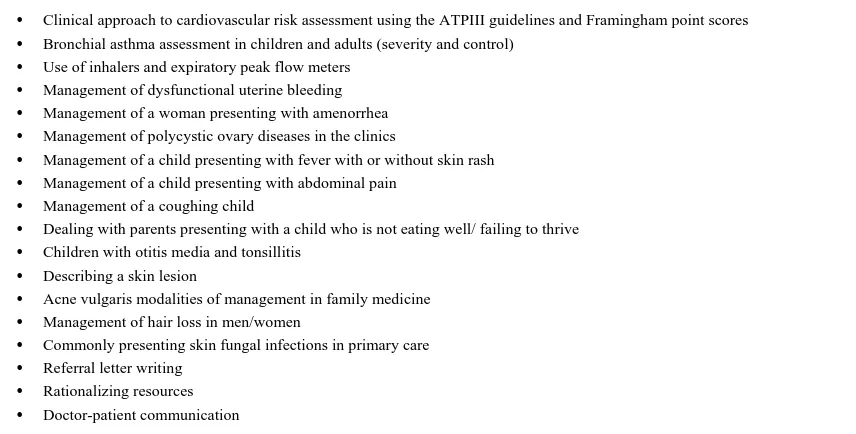
Before beginning the program, a survey was sent to inquire about doctors’ performance gaps, their main problems during working in the clinics, and the style of learning they would prefer. Rounds were scheduled to observe doctors’ consultation skills based on a consultation observation model with patients (Appendix 1). The design, development and implementation phases are summarized as follows. Six sessions were conducted over six months with each group on different medical topics .Facilitators of the sessions were chosen from the de-partments in which consultants and senior trainers had more experience and/or qualifications in dealing with common family medicine problems. The sessions were designed to be interactive and case-based discussions were prepared on the topics listed(Table 1).
[image:3.595.110.538.499.716.2]Cases were discussed in an interactive manner among facilitators and candidates and materials were provided if a topic required reading or preparation ahead of time. Some topics required presentation of slides, others
Table 1. Topics included in the case-based discussions.
Clinical approach to cardiovascular risk assessment using the ATPIII guidelines and Framingham point scores Bronchial asthma assessment in children and adults (severity and control)
Use of inhalers and expiratory peak flow meters Management of dysfunctional uterine bleeding Management of a woman presenting with amenorrhea Management of polycystic ovary diseases in the clinics
Management of a child presenting with fever with or without skin rash Management of a child presenting with abdominal pain
Management of a coughing child
Dealing with parents presenting with a child who is not eating well/ failing to thrive Children with otitis media and tonsillitis
Describing a skin lesion
Acne vulgaris modalities of management in family medicine Management of hair loss in men/women
Commonly presenting skin fungal infections in primary care Referral letter writing
required dummies for examination, and case scenarios with role plays were used to highlight communication is-sues (Table 2).
Facilitators of the sessions were chosen from the departments in which consultants and senior trainers had more experience and/or qualifications in dealing with common family medicine problems. The sessions were designed to be interactive, and case-based discussions were prepared on the topics listed in Table 1. Cases were discussed in an interactive manner among facilitators and candidates, and materials were provided if a topic re-quired reading or preparation ahead of time. Some topics rere-quired presentation of slides, others rere-quired dum-mies for examination, and case scenarios with role-plays (e.g., see Table 2) were used to highlight communica-tion issues.
Evaluation of the program was done using multiple instruments. An evaluation form was used to evaluate in-dividual sessions and facilitators. At the end of the six-month program, participants completed a final prob-lem-based multiple-choice assessment, a form-based evaluation of the program, and a self-assessment question-naire. Focus group discussions were conducted for both participants and trainers to explore their feelings and perceptions about the program activities.
4. Results
Twenty-six out of the 37 physicians attended the sessions over the six-month period and completed both the fi-nal knowledge test and the self-assessment test. The remaining 11 participants were removed from the sessions to meet service needs or did not complete the full six months’ attendance due to leaves.
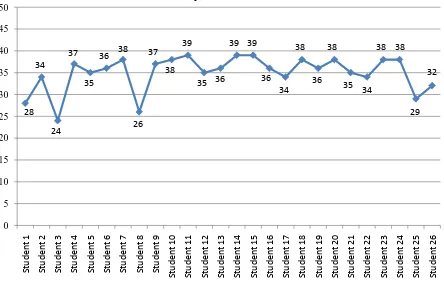
Figure 1 summarizes scores on the final knowledge assessment. The average mark was 35 correct answers out of 50 questions, ranging from 24 to 39; the majority of participants scored between 34 and 40.
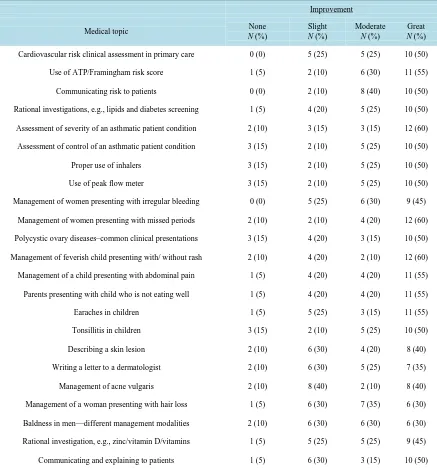
[image:4.595.95.539.421.708.2]Table 3 summarizes the results of the self-assessment questionnaire. Six participants’ self-assessments were removed from the analysis because they attended less than three sessions. For 16 out of the 23 topics discussed, at least 50% of participants rated their improvement as a result of attending the group sessions and discussions as “great”. Dermatology topics, however, showed less improvement.
Table 2. Sample case used in the CPD sessions.
Topic Case Question Competencies Required
18-month-old child with adenoids
Mother and father presenting with a child breathing through the mouth for the
last three months with disturbed sleep and continuous runny nose
What is your management
approach?
Definition of the problem
Assessment of the child’s general wellbeing based on history and examination
Assessment of child’s risk factors
Consideration of different management approaches based on assessment
Sharing decision options with parents Consideration of parents’ worries and anxieties
Table 3. Physicians’ self-assessments of their level of improvement (N = 20) as a result of attending the six-month course*.
Improvement
Medical topic None
N (%)
Slight
N (%)
Moderate
N (%)
Great
N (%)
Cardiovascular risk clinical assessment in primary care 0(0) 5(25) 5(25) 10(50)
Use of ATP/Framingham risk score 1(5) 2(10) 6(30) 11(55)
Communicating risk to patients 0(0) 2(10) 8(40) 10(50)
Rational investigations, e.g., lipids and diabetes screening 1(5) 4(20) 5(25) 10(50)
Assessment of severity of an asthmatic patient condition 2(10) 3(15) 3(15) 12(60)
Assessment of control of an asthmatic patient condition 3(15) 2(10) 5 (25) 10(50)
Proper use of inhalers 3(15) 2(10) 5(25) 10(50)
Use of peak flow meter 3(15) 2(10) 5(25) 10(50)
Management of women presenting with irregular bleeding 0(0) 5(25) 6(30) 9(45)
Management of women presenting with missed periods 2(10) 2(10) 4(20) 12(60)
Polycystic ovary diseases–common clinical presentations 3(15) 4(20) 3(15) 10(50)
Management of feverish child presenting with/ without rash 2(10) 4(20) 2(10) 12(60)
Management of a child presenting with abdominal pain 1(5) 4(20) 4(20) 11(55)
Parents presenting with child who is not eating well 1(5) 4(20) 4(20) 11(55)
Earaches in children 1(5) 5(25) 3(15) 11(55)
Tonsillitis in children 3(15) 2(10) 5(25) 10(50)
Describing a skin lesion 2(10) 6(30) 4(20) 8(40)
Writing a letter to a dermatologist 2(10) 6(30) 5(25) 7(35)
Management of acne vulgaris 2(10) 8(40) 2(10) 8(40)
Management of a woman presenting with hair loss 1(5) 6(30) 7(35) 6(30)
Baldness in men—different management modalities 2(10) 6(30) 6(30) 6(30)
Rational investigation, e.g., zinc/vitamin D/vitamins 1(5) 5(25) 5(25) 9(45)
Communicating and explaining to patients 1(5) 6(30) 3(15) 10(50)
*
[image:5.595.101.538.238.707.2]In addition to the above-mentioned assessments, a focus group discussion was conducted to explore physi-cians’ feelings and perceptions about the effect of being enrolled in these kinds of activities as a form of profes-sional development. Participants made positive comments regarding reviewing the topics from the clinical point of view and reflecting on the problems that they faced in their daily work. One of the participants voiced her opinion as “We have the knowledge background from basic education, but sometimes we need to review and share different views”. Another said that “It’s is a brilliant idea to be pulled out of work once a month for the purpose of continuing education and professional development”.
However, participants were concerned about the issue of the final appraisal being part of their annual em-ployee review, as a result of participating in this program. Participants often questioned the need for the final test and queried the weight of the final assessment on contract renewal. In addition, the trainers who facilitated the sessions were concerned about the variability between their usual teacher-directed teaching styles and their learner-centered group facilitation experience.
5. Discussion
This study highlighted our valuable experience with the process of physicians’ continuing professional devel-opment in primary care. Application of the ADDIE model through a pdesigned, structured small-group re-view and discussions of relevant clinical topics led to better identification of physicians’ professional perfor-mance. The final objective assessment of clinical knowledge was identified as lower than expected for a prac-ticing physician; the average score was 35/50 (70%). This finding could be attributed to problems in the physi-cians’ clinical knowledge application due to workload issues or maybe a result of employee selection. Analyzing this further could be fruitful for the organization and patient care.
Participants’ evaluations of individual sessions identified issues such as low satisfaction scores for the der-matology sessions, where findings did not indicate significant improvement. Exploring the study participants’ and trainers’ views regarding the activity highlighted issues needing improvement such as the quality of training and employee appraisal.
Evaluating the effectiveness of different models of CPD is not new to the literature. As mentioned earlier, CPD is required for all physicians for reasons including improving performance and quality of care [12]. The workloads and structure in primary care mandate a different design and development process. The formats of conducting national and international events such as large audience conferences and big workshops might not always fulfill the purpose. Instructional design is the key tool to establishing a systematic CPD process that can ensure professional improvement, credibility and transparency to the community by analyzing, designing, de-veloping, implementing, and evaluating the CPD education program [11].
6. Conclusion
Applying a structured instructional design model for creating professional development program for physicians is a fruitful, relevant experience in primary healthcare. We recommend that this study be repeated on a wider na-tional and internana-tional scale.
Declaration of Interest
The authors report no declarations of interest.
References
[1] Choudary, G.B. and Purnik, S. (2014) A Study on Employee Performance Appraisal in Health Care. Asian Journal of Management Sciences, 2, 59-64.
[2] Toon, P. (1997) Educating Doctors to Improve Patient Care. BMJ, 315, 326.
http://dx.doi.org/10.1136/bmj.315.7104.326
[3] Paterson, K. (2002) The Professional Development of Principals: Innovations and Opportunities. Educational Admin-istration Quarterly, 38, 213-232. http://dx.doi.org/10.1177/0013161X02382006
[4] Towle, A. (1998) Changes in Health Care and Continuing Medical Education for the 21st Century. BMJ, 316, 301-304.
http://dx.doi.org/10.1136/bmj.316.7127.301
Ref-lective Model. Postgraduate Medical Journal, 73, 23-26.
[6] Booth, B. (1997) Does Continuing Medical Education Make a Difference? Medical Journal of Australia, 167, 236-237. [7] Davis, D.A., Thomson, M.A., Oxman, A.D. and Haynes, R.B. (1995) Changing Physician Performance: A Systematic
Review of the Effect of Continuing Medical Education Strategies. JAMA, 274, 700-705.
http://dx.doi.org/10.1001/jama.1995.03530090032018
[8] Moellem, M. (2001) Applying Constructivist and Objectivist Learning Theories in the Design of a Web-Based Course: Implications for Practice. Educational Technology & Society, 4, 113-125.
[9] Lee, J. and Jang, S. (2014) A Methodological Framework for Instructional Design Model Development: Critical Di-mensions and Synthesized Procedures. Educational Technology Research and Development, 62, 743-765.
http://dx.doi.org/10.1007/s11423-014-9352-7
[10] Morrison, G.R. (2010) Designing Effective Instruction. 6th Edition, John Wiley & Sons, Hoboken, New Jersey. [11] Department of Health (2015) Allied Health Professions Project: Demonstrating Competence through Continuing
Pro-fessional Development [CPD].
http://webarchive.nationalarchives.gov.uk/+/www.dh.gov.uk/en/consultations/closedconsultations/DH_4071458
[12] Battles, J.B. (2006) Proving Patient Safety by Instructional Systems Design. Quality & Safety in Health Care, 15, 25- 29. http://dx.doi.org/10.1136/qshc.2005.015917
[13] COT-for-MRCGP-Workplace-Based-Assessment (2015).
Appendix 1: Needs Assessment
Dear colleague:
As an endeavor to promote doctors’ performance in the division, we seek your collaboration as a member to actively participate in the doctors’ on-the-job training program. In order to tailor the program to the needs and demands of the doctors, we ask you to complete this form. The results will help us to build up a program that responds to your needs and helps enhance your competencies and performance.
Name: (optional)
Doctor’s title: Registrar Resident
Have you had formal training in family medicine: Yes No
How many years of training have you had in family medicine? Years: ____
How many years of experience in family medicine do you have? Years: ____
Do you have any special area of interest? Yes No
Please specify _______________________________________
Have you had any training in the doctor-patient interaction/ commutation skills? Yes No
Regarding the previous question, what type of training have you had?
Formal Non-formal Other (please explain) ______________________________________
Plan of activities:
What is your preferred frequency for this program? Daily Twice a week Weekly
What is/are your preferred form/s of learning?
Lecture Group discussion
One-to-one Clinical observation
Case-based discussion Peer review
Other (please specify) __________________________________________________
Would you prefer practical sessions? Yes No
Would you like to have sessions on special procedures and hands-on skills? Yes No
Others (please specify) ____________________________________________________________
In what areas of your daily work do you feel that you need improvement?
Main area Specify topic(s)
• Adult medicine
• Pediatrics
• Geriatric
• Women’s health
• Psychiatry
• Derma
• Eye
• ENT
• Prevention
• Lab
• Imaging
In what areas would you like to contribute during this program?
• Organization • Topic preparation • Group facilitation
• IT skills • Research • Other (explain)
Thank you
Appendix 2
Consultation observation sheet1.
Observed competencies
Grading
Insufficient Needs
Improvement Sufficient Excellent
A Discovers the reason for the patient attendance
1 Encourages the patient’s contribution
2 Responds to cues
3 Places complaints in appropriate psychological context
4 Explores patient’s health understanding
B Defines the clinical problem
5 Includes or excludes likely relevant significant condition
6 Conducts appropriate physical or mental state examination
7 Makes an appropriate working diagnosis
C Explains the problem in appropriate language
8 Explains the problem in appropriate language
D Addresses the patient’s problem
9 Seeks to confirm the patient's understanding
10 Provides an appropriate management plan
11 Involves patient in management decisions
E Makes effective use of the consultation
12 Makes effective use of resources
13 Specifies conditions and interval for follow up
Overall assessment
Feedback and recommendations for further development
1
Submit or recommend next manuscript to SCIRP and we will provide best service for you: Accepting pre-submission inquiries through Email, Facebook, LinkedIn, Twitter, etc.
A wide selection of journals (inclusive of 9 subjects, more than 200 journals) Providing 24-hour high-quality service
User-friendly online submission system Fair and swift peer-review system
Efficient typesetting and proofreading procedure
Display of the result of downloads and visits, as well as the number of cited articles Maximum dissemination of your research work