0095-1137/95/$04.0010
Copyrightq1995, American Society for Microbiology
Characterization of Hafnia alvei by Biochemical Tests,
Random Amplified Polymorphic DNA PCR, and
Partial Sequencing of 16S rRNA Gene
JOUKO RIDELL,
1* ANJA SIITONEN,
2LARS PAULIN,
3OUTI LINDROOS,
3HANNU KORKEALA,
1ANDM. JOHN ALBERT
4Department of Food and Environmental Hygiene, University of Helsinki,
1Laboratory of Enteric Pathogens, National
Public Health Institute,
2and Institute of Biotechnology, University of Helsinki,
3Helsinki, Finland, and International
Centre for Diarrhoeal Disease Research, Bangladesh, Dhaka, Bangladesh
4Received 30 January 1995/Returned for modification 3 April 1995/Accepted 31 May 1995
Hafnia alvei
strains which possess the attachment-effacement gene (
eaeA
) may have clinical importance as
new diarrhea-causing pathogens and should therefore be differentiated from other
H. alvei
strains. We
characterized diarrheal
H. alvei
strains, which were positive in the PCR test for the
eaeA
gene, using
biochem-ical tests not routinely used for identification of members of the family
Enterobacteriaceae
, and compared them
with
eaeA
-negative strains isolated from different clinical and nonclinical sources to find characteristics useful
for identification. Random amplified polymorphic DNA (RAPD)-PCR and partial sequencing of the 16S rRNA
gene were utilized to study the genetic diversity of the isolates. The
eaeA
-positive strains were found to have
many characteristic biochemical properties. Negative reactions in the 2-ketogluconate and histidine
assimi-lation tests and a positive reaction in the 3-hydroxybenzoate assimiassimi-lation test may be useful in routine
diagnostics. Nearly identical RAPD-PCR profiles and identical 353-bp fragments of the 16S rRNA genes
indicated little genetic diversity among the
eaeA
-positive strains. The low level of homology (92%) in the partial
16S rRNA genes of
eaeA
-positive and -negative
H. alvei
strains raises questions about the taxonomic positioning
of
eaeA
-positive
H. alvei
.
Recent studies have shown that in addition to
enterohem-orrhagic and enteropathogenic Escherichia coli (EHEC and
EPEC, respectively) and one biotype of Citrobacter freundii,
Hafnia alvei may also possess the virulence-associated gene
eaeA (EPEC attaching and effacing) (2, 6, 9, 13, 15). In contrast
to most H. alvei strains, which are generally not considered
pathogens, the eaeA-positive H. alvei strains may be
diarrhea-genic. Although the role of the eaeA gene is not fully
under-stood, the gene appears to be necessary, but not sufficient, for
intimate adherence of the pathogen to epithelial cells and for
formation of the characteristic attaching-effacing lesions in the
intestinal brush border (9). The eaeA gene is the only
viru-lence-associated factor described so far for H. alvei. However,
we have shown an epidemiological association of
eaeA-nega-tive H. alvei and diarrhea symptoms (13), indicating that other
mechanisms may also be involved in the association of H. alvei
with diarrhea.
In addition to some case reports which implicate H. alvei as
a new diarrheagenic pathogen (11, 12, 17), more-specific
evi-dence has been demonstrated. In an animal model, H. alvei
strains isolated from diarrheic children in Bangladesh
pro-duced diarrhea and lesions typical of EPEC and gave positive
reactions in the fluorescent actin staining test with HEp-2 cells
(1, 2, 13). These strains were shown, by DNA hybridization and
PCR, to carry a gene homologous to the eaeA gene family (2,
13). Recently, Frankel et al. demonstrated that the fusion
protein encoded by the H. alvei eaeA gene attached to HEp-2
cells with an affinity equal to that of the proteins of EPEC and
EHEC (6).
Differentiating eaeA-positive H. alvei strains other H. alvei
strains is important, but it is not routinely done in clinical
laboratories. eaeA-positive strains give typical reactions in
stan-dard biochemical tests used to identify members of the family
Enterobacteriaceae, e.g., the API 20E commercial biochemical
panel (1, 2, 13), and are thus indistinguishable from other H.
alvei strains. The aim of this study was to characterize
diarrhea-causing positive H. alvei strains in comparison with
eaeA-negative strains to find useful characteristics for the
identifi-cation of H. alvei strains which cause diarrhea through the
attaching-effacing mechanism. Useful biochemical reactions
were sought by utilizing commercial biochemical identification
systems not routinely used for the identification of members of
the Enterobacteriaceae. Molecular methods, random amplified
polymorphic DNA (RAPD)-PCR and partial sequencing of
the 16S rRNA gene, were used to estimate the genetic diversity
of H. alvei strains.
MATERIALS AND METHODS
Bacterial strains.The study included 16 diarrhea-associated H. alvei strains
isolated in Bangladesh from 16 patients between 1990 and 1993, 43 diarrhea-causing H. alvei isolates from 16 Finnish patients, 9 other clinical strains from 9 patients, 42 H. alvei isolates from 16 food samples, and 10 H. alvei strains from 10 environmental samples, including drinking water, fish farm water, fish intes-tines, and rabbit intestines. In addition, the following H. alvei reference strains were included: ATCC 13337T
(NCTC 8105T
), ATCC 29926 (CDC5632-72; DNA hybridization reference strain), and ATCC 29927 (CDC4510-73; DNA hybrid-ization reference strain). H. alvei ATCC 29926 and ATCC 13337T
represent hybridization group (HG) 1, and ATCC 29927 belongs to HG 2 (7). eaeA-positive bacterial strains E. coli E2348/69 (EPEC; O127:H6), obtained from J. P. Nataro (Center for Vaccine Development, University of Maryland School of Medicine, Baltimore), and E. coli ATCC 43895 (EHEC) were also included.
Biochemical reactions.Biochemical reactions with the commercial API 20E,
API rapid ID 32E, and API ID 32GN systems (Biomerieux, Marcy l’Etoile, France) were performed according to the instructions of the manufacturer. Extended incubations (48 h at 378C and 24 h at 308C) were tested with three eaeA-positive and five eaeA-negative strains.
* Corresponding author. Mailing address: Department of Food and Environmental Hygiene, University of Helsinki, P.O. Box 57, FIN-00014 Helsinki, Finland. Phone: 358-0-70849701. Fax: 358-0-70849718. Electronic mail address: [email protected].
2372
on May 15, 2020 by guest
http://jcm.asm.org/
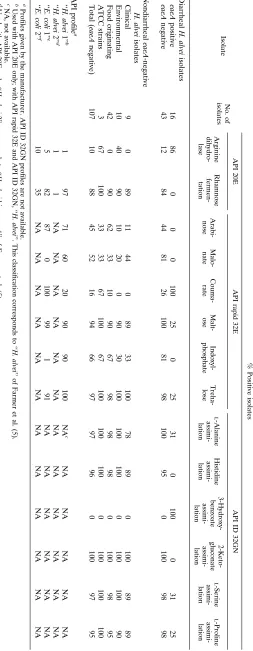
TABLE 1. Results of selected biochemical reactions with the API 20E, rapid ID 32E, and ID 32GN identification systems for eaeA -positive and -negative H. alvei strains Isolate No. of isolates % Positive isolates API 20E API rapid 32E API ID 32GN Arginine dihydro-lase Rhamnose fermen-tation Arabi-nose Malo-nate Couma-rate Malt-ose Indoxyl-phosphate Treha-lose L -Alanine assimi-lation Histidine assimi-lation 3-Hydroxy-benzoate assimi-lation 2-Keto-gluconate assimi-lation L -Serine assimi-lation L -Proline assimi-lation Diarrheal H. alvei isolates eaeA positive 16 86 0 0 0 100 25 0 25 31 0 100 0 31 25 eaeA negative 43 12 84 44 81 26 100 81 98 100 95 0 100 98 98 Nondiarrheal eaeA -negative H. alvei isolates Clinical 9 0 89 11 44 0 89 33 100 78 89 0 100 89 89 Environmental 10 40 90 10 20 0 90 30 100 100 100 0 100 100 90 Food originating 42 0 90 62 33 10 90 67 98 98 98 0 100 98 95 ATCC strains 3 67 100 33 33 67 100 67 100 100 100 0 100 100 100 Total (eaeA negative) 107 10 88 45 52 16 94 66 97 97 96 0 100 97 95 API profile a ‘‘ H. alvei 1’’ b 1 97 71 60 20 90 90 100 NA c NA NA NA NA NA ‘‘ H. alvei 2’’ d 1 1 NA NA NA NA NA NA NA NA NA NA NA NA ‘‘ E. coli 1’’ e 5 82 87 0 100 99 1 91 NA NA NA NA NA NA ‘‘ E. coli 2’’ f 10 35 NA NA NA NA NA NA NA NA NA NA NA NA a Profiles given by the manufacturer. API ID 32GN profiles are not available. b Used with API 20E only; with API rapid 32E and API ID 32GN, ‘‘ H. alvei ’’. This classification corresponds to ‘‘ H. alvei ’’ of Farmer et al. (5). c NA, not available. d Used with API 20E only. ‘‘ H. alvei 2’’ corresponds to ‘‘ H. alvei biogroup 1’’ of Farmer et al. (5). e Used with API 20E and API ID 32GN; with API rapid 32E ‘‘ E. coli .’’ f Used with API 20E and API ID 32GN. ‘‘ E. coli 2’’ corresponds to ‘‘ E. coli , inactive’’ of Farmer et al. (5).
on May 15, 2020 by guest
http://jcm.asm.org/
[image:2.612.182.435.76.727.2]PCR methods.Seventy-eight strains not previously tested for the eaeA gene were screened by PCR as described previously (13).
RAPD-PCR analysis of all 123 strains was performed basically as described by Williams et al. (18), with factors affecting reproducibility carefully observed (10, 18). Amplifications were performed with a DNA thermal cycler (PTC-100; MJ Research, Watertown, Mass.) using the following conditions: 45 cycles of 30 s at 948C, 30 s at 368C, and 1 min 30 s at 728C with a 3-min initial denaturation at 948C and a 5-min final extension at 728C, with a 25-ml volume containing 25 ng of purified DNA and 0.25 U of Dynazyme DNA polymerase (Finnzymes, Espoo, Finland) in a buffer provided by the manufacturer (containing 3 mM MgCl2, 10
mM Tris-HCl [pH 8.8], 50 mM KCl, 0.1% Triton X-100, 200mM [each] dATP, dCTP, dGTP, and dTTP, and 0.5mM primer and overlaid with 1 drop of sterile paraffin oil). Genomic DNAs from H. alvei HG 1 (ATCC 29926) and 2 (ATCC 29927) and the type strain (ATCC 13337) were included as controls in each of the experiments. Three primers based on the enterobacterial repetitive inter-genic consensus sequence were used: E7 (59-AGTAAGTGACTGGGGTGAG CG-39), E8 (59-ATGTAAGCTCCTGGGGATTCAC-39), and E8b (59-ATGTA AGCTCCTGGGGATTCA-39). The reproducibility of the method was tested by repeating the amplifications two or three times.
Partial sequencing of the rRNA genes.The 16S rRNA genes from 14 H. alvei
FIG. 1. (A) eaeA-positive H. alvei strains produce characteristic and homologous profiles in RAPD-PCR analysis using three different primers, as demonstrated here with primer E8b. H. alvei ATCC 29926 (DNA reference strain) and ATCC 13337T
represent HG 1, and ATCC 29927 (DNA reference strain) represents HG 2. H. alvei KT1 was isolated from a septicemic patient. eaeA-positive H. alvei strains were isolated from various patients with diarrhea in Bangladesh over several years. The PCR products specific for the eaeA-positive strains are indicated (arrows). (B) eaeA-positive strains did not show any detectable homology with the 107 eaeA-negative H. alvei strains when three primers were used, as demonstrated here with primer E7. eaeA-negative H. alvei strains formed polymorphic RAPD profiles, but two profile types, resembling HG 1 and 2, dominated. Strains SD1, KT3, KT5, and SD12 are diarrheal isolates; strains KT1, KT2, HY1, HY2, and HY3 are from other clinical samples; and strains J8, J57, J138, J402, J403, J452, and J453 are from minced meat. Boehringer Mannheim marker VII was used as a molecular weight (MW) marker.
on May 15, 2020 by guest
http://jcm.asm.org/
[image:3.612.143.473.92.565.2]and 2 E. coli strains were amplified by using primers pA-B (59-biotin-AGAGTT TGATCCTGGCTCAG-39) and pC* (59-CCCACTGCTGCCTCCCGTAG-39) (4), yielding a PCR product of 353 bp from the 59end of the gene. Templates were prepared by the boiling method as described elsewhere (14). The amplifi-cation was performed in a 100-ml volume by using 10ml of boiled bacterial lysate as a template, 1mM primer, 1 U of Dynazyme DNA polymerase, and the buffer provided by the manufacturer with 33 cycles of 948C for 30 s, 558C for 30 s, and 728C for 1 min 20 s. The amplified PCR product was sequenced by the solid-phase method as described previously (8). Sequencing reactions were done with the AutoRead kit (Pharmacia, Uppsala, Sweden), and the results were analyzed with an automated laser fluorescent DNA sequencer (Pharmacia). The align-ment of the obtained sequences was done by using the PC-Gene program (In-telligenetics, Geneva, Switzerland).
Nucleotide sequence accession numbers.Partial sequences of 16S rRNAs from
EPEC strain E2348/69 and eaeA-positive H. alvei 10457 have been deposited in the EMBL data bank under accession no. Z47359 and Z47360, respectively.
RESULTS
In addition to the 6 Bangladeshi diarrheal H. alvei isolates
previously shown to be eaeA positive (13), 10 new Bangladeshi
diarrheal isolates generated a PCR product of the size
pre-dicted for the eaeA gene.
H. alvei strains possessing the eaeA gene had 2 unique
bio-chemical reactions (assimilation of 2-ketogluconate and
3-hy-droxybenzoate) and 11 other characteristic reactions among
the 83 reactions tested; the remaining reactions did not
differ-entiate between the eaeA-positive and -negative strains (Table
1). Some of the characteristic reactions were typical of E. coli,
although many reactions in the three identification systems
were against E. coli (Table 1). The eaeA-negative strains
iso-lated from different sources did not differ markedly from each
other in their biochemical properties.
The API 20E species identification system classified all
eaeA-positive strains as ‘‘H. alvei2,’’ with identifications of
91.9% for 2 strains and 70.1% for 14 arginine-positive strains.
Extending the incubation time to 48 h did not have any effect
on the biochemical reactions, nor did lowering of the
incuba-tion temperature to 308C. The API rapid ID 32E system gave
identifications of ‘‘H. alvei’’ of 83.4 to 98.3% for 12 strains and
49.6% for 4 strains. The next most common identification for
all strains was Serratia marcescens. The API ID 32GN system
identified 12 of the eaeA-positive strains as ‘‘E. coli 2’’ with
identification of 98.6 to 99.3%; 2 strains as ‘‘E. coli 2’’ with an
identification of 49.6%, though the next most common
classi-fication was ‘‘H. alvei’’ with an identiclassi-fication of 49.0%; and 2
strains as ‘‘H. alvei’’ with an identification of 76.2%. All 107
eaeA-negative H. alvei strains were identified as ‘‘H. alvei’’ by
all three identification systems. With API 20E, 95 strains were
named as ‘‘H. alvei 1’’ and 12 rhamnose-negative strains were
named ‘‘H. alvei 2’’. Extending the incubation time to 48 h for
the API ID 32GN system influenced the identification only
once, when an unacceptable profile giving an identification of
‘‘Shigella sp.’’ was turned into an acceptable profile giving an
identification of ‘‘H. alvei.’’
In RAPD-PCR analysis, the eaeA-positive strains produced
nearly identical profiles which were different from those of the
eaeA-negative strains (Fig. 1). The majority of the
eaeA-nega-tive strains shared some homology with the representaeaeA-nega-tive(s)
of either HG 1 or HG 2 (Fig. 1).
The 353-bp fragments from the 5
9
end of the 16S rRNA
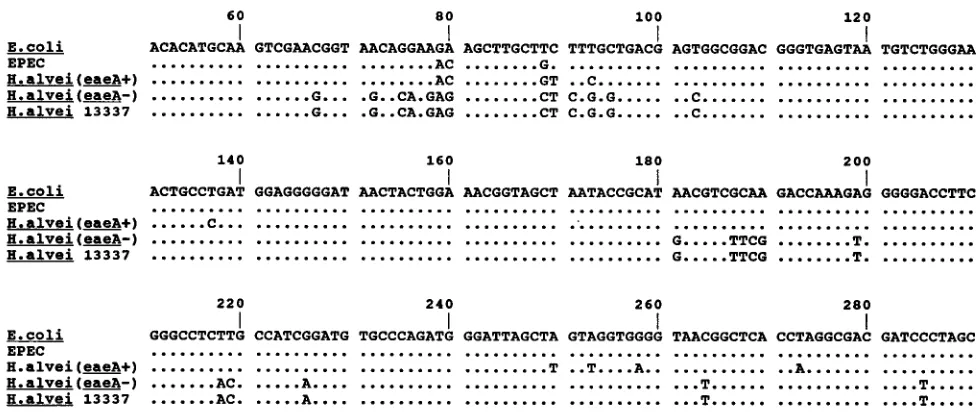
genes of all 10 eaeA-positive H. alvei strains tested were
iden-tical and differed from the fragments from the five
eaeA-neg-ative H. alvei strains in 27 nucleotides, giving a homology of
92% (Fig. 2). A search of the database demonstrated that the
eaeA-positive H. alvei strains showed closest homology to E.
coli, with a difference of 10 nucleotides (Fig. 2). The best
homology observed was with EPEC E2348/69, which was
se-quenced in this study and had only seven differing nucleotides
(Fig. 2), giving a homology of 98%. EHEC strain ATCC 43895
was homologous with the E. coli sequence reported by Brosius
et al. (3), but EPEC strain E2348/69 differed from their E. coli
sequence by three nucleotides.
DISCUSSION
[image:4.612.60.550.69.275.2]eaeA-positive H. alvei strains may have clinical importance as
diarrheal pathogens, and therefore, their differentiation from
other H. alvei strains may have diagnostic usefulness. Neither
conventional biochemical tests nor the commercial API 20E
system reliably differentiates between eaeA-positive and
-neg-ative H. alvei strains. Therefore, we tested the usefulness of
FIG. 2. Alignment of the partial 16S rRNA genes of E. coli as determined by Brosius et al. (3), EPEC E2348/69, 10 identical eaeA-positive H. alvei strains (H. alvei eaeA1), 4 identical eaeA-negative H. alvei strains (H. alvei eaeA2-, including strains SD1 and SD12 from Finnish diarrheic patients, strain J6 from minced meat, and the H. alvei DNA reference strain ATCC 29927), and the eaeA-negative type strain H. alvei ATCC 13337, obtained from GenBank (accession no. M59155). Numbering is according to Brosius et al. (3).on May 15, 2020 by guest
http://jcm.asm.org/
biochemical reactions in the API rapid ID 32E and API ID
32GN systems and characterized the genetic diversity of the
isolates by molecular methods.
The new biochemical tests introduced in this study simplify
the identification of eaeA-positive H. alvei strains in routine
clinical laboratory tests. When H. alvei is suspected as a
caus-ative agent of diarrhea, assimilation of 2-ketogluconate,
3-hy-droxybenzoate, and histidine should be included in the
bio-chemical tests. Biobio-chemically typical isolates can then be
further tested for the attaching-effacing property. At the
mo-ment, little is known about the relative importance of
eaeA-positive H. alvei strains as diarrheal pathogens. eaeA-eaeA-positive
H. alvei strains are frequently isolated from diarrheal feces in
Bangladesh. However, in our previous study, which included
189 diarrheal Finnish patients, no eaeA-positive strains were
detected, although H. alvei was isolated from the stools of 14
patients (13). To our knowledge, the occurrence of
eaeA-pos-itive H. alvei in countries other than Bangladesh and Finland
has not been studied. These new data should help to clarify the
possible role of H. alvei as a causative agent of diarrhea.
Results with the molecular methods indicate that
eaeA-pos-itive H. alvei strains have little genetic diversity, in contrast to
the other H. alvei strains. The present RAPD-PCR results are
in accordance with the previous observation that H. alvei
con-sists of at least two genospecies (16). RAPD-PCR is very
sen-sitive to genetic variation and suitable for characterizations
within a species. However, RAPD-PCR is also sensitive to
minor changes in the reaction conditions (18), and great care is
needed to achieve reproducible results. Although the
taxon-omy of H. alvei is beyond the scope of this article, the low level
of homology (92%) between rRNA genes of the eaeA-positive
and -negative strains and the identifications produced with the
API ID 32GN system call into question the present taxonomic
position of this organism. Studies including sequencing of the
entire 16S rRNA genes and DNA-DNA hybridization are in
progress to determine the taxonomic status of eaeA-positive H.
alvei.
In conclusion, this study showed that the eaeA-positive H.
alvei strains associated with diarrhea form a distinct and
ge-netically homologous group which is identifiable by
biochem-ical methods.
ACKNOWLEDGMENTS
We thank J. P. Nataro, S. Niemela¨, and M. Niemi for the strains and P. Helena Ma¨kela¨ and P. Russo for critical reading of the manuscript. This work was supported by a grant from the University of Veteri-nary Medicine, Helsinki, Finland.
REFERENCES
1. Albert, M. J., K. Alam, M. Islam, J. Montanaro, A. S. M. H. Rahman, K.
Haider, M. A. Hossain, A. K. M. Kibriya, and S. Tzipori.1991. Hafnia
alvei, a probable cause of diarrhea in humans. Infect. Immun. 59:1507– 1513.
2. Albert, M. J., S. Faruque, M. Ansaruzzaman, M. Islam, K. Haider, K. Alam,
I. Kabir, and R. Robins-Browne.1992. Sharing of virulence-associated
prop-erties at the phenotypic and genetic levels between enteropathogenic Esch-erichia coli and Hafnia alvei. J. Med. Microbiol. 37:310–314.
3. Brosius, J., M. L. Palmer, P. L. Kennedy, and H. F. Noller. 1978. Complete nucleotide sequence of a 16S ribosomal rRNA gene from Escherichia coli. Proc. Natl. Acad. Sci. USA 75:4801–4805.
4. Edwards, U., T. Rogall, H. Blo¨cker, M. Emde, and E. C. Bo¨ttger.1989. Isolation and direct complete nucleotide determination of entire genes. Characterization of a gene coding for 16S ribosomal RNA. Nucleic Acids Res. 19:7843–7853.
5. Farmer, J. J., III, B. R. Davis, F. W. Hickmann-Brenner, A. McWhorter,
G. P. Huntley-Carter, M. A. Asbury, C. Riddle, H. G. Wathen-Grady, C. Elias, G. R. Fanning, A. G. Steigerwalt, C. M. O’Hara, G. M. Morris, P. B.
Smith, and D. J. Brenner.1985. Biochemical identification of new species
and biogroups of Enterobacteriaceae isolated from clinical specimens. J. Clin. Microbiol. 21:46–76.
6. Frankel, G., D. C. A. Candy, P. Everest, and G. Dougan. 1994. Character-ization of the C-terminal domains of intimin-like proteins of enterohemor-rhagic Escherichia coli, Citrobacter freundii, and Hafnia alvei. Infect. Immun.
62:1835–1842.
7. Gelev, I., E. Gelev, A. G. Steigerwalt, G. P. Carter, and D. J. Brenner. 1990. Identification of the bacterium associated with haemorrhagic septicemia in rainbow trout as Hafnia alvei. Res. Microbiol. 141:573–576.
8. Hultman, T., S. Bergh, T. Moks, and M. Uhle´n. 1991. Bidirectional solid-phase sequencing of in vitro amplified plasmid DNA. BioTechniques 10:84– 93.
9. Law, D. 1994. Adhesion and its role in the virulence of enteropathogenic Escherichia coli. Clin. Microbiol. Rev. 7:152–173.
10. Micheli, M. R., R. Bova, E. Pascale, and E. Ambrosio. 1994. Reproducible fingerprinting with the randomly amplified polymorphic DNA (RAPD) method. Nucleic Acids Res. 22:1921–1922.
11. Ratnam, S. 1991. Etiologic role of Hafnia alvei in human diarrheal illness. Infect. Immun. 59:4744–4745. (Letter.)
12. Reina, J. 1993. Acute gastroenteritis caused by Hafnia alvei in children. Clin. Infect. Dis. 16:443. (Letter.)
13. Ridell, J., A. Siitonen, L. Paulin, L. Mattila, H. Korkeala, and M. J. Albert. 1994. Hafnia alvei in stool specimens of patients with diarrhea and healthy controls. J. Clin. Microbiol. 32:2335–2337.
14. Saris, P. E. J., L. Paulin, and M. Uhle´n. 1990. Direct amplification of DNA from colonies of Bacillus subtilis and Escherichia coli by the polymerase chain reaction. J. Microbiol. Methods 11:121–126.
15. Schauer, D. B., and S. Falkow. 1993. The eae gene of Citrobacter freundii biotype 4280 is necessary for colonization in transmissible murine colonic hyperplasia. Infect. Immun. 61:4654–4661.
16. Steigerwalt, A. G., G. R. Fanning, M. A. Fife-Asbury, and D. J. Brenner. 1976. DNA relatedness among species of Enterobacter and Serratia. Can. J. Microbiol. 22:121–137.
17. Westblom, T. U., and T. W. Milligan. 1992. Acute bacterial gastroenteritis caused by Hafnia alvei. Clin. Infect. Dis. 14:1271–1272. (Letter.) 18. Williams, J. G., M. K. Hanafey, J. A. Rafalski, and S. V. Tingey. 1993.
Genetic analysis using random amplified polymorphic DNA markers. Meth-ods Enzymol. 218:705–740.