© 2016, IRJET | Impact Factor value: 4.45 | ISO 9001:2008 Certified Journal | Page 1777
SELECTION OF STRUCTURAL AND INSULATION MATERIAL FOR
INFRARED HEATING SYSTEM BY WEIGHED PROPERTY METHOD
Kiran.K
[1], Dr.Kiran Kumar P
[2], Prof T.Madhusudhan
[3][1]
M.Tech student, Dept. of Mechanical Engineering, S J B Institute of Technology, Bengaluru, India
[2]
Professor, Dept. of Mechanical Engineering, S J B Institute of Technology, Bengaluru, India
[3]
HOD, Dept. of Mechanical Engineering, S J B Institute of Technology, Bengaluru, India
---***---Abstract -
An infrared radiator or warmth light is a body with a higher temperature which exchanges vitality to a body with a lower temperature through electromagnetic radiation. Contingent upon the temperature of the transmitting body, the wavelength of the crest of the infrared radiation ranges from 780 nm to 1 mm. No contact or medium between the two bodies is required for the vitality exchange. The effectiveness of infrared radiation mainly depends on the type of insulation employed inside the chamber and also there should be a proper structural material for the particular application. In this papers the material considered for structural applications are Mild steel (ASTM A210), Mild steel (ASTM A36), Grey cast iron (ASTM 25), Grey cast iron (ASTM 30), Grey cast iron (ASTM 35) having variable constituents and the materials considered for insulation are Portland cement, refractory clay, glass, concrete, chrome brick and asbestos fiber among these Mild steel (ASTM A210) and refractory clay (ceramic) are selected by weighed property method.Key Words: Material, WPM, IR, Mild steel (ASTM A210),
Refractory clay (ceramic).
1. INTRODUCTION
Selection of material is a very important task in every product design process traditionally material selections are taken place at a detailed design stage. In the design and development of infrared heating system. The most common
© 2016, IRJET | Impact Factor value: 4.45 | ISO 9001:2008 Certified Journal | Page 1778
2. LITERATURE SURVEY
WPM is very useful in Selection of material for particular application when there are a large number of important properties to be compare and evaluated. In this method Scaled values of the criteria (β) are multiplied by the weighting index (α). The sum of multiplied scaled properties and weighting factors represents the performance index (γ). The combination of stock material and matching design process with the highest performance index is the optimum solution.
Kasim M. Daws, et.al [3]: He has studied about the
automated advisory casting process selection system is designed. Selection of material trusted on specified criteria weighted property index algorithm calculates relative importance of each property. Ranking or for rating of each requirements and alternative process was given by Fuzzy Logic method, which shows optimized alternative process. Dr. Mohammed Jasim Kadhim, et.al [4]: has made an
endeavor to appear, there is no hole in the middle of materials and capacity arranged configuration. Simultaneous subjective determination of materials strategy (CQSM) was created to know the significance of materials properties in the early plan stages. The Weighted Property Method was adjusted from Quantitative technique to Qualitative Method for determination of materials. Weighted element record was figured by Digital Rationale (DL) and contrasted and the conventional strategy, Advanced Logic (DL) strategy indicates precise results because it does not eliminate least important properties.
Suresh talur, et.al[5] : In his paper he mainly studied on the
selection of suitable material for wind turbine blades by Weighted Property Method, for manufacturing of small scale Savonius Vertical Axis Wind Turbine (SVAWT),material considered are Aluminium (7020 Alloy), Mild Steel (grade 55), Stainless Steel (A580) and Polycarbonate sheet, among these optimized material is selected based and weighed property method to increase performance of wind turbine ,
the selected material for SVAWT shows low density, corrosion resistant, economic, good
3. DISCUSSION AND CALCULATION
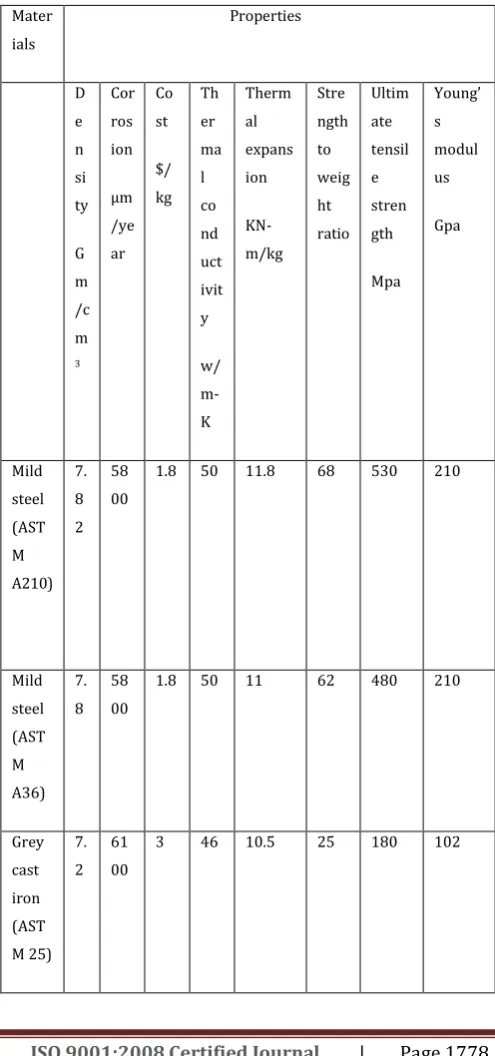
[image:2.595.308.556.261.790.2]The below table shows the list of different materials to be investigated for structural and insulation applications and their properties
Table 1.1 properties of structural materials Mater
ials
Properties
D e n si ty
G m /c m 3
Cor ros ion
µm /ye ar
Co st
$/ kg
Th er ma l co nd uct ivit y
w/ m-K
Therm al expans ion
KN-m/kg
Stre ngth to weig ht ratio
Ultim ate tensil e stren gth
Mpa
Young’ s modul us
Gpa
Mild steel (AST M A210)
7. 8 2
58 00
1.8 50 11.8 68 530 210
Mild steel (AST M A36)
7. 8
58 00
1.8 50 11 62 480 210
Grey cast iron (AST M 25)
7. 2
61 00
© 2016, IRJET | Impact Factor value: 4.45 | ISO 9001:2008 Certified Journal | Page 1779 Grey
cast iron (AST M 30)
7. 2
61 00
3 46 10.5 29 250 113
Grey cast iron (AST M 35)
7. 2
61 00
3 46 10.5 38 270 119
Table1.2 properties of insulation materials
Materi als
Properties
Density (ϼ)
Kg/m3
Cost
Rs/ Kg
Temper ature
0c
Therma l conduct ivity
W/m-K
Specific heat (c)
J/Kg/K
Portlan d cement
1900 20 30 0.3024 1130
Refract ory clay(ce ramic)
1845 12 450 1.036 1089
Glass 2500 23 20 0.7443 670
Concre te
419 22 100 0.1907 1214
Chrom e brick
3000 18 200 2.320 840
Asbest os fibre
470 900 50 0.1105 816
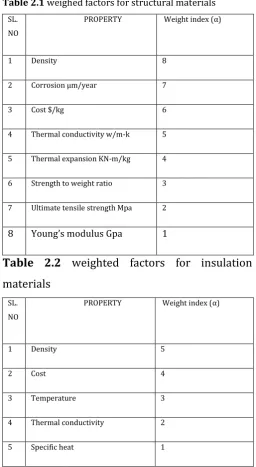
Now the weighting factor (α) is obtained by giving relative priorities to the properties of material. This factor is obtained by using the past experience or the digital-logic method. Digital-logic method calculates by the comparison of properties, weighed property method is used in combined
[image:3.595.306.563.191.659.2]properties with having different units. WPM shows each material requirement (or property) is assigned to a certain weight depending on its importance in the design. Value for each weighing factor (α) should be given based on its importance.
Table 2.1 weighed factors for structural materials SL.
NO
PROPERTY Weight index (α)
1 Density 8
2 Corrosion µm/year 7
3 Cost $/kg 6
4 Thermal conductivity w/m-k 5
5 Thermal expansion KN-m/kg 4
6 Strength to weight ratio 3
7 Ultimate tensile strength Mpa 2
8 Young’s modulus Gpa 1
Table 2.2
weighted factors for insulation
materials
SL.NO
PROPERTY Weight index (α)
1 Density 5
2 Cost 4
3 Temperature 3
4 Thermal conductivity 2
5 Specific heat 1
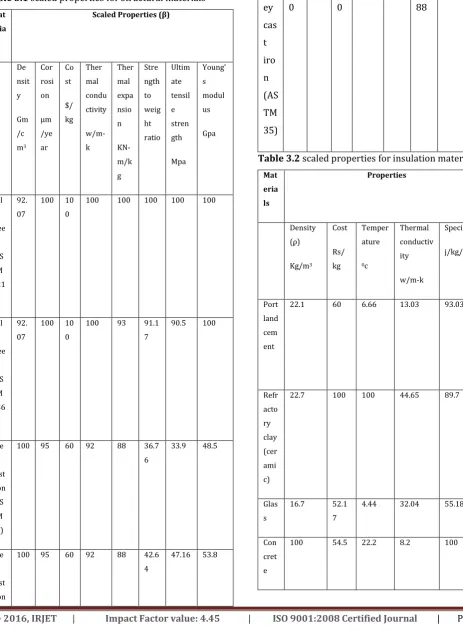
Now, the weighed factor (β) is calculated using the formula Scaled property value for lower value of the property is required example costs, mass loss, etc.
Scaled Property
(β) = ( ) Х100
[image:3.595.308.562.209.661.2]© 2016, IRJET | Impact Factor value: 4.45 | ISO 9001:2008 Certified Journal | Page 1780 the is required for example hardness, tensile strength, etc.
Scaled Property
[image:4.595.50.514.169.801.2](β) = ( ) Х100
Table 3.1 scaled properties for structural materials
Mat eria ls
Scaled Properties (β)
De nsit y
Gm /c m3
Cor rosi on
µm /ye ar
Co st
$/ kg
Ther mal condu ctivity
w/m-k
Ther mal expa nsio n
KN-m/k g
Stre ngth to weig ht ratio
Ultim ate tensil e stren gth
Mpa
Young’ s modul us
Gpa
Mil d stee l (AS TM A21 0)
92. 07
100 10 0
100 100 100 100 100
Mil d stee l (AS TM A36 )
92. 07
100 10 0
100 93 91.1
7
90.5 100
Gre y cast iron (AS TM 25)
100 95 60 92 88 36.7
6
33.9 48.5
Gre y cast iron
100 95 60 92 88 42.6
4
47.16 53.8
(AS TM 30)
Gr ey cas t iro n (AS TM 35)
10 0
95 6 0
92 88 55.
88
[image:4.595.39.281.174.794.2]50.9 56.6
Table 3.2 scaled properties for insulation materials
Mat eria ls
Properties
Density (ϼ)
Kg/m3
Cost
Rs/ kg
Temper ature
0c
Thermal conductiv ity
w/m-k
Specific heat (c)
j/kg/k
Port land cem ent
22.1 60 6.66 13.03 93.03
Refr acto ry clay (cer ami c)
22.7 100 100 44.65 89.7
Glas s
16.7 52.1
7
4.44 32.04 55.18
Con cret e
© 2016, IRJET | Impact Factor value: 4.45 | ISO 9001:2008 Certified Journal | Page 1781 Chr
ome bric k
14 66.6 44.4 100 69.19
Asb esto s fibre
89.2 1.33 11.1 4.7 67.2
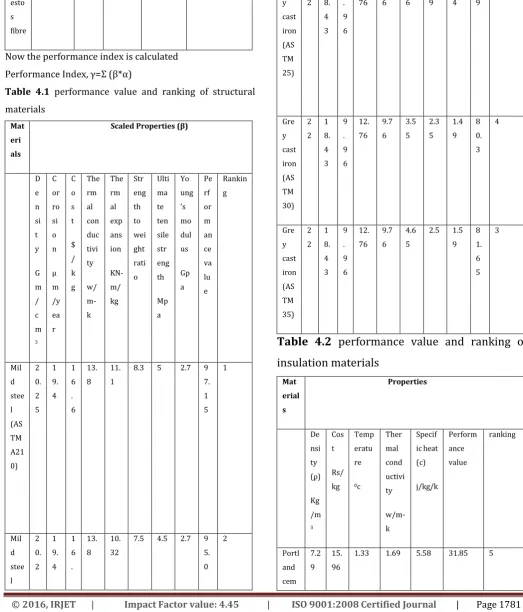
Now the performance index is calculated Performance Index, γ=Σ (β*α)
Table 4.1 performance value and ranking of structural materials
Mat eri als
Scaled Properties (β)
D e n si t y G m / c m 3 C or ro si o n µ m /y ea r C o s t $ / k g The rm al con duc tivi ty w/ m-k The rm al exp ans ion KN-m/ kg Str eng th to wei ght rati o Ulti ma te ten sile str eng th Mp a Yo ung ’s mo dul us Gp a Pe rf or m an ce va lu e Rankin g Mil d stee l (AS TM A21 0) 2 0. 2 5 1 9. 4 1 6 . 6 13. 8 11. 1
8.3 5 2.7 9
7. 1 5 1 Mil d stee l 2 0. 2 1 9. 4 1 6 . 13. 8 10. 32
7.5 4.5 2.7 9
5. 0 2 (AS TM A36 )
5 6 7
Gre y cast iron (AS TM 25) 2 2 1 8. 4 3 9 . 9 6 12. 76 9.7 6 3.0 6 1.6 9 1.3 4 7 9 5 Gre y cast iron (AS TM 30) 2 2 1 8. 4 3 9 . 9 6 12. 76 9.7 6 3.5 5 2.3 5 1.4 9 8 0. 3 4 Gre y cast iron (AS TM 35) 2 2 1 8. 4 3 9 . 9 6 12. 76 9.7 6 4.6 5
2.5 1.5
9 8 1. 6 5 3
Table 4.2
performance value and ranking of
insulation materials
Mat erial s Properties De nsi ty (ϼ) Kg /m 3 Cos t Rs/ kg Temp eratu re 0c Ther mal cond uctivi ty w/m-k Specif ic heat (c) j/kg/k Perform ance value ranking Portl and cem 7.2 9 15. 96 [image:5.595.31.555.183.796.2]© 2016, IRJET | Impact Factor value: 4.45 | ISO 9001:2008 Certified Journal | Page 1782 ent
Refr actor y clay (cera mic)
7.4 9
26. 6
20 5.8 5.3 65.19 1
Glass 5.5 1
13. 8
0.89 4.16 3.3 27.6 6
Conc rete
33 14.
5
4.4 1.06 6 58.96 2
Chro me brick
4.6 2
17. 7
8.88 13 4.15 48.27 3
Asbe stos fiber
29. 43
0.3 5
2.22 0.6 4.03 36.03 4
5. CONCLUSION
Ranking of materials in Weighted factor computed by Digital logic method, among the different types of structural materials Mild steel (ASTM A210), Mild steel (ASTM A36), Grey cast iron (ASTM 25), Grey cast iron (ASTM 30), Grey cast iron (ASTM 35) and the different types of insulating materials Portland cement, refractory clay, glass, concrete, chrome brick and asbestos fiber. The Mild steel (ASTM A210) higher performance of 97.15% and refractory clay with the performance of 65.19 % is selected since; they are showing higher performance than all others.
6. REFRENCES
[1] Boothroyd G, Dewhurst P, Knight W. "Product design for manufacture and assembly", Marcel Dekker, Inc., 2002, U.S.A. [2] Deng YM, Edwards KL." The role of materials identification and selection in engineering design", Mater Design 2007; 28:131-139.
[3] Kasim M. Daws , Zouhair I. AL-Dawood , Sadiq H. AL-Kabi “Selection of Metal Casting Processes: A Fuzzy Approach” Jordan Journal of Mechanical and Industrial Engineering, Volume 2, Number 1, Mar. 2008, ISSN 1995- 6665,Pages 45 – 52.
[4] Dr. Mohammed Jasim Kadhim , Dr.Mithal A. AlBassam & Dr. Suad Hamzah Abdas “Materials Selection in Conceptual Design using Weighting Property Method” Eng. & Tech. Journal, Vol. 29, No. 1, 2011.
[5] Suresh talur, Dr kiran kumar P and prof T Madhusudan “Selection of Material by weighted property method for Savonius Vertical Axis Wind Turbine Rotor blade” Volume: 02 Issue: 01 | Apr-2015.
BIOGRAPHY
Kiran K
M.Tech (machine design) Student,
Department of mechanical
engineering SJB Institute of Technology, Bengaluru.
Dr. Kiran Kumar P
Professor, Department of
mechanical engineering SJB Institute of Technology, Bengaluru.
Prof. T Madhusudhan