© 2016, IRJET | Impact Factor value: 4.45 | ISO 9001:2008 Certified Journal | Page 173
Arithmetic of 5
thGeneration Computer
Sinthia Roy
1, Sanjit Kumar Setua
2Assistant Professor, Computer Science
& Engineering Department, Guru Nanak Institute of Technology
Associate Professor, Computer Science
& Engineering Department, University of Calcutta, West Bengal, India
---***---Abstract
–Decimal number system is purportedly the most used number system by humans. However, there are diverse ways of counting numbers, when it comes to computer systems, the number system that crosses our mind is the binary number system. When represented, binary number system takes a considerable number of bitsin comparison to ternary number system i.e trits.In this paper we propose an algorithm based on ternary number system which enables us to multiply two ternary numbers, which will be more efficient in a ternary system only.
Keywords— Binary, Ternary, Trit, Arithmetic, Decimal, Conversion.
I.
I
NTRODUCTIONDuring the childhood of organic systems the counting was with the pebbles first, then with fingers, afterwards with Abacus, slide rule, calculator and finally digital computers.[1] Digital computer deals with digits. In fact a computing system is nothing but high speed, cost effective manipulator of different codes. The bottle neck of codes and their technology mapping was overcome by the advent of positional number systems.
In computers, if we can count something then it cannot be infinite. The problem can be solved if we take only binary digits 0 and 1 using positional number system. This is because 0 and 1 can serve our multipurpose activity. Now man machine interface demands use of decimal numbers, but alas 10 symbols required for this cannot be represented in a robust way.
Although we are accustomed to deal with numbers 0 and 1 effectively, according to Hayes, base e=3 is the most optimal base[16]. Moreover it is shown that it is much more efficient in ALU design provided we can forecast an balanced technology mapping . Therefore we will be dealing with base 3 i.e ternary number system in the rest of the paper whose benefits are illustrated in the section II.
In this paper, we demonstrate that addition, subtraction and multiplication can be done inexpensively if time factor can be effectively minimized.
The rest of the paper has been organized as follows: Section II delineates ternary number system , its
optimality and its benefits. Section III specifies the algorithm to convert a decimal number to its equivalent balanced ternary number. Section IV describes the kinds of arithmetic operations viz. addition, subtraction and multiplication. Section V concludes the paper.
II.
T
ERNARYN
UMBERS
YSTEMA.
What is ternary number system?
Ternary (sometimes called trinary) is the base 3 numeral system. Analogous to bit, a ternary digit is a trit (trinary digit). One trit contains log23 (about 1.58496) bits of information. Ternary number system is of two kinds namely unbalanced ternary number system and balanced ternary number system. Unbalanced ternary number system is expressed using the symbols 0, 1 and 2[18]. Balanced ternary is a non-standard positional number system (a balanced form), useful for comparison logic. Unlike unbalanced ternary system, the digits have the values −1, 0, and 1[5]. Balanced ternary can represent all integers without resorting to a separate minus sign. Therefore in balanced ternary number system, if we encounter a positive number then its corresponding negative number can be understood by interchanging the sign, for ex: 111 represents -5 and 11 1 represents
+5. Balanced ternary is enumerated as follows- the symbol 1 / 1’ denotes the digit −1, but alternatively for
easier parsing "−" may be used to denote −1 and "+" to denote +1.
B.
Why Base 3 is considered as the most optimal
base?
© 2016, IRJET | Impact Factor value: 4.45 | ISO 9001:2008 Certified Journal | Page 174
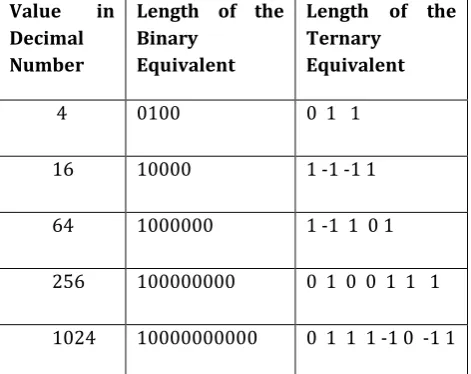
Value inDecimal Number
Length of the Binary
Equivalent
Length of the Ternary
Equivalent
4 0100 0 1 1
16 10000 1 -1 -1 1
64 1000000 1 -1 1 0 1
256 100000000 0 1 0 0 1 1 1
1024 10000000000 0 1 1 1 -1 0 -1 1
Table 1 : The decimal numbers and their corresponding binary & ternary numbers.
Secondly, according to Haye’s[16] the cost(i.e cost of computing for a particular base or cost in terms of space or time tradeoff) of a particular base or radix ‘r’ is proportional to ’r’, if r(for radix) denotes the number for primitive symbols or digits used to represent numbers in a computer. This is quiet reasonable because the complexity of the circuits( i.e appropriate physical logic) needs to store and process numbers increases with r. Now according to him the optimal base, which is the product of base and width (number of digits used to represent a number) of the digit is an objective function needs to be minimized[16]. Thus, for optimal number of computations, it may be noted that the product b × w needs to be minimized, where b is the base and w is the width in the digits. Using simple mathematics it is shown that for optimal result, b = e. For practical purposes, the integer 3,taken as the ceiling function of e is considered as the optimal value of base width.
C.
Benefits of Ternary Technology
The most important and immediate use of ternary technology is in the new and emerging field of Quantum Computing, a technology which has been described as a promising and flourishing research area.
Ternary computing also serves as a reference point from which a comparison of different base systems can be conducted, while higher bases may be too cumbersome for practical use and lower bases become too phony, therefore
ternary systems strike a careful balance[16]. Some of the interesting properties of a balanced ternary number system include[10] :
1. The negative number is obtained by interchanging 1 and -1.
2. The sign of a number is given by its most significant nonzero trit.
3. The operation of rounding off to the nearest integer is identical to truncation.
Ternary number system also serves as a stepping stone on the way to Multi-Valued-Logic (MVL) which is currently being probed for its application in artificial intelligence.
III.
C
ONVERSION OFD
ECIMAL TOB
ALANCEDT
ERNARYNUMBER
Conversion from decimal to balanced ternary number requires converting the decimal number to unbalanced ternary notation (represented with 0, 1, and 2). Then we have to append a zero before the unbalanced number. The unbalanced ternary is then converted to balanced ternary by adding runs of 1’s i.e 1111… with considering carry, then again from the resultant unbalanced ternary numbers subtract runs of I’s i.e 1111… without considering borrowing (the thing to be noted is that the string of 1s should be of the same length as the ternary numbers, so if the result of the addition has more number of digits, then subtract nothing from these extra digits). In order to add 1s to the unbalanced ternary notation, ternary arithmetic addition operation is performed. The following table 2 shows the basic addition operations performed on ternary arithmetic.
A B Sum Carry Diff Borrow Max Min
1 1 2 0 0 0 1 1
1 0 1 0 1 0 1 0
1 2 0 1 2 1 2 1
Table 2 : Truth Table of Unbalanced Ternary arithmetic operation
The Decimal to balanced ternary conversion can be done using the following algorithm:
//Accept the input
decNum ← Decimal number from user base ← Target base(in this case it is 3)
//convert decNum to unbalanced ternary while(decNum!=0)
[image:2.595.58.294.112.299.2]© 2016, IRJET | Impact Factor value: 4.45 | ISO 9001:2008 Certified Journal | Page 175
remainder ← decNum % base;unbalancedTernary ← (remainder * 10) + unbalancedTernary;
decNum ← decNum / base; }
//Prefix unbalancedTernary with a zero
unbalancedTernary ← “0” + unbalancedTernary;
//Generate a run of one whose length matches //with the unbalancedTernary
For i=1 step 1 to lengthofUnbalancedTernary //Prefix unbalancedTernary with a zero secondTernay ← “1” + secondTernay; end For // loop on i
//Add secondTernary to unbalancedTernary considering //carry
unbalancedTernary ← secondTernay + unbalancedTernary;
//Subtract secondaryTernay from unbalancedTernary //This gives resulting balanced ternary
balancedTernary ← unbalancedTernary – secondaryTernay;
Decimal number = 55 Base = 3
Number Operation1 Result Operation 2
55 55%3=1 1 Number = 55/3 = 18
18 18%3=0 0 Number = 18/3 = 6
6 6%3=0 0 Number = 6/3 = 2
2 2%3=2 2 Number = 2/3 = 0
Unbalanced Ternary Equivalent= 2001
*‘%’ -modulo operator
Table 3: Example of Conversion from Decimal to Unbalanced ternary & Unbalanced ternary to Balanced Ternary
Example:
Adding 11111 to 02001: 0 2 0 0 1 1 1 1 1 1 2 0 1 1 2
Subtracting 11111 from 20112: 2 0 1 1 2
1 1 1 1 1
1 -1 0 0 1
So, Resultant Balanced Ternary equivalent for decimal number 55 is 1 -1 0 0 1.
IV.
ARITHMETIC OPERATIONS IN BASE 3 NUMBER SYSTEMA.
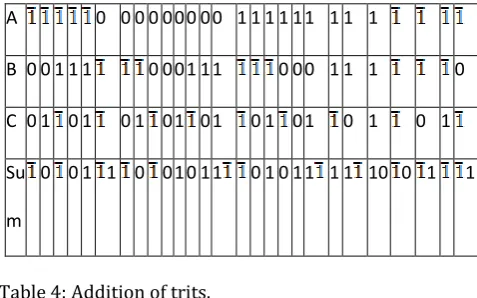
Addition- The underlying table illustrates some examples of additions for the ternary number system. Each column corresponds to a pair of trits to be added and a carry trit. Thus, the total number of possible columns would be 33 = 27.A 0 0 0 0 0 0 0 0 0 1 1 1 1 1 1 1 1 1
B 0 0 1 1 1 0 0 0 1 1 1 0 0 0 1 1 1 0
C 0 1 0 1 0 1 0 1 0 1 0 1 0 1 0 1 0 1
Su
m
0 0 1 1 0 0 1 0 1 1 0 1 0 1 1 1 1 10 0 1 1
Table 4: Addition of trits.
B.
Subtraction
- The operation of Subtraction can be viewed simply as negation of a number followed by addition.
Multiplication
-
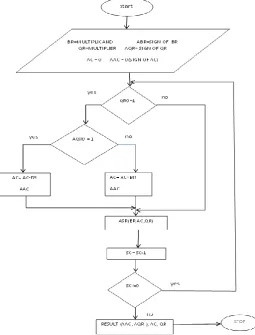
For multiplication we store multiplicand in a register BR, (say), & ABR is another register which holds the sign bit of the multiplicand. Multiplier is again stored in a register QR, (say), & AQR is another register holding the sign bit of the multiplier. AC is a register which acts as an accumulator and AAC register correspondingly holds the sign bit of the accumulator. Initially, we assume that product is zero. This is known as the partial product, where a partial product is obtained by multiplying the multiplicand with one trit of the multiplier. In simple multiplication, if the trit of the multiplier is 1( ) then multiplicand is added (subtracted) with the partial product to generate a new partial product. Now the next trit of the multiplier is multiplied with multiplicand and the product is shifted by one trit to the left and added with the partial product to generate a new partial product.[10] But in case of hardware multiplication (using registers), instead of shifting the (multiplicand × c) (where c is a trit of the multiplier, having value 0 or 1 or ) to the left we shift the partial product one trit to the right. We use the term ASHR to indicate arithmetic shift right. The multiplication algorithm is shown below. [image:3.595.320.559.229.378.2]© 2016, IRJET | Impact Factor value: 4.45 | ISO 9001:2008 Certified Journal | Page 176
Algorithm:// Initialize ER to zero ER ← 0;
Initialize AC(accumulator), BR(multiplicand) and QR(multiplier), and their respective sign
representations AAC,ABR and AQR respectively while SC != 0
do
If LSB of multiplier = 1
If LSB of the sign representation == 1 AC ← AC – multiplier;
//same operation is performed on the signed representation
else
AC ← AC + multiplier;
//same operation is performed on the signed representation
Perform Arithmetic right shift on ER, AC, QR, AAC, and AQR;
SC ← SC -1; If SC = 0
ER, AC, QR is displayed along with ER, AAC, and AQR; this represents the ternary equivalent.
Figure 1: Flowchart of Ternary Multiplication algorithm
Example:
BR=1 0 0 1(i.e 55 in decimal) BR=1 1 0 0 1
ABR=0 1 0 0 0
QR=1 0 1 (i.e. 56 in decimal) QR=1 1 0 1 1 AQR=0 1 0 0 1
= 1 0 0 = 1 1 0 0 1
[image:4.595.38.294.406.742.2]= 1 0 0 0 1
© 2016, IRJET | Impact Factor value: 4.45 | ISO 9001:2008 Certified Journal | Page 177
Final Product = 0 0 1 1 1 0 0 1= ( 3080)10
V.
CONCLUSION
The model of computation provided by an ordinary computer assumes that the basic arithmetic operations- Addition, subtraction, multiplication and division can be performed in constant time. This abstraction is reasonable because most basic operations on a random access machine have similar costs. But when it comes to designing the circuit’s those implement these operations, from here we realise that the performance depends on the magnitudes of numbers been operated on.
References
[1] Behrooz Parhami.2005. Computer Architecture-from microprocessors to supercomputers. United States: Oxford University Press.
[2] Cormen, Thomas, H. et al. (2008). Introduction to Algorithms. Tata McGraw Hill
[3] Rangaraju H G, Venugopal U. (3 september 2010). Low Power reversible Parallel Binary adder
subtractor.International Journal of VLSI design & communications System.
[4] TedBorys. (19.04.2004). Computer Arithmetic.
[5] ProfLoh.(February 2,2005). Carry Save Addition.
[6] Digi Key Corporation (7 September,2006). Binary Coded Decimal Division by Shift & Subtract Application Note:DKAN0003A.
[7] SherifGalal, Dung Pham. Division Algorithms and Hardware Implementations.
[8] AbenetGetahun. (2003). Booth Multiplication Algorithm.
[9] Prof. M RajashekharaBabu. Binary Multiplicatin- Booths Algorithm.
[10] Subrata Das et.al. (2011). Algorithms for Ternary Number System. Science Direct
[11] Afolayan A. Obiniyi et.al.(July 2011).Arithmetic Logic Design with Color-Coded Ternary for Ternary Computing. International Journal of Computer Application.
[12] A.Satish Kumar et.al.(2010). Minimization of Ternary Combinational Circuits-A Survey.Internatioanal Journal of Engineering Science & Technology.
[13] A.P.Dhande et.al.(2007). Ternary Logic Simulator Using VHDL.IEEE.
[14] HenningGundersen et.al.(2000). Ternary Operations.University of Oslo.
[15]file:///E:/M%20TECH/SSS%20PROJECT/Ternary %20study/Paper/History-of-Ternary-Computers.htm
[16] Brian Hayes.December(2001).Third Base.A reprint from American scientist.
[17]
http://en.wikipedia.org/wiki/Ternary_numeral_system
[18] http://en.wikipedia.org/wiki/Balanced_ternary
[19]
http://www.mortati.com/glusker/fowler/ternary.htm
[20]