Journal of Chemical and Pharmaceutical Research, 2017, 9(3):184-188
Research Article
CODEN(USA) : JCPRC5
ISSN : 0975-7384
184
Effect of Polyethylene Terphalet (PET) On Mechanical and Optical Properties
of Polylactic Acid (PLA) for Packaging Application
Nadia A Ali
Department of Physics, College of Science, University of Baghdad, Iraq
_____________________________________________________________________________
ABSTRACT
Blends of polyethylene terphalet (PET) with polylactic acid (PLA) were investigated to determine the influence of the addition of PET on mechanical and optical properties. The compositions were prepared in wt (20/80), (50/50), (80/20). Mechanical properties like tear strength, and optical properties like colors and transparency were also reported. Polyethylene terphaletee decrease the tear strength when adding PET and Impact strength of PLA was increased when adding PET when tested in the machine directions. Optical property such as colors was increased and the value of transparency was decreased as the loading of PET increased.
Keywords: PET; PLA; Tear strength; Impact strength; Color; Transparency
_____________________________________________________________________________
INTRODUCTION
185
minimize the huge environmental problem created by this non-biodegradable plastic waste [8]. Most of the physical and mechanical properties of PET improve as the molecular weight increases is a hard, stiff and strong material with a decent resistance to degradation upon exposure to chemicals PET. While some of the polymer blend approaches show promise, the options become very limited when the biobased carbon content and compostability of the blend are deemed important [9]. Tear resistance is one of the most important properties for the packaging application films. Tear resistance as determined is a measure of the force necessary to initiate tearing in plastic film tapes. This is contrasted with other methods which measure the force necessary to propagate a tear after it has been initiated. Tear resistance in plastic film tapes indicates how well-integrated the material will remain when it is used to conform to irregular shapes under tensions which vary across the width of the applied strip[9, 10] .Tear resistance can be measured by the ASTMD-412 method (the same used to measure tensile strength, modulus and elongation) , that can be used to measure the resistance to the formation of a tear (tear initiation) and the resistance to the expansion of a tear (tear propagation). Regardless of which of these two is being measured, the sample is held between two holders and a uniform pulling force applied until the aforementioned deformation occurs. Tear resistance is then calculated by dividing the force applied by the thickness of the material. Impact strength is defined as the absorbing of energy before failure or is a measure of the work done to fracture a test specimen. When the striker impacts the specimen, the specimen will absorb energy until it yields. At this point, the specimen will begin to undergo plastic deformation at the notch. The test specimen continues to absorb energy and work hardens at the plastic zone at the notch. When the specimen can absorb no more energy, fracture occurs.
In this study, PET was chosen as a benchmark for comparison with PLA as its clarity, ease of processing and favorable mechanical properties make it one of the most widely used polymers in the food packaging industry compared with PET the main disadvantages of PLA with respect to material properties are primarily associated with its brittleness. Goal is to improve tear resistance and impact strength have been developed impact resistance agents, compatible with the same PLA blend with PET.
MATERIALS AND METHODS Materials
Lactic acid (99.9%), Tin chloride dehydrated (SnCl2.2H2O ) P-toluene sulfonic acid (TSA) were purchased from
Fluka . Methylene Chloride was purchased from Sigma-Aldrich
Preparation of pure Polylactic acid:
The reaction was conducted in 250ml , three necked flask reactor equipped with a magnetic stirrer and a reflux condenser .100 gm of aqueous solution of lactic acid acid was mixed with methylene chloride for 5hrs at reflux temperature without any catalyst .After the removal of water of the condenser , the reaction vessel was cooled at 50°C, the required amount of catalyst SnCl2.2H2O (0.5wt%), TSA(0.4wt%) were add and this was followed by slow
heating of the reaction mixture to the refluxing temperature of the solvent under mild stirring with the help of magnetic stirring bar . The temperature gradually increased to 120°C in 3 hrs, and the reaction mixture was stirred continuously. Polymerizations are done at 120-160°C for 5hrs .At the end of the reaction, the flask was cooled, and the product was dissolved in chloroform and subsequently precipitated in methanol .The resulting solid was filtered and dried Under vacuum at 60°C under vacuum for 24hrs . Powder PLA weighted grade (1wt%) by using electronic balance of four digits type (Sartorius H51) and then dissolved in chloroform to obtain 20 wt% solution of PLA grade by slowly in 60°C for 2 hours warming until the solution become viscous using magnetic stirrer hot plate, then cast into petri dish at room temperature for 24 hour to ensure complete solvent removal.
Preperation of Polyethylene terphatalete/Polylactic acid blend:
PLA was dried in an oven at 70 °C for 4 hours to eliminate moisture. All compositions of each PET/PLA(20/80) (50/50), (80/20) blends were mixed using an internal mixer (Hakke Rheomix, 3000p) at temperature of 170 °C with a rotor speed of 60 rpm for 10 min. Compression molding (LabTech, LP20- B) were used to prepare the specimens. The melting temperature of 165 °C and mold temperature of 25 °C were used.
Tear test
186
the edge of the test sample. One use of these results would be for the specification of materials and thickness for plastic film used in packaging
Impact Izod test
The Izod impact testing was performed on the same impact tester (GT-7016-A2, Gotech Testing Machines,Taiwan) with maximum hammer energy of 4 J. Shape of the specimens conformed to ASTM D256 standard method of determining the impact resistance of materials. An arm held at a specific height (constant potential energy) is released, the arm hits the sample and the specimen either breaks or the weight rests on the specimen. From the energy absorbed by the sample, its impact energy is determined. A notched sample is generally used to determine impact energy and notch sensitivity.
Color test
Color properties were evaluated measuring color coordinates in the CIELAB color space L* (lightness), a*(redness and greenness) and b* (yellowness and blueness) were analyzed using a KONICA CM-3600d COLORFLEX-DIFF2. The instrument was calibrated with a white standard tile. Measurements were carried out in quintuplicate at random positions over the film surface. Average values for samples were calculated. Total color differences (ΔE) was evaluated by Equation (3)
ΔE=
(Δa
2+ Δb
2+ ΔL
2) ………3
Where
ΔL = Lstander-Lsample , Δa = a stander – a sample , Δb = b stander-b sample ,
Stander values for white plate were L = 96.86, a = - 0.02 and, b = 1.99 respectively . Five measurements were taken on each film, one at the center and four around the perimeter, and the mean values were used.
Transparency
Transparency of the films was determined by measuring the percent transmittance at 660 nm using a UV- visible spectrophotometer Shimadzu UV.
RESULTS AND DISCUSSION Tear strength
Generally plastic sheet with a property of brittleness will have very low tear strength, since neat PLA is a brittle material it shows tear strength is 0.11N and tear resistance was obtained dividing the tear strength by the thickness of neat PLA is 3.1 N/mm that appear in Table 1. Materials with low tear resistance tend to have poor resistance to abrasion and when damaged will quickly fail.
Table 1: Tear Resistance of neat PLA and PLA blend
Materials Tear Strength (mPa) Tear Resistance (N/mm) Neat PLA 0.11N 3.1
PET/PLA 20/80 0.23 4.3 PET/PLA 50/50 0.45 5.18 PET/PLA 80/20 0.76 6.25
In blend PET /PLA films shows better performance in tear propagation than neat PLA because that PET has better ductility, good strength, stiffness, and hardness this is an important issue of food packaging applications.
Impact Izod test
187
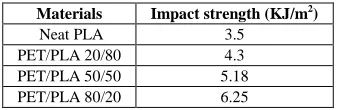
Table 2: Impact strength of neat PLA and PET/PLA blend
Materials Impact strength (KJ/m2)
Neat PLA 3.5 PET/PLA 20/80 4.3 PET/PLA 50/50 5.18 PET/PLA 80/20 6.25 Color
[image:4.612.212.403.206.260.2]Color is important factors to be considered in food packaging since it could influence consumer acceptance and commercial success of a food product. Table 3 shows the some differences in the CIELAB coordinates L* (lightness), a*(red-green) and b* (yellow-blue) and ΔE between neat PLA and PLA/PET blends.
Table 3: Color parameter of neat PLA and PLA/PET blend
Sample L* a* b* ΔE
Neat PLA 94.05 -1.01 1.31 - PET/PLA 20/80 94 -0.98 1.27 0.26 PET/PLA 50/50 93.85 -0.95 1.22 0.35 PET/PLA 80/20 93.12 -0.91 1.2 1.24
Table 3 shows the results obtained from the colorimeter analysis. When polyethylene terphalete is added to the film sample, a slight decrease in lightness values (L*) was observed. However, PLA and also both PET/PLA blends presented high L* values showing their high brightness. Furthermore, no major differences were found for total color difference values. This result suggested high transparency for films containing PET and the possibility to see through the film is one of the most important requirements for consumers. Negative values obtained for a* coordinate are indicative of a deviation towards green. However, these values are close to zero so the green tone was not noticeable. Positive values obtained of b* coordinate indicate a slight deviation towards yellow.
Transparency
Transparency is an important property of Packaging films. Transparency was calculated by equation Transparency= A600/ t …………..
Where A600 Absorbance at 600 nm and t thickness at mm of samples
Table 4: Transparency of neat PLA and PLA/PET blend
Sample T % Neat PLA 80 PET/PLA 20/80 78 PET/PLA 50/50 75 PET/PLA 80/20 74
Neat PLA showed the highest transparency characteristic of the high brightness of PLA films. The addition of PET no significant differences between PET and PLA were observed.
CONCLUSIONS
PLA is a promising biodegradable polymer for use in food packaging .However , because of its inherent brittle behavior need to be blended with PET foe some specific applications in particular production of films .In the present have shown a good improvement in tear and impact strength to make them useful for this particular application .The PLA has been receiving a great deal of attention, essentially due to its degradability. With this environmental-friendly property, along with a highly transparent appearance similar to that of polyethylene terephthalate (PET), PLA has undoubtedly become one of the most promising alternatives to non-biodegradable synthetic polymers conventionally derived from petroleum-based chemicals
REFERENCES
[1] NR Edmonds; PN Plimmer; C Tanner. High melt strength, tear resistant blown film based on poly (lactic acid). In Jana SC, editor. AIP Conference Proceedings, AIP Publishing, 2015, 1664, 090002.
[2] R Auras; SP Singh; J Singh. J Test Eval, 2006, 34(6), 1-7.
188
[4] M Jamshidian; EA Tehrany; M Imran; M Jacquot; S Desobry. Compr Rev Food Sci Food Safety, 2010, 9(5), 552-571.
[5] B Imre; B Pukánszky. Eur Polym J, 2013, 49(6), 1215-1233. [6] V Tanrattanakul; P Bunkaew. Express Polym Lett. 2014, 8(6).
[7] N Burgos; VP Martino; A Jiménez. Polym Degrad Stabil, 2013, 98(2), 651-658. [8] BW Chieng; NA Ibrahim; WM Yunus; MZ Hussein. Polymers, 2013, 6(1), 93-104.
[9] RK Krishnaswamy. Metabolix, Inc., assignee. Toughening polylactic acid with polyhydroxyalkanoates. United States patent US 9,328,239. 2016.