http://dx.doi.org/10.4236/msce.2014.21005
Molecular Dynamic Simulation Study on Glass Transition
Temperature of DGEBA-THPA/SWCNTs Composites
Cai Jiang, Jianwei Zhang, Shaofeng Lin, Dazhi Jiang
College of Aerospace Science and Engineering, National University of Defense Technology, Changsha, China Email: [email protected]
Received October 2013
ABSTRACT
Molecular dynamic (MD) simulations were carried out to predict the thermo-mechanical properties of the cured epoxy network composed of diglycidyl ether bisphenol A (DGEBA) epoxy resin and tetrahydrophthalic anhy-dride (THPA) curing agent and their single-walled carbon nanotubes (SWCNT) reinforced the epoxy matrix composites. Different characters such as the density of the materials and mean square displacements (MSDs) were calculated to estimate the glass transition temperatures (Tgs) of of the materials. 365 K and 423 K of the Tgs were obtained respectively, whereas the latter is much higher than the former. The simulation results indi-cated that the incorporation of SWCNTs in the epoxy matrix can significantly improve the Tgof the cured epoxy. The approach presented in this study is ready to be applied more widely to a large group of candidate polymers and nanofillers.
KEYWORDS
Molecular Dynamics Simulation; Glass Transition Temperature; Carbon Nanotubes Composites
1. Introduction
Glass transition temperature (Tg) is a key descriptor to evaluate the thermal properties of the heat-resistant ma-terials, while the useability determined by the mechanical properties at high temperature. The ability to predict the Tg and mechanical properties is of great value in the se-lection and design of new materials. Conducting experi-ments to measure the Tg and mechanical properties is a reliable, however, time-consuming and expensive ap-proach. Recently, molecular dynamics (MD) simulation has provided great insight into the Tg and elastic re-sponse of polymer and its composite materials.
Abu-Sharkh [1] conducted the rigid unit model and the explicit atom model to generate volume-temperature (V- T) data of poly (vinylchloride)respectively, which con- firmed the validity of MD simulation in predicting the Tg of amorphous polar polymers. Wu et al. [2,3] calculated the density and elastic constants of diglycidyl ether bis- phenol A (DGEBA) cured with isophorone diamine (IPD) using atomistic molecular simulation. The results indi-cated that both the use of COMPASS force-field and DREIDING force-field resulted in unrealistically high elastic constants whereas the former compared more fa-vorably with the corresponding experimental values than the later. Fan et al. [4] used PCFF force-field to predict
the Tg, linear thermal expansion coefficients (LCTEs) and Young’s modulus of cross-linked EPON862-TETA (triethylenetetramine) systems from MD simulations. Their results were in good agreement with the experimen-tal values in the literature. Li et al. [5,6] and Bandyop-adhyay et al. [7,8] studied the EPON862-DETDA (die- thylene toluene diamine) systems. The simulation results indicated a significant increase in Tg, Young’s modulus and yield stress with degree of polymerization, while the thermal expansion coefficient (CTE) decreased with the overall crosslink density, and the yield strain was less sensitive to it, however, there was no discernible influ-ence of cross-link distribution on the elastic modulus and the LCTE. Shenogina et al. [9,10] employed a new method-dynamic deformation approach to simulate the thermo-mechanical constants and the elastic constants of DGEBA-DETDA systems. Results were in very good agreement with experimental data of actual cured poly-mers. The approach showed excellent improvement compared to constants calculated using the static defor-mation approach.
lightweight structural materials. It has been observed that the incorporation ofCNTs[11] in the epoxy resin can sig-nificantly enhance its mechanical, thermal, and electri-calproperties, and thus, CNTs can be used as a potential reinforcement for epoxy. Gou et al. [12] investigated the interfacial bonding of single-walled carbon nanotube (SWCNT) reinforced epoxy resin composites in terms of stress transfer. A 250% ~ 300% increase in storage modulus with the addition of 20 ~ 30 wt% nanotubes was resulted. Liang et al. [13] found that both the EPON862 resin and DETDA molecules have attractive intercala-tions with (10, 10) SWCNT, and the aromatic ring struc-tures of the molecules try to align the aromatic ring planes toward the SWCNT surface and wrap around it. Mittal et al. [14] found that the reinforcement of SWCNTs with different diameters, whereas the (8, 8) SWCNTs reinforced EPON862 resin composites exhib-ited the highest enhancement of the Young's modulus. Chakraborty et al. [15] investigated the properties of the composites of pure monomer and trimer polycarbonate and their mixtures with different weight percentages of embedded SWCNTs at different temperatures. It was seen that the diffusivity of solvent molecules decreased with increasing percentage of CNTs at a specific tem-perature; and the polymerization played a role in en-hancement of binding energy.
In this study, molecular dynamic (MD) simulations werecarried out to predict the thermo-mechanical proper-ties of the curedepoxy network composed of diglycidyl ether bisphenol A(DGEBA) epoxy resin and tetrahy-drophthalic anhydride (THPA) curing agent and sin-gle-walled carbon nanotubes (SWCNT) reinforced the epoxy matrix composites, respectively. Density of the materials and mean square displacements (MSDs) were calculatedto estimate the glass transition temperatures (Tgs) of the materials.
2. Molecular Dynamic Simulation
MD simulations were conducted using the Materials Stu-dio 5.5 (Accelrys Inc.) software. COMPASS force-field was used in the simulation, which has been shown to provide accurate predictions of thermo-mechanical prop-erties of thermosetting polymers [3,4,10]. The non-bond interactions with a cutoff distance of 9.5Å, including van der Waals and electronic static forces, were applied. The atom approach was used for the dispersion interactions.
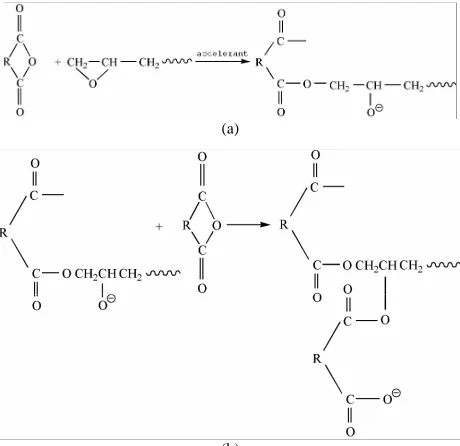
The cured epoxy network is composed of DGEBA resin and THPA curing agent. Chemical structures of the resin and hardener segments are shown in Figure 1. During the curing reaction, the acid anhydride groups of the curing agent molecules reacted with the epoxide groups of the epoxy resin. Initially, one THPA molecule reacted with one epoxide group. As the reaction
contin-ued, more cross-links were generated between the epoxy resin and the curing agent. The cross-linking activity expanded in all directions and formed a network of mac-romolecules. Schematic of the curing reactions are shown in Figure 2.
In this study, the polymer model was dynamically built by assumptions. Firstly, 8 epoxy segments and 16 hard-ener segments containing reactive sites with a density equal to 1.2 g/cm3 were packed into a 3D periodic cell box using the Amorphous Cell tool. This formulation was then mixed using the ensembles of the constant number of particles, constant volume and constant tem-perature (NVT) MD simulation for 100 ps performed at 298 K after initial molecular minimization (MM) based
(a)
[image:2.595.312.535.271.443.2](b)
Figure 1. Chemical structures of the resin, hardener. (a) DGEBA; (b) THPA.
(a)
(b)
[image:2.595.308.538.483.706.2]on COMPASS force-field. Under close proximity, cova-lent bonds were formed between the nearest reactive pairs within the reaction cutoff distance of 9.5 Å consid-ering the removal of ring catenation or spearing. Repeat-ing these steps to form bonds for several times, a 19.33 Å × 19.33 Å × 19.33 Å cross-linked polymer network with a conversion of 80% was finally obtained. For the CNT composites, a zigzag SWCNT (4,0) with the diameter of 3.13 Å and length of 34.08 Å consisting of 196 atoms is embedded into the above amorphous DGEBA-THPA systems with a density equal to 1.0 g/cm3, followed by the cross-linking activities. The resulting model system has a cell dimension of 21.52 Å × 21.52 Å × 21.52 Å with a conversion of 60%. Periodic boundary conditions are applied in all three directions for both models.
After the initial microstructure was generated, the minimization of the potential energy of the model was carried out, where COMPASS force-field was used. Then simulated annealing was performed by raising the tem-perature from 500 K to 900 K and cooling down to 500 K with steps of 20 K and an annealing time of 50 ps. After that, geometric optimization of 10000 steps and NVT MD simulation of 200ps were performed at a tem-perature above the Tg, such as 523 K in Forcite modules, and repeated for several times to relax the polymer chains.
In order to imitate the thermal performance in a kinetic process, simulation of cooling process was performed. The system was cooled stepwise from 523 K to 283 K with the rate of 10 K/200 ps. At each temperature, 10000 steps geometric optimization simulation was performed to relax the polymer chains, followed by the ensembles of the constant number of particles, constant pressure and constant temperature (NPT) MD simulation under a pressure of 0.1 MPa for 200 ps to obtain the optimized density. In terms of non-bonding interaction treatments, atom-based direct cutoff of 9.5 Å and a buffer of 0.5 Å were used depending on the accuracy and efficiency of the computation. Velocity Verl et al. gorithm with a time step of 1fs was used for the integration of the atom mo-tion equamo-tions throughout all simulamo-tions. Nose thermo-stat and Anderson barothermo-stat with cell time constant of 1.0 ps have been adopted. Each subsequent simulation was started from the final configuration obtained at the pre-ceding temperature. The simulation in each case was performed with an interval of 1 femtosecond (fs) in each simulation step.
3. Results and Discussion
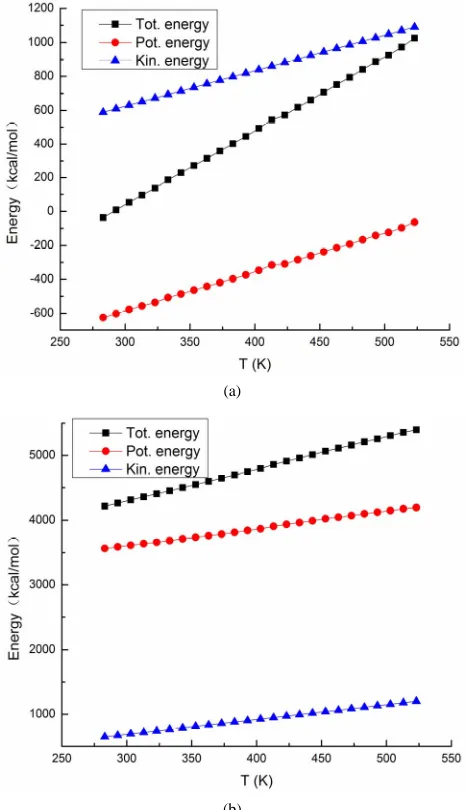
Various energies can be calculated from the MD simula-tions, which are used to analyze the roles of them in glass transition. The simulated results of total energy, potential energy and kinetic energy of the system against the
tem-perature are plotted in Figure 3. It can be seen that the plots of these energy increases almost linearly with in-creasing temperature in the whole temperature range, indicating that the total energy, potential energy and ki-netic energy play no distinctive roles in the glass transi-tion process of the epoxy resin and its CNT composites.
Densities of the epoxy resin and the composites at room temperature were calculated to be 1.228 g/cm3 and 1.012 g/cm3, respectively, which are in good agreement with the appointed values. The evolution of density as a function of temperature of the DGEBA-THPA/SWCNT composites is plotted in Figure 4. A steady increase of the density with decreasing temperature and a clear chan- ge in the slope of the density curve were observed. The kink in the density vs temperature slope is defined as the
(a)
[image:3.595.307.540.282.687.2](b)
values of Tg, which occurs at approximately 423 K, where the epoxy resin passes from the glassy state to the rubbery state.
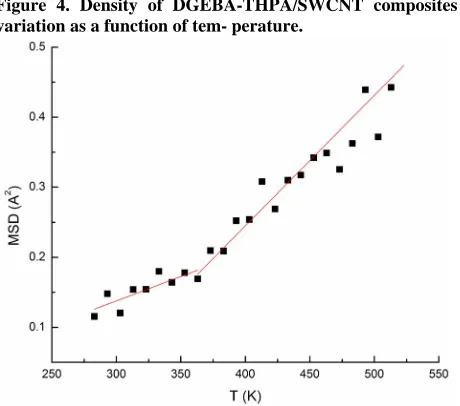
[image:4.595.59.285.316.491.2]The cross-reactions in the epoxy resin make significant differences in structure and properties from other linear polymers. It is instructive to analyze the motion of these cross-links in the model systems as a function of tem-perature. Because of incomplete reaction, segments on the polymer chains can be classified as cross-linked and free ones. Generally, the cross-linked segments exhibit much lower mobility than the free ones due to topologi-cal constraints. The value of Tg is correlated well with the polymer rigidity, namely the segmental mobility in polymer chain. The mean square displacements (MSDs) of the epoxy resin chains at 30 ps were calculated, which is plotted in Figure 5. The turning point of MSDs indi-cated Tg of the DGEBA-THPA polymer, which occurs around 365 K.
Figure 4. Density of DGEBA-THPA/SWCNT composites variation as a function of tem- perature.
Figure 5. MSDs of the epoxy resin chainsvariation as a function of temperature.
From the MD simulations, Tg of the DGEBA-THPA/ SWCNT composites is much higher than the DGEBA- THPA polymer, which is consistently with the fact.
It is very inspiring to see that the MD simulation method can be successfully applied to investigate the thermomechanical properties of the CNT/polymer com-posites. Once established, this approach can be applied more widely to a large group of candidate polymers and nanocomposites, proving a much more cost-effective way to narrow the fabrication and testing efforts to the selectedbest performers predicted by the MD simula-tions.
4. Conclusion
In the current study, two models of DGEBA-THPA cross-linked resin and its CNT composites were investi-gated by MD simulations. Different characters were cal-culated for the two models. The calcal-culated results showed that the Tg of the two systems are 365 K and 423 K, respectively, whereas the value of latter is much higher than the former, which is consistent with the fact. It can be expected that the method would be employed in further molecular simulation of structure and properties for cross-linked epoxy resin or other cured polymer net-work and their CNTs composites.
Funding
The present work is supported by the Key Projects of National High-tech R&D Program of China (863 Pro-gram) under Grant No. 2012AA03A205, Hunan Province Technology Major Project of China under Grant No. 2011FJ1001.
REFERENCES
[1] B. F. Abu-Sharkh, “Glass Transition Temperature of Poly(vinylchloride) from Molecular Dynamics Simula- tion: Explicit Atom Model Versus Rigid CH2 and CHCl
Groups Model,” Computational and Theoretical Polymer Science, Vol. 354, No. 11, 2001, pp. 29-34.
http://dx.doi.org/10.1016/S1089-3156(99)00070-7
[2] C. F. Wu and W. J. Xu, “Atomistic Molecular Modelling of Crosslinked Epoxy Resin,” Polymer, Vol. 47, 2006, pp. 6004-6009.
http://dx.doi.org/10.1016/j.polymer.2006.06.025
[3] C. F. Wu and W. J. Xu, “Atomistic Molecular Simula- tions of Structure and Dynamics of Crosslinked Epoxy Resin,” Polymer, Vol. 48, 2007, pp. 5802-5812.
http://dx.doi.org/10.1016/j.polymer.2007.07.019
[4] H. B. Fan and Matthew M. F. Yuen, “Material Properties of the Cross-linked eEpoxy Resin Compound Predicted by Molecular Dynamics Simulation,” Polymer, Vol. 48, 2007, pp. 2174-2178.
[image:4.595.59.289.501.704.2][5] C. Y. Li and A. Strachan, “Molecular Simulations of Crosslinking Process of Thermosetting Polymers,” Poly- mer, Vol. 51, 2010, pp. 6058-6070.
http://dx.doi.org/10.1016/j.polymer.2010.10.033
[6] C. Y. Li and A. Strachan, “Molecular Dynamics Predic- tions of Thermal and Mechanical Properties of Thermoset Polymer EPON862/DETDA,” Polymer, Vol. 52, 2011, pp. 2920-2928.
http://dx.doi.org/10.1016/j.polymer.2011.04.041
[7] G. M. Odegard and A. Bandyopadhyay, “Molecular Mo- deling of Crosslink Distribution in Epoxy Polymers,” Modelling and Simulation in Materials Science and En-gineering, Vol. 20, 2012.
[8] A. Bandyopadhyay, “Molecular Modeling of EPON 862- DETDA Polymer,” Ph.D. Thesis, Michigan Technologi-cal University, Houghton, 2012.
[9] N. B. Shenogina, M. Tsige, S. S. Patnaik and S. M. Mukhopadhyay, “Molecular Modeling Approach to Pre-diction of Thermo-Mechanical Behavior of Thermoset Polymer Networks,” Macromolecules, Vol. 45, 2012, pp. 5307-5315. http://dx.doi.org/10.1021/ma3007587
[10] N. B. Shenogina, M. Tsige, S. S. Patnaik and S. M. Muk- hopadhyay, “Molecular Modeling of Elastic Properties of Thermosetting Polymers Using a Dynamic Deformation Approach,” Polymer, Vol. 54, 2013, pp. 3370-3376.
http://dx.doi.org/10.1016/j.polymer.2013.04.034
[11] S. Iijima, “Helical Microtubules of Graphtic Carbon,” Nature, Vol. 354, No. 7, 1991, pp. 56-58.
http://dx.doi.org/10.1038/354056a0
[12] J.H. Gou, B. Minaie, B. Wang, Z. Y. Liang and C. Zhang, “Computational and Experimental Study of Interfacial Bonding of Single-walled Nanotube Reinforced Compos-ites,” Computational Materials Science, Vol. 31, 2004, pp. 225-236.
http://dx.doi.org/10.1016/j.commatsci.2004.03.002
[13] Z. Y. Liang, J. J. Gou, C. Zhang, B. Wang and L. Kramer, “Investigation of Molecular Interactions Between (10, 10) Single-walled Nanotube and Epon 862 Resin/DETDA Curing Agent Molecules,” Materials Science and Engi-neering A, Vol. 365, 2004, pp. 228-234.
http://dx.doi.org/10.1016/j.msea.2003.09.032
[14] R. Mittal, M. Rastogi, N. Mahatele and A. Vidhyarthi, “Molecular Modeling for Calculation of Mechanical Properties of EPON862/Swcnts Composites,” IEEE, 2011.