Munich Personal RePEc Archive
Workforce Occupancy – Essential
Indicator within the Analysis of the
Country Economic Development
Dobrota, Gabriela and Busan, Gabriela and Chirculescu,
Felicia Maria
University of Constantin Brancusi Targu Jiu, Romania
May 2007
Workforce Occupancy – Essential Indicator
within the Analysis of the Country Economic Development
Professor doctor Gabriela Dobrotă Lecturer doctor Gabriela Buşan Junior assistant Felicia Chirculescu
"Constantin Brâncuşi" University Târgu Jiu
Abstract: The level of economic development of county and it’s capacity to provide jobs reflects important issues which could be measured in line with the occupancy degree of the workforce. In the context of our county’s accession to the European Union, Romania should pursue a sustainable economic growth which would further generate high quality jobs in an increasing proportion.
The reorganization process of Romanian economy should run parallel to active measures on labour market intended for the young people and the long-term unemployed, countryside inhabitants and people working in agriculture. The paper exhibits issues related to the distribution of the occupied population within activity domains and the evolution of the unemployment rate which relieves the direct relation between the development level of Romanian economy, the occupancy rate and the professional qualification of the workforce.
Key Words: the unemployment, workforce occupancy, the economic development
The starting point for this analysis is Paul Samuelson’s affirmation: “man is more than merchandise”. The human factor is a fundamental element for the existence and development of a society. He must be a priority within the economic and social politics actions at the level of any community.
Any economy must exploit the competitive advantages caused by a high degree of work force qualification. This supposes investments accomplishment in the human capital, in the education and professional training of the human resources, the connection between the development level and these investments being obvious. The reality on the Romanian labor market highlights the fact that people with a medium education are affected by unemployment in a higher proportion that the people with a superior qualification. At the same time, within the competition context that has a human capital coming from a high performance economic area, we can observe the fact at the level of our country the output of the national human resource is much lower in comparison with tat determined by the Western one, a fact that has repercussions upon the remuneration level. The existence of cheap work force in our country has been exploited by many foreign companies that had activities in the easy industry. The Lohn has developed a lot in Romania after 1990 due to the decreased level of used people wages plans. At present, we observe a certain decline, as a consequence of the fact that more and more Romanian people prefer to leave and work abroad, where the income level is higher. Still, what fields do they work in? the answer is obvious: the most part of the Romanians carry activities that mainly suppose physical capacities, which reveals a low level of their qualifications and abilities.
Our country must act in the sense of increasing the budget allocations for education, because the level of the economic development decisively depends on the performances registered by the human capital. But, at the same time, one should follow the youg people stimulation in order to carry productive activities in Romania and not in other countries. We must not train the human capital for “export’, but on the contrary, we must give the opportunity to benefit from the results of the investment in the human capital.
generating also the obligation to create new work places, to apply new strategies of decreasing unemployment and develop the human resources. The adopted measures must focus on the accomplishment of investments into the human capital in order to provide the necessary competitiveness in accordance with the modern economic dynamics, to diminish the early school abandon rate, to finish the initial training courses, to carry adults professional training courses.
The analysis of a country’s economic results is made with the help of macroeconomic indicators (GDP, NP, NV). In order to reveal some important macroeconomic correlations we can make an combined analysis of different indicators. Therefore, the correlation GDP – work force highlights the influence of the work factor upon the macroeconomic results. According to “the Okun’s law” this connection underlines a decrease of the unemployment rate due to a GDP decrease in the economic recession phase and a decrease of the unemployment rate in the context of GDP rhythm increase in the phase of national economy expansion.
The analysis of the dependent evolution between the population and economy supposes some specifications:
worldwide, we notice an indirect correlation between the economic development level and the population increase rhythm;
a series of other factors act directly upon the unemployment size: technical progress, the level of investments in the human resources;
the economy of a country has, at a certain time, a limited number work places;
there are always persons that do not want are not qualified to carry wage activities;
the work force mobility, in the context of economy’s structural modifications, causes difficulties in finding persons that agree to work in some activity fields (construction, IT, easy industry);
the statistic data do not always reflect the reality if they are not strictly analyzed, and they must be interpreted in a certain context.
In Romania, unemployment has been legislated on beginning with 1991, when the Law no. 1/1991 regarding the unemployed social protection and their professional reintegration entered in force. The unemployment evolution from the apparition of this law is reflected in table no. 1
Unemployment evolution rate after 1991
Table 1
Year ‘91 ‘92 ‘93 ‘94 ‘95 ‘96 ‘97 ‘98 ‘99 ‘00 ‘01 ‘02 ‘03 ‘04 ‘05 ‘06 Unemployment
rate
3 8,4 10,4 10,9 9,5 6,6 8,9 10,4 11,8 10,5 8,8 8,4 7,4 6,3 5,9 5,2
The increase of the unemployment rate has occurred due to the continuous diminishing of the occupied population, as it results from table no. 2
The occupied population in Romania Table no. 2 Year Occupied population
Beginning with 2003, we notice a decrease of the unemployed number, as a consequence of an economic increase but also due to the Romania’s total population decrease, at the level of 2006, registering a number of 21584365 inhabitants. This afct should represent an alarm signal for the authorities, because the birthrate decrease may lead to the population aging, the decrease of the persons that are fit for work and generating serious difficulties in a few years.
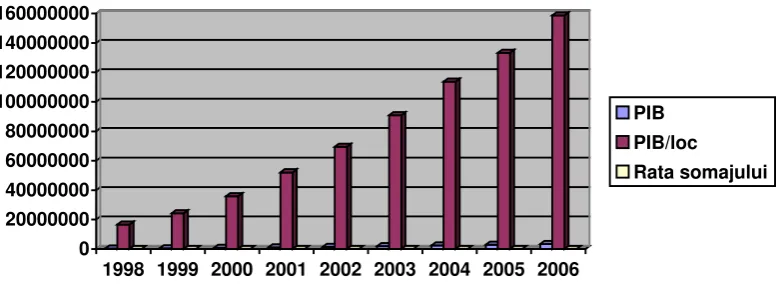
[image:4.595.108.500.436.579.2]As we have mentioned before, between the unemployment rate and the economic development level of a country, there is a tight connection. This can be observed from the GDP and GDP/inhabitant evolution correlated to the unemployment rate evolution (table no. 3)
Table no. 3 Year GDP
(billion lei)
GDP /inhabitant (lei)
Unemployment rate (%)
1998 373.798,2 16.611.185 10,4 1999 545.730,2 24.300.009 11,8 2000 803.773,1 35.826.421 10,5 2001 1.167.687 52.109.359 8,8 2002 1.514.750,9 69.500.586 8,4 2003 1.975.648,1 90.903.123 7,4 2004 2.464.687,9 113.719.863,41 6,3 2005 2.880.478 133.208.384,87 5,9 2006 3.424.180 158.641.683,45 5,2
Graphically, this connection is reflected as follows:
0 20000000 40000000 60000000 80000000 100000000 120000000 140000000 160000000
1998 1999 2000 2001 2002 2003 2004 2005 2006
PIB
PIB/loc
Rata somajului
Graphic no. 1 GDP, GDP /inhabitant, Unemployment rate evolution
The analysis may be deepened on the structure of the occupied population on the national economy branches, on environments (urban and rural) by watching the number of people that take qualification and requalification courses, on socio-professional categories.
The measures adopted at the level of Romania regarding the unemployment must focus on:
increasing the work places and their quality in order to increase work productivity;
diminishing the discrepancies between the levels of developing the country’s regions;
accomplishing investments in the education field in order to develop a knowledge based economy, in order to train a competition mentality, flexibility to the requirements of a continuously changing economic system;
providing professional training for adult unemployed and persons that risk to lose their work place;
facilitating and stimulating the intermediation and placing work force; direct creation of work places;
facilities granting for those who want to carry their activities in the rural environment or agriculture.
In order to increase the work force occupation as well as the unemployment rate reduction, one takes into consideration the modernization and the application of some active measures on the labor market that have the following objectives:
reducing unemployment within the young people until 25 years old, by applying the stimulation measures of the employers for hiring graduates, professional counseling, professional training courses, small business establishment advice;
reducing long-term unemployment by granting allocations for the unemployed that are hired before the remuneration period expires, mobility stimulation, by stipending measures for the work force engaged in temporary occupation programs;
reducing the unemployment of the special needs persons, by taking measures to encourage employers that hire unemployed over 45 years old, sole family supporters, handicapped persons;
decreasing unemployment within the young people that come from social protection institutions, by signing solidarity contracts and identifying the insertion employers;
continuous professional training, by organizing courses and for the persons that have interrupted their activity, so that, when they begin work again, they are able to carry their work attributions, and on the other hand, the diversification of professional competences in order to facilitate their integration on the work market;
active life prolongation, by stimulating the employers that hire unemployed who have time before their partial anticipated pension or for granting the pension for age limit 3 years according to the law;
reducing the regional discrepancies for occupation and unemployment, by increasing the economic development potential and creating new work places at local level due to the advantageous credits
unrepayable credits for developing the localities that are facing poorness phenomena and social exclusion due to the unemployment increased level.