A SIMULATION OF RANDOM WALK AND CELLULAR AUTOMATA
METHOD TO GENERATE NAUTILUS MOTIF AS A BEAUTY
BATIK PATTERN
Risky Amalia Haris, Tito Waluyo Purboyo
and Purba Daru Kusuma
Department of Computer Engineering, Faculty of Electrical Engineering, Telkom University, Bandung, Indonesia E-Mail: [email protected]
ABSTRACT
Batik is a traditional pattern from Indonesia that usually implemented on a fabric. The traditional pattern has been developed by computational methods. There are many computational method that can be used to generate a beauty batik pattern. For example, L-System method, Random Walk method, and Cellular Automata Method. The existence of computational methods give us an edge to generate beauty batik pattern. In this paper, described how random walk and cellular automata work to generateNautilus motif as a beauty batik pattern, and how to implemented it to web-based batik application, so that the motif can to be costumized.
Keywords: batik, pattern, random walk, cellular automata.
INTRODUCTION
Batik has been admitted by UNESCO as one of Indonesian cultural heritage on 2 October 2009 [1] [2] [3]. This heritage is a heritage worth preservng. Therefore, various ways ought to go. For example, many instance apply Batik Uniform Day on Friday for their employees, or students, and anybody else.
Batik has rich types. It is can be classified based on several things, suppose classification based on origin, based on ways to print it, based on constructing the pattern, and anything else. For classification batik based on ways to print it, consist traditional batik and modern batik. Traditional batik can be described as type of batik making is bound by the rules. It is usually called handdrawn batik. As its name suggest, handdrawn batik draw manually using canting, and it can be take as long as 3 until 6 months. While modern batik consist handstamp batik (tjap printing batik) and batik printing. Handstamp batik is a type of modern batik that produced through the wetting process of a certain part of the stamp, then affixed to the darker colored fabric. This stamp shapes the pattern. And then, batik printing is type of modern batik that given batik motif through the printing process using machine. To create the pattern, it can be used computational methods, suppose Random Walk methods and Cellular Automata methods.
Cellular Automata Method is simplicity and less complex nature method that suitable for generating homogeneous pattern [4]. While, uncertaintly part of the pattern made by Random Walk method[5].
MATERIALS AND METHOD
In this paper, we offer two method to generate beauty motif Batik. That two method are Cellular Automata and Random Walk.
Main motif with cellular automata method: Cellular Automata was first proposed by Von Neumann and Ulam [6]. Cellular Automata (CA) model has several types based on its dimensions. There are two popular types of
CA, that isone-dimensional CA (elementary CA) and two-dimensional CA [7].
Two dimensional Cellular Automata have two fundamental types too, that is von Neumann Neighboorhood that consisting of 4 or 5 cell arrays like picture in Figure-1. The Moore Neighboorhood that consisting of 8 or 9 cell arrays like picture in Figure-2 [7]. At first glance, it is about two dimensional Cellular Automata. But in this experiment, it uses Elementary Cellular Automata.
Figure-1. Von Neumann Neighboorhood.
Figure-2. The Moore Neighboorhood.
23= 8 (represent of total ways 3 cell neighborhood ),
𝑟 = 1,
𝑘 = 2,
Where,
𝑟 = 𝑅𝑎𝑑𝑖𝑢𝑠 (𝑟𝑎𝑛𝑔𝑒)
𝑘 = 𝑁𝑢𝑚𝑏𝑒𝑟 𝑜𝑓 𝑃𝑜𝑠𝑠𝑖𝑏𝑙𝑒 𝑆𝑡𝑎𝑡𝑒𝑠 𝑓𝑜𝑟 𝑎 𝐶𝑒𝑙𝑙
Figure-3. Possible States with 3 cell neighborhood.
The states can be seen in Figure-3. Then, at the time stamp t,the cell (𝑐𝑖) states with two nearest neighborhood can be seen in Figure-4.
* * * 𝑐𝑖−1(𝑡) 𝑐𝑖(t) 𝑐𝑖+1(𝑡) * * *
Figure-4. Cell States at Time Stamp t with Its Left and Right Neighborhood.
𝑐𝑖(𝑡 + 1) = 𝜑[𝑐𝑖−1(𝑡), 𝑐𝑖(𝑡), 𝑐𝑖+1(𝑡)] ... (1)
Where,
φ = Local Transition Function,
ci= My Cell,
ci−1= Left Neighborhood of Cell,
ci+1= Right Neighborhood of Cell,
Suppose transition rule is:
ci(t + 1) = φ[ci−1(t) + ci(t) + ci+1(t)] mod 2, .... (2)
[image:2.595.309.543.126.352.2]Here is transition table for the eight different input:
Table-1. Transition Table.
𝒄𝒊−𝟏(𝒕) 𝒄𝒊(𝒕) 𝒄𝒊+𝟏(𝒕) 𝒄𝒊(𝒕 + 𝟏) States
1 1 1 1
1 1 0 0
1 0 1 0
1 0 0 1
0 1 1 0
0 1 0 1
0 0 1 1
0 0 0 0
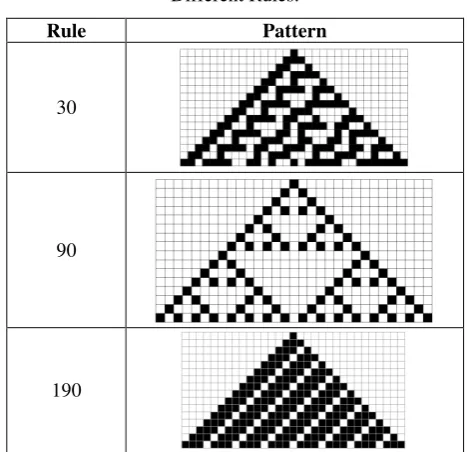
The patterns that generated are different depends on the rule that used. Table-2 represent some patterns that generated by different rules.
Table-2. Pattern Result of Several Elementary Dimensional Cellular Autoomata Based on
Different Rules.
Rule Pattern
30
90
190
[image:2.595.309.547.397.606.2]The CA concept that we use in this motif can be seen in Figure-5.
Figure-5. Determine the Direction of the Arrow Using CA.
[image:2.595.50.287.496.729.2]token←0 i←0
while i<3000 begin
j←0
while j<3000 begin
if token=0 begin
if random(0,100)<70 token←1
end else begin
if random(0,100)<70 token←0
end if token=0 Nautilus() else
Nautilus_Flip() end
𝑗𝑛+1←j+jarx end
𝑖𝑛+1←i+jary; end
Figure-6. Algorithm to Determine the Direction of the Arrow Using CA.
Right arrow in orange and left arrow in green. If token is 0 and random value less than 70, and then token become 1. And when token become 1, then the pixel will filled by left arrow with its green color.Otherwise, if token is 1 and random value less than 70, and then token become 0. And when token become 0, then the pixel will filled by right arrow with its orange color. This concept that implemented in main motif. The motif can be seen in Figure-7.
Figure-7. Main Motif.
Background motif with random walk method: A Random Walk is a stochastic sequence {Sn}, with S0=
0, defined by:
Sn= ∑ Xk
n
k=1
Where Xk are independent and identically distributed random variables [8].
Random Walk make batik motif look more beautiful with random spread of the pattern. Here is one algorithm to generate motif batik with a beauty pattern; it can be seen in Figure-8.
In this experiment, random walk method use as background motif.
Begin i ← (-10) while (i<2100) begin
j ← -30; while(j<2100 begin
x ←i + random(-2,2) y ←j + random(-2,2) x1 ← x + 100 y1 ← y β← 0 r ← 30 while(β ≤ 720) begin
px ← x1 + r *cos(deg2rad(sudut)) py ← y1 + r *sin(deg2rad(sudut)) px←x1 + 0.9 * r * cos(deg2rad(sudut)) py ←y1 + 0.9 *r * sin(deg2rad(sudut)) px ←x1 + 0.8 * r * cos(deg2rad(sudut)) py ←y1 + 0.8 * r * sin(deg2rad(sudut)) r(n+1)←r + 2
β(n+1) t← β(n) + 10 end
j(n+1)←j(n) + random(350,450) end
i(n+1)←i(n) + 300 end
end
Figure-8. Algorithm of Nautilus Motif with Random Walk.
Figure-9. Result of Nautilus Background Motifwith Random Walk Method.
Implementation to web-based application
Motif that have been made then it is implemented to a web based application. The interface of the web can be seen in Figure-10. In that Figure, show that the Nautilus
motif can be costumized by custom the variable value. The background of batik or usually called isen-isen can be costumized too by select either radio button of isen-isens.
Figure-10. Interface of Nautilus Batik Web Application.
In Figure-11 until Figure-17, show some variables that can be changed.
Figure-11. Form Nautilus Color (RGB).
Form that can be seen in Figure-11, show that RGB value of Nautilus motif color can be changed. The value that can be entered is from 0 until 255. Other than that, the form will be show a notification “Value cannot be less than 0 or greater than 255”.
Figure-12. Form Distance Between Nautilus.
Figure-13. Form Eye of Nautilus.
Form that can be seen in Figure-13, show that eye of Nautilus in batik motif can be changed, can be costumized. It consist of sclera width and height, and pupil width and height. The value that can be entered is integer. Other than that, the form will be show a notification.
Figure-14. Form of Nautilus Sclera Color (RGB).
Form that can be seen in Figure-14, show that RGB value of Nautilus Sclera color can be changed. The value that can be entered is from 0 until 255. Other than that, the form will be show a notification “Value cannot be less than 0 or greater than 255”.
Figure-15. Form of Nautilus Pupil Color (RGB).
Form that can be seen in Figure-15, show that RGB value of Nautilus Pupil color can be changed. The value that can be entered is from 0 until 255. Other than that, the form will be show a notification “Value cannot be less than 0 or greater than 255”.
Figure-16. Form of Nautilus Specification (RGB).
Form that can be seen in Figure-16, show that Shell thickness, the thickness of eggshell pattern, angle size, and total of turns value of Nautilus can be changed.
The value that can be entered is integer. Other than that, the form will be show a notification.
Figure-17. Form of Nautilus Sclera Color (RGB).
Form that can be seen in Figure-17, show that amplitude, thickness, total, damping, and wave length of Nautilus value can be changed,can be costumized. The value that can be entered is integer. Other than that, the form will be show a notification.
RESULTS AND DISCUSSIONS
Simulation 1: Nautilus motif 1
Nautilus motif (can be seen in Figure-18) that had been generated with variables specification as follows (in Table-3):
Table-3. Specification of Nautilus Motif 1.
Variables Value
Length of tentacles 10
Thickness of Tentacles 6
Angle of Nautilus 10
Vertical Ditance 500
Horizontal Distance 700
Simulation 2: Nautilus motif 2 (with different variables value)
Nautilus motif (can be seen in Figure-19) that had been generated with variables specification as follows (in Table-4):
Table-4. Spcification of Nautilus Motuf.
Variables Value
Length of tentacles 3
Thickness of Tentacles 6
Angle of Nautilus 7s
Vertical Ditance 500
Horizontal Distance 800
Figure-19. Result of Nautilus Motif Batik 2 (Simulation 2).
Relation between angle and distance of nautilus to nautilus surface
After simulating 10 times like simulation 1 and simulation 2 above to generate Nautilus Motif with different angle ($β) from 10 until 100, then the distances value can be seen below (in Table-5).
Table-5. Distance Values After Simulating 10 Times (with Different Value of Angle).
Angle (degree)
Distance on First
Trial (pixel)
Second Trial (pixel)
Third Trial (pixel)
Fourth Trial (pixel)
Fifth Trial (pixel)
Sixth Trial (pixel)
Seventh Trial (pixel)
Eight Trial (pixel)
Ninth Trial (pixel)
Tenth Trial (pixel)
10 168,33 159,01 156,45 156,64 157,44 159,41 157,58 156,25 160,29 160,80
20 88,33 91,48 89,90 89,03 88,06 88,26 88,14 88,13 88,45 90,15
30 62,12 62,39 62,07 62,54 62,54 62,66 62,05 62,05 62,35 62,58
40 54,09 54,23 54,05 54,21 54,19 54,06 54,15 54,10 54,01 54,15
50 42,01 42,01 42,20 42,00 42,71 42,17 42,04 42,12 42,29 42,12
60 36,12 36,02 36,31 36,63 36,15 36,05 36,12 36,39 36,34 36,03
70 30,06 30,32 30,10 30,02 30,02 30,01 30,05 30,45 30,51 30,10
80 37,12 37,12 37,00 37,07 37,01 37,02 37,01 37,09 37,19 37,12
90 34,16 34,10 34,10 34,20 34,01 34,01 34,00 34,01 34,07 34,05
100 31,05 31,07 31,13 31,10 31,20 31,10 31,10 31,20 31,10 31,10
From the Table above, there are 10 experimental that have been carried out in every angle (from 10 degree until 100). After averaging 10 experimental results at each angle, then we find that the bigger the angle, the smaller the distance between the nautilus. Although not always
Figure-20.Relation between Angle and Distance of Nautilus to Nautilus Surface in a Graph.
Figure-20 is a values representation of Table-4. We can see that relation between the distance between nautilus and the angle produce graph that is logarithmic.
CONCLUSIONS
Based on the explanation above, can be summarized that random pattern that combination between cellular automata and random walk method can be generate more beautiful batik pattern. And then, through the application, user can generate Nautilus motif on their terms.
Can be simulated several times with different value of variable until you find the results you like. And its simulations can be used as a way too, to determine the relationship between variables. In this paper, simulations has been done to find out the relationship between angle and distance of Nautilus to Nautilus Surface. From these simulations, can be summarized that the relationship between angle and distance of Nautilus to Nautilus Surface is logharitmic.
REFERENCES
[1] R. A. Haris, T. W. Purboyo and P. D. Kusuma. 2018. Several Patterns Classification of Batik Art in the World : A Study. Medwell Journals.
[2] R. Azhar, D. Tuwohingide and D. Kamudi. 2015. Batik Image Classification Using SIFT Feature Extraction, Bag of Features and Support Vector Machine. Procedia - Procedia Comput. Sci. 72: 24-30.
[3] C. Math, G. Britain, P. Press and J. W. Goethe-universit. 1989. What does ‘'batik’ mean? Comput. Math. Applic. 17(4): 815-826.
[4] P. D. Kusuma. 2016. Implementation of Pedestrian Dynamic. Int. J. Adv. Comput. Sci. Appl. 7(3): 65-70.
[5] P. D. Kusuma. 2017. Interaction Forces-Random Walk Model in Traditional Pattern Generation. J. Theor. Appl. Inf. Technol. 95(14): 3294-3302.
[6] D. Das. 2015. CCIS 269 - A Survey on Cellular Automata and Its Applications. Commun. Comput. Inf. Sci. 1(no. September): 753-762.
[7] B. Aoun and M. Tarifi. 2004. Introduction to Quantum Cellular Automata. Cornell University. [Online]. Available: http://arxiv.org/abs/quant-ph/0401123. [Accessed: 18-Nov-2018].
[8] S. E. Alm. 2006. Simple random walk. [Online]. Available:
http://www2.math.uu.se/~sea/kurser/stokprocmn1/slu mpvandring_eng.pdf. [Accessed: 01-Apr-2019].
0.000000000000 20.000000000000 40.000000000000 60.000000000000 80.000000000000 100.000000000000 120.000000000000 140.000000000000 160.000000000000 180.000000000000