Simple and Effective Tool To Detect HIV-1 Drug Resistance
Mutations
Aubin J. Nanfack,a,b,cLucy Agyingi,d,eJean Jacques N. Noubiap,e,fJohnson N. Ngai,eVittorio Colizzi,b,gPhillipe N. Nyambia,h
Department of Pathology, New York University School of Medicine, New York, New York, USAa
; Department of Immunology and Applied Biotechnology, University of Rome Tor Vergata, Rome, Italyb
; Chantal Biya International Reference Center, Sequencing Unit, Yaounde, Cameroonc
; Faculty of Sciences, University of Dschang, Dschang, Cameroond
; Serology Unit, Medical Diagnostic Center, Yaounde, Cameroone
; Internal Medicine Unit, Edéa Regional Hospital, Edéa, Cameroonf
; UNESCO Chair of Interdisciplinary Biotechnology, University of Rome Tor Vergata, Rome, Italyg
; Veterans Affairs New York Harbor Healthcare Systems, New York, New York, USAh
Access to genotyping assays to determine successful antiretroviral treatment (ART) is limited in resource-constrained settings by
high cost, suggesting the need for a cost-effective and simplified method to identify HIV-1 drug resistance (HIVDR) mutations.
In this study, an amplification refractory mutation system (ARMS)-PCR assay was developed and used to investigate the most
frequent HIVDR mutations affecting first-line ART in settings where WHO ART guidelines are applied. Seventy-five
HIV-posi-tive (HIV
ⴙ) samples from Cameroon were used to assess the performance of this assay. Sequencing of HIV-1 reverse
transcrip-tase was simultaneously performed for comparison, and discordant samples were tested with a Trugene HIV-1 genotyping kit.
The ARMS-PCR assay was able to detect M184V, T215Y/F, K103N, and Y181C mutations with sensitivities of 96.8%, 85.7%,
91.3%, and 70%, respectively, and specificities of 90.6%, 95%, 100%, 96.9%, respectively, compared with data on sequencing.
The results indicated the highest positive predictive value for K103N (100%) and the highest negative predictive value for M184V
(97.5%). ARMS-PCR’s limits of detection for mutations M184V, T215Y/F, K103N, and Y181C were
<
75 copies/ml, 143 copies/
ml, 143 copies/ml, and 836 copies/ml, respectively. ARMS-PCR efficiently identified mutations in individuals harboring different
HIV-1 clades (CRF02_AG and non-CRF02_AG). In addition, this approach was more cost-effective than other genotyping assays.
The high throughput, the cost-effectiveness, and the simplicity of the ARMS-PCR assay make it a suitable tool to monitor
HIVDR patterns in resource-constrained settings with broad HIV-1 genetic diversity.
I
n recent years, significant progress has been made in the
treat-ment of HIV-infected patients. Gains in antiretroviral treattreat-ment
have been achieved in low- and middle-income countries with
more than 9.7 million people living with HIV/AIDS, 7.2 million of
whom lived in sub-Saharan Africa as of the end of 2012 (
35
). This
scaling up of antiretroviral therapy in resource-constrained
set-tings, where the logistics of medication disbursement and patient
follow-up are not always optimal, results in the emergence and
transmission of HIV drug-resistant variants, thus providing
ob-stacles to successful antiretroviral treatment (ART) programs (
1
).
The monitoring of HIV drug-resistant mutations in developed
countries is an important aspect of clinical management of HIV
infection. In these developed countries, sequencing-based drug
resistance assays are used to select the most appropriate regimens
when initiating or switching ART (
2
,
3
). In resource-constrained
settings, due to high cost, only a limited number of HIV drug
resistance mutation tests are performed for patient management.
In such countries, the majority of tests are used for research
pur-poses or for surveillance of HIV-1 drug resistance (HIVDR)
mu-tations recommended by WHO to update antiretroviral therapy
policies (
4
,
5
).
Resource-constrained settings use the WHO public health
ap-proach for the treatment of HIV-infected patients. This apap-proach
recommends the standardized and simplified treatment protocol
consisting of two nucleoside reverse transcriptase (RT) inhibitors
(NRTI) plus one non-NRTI (NNRTI) for first-line therapy.
Treat-ment initiation or switching is based on clinical parameters and
CD4 count because viral load (VL) assessment is not feasible for
the majority of patients (
6
,
7
). In addition to these challenges, the
low genetic barrier of commonly used antiretrovirals (ARV) for
first-line treatment further increases the risks of HIVDR
muta-tions. The most prevalent mutations that cause intermediate- to
high-level resistance to this first-line regimen in countries such as
those in the central African region, including Cameroon, Central
African Republic, Gabon, etc., that use the WHO approach are
M184V (37% to 90%), T215Y/F (11% to 47.2%), K103N (14% to
44%), and Y181C (9.4% to 19.8%) (
8–13
). These can restrict
treatment options and increase cost by requiring new and more
expensive ARV regimens (
36
).
The detection of HIVDR mutations essentially depends on
genotyping assays. However, their use is limited in
resource-con-strained settings because these assays require sophisticated
equip-ment such as a genetic analyzer, costly reagents, and highly
sophis-Received15 January 2015 Returned for modification9 February 2015
Accepted10 March 2015
Accepted manuscript posted online18 March 2015
CitationNanfack AJ, Agyingi L, Noubiap JJN, Ngai JN, Colizzi V, Nyambi PN. 2015.
Use of amplification refractory mutation system PCR assay as a simple and effective tool to detect HIV-1 drug resistance mutations. J Clin Microbiol 53:1662–1671.doi:10.1128/JCM.00114-15.
Editor:A. M. Caliendo
Address correspondence to Phillipe N. Nyambi, [email protected]. Supplemental material for this article may be found athttp://dx.doi.org/10.1128 /JCM.00114-15.
Copyright © 2015, American Society for Microbiology. All Rights Reserved.
doi:10.1128/JCM.00114-15
on May 16, 2020 by guest
http://jcm.asm.org/
ticated manpower. Some laboratories in developing countries
have developed and validated highly sensitive in-house HIV-1
genotyping assays comparable to FDA-approved assays to reduce
the cost and to overcome subtype specificities (
1
,
14
,
15
). Despite
these efforts, these in-house genotyping assays still remain
unaf-fordable to the majority of patients in need.
Point mutation assays have been developed as alternatives for
genotyping assays. These assays are allele specific and include
mu-tant-allele-specific amplification (MASA), PCR amplification of
specific alleles (PASA), and amplification refractory mutation
sys-tem (ARMS)-PCR (
12
,
13
,
16–18
). These methods utilize the
dif-ference in extension efficiency between primers with matched and
mismatched 3
=
bases. Product detection and identification are the
most variable steps that contribute to the throughput capacity of
each particular method. The drawback with some of these assays is
the detection method, such as fluorescence resonance energy
transfer, fluorescence polarization, luminescence, or absorbance
(
19–21
), requiring expensive equipment and reagents which still
have limited use in resource-constrained settings. Thus, we have
developed and evaluated the use of a simplified ARMS-PCR to
detect the most frequent HIV-1 drug resistance mutations in
in-dividuals infected with strains of broad HIV-1 genetic diversity.
MATERIALS AND METHODS
Ethical considerations.This study was approved by the Institutional Eth-ical Review Board of New York University School of Medicine, New York, USA, and by the Institutional Review Board of Cameroon’s Ministry of Public Health. Written informed consent was obtained from all the study participants.
Characteristics of the study patients.The samples analyzed in this study are part of an ongoing project in Cameroon aimed at analyzing viral
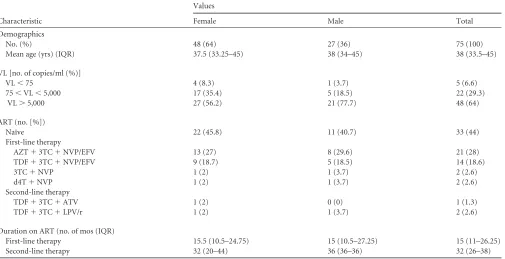
evolution and humoral immune response to dual HIV-1 infection. Plasma samples were included from 75 HIV-1-infected patients in the study whose demographics and clinical characteristics are described in Table 1. Forty-eight (64%) of them were women, and the median age was 38 years (interquartile range [IQR], 33.5 to 45). Thirty-three (44%) pa-tients were ART naive, 39 (52%) were receiving first-line ART, and three (4%) were receiving second-line ART. The median times on ART were 15 months (IQR, 11 to 26.5) for subjects on first-line ART and 32 months (IQR, 26 to 38) for patients receiving first-line ART. The median viral loads (VL) were 9,373 copies/ml for naive patients (IQR, 2,878 to 18,762), 17,314 (IQR, 7,031 to 34,927) for patients on first-line ART, and 14,535 (IQR, 8,890.5 to 16,394) for patients on second-line ART. Among the patients receiving first-line ART, combinations of zidovudine (AZT) plus lamivudine (3TC) plus nevirapine (NVP) and efavirenz (EFV) (NVP/ EFV), tenofovir (TDF) plus 3TC plus NVP/EFV, stavudine (d4T) plus 3TC plus NVP, and 3TC plus NVP were taken by 28%, 18.6%, 2.6% and 2.6%, respectively. Among the patients receiving second-line ART, TDF plus 3TC plus lopinavir/ritonavir (LPV/r) and TDF plus 3TC plus ATV were taken by 2.6% and 1.3%, respectively.
Viral load determination.The plasma HIV-1 load was determined by the use of a Versant HIV RNA 3.0 assay (bDNA, Siemens, IL) as recom-mended by the manufacturer using the same plasma specimen used for ARMS-PCR and the sequencing of reverse transcriptase.
Selection of HIV drug resistance mutations for ARMS-PCR assay.
[image:2.585.43.548.79.338.2]HIV drug resistance mutations were selected based on their prevalence, their effect on the first-line regimen recommended by WHO for resource-constrained settings, and the Stanford HIV drug resistance database mu-tation scoring system (http://hivdb.stanford.edu/DR/asi/releaseNotes /index.html). Using the aforementioned criteria, M184V and T215Y/F were selected as nucleoside reverse transcriptase inhibitor (NRTI) resis-tance mutations, while K103N and Y181C were selected as non-NRTI (NNRTI). M184V is the most common (37% to 90%) of the NRTI resis-tance mutations causing high-level resisresis-tance to lamivudine (3TC) and TABLE 1Demographics and characteristics of the HIV-1-infected individuals studieda
Characteristic
Values
Female Male Total
Demographics
No. (%) 48 (64) 27 (36) 75 (100)
Mean age (yrs) (IQR) 37.5 (33.25–45) 38 (34–45) 38 (33.5–45)
VL [no. of copies/ml (%)]
VL⬍75 4 (8.3) 1 (3.7) 5 (6.6)
75⬍VL⬍5,000 17 (35.4) 5 (18.5) 22 (29.3)
VL⬎5,000 27 (56.2) 21 (77.7) 48 (64)
ART (no. [%])
Naïve 22 (45.8) 11 (40.7) 33 (44)
First-line therapy
AZT⫹3TC⫹NVP/EFV 13 (27) 8 (29.6) 21 (28)
TDF⫹3TC⫹NVP/EFV 9 (18.7) 5 (18.5) 14 (18.6)
3TC⫹NVP 1 (2) 1 (3.7) 2 (2.6)
d4T⫹NVP 1 (2) 1 (3.7) 2 (2.6)
Second-line therapy
TDF⫹3TC⫹ATV 1 (2) 0 (0) 1 (1.3)
TDF⫹3TC⫹LPV/r 1 (2) 1 (3.7) 2 (2.6)
Duration on ART (no. of mos (IQR)
First-line therapy 15.5 (10.5–24.75) 15 (10.5–27.25) 15 (11–26.25)
Second-line therapy 32 (20–44) 36 (36–36) 32 (26–38)
a
ART, antiretroviral treatment; IQR, interquartile; AZT, zidovudine; 3TC, lamivudine; TDF, tenofovir; d4T, stavudine; NVP, nevirapine; EFV, efavirenz; ATV, atazanavir; LPV/r, lopinavir boosted with ritonavir. Viral load (VL)⬍75 indicates successful ART; 75⬍VL⬍5,000 indicates ART failure that can still be managed with increased adherence; VL⬎
5,000 necessitates therapy change.
on May 16, 2020 by guest
http://jcm.asm.org/
emtricitabine (FTC). T215Y/F is the most common (11% to 47.2%) thy-midine analog mutation (TAM) that causes intermediate-level resistance to zidovudine (AZT) and stavudine (d4T) and with the potential of caus-ing high level resistance to AZT and d4T when occurrcaus-ing with other TAMs (M41L, D67N, K70R, L210W, and K219QE). K103N is one of the most common (14% to 44%) NNRTI resistance mutations causing high-level resistance to nevirapine (NVP) and efavirenz (EFV). Y181C is a common (9.4% to 19.8%) NNRTI resistance mutation that reduces⬎50-fold the susceptibility to NVP (http://hivdb.stanford.edu/). The prevalence of these mutations ranges from 8.2% in naive patients to 90% in patients failing a first-line ART (8,22,23). The drugs affected (FTC, 3TC, AZT, ABC, EFV, and NVP) are among those most commonly used in the regi-mens recommended by WHO guidelines for first-line treatment in re-source-constrained countries, especially in sub-Saharan Africa (6).
RNA extraction and RT-PCR.Virus in 500l of plasma was concen-trated by ultracentrifugation at 14,000⫻gfor 1 h at 4°C prior to RNA extraction. After removal of 360l of supernatant, the virus pellet was resuspended by vortex mixing and viral RNA was extracted from plasma using a QIAamp viral RNA minikit (Qiagen, Inc., Valencia, CA) according to the manufacturer’s instructions. A total of 2.5l of RNA extract was used for the amplification of 1,750 bp of thepolregion using a Superscript One-Step reverse transcription PCR (RT-PCR) system with platinumTaq
(Invitrogen, Carlsbad, CA), following the manufacturer’s instructions. For RT-PCR, forward primer RTPOL1F (5=-GTATTAGTAGGACCTAC ACCTGTC-3=; HXB2 locations 2475 to 2498) and reverse primer RTPOL1R (5=-ACCTTCCTGATTCCATTACTGAC-3=; HXB2 locations 4203 to 4225) were used. The cycling conditions included an initial cDNA synthesis step for 30 min at 50°C, followed by denaturation for 2 min at 94°C and then 35 cycles at 94, 50, and 72°C for 60, 60, and 90 s, respec-tively, and a final extension step at 72°C for 7 min.
Control.The specificity of the ARMS-PCR assay was assessed using an HIV-1 subtype B molecular clone containing several NRTI- and NNRTI-associated mutations. This clone (AIDS reagent program catalog no. 12229; GenBank accession numberJQ814884) was obtained from Robert Shafer through the NIH AIDS Research and Reference Reagent Program, Division of AIDS, NIAID, NIH.
ARMS-PCR procedure.HIV-1-specific primers were manually de-signed after compiling the different HIV-1 pure and recombinant sub-types that are most prevalent in central Africa from the HIV sequence database (http://www.hiv.lanl.gov). For each mutation tested, two reverse primers were designed such that the sequences (wild-type [Wt] and mu-tant [Mut] variants) at their 3=-terminal nucleotide ends differed. Addi-tional deliberate mismatches were introduced within the last four nucle-otides at the 3=terminus to increase the specificity of the assay using principles established for ARMS-PCR primer design (17,24). The forward primers were designed following the classical rules and so as to obtain a short (200- to 600-bp) amplification product. Primers were manufac-tured by Integrated DNA Technologies (Coralville, IA) with the details provided (see Table S1 in the supplemental material).
An amplifiedpolgene fragment from RT-PCR was used as the tem-plate to detect wild-type and mutant sequences at different codons (M184V, T 215Y/F, K103N, and Y181C) by ARMS-PCR. Two reactions (wild type and mutant) were performed for each mutation with the re-spective specific primers using Platinum PCR High Fidelity SuperMix (Invitrogen, Carlsbad, CA). The cycling conditions included an initial denaturation of 2 min at 94°C, followed by 35 cycles at 94, 55, and 72°C, respectively. Ten microliters of ARMS-PCR products was visualized on a 2% agarose gel after ethidium bromide staining, and pictures were taken with inverted gel images using a ChemiDoc MP system from Bio-Rad. The two amplified products from each sample were run on the 2% agarose gel next to one another. The ARMS-PCR result was recorded as Wt or Mut depending on the amplicon band detected on the agarose gel picture. Only one band was expected for patients harboring the wild-type variant, while two bands of the same molecular size were expected for patients harboring a mutant variant due to the presence of mixed (wild-type and mutant)
viral populations. ARMS-PCR results were compared to the sequencing data, the latter being the gold standard. The specificity of the ARMS-PCR primers for detection of M184V, T215Y/F, K103N, and Y181C mutations was assessed using the subtype B clone obtained from NIH. Only mutant amplicon bands for mutations M184V, T215Y/F, and K103N and a wild-type amplicon band for mutation Y181C were expected on the agarose gel.
Sequencing.Two microliters of RT-PCR product was used for nested PCR using RTPOL2F as the forward primer (5=-TAAAGCCAGGAATGG ATGGCCC-3=; HXB2 locations 2584 to 2605) and RTPOL2R as the re-verse primer (5=-CCTCCAATCCCTTTGTGTGCTG-3=; HXB2 locations 4159 to 4180). The PCR cycling conditions were an initial denaturation for 2 min at 94°C, followed by 35 cycles at 94, 50, and 72°C for 60, 60, and 90 s, respectively, and a final extension step of 7 min at 72°C. Direct sequencing of the 5=and 3=ends of the purified PCR amplicons was per-formed with the two nested RTPOLF2 and RTPOLR2 primers by Micro-gen (New York, NY), using ABI BigDye Terminator cycle sequencing chemistry and an ABI 3730XL DNA analyzer.
Phylogenetic analysis and drug resistance genotyping.All sequences were automatically aligned with reference sequences of all known HIV-1 group M subtypes and circulating recombinant forms (CRFs) from the Los Alamos HIV sequence database using CLUSTAL X with minor man-ual adjustments. Phylogenetic analyses were conducted using the MEGA version 3.1 software package (25) with pairwise evolutionary distances estimated by using Kimura’s two-parameter method. Phylogenetic trees were constructed by the neighbor-joining method, and the reliability of the topologies was estimated by performing bootstrap analysis. Clustering of sequences with bootstrap values of more than 70% was considered significant for subtyping.
The reverse transcriptase DNA sequences amplified from patients were analyzed for potential drug resistance mutations using the Stanford University HIV database genotypic-resistance interpretation algorithm (http://hivdb.stanford.edu/index.html). Mutations in the study quences were defined as differences from the consensus B reference se-quence and were further characterized as NRTI resistance mutations or NNRTI resistance mutations.
Trugene HIV-1 genotyping assay.Ten patients with concordant quencing and ARMS-PCR results and 10 patients with discordant se-quencing and ARMS-PCR results and with various viral loads and differ-ent HIV-1 clades were genotyped using a Trugene HIV-1 genotyping kit (Siemens, IL), an FDA-approved assay for the detection of HIV-1 drug resistance; the test was performed as recommended by the manufacturer.
ARMS-PCR performance analysis.Using sequencing as the gold standard, the sensitivity, specificity, and positive predictive and nega-tive predicnega-tive values were calculated from the following formulas: sensitivity⫽true positives/(true positives plus false negatives)⫻100 (with true positives being the number of samples positive on ARMS-PCR and sequencing [gold standard] and false negatives being the number of samples negative on ARMS-PCR but positive on sequencing); spec-ificity⫽true negatives/(true negatives plus false positives)⫻100 (with true negatives being the number of samples negative on ARMS-PCR and sequencing [gold standard] and false positives being the number of sam-ples positive on ARMS-PCR and negative on sequencing [gold standard]); positive predictive value (PPV)⫽true positive/(true positive plus false positive)⫻100; and negative predictive value (NPV)⫽true negative/ (true negative plus false negative)⫻100.
RESULTS
Use of ARMS-PCR to detect the M184V, T215Y/F, K103N, and
Y181C mutations in plasma samples.
In these studies, we first
ensured that the ARMS-PCR was able to correctly detect the
dif-ferent HIVDR mutations in the subtype B molecular clone which
we obtained from the NIH reagent program. These mutations
included K103N, M184V, Y181C, and T215Y/F and were correctly
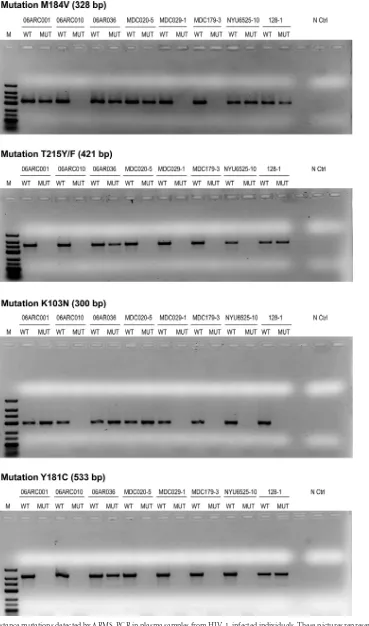
detected as shown in the gel picture presented in Fig. S1 in the
supplemental material. Representative gel pictures revealing the
on May 16, 2020 by guest
http://jcm.asm.org/
detection of the different HIVDR mutations among eight HIV-1
patients infected with different HIV-1 subtypes, on different
treat-ment regimens, and with various viral loads studied are shown in
Fig. 1
, to illustrate that this assay is able to detect the various
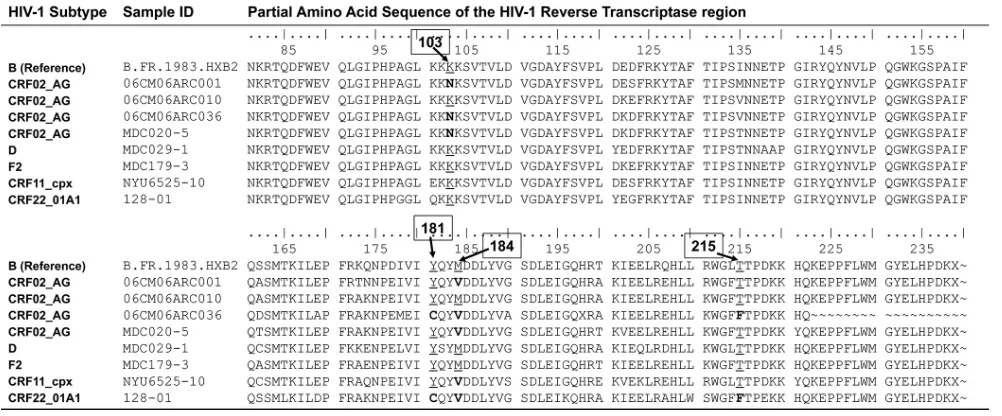
HIVDR mutations studied. These HIVDR mutations as well as the
wild-type amino acids identified by ARMS-PCR shown in the gel
pictures in
Fig. 1
were also confirmed by sequencing as shown in
Fig. 2
.
We also evaluated the ARMS-PCR assay to detect HIVDR
mu-tations in samples with various viral loads as well as with different
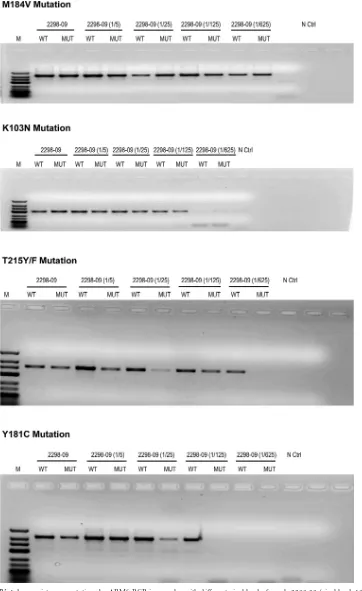
HIV-1 subtype variants. Thus, we tested the limit of detection of
HIVDR mutations using a plasma sample from a patient with a
high viral load (18,253 copies/ml) infected with a CRF02_AG
vari-ant. The plasma sample was serially diluted at 1/5, 1/25, 1/125, and
1/625 in RPMI medium, and the measured viral load
corre-sponded to 4,977, 836, 143, and
⬍
75 copies/ml, respectively. All
four HIVDR mutations, M184V, T215Y/F, K103N, and Y181C,
were detected in samples corresponding to a viral load of
ⱖ
836
copies/ml. Furthermore, T215Y/F and K103N could also be
de-tected at 143 copies/ml, and M184V was also dede-tected at a viral
load of as low as
⬍
75 copies/ml (
Fig. 3
). This analysis confirms
detection of HIVDR mutations with low viral loads, confirming
the high sensitivity of the ARMS-PCR assay.
The 75 HIV-1-infected patients studied harbored viral loads
that ranged between
⬍
75 and 400,927 copies/ml. We noted that
ARMS-PCR was able to detect mutations in patients with low viral
loads and in those with high viral loads. For example, in patient
06ARC001, with a low viral load of 3,135 copies/ml, the M184V
and K103N mutations were detected; in patient 06ARC036, with a
moderate viral load of 8,221 copies/ml, mutations M184V,
T215Y/F, K103N, and Y181C were detected; and in patient
NYU6525-10, with a high viral load of 17,876 copies/ml, mutation
M184V was detected (
Fig. 1
). These results suggest that these
mu-tations can be detected in plasma samples with low to high viral
loads.
While the CRF02_AG recombinant variant is the predominant
strain infecting individuals in Cameroon, several other subtypes
and recombinants also cause infections. Thus, we examined
whether the ARMS-PCR assay was able to detect mutations in
CRF02_AG variants as well as in non-CRF02_AG variants. As
shown in
Fig. 1
with the eight patient samples, infections due to
CRF02_AG were present in patients 06ARC001, 06ARC010,
06ARC036, and MDC020-5, and non-CRF02_AG infections were
present in patients MDC029-1 (subtype D), MDC179-3 (subtype
F2), NYU6525-10 (subtype CRF11_cpx), and 128-01 (subtype
CRF22_01A1). Using the samples from these patients, we were
able to detect mutations in these different subtype infections. For
example, M184V mutation was detected in patients 06ARC001
(CRF02_AG), NYU6525-10 (CRF11_cpx), and 128-01 (CRF22_01A1);
mutation T215Y/F was detected in patients 06ARC036 (CRF02_
AG) and 128-01 (CRF22_01A1); and mutation Y181C was
de-tected in patients 06ARC036 (CRF02_AG) and 128-01 (CRF22_
01A1). The results of these analyses were confirmed by sequencing
of the reverse transcriptase gene (
Fig. 2
). Overall, HIV-1 drug
resistance mutations were found in patients infected with
CRF02_AG subtypes as well as in those with non-CRF02_AG
in-fections; the M184V mutation was the most prevalent in both
groups, and none of the mutations was found exclusively in one of
the groups (see Table S2 in the supplemental material).
Detection of M184V/T215Y/F (NRTI) and K103N/Y181C
(NNRTI) drug resistance mutations using the ARMS-PCR
as-say.
After establishing that ARMS-PCR could correctly detect
HIVDR mutations, we then used the assay to study the mutations
in the 75 study subjects, including those who were ART naive (
n
⫽
33) and those on ART (
n
⫽
42). The combinations of HIVDR
mutations are shown in
Table 2
.
Detection of HIVDR mutations in ART-naive patients.
Of
the 33 ART-naive patients studied, 6 (18.1%) harbored viruses
with M184V or T215Y/F mutations, and 1 (3%) concomitantly
had both mutations. Four (12%) patients had the M184V
muta-tion, whereas 3 (9%) patients had the T215Y/F mutation. Five
(15.1%) ART-naive patients had the K103N mutation, and none
of them had the Y181C mutation.
Detection of HIVDR mutations in patients on first-line ART.
Among the 39 patients on first-line ART, 29 (74.3%) harbored
viruses with M184V or T215Y/F mutations, and 9 (23%)
concom-itantly had both mutations. Twenty-nine (74.3%) patients had the
M184V mutation, whereas 9 (23%) had the T215Y/F mutation.
Nineteen (48.7%) patients harbored viruses with K103N or
Y181C mutations, and 4 (10.2%) concomitantly had both
muta-tions. Sixteen (41%) patients had the K103N mutation, whereas 9
(23%) patients had the Y181C mutation.
Detection of HIVDR mutations in patients on second-line
ART.
All three patients harbored viruses with the two NRTI
(M184V and T215Y/F) mutations tested. Of the NNRTI
muta-tions, one patient harbored virus with the K103N mutation and
another patient had virus with the Y181C mutation.
Detection of M184V/T215Y/F (NRTI) and K103N/Y181C
(NNRTI) drug resistance mutations using sequencing.
The
HIVDR mutations identified by sequence analysis are shown in
Table 2
. The results reveal that among the 33 ART-naive
pa-tients studied, 3 (9%) harbored viruses with M184V or
T215Y/F mutation, and 1 (3%) concomitantly had both
muta-tions. Three patients (9%) had the M184V mutation, whereas 1
(3%) had the T215Y/F mutation. Five (15.1%) patients had the
K103N mutation, and no ART-naive patient was identified
with a Y181C mutation.
Among the 39 patients on first-line ART, 26 (66.6%) harbored
viruses with M184V or T215Y/F; 10 (25.6%) concomitantly had
both mutations. Twenty-six (66.6%) patients had the M184V
mu-tation, whereas 10 (25.6%) had the T215Y/F mutation.
Twenty-two (56.4%) patients harbored viruses with K103N or Y181C;
among those patients, 5 (12.8%) concomitantly had both
muta-tions. Seventeen (43.5%) patients had the K103N mutation,
whereas 9 (23%) had the Y181C mutation.
The results of sequence analysis of all the three patients on
second-line ART were identical to those of ARMS-PCR in
detect-ing the two NRTI (M184V and T215Y/F) mutations tested.
Fur-thermore, the detection of the NNRTI mutation in only one
pa-tient who harbored virus with the K103N mutation and another
patient that had virus with the Y181C mutation was also similarly
revealed by the ARMS-PCR assay.
Performance of the ARMS-PCR assay versus sequencing and
a Trugene HIV-1 genotyping kit.
The mutation rates obtained
with ARMS-PCR and sequencing were comparable. Of 75
pa-tients, 63 had similar results for all the mutations tested using
ARMS-PCR and sequencing. The highest number of false
posi-tives (
n
⫽
4) was obtained for the M184V mutation, whereas the
on May 16, 2020 by guest
http://jcm.asm.org/
FIG 1HIV-1 drug resistance mutations detected by ARMS-PCR in plasma samples from HIV-1-infected individuals. These pictures represent 2% agarose gels stained with ethidium bromide, showing the results from eight individuals infected with different HIV-1 subtypes on different ART regimens and harboring
on May 16, 2020 by guest
http://jcm.asm.org/
[image:5.585.112.481.75.701.2]highest number of false negatives (
n
⫽
3) was obtained for the
Y181C mutation as shown in
Table 3
.
Ten patients with concordant results and 10 patients with
dis-cordant results between sequencing and ARMS-PCR were tested
with the Trugene HIV-1 genotyping assay, and the results
ob-tained were 100% concordant with the sequencing results. The
sensitivity, specificity, PPV, and NPV of ARMS-PCR assay were
calculated for each mutation, and results are presented in
Table 3
.
The highest sensitivity (96.8%) and the highest NPV (97.5%) were
for the detection of the M184V mutation, while the highest
spec-ificity (100%) and the highest PPV (100%) were for the detection
of K103N mutation.
Concordance of prevalence rates of mutations based on
ARMS-PCR and sequencing.
The overall prevalence rates using
ARMS-PCR were 48%, 20%, 29.3%, and 12% for the M184V,
T215Y/F, K103N, and Y181C mutations, respectively, whereas the
prevalence rates using sequencing were 42.6%, 18.6%, 30.6%, and
13.3% for the M184V, T215Y/F, K103N, and Y181C mutations,
respectively (see Fig. S2 in the supplemental material). The ability
of ARMS-PCR to detect the various HIVDR mutations at the
in-dividual level and at the population level in analysis of all 75
sam-ples was comparable to that of sequence analysis (see Fig. S2).
HIV-1 subtypes infecting study subjects.
Phylogenetic
analy-sis of the reverse transcriptase gene of studied patients revealed a
predominance of CRF02_AG and several other variants. These
HIV-1 subtypes included CRF02_AG (70.6%), CRF11_cpx
(9.3%), CRF22_01A1 (8%), F2 (4%), D (4%), A1 (1.3%), G
(1.3%), and CRF18_cpx (1.3%). The distribution of the infecting
subtypes among treatment-naive patients was similar to that
among those on treatment (data not shown).
DISCUSSION
The scaling-up of antiretroviral treatment (ART) in
resource-con-strained settings without adequate virological follow-up raises
concerns with respect to ART program sustainability. Sequencing
technology is not available for all patients in need, and because of
financial constraints, it is not affordable where it is available;
therefore, providing an alternative cost-effective and less
labori-ous assay to identify HIVDR mutations will be a great asset. In this
study, an ARMS-PCR assay was developed and used to investigate
the presence of the most common HIVDR mutations (M184V,
T215Y/F, K103N, and Y181C) affecting the first-line ARV
regi-men. The results of the ARMS-PCR were highly concordant with
those of sequencing in identifying all four mutations studied in
comparisons of the results determined for each sample in both
assays for each mutation (see Fig. S2a in the supplemental
mate-rial) or in comparisons of all the samples at the population level
(see Fig. S2b). In particular, the assay was most sensitive in
iden-tifying the M184V and K103N mutations, with sensitivities of
96.8% and 91.3%, respectively. The specificities of the M184V and
K103N mutations were also high (88.5% and 100%, respectively).
HIVDR drug resistance mutations were found in patients infected
with CRF02_AG subtypes and non-CRF02_AG at comparable
rates, and the M184V mutation was the most prevalent in both
groups.
Taken together, among all the mutations studied, a few
sam-different viral loads. M, molecular marker (low-range DNA ladder; Invitrogen). WT, wild type; MUT, mutant; N Ctrl, negative control. The presence of a band in the MUT lane indicates the presence of the mutation in the sample. Pictures were taken using an inverted gel image and a ChemiDoc imaging system (Bio-Rad). The viral loads in each sample were 3,135 copies/ml (06ARC001), 14,715 copies/ml (06ARC010), 8,221 copies/ml (06ARC036), 9,572 copies/ml (MDC020-5), 36,988 copies/ml (MDC029-1), 11,272 copies/ml (MDC179-3), 3,246 copies/ml (128-01), and 17,876 copies/ml (NYU6525-10). The infecting subtypes were CRF02_AG (06ARC001, 06ARC010, 06ARC036, and MDC020-5), D (MDC029-1), F2 (MDC179-3), CRF11_cpx (NYU6525-10), and CRF2201A1 (128-01). FIG 2Reverse transcriptase sequences of HIV-1 in plasma samples from eight patients indicating wild-type or HIV drug resistance mutations. These same samples were also analyzed by ARMS-PCR, and the results are shown inFig. 1. The positions of the amino acids are indicated above the sequences in boxes. The HIV drug resistance mutations analyzed included M184V, K103N, Y181C, and T215Y/F. The presence of a wild-type amino acid is underlined, and the presence of a mutant amino acid is indicated in bold.
on May 16, 2020 by guest
http://jcm.asm.org/
[image:6.585.40.541.68.276.2]FIG 3Detection of HIV-1 drug resistance mutations by ARMS-PCR in samples with different viral loads. Sample 2298-09 (viral load, 18,253 copies/ml) was serially diluted 1/5, 1/25, 1/125, and 1/625, corresponding to 4,977, 836, 143, and⬍75 copies/ml, respectively. The four HIVDR mutations, M184V, T215Y/F, K103N, and Y181C, were detected in samples corresponding to a viral load ofⱖ836 copies/ml. Furthermore, T215Y/F and K103N were detected at 143 copies/ml and M184V was detected at a viral load of⬍75 copies/ml.
on May 16, 2020 by guest
http://jcm.asm.org/
[image:7.585.111.473.67.658.2]ples (
n
⫽
9) revealed discordant results for the different
muta-tions; some were identified by ARMS-PCR as positive results
whereas they were negative on sequence analysis. Also, a few (
n
⫽
8) were negative on ARMS-PCR but were positive on sequence
analysis (
Table 3
). The few false positives identified could have
been due to the fact that, like many point mutation assays, the
ARMS-PCR is more sensitive than sequencing in detecting
muta-tions in mixed HIV-1 genotypic populamuta-tions (
26
). The few results
that were false negatives could have been due to unusual
polymor-phisms. These false negatives and positives indicate the need to
further study the variables that account for them to improve the
assay. These also indicate the need to randomly select specimens
and subject the results to quality control in other reference
labo-ratories, especially in conducting population-based surveillance
in public health programs prior to introduction of antiretroviral
drugs. Nonetheless, the ARMS-PCR assay still revealed high
per-formance in identifying HIVDR compared with sequence analysis
and has several advantages over other alternative approaches that
have been developed. For example, most of the point mutation
assays use mass spectrometry, fluorescence, or luminescence to
identify the allele-specific PCR products (
4
,
16
); this implies the
use of expensive equipment and reagents. Furthermore, these
as-says are designed to be performed in 96-well plates requiring
many samples to perform the test, while ARMS-PCR can be
per-formed even with only one sample. The use of ARMS-PCR
re-duces the time to results, taking an average of 8 h. The high
throughput of this assay also reduces the cost of supplies and of
reagents. These advantages make ARMS-PCR cost-effective and
affordable for resource-constrained settings.
The results of our newly developed ARMS-PCR assay, which
were confirmed by sequence analysis and the use of a Trugene
HIV-1 genotyping kit, now allow us to describe the HIVDR
mu-tations identified in our study subjects. The samples from the
study subjects were obtained during the period 2006 to 2014. This
study revealed a high rate of the first-line drug resistance
muta-tions studied in ART-naive patients (
n
⫽
33) and in patients on
ART (
n
⫽
42). Among the ART-naive patients, 18% and 15%
harbored viruses with NRTI-associated mutations (M184V and
T215Y/F) and viruses with NNRTI-associated mutations (K103N
and Y181C), respectively. These prevalence rates are higher than
the rates seen in earlier studies in Cameroon, which reported
transmitted drug resistance rates in Cameroon ranging from 1.9%
to 12.3% (
1
,
11
,
23
) in ART-naive patients. This increasing rate
of transmitted HIVDR mutation is consistent with the increase in
the availability of ARV in Cameroon over time. A meta-analysis of
data from many low- and middle-income countries, including
African countries with ART programs similar to Cameroon’s, has
also shown an increase of transmitted drug resistance mutations
(
27
). Similarly, reports in developed countries with long ART
ex-perience have shown an increase in transmitted drug resistance
mutations to up to 25% (
9
,
28
,
29
). The most prevalent mutation
was K103N, with a 15% rate. This could be explained by the wide
use of nevirapine in first-line combinations and prophylaxis for
prevention of mother-to-child transmission of HIV-1; therefore,
the K103N mutation is more likely to develop and spread in the
population (
30
).
[image:8.585.41.545.77.224.2]Treated patients exhibited high rates of the HIVDR mutations
tested: M184V (76.1%), T215Y/F (28.5%), K103N (40.4%), and
TABLE 2Drug resistance mutations among HIV-1-infected individuals determined by sequencing and ARMS-PCRa
ARV
class Mutation(s)
No. (%) of patients
ART-naïve (n⫽33) First-line ART (n⫽39) Second-line ART (n⫽3) Overall (n⫽75)
Sequencing (%)
ARMS-PCR (%)
Sequencing (%)
ARMS-PCR (%)
Sequencing (%)
ARMS-PCR (%)
Sequencing (%)
ARMS-PCR (%)
NRTI M184V 3 (9) 4 (12) 26 (66.6) 29 (74.3) 3 (100) 3 (100) 32 (42.6) 36 (48)
T215Y/F 1 (3) 3 (9) 10 (25.6) 9 (23) 3 (100) 3 (100) 14 (18.6) 15 (20)
M184V or T215Y/F 3 (9) 6 (18) 26 (66.6) 29 (74.3) 3 (100) 3 (100) 32 (42.6) 38 (50.6) M184V⫹T215Y/F 1 (3) 1 (3) 10 (25.6) 9 (23) 3 (100) 3 (100) 14 (18.6) 13 (17.3)
NNRTI K103N 5 (15) 5 (15) 17 (43.5) 16 (41) 1 (33.3) 1 (33.3) 23 (30.6) 22 (29.3)
Y181C 0 (0) 0 (0) 9 (23) 8 (20.5) 1 (33.3) 1 (33.3) 10 (13.3) 9 (12)
K103N or Y181C 5 (15) 5 (15) 22 (56.4) 19 (48.7) 2 (66.6) 2 (66.6) 29 (38.6) 26 (34.6)
K103N⫹Y181C 0 (0) 0 (0) 5 (12.8) 4 (10.2) 0 (0) 0 (0) 5 (6.6) 4 (5.3)
a
ARV, antiretroviral; ART, antiretroviral treatment; NRTI, nucleoside reverse transcriptase inhibitor; NNRTI, non-NRTI. Percentages in each column were calculated based on the number of individuals in the respective ART group (ART-naive, first-line ART, or second-line ART).
TABLE 3Detection of HIVDR mutations in corresponding plasma samples by ARMS-PCR compared with sequence analysisa
Mutation
No. of samples
Sensitivity (%)
Specificity
(%) PPV (%) NPV (%)
POS ARMS-PCR
POS sequencing
False-POS ARMS-PCR
False-NEG ARMS-PCR
M184V 35 32 4 1 96.8 90.6 88.5 97.5
T215Y/F 15 14 3 2 85.7 95 80 96.6
K103N 21 23 0 2 91.3 100 100 96.2
Y181C 9 10 2 3 70 96.9 77.7 95.4
a
POS, positive; NEG, negative; PPV, positive predictive value; NPV; negative predictive value. Sensitivity, specificity, PPV, and NPV of ARMS-PCR were calculated using sequencing as the gold standard.
on May 16, 2020 by guest
http://jcm.asm.org/
[image:8.585.40.543.624.707.2]Y181C (21.4%). These findings are consistent with previous
stud-ies that have reported similar rates of acquired drug resistance
mutations in Cameroon (
8
,
23
) and other African countries with
similar ART programs (
10
,
31
,
32
). The most prevalent mutations
identified were M184V and K103N. The high frequency of these
mutations in patients on ART is related to the wide use of
3TC-and NVP/EFV-based first-line combinations, representing 94.8%
(37/39) of drug used by patients on first-line ART in our study;
therefore, these mutations are more likely to develop in this
pop-ulation. This high rate of HIVDR mutations is the result of a
me-dian time of only 15 months for the patients that were on first-line
ART and of 32 months for patients on second-line ART.
The mutations identified in this study confer intermediate- to
high-level resistance to all the ARVs (3TC, FTC, AZT, NVP, and
EFV) used in resource-constrained settings for first-line treatment
except TDF. Patients with these mutations require a switch to
second-line treatment only after a median time of 15 months on
first-line treatment in settings where the drug options for
thera-peutic switch are already limited, thus requiring new and more
expensive ARV regimens (
36
). The high rate of transmitted and
acquired HIVDR mutations observed in this study underlines the
necessity to improve efforts for closer monitoring of viral load in
HIV-infected patients and the necessity to make drug resistance
testing assays more accessible and more affordable. This will guide
physicians in the choice of the most appropriate therapy for
treat-ment initiation and a therapy switch in a timely manner to sustain
ART programs in resource-constrained settings. It should be
noted that better outcomes are expected in patients who failed
first-line therapy only when they switch ART within 8 weeks of
failure (
33
).
Because of financial constraints, evaluations of ARV treatment
programs in poor settings are usually done in a limited number of
patients and in only a few sites (
5
,
34
). The ARMS-PCR assay
would be an advantageous tool to evaluate current antiretroviral
programs in larger populations and in more sites, to better assess
the need for the introduction of new ARVs. In fact, the ARMS-PCR
assay costs only $10 to cover the reagent cost for one mutation ($40
for four mutations) compared to sequencing and commercial
geno-typing assays that cost $120 to $280 in resource-constrained settings
(
28
). The use of this assay will facilitate surveillance studies and
will improve ART programs, thereby reducing the risk of
trans-mitted and acquired drug resistance mutations and improving the
monitoring and care of HIV-1-infected patients.
ACKNOWLEDGMENTS
This study was supported by the National Institutes of Health (NIH) grant AI083142 from the National Institute of Allergy and Infectious Diseases (NIAID), grant CA153726 from the National Cancer Institute (NCI), and grant TW009604 from the Fogarty International Center.
We thank the Cameroon Ministry of Public Health for supporting our studies. We also thank Charles Kouanfack and Josephine Meli for their assistance in patient recruitment.
REFERENCES
1.Aghokeng AF, Kouanfack C, Laurent C, Ebong E, Atem-Tambe A, Butel C, Montavon C, Mpoudi-Ngole E, Delaporte E, Peeters M. 2011. Scale-up of antiretroviral treatment in sub-Saharan Africa is accompanied by increasing HIV-1 drug resistance mutations in drug-naive patients. AIDS25:2183–2188.http://dx.doi.org/10.1097/QAD.0b013e32834bbbe9. 2.Hirsch MS, Gunthard HF, Schapiro JM, Brun-Vezinet F, Clotet B, Hammer SM, Johnson VA, Kuritzkes DR, Mellors JW, Pillay D, Yeni PG, Jacobsen DM, Richman DD.2008. Antiretroviral drug resistance
testing in adult HIV-1 infection: 2008 recommendations of an Interna-tional AIDS Society-USA panel. Clin Infect Dis47:266 –285.http://dx.doi .org/10.1086/589297.
3.Little SJ, Frost SD, Wong JK, Smith DM, Pond SL, Ignacio CC, Parkin NT, Petropoulos CJ, Richman DD.2008. Persistence of transmitted drug resistance among subjects with primary human immunodeficiency virus infection. J Virol82:5510 –5518.http://dx.doi.org/10.1128/JVI.02579-07. 4.Bennett DE, Bertagnolio S, Sutherland D, Gilks CF.2008. The World Health Organization’s global strategy for prevention and assessment of HIV drug resistance. Antivir Ther13(Suppl 2):S1–S13.
5.Billong SC, Fokam J, Aghokeng AF, Milenge P, Kembou E, Abessouguie I, Meva’a-Onglene FB, Bissek AC, Colizzi V, Mpoudi EN, Elat JB, Shiro KS.2013. Population-based monitoring of emerging HIV-1 drug resis-tance on antiretroviral therapy and associated factors in a sentinel site in Cameroon: low levels of resistance but poor programmatic performance. PLoS One8:e72680.http://dx.doi.org/10.1371/journal.pone.0072680. 6.Gilks CF, Crowley S, Ekpini R, Gove S, Perriens J, Souteyrand Y,
Sutherland D, Vitoria M, Guerma T, De Cock K. 2006. The WHO public-health approach to antiretroviral treatment against HIV in re-source-limited settings. Lancet 368:505–510. http://dx.doi.org/10.1016 /S0140-6736(06)69158-7.
7.Kouanfack C, Laborde-Balen G, Aghokeng AF, Bourgeois A, Dontsop M, Mben JM, Kaze S, Mpoudi-Ngole E, Koulla-Shiro S, Delaporte E, Laurent C.2010. WHO clinical criteria-based initiation of antiretroviral therapy: lessons from rural district hospitals in Cameroon with regard to 2009 revised WHO recommendations. Trop Med Int Health15:580 –583. 8.Aghokeng AF, Kouanfack C, Eymard-Duvernay S, Butel C, Edoul GE, Laurent C, Koulla-Shiro S, Delaporte E, Mpoudi-Ngole E, Peeters M. 2013. Virological outcome and patterns of HIV-1 drug resistance in pa-tients with 36 months’ antiretroviral therapy experience in Cameroon. J Int AIDS Soc16:18004.http://dx.doi.org/10.7448/IAS.16.1.18004. 9.Descamps D, Chaix ML, Montes B, Pakianather S, Charpentier C,
Storto A, Barin F, Dos Santos G, Krivine A, Delaugerre C, Izopet J, Marcelin AG, Maillard A, Morand-Joubert L, Pallier C, Plantier JC, Tamalet C, Cottalorda J, Desbois D, Calvez V, Brun-Vezinet F, Mas-quelier B, Costagliola D.2010. Increasing prevalence of transmitted drug resistance mutations and non-B subtype circulation in antiretroviral-naive chronically HIV-infected patients from 2001 to 2006/2007 in France. J Antimicrob Chemother 65:2620 –2627. http://dx.doi.org/10 .1093/jac/dkq380.
10. Djoko CF, Wolfe ND, Vidal N, Tamoufe U, Montavon C, LeBreton M, Pike BL, Fair J, Mbacham WF, Benito A, Rimoin AW, Saylors K, Mpoudi-Ngole E, Grillo MP, Peeters M. 2010. HIV type 1 pol gene diversity and genotypic antiretroviral drug resistance mutations in Ma-labo, Equatorial Guinea. AIDS Res Hum Retroviruses26:1027–1031.http: //dx.doi.org/10.1089/aid.2010.0046.
11. Ndembi N, Abraha A, Pilch H, Ichimura H, Mbanya D, Kaptue L, Salata R, Arts EJ.2008. Molecular characterization of human immuno-deficiency virus type 1 (HIV-1) and HIV-2 in Yaounde, Cameroon: evi-dence of major drug resistance mutations in newly diagnosed patients infected with subtypes other than subtype B. J Clin Microbiol46:177–184. http://dx.doi.org/10.1128/JCM.00428-07.
12. Okayama H, Curiel DT, Brantly ML, Holmes MD, Crystal RG.1989. Rapid, nonradioactive detection of mutations in the human genome by allele-specific amplification. J Lab Clin Med114:105–113.
13. Richter S, Seth A.1998. One step direct detection of recurrent mutations in the breast cancer susceptibility gene, BRCA1. Int J Oncol12:1263–1267. 14. Fokam J, Salpini R, Santoro MM, Cento V, D’Arrigo R, Gori C, Perno CF, Colizzi V, Nanfack A, Gwom LC, Cappelli G, Takou D. 2011. Performance evaluation of an in-house human immunodefi-ciency virus type-1 protease-reverse transcriptase genotyping assay in Cameroon. Arch Virol 156:1235–1243. http://dx.doi.org/10.1007 /s00705-011-0982-3.
15. Saravanan S, Vidya M, Balakrishnan P, Kumarasamy N, Solomon SS, Solomon S, Kantor R, Katzenstein D, Ramratnam B, Mayer KH.2009. Evaluation of two human immunodeficiency virus-1 genotyping systems: ViroSeq 2.0 and an in-house method. J Virol Methods159:211–216.http: //dx.doi.org/10.1016/j.jviromet.2009.03.021.
16. Hayashi N, Ito I, Yanagisawa A, Kato Y, Nakamori S, Imaoka S, Watanabe H, Ogawa M, Nakamura Y.1995. Genetic diagnosis of lymph-node metastasis in colorectal cancer. Lancet345:1257–1259.http://dx.doi .org/10.1016/S0140-6736(95)90922-2.
17. Newton CR, Graham A, Heptinstall LE, Powell SJ, Summers C,
on May 16, 2020 by guest
http://jcm.asm.org/
Kalsheker N, Smith JC, Markham AF.1989. Analysis of any point mu-tation in DNA. The amplification refractory mumu-tation system (ARMS). Nucleic Acids Res17:2503–2516.
18. Sommer SS, Groszbach AR, Bottema CD.1992. PCR amplification of specific alleles (PASA) is a general method for rapidly detecting known single-base changes. Biotechniques12:82– 87.
19. Bengra C, Mifflin TE, Khripin Y, Manunta P, Williams SM, Jose PA, Felder RA.2002. Genotyping of essential hypertension single-nucleotide polymorphisms by a homogeneous PCR method with universal energy transfer primers. Clin Chem48:2131–2140.
20. Gelsthorpe AR, Wells RS, Lowe AP, Tonks S, Bodmer JG, Bodmer WF. 1999. High-throughput class I HLA genotyping using fluorescence reso-nance energy transfer (FRET) probes and sequence-specific primer-polymerase chain reaction (SSP-PCR). Tissue Antigens54:603– 614.http: //dx.doi.org/10.1034/j.1399-0039.1999.540611.x.
21. Myakishev MV, Khripin Y, Hu S, Hamer DH.2001. High-throughput SNP genotyping by allele-specific PCR with universal energy-transfer-labeled primers. Genome Res11:163–169.http://dx.doi.org/10.1101/gr .157901.
22. Burda ST, Viswanath R, Zhao J, Kinge T, Anyangwe C, Tinyami ET, Haldar B, Powell RL, Jarido V, Hewlett IK, Nyambi PN.2010. HIV-1 reverse transcriptase drug-resistance mutations in chronically infected in-dividuals receiving or naive to HAART in Cameroon. J Med Virol82:187– 196.http://dx.doi.org/10.1002/jmv.21677.
23. Ceccarelli L, Salpini R, Moudourou S, Cento V, Santoro MM, Fokam J, Takou D, Nanfack A, Dori L, Torimiro J, Sarmati L, Andreoni M, Perno CF, Colizzi V, Cappelli G. 2012. Characterization of drug resistance mutations in naive and ART-treated patients infected with HIV-1 in Yaounde, Cameroon. J Med Virol84:721–727.http://dx.doi.org/10.1002 /jmv.23244.
24. Kwok S, Kellogg DE, McKinney N, Spasic D, Goda L, Levenson C, Sninsky JJ.1990. Effects of primer-template mismatches on the polymer-ase chain reaction: human immunodeficiency virus type 1 model studies. Nucleic Acids Res18:999 –1005.http://dx.doi.org/10.1093/nar/18.4.999. 25. Kumar S, Tamura K, Nei M. 2004. MEGA3: Integrated software for
Molecular Evolutionary Genetics Analysis and sequence alignment. Brief Bioinform5:150 –163.http://dx.doi.org/10.1093/bib/5.2.150.
26. Van Laethem K, Van Vaerenbergh K, Schmit JC, Sprecher S, Hermans P, De Vroey V, Schuurman R, Harrer T, Witvrouw M, Van Wijn-gaerden E, Stuyver L, Van Ranst M, Desmyter J, De Clercq E, Van-damme AM.1999. Phenotypic assays and sequencing are less sensitive than point mutation assays for detection of resistance in mixed HIV-1 genotypic populations. J Acquir Immune Defic Syndr22:107–118.http: //dx.doi.org/10.1097/00126334-199910010-00001.
27. Gupta RK, Jordan MR, Sultan BJ, Hill A, Davis DH, Gregson J, Sawyer AW, Hamers RL, Ndembi N, Pillay D, Bertagnolio S. 2012. Global
trends in antiretroviral resistance in treatment-naive individuals with HIV after rollout of antiretroviral treatment in resource-limited settings: a global collaborative study and meta-regression analysis. Lancet380:1250 – 1258.http://dx.doi.org/10.1016/S0140-6736(12)61038-1.
28. Grant RM, Hecht FM, Warmerdam M, Liu L, Liegler T, Petropoulos CJ, Hellmann NS, Chesney M, Busch MP, Kahn JO.2002. Time trends in primary HIV-1 drug resistance among recently infected persons. JAMA 288:181–188.http://dx.doi.org/10.1001/jama.288.2.181.
29. Little SJ, Holte S, Routy JP, Daar ES, Markowitz M, Collier AC, Koup RA, Mellors JW, Connick E, Conway B, Kilby M, Wang L, Whitcomb JM, Hellmann NS, Richman DD.2002. Antiretroviral-drug resistance among patients recently infected with HIV. N Engl J Med347:385–394. http://dx.doi.org/10.1056/NEJMoa013552.
30. Kurle SN, Gangakhedkar RR, Sen S, Hayatnagarkar SS, Tripathy SP, Paranjape RS.2007. Emergence of NNRTI drug resistance mutations after single-dose nevirapine exposure in HIV type 1 subtype C-infected infants in India. AIDS Res Hum Retroviruses23:682– 685.http://dx.doi .org/10.1089/aid.2006.0167.
31. Adje C, Cheingsong R, Roels TH, Maurice C, Djomand G, Verbiest W, Hertogs K, Larder B, Monga B, Peeters M, Eholie S, Bissagene E, Coulibaly M, Respess R, Wiktor SZ, Chorba T, Nkengasong JN.2001. High prevalence of genotypic and phenotypic HIV-1 drug-resistant strains among patients receiving antiretroviral therapy in Abidjan, Cote d’Ivoire. J Acquir Immune Defic Syndr26:501–506.
32. Vergne L, Diagbouga S, Kouanfack C, Aghokeng A, Butel C, Laurent C, Noumssi N, Tardy M, Sawadogo A, Drabo J, Hien H, Zekeng L, Delaporte E, Peeters M.2006. HIV-1 drug-resistance mutations among newly diagnosed patients before scaling-up programmes in Burkina Faso and Cameroon. Antivir Ther11:575–579.
33. Li L, Eron JJ, Ribaudo H, Gulick RM, Johnson BA.2012. Evaluating the effect of early versus late ARV regimen change if failure on an initial reg-imen: results from the AIDS Clinical Trials Group Study A5095. J Am Stat Assoc107:542–554.http://dx.doi.org/10.1080/01621459.2011.646932. 34. Dzangare J, Gonese E, Mugurungi O, Shamu T, Apollo T, Bennett DE,
Kelley KF, Jordan MR, Chakanyuka C, Cham F, Banda RM. 2012. Monitoring of early warning indicators for HIV drug resistance in antiret-roviral therapy clinics in Zimbabwe. Clin Infect Dis54(Suppl 4):S313– S316.http://dx.doi.org/10.1093/cid/cir1014.
35. World Health Organization.2013. Global update on HIV treatment 2013: results, impact and opportunities. World Health Organization, Ge-neva, Switzerland.http://apps.who.int/iris/bitstream/10665/85326/1/978 9241505734_eng.pdf.
36. World Health Organization.2012. WHO HIV drug resistance report 2012. World Health Organization, Geneva, Switzerland.http://apps.who .int/iris/bitstream/10665/75183/1/9789241503938_eng.pdf.