© 2017, IRJET | Impact Factor value: 5.181 | ISO 9001:2008 Certified Journal | Page 1552
Development of IOS Application on Strengthening of Beams using FRP
Composites
Ritesh L
1, Mr. Manjunatha L
2, Mr. Nisarg Shankar
31
PG Student, Department of Civil Engineering, SJB Institute of Technology, Bengaluru, Karnataka, India
2,3
Assistant Professor, Department of Civil Engineering, SJB Institute of Technology, Bengaluru, Karnataka, India
---***---Abstract - In olden days, the large number of structures are
constructed using older design codes all over the world and they are deficient to carry a loads as per new design codes. The maintenance of such structures is difficult and incurs a huge amount of public money and time. The rehabilitation and restoration of a structure is one of the most important things in civil Engineering field and also a very challenging thing is to select a strengthening method that will enhance the strength and serviceability of the structure. Hence the use of FRP composites is one of the strengthened method adopted in this work and this can be done by developing IOS application because as in present days use of application is increasing day to day and person to person. So keeping in that the development of IOS application is done and validated and used for the case study of residential building in which the beams were retrofitted for extra live loads.
Key Words: Retrofitting, Carbon Fibre Laminates,
Flexural Strength, IOS Application, RC Beams.
1. INTRODUCTION
The reinforced concrete structure has very much important in these days. The solidness for this kind of structure has all the more relatively developed by utilizing other sort of materials. The upkeep is anything but difficult to sort of the structures. In a presently days, the rehabilitation and rebuilding of a structure is a standout amongst the most vital things in structural engineering field and furthermore an extremely difficult thing is to choose a fortifying technique that will improve the quality and serviceability of the structure.
1.1 Retrofitting
There is no single solution that offers a simple, straightforward method for all repair and strengthening projects. Further, the process of repair and retrofit of existing structures are complicated because most of these structures are occupied, and much of the mainstream construction community’s expertise is centered on new construction. However, success can be achieved if repair and strengthening systems are tailored to serve a structure’s intended use without interfering with its occupants or function. The key to success is a combination of different
design skills and application techniques, structural strengthening and structural repair necessary for such projects. As such, the Engineer must rely on his or her expertise in using mechanical and structural behavior principles to develop comprehensive retrofit solutions.
1.2
External strengthening by the usage of Fiber
Reinforced Polymers (FRP) composites
As of late the civil designing field has begun to utilize FRP for structural support. This enhances a few extent such high quality weight proportion, high-firmness weight proportion, adaptability in plan, non-destructiveness. For the most part FRP materials are non-destructive, non-attractive and impervious to different sorts of chemicals they are progressively being utilized for outer support of existing concrete structural. This kind of utilization is normally alluded to as inside fortification. Also, carbon fiber fortified polymer (CFRP) strips can be utilized as outer fortification for expanding the load-conveying limit of ordinary steel and fortified concrete beams. In this kind of utilization, the CFRP strips are clung to the outside tensile face of a beam to supplement its flexural limit.
1.3 Growing importance of software application
in daily life
© 2017, IRJET | Impact Factor value: 5.181 | ISO 9001:2008 Certified Journal | Page 1553
1.4 X-code and Swift Programming Language
Xcode is an incorporated improvement condition for macOS containing a suite of programming advancement instruments created by Apple for creating programming for macOS, iOS, watchOS and tvOS. To begin with discharged in 2003, the most recent stable discharge is rendition 2008 and is accessible by means of the Mac App Store for nothing out of pocket for macOS Sierra users. Swift is a universally useful, multi-worldview, gathered programming dialect created by Apple Inc. for iOS, macOS, watchOS, tvOS, and Linux. Swift is intended to work with Apple's Cocoa and Cocoa Touch structures and the expansive assortment of surviving Objective-C (ObjC) code composed for Apple items.
2. ANALYSIS OF STRUCTURE CONSIDERED
To study the flexural behavior of reinforced concrete beams with and without external strengthening by FRP wrapping as per ACI code and the analysis of residential building using ETABS for existing moment values of beams and also for the required live load moments for the strengthening of beams. To develop the IOS application on design of strengthening of flexural member the need of XCODE and SWIFT programming is used and also strengthening of existing beams for the additional loads using FRP composites by IOS application.
2.1 Analysis of structure
The modelling of the residential building is done using ETABS and analyzed for the static dead load, live load and earthquake loads. The project is residential building construction and situated at Haraluru Bangalore. Here moderate exposure conditions are expected and fall in earth quake zone II. The safe bearing capacity of soil at depth of 1.5 m is taken as 200 kN/m2. The building consists of G+3 floors and this building required to build the swimming pool at the terrace floor. The building is analyzed without swimming pool and with swimming pool load to know the values of moments. By knowing the moment values the strengthening of beams is done.
[image:2.595.309.558.69.305.2]Theoretical analysis and design check of the structural members of RC framing system is carried out using structural analysis software ETABS. As per the built structural framing plans and the dimensions obtained, the three dimensional analysis of the existing structure is carried out using structural analysis software.
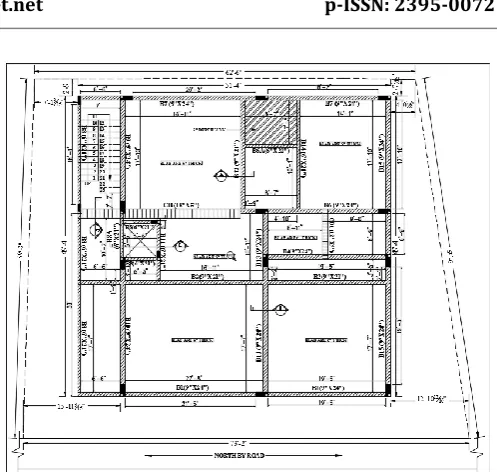
Fig 2.1 Beam layout of the plan
Table -2.1: Design codes and standards referred
IS: 875-1987 : Code of Practice for Design Loads
Part 1-Unit Weight of Building Materials
Part 2 – Live loads
IS: 456 -2000: Code of Practice for plain and reinforced Concrete
SP: 16 – 1980 : Design aids for Reinforced Concrete to IS:456-2000
ACI 440-2r : Guide for the Design and Construction of Externally Bonded FRP Systems for Strengthening Concrete Structures
2.2 Load and Load Cases
The dead load in a building shall comprise the weight of all walls, partitions, floors and roofs and shall include the weight of all other superimposed loads, which are permanently attached to the structure.
Self-Weight of slab is considered = 0.15 x 25 = 3.75 kN/m2 (Considering 150mm thick slab)
Finishes = 1.5kN/m2
(Including suspending weights of AC ducts, pipelines, false ceiling etc)
In live load the following loads are considered, Load on RCC slab = 2.0 kN/m2
Load on roof slab = 1.0 kN/m2
© 2017, IRJET | Impact Factor value: 5.181 | ISO 9001:2008 Certified Journal | Page 1554
Density of water = 10 kN/m3Total live load on slab = 1.22x10 = 12.2 kN/m2
In addition to gravity loads there are certain loads that are almost always applied horizontally, and these must often be considered in structural design. Such loads are called lateral loads. Some of the most important kinds of lateral loads are Wind loads, soil pressure, hydrostatic pressures, forces due to earthquakes, centrifugal forces, and longitudinal forces.
Fig 2.2 3D model of residential building
The model of with swimming pool and without swimming pool has been done and the values of bending moments and shear forces are compared. The model with failure of beams are taken and strengthened by using developed IOS application.
[image:3.595.318.541.205.620.2]Fig 2.3 BMD of without and with swimming pool model
Fig 2.4 SFD of without and with swimming pool model
3. APP DEVELOPMENT
Development of IOS application using XCODE in OSX software and writing program on strengthening of beams by using FRP composites on SWIFT programming language.
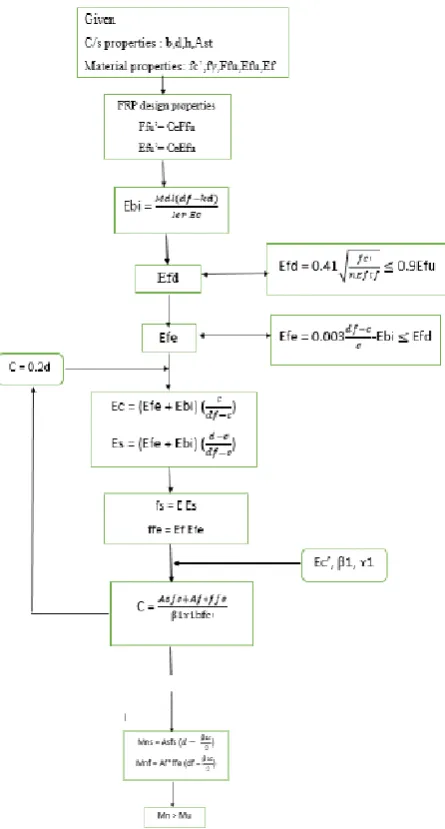
[image:3.595.83.240.225.355.2]To develop any program the flow chart is very important and it is step by step procedure to do the programming.
Fig 3.1 Flow chart of developed program
4. DEVELOPMENT OF IOS APPLICATION
[image:3.595.43.251.458.582.2]© 2017, IRJET | Impact Factor value: 5.181 | ISO 9001:2008 Certified Journal | Page 1555
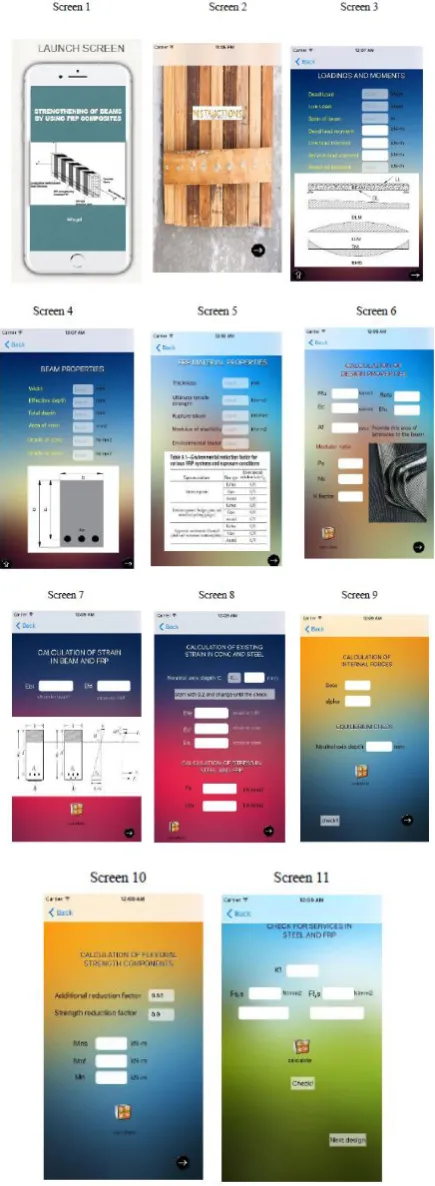
algorithm for the development, the flow-chart is described in [image:4.595.52.270.138.732.2]the previous session and the GUI of the application is shown in the Fig 4.1
Fig 4.1 GUI of developed screens
4.1 Building of application in X-code
X-code is the IOS application developer tool used in the Mac system for building of the application and act as a platform for the design and development of apps. X-code consists of swift programming language where program is done for the development of the app.
The steps in developing the application is 1. Creating new project in the X-code
2. Selecting particular story boards like launch screen, navigation controller and view controller for the particular gadget.
3. Designing the view controller screen by using the assistant tools like outlets, table views, images and buttons etc. 4. Writing program in the coca touch classes for the app and assigning to the particular view controllers.
4.2 Procedure
A. Initially the screen of the application is designed for the app and that can be done using view controllers of particular size and that screen should be disabled for auto layouts. Multi screens can be done using multiple view controllers and these screens can be attached by using the push segue.
B. The design of the view controller is done by using the assistant tools in the X-code, suppose if we need to input the data the outlets is used and for the naming text field is used similarly the image view can be used for the image update. After inputting the outlets the action can be done and this can be achieve by using the buttons.
C. After designing the view controller using assistant tools, the screen should be attached to the swift programming class called the coca touch class where the programming for the current screen can be done. Swift programming language consists of many data types, functions, variables, arrays, strings, and conditionals. By using these data types the programming can be done for the required application.
© 2017, IRJET | Impact Factor value: 5.181 | ISO 9001:2008 Certified Journal | Page 1556
Fig 4.2 Coca touch class in X-code5. USE OF DEVELOPED APP FOR STRENGTHENING
OF STRUCTURAL MEMBERS.
[image:5.595.297.569.117.327.2]The residential building is analyzed with swimming pool model and without swimming pool model using ETABS. The bending moment of beams are compared and there is increase in the value of bending moments in the terrace floor of swimming pool model and 5 of them are deficient due to increase in live load and deficient beams were taken and strengthened by the developed application.
Fig 5.1 Cross section of beam (B35)
Beam properties: Breadth (b) = 230 mm Effective depth (d) = 585 mm Total depth (D) = 600 mm Material properties: Thickness of FRP = 1.02 mm
Ultimate tensile strength = 621 N/mm2
Rupture strain = 0.0015
Modulus of elasticity = 37000 N/mm2
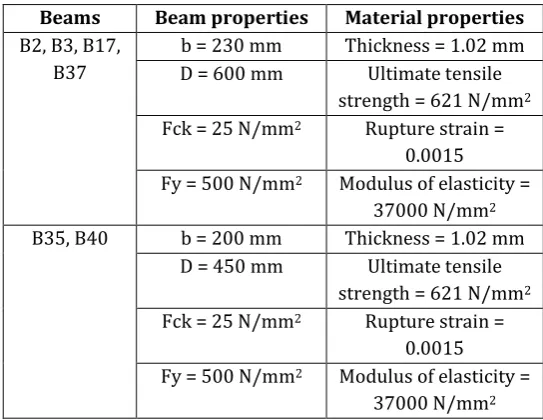
Table 5.1 Beam and material properties
Beams Beam properties Material properties B2, B3, B17,
B37
b = 230 mm Thickness = 1.02 mm D = 600 mm Ultimate tensile
strength = 621 N/mm2
Fck = 25 N/mm2 Rupture strain =
0.0015 Fy = 500 N/mm2 Modulus of elasticity =
37000 N/mm2
B35, B40 b = 200 mm Thickness = 1.02 mm D = 450 mm Ultimate tensile
strength = 621 N/mm2
Fck = 25 N/mm2 Rupture strain =
0.0015 Fy = 500 N/mm2 Modulus of elasticity =
37000 N/mm2
Table 5.2 Design Summary of Strengthened beams by bonding FRP laminates
5.1 Strengthening of beam B40 by revising cross
section followed by FRP wrapping
From the above tables it is observed that 5 beams in the top floor of the building were unable to take extra live loads, hence those beams are strengthened by using developed
application. After strengthening of beams it is observed that beam (B40) has a flexural moment 230 kN-m which is less than required moment 254 kN-m and it is not safe.
The following procedure is used for the beam (B40) to sustain required moment.
Initially the beam properties of B40 and required moments were taken out and suitable additional cover concrete of 150 mm is provided by concrete.
Bea m
L m
As mm 2
Mp kN-m
Mr kN-m
Af mm 2
Mn kN-m
Remar ks
B2, B3
6.3 902 12 3
290 470 303 Safe
B17, B37
6.2 904 10 8
230 470 300 Safe
B35 5.6 864 80 202 408 215 Safe
[image:5.595.44.278.453.627.2]© 2017, IRJET | Impact Factor value: 5.181 | ISO 9001:2008 Certified Journal | Page 1557
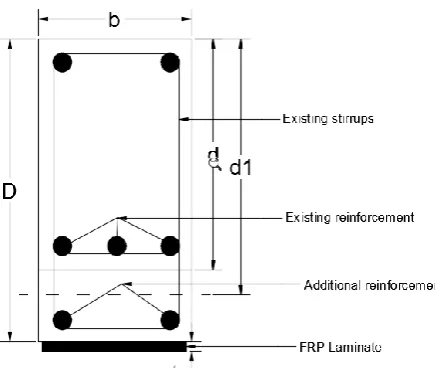
Fig 5.2 Revised cross section of beam (B40)Beam properties after concrete jacketing Breadth = 200 mm
Initial depth (d) = 450 mm Extra depth (d2) = 150 mm Effective depth (d1) = 545 mm Total depth (D) = 600 mm
Material properties: Thickness of FRP = 1.02 mm
Ultimate tensile strength = 621 N/mm2
Rupture strain = 0.0015
Modulus of elasticity = 37000 N/mm2
Area of FRP laminates required for the beam = 408 mm2
The flexural strength of the provided laminates = 332 kN-m > 93 kN-m
Hence the section is capable of sustaining required bending moment = 254 kN-m
6. SUMMARY AND CONCLUSIONS
Based on the analysis and interpretation of results carried out in the work undertaken the following conclusion are drawn
1. Fibers elasticity plays an important role in increasing stiffness and this has led to decrease of deflection.
2. Several beams were found deficient and strengthened by developed application.
3. Strengthening of beams are done according to ACI 440 -2R code by bonding FRP.
4. To carry out the design calculations for strengthening of beams, an IOS application has been developed in swift code.
5. By using FRP as strengthening material the load carrying capacity of member increases.
6. The results obtained from developed application are comparable with the example problem given in ACI 440-2r and are reliable.
7. One of the beam in which the depth is low and bonding the FRP laminates is alone cannot be sufficient for strengthening, hence the depth of beam has been increased and followed by bonding FRP has been done.
8. With the use of IOS application the time taken for design calculations for strengthening is reduced. With the use of IOS application the complexity in design calculations for strengthening is reduced.
REFERENCES
[1] Habibur Rahman Sobuz, et al “Use of carbon fiber
laminates for strengthening reinforced concrete beams in bending”, IJCSE (2011) Volume-2, pp 67-84
[2] K.B. Parikh, N.S Patel “Review on analytical study on
strengthening of beam by FRP” IJRET, Volume 5, 2016, pp 11-14R.
[3] N. Sundar at al “Flexural behavior of RC beams with
hybrid FRP strengthening”, IJCIET (2016), pp 427-433
[4] Sandeep G et al “Strengthening of RCC beam using
different glass fiber”, IJES, V0lume 1, 2013, pp 1-8
[5] T.H. Patel et al “Strengthening of RC beams with FRP
sheets with different configurations in shear and flexure”, IJETAE, Volume 6, 2016, pp 16-160
[6] Building Code Requirements for Structural Concrete and
Commentary (ACI 318m05)
[7] Guide for the Design and Construction of Externally