© 2017, IRJET | Impact Factor value: 5.181 | ISO 9001:2008 Certified Journal
| Page 2491
ANALYSIS AND DESIGN OF RESIDENTIAL BUILDING BY USING SAP-2000
Rajeshwari Patil
1, Shweta Anoor
2, Shweta Desai
3, Sudha
4, Gajendra
5, Mithun Kumar
61,2,3,4
UG Student, Civil engineering Dept, AIET Kalaburagi, Karnataka, India
5,6Asst. Professor, Civil engineering Dept, AIET Kalaburagi, Karnataka, India
---***---Abstract - SAP2000 stands for STRUCTURAL ANALYSIS PROGRAMMING. SAP2000 is commonly used to analyze concrete structures, steel structures, parking garages, skyscrapers, low and high raise buildings, and portal frame design of multi-storey R.C.C residential building of ‘3’ storey’s. Modeling of 3- storey’s R.C.C. framed building is done by using the SAP2000 software for analysis. Post analysis of the structure, maximum shear forces, bending moments, and maximum member displacement are computed. The structural elements are designed manually by using IS456 & SP16
Key Words: SAP 2000, structural elements, static load analysis.
1. INTRODUCTION
The SAP name has been synonymous with state-of-the-art analytical methods since its introduction over 30 years ago. SAP2000 follows in the same tradition featuring a very sophisticated, intuitive and versatile user interface powered by an unmatched analysis engine and design tools for engineers working on transportation, industrial, public works, sports, and other facilities.
At present people are facing problems of land scarcity, cost of land. The population explosion and advent of industrial revolution led to the exodus of people from villages to urban areas i.e. construction of multi-storied buildings has become inevitable both for residential and as well as office purposes. If such structures are not properly designed for the resistance of forces, it may cause to the complete failure of the structures. A multistorey residential building is a building that has a rise in storey’s of more than three. The number of storey’s contained in a building can differ from the rise in storey’s. The building relates to the works that a builder proposes to construct under a major domestic building contract.
Structural designs are an art and science of designing with economy and elegance, a safe, serviceable, and a durable structure. The entire process of structural planning and design requires not only imagination and conceptual thinking (which form art of designing) but also sound knowledge of science of structural engineering besides knowledge of practical aspects, such as relevant design codes and bye-laws, backed up by ample experience, institution and judgment.
The process of design commences with planning of a structure, primarily to meet the functional requirements of the building. The functional requirements and the aspect of aesthetics are look into normally by an architect while the aspect of safety, serviceability, durability and economy of the structure for its intended use over life span of the structure are attended by the structural designers (many times, a structural engineer is require to act in capacities of both the architect and the structural designer.
2. LITERATURE REVIEW
1) V.Varalaxmi: The design & analysis of multistored G+4 building at Kukatpally, Hyderabad, India. The study includes design & analysis of columns, beams, footings & slabs by using well known civil engineering software named as SAP2000. Test on safe bearing capacity of soil was obtained.
2) P.Jayachandran: The design & analysis of multistoried G+4 building at Salem, Tamilnadu, India. The study includes design & analysis of footings, columns, beams, and slabs by using two softwares named as SAP2000 & AUTOCAD.
3) L.G.Kalurkar: The design & analysis of multistoried G+4 building using composite structure at earthquake zone 3. A 3D modelling & analysis of the structure are carried out with the help of SAP 2000 software. Equivalent static method of analysis & response spectrum analysis method are used for analysis of both composite & RCC structures.
3. SAP-2000 Features
This program is primarily used for gravity analysis and design
This tool is often utilized for smaller structures, or portions of a larger structure.
It is great at handling complex geometry as it offers users a lot of different element types and a lot of customization with regards to meshing options.
© 2017, IRJET | Impact Factor value: 5.181 | ISO 9001:2008 Certified Journal
| Page 2492
the desired results for story drift, story shear, base shear etc.
It lacks some of the simplicity that ETABS has of discretizing the structure into macroscopic elements.
4. OBJECTIVES
Analysis and Design the multistory residential building by using SAP-2000 which includes.
1. Creating structural plan
2. Modeling
3. Loading
4. Analysis
5. Design by using IS-456
5.DESIGN PROCEDURE
BUILDING DETAILS
Floor to floor height= 3.0mts
Base to ground floor height = 2.62 mts
Size of building = 24.2 x 21.2mts
Over all height of the building =15.54mts
Shape of the building = regular
S.B.C of soil considered =180 kN/m2
Type of building = residential building
Minimum clear width of stair = 1.5mts
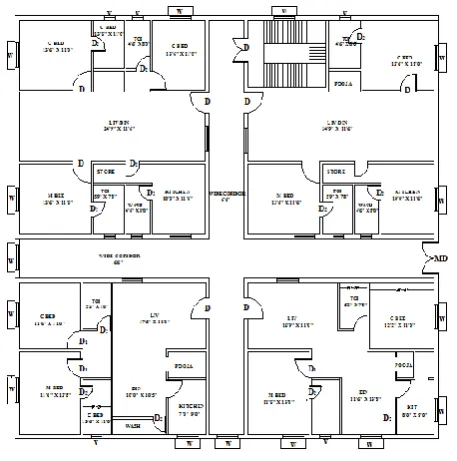
From the execution plan shown in figure no 1. A structural framing plan is developed showing column positions and beam locations such that the load of the building is evenly disturbed on the columns. The beams are located in such a way that all the columns are tied in both X & Y directions. Structural plan also shows c/c distance between the columns shown in fig. This helps in creating a model of structural in SAP-2000.
6.Modeling using SAP-2000
1)Open the SAP-2000 SAP program
2) Check the units of the model in the drop-down box in lower right-hand side corner of the SAP-2000 window, click the drop-down box to set units to kN-m
3) Click the File menu > New model command
4) The next form of Grid System and Story Data Definition will be displayed after you select NO button set the grid line and spacing between two grid lines. Set the story height data using Edit Story Data command.
5) Click on grid only. A new window of SAP2000 will be displayed.
6) Edit grid data and storey data as per the structural framing plan.
7) Click the Define menu > Material Properties
8) SAP2000 Define section columns and beams using Define > Frame section properties
9) Define wall/slab/deck
To define a slab as membrane element and one way slab define using special one way load distribution
10) Generate the model Draw beam using Create Line Command and draw column using Create Column command
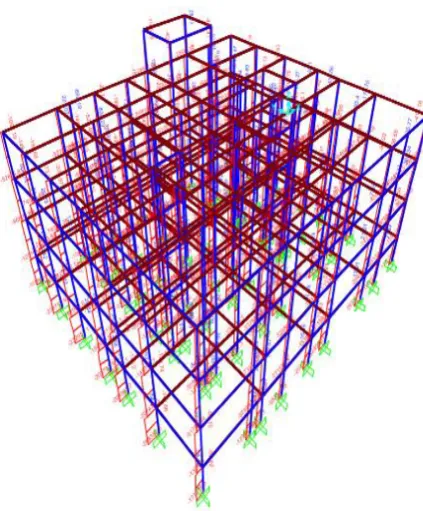
Above creating option used to generate the model as shown in below figure.
11) Assign support condition
Drop-down box in the lower right-hand corner of the SAP2000 window, Select only bottom single storey level to assign fixed support using assign > Joint/Point>Restrain (Support)
(a) Materials
Grade of steel = Fe 415
Grade of concrete = M2O
© 2017, IRJET | Impact Factor value: 5.181 | ISO 9001:2008 Certified Journal
| Page 2493
(b) Assumed sections
Beam = B230x450 mm
Column = C230x450 mm
Slab = 150 mm thick
Supports : fixed supports are provided at all the column bases.
LOADING
Define various loads (Dead load, Live load, SDL)
Dead Load: self weight multiplier is used 1 to calculate dead load as default.
Live load case will be present by default. Define super dead load.
1st select the member where the load is to be assigned
then click the assign button
Analysis
(a) Check model for errors in line elements, points, area elements with tolerance factor 0.001m
Analyze>check model command.
[image:3.595.43.545.93.738.2](b) Static analysis of structure Analyze>Run analysis command
[image:3.595.325.535.117.393.2]Fig: 1. Plan of building
Fig: 2. Grid line diagram
[image:3.595.44.273.502.733.2]© 2017, IRJET | Impact Factor value: 5.181 | ISO 9001:2008 Certified Journal
| Page 2494
[image:4.595.78.255.112.388.2]Fig 4. Shear Force Diagram
[image:4.595.347.559.125.381.2]Fig 5. Bending Moment Diagram
Fig 6. Axial Force Diagram
7. Design of Rcc Elements
7.1 DESIGN OF BEAM
B1
Ast = 372 mm2
Provide 3# - 12 mm
Ast= 274mm2
Provide 2# - 16 mm
Lateral ties 2L 8mm -150mm c/c
B2
Ast = 721 mm2
Provide 3# - 16mm & 2# -12mm
Ast= 571 mm2
Provide 3# 16 mm
© 2017, IRJET | Impact Factor value: 5.181 | ISO 9001:2008 Certified Journal
| Page 2495
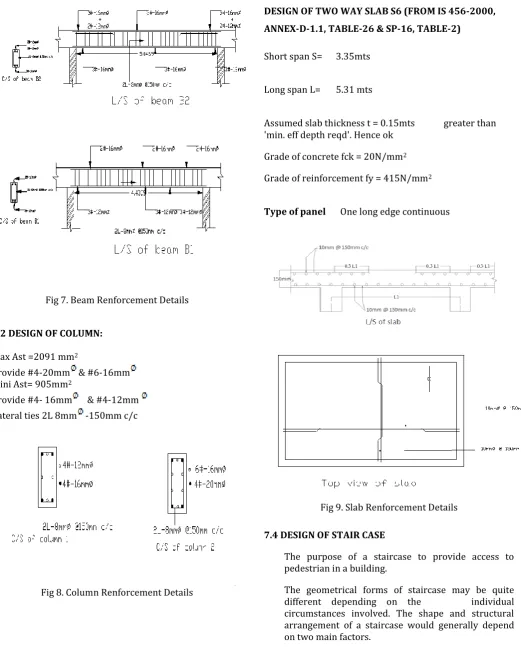
Fig 7. Beam Renforcement Details
7.2 DESIGN OF COLUMN:
Max Ast =2091 mm2
Provide #4-20mm & #6-16mm Mini Ast= 905mm2
Provide #4- 16mm & #4-12mm Lateral ties 2L 8mm -150mm c/c
Fig 8. Column Renforcement Details
7.3 DESIGN OF SLAB
DESIGN OF TWO WAY SLAB S6 (FROM IS 456-2000, ANNEX-D-1.1, TABLE-26 & SP-16, TABLE-2)
Short span S= 3.35mts
Long span L= 5.31 mts
Assumed slab thickness t = 0.15mts greater than 'min. eff depth reqd'. Hence ok
Grade of concrete fck = 20N/mm2
Grade of reinforcement fy = 415N/mm2
[image:5.595.44.566.122.770.2]
Type of panel One long edge continuous
Fig 9. Slab Renforcement Details
7.4 DESIGN OF STAIR CASE
The purpose of a staircase to provide access to pedestrian in a building.
© 2017, IRJET | Impact Factor value: 5.181 | ISO 9001:2008 Certified Journal
| Page 2496
1. Type of construction of structure around the stair case that is load bearing brick structure or reinforced concrete framed structure.
2. Availability of space.
Type of staircase provided for the proposed building is Bifurcated staircase, which consists of two flights. The first flight starts from plinth level to lintel level and second flight starts from lintel level to roof level.
Design of First Flight:
Width of the flight = 3.35m
Assuming rise = 150mm
Tread = 250mm
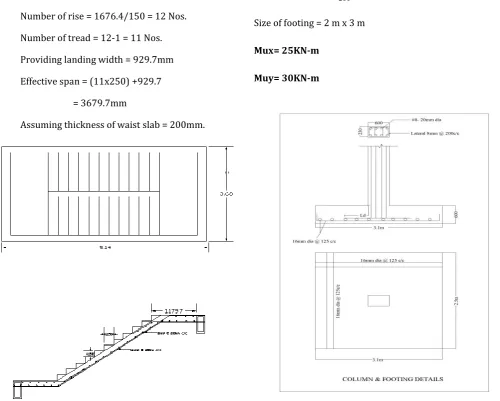
Number of rise = 1676.4/150 = 12 Nos.
Number of tread = 12-1 = 11 Nos.
Providing landing width = 929.7mm
Effective span = (11x250) +929.7
= 3679.7mm
Assuming thickness of waist slab = 200mm.
Fig 10. Stair case Renforcement Details
7.5 DESIGN OF FOOTINGS
Consider the column member which is subjected to maximum axial load & moment.
Size of column = 230x450mm
Assuming safe bearing capacity of soil as180 KN/m2
Factored load from column Pu= 1420KN
Working load from column = 946.667KN
Assuming self wt. of footing at 10% of column
Area of footing =
= 5.78m
2 =6m2
Size of footing = 2 m x 3 m
Mux= 25KN-m
[image:6.595.54.555.312.713.2]Muy= 30KN-m
© 2017, IRJET | Impact Factor value: 5.181 | ISO 9001:2008 Certified Journal
| Page 2497
7. CONCLUSIONS
1. The structural components of the building are safe in shear and flexure.
2. Short term deflection of all horizontal members is within 20mm
3. Amount of steel provided for the structure is economic.
4. Proposed sizes of the elements can be used in the structure
5. Maximum size of column and beam required is 230mm x 450mm.
6. Maximum thickness of slab provided is 150mm.
8. FUTURE SCOPE OF STUDY
By keeping the same analysis results of software, the design can be made more economical by designing members individually or in group.
Meshing of the slab element can be done to get the accurate load distribution.
REFERENCES
[1] V.Varalakshmi, G. Shiva Kumar and R. Sunil Sarma, Analysis and Design of G+3 residential building, mini project report, Marri Laxman Reddy Institute of Technology and Management, Dundigal, Hyderabad, India-2014.
[2] P. Jayachandran and S. Rajasekaran, Structural Design of Multi-story Residential Building for in Salem, India, mini project report, PSG College of Technology, Coimbatore, Tamil Nadu, India-2006.
[3] Mahesh Suresh Kumawat and L.G. Kalurkar, Analysis and Design of multistory building using composite structure-2014.
[4] Divya kmath, K.Vandana Reddy, Analysis and Design of reinforced concrete structures-A G+3building model, mini project report, Gokaraju Rangaraju Institute of Engineering and Technology, Hyderabad, India- 2012.
IS CODES :
IS 456-2000 ( Design of RCC structural elements )
IS 875-Part 1 ( Dead Load )
IS 875-Part 2 ( Live Load )
SP-16 ( Depth and Percentage of