© 2017, IRJET | Impact Factor value: 5.181 | ISO 9001:2008 Certified Journal | Page 1449
Translation Invariant Wavelet Transform Based Image Denoising on
Normal images using Hard Threshold
Syed Ali Fathima KMN
1, Shajun Nisha
2, Dr.M.Mohamed Sathik
31
M.Phil.(PG Scholar)Department of Computer Science,Sadakathullah Appa College,Tirunelveli,India.
2
Prof.& Head,PG Department of Computer Science,Sadakathullah Appa College,tirunelveli,India
3
Principal, Sadakathullah Appa College, Tirunelveli, TamilNadu,India
---***---Abstract
- Digital Images are generally corrupted by noise,Noise is nothing but addition of unwanted information for the Original Image. Image noise is random variation of brightness or color information in images, Removal of the noise is necessary to reduce the minimal damage of the image, improve image details, one of the newer Wavelet Transform method is Translation-Invariant were introduced, Translation invariant method improved the wavelet thresholding methods by averaging the estimation of all translations of the degraded image. In this Paper, It is Proposed the hard thresholding with the Translation Invariant wavelet Transform. The experimental results indicate that the proposed methods in this paper are better than traditional Translation invariant wavelet hard thresholding denoising methods improves the image quality.
Key Words: Denoising, TI Wavelet Transform, Hard Thresholding.
1. INTRODUCTION
Image Denoising techniques are necessary to prevent this type of corruption from digital images Generally, data sets collected by image sensors are contaminated by noise. Imperfect instruments, problems with data acquisition process[1].Image Denoising has remained a fundamental
problem in the field of image processing. Due to properties like sparsity and multiresolution structure, Wavelet transform translation invariant have become an attractive and efficient tool in image denoising. Wavelet based denoising techniques since Donoho[4] demonstrated a simple
approach to a difficult problem. Researchers published different ways to compute the parameters for the Wavelet translation
invariant hard thresholding[3].TIWT hard thresholding
techniques were applied to the TI Wavelet coefficients to reduce artifacts[3],The translation invariant wavelet
transform (TIWT) performs multi resolution analysis by filtering the shifted coefficients as well as the original ones at each decomposition level. TIWT is shift invariant (also known as time invariant). This approach produces additional wavelet coefficients (possessing different properties) from the same source[5].TIWT produce better estimation
performance than orthogonal wavelet transforms.
De-noising of natural images corrupted by noise using wavelet techniques is very effective because of its ability to
capture the energy of a signal in few energy transform values. Wavelet denoising attempts to remove the noise present in the signal while preserving the signal characteristics, regardless of its frequency content[5]. The
denoising performance of wavelet transform methods is affected by the following:
Wavelet basis
Number of decompositions
Transform type (orthogonal, redundant, translation invariant, etc)
A translation Invariant wavelet transform is implemented by omitting the sub-sampling at the each stage of the transform. Invariance means that you can recognize an object as an object, even when its appearance varies in some way. This is generally a good thing, because it allows to extract an object's identity or category from the specifics of the visual input, like relative positions of the viewer/camera and the object). TIWT is the most well-known two dimensions and multi-resolution transform that decompose an image in horizontal, vertical and diagonal directions. Researchers attempt to find new two dimensions and multi-resolution transforms as the traditional WT with more directionality in contrast with TIWT[12].
1.1 Related Works
Image denoising is a restoration process, where attempts are made to recover an image that has been degraded by using prior knowledge of the degradation process[1].De-noising of
normal images corrupted by noise using TIWT Hard thresholding[5] used to prevent the image fine details.
Translation Invariant Wavelet Transform denoising suppresses noise by averaging over thresholded signals of all circular shifts. The hard thresholding will kill all the coefficients whose magnitudes are less than the threshold to zero while keeping the remaining coefficients unchanged. All the coefficients whose magnitudes are greater than the threshold will be reduced by the amount of the threshold[14].
The main of an image-denoising algorithm is then to reduce the noise level, while preserving the image features. In wavelet domain, the noise is uniformly spread throughout the coefficients, while most of the image information is concentrated in the few largest coefficients. The most straightforward way of distinguishing information from noise in the wavelet domain consists of thresholding the wavelet coefficients[9].Translation-invariant(TI)[6] scheme of
© 2017, IRJET | Impact Factor value: 5.181 | ISO 9001:2008 Certified Journal | Page 1450 translation invariant wavelet transform (TIWT) performs
multi resolution analysis by filtering the shifted coefficients as well as the original ones at each decomposition level. TIWT is shift invariant (also known as time invariant)[7].
1.2 Motivation and Justification
In order to suppress Pseudo-Gibbs phenomena, a new de-noising method combining above improved thresholding with the translation-invariant (Tl) wavelet transform is proposed in this paper. Translation Invariant denoising suppresses noise by averaging over thresholded signals of all circular shifts. The hard thresholding will kill all the coefficients whose magnitudes are less than the threshold to zero while keeping the remaining coefficients unchanged. All the coefficients whose magnitudes are greater than the threshold will be reduced by the amount of the threshold. 1.3 Organisation of the Paper
The remaining paper is organized as follows: Methodology which include the proposed work of, TIWT with hard thresholding, noises are represented in Section II. Experimental results are shown in section III. Performance Analysis are discussed in Section IV. Finally, Conclusion is presented in Section V.
2. METHODOLOGY
2.1 Outline of the Prosposed work
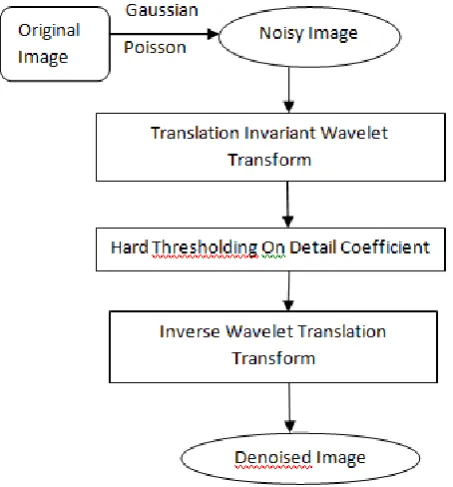
Denoising uses TIWT is represented Fig.1,Gaussian and Poisson noises are added to the input images such as Lena, Cameraman. TIWT is decomposed the noisy image and then apply the hard thresholding.
Fig -1: Block diagram of TI Wavelet Transform
2.2 TI Wavelet Transform
TI wavelet denoising suppresses noise by averaging over thresholded signals of all circular shifts. TI wavelet Denoising better than the traditional wavelet transform may produce artifacts on discontinuities of the signal. the de-noised signal can be reconstructed using inverse wavelet[13].Pseudo-Gibbs phenomena are correlated with
sequence position of original signal singularities. So Coifman and Donoho[14] put TI de-noising to eliminate this defect.
Given a signal x(n)(n=0,1,…,N-1),defined Sh as arithmetic operator of translation[15], the value of shifting is h:
Sh ( x(n)) = x((n + h) mod N ) For all x, y a X and every scalar α
) , ( || || || ) ( || ) ,
(x a y a x a y a x y d x y
d
) , ( | | || || | || ||
) ,
( x y x y x y d x y
d
| | | | ||
||x 1 1 2 | |x| |p (1p|2p)1p 2
1 2 2 2 1
2 ( | )
||
||x ||x||max
1, 2
2.2.1 THRESHOLDING
TI Wavelet Hard Thresholding is very simple non-linear technique, which operates on wavelet coefficient at a time. In its most basic form, each coefficient is threshold by compare against threshold, if the coefficient is smaller than threshold, set to zero; otherwise it is kept or modified. Replacing the all small noisy coefficients by zero and inverse wavelet transform on the result may lead to reconstruction with the essential signal characteristics and with less noise. Wavelet thresholding involves threes steps A linear discrete wavelet transform, nonlinear thresholding Step & a linear inverse wavelet transform.
2.2.2 TIWT Hard thresholding:
Hard threshold is a “keep or kill” procedure and is more intuitively appealing. Wavelet TI coefficients above the threshold in absolute value[1].The hard thresholding will kill
all the coefficients whose magnitudes are less than the threshold to zero while keeping the remaining coefficients unchanged.The TIWT hard thresholding algorithm sets any coefficients less than or equal to the threshold value to zero,and keeps the value of the signal for those coefficients above the threshold value.
Where T is Hard threshold. Let S(x, y) represent the initial wavelet coefficient in the point (x, y) in each sub-band, The aim of this paper is to obtain denoised coefficient D(x,y) at the point S(x,y) by adjusting the pixel values.steps of wavelet threshold denoising method are shown as the following:
Step 1: wavelet decomposition of the image: Determine the wavelet function and decomposition levels N , and decompose the image with N layer wavelet.
[image:2.595.39.266.516.760.2]© 2017, IRJET | Impact Factor value: 5.181 | ISO 9001:2008 Certified Journal | Page 1451
Step 3: TIWT coefficient with threshold processed will be used to reconstruct the image by inverse wavelet transform[10].
R. Coifman and D. Donoho[14] improved the wavelet
thresholding methods by averaging the estimation of all translations of the degraded image.
2.2.3 Decompose the Coefficients
Normally, those wavelet coefficients with smaller magnitudes than the preset threshold are caused by the noise and replaced by zero, and the others with larger magnitudes than the preset threshold are caused by original signal, Then the denoised signal could be reconstructed from the resulting wavelet coefficients[11].
A new translation-invariant (TI) wavelet denoising method with improved hard thresholding is presented to eliminate the noise from the denoised image.
The process, consists of following main stages: 1)Read the noisy image as input
2)Perform shearlet of noisy image and obtain Wavelet coefficients
3) Estimate noise variance from noisy image
4)Calculate threshold value using various threshold selection rules.
5)Apply hard thresholding function to noisy coefficients 6)Perform the inverse wavelet to reconstruct the denoised image[1].
Fig.2: Lena image two level TIWT Decomposition
Fig.3: Cameraman image two level TIWT Decomposition Optimal choice of thresholds called as image denoising, removing the noise from the image to increase the overall quality of the processed image. The definition of coefficient independent threshold given by Donoho and Johnston depends on the noise power and the size of the image[6].
2.3 Noise Categories
Noise is an unwanted or distort signal that may corrupt the quality or originality of the image.
i)Gaussian Noise ii)Poisson Noise
2.3.1 Gaussian noise
Gaussian noise is evenly distributed over the signal. This means that each pixel in the noisy image is the sum of the
true pixel value and a random Gaussian distributed noise value.
- (1)
2.3.2 Poisson noise:
Shot noise which follows a Poisson distribution, is due to the quantum uncertainty in photoelectron generation. Amplifier noise and quantization noise arises when number of electrons converts into pixel intensities.
for λ>0 and x=0,1,2. - (2)
3. EXPERIMENTAL RESULTS
TIWT by hard thresholding to verify its effectiveness. One is use objective data such as MSE, RMS, PSNR to objective analyzed its performance. Experimental results were conducted to denoise a normal such as Lena, cameraman shown in Fig 4. Gaussian and Poisson noises were considered. Shearlet with hard Thresholding used and their various denoised images is shown in Fig.5 and Fig.6
Fig.4: Original Image for Lena and Cameraman
© 2017, IRJET | Impact Factor value: 5.181 | ISO 9001:2008 Certified Journal | Page 1452 Fig.6: Cameraman image using TIWT with hard threshold
4. PERFORMANCE ANALYSIS 4.1 Performance Metrics
4.1.1 PSNR:
Peak signal to noise ratio is the ratio between maximum possible power of a signal and the power of corrupting noise that affects the quality and reliability of its representation. PSNR is calculated as,
- (3)
4.1.2 MSE:
The smaller the MSE the closer the estimator is to the actual data. A small mean squared error means that the randomness reflects the data more accurately than a larger mean squared error. The goal is to estimate the signal xij
from noisy observations yij such that Mean Squared error (MSE) is minimum. I.e.
-(4)
4.1.3 RMS:
The RMS overall time of a periodic function is equal to the RMS of one period of the function. The RMS value of a continuous function signal can be approximated by taking the RMS of a sequence of equally spaced
samples. Additionally, the RMS value of various waveforms can also be determined,
xrms= + + +….+ ) - (5)
4.2 Performance Evaluation
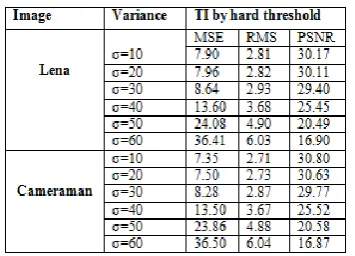
The performance of TIWT was evaluated by using MSE,PSNR,RMS. The experiments TIWT with hard
[image:4.595.60.268.97.295.2]thresholding have been tested and their denoised image results are shown in Table I and Table II. Considered all the metrics, it is observed that performs well for two images such as Lena, Cameraman.
[image:4.595.364.542.188.316.2]Table -1: Lena and Cameraman Image TIWT with Hard threshold in Gaussian noise
Table -2: Lena and Cameraman Image TIWT with Hard
threshold in Poisson noise
5. CONCLUSIONS
This Paper presents for normal image denoising based on TIWT with hard threshold is used to remove noise from the image. The normal images are corrupted by Gaussian and Poisson noise. TIWT is one of the method for decomposition is best suited for performance demonstrated that the use of translation invariant wavelet could offer better results than hard thresholding to improve the best quality of the image.
REFERENCES
[1]“Wavelet Based Image Denoising Implementation”, Anupama P S, Dr S C Prasanna Kumar, Dr B G Sudharshan, Dr N Pradhan, December, 2012 Vol 1 Issue 11,ijtrd.
[2]Kanika Gupta, S.K. Gupta, “Image Denoising Techniques – A Review paper”, International Journal of Innovative Technology and Exploring Engineering (IJITEE), March 2013, Vol.2, Issue-4.
[3]Rajni, Anutam “Image Denoising Techniques-An Overview”, International Journal of Computer Applications (0975 – 8887) Volume 86 – No 16, January 2014.
[image:4.595.314.513.334.471.2]© 2017, IRJET | Impact Factor value: 5.181 | ISO 9001:2008 Certified Journal | Page 1453 [5]Mrs.P.Sivamani1, Mrs.V.Vidhya Gowri2, Ms.
S.V.Priyavarshini3, Ms. N.Revathi4,“Image Denoising Using
Wavelet Thresholding”, International Journal of Advanced Research Trends in Engineering and Technology (IJARTET) Vol. 3, Issue 4, April 2016.
[6]”image denoising using translation-invariant contourlet transform”, Ramin Eslami and Hayder Radha.
[7]”Denoising of Natural Images Using the Wavelet Transform“, 2010, Manish Kumar Singh San Jose State University.
[8]”Image Denoising Method based on Threshold, Wavelet Transform and Genetic Algorithm”,
Yali Liu,International Journal of Signal Processing, Image Processing and Pattern Recognition Vol. 8, No. 2 (2015), pp. 29-40.
[9]”Wavelet thresholding approach for image Denoising”Pankaj hedaoo1 and swati s godbole2
International Journal of Network Security & Its Applications (IJNSA), Vol.3, No.4, July 2011.
[10]”Implementation of Image Denoising using
Thresholding Techniques”,Rajesh Kumar Rai, Trimbak R. Sontakke, ISSN 2249-6343 International Journal of Computer Technology and Electronics Engineering (IJCTEE) Volume 1 , Issue 2.
[11]”Denosing ECG using Translation Invariant Multiwavelet”, World Academy of Science, Engineering and Technology , Jeong Yup Han, Su Kyung Lee, and Hong Bae ParkInternational Journal of Electrical, Computer, Energetic, Electronic and Communication Engineering Vol:2, No:5, 2008.
[12]”Comparative Study between Wavelet Thresholding Techniques (Hard, Soft and Invariant-translation) in Ultrasound Images”,
R. Bouchouareb and D. Benatia,international Journal of Bio-Science and Bio-Technology Vol.6, No. 6 (2014), pp.29-38. [13]”The denoise based on translation invariance wavelet transform and its applications”, Shuren Qin, Changqi Yang, Tang Baoping and Shanwen Tan, The Test Center, Institute of Mechanical Engineering, Chongqing University Chongqing 400044, P. R. China.
[14]Translation-Invariant De-Noising, R.R. Coifman and D.L. Donoho ,Yale University and Stanford University.
[15]”An Effective Signal De-noising Algorithm CombiningOptimal Wavelet Packet Basis and Translation-Invariant”, Di Wu Zhejiang University,Conference Paper · June 2008.
BIOGRAPHIES
K.M.N.Syed Ali Fathima received the B.sc degree in Computer Science from MS University in 2012 and M.sc degree in Computer Science from MS University in 2015.She is currently pursuing the M.Phil degree in Computer Science under the guidance of S. Shajun Nisha. Her Research interest are mainly include domain of Image Denoising.
Shajun Nisha S, Professor and Head of the Department of Computer Science, Sadakathullah Appa College, Tirunelveli. She has completed M.Phil. (Computer Science) and M.Tech (Computer and Information Technology) in M.S. University, Tirunelveli. She has involved in various academic activities. She has attended so many national and international seminars, conferences and presented numerous research papers. She is a member of ISTE and IEANG and her specialization is Image Mining.