289
ARTIFICIAL DNA HYBRIDIZATION TO PULSE-WIDTH
MODULATION
1JUAN C. HERRERA-LOZADA, 2RODRIGO CADENA-MARTINEZ, 1JESUS A.
ALVAREZ-CEDILLO, 1MAURICIO OLGUIN-CARBAJAL, 1MIGUEL HERNANDEZ-BOLAÑOS, 1ISRAEL
RIVERA-ZARATE, 1JACOBO SANDOVAL-GUTIERREZ
1Instituto Politécnico Nacional – Centro de Innovción y Desarrollo Tecnológico en Cómputo,
IPN - CIDETEC, MÉXICO.
2Universidad Tecnológica de México – UNITEC MÉXICO
E-mail: 1{jlozada; jaalvarez; molguinc; mbolanos; irivera}@ipn.mx; 2[email protected]
ABSTRACT
The analysis and design of a Pulse-width modulation (PWM) embedded unit as an alternative to convert digital signals to analog signals is presented herein, extrapolating the biological principle of DNA hybridization. The biological hybridization process is a binding event between two complementary DNA single strands that leads to the formation of a double-stranded helix. The proposed technique to detect the hybridization is based on direct comparison of data, allowing a high degree of parallelism in the Bio-inspired Architecture, it was specially designed to regulate the light intensity of LED lamps as a home automation application.
Keywords: Five Pulse-widht Modulation, Artificial DNA Hybridization, LED Lamp, Bio-inspired Architecture, Digital- Analogic Converter
1. INTRODUCTION
In digital electronic design, a PWM (Pulse-width modulation) unit is basically a digital – analog converter (DAC) which can be used in solutions that do not require a high frequency of sampling, it converts a binary data into a series of pulses, so that the pulse duration is directly proportional to the value of binary data, so it is a scheme that provides an intermediate amount of electric power between fully on and fully off. PWM is widely used in different areas of control systems, such as robotics, industrial process control, power control systems, and others [1].
With regard to home automation (domotics), PWM has been very useful in regulating the light intensity of lamps (LED, fluorescent and incandescent), as well as regulating valves and small engines that automate some process [2], [3].
When designing with programmable logic devices (FPGA, CPLD), embedded realization of such converters is common [4], so this paper proposes an alternative to design a PWM unit simulating the combination of DNA strands in order to regulate the light intensity of an LED lamp in an application for home automation and so contribute to energy savings. The artificial DNA hybridization
suggests a simple mechanism that compare parallel binary strands stored in the data registers looking for evidence that they are complementary to each other to validate a subsequent action as a response. This approach is very similar to evaluation of inference rules in an expert system that tries to model the reasoning of a human operator [5].
2. ELECTRONIC DETECTION OF DNA
HYBRIDIZATION
290 distributed DNA single strands that have been implanted into a silicon base. These sequences have a simple fixed value that when they are incubated with strands injected up to the chip, generating helices of DNA that can be detected through electronic tools. Engineering has shown that DNA chips can be used to store and evaluate in parallel, Boolean or fuzzy rules [5], [7].
In electronic design, hybridization can be implemented using a reference register that will be compared in parallel with others test registers, looking for evidence that they are complementary. In Figure 1, test register represents the simple sequence of DNA with a fixed value and reference register is the DNA strand that is injected or introduced to chip. To maintain the analogy with biological hybridization, the reference register is unique and will be compared with all test registers in parallel form. Note that to make this comparison, both registers must have the same size and only if they are complementary, the flag output will be high logical value. To verify that the bits of both registers are mutually complementary, XOR logic gates are used for bitwise comparison.
3. PULSE-WIDTH MODULATION (PWM)
In digital electronic a PWM embedded unit is usually accomplished by connecting a binary counter and a comparator circuit together; this last one will determine when data applied to the entrance of the unit is less than the value of binary counter constantly changing. At the output of the PWM unit, is necessary to connect a low-pass RC filter to determine the voltage of the analog signal equivalent to digital data entered [8]. The entire period of a PWM cycle is equal to the product of the period clock signal reference (system clock) with 2n, where n is the number of bits of the counter
circuit proposed. In the particularity of this work were considered 4-bit data registers, so in [8] is demonstrated that a converter of more than 8 bits does not get more benefits, so 16 different levels (at a rate of 24) of luminous intensity are adequate.
4. BIO-INSPIRED ARCHITECTURE
We consider a modular design consisting of three parts. First part of this realization uses a reference register to be compared in parallel with every test registers, simultaneously.
According to the scheme established with 4-bit registers, 16 test registers were designed with fixed and different values, and a single reference register
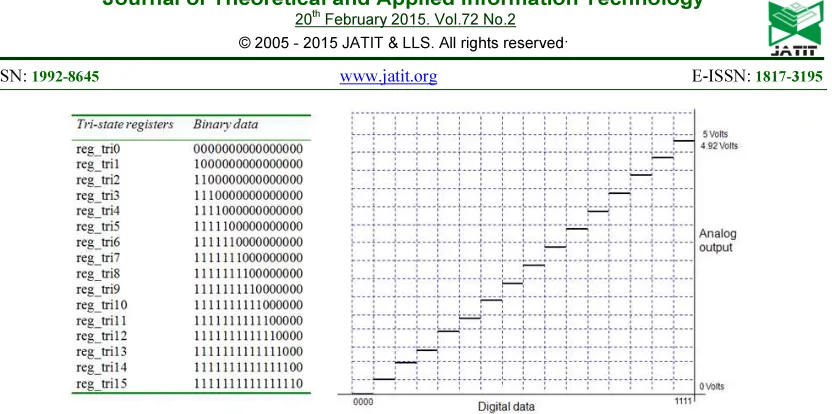
which establishes the digital data to convert to their analog equivalent in a range of 0 to 5 V, for example, a binary input equal to 0000 will get an analog voltage of 0V; in the same way, a binary input equal to 1111 will get the maximum analog value equal to 5V. The fixed values of the test registers were assigned complementary in corresponding to the values that they can take at the rate of 2n, in other words, for a binary entry 0000,
stored in the reference register, the test register labeled as "0" will store a binary data 1111; for an entry 0001, it was assigned 1110 in the test register labeled as "1". Just the only one output from the module in Figure 1 is a data flag that indicates a successful hybridization through a high logical level.
In the second part of our design each flag from the previous stage actives individually a tri-state data register which is connected to a common output bus. This time were considered 16-bit tri-state registers to improve the resolution of the converter. In this scheme, only a single tri-state register may be enabled at a time. Each tri-state register has a fixed value assigned according to the binary value that will be delivered as the result of modulation.
The third and final stage of architecture, is the stage of control, consisting of a 16-bit multiplexer that with the help of a 4-bit binary counter, performs a binary sweep of the only tri-state register enabled, starting with the most significant bit. The same binary counter determines that after 16 pulses clock, when the unit PWM has finished data conversion, the reference register can receive a new data to process.
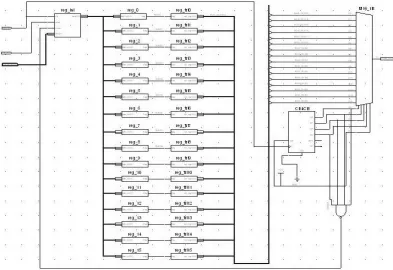
Figure 2 shows the schematic diagram of the complete unit designed with the three parts. All modules were described in VHDL for logic synthesis.
5. RESULTS
The logic synthesis design was carried out using ISE Webpack v.8.1i, to configure a 3S200 Spartan 3 FPGA of vendor Xilinx. The PWM Bio-inspired unit implemented using only 4% of the amount of internal resources of FPGA.
291 seen in Figure 3. It verifies the correct operation of PWM generator. It was necessary to design an electronic power stage to attach the PWM output with the LED lamp used in the laboratory. In Figure 4 we show the lamp used in our experiments. This lamp was designed with similar characteristics as commercial lamps with a panel of 18 x 18 high brightness LEDs.
Figure 4: LED lamp used in the laboratory
6. CONCLUSIONS AND FUTURE WORK
The artificial hybridization of DNA single strands allows direct a design based on inference rules, into a natural parallelization that can be explored through implementation in programmable logic devices. This technique transferred to Bio-inspired hardware has allowed the completion of a functional PWM generator as an alternative to convert digital signals to analog signals.
Each tri-state register enabled individually, as a result of a successful hybridization, stores a value that can be updated in real-time increasing the scope of this proposal. This will allow attacking the quantification problem, which directly affects the converter resolution and that a conventional PWM unit could not stand it. This modular design supports changing the content of the registers according to the needs of modulation, being possible to increase or decrease the resolution of the conversion.
It will be interesting to explore the capabilities of parallel evaluation of inference rules in expert systems more complex; in future work we will apply this same technique to create intelligent systems that allow the automatic regulation of the luminous intensity in conventional lamps, focusing more specialized home automation applications, encouraging a systematic energy saving.
ACKNOWLEDGMENTS
Authors acknowledge financial support for projects IPN – SIP 20144053 and CÁTEDRAS
CONACYT 1507.
REFERENCES:
[1] Zrilic, D. G. “Alternative Approach to Use of Pulse Width Modulation”, Automation
Congress, 2006. WAC '06. World IEEE, 24-26
July 2006, pp. 19–24.
[2] Alonso, J. M. “A fluorescent lamp electronic ballast for railway applications based on low cost microcontroller”, Industry Applications Conference, 2003. 38th IAS Annual Meeting IEEE. Conference Record of the Volume 1, Issue , 12-16 Oct. 2003, pp. 523 – 530.
[3] Sandu, F. “Remote and mobile control in domotics”, Optimization of Electrical and
Electronic Equipment, 2008. OPTIM 2008. 11th
International Conference on 22-24 May 2008, pp. 225 - 228.
[4] Dan, D. “FPGA implementation of PWM pattern generators [for PWM invertors]”,
Canadian Conference on Electrical and Computer Engineering IEEE, 2001, pp. 225-230, vol.1.
[5] Delgado, A. “Rule base evaluation using DNA chips”, Proceedings American Control Conference, Anchorage - Alaska, Mayo 8-10, 2002, pp. 3242 – 3245.
[6] Moeller, R. “Chip-based electrical detection of DNA”, Nanobiotechnology, IEEE Proceedings
- Vol 152, Issue 1, 4 Feb. 2005, pp. 47 – 51. [7] Delgado, A. “DNA chips as lookup tables for
rule based systems”, IEEE Computing and Control Engineering Journal 2002, Vol. 13, No. 3, pp. 113-119.
[8] Yu, Z. “A Review of three PWM Techniques”,
292
Figure 1: Standard Model Of Artificial Hybridization With Digital Electronics
[image:4.595.100.493.395.665.2]293