THE DESIGN OF KNOWLEDGE MANAGEMENT SYSTEM
MODEL FOR SME (UKM)
1YULIANA LISANTI, 2DEVYANO LUHUKAY
1,2
Binus University, School of Information System E-mail: [email protected], [email protected]
ABSTRACT
Studies on knowledge management showed that the knowledge management plays an important role to improve SME’s performance, as knowledge or Information is one of innovation driver that will support the SME competitiveness. Therefore, in this study, together with KOPWANI UKM (SME) the team has designed a solution to manage the SME knowledge, called as SME Portal, which is a Knowledge Management System for SME. Furthermore, we also combined the Knowledge management system with social networking capability, as SME Portal members will get more benefit from the system namely to promote their products, to open business opportunities by extending their business networking, to find solution of their business problems.
Keywords: Knowledge Management, Information, SME, Innovation, Knowledge Management System, SME Portal, networking
1. INTRODUCTION
SMEs (Small and Medium Enterprises) are important to economy everywhere in the world. Usually, they are established from a family business, managed by traditional ways, and supported by limited resources, hence those conditions could become obstacles for them to compete and to grow in today’s global environment. In Indonesia, these low to middle-class businessmen gathered in an organization called
UKM (Usaha Kecil dan Menengah), where UKM
can be categorized as one of SME.
Studies on how to improve SME competitive advantages in Indonesia revealed that , beside capital issues, the lack of information about the know how in many areas , such as the quality standard, efficient production process, effective marketing, sales and distribution, accounting, resourcing , etc , need to be addressed and improved. As a result, researches on Knowledge Management in SME, which would help to collect, manage and distribute information and knowledge for SME, have been conducted by local researcher since years ago.
The Research on the importance of Knowledge Management in SMEs as written by Rasheed, Nazar (2005)[1] and Setiarso, Bambang (2009)[2], and [3]
Ngah, Rohana (2009)[3] concluded that Knowledge management is one of the supporting
elements of the competitiveness of SMEs. Furthermore, one important factor in the development of Knowledge Management in SMEs, as mentioned by Mohayidin, Mohd Ghazali, et al (2007)[4] is the availability of supporting KM’s infrastructure. Infrastructure such as Knowledge Management System that allows the utilization of human capital and organizational knowledge through best practices, rules and procedures, which will result in improved performance.
Infrastructure is the key factor in the successful implementation of knowledge management, that’s why, to continue the above research result to support KM implementation in SME, this paper will further discuss a knowledge management system model design for SME , in order to improve SME’s performance and competitive advantages. .The research will study, analyze and design a web-based KM application prototype, which is expected could help to address the lack of information issues in SME.
Digital Economy” by Turban (2010)[5]. While the model design process refers to “The System Analysis and Design: In a Changing World” by Satzinger (2009)[6]. And KOPWANI, one of SME association for woman in Indonesia, would be our partner to further study the SMEs information/knowledge issues.
While The research scope would be to analyse and design a web based application Knowledge Management system model for SME with the capability to provide a forum to exchange information and knowledge, portal as a reference to get necessary information for SME, and also to develop networking between SME that will help to open new opportunities among SME’s members.
2. RESEARCH METHODS
2.1 Data Collection Techniques
The data collection has been conducted by literature study, such as from previous journals, current knowledge management system for SME and from knowledge management text books. Secondly, we have interviewed and distributed questionnaire to KOPWANI UKM members to understand more about SME situation and challenge in Indonesia. Lastly, we performed observation, the team conducted a direct observation on the parts associated with the research namely current to analyze current business process, to understand information that is available and needed, and technologies used by organizations as well as looking at the performance of the people associated with the business process
2.2 Sampling Techniques
In sampling, we adopted purposive sampling method. Respondents who filled out questionnaires were all KOPWANI UKM members
2.3 Research Stages
The whole research would be divided into three stages , which have been started in early 2013, they are :
Part 1: To analyze and design the Knowledge Management System model for SME
Part 2: To analyze and develop the required SME KMS content in order to improve the performance of SMEs
Part 3: To build and implement the SME KMS as to enhance the competitiveness and performance of SMEs .
Furthermore, this article would further details the part 1 of the whole research that are still in progress, which is to analyze and design the Knowledge Management System for SME
3. KMS IN SME STUDY LITERATURE
3.1 KMS As SME’s Competitive Advantage
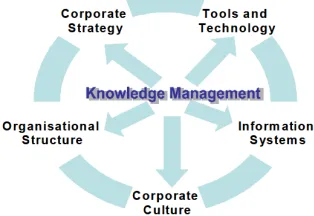
[image:2.595.318.475.450.558.2]Setiarso, Bambang (2009)[2] in the journal entitled "Knowledge Management (Knowledge-Management) and Intellectual Capital (Intellectual Capital) for Empowering SMEs", concluded that knowledge must be understood by SMEs as a source of innovation that supports the competitiveness, so that this knowledge should be managed properly. Competitiveness is formed from the influence of the elements of knowledge management - an important element in the company, or referred to as a corporate building blocks as illustrated by Rasheed, Nazar (2005)[1] on the impact of knowledge management to the SME (Figure 1). Corporate building blocks consist of Corporate Strategy, Tools and Technology, Information System, Corporate Culture and Organizational Structure.
Figure 1: Corporate Building Blocks
Along with Rasheed, Nazar (2005)[1] and Setiarso, Bambang (2009)[2], who wrote the benefits of knowledge management for SMEs on competitiveness, Ngah, Rohana (2009)[3], in his
in improving the quality of their products and services. The ability of SMEs to innovate and develop sustainable quality has also been evidenced correlated with the ability and knowledge of its employees by Nonaka (1998)[7].
3.2 The SME’s Business Characteristics
Rasheed, Nazar (2005)[1] also states that
knowledge management in SME (Small Medium Enterprise), known as SMEs, has some characteristics that have a higher benefit than the large companies , such as managers of SMEs are typically also is the owner which has the implication centralized decision-making process and not so much through the bureaucratic process , thus making the managers or owners of SMEs is a key driver in the implementation of knowledge management . In addition, a simple form of SME structure will accelerate the process of change within the organization, and employees in SMEs are more organic that most will have a cultural background, rationale and objectives are the same, so it will be easier to create a culture of knowledge sharing in SMEs, compared with companies that have employees who have vastly different backgrounds.
3.3 The Successful KMS Implementation
Therefore, Setiarso , Bambang (2009 )[2] also concluded that in order to support the successful implementation of knowledge management in SMEs , the IRSA concept should be applied. IRSA stands for Identity, Reflect, Share and Apply, where there are three areas that should also be first noticed by the SMEs. Firstly, organization interprets information about the environment to get a sense of what happened and what the company is doing. Secondly, new knowledge is created by converting and combining expertise and knowledge (the know-how) of its members to learn and innovate. Thirdly, the information is processed, analyzed, prioritized, and distributed; this will make company commits to what have been decided to be focused on.
Mohayidin , Mohd Ghazali , et al ( 2007)[4] in his article titled " The Application of Knowledge Management in Enhancing the Performance of Malaysian Universities" mentions that the socio - technical component , which consists info- culture, info- structure and infrastructure , has become the main parameters of knowledge management in improving the performance of the organization , so the organization can develop its core business . The
Implementation of knowledge management in all parts of the organization also needs to be an organizational culture , which can be deployed with the help of the right KM’s infrastructure , that allows the utilization of human capital and organizational knowledge through best practices , rules and procedures, which will result in improved performance .
3.4 Current KMS For SME
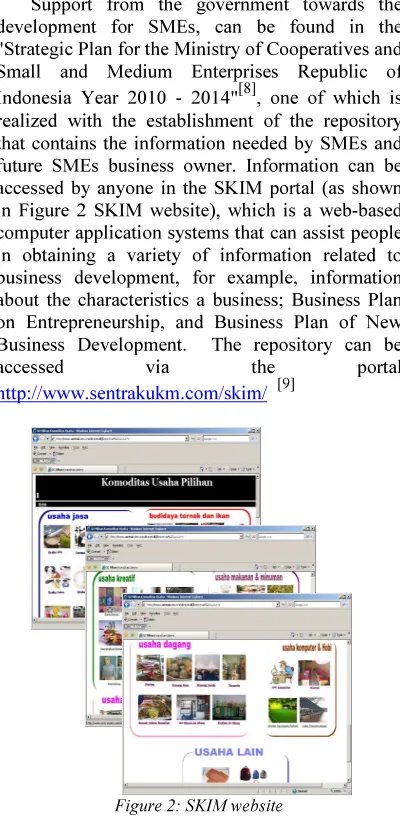
Support from the government towards the development for SMEs, can be found in the "Strategic Plan for the Ministry of Cooperatives and Small and Medium Enterprises Republic of Indonesia Year 2010 - 2014"[8], one of which is realized with the establishment of the repository that contains the information needed by SMEs and future SMEs business owner. Information can be accessed by anyone in the SKIM portal (as shown in Figure 2 SKIM website), which is a web-based computer application systems that can assist people in obtaining a variety of information related to business development, for example, information about the characteristics a business; Business Plan on Entrepreneurship, and Business Plan of New Business Development. The repository can be accessed via the portal
[image:3.595.307.507.252.660.2]http://www.sentrakukm.com/skim/ [9]
Figure 2: SKIM website
Based on information obtained from the SKIM
website via
http://www.sentrakukm.com/skim/WUB/book.php
[10]
this application can be grouped into 3 categories of modules , namely :
1. Commodities Business module
business as the market outlook , the factors that influence the success of the business , the factors that need to be wary of doing business , how to run a business , about permits , the cost of doing business, etc. These 50 types of commodities business are classified into :
a. Service Business
b . Livestock and Fish Cultivation c . Agricultural Cultivation d . Creative enterprises
e . Food and Beverage businesses f . Trading Business
g . Computer and Hobbies 2 . Start a Business Module
This module is a registration module, if they are interested in doing business on one of the commodites . In this module user is required to fill out forms that have been provided , starting from :
a. Identity Form
b . Aspects of Business Readiness c . Source of Funding
d . Business analysis e . Recommendation
f . Display / Print business plan ( Bussiness Plan )
3. And Developing Businesses module
This module can be used by existing UKM owners who want to develop their business. User is required to fill out the following forms:
a. Entrepreneurial Identity Form b. Aspects of Business Readiness c. Financial Performance d. Business analysis e. Recommendation
f. Display / Print business plan (Bussiness Plan)
3.5 What Should Be Done To Improve The Current KMS?
SKIM application is a website that can be used as a first step in designing a knowledge management system which can be used by SME. With Cloud Computing infrastructure, SME doesn’t need to spend a lot of cost to provide the back office infrastructure as the main support of knowledge management . In addition, the content and design of the current system needs to be improved by developing and implementing the research result in knowledge management. Some key points base on Setiarso, Bambang (2009)[2] , Rasheed, Nazar (2005)[1] and, Rohana (2009)[3] studies on KM for SME are
1. Awareness on the importance of Knowledge Management by SMEs as competitive advantag 2. Analyze and Interpret information about the environment to get a sense of what happen and what is being done by SMEs
3. Create new knowledge by converting and combining expertise and knowledge ( know-how ) of the members ( tacit knowledge ) in order to learn and innovate .
4. Process and analyze information to choose and commit activities which are consistent with actions
5. Implementation of KM as an organizational corporate culture
Furthermore, a good knowledge management system design should focus on the below four main factors, namely a) Infrastructure, Content and Portal, b) Collaboration and Learning, c) Social Capital, Expertise and Communities, d ) and Business Intelligence and Integration.
4. QUESTIONNAIRE RESULT
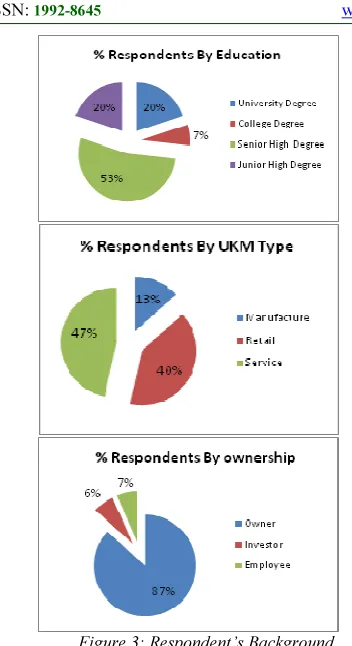
Figure 3: Respondent’s Background
From the above respondent’s background, we might expect KOPWANI members are mostly doing a conventional business practice, with a limited Information Technology awareness or involvement. If the respondents could represent the majority of SME’s background, this might be a challenge to introduce the knowledge management concept and system, as there might be technological gap issue which needs to be addressed before it is implemented.
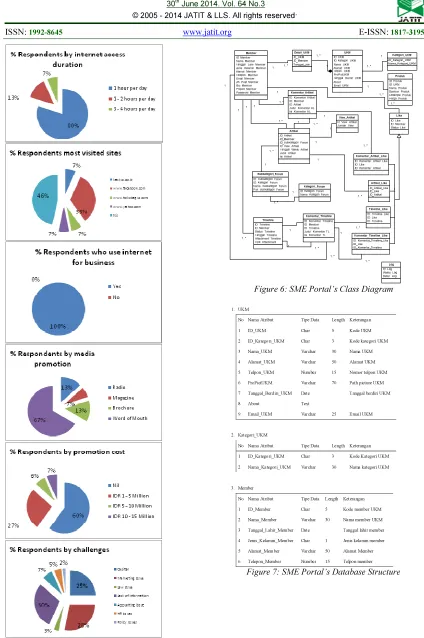
To further understand the requirement and challenges to develop and implement the Knowledge management system for SME, we asked questions about internet (Figure 5). Surprisingly, all respondents know about internet, 80% responded that on daily basis at least they access the internet for 1 hour, 46% informed that they usually access social networking sites (Facebook), although they only access internet for personal matters (not business related). The next questions on the questionnaire (Figure 5) are related with their business activity, such as how they promote their business, 67% respondents use the word of mouth marketing, which would be relying on their relatives or business partners recommendation. The word of mouth marketing is an efficient and effective ways, as in most of the time SMEs members or their relatives are helping
each other for free , which explains 60% responded that they don’t have to spend for promotion cost. Lastly, from the questionnaire, we have identified the top 3 SME challenges they are lack of information (30%), lack of marketing channel (28%) and lack of capital (25%).
Based on the above result, it’s clear that SME needs a forum or channel to expand and extend their networking, in order to increase their sales, and to get more information, such as how to get supply for their raw materials, how to improve product quality, how to distribute their product and services in an efficient ways, how to manage the warehouse, etc. Furthermore, networking would allow them to connect with potential investors that might be able to help them to solve the capital issue
5. THE DESIGN OF KNOWLEDGE
MANAGEMENT SYSTEM MODEL FOR SME
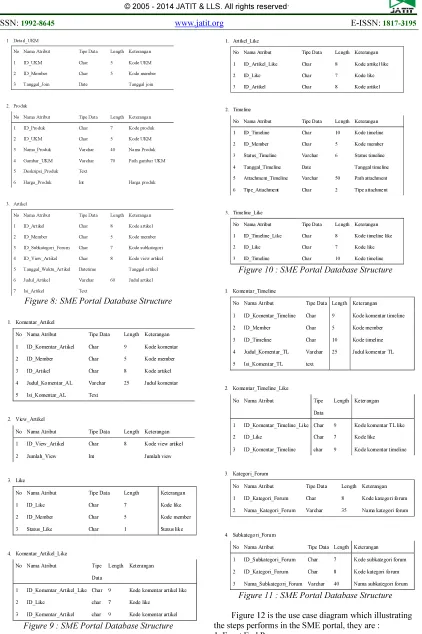
The KMS design consists of KMS cycle , class diagram (Figure 6), database structure (Figure 7 - 11), use case diagram (Figure 12) and user interface prototyping (Figure 13 - 15). Figure 4 shows that
the Knowledge Management System Cycle is
adopted in this KMS for SME or SME portal design.
No KM Process Implementation in KMS for SME (SME Portal)
1. Create Knowledge When a member makes an article that contains information that will be placed on the SME portal.
2. Capture Knowledge When there are other members who view the articles that have been posted and can understand the contents of the article
3. Refine Knowledge When other members who read the article can extract meaning and implement its SME activities.
4. Store Knowledge When an information and articles can be stored in the portal and access anytime by another member.
5. Manage Knowledge When the article information and can be updated, and can accommodate the comments of the other members so they can have a discussion and
reviews a discussion.
6. Disseminate knowledge
An article must have a format that can be easily accessed by all other members and also users who visit the portal so that it works as much as
possible.
[image:5.595.95.271.110.433.2]Figure 5: SME’s Questionnaire Result
Figure 6: SME Portal’s Class Diagram
1. UKM
No Nama Atribut Tipe Data Length Keterangan 1
2 3 4 5 6 7 8 9
ID_UKM ID_Katego ri_UKM Nama_UKM Alamat_UKM Telpon_UKM ProPictUKM Tanggal_Berdiri_UKM About Email_UKM
Char Char Varchar Varchar Num ber Varchar Date Text Varchar
5 3 30 50 15 70
25
Kode UKM Kode kategori UKM Nama UKM Alamat UKM Nomor telpon UKM Path picture UKM Tanggal berdiri UKM
Email UKM
2. Kategori_UKM
No Nama Atribut Tipe Data Length Keterangan 1
2
ID_Katego ri_UKM Nama_Kategori_UKM
Char Varchar
3 30
Kode Kategori UKM Nama kategori UKM
3. Member
No Nama Atribut Tipe Data Length Keterangan 1
2 3 4 5 6
ID_Member Nama_Member Tanggal_Lahir_Member Jenis_Kelamin_Member Alamat_Mem ber Telepon_Member
Char Varchar Date Char Varchar Num ber
5 30
1 50 15
[image:6.595.315.478.391.648.2]Kode member UKM Nama member UKM Tanggal lahir member Jenis kelamin member Alamat Member Telpon member
1. Detail_UKM
No Nama Atribut Tipe Data Length Keterangan
1 2 3 ID_UKM ID_Member T anggal_Join Char Char Date 5 5 Kode UKM Kode member
T anggal join
2. Pro duk
No Nama Atribut Tipe Data Length Keterangan
1 2 3 4 5 6 ID_Pro duk ID_UKM Nama_Produk Gambar_UKM Deskripsi_Produk Harga_Produk Char Char Var char Var char Text Int 7 5 40 70
Kode pro duk
Kode UKM
Nama Produk
Path gambar UKM
Harga produk
3. Artikel
No Nama Atribut Tipe Data Length Keterangan
1 2 3 4 5 6 7 ID_Artikel ID_Member
ID_Subkategor i_Foru m
ID_View_Artikel T anggal_Waktu_Artikel Judul_Artikel Isi_Artikel Char Char Char Char Datetime Var char Text 8 5 7 8 60 Kode artikel Kode member Kode subkategori
Kode view artikel
T anggal artikel
Judul artikel
Figure 8: SME Portal Database Structure
1. Komentar_Artikel
No Nama Atribut Tipe Data Length Keterangan
1 2 3 4 5 ID_Komentar_Artikel ID_Member ID_Artikel Judul_Komentar_AL Isi_Komentar_AL Char Char Char Varchar Text 9 5 8 25 Kode komentar Kode member Kode artikel Judul komentar 2. View_Artikel
No Nama Atribut Tipe Data Length Keterangan
1 2 ID_View_Artikel Jumlah_View Char Int
8 Kode view artikel
Jumlah view
3. Like
No Nama Atribut Tipe Data Length Keterangan
1 2 3 ID_Like ID_Member Status_Like Char Char Char 7 5 1 Kode like Kode member Status like 4. Komentar_Artikel_Like
No Nama Atribut Tipe
Data
Length Keterangan
1 2 3 ID_Komentar_Artikel_Like ID_Like ID_Komentar_Artikel Char char char 9 7 9
Kode komentar artikel like
Kode like
[image:7.595.91.513.92.726.2]Kode komentar artikel
Figure 9 : SME Portal Database Structure
1. Artikel_Like
No Nama Atribut Tipe Data Length Keterangan
1 2 3 ID_Artikel_Like ID_Like ID_Artikel Char Char Char 8 7 8
Kode artikel like
Kode like
Kode artikel
2. Timeline
No Nama Atribut Tipe Data Length Keterangan
1 2 3 4 5 6 ID_Timeline ID_Member Status_Timeline Tanggal_Timeline Attachment_Timeline
Tip e_Attachme nt Char Char Varchar Date Varchar Char 10 5 6 50 2 Kode timeline Kode member Status timeline Tanggal timeline Path attachment Tipe attachment 3. Timeline_Like
No Nama Atribut Tipe Data Length Keterangan
1 2 3 ID_Timeline_Like ID_Like ID_Timeline Char Char Char 8 7 10
Kode timeline like
Kode like
Kode timeline
Figure 10 : SME Portal Database Structure
1. Komentar_Timeline
No Nama Atribut Tipe Data Length Keterangan
1 2 3 4 5 ID_Ko mentar_Timeline ID_Member ID_Timeline Judul_Komentar_TL Isi_Komentar_TL Char Char Char Varchar text 9 5 10 25
Kode komentar timeline
Kode member
Kode timeline
Judul komentar TL
2. Komentar_Timeline_Like
No Nama Atribut Tipe
Data
Length Keterangan
1 2 3 ID_Ko mentar_Timeline_Like ID_Like ID_Ko mentar_Timeline Char Char char 9 7 9
Kode komentar TL like
Kode like
Kode komentar timeline
3. Kategori_Forum
No Nama Atribut Tipe Data Length Keterangan
1 2 ID_Kategori_Forum Nama_Kategori_Forum Char Varchar 8 35
Kode kategori forum
Nama kategori forum
4. Subkategori_Forum
No Nama Atribut Tipe Data Length Keterangan
1 2 3 ID_Subkategori_Forum ID_Kategori_Forum Nama_Subkategori_Forum Char Char Varchar 7 8 40
Kode subkategori forum
Kode kategori forum
Nama subkategori forum
Figure 11 : SME Portal Database Structure
Figure 12 is the use case diagram which illustrating the steps performs in the SME portal, they are : 1. Front End Page
b. Members Home Page (i) Home Page
(ii) Member Profile Page (iii) Page Forum Member (iv) SMEs page
- Creating new SMEs page - MyUKM page
- SMEs list page 2. Back End Page
a. Visitors Home Page b. Home page c. SMEs page
(i) SMEs Creating New Pages (ii) My UKM Page
(iii) SMEs list page d. Forum page
Figure 12: SME Portal Use Case Diagram
Figure 13: SME Portal User Interface Prototyping(Unregistered Home Page)
Figure 13 shows the Unregistered Home Page, where this page is the main page that will appear to visitors who have not registered. Visitor can register to become a member in this page, to access main article, and to login as a member.
Figure 14 : SME Portal User Interface
Figure 15: SME Portal User Interface
Fig 15 is a page that will appear when a member successfully login in to SME portal. On this page members can access and update their profile, access article sections, Forum. In addition, a member is able to create his/her SME profile, product and post articles
6. CONCLUSION AND SUGGESTIONS
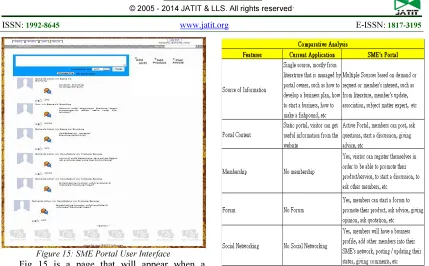
The top 3 SME’S challenges which are lack of information, capital issue and some problem in sales area namely promotion, might be able to be solved by developing a strong relationship between SMEs and extending their networking. A knowledge management system for SME, or called as SME portal, which has the ability and functions to connect between SME’s member, also investors as a media to improve communication, open new opportunities, and share information such as product promotion, quality improvement, distribution channel, etc, has been designed based on a study in KOPWANI UKM.
Fig 16 shows the comparative analysis between current application and SME’s Portal. The SME’s portal features such as forum, social networking, membership, active portal and multiple information sources would enable the application to support the above objectives . Members can post their interest , giving advice, ask quotation, promote their products, while association, such as KOPWANI would also be able to act as subject matter expert to facilitate a forum or start a project, etc.
Fig 16 Comparative Analysis between Current Application (SKIM) and SME’s portal
For the next research, we learned that the SME portal channel and user interface, should be able to accommodate the technological gap issue as we want everyone to easily use the system and contribute to share information in the forum, therefore, for the next research, in phase 2, a further study of user interface design will be conducted, beside developing both application and content, team will also explore the feasibility to develop a mobile channel to access the portal (e.g android), as most members currently access the internet via their mobile phones. However, infrastructure limitation such as server’s internet bandwidth capacity or hardware specification would restrict some application features, for example for the beginning, one member would only able to have 50 friends, video would be uploaded to other repository and members can refer via the url link, etc.
play an important role in this implementation phase, as they have the media, facility and network to support the successful of SME Portal implementation.
REFFERENCES:
[1] Rasheed, Nazar (2005), The Impact Of Knowledge Management On Sme’s, Http://Www.Knowledgeboard.Com/Item/776/2 3/5/3
[2] Setiarso, Bambang (2009) Pengelolaan Pengetahuan (Knowledge- Management) Dan Modal Intelektual ( Intellectual Capital) Untuk Pemberdayaan Ukm, Lembaga Ilmu Pengetahuan Indonesia, www.ilmukomputer.com
[3] Ngah, Rohana (2009), Tacit Knowledge Sharing And Smes’ Organizational Performance, Vol 1 No 1, Feb 2009, International Journal Of Economics And Finance
[4] Mohayidin M G Et Al (2007) “The Application Of Knowledge Management In Enhancing The Performance Of Malaysian Universities” The Electronic Journal Of Knowledge Management Volume 5 Issue 3, Pp 301 - 312, Available Online At www.ejkm.Com
[5] Turban, E., & Volonino, L. (2010).
Information Technology for Management : Transforming Organizations in the Digital
Economy (Seventh ed.). New Jersey: John
Wiley & Sons.
[6] Satzinger, J. W., Jackson, R. B., & Burd, S. D. (2009). System Analysis and Design In a
Changing World (Fifth ed.). Boston: Course
Technology.
[7] Nonaka, I. & Takeuchi, H. (1995). The Knowledge-Creating Company: How Japanese Companies Create The Dynamics Of Innovation. Oxford University Press. New York, NY.
[8] Kementrian Koperasi Dan UKM (2010) , Rencana Strategis Kementerian Koperasi Dan Usaha Kecil Dan Menengah Republik Indonesia Tahun 2010 – 2014, Www.Depkop.Go.Id
[9] http://www.sentrakukm.com/