Enhancement of Radnet Protocol Using Red
Routing Algorithm in Manets
Balkar Singh1, Vinay Bhardwaj2
1
Research Scholar(Department of Computer Science),Sri Guru Granth Sahib World University, Fatehgarh Sahib,Punjab (India)
2
Asst.Professor(Department of Computer Science), Sri Guru Granth Sahib World University, Fatehgarh Sahib, Punjab (India)
Abstract—The widespread use of mobile devices with wireless
communication interfaces has made applications for mobile networks, particularly mobile ad hoc networks (MANETs), increasingly attractive for physical environments with defective or infrastructure-less communication. Routing protocols for MANETs still present limited message delivery, high latency, and large message overhead, after many years of research efforts, which strongly inhibit the applications of MANETs in practice. Mobile ad hoc Networks (MANETs) pose significant shared communication medium constraints such as limited memory, access channels, and bandwidth to the development of effective communication protocols. Furthermore, multi hop message forwarding multiplies the amount of simultaneous transmissions, which increases network congestion, interference and decreases protocol performance. To solve these problems, we are going to enhance a variation of MANET which we called interest centric mobile ad-hoc network or simply RADNET in which every participant node implements in the network layer an Active Prefix (AP) composed of a prefix and an application interest, which the RADNET protocol uses to identify the nodes, to address the messages, probabilistic message forwarding and name search in a distributed way. This research work aims to enhance the performance of RADNET protocol in MANET by using RED routing algorithm. The work of simulation has been completed with the help of network simulator NS-2. This research work proposes early congestion detection and adaptive routing in MANET by enhancing the performance of RADNET protocol using RED routing technique. To evaluate the effectiveness of RADNET for generating lower disturbance in the shared medium of communication, to enable resource savings and to reduce message overheads, the simulated performances of Enhanced RADNET protocol with traditional RADNET protocol and AODV is compared. Parameters taken for this work are packet loss ratio, bandwidth, packet delay, packet delivery ratio and energy consumption on the base of which it is concluded that the system is enhanced
Keywords— MANET; RADNET Protocol; RED Routing algorithm.
INTRODUCTION
As the importance of computers in our daily life increases it also sets new demands for connectivity. The wired solutions have been around for a long but there is increasing demand on working wireless solutions. Wireless communication between mobile users is growing more popular than ever before. This growth is due to the technological advancements in the field of computers and
communicating devices. It has enabled all communicating devices to be equipped with radio interfaces to communicate without wires .It provides the mobile user with versatile and flexible communication and continuous access of networked services. Mobile Ad hoc Networks as an infrastructure-less wireless communication systems described by MANET’s routing is one of the key research areas for researchers. Each and every routing protocol of MANET has its own characteristics and level of performance level. So, it is necessary to identify the key routing protocol to be adopted for selected scenario for better performance. There are some challenges that shows the limitations that have to be overcome in a MANET environment:
1. Limited wireless transmission range: In wireless networks the radio band will be limited and hence data rates it can offer are much lesser than what a wired network can offer. It requires the routing protocols in wireless networks to use the bandwidth always in an optimal manner by keeping the overhead as low as possible.
2. Routing Overhead: The nodes often change their location within network. This generates some stale routes in the routing table which leads to unnecessary routing overhead.
3. Battery constraints: This is one of the limited resources that form a major constraint for the nodes in an ad hoc network. The devices used in these networks have restriction on the power source in order to maintain portability, weight and size of the devices. If we increases the power and ability of processing then it makes the nodes bulky and less portable so only MANET nodes has to optimally use this resource.
4. Asymmetric links: Mostly wired networks rely on the symmetric links which are always fixed but this is not a case with Ad hoc networks as the nodes are mobile and constantly changing their position within network.
PROTOCOL DESCRIPTION
(i) RADNET is an open communication protocol which defines the structure of information to be communicated across a known hardware and Electronic interface. It defines the method of communication between instruments and software which presents that information to the end user. It is a format of the data contained within a UDP datagram. The messages in it are outlined in RFC's 768, 862-865, 867, and 1119.RADNET is divided into three functional areas: header, body and footer.
(ii) RED (Random Early Detection) provides portable computers with an in- expensive wireless network connection which uses a mechanism of early detection of packet drop, without waiting to queue overflow. Such mechanism informs both, the sender to reduce the packet transmission rate and the receiver to not to send excessive acknowledgement packets. With the help of this , it can reduce considerable amounts of delay time if network length is more; sender and receiver are at sufficient distance. The RED algorithm is best suited for to avoid the congestion .
IMPLEMENTATION
The routing algorithm in RADNET uses drop tail queue for data transmission which causes inefficient data transmission and congestion in the network. RED (Random Early Detection) is well suited for congestion avoidance and it manages the buffer efficiently as it uses a mechanism early detection of packet drop without waiting to queue overflow.
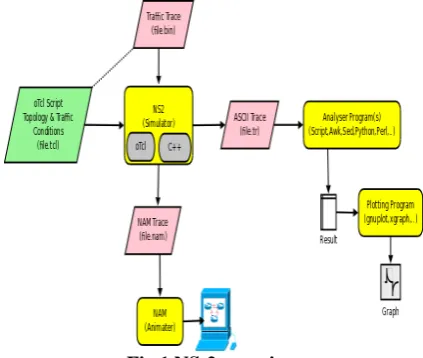
The ns-2 simulator stands for Network Simulator version 2. It is a discrete event simulator for the research of networking. It works at packet level and provides support to simulate bunch of protocols like TCP, UDP, FTP, HTTP and DSR. It also simulates wired and wireless networks. It is primarily UNIX based & its scripting language is TCL and it is a standard experiment environment in the research community.
NS2 simulator is adopted in this work to evaluate the performance of the proposed methodology and compare the traditional RADNET Protocol with the proposed Enhanced Protocol and AODV. The parameter values of simulation are as shown in table1.
Fig.1 NS-2 overview
To evaluate and compare the effectiveness of these routing protocols in a MANET, extensive simulations have been performed in NS2.34 simulator. Each simulation is carried out under a constant mobility. The simulation parameters for node density are listed in Table 1.
Table 1: Network Scenario
Parameters Value
Simulator NS2
Channel Channel/Wireless Channel
Radio Propagation Model Two ray ground Network Interface Physical/Wirelessphy
MAC MAC/802_11 Interface Queue Queue/Drop Tail/Pri-queue
Antenna Antenna/Omni antenna
Link layer LL
Interface queue length 50 Routing Protocol RADNET Simulation time 200s
Nodes in mobile ad hoc environment pose significant shared communication medium constraints such as limited memory, some number of access channels and bandwidth to the development of effective protocols of communication. In this way, multi hop message forwarding multiplies the amount of simultaneous transmissions, which increases channel contention and network congestion, increasing interference and reducing performance of protocol. With these issues in mind, we have tried to enhance a variation of MANET which we called interest centric mobile ad-hoc network or simply RADNET in which every participant node appends in the network layer an Active Prefix (AP) composed of a prefix and an application interest, which the Radnet protocol uses to identify the nodes, to address the messages, probabilistic message forwarding, and searching of name in a distributed way. In this way, to evaluate the effectiveness of Radnet for generating lower disturbance in shared medium of communication , thus enabling resource savings, and to reduce message overheads, then we compared the simulated performances of Enhanced RADNET protocol (RP) with traditional RADNET and AODV protocols by changing probabilistic message forwarding to opportunistic message forwarding scheme.
PROBLEM FORMULATION
The intent of proposed work is to design wireless ad-hoc network delineating various intermediate nodes between source & destination. And to analyse protocol performance among dynamic set of nodes for MANET in relation to enhance packet delivery ratio ,to lower down the bandwidth, packet loss ratio, packet delay and energy consumption.
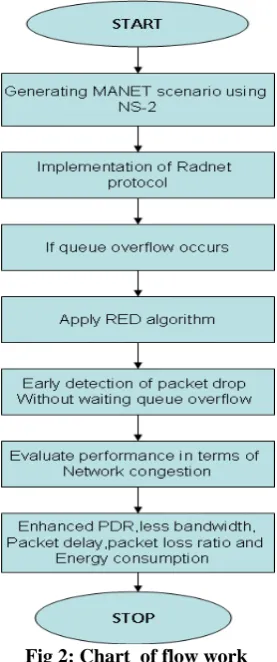
Fig 2: Chart of flow work
The flow of work shown in above figure shows the complete process of our work step by step. The first step of our work is to generate the complete MANET scenario to give the proper communication environment using NS-2.The second step of this process to implement the RADNETprotocol in the system .In the case of queue overflow, we have to apply the RED routing algorithm because RED uses a mechanism early detection of packet drop without waiting overflow of queue, this mechanism inform the sender to reduce the packet transmission rate and also inform the receiver to not to send excessive acknowledgement packets. After that we have to evaluate the performance in terms of network congestion. RED adjusts queue parameters according to current queue condition and reduces the queuing delay and reduces the queuing delay and increase the throughput. In this way, we get better packet delivery ratio and less bandwidth, packet delay, packet loss ratio and low energy consumption and finally we get the enhanced RADNET protocol .RED basically uses four parameters according to which queue is managed.
1. Queue length
2. Min threshold (THmin) 3 .Max threshold (THmax) 4. Max probability (P)
1. Queue size or length is maximum size of buffer in which packets are stored.
2. Min threshold is the value where the first notification is sent if queue length is crossed the min threshold all the packets are forwarded without any packet drop.
3. Max threshold is the value where all incoming packet is dropped if average queue length is crossed the max threshold.
4 .If average queue length is between min and max threshold then packet is dropped with max probability (P). Random Early Detection start dropping packet as average queue length reaches to a soft limit and both end detect the congestion before becoming burst and lower packets transmission thus the drop rate of packet is reduces. Using of RED instead of Drop tail improves the certain parameters such as efficiency, packet delivery ratio, bandwidth, lower down the energy consumption etc.
Fig.3 Conditions for packet marks/drops
Process of RED algorithm according to different cases according to which Queue is managed-
Case I- If queue occupancy is less than min threshold then red will not drop packets and behave normally.
Case II- If queue occupancy is between min and max threshold then but red will drop packets with probability P. Case III- If queue occupancy is crossed the max threshold value then red will drop all the incoming packets.
RESULTS
To simulate the real moving behaviours of the nodes in a mobile ad hoc network, ns2 simulator is used. The evaluation has been conducted with some specific number of nodes that will be randomly scattered in a specific region with specific number of connections. After that the simulation evaluates protocol using the various performance parameters like Packet delivery Ratio, Packet loss, Bandwidth, Packet delay and energy consumption.
Fig. 4: Packet Loss Ratio
In fig.4 the graph represents packet loss ratio for three protocols out of which blue arc is used for AODV, Red arc is used for RAD and green arc is used for enhanced_RAD. The enhanced RADNET protocol results in less packet loss for MANET nodes as the packet delivery ratio is considerably increased. Minimum the value of packet loss better the performance of the system so according to graph result enhanced RAD gives better result.
Fig.5: Represents Bandwidth
In fig.5 the graph represents bandwidth for three protocols out of which blue arc is used for AODV, Red arc is used for RAD and green arc is used for enhanced_RAD. Minimum the value of bandwidth better the performance of the system so according to graph result enhanced RAD gives better result.
Fig.6: Represents Packet Delay
In fig.6 the graph represents packet delay for three protocols out of which blue arc is used for AODV, Red arc is used for RAD and green arc is used for enhanced_RAD. Minimum the value of packet loss better the performance of the system so according to graph result enhanced RADNET gives better result.
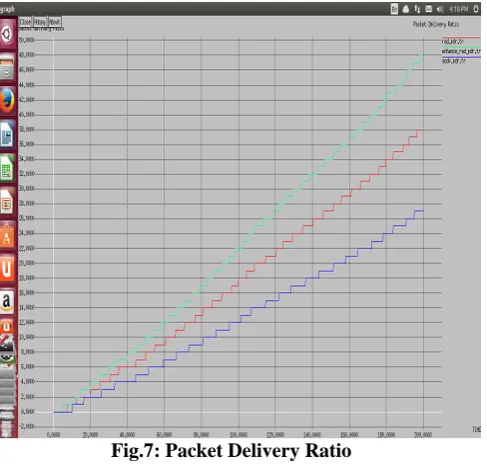
Fig.7: Packet Delivery Ratio
Fig.8:Energy Consumption
In fig.8 the graph represents energy consumption ratio for three protocols out of which blue arc is used for AODV, Red arc is used for RAD and green arc is used for enhanced_RAD. Minimum the value of energy consumption better the performance of the system so according to graph result enhanced RAD gives better result.
CONCLUSION
In this work RADNET protocol is enhanced using RED algorithm in NS-2 simulation tool .The RADNET protocol is the format of the data contained within a UDP data-gram and number of nodes taken for scenario generation is 50. The existing RADNET protocol has network congestion problems. For this reason enhancement in the RADNET protocol has been done by implementing RED algorithm in RADNET. Hence for different performance parameters, the enhanced RADNET protocol is compared with traditional RADNET and AODV protocol. Some parameters are taken to improve performance and those parameters are packet loss ratio, bandwidth, packet delay, packet delivery ratio and energy consumption. These parameters are shown by graphs and comparison is done with AODV and traditional RADNET which conclude that enhanced RADNET gives better results than AODV.NS2 based simulation has confirmed the advantages of enhanced RADNET and improvement in packet delivery ratio ,packet delay, packet loss ratio, bandwidth and energy consumption over traditional RADNET. Simulation results depict that enhanced RADNET protocol helps to improve the overall performance of the MANET by decreasing network congestion & channel contention.
REFERENCES
[1] Avdesh Kumar Bhatt, Chander Mohini and Shikha Thakur, “ A New Efficient and Reliable On-Demand Routing Protocol for MANET (ERORPM)” ,Volume 3,May 2013.
[2] Capt. Dr. S. Santhosh Baboo and Mr. V J Chakravarthy, “An Improvement In Congestion Control Using Multipath Routing In MANET – Right Angled And Ant Search Protocol (RAAA)”, Volume 2, May 2013.
[3] Charles E.Perkins and Elizabeth M. Royer, “ Ad hoc on demand distance vector (AODV) routing (Internet-Draft)”, Aug, 1998. [4] Dhirendra Kumar Sharma, Sanjay Kumar Biswash, Chiranjeev
Kumar, “Enhancement of Split Multipath Routing Protocol in MANET” , Vol. 02,2010.
[5] Humayun Bakht,“Computing Unplugged, Wireless
infrastructure, Some Applications of Mobile ad hoc networks”, Apr,2003.
[6] Jaya Jacob, V.Seethalakshmi, “Performance Analysis and Enhancement of Routing Protocol in Manet”, Volume 2, Mar-Apr, 2012.
[7] Jeetendra Kumar Patel, Jigyasu Dubey, “Mobile Ad hoc
Network Performance Improvement Using Strategical RED”, 20-22 Sept., 2012.
[8] Loutfi, Valerie, Bruno, “Securing mobile adhoc networks”, 2003.
[9] M.Chandrika, N.Papanna, “A Survey on Reactive Protocols in Mobile Ad Hoc Networks”, Jan, 2013.
[10] Mario Joa-Ng, “A Peer-to-Peer Zone-Based Two-Level Link State Routing for Mobile Ad Hoc Networks”, Vol. 17, No. 8, Aug,1999.
[11] N.Enneya, K.Oudidi, M. Elkoutbi, “Enhancing Delay in MANET Using OLSR Protocol”, 2009.
[12] Padmini Misra, “Routing Protocols for ad hoc mobile wireless Networks”, Nov, 1999.
[13] Parihar, “Wireless Ad-Hoc and Sensor Networks: Tcp
Enhancement (TCP-MANET) For Wireless Ad-Hoc Networks and Data Dissemination Protocol (Spin-G) In Wireless Sensor Networks”, 2013.
[14] Patil V.P, “Efficient AODV Routing Protocol for MANET with enhanced packet delivery ratio and minimized end to end delay”, Volume 2, August 2012.
[15] Rakesh Kumar, Manoj Misra, and Anil K. Sarje, “A Simplified Analytical Model for End-To-End Delay Analysis in MANET”, 2010.
[16] Renato C. Dutra, “Interest-Centric Mobile Ad Hoc Networks”, 23-25 Aug., 2012.
[17] S. Sridhar and R. Baskaran, “A Survey on QoS Based Routing Protocols for MANET”, Volume 8– No.3, Oct, 2010.
[18] Sally Floyd, Ramakrishna Gummadi, and Scott Shenker,
“Adaptive RED: An Algorithm for Increasing the Robustness of RED’s Active Queue Management”, 2001.
[19] W. Arshad, N. Javaid, R. D. Khan, M. Ilahi, U. Qasim, Z. A. Khan, “Modeling and Simulating Network Connectivity in Routing Protocols for MANETs and VANETs'', 2013.