Cloud Computing In Retail Organization
Navya Somesh
& A Thyagaraja Murthy
1 M.Tech, Department of Electronics & Communication Engineering, Sri Jayachamarajendra College of Engineering(SJCE), JSS
S&T University Campus, Mysore, Karnataka, India
2Assistant Professor, Department of Electronics & Communication Engineering, Sri Jayachamarajendra College of
Engineering(SJCE), JSS S&T University Campus, Mysore, Karnataka, India
Abstract—
Cloud computing is a novel
approach which is practicing by many industries
in the world, specifically the small and medium
scale industries. It has become a talk of the town
in computing industry and in business. Its gaining
popularity can provide a lot of opportunities for
the retailing industry to improve their business.
This paper discusses the concept of cloud
computing and its importance in retailing
industry. Application of cloud computing in retail
sector and comparison between traditional
retailing and cloud computing retailing are also
discussed. Both small and large retailers may be
benefited by using cloud computing in cutting
costs, segmenting, targeting and positioning the
products in the market, and build and maintain
relationships with customers in lesser time.
Keywords— Cloud Computing, Retail Service Model, Deployment Model, Retailing Industry, Cloud Computing process
I. INTRODUCTION
This paper focuses on cloud computing on retail. Cloud computing is an emerging technology and a buzz word in the distributed computing world which allows using the software and hardware on demand over the Internet. Cloud computing is based on “pay per use” billing model i.e., the consumer companies access the cloud computing services and infrastructure on need and pay per use much like as we pay and use services like water, electricity etc. on need. Cloud computing is a method for facilitating suitable permission to use collective group of organized computing assets like networks, servers, storage, applications and services which can be quickly reserved and freed up as and when required by user and without spending too much time or working hard for it. Cloud computing technology focuses on an idea more specific to use of computing capabilities without any other investment in infrastructure, trained staff or licenses (Robu, 2011).
Retailing Industry is where the products are sold to the ultimate consumer who buys them for personal use but not for making profits. They buy wholesale products in bulk from wholesalers including suppliers and distributors, and add their margin before selling it to consumers. They have good product knowledge and provide advice and customer service to consumers. Moreover, they target the consumers based on their age, location and requirement and update the products supply according to the consumers’ interest.
II. CLOUD COMPUTING
delivery of computing as a service rather than a product, whereby shared resources, software, and information are provided to computing devices as a rented service over the Internet (Shufeng Gao, Ai Xu, 2012). Furthermore, Buyya et al. (2008) defined as "a cloud is a type of parallel and distributed system consisting of a collection of interconnected and virtualized computers that are dynamically provisioned and presented as one or more unified computing resources based on service-level agreements established through negotiation between the service provider and consumers”. Their definition of Cloud Computing overlaps with many existing technologies, such as Grid Computing, Utility Computing, Services Computing, and distributed computing in general. Cloud computing can be defined as a mechanism for providing a bunch of shared computing resources like dynamic networked servers, storage, software and services on lease over the Internet.
III. HOW CAN THE CLOUD TRANSFORM TODAY’S RETAIL ORGANIZATION?
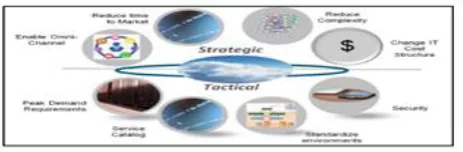
Adaptability – Businesses can scale to meet their
in the past. This is key to rolling out capabilities such Omni-Channel Experience, Digital Customer Data Management, etc
Security – Many retail IT departments struggle with rogue non-IT employee behavior. As an example, consider a set of servers sitting in an insecure “server room” or closet in a remote location. Such issues seem to proliferate across many retailers – large and small. In addition, some spectacular data breaches at large retailers have put this issue front and center in corporate boardrooms. In many instances, these breaches were enabled by insecure devices of suppliers connected to the retailer’s network. While these retail organizations had secured their own networks and devices, they had been unable to enforce the same rigor on to their suppliers.
IT Cost and Simplicity - Using cloud technology reduces many hidden costs and fees. No more servers, software, and maintenance fees. Many of the costs typically associated with software implementation and updates, customization/extension, hardware and training are bundled into a simple subscription fee that retailers can account for under operating expenses. Moreover, the back-office complexities can be moved to the Cloud simplifying operations, retiring legacy systems, and avoiding costly upgrades and customizations. This all results in operations that are much nimbler.
Figure 1 Benefit for cloud to retail organization
Hardware Infrastructure – Organizations have to spend a lot of budget on human capital required to manage IT infrastructure. With cloud computing, retail IT can instead focus on how IT solutions will help business to deliver against the organizational mission; the infrastructure and software pieces belong to someone else.
Open & Standards Based – Internet standards and web services allow retail organizations to connect services to each other. This means that companies can centralize their information and access it from anywhere in the world, on any computer or mobile device, at any time. This is key for enablement of a 360-degree customer view and for taking on challenges such as Mobile and
social that requires robust integration and data management capabilities
IV. CHARACTERISTICS OF CLOUD COMPUTING
The NIST (The National Institute of Standards and Technology) definition of cloud computing [4] includes the five essential characteristics of cloud computing: on demand self-service, broad network access, resource pooling, rapid elasticity and measured service.
On-Demand Self-Service: Using a simple computing internet connected device and with a web browser installed, customers can access the additional computing resources anytime and from anywhere at their own convenience without any human interaction with the cloud provider.
Broad Network Access: Customers have broader capabilities over the network and can be accessed using heterogeneous thick and thin multiple platforms. (e.g., Mobile phones, laptops, and workstations).
Resource Pooling: Using multi-tenanted computing model, the cloud computing service provider’s resources are pooled to serve the multiple customers, which can be dynamically allocated and reallocated according to the customer demand. This makes the computing resources invisible to customers, who have no idea of location and originality of the resources (storage, processing etc.). For example, consumers are not able to tell where their data is going to be stored in the cloud.
Rapid Elasticity: Cloud computing enables computing resources or user accounts to be rapidly and elastically provisioned or released so that customers can scale their systems (and costs) up and down at any time according to their changing requirements.
Measured Service: Cloud computing providers automatically monitor and optimize the resources by leveraging a metering capability (typically done on a pay per-use) at some level of abstraction appropriate to the types of services.
V. CLOUD COMPUTING DEPLOYMENT
MODELS
Private Cloud: In this model the cloud infrastructure is provided to a single organization or a third party, or both exclusively and it may exist on premises (local) or off premises (remote). The main advantage of private cloud is that it is easier to manage security, maintenance and upgrades and also provides more control over the deployment and use (Jadeja and Modi, 2012).
Community Cloud: The cloud infrastructure is provided to a group of organizations that have shared concerns (e.g., mission, security requirements, policy, and compliance considerations) for exclusive use. It may be operated by one or more of the organizations in the community, a third party and it may exist on or off premises.
Public Cloud: The cloud infrastructure is provided to the general public. It may be owned, managed, and operated by the cloud provider and it exists on the premises of the cloud provider. It helps in cutting costs and is less secure compared to other cloud models as all the applications and data on the public cloud are more prone to malicious attacks (Jadeja and Modi, 2012).
Hybrid Cloud: The cloud infrastructure is a composition of two or more distinct cloud infrastructures (private, community, or public) that remain unique entities, but are bound together by standardized or proprietary technology that enables data and application portability (e.g., cloud bursting for load balancing between clouds).
VI. PROS AND CONS OF CLOUD
COMPUTING
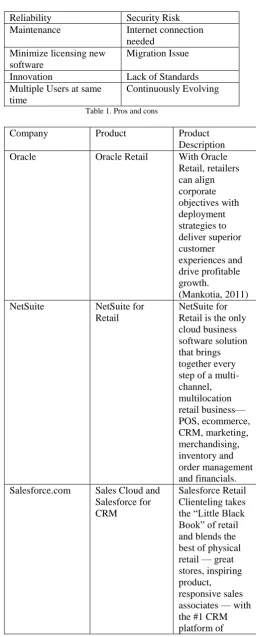
After the global financial crisis in 2010, business organizations everywhere are looking for strategies to cut costs. At these critical times, cloud computing played an important role for the businesses in cutting costs. Retailing industry can also benefit from cloud computing in cutting costs. According to Vaidya & Gaur (2013), a shift towards cloud computing can provide a lot of benefits to retailers and would take the retailers to a higher and better level. In addition, retailers should evaluate cloud computing as a viable solution for reducing operating costs, simplifying business processes and collaborating more easily with partners and suppliers. Azam et al. (2013) have identified that cloud computing is beneficial to midsize and large size companies but not for smaller businesses. Table 1 presents the advantages and disadvantages of cloud computing.
Advantages Disadvantages
Cutting costs Lack of Control Dynamic Scalability Dependency
Reliability Security Risk
Maintenance Internet connection needed
Minimize licensing new software
Migration Issue
Innovation Lack of Standards
Multiple Users at same time
Continuously Evolving
Table 1. Pros and cons
Company Product Product
Description
Oracle Oracle Retail With Oracle
Retail, retailers can align corporate objectives with deployment strategies to deliver superior customer experiences and drive profitable growth.
(Mankotia, 2011) NetSuite NetSuite for
Retail
NetSuite for Retail is the only cloud business software solution that brings together every step of a multi-channel, multilocation retail business— POS, ecommerce, CRM, marketing, merchandising, inventory and order management and financials. Salesforce.com Sales Cloud and
Salesforce for CRM
Salesforce. The boundaries between physical and digital retailing have disappeared. With Retail Clienteling, retailers can bring a whole new level of personalization to the shopping journey.
Table 2. company and their retail product
VII. LITERATURE SURVEY
Cloud Computing Survey Results 2013
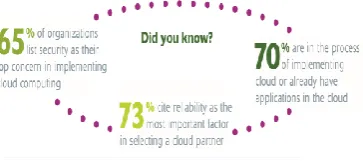
There is no one-size-fits-all version of cloud technology when it comes to real-world applications. That’s why we view cloud computing technologies as raw materials that you can combine in multiple ways to achieve the desired business outcomes[4] Like many IT professionals, many organization may want to offer the option of cloud computing. But where do you start? Begin your journey to the cloud by learning how organizations like yours embrace this revolutionary technology.
Figure 2(a). Survey
We expect widespread cloud adoption in the retail industry, with the industry’s cloud market tripling from $4.2 billion in 2011 to an estimated $15.1 billion in 2015.
Figure 2(b). Survey in yearly
VIII. CHALLENGES IN CLOUD IMPLEMENTATIONS
The latest innovations in cloud computing are making retail applications even more mobile and collaborative. Still, with cloud models and implementations constantly evolving, a smooth transition for the retail industry entails a thorough understanding of the benefits as well as challenges involved. Like any new technology, the adoption of cloud computing is not free from issues. Some of the most important challenges are as follows.
Security and Privacy
One of the challenges to cloud computing is how security and privacy will be handled. The fact that valuable enterprise data will reside outside the corporate firewall raises serious concerns - especially in some industries such as Finance and Healthcare – but also Retail. This is one of the reasons organizations may be compelled to keep part of the data in-house or on a private cloud.
Service Delivery and Billing
It is sometimes difficult to assess the costs involved due to the on-demand nature of Cloud services. Budgeting and assessment of the cost could be very difficult unless the provider has comparable benchmarks to offer. The servicelevel agreements (SLAs) of the provider are not adequate to guarantee the availability and scalability.
Figure 3. Challenge to adopt market
Interoperability and Portability
Retail organizations should have the leverage of migrating in and out of the cloud and switching providers whenever they want, and there should be no lock-in period. Cloud computing services should have the capability to integrate smoothly with the on-premises retail IT.
Cloud providers still lack round-the-clock service; this results in frequent outages. It is important to monitor the service being provided using internal or third-party tools. It is vital to have plans to supervise usage, SLAs, performance, robustness, and business dependency of these services.
Performance and Bandwidth
Cost Businesses can save money on hardware but they have to spend more for the bandwidth. This can be a low cost for smaller applications but can be significantly high for the data-intensive applications. Delivering intensive and complex data over the network requires sufficient bandwidth. Because of this, many businesses are waiting for a reduced cost before switching to the cloud.
Cloud Maturity
Cloud providers are still maturing and rolling out services at a brisk pace. While some services have substantially matured, others have a way to go. Organizations may find that some functions or LOBs are very well suited to public cloud while others need to keep systems and data in-house due to security, performance or maturity concerns. Such in-house systems might best be suited for private cloud implementations.
IX. HOW CLOUD TECHNOLOGY IS REVOLUTIONIZING THE RETAIL
INDUSTRY
Many industries are seeing benefits from cloud computing, but it stands to make a huge impact in retail. According to eBay Enterprise, online retailers expect to increase their revenue by 17 percent this 2015.Those in the retail industries as well as other small businesses are seeing a huge potential with cloud technology and most are actually using it to their advantage. Also, a British online fashion retailer, uses cloud technology to expand its services in the international arena. Other companies such as Specsavers and Amazon also used the cloud in similar manner. With companies seeing how cloud computing can reduce the IT costs in managing existing as well as integrating new systems, here are four other ways the cloud-based technology is poised to revolutionize the retail industry.
Interacting With Consumers Becomes Easier
Imagine a life when you are out shopping and you don’t have to go into the dressing rooms just to check if the clothing fits you, because the clerk is equipped with a mobile device that confirms if the size and style of that clothing is right for you.
Cloud Aids in the Supply Chain Process
A top producer of food products in U.S. improved its supply chain operating platform with the help of cloud-based technology services. If retailers see supply chain as a crucial area of focus, investing in a cloud collaboration platform that's specifically geared towards retailers could be of great benefit.
Developing Products in the Cloud is Cost Effective
With low-cost development tools required in implementing cloud technology (as well as maintenance), retailers can use it to reduce spending. Pete Marsden, Chief Information Officer of Asos, said the company does not have to keep buying new equipment because of the use of cloud technologies. Moving to cloud technology also allows retailers to save money on server maintenance. Given that retailers have some of the lowest budgets among all industries, they can use that budget for other things, such as opening a new store, taking on more employees and paying attention to the business itself.
Communication Between Departments Becomes Easier
Success goals in retail become less complicated and achievable with the help of cloud based technology. Cloud-based technology gives retailers access to industry-leading inventory processes and makes things less sophisticated for both the enterprise managers and staff. Technology allows people to have a say in the decision-making, according to Cheryl Millington, the chief information officer of Waitrose. As cloud technology empowers the staff and make their lives a bit easier, more productive days are surely on the way.
X. WHAT RETAILERS AND THEIR CUSTOMERS ARE DOING TODAY
Customers use cloud-based social tools toshop on their own terms
Many cloud-based tools are available to help
retailers allow customers to shop on their
terms, through the channels they choose and
with the information they control.
significantly more on average than other
online shoppers.
Retailers are using cloudbased tools to engage customers.Case in point: Burberry’s implementation of
Burberry Chat on Salesforce’s Chatter
platform. Sales teams had noticed that
large-framed male customers were dissatisfied with
one of the retailer’s suits. This news was
passed quickly through Chatter to the design
team, which made quick alterations to the
product.24 Another example of a retailer
adopting cloudbased technology to engage
customers is Walmart. Early in 2012, Walmart
launched its Get on the Shelf contest, allowing
anyone in the U.S. to submit online video
pitches for an invention or a request for
Walmart to carry a new product. The winners,
selected by the public, were to be invited to
sell their products on Walmart.com[a]
E-commerce portals are improving on the cloud.
Witness
Nambé,26
a
purveyor
of
artistdesigned kitchenware and diningware,
which transitioned to a cloud-based,
software-as-a-service ecommerce portal. Now the
company pays only for what they use
on-demand.27 Control of the system is now in the
hands of the marketers and merchants. Even
without the IT department’s help, they can
retrieve transactional data easily. At least
initially, Tesco launched its F&F clothing
brand online by sourcing its e-commerce site
from a cloud provider. This approach allowed
the supermarket chain to launch the brand
quickly and in multiple geographies; however,
the platform may very well migrate in-house,
given the desire of larger retailers to own and
control.
Hybrid Cloud for the Retail Hybrid Enterprise
Retail enterprises are constantly seeking to optimize how physical stores and e-Commerce work together. With the rapid growth of online sales, many have
predicted the decline or end of the traditional store model. Does this mean retailer should close shop and focus all their energies to e-Commerce? Not yet. Instead, many retailers are retooling their strategies to bring together the advantages of their brick-and-mortar business and the online shopping experience – in other words, Retail Hybrid Enterprise. Customers appreciate the convenience and speed of online shopping. On the other hand, they still like talking in person to a salesperson and they still want to kick the tires for potential purchases, especially for big ticket items. The advantages of one model are the shortcomings of the other. Consequently, many retailers with an existing base of physical stores are rolling out true Buy Online & Pick-Up in Store (BOPUS).
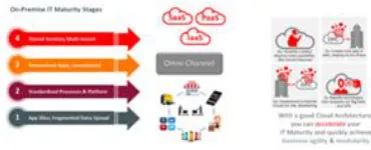
Similarly, in the world of IT, Hybrid Cloud pulls together the advantages of private cloud and public cloud models for the
Figure 4. Rapid IT Maturity model
Retail Hybrid Enterprise. The IT world largely recognizes IT Maturity by stages where an enterprise moves from Stage.
XI. CONCLUSION
Apart from technology, scores of retail organizations are struggling to implement new systems due to limited IT skill sets and rigid change management processes. This is the prime reason organizations should take a closer look at Hybrid Cloud. A hybrid cloud strategy will help to enable new capabilities quickly while at the same time allowing for protection and preservation of core data and applications, on-premises. With new and innovative public cloud services built on the latest technology and architecture, maturity is instantly enhanced and integration with on premises applications and data is made straight-forward. Considering one or more of the following hybrid cloud patterns to deliver new capabilities to stakeholders.
XII. THE FUTURE OF CLOUD COMPUTING IN RETAIL
cloud in retail. As our recent seamless retail survey showed, customers want the same products, pricing and promotions in store and online. They expect to be recognized for their loyalty and receive personalized offers regularly. And they want a seamless rather than a channel-specific experience of the brand.
We see large retailers embracing this concept — witness Walmart’s interest in “winning in ecommerce by giving customers a seamless shopping experience through mobile and online” and Target’s search “for a broad, seamless experience across all retail formats.” So far, retailers have focused on the easier capabilities. Now it is time to use cloud computing to tackle the harder work. Building these seamless capabilities will lead to collaboration across retailers and with existing and emerging third parties. We believe, one reason for this trend is that retailers will change their understanding of what differentiates them in the marketplace; as technology infrastructure becomes a service, retailers will develop best practices as collaborators, such as is happening in the pharmaceutical industry.
Further, we believe that efficient innovators will win the seamless game. The pace of change will not slow down. Consumers will continue to be quick to change their priorities and therefore their expectations of retailer capabilities. The cloud gives retailers the easily scalable resources they need to innovate using a consumption based model — and provides resource bandwidth, as employees are freed from tasks moved to the cloud.
References
[1] Arun, BalaGopalan,. The Future of Retail Industry is in Cloud
Computing, Jul 2010 (Retrieved on Aug 23, 2014 http://ezinearticles.com/?The-Future-of-Retail-Industry-is-in-CloudComputing&id=4618226).
[2] A New Era for Retail: Cloud Computing Changes the Game,
(Retrieved on Nov 30, 2014
http://www.accenture.com/SiteCollectionDocuments/PDF/Acce nture -A-New-Era-For-Retail.pdf)
[3] Types of Retailers (Retrieved on Sep 30, 2014
http://www.thereseller-network.com/content/88/types-of-retailers/)
[4] Oracle Retail – World Class Commerce Solutions, (Retrieved on
Dec 14, 2014 https://www.oracle.com/industries/retail/)
[5] NetSuite for Retail (Retrieved on Dec 14, 2014
http://www.netsuite.com/portal/common/pdf/ds-retail.pdf)
[6] Retail Clienteling: The Store Re-personalized (Retrieved Dec
14, 2014: http://www.salesforce.com/industries/retail/)
[7] Survey on cloud computing
http://www.pcconnection.com/it-services/cloud-practice 25240_PCC_CloudSurvey.pdf
[8] “Walmart’s ‘Get on the Shelf’ Contest Draws Over a Quarter
Million Votes,” Walmart press release, March 12, 2012, http://www.walmartstores.com/ pressroom/news/10839.aspx
[9] www.fastretailing.com
[10] https://squareup.com
Retail Information Systems, Next Steps for Cloud Retailing, May 2012.
[11] Retail Information Systems, Optimizing POS for the 21st
Century, August 2012.
[12] Economist Intelligence Unit, Retail 2022: “How the Economist
Intelligence Unit sees the retail landscape changing over the next decade,” 2012.
[13] Retail Information Systems (RIS), Next Steps for Cloud
Retailing, May 2012.
[14] Fujitsu, “Transforming Retail with the Power of Cloud,” 2012.
[15] www.magentocommerce.com
[16] http://www.dell.com/us/corp/p/d/
secure/2013-01-10-dell-cloud-retailsolutions
[17] Retail Information Systems, Next Steps for Cloud Retailing, May
2012.
[18] Gartner, Hype Cycle for Retail Technologies 2012. By Gale