University of South Carolina
Scholar Commons
Theses and Dissertations
2017
Glacial to Holocene Changes in Eastern Equatorial
Pacific Deep-Water Chemistry and Circulation
Natalie E. UmlingUniversity of South Carolina
Follow this and additional works at:https://scholarcommons.sc.edu/etd
Part of theGeology Commons
This Open Access Dissertation is brought to you by Scholar Commons. It has been accepted for inclusion in Theses and Dissertations by an authorized administrator of Scholar Commons. For more information, please [email protected].
Recommended Citation
GLACIAL TO HOLOCENE CHANGES IN EASTERN EQUATORIAL PACIFIC DEEP-WATER CHEMISTRY AND CIRCULATION
By
Natalie E. Umling
Bachelor of Arts
University of North Carolina at Wilmington, 2013
Submitted in Partial Fulfillment of the Requirements
For the Degree of Doctor of Philosophy in
Geological Sciences
College of Arts and Sciences
University of South Carolina
2017
Accepted by:
Robert Thunell, Major Professor
Howie Scher, Committee Member
Michael Bizimis, Committee Member
Lori Ziolkowski, Committee Member
Ryan Rykaczewski, Committee Member
©Copyright by Natalie E. Umling 2017
ACKNOWLEDGEMENTS
I am immensely thankful to the support of my advisor Bob Thunell. He gave me
the freedom to choose the direction of my research and to develop my own research
interests while also providing me with the guidance and confidence to succeed with that
research. The opportunities I have had as his student have been incredible and will likely
forever shape the scientist I am and become. His high regard for correct usage of the
English language has made me a far better writer than when I began my PhD. And
luckily, we are both fans of the Oxford comma! I would also like to thank the members of
my dissertation committee, who not only had insightful comments and advice for the
preparation of my dissertation but also for my professional development as an early
career scientist. Their guidance along the way has truly made me a better scientist and
researcher. I don’t know how to begin to thank my lab-mate Emily, whose close
friendship and encouragement helped get me through grad school. I will be forever
grateful that our time in Columbia overlapped with one another. I am also grateful for the
irreplaceable lab support of Eric Tappa and many hours of help from Chris and Jess in the
Marine Sediments lab. And thank you for Beth, Wayne, Brian, and Emily for the many
hours of help in the CEMS lab. And finally, I would especially like to thank my family.
Although they understand little of what it is that I do, their support has always been
ABSTRACT
It has been hypothesized that the oceans store CO2 during glacial periods and then
release it to the atmosphere, causing the onset of warm interglacial periods (Sigman and
Boyle, 2000). Documenting this past transfer of CO2 between the oceans and atmosphere
is of utmost importance for better understanding the impact that anthropogenic CO2 has
and will have on Earth’s climate. The last deglaciation is a good analogue to modern
increases in CO2 and temperature and is recent enough to be studied using radiocarbon.
This period provides important insights into the nature of climate changes during the
transition from glacial to interglacial conditions. Specifically, this transition is punctuated
by brief periods of rapid return to cold, glacial-like conditions followed by abrupt
warmings that are synchronous with increases in atmospheric CO2 depleted in 14C
(Hughen et al., 2000; Monnin et al., 2001). This link between increasing atmospheric
CO2 and abrupt temperature rise during deglaciation has prompted the search for the
location of a suitably large 14C-depleted pool of respired carbon in the oceans that could
serve as the source for these large increases in atmospheric CO2. Changes in the
efficiency of the biological pump and in meridional overturning circulation have both
been cited as possible mechanisms of respired carbon storage. We seek to understand the
role of these mechanisms in the Eastern Equatorial Pacific (EEP) over the last 25,000
years using a combination of radiocarbon, trace element, and isotopic studies of
TABLE OF CONTENTS
ACKNOWLEDGEMENTS ... iii
ABSTRACT ... iv
LIST OF TABLES ... Vii LIST OF FIGURES ... iX LIST OF SYMBOLS ... Xi LIST OF ABBREVIATIONS ... Xii MOTIVATION ...1
CHAPTER 1: SYNCHRONOUS DEGLACIAL THERMOCLINE AND DEEP-WATER VENTILATION IN THE EASTERN EQUATORIAL PACIFIC ...6
1.1 ABSTRACT ...7
1.2 INTRODUCTION ...7
1.3 RESULTS ...10
1.4 DISCUSSION ...13
1.5 METHODS ...19
1.6 TABLES ...22
1.7 FIGURES ...23
CHAPTER 2: MID-DEPTH RESPIRED CARBON STORAGE AND OXYGENATION IN THE EEP OVER THE LAST 25,000 YEARS ...32
2.1 ABSTRACT ...33
2.3 SAMPLE MATERIAL AND OCEANOGRAPHIC SETTING ...36
2.4 METHODS ...37
2.5 RESULTS ...41
2.6 DISCUSSION ...44
2.7 CONCLUSIONS ... 5O 2.8 TABLES ...51
2.9 FIGURES ...52
CHAPTER 3: EVIDENCE FOR GLACIAL DEEP WATER EXPANSION AND ENHANCED REMINERALIZATION IN THE EASTERN EQUATORIAL PACIFIC ...61
3.1 ABSTRACT ...62
3.2 INTRODUCTION ...62
3.3 SAMPLE MATERIAL AND OCEANOGRAPHIC SETTING ...65
3.4 METHODS ...66
3.5 RESULTS ...69
3.6 DISCUSSION ...72
3.7 CONCLUSIONS ...77
3.8 TABLES ...80
3.9 FIGURES ...82
IMPLICATIONS AND FUTURE DIRECTIONS ...89
REFERENCES ...94
APPENDIX A: PERMISSION TO REPRINT ...110
APPENDIX B: CHAPTER 1 SUPPLEMENTARY INFORMATION ...111
APPENDIX C CHAPTER 2 SUPPLEMENTARY INFORMATION ...119
LIST
OF
TABLES
Table 1.1 Method of age model constraint for cited radiocarbon records ...22
Table 2.1 Core locations and depths ...51
Table 3.1 Eastern and western equatorial Pacific core locations, depths, and references .80 Table 3.2 Pearson correlation coefficients of bulk planktonic authigenic Mn and Cd ...81
Table B.1 Benthic and planktonic radiocarbon data from TR163-23 ...112
Table B.2 Age model constructed using a constant reservoir age ...113
Table B.3 Tie point constraint of TR163-23 independent age models ...114
Table B.4 TR163-23 oxygen isotope tuned age models ...115
Table B.5 Radiocarbon plateau tuned age models ...116
Table B.6 Estimates of TR163-23 Δ14C0, Δ14C0-atm, using the Hulu-tuned age model ....117
Table C.1 TR163 planktonic radiocarbon ages ...120
Table C.2 Reservoir ages used for radiocarbon age calibration ...121
Table C.3 Published data references and core locations ...122
Table C.4 C. wuellerstorfi carbon isotopes for TR163-23 ...123
Table C.5 Uvigerina spp. carbon isotopes for TR163-23 ...124
Table C.6 Globobulimina spp. and C. oolina carbon isotopes for TR163-23 ...125
Table C.7 Benthic carbon isotope difference and [O2] estimates ...126
Table C.8 N. dutertrei authigenic uranium estimates for TR163-25 ...127
Table C.10 N. dutertrei authigenic uranium estimates for TR163-20B ...129
Table C.11 TR163-14 and TR163-20B Bulk planktonic authigenic uranium estimates .130 Table C.12 Trace element data for TR163-2, TR163-14, and TR163-20B ...131
Table C.13 Trace element data for TR163-25 ...132
Table C.14 Trace element data for TR163-23 ...133
Table C.15 Trace element data for TR163-20B ...134
Table C.16 Eastern equatorial Pacific profiles of carbonate ion concentration ...135
Table D.1 Age models for TR163-2, TR163-18, TR163-14 ...139
Table D.2 Age model for TR163-25 ...140
Table D.3 Age model for TR163-20B ...141
Table D.4 Benthic carbon isotopes for TR163-25 ...142
Table D.5 Benthic carbon isotopes for TR163-20B ...143
Table D.6 Benthic Cd/Ca and CdW for TR163-2 ...144
Table D.7 Benthic Cd/Ca and CdW for TR163-18 and TR163-14 ...145
Table D.8 Benthic Cd/Ca and CdW for TR163-25 0-90 cm ...146
Table D.9 Benthic Cd/Ca and CdW for TR163-25 92.5-200.5 cm ...147
Table D.10 Benthic Cd/Ca and CdW for TR163-23 ...148
Table D.11 Benthic Cd/Ca and CdW for TR163-20B ...149
LIST OF FIGURES
Figure 1.1 Atmospheric CO2 and temperature changes across the last deglaciation ...23
Figure 1.2 Core locations and study area ...24
Figure 1.3 Construction of TR163-23 tuned chronologies ...25
Figure 1.4 Comparison of age model techniques ...27
Figure 1.5 Radiocarbon records for TR163-23 ...28
Figure 1.6 Foraminifera radiocarbon offsets from the atmosphere over the last 25,000 years ...29
Figure 1.7 Interocean comparison of shallow and deep water ventilation ...30
Figure 1.8 Inter-ocean synchronicity of the 14.8 ka ventilation event ...31
Figure 2.1 Antarctic records of atmospheric CO2 and temperature ...52
Figure 2.2 Core locations and depths ...53
Figure 2.3 Radiocarbon ages for each core ...54
Figure 2.4 Benthic carbon isotopes and estimated oxygen content ...55
Figure 2.5 Deglacial authigenic uranium ...56
Figure 2.6 Carbonate saturation and B/Ca for TR163 cores ...57
Figure 2.7 Comparison of TR163-23 proxies for ventilation, carbonate saturation, and oxygenation ...58
Figure 2.8 Compilation of regional carbonate ion records ...59
Figure 2.9 Depth profiles of carbonate ion concentrations ...60
Figure 3.2 Benthic foraminiferal carbon isotopes over the last deglaciation ...83
Figure 3.3 Seawater CdW over the last deglaciation ...84
Figure 3.4 Holocene and Last Glacial Maximum CdW profiles ...85
Figure 3.5 The PAAS-normalized distribution of rare earth elements ...86
Figure 3.6 Estimated cerium anomalies over the last deglaciation ...87
Figure 3.7 Down-core foraminiferal CdW values versus δ13C ...88
Figure B.1 TR163-23 G. ruber oxygen isotopes and conventional radiocarbon ages from benthic and planktonic foraminifera plotted versus core depth ...118
Figure C.1 Box and Whisker plots of trace element ratios to calcium ...136
Figure C.2 Trace element cleaning comparison ...137
LIST OF SYMBOLS
‰... Per mil
µ ... micro (10-6)
Ce/Ce* ... Cerium anomaly
D ... Distribution coefficient
Δ14C ... Measured radiocarbon content
Δ14C0 ... Initial radiocarbon content
Δ14C0-atm ... Radiocarbon offset from the atmosphere
δ18C ... Oxygen isotopic composition
δ13C ... Carbon isotopic composition
δ13Cas ... The air-sea component of δ13C!
Δδ13C ... Foraminiferal infaunal-epifuanal carbon isotope difference
[CO32-] ... Carbonate ion concentration
[CO32-]sat ... Carbonate ion concentration at calcite saturation
Δ[CO32-] ... Degree of carbonate saturation
LIST OF ABBREVIATIONS
ACC ... Antarctic Circumpolar Current
Al/Ca ... Aluminum to Calcium ratio
AMOC ... Atlantic Meridional Overturning Circulation
AMS ... Accelerator Mass Spectrometry
BA ... Bølling Allerød
B/Ca ... Boron to Calcium ratio
B-P ... Benthic-Planktonic offset
Cd/Ca ... Cadmium to Calcium ratio
CdS ... Cadmium sulfide
CEP ... Central Equatorial Pacific
C. oolina ... Chilostomella oolina
C. wuellerstorfi ... Cibicidoides wuellerstorfi
EEP ... Eastern Equatorial Pacific
EqPIW ... Equatorial Pacific Intermediate Water
ETP ... Elastic Tie-Pointing
EUC... Equatorial Undercurrent
Fe/Ca ... Iron to Calcium ratio
GICC05 ... Greenland Ice Core Chronology 05
GLODAP ... Global Data Analysis Project
HS1 ... Heinrich Stadial 1
ICP-MS ... Inductively coupled plasma mass spectrometry
ka ... Thousands of years ago
km ... kilometers
kyr ... Thousands of years
LCDW ... Lower Circumpolar Deep Water
LGM ... Last Glacial Maximum
m ... meters
mg ... miligram
Mg/Ca ... Magnesium to Calcium ratio
mol kg-1 ... mol per kilogram
mmol mol-1 ... 10-3 mol per mol
Mn/Ca ... Manganese to Calcium ratio
NADW ... North Atlantic Deep Water
N. dutertrei ... Neogloboquadrina dutertrei
nmol kg-1 ... 10-9 mol per kilogram
NPDW ... North Pacific Deep Water
PAAS ... Post-Archaean Australian Shale
PDW ... Pacific Deep Water
ppm ... parts per million
REE ... Rare Earth Element
R/V ... Research Vessel
spp ... Species (plural)
SST ... Sea Surface Temperature
U/Ca ... Uranium to Calcium ratio
UCDW ... Upper Circumpolar Deep Water
U/Mn ... Uranium to Manganese ratio
µg ... microgram
µmol kg-1 ... 10-6 mol per kilogram
µmol mol-1 ... 10-6 mol per mol
WEP ... Western Equatorial Pacific
YD ... Younger Dryas
MOTIVATION
Carbon dioxide is the primary atmospheric gas associated with greenhouse
forcing, with concentrations of atmospheric CO2 playing a large role in setting Earth’s
thermostat (Lacis et al., 2010). The anthropogenic increase in atmospheric CO2 since the
onset of the industrial revolution is widely considered to be the primary driver of
changing climate conditions during the past two centuries (IPCC Report, 2014).
Similarly, greenhouse gas forcing has been shown to amplify the orbital cycles of the last
one million years, driving the transition between glacial and interglacial conditions
(Sigman and Boyle, 2000). It has been hypothesized that the oceans store CO2 during
glacial periods and then release it to the atmosphere, causing the onset of warm
interglacial periods (Sigman and Boyle, 2000). Documenting this past transfer of CO2
between the oceans and atmosphere is of utmost importance to understanding the role the
oceans play in modifying the natural variability of atmospheric CO2 during
glacial-interglacial cycles and to predict the role the oceans will play in an anthropogenically
driven high-CO2 world.
The overarching goal of my dissertation research is to better understand how the
oceans store carbon during glacial periods and then release this carbon to the atmosphere
during deglaciations. Specifically, my research focuses on the CO2 and temperature
increases of the last deglacial period (~20,000-10,000 years ago) as it is recent enough to
trace carbon sources using radiocarbon, and records for this period can be of sufficiently
several thousand years. This period provides important insights into the transition from
glacial to interglacial conditions and the mechanisms that may play a role during present
and future rapid climate change. Specifically, this transition is defined by gradually
increasing atmospheric CO2 overprinted by periods of rapid CO2 rise occurring over
several hundred years (Hughen et al., 2000; Marcott et al., 2014; Monnin et al., 2001). In
addition to increasing CO2, gradual decreases in atmospheric radiocarbon content have
been recorded over this same period. Radiocarbon is formed cosmogenically in the upper
levels of the atmosphere, and the production of radiocarbon varies through time
depending on the strength of Earth’s magnetic field and the number of cosmic rays hitting
Earth (Lal and Peters, 1967). However, the radiocarbon decreases during the last
deglaciation cannot be accounted for by changes in production alone (Hain et al., 2014),
suggesting the transfer of CO2 from a radiocarbon-depleted carbon reservoir. This has
prompted the search for the location of a suitably large 14C-depleted pool of carbon in the
oceans that could serve as the source for these large increases in atmospheric CO2, as the
deep ocean is the largest carbon reservoir to exchange with the atmosphere on hundred
and thousand year timescales (Holmen, 1992). While, both physical and biological
mechanisms have been suggested as possible drivers of oceanic CO2 storage and release,
there is little general agreement on the relative role of these mechanisms.
Many of the suggested physical drivers focus on changes in the rate and pathway
of oceanic circulation as mechanisms for the glacial-interglacial transfer of carbon
between the oceans and the atmosphere. Specifically, it was predicted that deep-water
production weakened during glacial periods resulting in the build-up of CO2 due to
atmosphere (Huang et al., 2014; Pahnke et al., 2008). The resumption of a vigorous
circulation during deglaciation would rapidly restore communication of isolated deep
waters with surface waters and the atmosphere, producing the observed periods of
depleted atmospheric 14C and increased CO2 (Keeling and Stephens, 2001; Broecker et
al., 2007; Matsumoto and Yokoyama, 2013; Ferrari et al., 2014). However, there has
been much disagreement about the feasibility of an isolated abyssal reservoir, with critics
suggesting that the required amount of respiration for this stagnant water-mass would
result in anoxic conditions (Hain et al., 2011). So far, little evidence of anoxic conditions
and decreased radiocarbon in abyssal-depth waters has been found (Broecker et al., 2004;
Jaccard and Galbraith, 2011; Lund, 2013; Rae et al., 2014; Ronge et al., 2016).
In light of these shortcomings, many researchers have focused instead on the
biological transfer of carbon from the surface ocean to the deep ocean and the overall
efficiency of this biological pump (Anderson et al., 2002; Boyle, 1988; Jaccard et al.,
2009; Martin, 1990; Matsumoto et al., 2002). Phytoplankton take up CO2 from the
surface ocean during photosynthesis and subsequently export CO2 to the deep ocean as
organic carbon rain. When the biological pump is inefficient, phytoplankton in the
surface ocean are not able to fully use the available nutrients leading to a greater amount
of unused, preformed nutrients and a missed opportunity to sequester CO2. It has been
hypothesized that increased atmospheric transport of iron due to glacial erosion and
increased aridity could have alleviated iron-limiting conditions in some areas during the
glacial period (Martin, 1990). This would have led to a more efficient biological pump
and increased CO2 drawdown. During deglaciation, biological pump efficiency may have
transfer to the deep ocean, allowing evasion of excess CO2 to the atmosphere. A flaw in
the hypothesized biological mechanisms of oceanic atmospheric CO2 exchange is that the
biological sequestration of atmospheric CO2 could at most have accounted for only half
of the observed glacial-interglacial atmospheric CO2 change, requiring a secondary
mechanism to account for the full CO2 change (Kohfeld et al., 2005).
The aim of my dissertation research was to document changes in past oceanic
chemistry and circulation in order to evaluate the proposed mechanisms for the
glacial-interglacial transfer of CO2 between the oceans and atmosphere. This was accomplished
by developing records of past ocean chemistry using the shells of single-celled protists
called foraminifera. As they build their calcite shells, the chemistry of the water in which
they live gets incorporated in those shells, and those shells are preserved in sediments
allowing us to perform a variety of geochemical analyses to constrain past seawater
chemistry. Chapter one of this study uses foraminiferal radiocarbon analyses to assess the
physical drivers of oceanic CO2 sequestration during the last glacial period and
subsequent deglacial evasion of this reservoir to the atmosphere. The biological
sequestration of CO2 is investigated in chapter two of this study to evaluate whether
changes in the efficiency of the biological pump may have played a role in glacial
atmospheric CO2 drawdown. This is accomplished by documenting changes in respired
carbon storage using foraminiferal stable isotope and trace element analyses of past
oceanic oxygenation and carbonate chemistry. Finally, the role of circulation in driving
changes in the biological pump and in ventilation is investigated in chapter three by
characterizing deep and mid-depth water-masses using paired stable isotope and trace
This study focuses on the eastern equatorial Pacific as this region is the largest
modern oceanic source of CO2 to the atmosphere (Pennington et al., 2006) making it
particularly well suited for investigating the transfer of CO2 between the oceans and the
atmosphere. In this region, CO2 is brought to the surface ocean by equatorial upwelling,
northward advection of cool, nutrient rich waters from the Peru current, and upwelling of
cold equatorial undercurrent waters off the Galapagos. This oceanic evasion of CO2 is
modified by the biological uptake of CO2 during photosynthesis, which works to stem
some of the CO2 leak to the atmosphere. Productivity in this region is spatially variable
and is limited in some areas by nitrate availability whereas other regions have excess
nitrate and are limited instead by micronutrients such as iron. Reductions in nutrient
CHAPTER 1
SYNCHRONOUS DEGLACIAL THERMOCLINE AND DEEP-WATER
VENTILATION IN THE EASTERN EQUATORIAL PACIFIC1
1 Umling, N.E., Thunell, R.C., 2017. Nature Communications. 8, 14203.
1.1
A
BSTRACTThe deep-ocean is most likely the primary source of the radiocarbon depleted CO2
released to the atmosphere during the last deglaciation. While there are well-documented
millennial-scale Δ14C changes during the most recent deglaciation, most marine records
lack the resolution needed to identify more rapid ventilation events. Furthermore,
potential age model problems with marine Δ14C records may obscure our understanding
of the phase relationship between inter-ocean ventilation changes. Here we reconstruct
changes in deep water and thermocline radiocarbon content over the last deglaciation in
the Eastern Equatorial Pacific (EEP) using benthic and planktonic foraminiferal 14C. Our
records demonstrate that ventilation of EEP thermocline and deep waters occurred
synchronously during the last deglaciation. Additionally, both gradual and rapid deglacial
radiocarbon changes in these Pacific records are coeval with changes in Atlantic records.
This in-phase behavior suggests that Southern Ocean overturning was the dominant
driver of changes in Atlantic and Pacific ventilation during deglaciation.
1.2
I
NTRODUCTIONAtmospheric CO2 plays an important role in setting Earth’s thermostat and
changes in atmospheric CO2 provide the feedback mechanism needed to amplify the
orbitally-driven Pleistocene glacial-interglacial climate cycles (Sigman and Boyle, 2000).
Documenting the transfer of CO2 between oceanic and atmospheric reservoirs is
paramount to understanding the relationship between CO2 and climate change.
Radiocarbon studies are uniquely suited for identifying the pathway and rate of CO2
exchange between the oceans and atmosphere by providing a tool for tracing carbon
is recent enough to be studied using radiocarbon and provides important insights into the
nature of climate transitions and the role of tipping points in predicting abrupt shifts in
the climate system (Lenton et al., 2012).
Antarctic ice core records spanning the last deglaciation reveal a tight coupling
between changes in atmospheric CO2 and temperature (Parrenin et al., 2013). In
particular, these records contain two millennial-scale episodes of increasing atmospheric
CO2 that are synchronous with decreases in atmospheric Δ14C (Hughen et al., 2000;
Monnin et al., 2001). The first is a large 170‰ drop in Δ14C and ~50 ppmv rise in CO2
occurring during late Heinrich Stadial 1 (HS1; ~17.5 to 14.7 ka), and the second is a
smaller Δ14C drop of 70‰ and ~30 ppmv rise in CO2 marking the end of the Younger
Dryas (YD; ~12.8 to 11.5 ka; Monnin et al., 2001; Hain et al., 2014; Figure 1.1). The
magnitudes of these events suggest that the intermediate and/or deep ocean must be the
primary source of this excess CO2 (Broecker and Barker, 2007), although identifying the
specific source region has proven difficult. There is evidence to suggest that the large
fluctuations in atmospheric CO2 are driven by changes in Southern Ocean meridional
overturning circulation (Watson and Naveira Garabato, 2006).
Previous studies from both intermediate and deep water locations yield conflicting
results regarding the magnitude and extent of the glacial carbon pool, as well as the
timing of deglacial ventilation events (Rae e al., 2014; Marchitto et al., 2007; Lindsay et
al., 2015; Burke and Robinson, 2012; Skinner et al., 2010; Thornalley et al., 2011;
Robinson et al., 2005; Chen et al., 2015; Skinner et al., 2014; de la Fuente et al., 2015;
Sikes et al., 2000; Broecker et al., 2008; De Pol-Holz et al., 2010; Siani et al., 2013;
al., 2016) , resulting in difficulty resolving both regional and inter-ocean ventilation
signals. These inconsistencies may be due, at least in part, to the age models used for the
different records. Traditionally, a constant reservoir age is used when calibrating
foraminiferal radiocarbon dates (Broecker et al., 2008, De Pol-Holz et al., 2010; Freeman
et al., 2015). However, variability in marine reservoir ages of at least several hundred
years have been documented for the Pacific since the last glacial maximum (LGM) from
dating of contemporaneous marine and terrestrial samples (Ortlieb et al., 2011), from
correlation of marine tephra layers to dated terrestrial eruptions (Siani et al., 2013), and
from paired U-Th and 14C dating of corals (Paterne et al., 2004). Additionally, reservoir
age variability of >800 years has been suggested from tuning of plateaus in atmospheric
14C (Sarnthein et al., 2015; Balmer et al., 2016), from several tephra-dated records (Sikes
et al., 2000; 2016), and from correlation of climatic events to age control points in
independently dated oxygen isotope records from the Hulu Cave speleothem or
Greenland and Antarctic ice cores (Skinner et al., 2010; 2014; 2015). Without
independent age control of radiocarbon-derived ventilation records, it is difficult to
quantify the actual magnitude of error introduced into initial foraminiferal radiocarbon
content (∆14C0) calculations from age model uncertainty (Cook and Keigwin, 2015).
Furthermore, age model uncertainties make it difficult to determine whether ventilation
events in different ocean basins occur synchronously or if there is an inter-ocean
ventilation seesaw associated with the waxing of North Pacific Deep Water (NPDW)
production when North Atlantic Deep Water (NADW) production waned (Freeman et al.,
Here we reconstruct surface and deep water mass radiocarbon contents in the
Eastern Equatorial Pacific (EEP) from sediment core TR163-23 (0°24’N, 92°09’W;
2,730 m water depth). This core site is located within the eastern equatorial cold tongue
region off the Galapagos platform, along the return pathway of Pacific Deep Water
(PDW; Figure 1.2). The Galapagos region presently is influenced by the upwelling of
nutrients and CO2 from the Equatorial Undercurrent (EUC) into thermocline depth waters
(Toggweiler et al., 1991). The southern hemisphere currently accounts for ~2/3 of the
source waters feeding the EUC with Sub-Antarctic Mode Water (SAMW) formed along
the northern edge of the Antarctic Circumpolar Current (ACC) contributing much of the
Δ14C signature (Toggweiler et al., 1991). Consequently, TR163-23 is ideally positioned
to record Southern Ocean-sourced ventilation of both thermocline and deep waters. We
develop a well constrained age model for TR163-23 that does not require a static
reservoir age and minimizes chronological uncertainty associated with the calculation of
past radiocarbon content. Our records demonstrate that EEP thermocline and deep water
ventilation occurred synchronously over the last 25,000 yrs. They also indicate that both
Atlantic and Pacific ventilation were sensitive to changes in Southern Ocean deep-water
formation consistent with a southern driver of deglacial climate change (Sigman and
Boyle, 2000; Keeling and Stephens, 2001; Watson et al., 2015).
1.3
R
ESULTS1.3.1 AGE MODEL DEVELOPMENT
To constrain age model uncertainty, three independent age models have
been developed for TR163-23 (Figure 1.3), along with an age model based on a constant
(Supplementary tables A.1 and A.2). Two of the age models were derived from the
tuning of a planktonic foraminiferal (Globigerinoides ruber) oxygen isotope record for
TR163-23 (Supplementary Fig. A.1) to the δ18O records from the GRIP Greenland ice
core (Figure 1.3a; Johnson et al., 1997; Rasmussen et al., 2014; Seierstad et al., 2014) and
the Hulu Cave speleothems(Wang et al., 2001; Wu et al., 2009; Southon et al., 2012;
Figure 1.3b). In addition, we used 14C plateau tuning of the N. dutertrei radiocarbon dates
following the procedure presented in Sarnthein et al. (2015; Figure 1.3c) to develop a
third independent age model. Reference record age estimates for the various tie points
(Supplementary Table A.3) were translated to TR163-23 using the elastic tie-point (ETP)
method (Heaton et al., 2013), and the final age models were developed using the
Bayesian age-depth modeling program BACON(Blaauw and Christen, 2011;
Supplementary Tables 4-5).
This method was chosen as it provides a computationally feasible way to quantify
uncertainty associated with the transfer of age-depth estimates from a reference
chronology. Tie-point constraint allows us to estimate reservoir age changes over the last
glacial-interglacial transition, and our sampling resolution of TR163-23 permits the
observation of sub-millennial scale ventilation events. Above all, this technique of age
model construction is not reliant upon the assumption of an unchanging reservoir age
throughout deglaciation and provides more realistic estimates of age-model uncertainty.
We did not have sufficient resolution during the Holocene to identify tie points, and as a
result this portion of the chronology was constructed using three calibrated (ΔR=147±13)
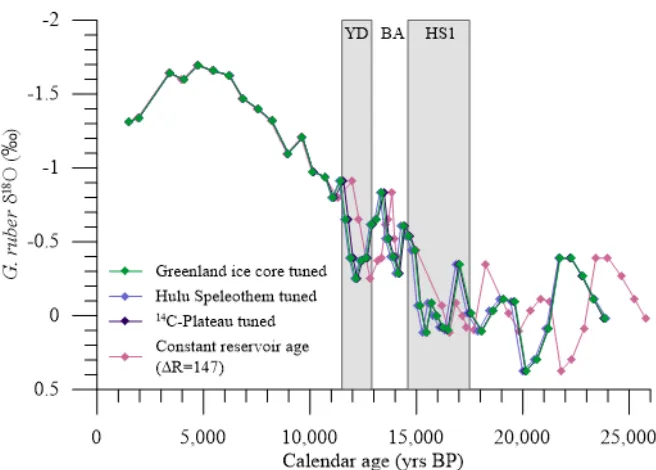
N. dutertrei calendar ages. All three of the independently developed age models yield
radiocarbon-based age model yields significantly different and generally older ages
(Figure 1.4). For the purpose of this study, we use the Hulu cave speleothem tuned age
model to interpret our results from the Galapagos. A more detailed description of the
procedures used to establish each of the four age models is presented in the Methods.
1.3.2 THERMOCLINE AND DEEP WATER VENTILATION
The deep and thermocline carbon pools were assessed through calculation of the
paleo-reservoir ages and the anomaly of the initial foraminiferal radiocarbon content
(!14C0) from the IntCal13 atmospheric record (Reimer et al., 2013), or Δ14C0-atm as
defined by Cook and Keigwin (2015). Contemporaneous atmosphere 14C and Δ14C values
were averaged around associated Hulu-tuned age model 2σ error windows, and the error
was estimated from the standard deviation of each averaged value. Reservoir ages and
!14C0-atm values were calculated from measured radiocarbon ages of mixed benthic
foraminifera for deep waters and of N. dutertrei for thermocline depths (Figure 1.5;
Supplementary Table A.6). An initial increase in EEP ∆14C0-atm at ~17.5 ka coincides
with the onset of rising atmospheric CO2 at the beginning of HS1 (Parrenin et al., 2013;
Marcott et al., 2014), with a second period of increasing ∆14C0-atm corresponding to the
YD-Holocene transition (Figure 1.6). These two episodes of gradually increasing ∆14
C0-atm are separated by a period of generally well ventilated thermocline and deep waters
during the Bølling-Allerød (BA), a time when atmospheric CO2 levels remained constant.
For TR163-23, benthic and planktonic foraminiferal 14C offsets from the atmosphere
co-vary and as a result the B-P offset changes very little over the past 22,000 years,
remaining close to the modern difference of ~1,250 14C years (Figure 1.5). Although the
are three brief periods of little to no increase or even decline in deep water ∆14C0-atm
(15.6-15.1 ka; 14.6-13.3 ka; 13.1-12.4 ka). Each of these events is followed by a period
of rapid ∆14C0-atm increase (15.1-14.6 ka; 13.3-13.1 ka; 12.4-10.8 ka). Our results clearly
demonstrate that the ∆14C0-atm of EEP thermocline and deep waters varied by at least
250‰ since the last glacial period (Figure 1.6).
1.4
D
ISCUSSIONBenthic-planktonic (B-P) 14C offsets have often been used to estimate past
ventilation changes(Broecker et al., 2008; De Pol-holz et al., 2010; Freeman et al., 2015).
However, concurrent increases in surface ocean reservoir ages and bottom water
radiocarbon depletion, as seen in this study, may lead to the underestimation of
ventilation changes calculated simply from B-P 14C age differences (Sikes et al., 2016).
While both TR163-23 and Panama Basin core ODP1240 (de la Fuente et al., 2015)
suggest similar B-P offsets during the deglacial, ODP1240 indicates an overall decrease
of ~870 years in the B-P offset from the glacial to the Holocene (Figure 1.5). This
dissimilarity in the two records could be due to differences in stratification through time
between the two locations or it could be due to the fact that we have very little data for
TR163-23 older than HS1 and thus are not capturing the true glacial B-P differences at
our core location. Simultaneous deglacial benthic and planktonic reservoir age changes
during deglaciation have also been observed in the southeast (Siani et al., 2013) and
southwest Pacific (Skinner et al., 2015; Sikes et al., 2016; Sikes and Guilderson, 2016).
This observation is consistent with modeling studies suggesting that surface reservoir
“ρCO2 effect” in which higher atmospheric CO2 concentrations result in an increased
oceanic equilibration rate of Δ14C (Galbraith et al., 2015).
Our B-P and Δ14C0-atm results indicate that increases in both thermocline and deep
water radiocarbon content not only occurred synchronously over the last deglaciation but
that the magnitude of change was similar at both depths (Figure 1.6). Taken together,
these records suggest that the initial oceanic “flushing” of the respired carbon reservoir
was likely completed by ~14.5 ka and that any continued ventilation during the BA did
not release a significant amount of carbon to the atmosphere. In addition, regrowth of the
terrestrial biosphere during the BA may have contributed to the drawdown of CO2
(Bauska et al., 2016; Crichton et al., 2016), offsetting any oceanic CO2 ventilation during
this period. The 14C-depleted deep waters at our site likely represent depletions within
PDW as it flows southward at mid-water depths (2-3.5 km). Similar radiocarbon
anomalies have been recorded at this depth range in high latitudes in the Gulf of Alaska
(Rae et al., 2014), off New Zealand (Ronge et al., 2016; Sikes et al., 2016), in the
northwest Atlantic (Robinson et al., 2005), and in the south Atlantic (Burke et al., 2015;
Skinner et al., 2014). Thus, this mid-depth carbon reservoir (Burke et al., 2015) appears
to have been a pervasive feature of the glacial ocean. The ventilation pathway of this
carbon to surface waters is less clear. The simultaneous 14C depletions in EEP deep and
thermocline waters indicate that the EUC likely transported carbon to upwelling zones in
the Eastern Pacific, much as it does at present. Indeed, boron isotope derived pH
estimates suggest that ventilation in the EEP was a significant source of CO2 to the
atmosphere during the deglaciation (Martínez-Botí et al., 2015). While SAMW is a major
Southern Ocean after ~18 ka (Sikes et al., 2016). Although the north Pacific currently
produces only ~1/3 of EUC waters (Rodgers et al., 2003), it could have been a more
important source of 14C-depleted waters to the EUC during deglaciation.
As mentioned, the last deglaciation is marked by two millennial scale periods of
increasing atmospheric CO2 (17.5-14.5 ka; 13-11.5 ka), which are overprinted by several
short-lived, rapid increases and plateaus (Marcott et al., 2014; Figure 1.6). Generally,
each period of little to no increase or even decline in ∆14C0-atm appears to correspond with
a pause in the build-up of atmospheric CO2 (Marcott et al., 2014) and may be indicative
of the establishment of brief periods of stable climate conditions (Figure 1.6). Alternating
periods of oceanic ventilation and stratification during deglaciation appear to be tightly
coupled to the increases and plateaus, respectively, in the CO2 record, beginning with the
initial rise in CO2 and the onset of increasing ventilation in marine records at 17.5 ka
(Marcott et al., 2014). More importantly, this emphasizes the integral role of oceanic
ventilation in modulating atmospheric CO2.
The West Antarctic Ice Sheet Divide Ice Core (WDC) atmospheric CO2 record is
marked by three centennial-scale increases during the last deglaciation at ~16.3, 14.8, and
11.7 ka (Marcott et al., 2014; Figure 1.6). No marine equivalent of the 16.3 ka increase in
atmospheric CO2 has been identified in Southern Ocean 14C records. However, high
latitude ventilation records from the North Pacific (Rae et al., 2014), Nordic Seas
(Thornalley et al., 2015), and Iceland margin (Thornalley et al., 2011) record decreased
deep water reservoir ages at ~16 ka. Concurrent decreases in surface water reservoir ages
have been recorded in the sub-tropical south Atlantic at 16.3 ka (Balmer et al., 2016).
record, thermocline waters at our site display a small excursion towards younger
radiocarbon values and less negative ∆14C0-atm. This thermocline event is reduced in
magnitude relative to that seen in North Pacific records and is consistent with a smaller
proportion of northern relative to southern sourced waters incorporated into the EUC
waters feeding our study site. Alternately, the 16.3 ka CO2 increase may not be due to
increased ocean ventilation but rather to the transfer of terrestrial carbon to the
atmosphere (Balmer et al., 2016; Bauska et al., 2016). In contrast, the 14.8 ka event at the
HS1-Bølling transition is coincident with a ~200‰ increase in ∆14C0-atm in both EEP
thermocline and deep waters (Figure 1.6). This is easily the largest magnitude ventilation
change recorded in TR163-23 and it is likely responsible for release of a significant
amount of the carbon stored in the mid-depth reservoir. After a period of generally
decreasing ∆14C0-atm from ~14.1-12.4 ka, TR163-23 records the resumption of increased
EEP ventilation at ~12.4 ka during the Younger Dryas. However, during this period our
record has insufficient resolution to identify the presence of a distinct EEP ventilation
event associated with the rapid 100-200 year long increase in CO2 at ~11.7 ka.
Nevertheless, a significant rapid increase in ∆14C0-atm is recorded at this time in
intermediate depth waters off Baja, California (Marchitto et al., 2007; Lindsay et al.,
2015), supporting a link between ocean ventilation and the centennial-scale CO2 rise at
~11.7 ka.
While the rapid increases in CO2 at 14.8 and 11.7 ka coincide with changes in
ocean ventilation, we also observe 75‰ and 100‰ ∆14C0-atm increases in EEP deep and
thermocline depth waters, respectively, during the late-BA (~13.0-13.3 ka) that are not
thermocline depth or upwelling strength can result in Δ14C variability, the magnitude of
the late-BA increase in ∆14C0-atm far exceeds the range of thermocline driven seasonal and
decadal variability observed in Galapagos coral radiocarbon over the last 400 years
(Druffel et al., 2007).This suggests that although upwelling may have increased at ~13.3
ka, a change in endmember ∆14C is required to produce an increase of the magnitude we
observe at this time. Several explanations could account for the lack of an equivalent
late-BA increase in atmospheric CO2: (1) a more efficient biological pump reduced the “leak”
of CO2 to the atmosphere, (2) the re-growth of terrestrial forests caused a draw-down of
atmospheric CO2, and/or (3) decreased air-sea exchange in the North Atlantic or Southern
Ocean due to changes in wind stress and/or sea ice extent kept pace with ventilation,
sequestering an amount of carbon comparable to that released in the EEP (Marcott et al.,
2014).
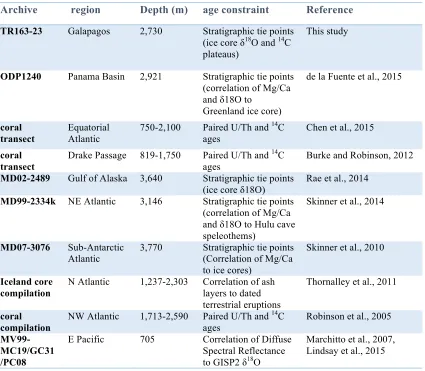
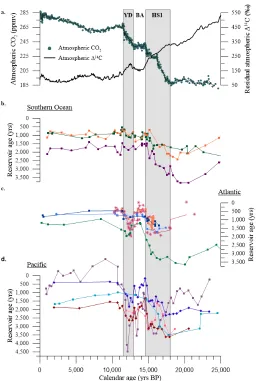
Using only marine 14C records with independently constrained age models (Table
1) we find that EEP reservoir age changes are coherent with both shallow and deep
Atlantic and Pacific reservoir ages, not only at the millennial scale but also with more
rapid ventilation events (Figure 1.7). Specifically, gradually increasing ventilation early
in HS1 (~17.5 ka) followed by an abrupt acceleration in the rate of ventilation coincident
with the ~14.8 ka rise in atmospheric CO2 is recorded in the EEP (this study), the
subtropical NE Pacific (Marchitto et al., 2007; Lindsay et al., 2015), the subpolar NE
Pacific (Rae et al., 2014), the Equatorial Atlantic (Chen et al., 2015), the North Atlantic
(Thornalley et al., 2011; Robinson et al., 2005; Skinner et al., 2014), and the sub-polar
South Atlantic (Skinner et al., 2010). Among these records, the EEP (this study), the
Atlantic (Thornalley et al., 2011; Skinner et al., 2014) also indicate a period of enhanced
ventilation during the late Younger Dryas (Figure 1.7). Using the Bayesian age-depth
modeling program BACON (Blaauw et al., 2007; Blaauw and Christen, 2011), each of
these records was analyzed for the probability that the 14.8 ka ventilation event occurred
at a given point in time from 13-18 ka. For each region, the probability of this event
occurring at a given point in time was combined with the event probability for TR163-23
to determine the likelihood that EEP ventilation was occurring simultaneously with
ventilation in the Atlantic and Southern oceans. Taking into account chronological
uncertainty, rapid ventilation in the EEP during the HS1-BA transition was synchronous
with the North Atlantic (Figure 1.8) but did not show significant likelihood of
synchronicity with the Southern Ocean. Rather, the Southern Ocean ventilation event
associated with the 14.8 ka atmospheric CO2 excursion (Marcott et al., 2014) occurs
slightly earlier than in the Eastern Pacific and the North Atlantic. Because of their low
resolution, it is not possible to calculate the synchronicity of events from the equatorial
Atlantic coral records.
The internal consistency of the Atlantic and Pacific ventilation records argues
against the existence of inter-ocean differences in the timing of ventilation changes
during the last deglaciation (Freeman et al., 2015). Furthermore, the early onset of
ventilation in the Southern Ocean due to overturning (Watson et al., 2015) suggests that
this region was the dominant driver of deglacial ocean ventilation that then propagated
northward into both the Pacific and Atlantic basins. The close correlation between
Greenland ice core and Gulf of Alaska oxygen isotope records has been used as a basis
Pacific and Atlantic oceans during the last deglaciation (Praetorius and Mix, 2014).
Similarly, the results of our study suggest that ventilation of the Atlantic and Pacific
Oceans was also synchronous during the most recent deglaciation (Figure 1.8).
1.5
M
ETHODS1.5.1 RADIOCARBON ANALYSIS
Sediment core TR163-23 (0°24’N, 92°09’W) was collected from 2,730 m
water-depth off the western margin of the Galapagos Islands during R/V Trident cruise TR-163
in February 1975. Sedimentation rates in this core range from 8 to12 cm/kyr making it
ideally suited for study of the last deglaciation. Samples of ~10 mg of the thermocline
dwelling planktonic foraminifera Neogloboquadrina dutertrei and 3-8 mg of mixed
benthic species were measured for radiocarbon content at the University of California,
Irvine Keck-Carbon Cycle AMS facility (Supplementary Table A.1 and Supplementary
Figure A.1). Mixed genus benthic foraminiferal samples were necessary to assure
sufficient material for radiocarbon analysis. Deep infaunal species (Globobulimina spp.,
Chilostomella oolina) that may bias the results towards younger calendar ages were
avoided (Magana et al., 2010). The contemporary benthic-planktonic offset was
calculated using bomb corrected Δ14C from the Global Ocean Data Analysis Project
(GLODAP) bottle data (Key et al., 2004), following de la Fuente et al. (2015). The
modern 14C ages were estimated from GLODAP Δ14C using the equation from Stuiver
and Polach (1977; 14C age=-8033*ln(1+(D14C/1000)) modified for Δ14C.
1.5.2 STRATIGRAPHIC ALIGNMENT
In addition to the tuned age models, an age model was developed by applying a constant
Bayesian age-depth modeling program BACON (Blaauw and Christen, 2011). Oxygen
isotope analyses were carried out on the planktonic foraminifera G. ruber
(Supplementary Figure A.1) using an Elementar Isoprime stable isotope ratio mass
spectrometer. Distinctive oxygen isotope events were visually identified in TR163-23 and
matched to Northern Hemisphere reference events in the GRIP Greenland ice core on the
Greenland Ice Core Chronology 05 (GICC05; Johnsen et al., 1997; Rasmussen et al.,
2014; Seierstad et al., 2014) for the Greenland-tuned chronology and to the H82 and
MSD Hulu speleothems (Wang et al., 2001; Wu et al., 2009; Southon et al., 2012) for the
Hulu-tuned age model. Tuning the EEP to Northern Hemisphere climatic events is
supported mechanistically by an atmospheric bridge across the Isthmus of Panama (Xie et
al., 2008). During North Atlantic cold periods increased northeasterly winds across
Panama drive decreased sea surface temperatures (SST) and shoaling of the thermocline
resulting in an expansion of the equatorial cold tongue. The link between Northern
Hemisphere climate change and the EEP has been recorded over the last 100 kyr by
paleoclimate records of SST and sea surface salinity (Kienast et al., 2006; Leduc et al.,
2007; Dubois et al., 2014).
1.5.3 RADIOCARBON PLATEAU TUNING
Visually identified TR163-23 radiocarbon plateaus were matched to Lake Suigetsu
atmospheric 14C-plateaus (Sarnthein et al., 2015; Bronkk Ramsey et al., 2012) on the
varve-derived Suigetsu age model consistent with published plateau-tuned age models
(Balmer et al., 2016; Sarnthein et al., 2015). This chronology is preferable to the modeled
chronology because it is independent of assumed limits on changes in the dead carbon
Furthermore, the plateau tuned age model developed using the varve chronology provides
a closer match to the Hulu speleothem and Greenland ice core tuned age models for
TR163-23. The indistinct base of plateau 1a/top of plateau 1 was not included in the final
plateau-tuned age model. Plateau tuning suggest the presence of a short hiatus between
the Younger Dryas plateau and plateau 1a. The timing and length of the hiatus is
estimated using the Bayesian age modeling program BACON (Blaauw and Christen,
2011) with the prior distribution for the hiatus modelled by a gamma distribution with a
mean chronological time gap of 1000 years. Accumulation rates are assumed not to be
auto-correlated between the depths just before and after the hiatus. However, inclusion of
the hiatus has little effect on the final age model. The Elastic Tie Pointing method
(Heaton et al., 2013) was used to transfer tie-point ages from the reference record to
TR163-23. Larger matching uncertainty was applied to the glacial tie-points in each of
the tuned records to allow for a lower level of certainty associated with event
contemporaneity during this period. Because we did not have sufficient resolution to
identify tie-points during the Holocene this portion of the chronology was constructed
using 3 calibrated (ΔR=147±13) N. dutertrei calendar ages for each of the tuned
chronologies. Additionally, radiocarbon plateaus could not be identified in TR163-23
during the glacial period requiring the use of one Greenland tie-point to constrain this
period. Tie-point errors determined using the ETP method (Heaton et al., 2013) and
conventional radiocarbon ages were incorporated into the Bayesian age-depth modeling
program BACON (Blaauw and Christen, 2011) to calibrate Holocene radiocarbon dates
Table 1.1Method of age model constraint for cited radiocarbon records.
Archive region Depth (m) age constraint Reference
TR163-23 Galapagos 2,730 Stratigraphic tie points (ice core δ18O and 14C plateaus)
This study
ODP1240 Panama Basin 2,921 Stratigraphic tie points (correlation of Mg/Ca and δ18O to
Greenland ice core)
de la Fuente et al., 2015
coral transect
Equatorial Atlantic
750-2,100 Paired U/Th and 14C ages
Chen et al., 2015
coral transect
Drake Passage 819-1,750 Paired U/Th and 14C ages
Burke and Robinson, 2012
MD02-2489 Gulf of Alaska 3,640 Stratigraphic tie points (ice core δ18O)
Rae et al., 2014
MD99-2334k NE Atlantic 3,146 Stratigraphic tie points (correlation of Mg/Ca and δ18O to Hulu cave speleothems)
Skinner et al., 2014
MD07-3076 Sub-Antarctic
Atlantic 3,770 Stratigraphic tie points (Correlation of Mg/Ca to ice cores)
Skinner et al., 2010
Iceland core compilation
N Atlantic 1,237-2,303 Correlation of ash layers to dated terrestrial eruptions
Thornalley et al., 2011
coral compilation
NW Atlantic 1,713-2,590 Paired U/Th and 14C ages
Robinson et al., 2005
MV99-MC19/GC31 /PC08
E Pacific 705 Correlation of Diffuse Spectral Reflectance to GISP2 δ18O
Figure 1.3 Construction of TR163-23 tuned chronologies. (a) Tie point ages and age uncertainty for the TR163-23 Globigerinoides ruber δ18O record were constrained from the GRIP ice core δ18O record (Johnsen et al., 1997; Rasmussen et al., 2014; Seierstad et al., 2014) using Elastic Tie-Pointing (ETP; Heaton et al., 2013). Calibrated radiocarbon ages used in the final age model are indicated with an X and ETP derived tie points are indicated with a diamond. (b) ETP constrained deglacial tie-points from the H82 speleothem and glacial tie-points from the MSD speleothem δ18O records (Wang et al., 2001; Wu et al., 2009; Southon et al., 2012) are indicated by a triangle. As with the Greenland-tuned age model, calibrated radiocarbon ages are used to date the Holocene portion of the core in the final Bayesian-derived age model. Dashed lines connect TR163-23 δ18O data points to corresponding Hulu speleothem and Greenland ice core reference record events used as tie points. (c) Five 14C-plateaus were identified in the TR163-23 N.
dutertrei radiocarbon record that correspond to 14C-plateaus previously identified in the
Figure 1.5 Radiocarbon records for TR163-23. (a) TR163-23 benthic and planktonic
Δ14C0 and atmospheric records of Δ14C. The residual atmospheric Δ14C has been corrected for modeled cosmogenic 14C production (Hain et al., 2014).Benthic and planktonic Δ14C0 remains relatively constant through deglaciation except for a rapid increase at the end of HS1 and at the end of the BA. The major axis of 1σ error ellipses is plotted for benthic and planktonic Δ14C0. (b) Conventional radiocarbon ages measured from 31 Neogloboquadrina dutertrei, 3 Globogerinoides ruber, and 25 mixed benthic samples. Deglacial G. ruber and N. dutertrei samples show negligible 14C offsets. (c)
Benthic-planktonic 14C offsets in Galapagos core TR163-23 and Panama Basin core ODP 1240 (de la Fuente et al., 2015) indicate similar offsets during the deglacial period. Although TR163-23 B-P offsets show little overall change from the LGM to the
Figure 1.6 Foraminifera radiocarbon offsets from the atmosphere over the last 25,000 years. (a) Composite atmospheric [CO2] record from Antarctic ice cores (Bereiter et al., 2015) and δ13C from Taylor Glacier, Antarctica (Bauska et al., 2016). (b and c)
Reconstructed radiocarbon offsets from the atmosphere displayed in calendar years and as Δ14C0-atm with the major axis of 1σ error ellipses displayed. Contemporary Δ14C from GLODAP (Key et al., 2004) is shown for thermocline depths (green star, -85‰) and for 2.7 km (yellow star, -220‰). Three centennial increases in the WDC atmospheric CO2 record occur at 16.3, 14.8, and 11.7 ka (dashed line; Marcott et al., 2014). There is an EEP equivalent at both thermocline and deep water-depths for the 14.8 ka event, while a possible 16.3 ka event corresponds with only an increase in thermocline ventilation. Our records do not have sufficient resolution at 11.7 ka to capture ventilation changes
Figure 1.7 Interocean comparison of shallow and deep water ventilation. (a) An Antarctic ice core compilation of Atmospheric CO2 (Bereiter et al., 2015) indicates increasing CO2 during the deglacial coevalwith declining Atmospheric Δ14C (corrected for natural production; Hain et al., 2014; Marcott et al., 2014)
.
(b) Southern Ocean records include surface (dark-orange) and deep (3,770 m; dark-purple) water-depths from core MD07-3076 (Skinner et al., 2010) in the sub-Antarctic South Atlantic along with a Drake Passage coral compilation from Upper Circumpolar Deep Water (dark-green; Burke and Robinson, 2012). (c) Atlantic records include deep-water core MD99-2334k (3,146 m; green; Skinner et al., 2014) in the eastern Atlantic, a transect of cores off the southern coast of Iceland (1,237-2,303 m; magenta; Thornalley et al., 2011), a coral compilation from the NW Atlantic (819-1,750 m; orange; Robinson et al., 2005), along withFigure 1.8 Inter-ocean synchronicity of the 14.8 ka ventilation event. The Bayesian age modeling program BACON (Blaauw and Christen, 2011) was used to resample reported chronologies along a uniform time interval and to calculate the probability of the 14.8 ka ventilation event occurring at each study site from 13.0-17.0 ka using a 100 year window with a 10 year time step (Blaauw et al., 2007). Incorporating age uncertainties, event probabilities were combined to test for synchronicity. The width of an individual
probability curve is determined both by event length and age model uncertainty whereas the height is a function of age model certainty alone; e.g. a narrow curve with peak probability close to 1.0 corresponds to a brief, well-defined event. Our EEP record is synchronous with the other a) East Pacific (72.3%), and b) North Atlantic (78.0%) records within 1σ (68.27%). c) The 14.8 ka event in equatorial Atlantic records ends at a similar time as the EEP, however this region has insufficient resolution at the onset of this event to determine whether the 14.8 ka event was indeed simultaneous with the EEP.
CHAPTER 2
MID-DEPTH RESPIRED CARBON STORAGE AND OXYGENATION OF THE EASTERN EQUATORIAL PACIFIC OVER THE LAST 25,000 YEARS 2
2!Umling, N.E., Thunell, R.C. Submitted to Earth and Planetary Science Letters
2.1 A
BSTRACTA growing body of evidence suggests that respired carbon was stored in
mid-depth waters during the last glacial maximum (LGM) and released to the atmosphere
from upwelling regions during deglaciation. A more efficient biological pump has been
cited as a possible mechanism for increased nutrient and CO2 concentrations at depth
during the LGM, while a less efficient biological pump may have contributed to CO2
evasion to the atmosphere during deglaciation. An increase in glacial mid-depth water
respired carbon storage should result in a shift of DIC speciation towards lower carbonate
ion concentrations, along with deoxygenation of bottom waters. In this study, we use the
boron to calcium (B/Ca) ratios of the benthic foraminifera Cibicidoides wuellerstorfi to
reconstruct deep-water carbonate ion concentrations. Additionally, bottom water
oxygenation is estimated from the difference in δ13C of infaunal benthic foraminifera
living in pore waters at the anoxic boundary and of epifaunal species living in bottom
water. Our records indicate that oxygenation of the mid-depth Eastern Equatorial Pacific
increased through deglaciation by 80 µmol kg-1 and that carbonate ion concentrations
were significantly lower during the Younger Dryas and Heinrich Stadial 1 cold periods
relative to the Holocene. These results suggest that Eastern Equatorial Pacific mid-depth
waters stored respired carbon during the LGM releasing it to the atmosphere during
deglaciation, consistent with a deglacial reinvigoration of overturning circulation.
2.2 I
NTRODUCTIONThe last deglaciation provides important insights into the nature of climate
changes during the transition from glacial to interglacial conditions. Specifically, this
followed by abrupt warmings (Shakun et al., 2012). These cold periods are accompanied
by gradually increasing atmospheric CO2, ~50 ppmv during late Heinrich Stadial 1 (HS1;
~17.5-14.7 ka) and ~30 ppmv during the Younger Dryas (YD; ~12.8-11.5 ka) (Monnin et
al., 2001), overprinted by periods of rapid (100-200 yrs) CO2 increase at 11.7 ka, 14.8 ka,
16.3 ka (Marcott et al., 2014) (Figure 2.1). The deep and intermediate ocean is thought to
be a major contributor to the rise in atmospheric CO2 during the last deglaciation. Recent
radiocarbon evidence suggests that ventilation of mid-depth waters was reduced during
the last glacial maximum (LGM; Burke et al., 2015; Ronge et al., 2016; Umling and
Thunell, 2017), allowing respired carbon to accumulate before being subsequently
released to the atmosphere from upwelling regions such as the Eastern Equatorial Pacific
(EEP) during deglaciation (de la Fuente et al., 2015; Martínez-Botí et al., 2015; Umling
and Thunell, 2017). However, alternate mechanisms have been suggested to drive the
atmospheric CO2 excursions of the last 25,000 years (Broecker and Peng, 1987; Jaccard
et al., 2009; Köhler et al., 2014; Martínez-García et al., 2014, Matsumoto et al., 2002).
It has been hypothesized that a less efficient biological pump during periods of
enhanced oceanic circulation could have been responsible for the deglacial CO2 increases
(Ziegler et al., 2013), whereas more efficient sequestration of respired carbon from the
surface ocean to deeper waters during periods of reduced circulation may have
contributed to lower glacial atmospheric CO2 concentrations (Jaccard et al., 2009).
Benthic and planktonic foraminiferal δ13C records suggest that the surface to deep-water
carbon isotope gradient was lower during HS1 and the YD, when Atlantic Meridional
Overturning Circulation (AMOC) was reduced (Hertzberg et al., 2016). This implies that
amount of carbon exported to deep waters and allowing enhanced CO2 evasion to the
atmosphere (Hertzberg et al., 2016). However, the contribution of CO2 from decreased
biological pump efficiency alone, is not of sufficient magnitude to account for the total
deglacial atmospheric CO2 increase. Permafrost thawing (Köhler et al., 2014), carbonate
compensation (Broecker and Peng, 1987), and enhanced deep-water ventilation
(Broecker and Barker, 2007) have also been suggested as complementary mechanisms for
driving CO2 increases. The atmospheric carbon isotopic composition recorded in ice
cores suggests that the release of terrestrial carbon may have been important during rapid
(100-200 years) CO2 increases at 16.3 and 12.9 kyr (Bauska et al., 2016). However, rising
ocean temperatures and a less efficient biological pump likely drove much of the
millennial and some of the centennial-scale CO2 changes (Bauska et al., 2016). Because
the efficiency of the biological pump is modified, in part, by changes in oceanic
ventilation, a coupling of these two processes could account for the full deglacial CO2
increase.
Evidence of coeval shifts in ventilation and respired carbon export in
Sub-Antarctic Atlantic deep-waters hint that the biological pump and ocean circulation likely
worked in tandem to modify atmospheric CO2 concentrations during the last glacial
period (Gottschalk et al., 2016). However, it is not yet apparent whether this relationship
is limited to glacial Circumpolar Deep Waters (CDW) or whether it is regionally more
extensive. Qualitative estimates of intermediate and deep-water oxygen content suggest
large spatial and depth-dependent differences in oxygenation between the LGM and
Holocene (Jaccard and Galbraith, 2011), but the deglacial variability is not as well
chemistry for the Eastern Equatorial Pacific over the last 25,000 years to investigate the
linkages between respired carbon storage and ocean ventilation during the last
glacial-interglacial transition. Additionally, we evaluate regional trends in respired carbon
variability by compiling published records of deep and intermediate water carbonate
chemistry from benthic foraminiferal boron to calcium ratios.
2.3 S
AMPLEM
ATERIAL ANDO
CEANOGRAPHICS
ETTINGThis study utilizes a series of cores collected from the Panama Basin during R/V
Trident cruise TR-163 (Figure 2.2, Table 2.1). For a detailed analysis of the deglaciation
we focus on core TR163-23 (0°24.6’N, 92°9.6’W) collected from 2,730 m water-depth
off the Galapagos platform. Five additional cores from the Cocos and Carnegie Ridges in
the Panama Basin were used to evaluate depth dependent changes in mid-depth and deep
water properties during three time periods: LGM, Bolling-Alerod (B-A), and Holocene.
The Panama Basin is an important region for study of the biological pump because it is
responsible for ~10% of global ocean primary productivity and is strongly connected to
the Southern Ocean (Pennington et al., 2006). Primary productivity in this region is
controlled by upwelling strength, thermocline depth, and supply of nutrients to the
thermocline (Pennington et al., 2006). In particular, upwelling of the Equatorial
Undercurrent (EUC) is an important source of nutrients and CO2 to surface waters
(Fiedler and Talley, 2006). At present, the Panama Basin serves as a major site for the
efflux of CO2 from the surface ocean to the atmosphere (Takahashi et al., 2002).
Deep and mid-depth waters of the EEP are composed of Lower Circumpolar Deep Water
(LCDW) at abyssal depths and Pacific Deep Water at depths of ~1,000-3,200 m. LCDW
Water (NADW) in the Southern Ocean (Fiedler and Talley, 2006). The warming and
freshening of LCDW forms PDW at mid-depths; these waters are characterized by a
silica maximum at ~2,500-3,200 m, overlain by waters with low oxygen and silica
concentrations but overall higher concentrations of nutrients than found within mid-depth
waters (Fiedler and Talley, 2006).
2.4 M
ETHODS2.4.1AGE MODEL DEVELOPMENT
The age model for TR163-23 was developed using a combination of radiocarbon dating
and tuning of the oxygen isotope record from the planktonic foraminifera species
Globogerinoides ruber to the Hulu Cave Speleothem δ18O record (Southon et al., 2012;
Wang et al., 2001; Wu et al., 2009). Globigerinoides ruber oxygen isotope events were
visually identified in TR163-23 and matched to reference events in the U/Th dated Hulu
Cave Speleothem (Southon et al., 2012; Wang et al., 2001; Wu et al., 2009). For
estimation of tie-point uncertainty, the Hulu speleothem reference chronology was
translated to TR163-23 using the elastic tie-point method developed by Heaton et al.
(2013). Larger matching uncertainty was applied to the glacial tie-points to allow for a
lower level of certainty associated with event contemporaneity during this period. Three
samples of ~10 mg of the planktonic foraminifera Neogloboquadrina dutertrei were
measured for radiocarbon content at the University of California, Irvine Keck-Carbon
Cycle AMS facility and used to date the Holocene portion of the core (Figure 2.3). The
Bayesian age-depth modeling program BACON (Blaauw and Christen, 2011) was used to
calibrate the N. dutertrei radiocarbon ages (ΔR=147±13) and to construct the final age
calibration of the radiocarbon ages and tie-point uncertainty for constraint of the final age
model and its associated uncertainty. A more detailed description of the age model
construction for TR163-23 can be found in Umling and Thunell (2017). TR163-23
reservoir ages estimated from this method (Supplementary Table B2) were used with
BACON to calibrate N. dutertrei radiocarbon ages from each of the TR163 cores (Figure
2.3) used in this study and to develop chronologies for each of the cores.
2.4.2ESTIMATION OF BOTTOM WATER CARBONATE CHEMISTRY
Approximately 10 Cibicidoides wuellerstorfi of consistent morphology (Rae et
al., 2011) were picked from the 250-425 µm size fraction of each core sample for trace
element analyses. When limited material was available, additional C. wuellerstorfi were
picked from the 212-250 µm size fraction. Samples were cleaned in over-pressured flow
hoods equipped with boron-free HEPA filters following the Cd-cleaning protocol from
Boyle and Keigwin (1985/86) as modified by Boyle and Rosenthal (1996) using the
minimal settling technique from Barker et al. (2003) and analyzed on a Thermo Element
II high resolution ICP-MS. To increase boron washout efficiency and reduce boron
memory effects in the sample introduction system we used a HF-HNO3 sample matrix
(0.06 M HF and 0.1 M HNO3) following Misra et al. (2014). Multi-element standard
solutions were prepared gravimetrically using high purity mono-element standards.
Samples were dissolved in 100 µl of 0.2% Teflon-distilled HNO3. For each sample run,
calcium concentrations were measured from an aliquot of each sample solution and both
sample and standard solutions were diluted accordingly to 20 ppm Ca using the
platinum injector. The analytical error for B/Ca is ± 1.4 µmol mol-1 (± 0.9%) based on
repeated measurements of a standard of ~175 µmol mol-1.
The global core top calibration from Yu et al. (2013) was used to estimate deep
water carbonate saturation state (Δ[CO32-]) from B/Ca values (Eq. 2.1) and carbonate ion
values were estimated according to Equation 2.2. The [CO32-]sat was calculated from
preindustrial [CO32-] estimated from nearby GLODAP stations (Key et al., 2004) using
CO2SYS (Pelletier et al., 2005) with K1 and K2 of Mehrbach et al. (1973) refit by
Dickson and Millero (1987), KSO4 of Dickson (1990), and the boron-salinity relationship
of Lee et al. (2010).
B/Ca = 1.14 ± 0.04 * Δ[CO32-] + 176.6 ± 1.0 (Eq. 2.1)
Δ[CO32-] = [CO32-]in situ - [CO32-]sat (Eq. 2.2)
We monitored Al-silicate and oxide contamination through concurrent analysis of
diagenetic indicators Fe/Ca, Mn/Ca, and Al/Ca. Generally, Fe/Ca ratios in the TR163
cores were below ~100 µmol mol-1but, measured Al/Ca and Mn/Ca ratios were
commonly elevated with the lowest median Al/Ca occurring in cores TR163-20B and
TR163-18 which had generally the highest median Mn/Ca (Supplementary Fig. B1).
Despite the elevated Mn and Al, there was no significant correlation with B/Ca and any
of the diagenetic indicators (Supplementary Fig. B2).
2.4.3BOTTOM WATER OXYGEN ESTIMATES
The redox sensitive element uranium accumulates in sediments when bottom
water oxygenation is low and/or there is high flux of organic carbon to the seafloor
(McManus et al., 2005). This signal is recorded in the authigenic coating of bulk