University of South Carolina
Scholar Commons
Theses and Dissertations
2017
An Application of Dempster-Shafer Fusion Theory
to Lithium-ion Battery Prognostics and Health
Management
John Weddington
University of South CarolinaFollow this and additional works at:https://scholarcommons.sc.edu/etd Part of theElectrical and Computer Engineering Commons
This Open Access Thesis is brought to you by Scholar Commons. It has been accepted for inclusion in Theses and Dissertations by an authorized administrator of Scholar Commons. For more information, please [email protected].
Recommended Citation
An Application of Dempster-Shafer Fusion Theory to Lithium-ion Battery Prognostics and Health Management
by
John Weddington
Bachelor of Science
The Citadel, The Military College of South Carolina 2011
Submitted in Partial Fulfillment of the Requirements
for the Degree of Master of Science in
Electrical Engineering
College of Engineering and Computing
University of South Carolina
2017
Accepted by:
Bin Zhang, Director of Thesis
Xiaofeng Wang, Reader
c
Copyright by John Weddington, 2017
Acknowledgments
My Lord, Jesus, I need not say much except that you have seen me through,
immeasurably. Every time I hit a wrong turn, you filled me with wisdom to overcome
every obstacle. Thank you for your patience with me as I have sought to achieve
this in my own strength forgetting to rely on you. Thank you for giving me friends,
family, professors, bosses, and coworkers who has been so incredibly supportive. You
have blessed me in more ways than I can count.
Elizabeth, Hannah, and Lillian, my beautiful wife and daughters. What can I
say that would summarize how meaningful your support has been to me over these
years. I cannot thank you enough for being a bedrock of warmth and encouragement
over the many long months and late nights. I have missed family dinners, bedtime
stories, dance parties, and vacations to achieve this. All the while you have remained
committed to helping me complete my coursework and thesis, and you have been
selfless in doing so. However, our marriage has deepened and our famliy is stronger
than ever as we have learned to set priorities and make our time count. I look forward
to having my life back with you!
My parents for teaching me perseverance in the face of tremendous obstacles.
Working full time with a young family, and pursuing graduate school has certainly
characterized an obstacle.
Dr. Zhang, thank you for all of your patience. Working with me remotely much
of the time has been a chore I am sure, but I am thankful to you for helping me
achieve this goal. Without your encouragement, I would not have been able to see
into your home over Christmas and celebrating with your family, and the rest of the
research group.
My professors who taught me in my graduate studies: Dr. Enrico Santi, Dr.
Asif Khan, Dr. Zhang, Dr. Wang, and Dr. Zafer Gürdal. Thank you for your
instruction and generosity with me as an APOGEE student. We have exchanged
numerous emails, and you have graciously extended your office hours and availability
to accommodate my schedule on numerous occasions.
I am thankful to my many bosses and coworkers at Albemarle and SI Group who
have supported me along the way. You have covered for me more than I can count
and yet you still have encouraged me to complete this goal. Your support, however
small you may see it, has proved its weight in gold.
Wuzhao Yan, Zhichao Liu, Zheqing Zhou, Shijie Tang, Guangxing Niu, and
Patrick Murphy, thank you for your help and accommodation over the many years
and months of this journey, sharing your cubicles, food, transportation, and coffee
has been a tremendous help. Thank you for helping me work through my theoretical
difficulties and being genuinely interested in helping me out. I enjoyed our many
conversations and I even enjoyed worked into the early morning with you on many
Abstract
Prognostics and Health Management (PHM) is the discipline involving diagnostics
and prognostics of components or systems, with the primary objective of increasing
the overall reliability and safety of these components or systems. PHM systems
convert raw sensor data into features, and utilize state observers to estimate the
current damage state online. Popular state observers are the traditional Kalman
filter, along with its non-linear extensions, and the particle filter. Each technique
has differing advantages. This thesis investigates the fusion of results from different
techniques in order to achieve a more trustworthy probability of detection (PoD)
during diagnosis and a more reliable remaining useful life (RUL) prediction in
prognosis. Models for extended Kalman filter (EKF) and particle filter (PF) are
developed from the feature data. The results from EKF and PF are then fused using
an application of Dempster-Shafer theory (DST). Different models are utilized for
EKF and PF in order introduce multi-model PHM, and to optimize the performance
of each technique for both aging detection and RUL prediction. Prognostics is
triggered when one-step-ahead predictions compared against the healthy battery
demonstrate aging. DST is then applied to the prognostic results from EKF and
PF. The result of DST is a density function whose performance can be compared
with that of EKF and PF. DST allows for the fusion of multiple sensors and state
Table of Contents
Acknowledgments . . . iii
Abstract . . . v
List of Tables . . . viii
List of Figures . . . ix
Chapter 1 Introduction . . . 1
1.1 Motivation . . . 1
1.2 Contributions . . . 2
1.3 Organization . . . 2
Chapter 2 Literature Review . . . 3
Chapter 3 Approach Development . . . 7
3.1 Extended Kalman Filter . . . 8
3.2 Particle Filter . . . 10
3.3 Dempster-Shafer Combination Theory for Fusion . . . 12
3.4 Uncertainty Representation . . . 16
3.5 Evaluation Metrics . . . 17
4.1 State Estimation Implementation . . . 21
4.2 Data Fusion . . . 26
Chapter 5 Discussion of Results . . . 33
5.1 Fault Detection Results . . . 33
5.2 Prognostic Results . . . 35
Chapter 6 Conclusion and Future Work . . . 42
6.1 Conclusion . . . 42
6.2 Future Work . . . 42
List of Tables
Table 4.1 The combination of different states within DST framework. m1
and m2 represent mass functions for EKF and PF, respectively.
µ1, µ2, µ3, µ4 indciate healthy state, faulty state, aleatory
uncertainty, and epistemic uncertainty, respectively. . . 31
Table 5.1 TTF Comparison . . . 34
Table 5.2 PoF and Uncertainty Comparison for CS2_35 . . . 34
Table 5.3 PoF and Uncertainty Comparison for CS2_36 . . . 34
Table 5.4 PoF and Uncertainty Comparison for CS2_37 . . . 34
Table 5.5 PoF and Uncertainty Comparison for CS2_38 . . . 34
List of Figures
Figure 3.1 Fusion prognostics system diagram. . . 8
Figure 3.2 Disjoint sets for Dempster Shafer Fusion . . . 16
Figure 3.3 The concept of time-to-failure (TTF). . . 18
Figure 3.4 The concept ofα-λ accuracy [48]. . . 20
Figure 4.1 Data from run-to-failure test with four Li-ion batteries. . . 22
Figure 4.2 Detection is performed by comparing the baseline pdf (healthy battery) and the real-time pdf (based on model and measurement). The threshold is determined by the probability of false alarm. This figure shows an example of particle filter. . . 23
Figure 4.3 The fault progression from EKF over time and the generation of RUL pdfs from state estimate, or “damage”, pdfs with Gaussian distributions. Uncertainty grows in prognosis since there is no correction step. . . 24
Figure 4.4 The fault progression from PF over time and the generation of RUL pdfs from state estimate, or “damage”, pdfs using particles. Uncertainty grows in prognosis since there is no correction step. . . 26
Figure 4.5 Aleatory and epistemic uncertainty represented for Li-ion battery. 28 Figure 4.6 Unmodeled uncertainty functions for each RUL prediction alogrithm. 29 Figure 4.7 The graph depicts the belief distributions generated by DST fusion for prognosis. PU is the belief uncertainty and PF is the belief that the battery has reached EoL. . . 32
Figure 5.2 The trajectory of PF and EKF prognosis beginning at kP,
shown with confidence bounds. . . 36
Figure 5.3 Results for CS2_35 Li-ion battery. The upper and lower bounds
for each algorithm are shown. (a) EKF α-λ plot, (b) PF α-λ
plot, (c) DST α-λ plot, and (d) RA and CRA metrics. . . 38
Figure 5.4 Results for CS2_36 Li-ion battery. The upper and lower bounds
for each algorithm are shown. (a) EKF α-λ plot, (b) PF α-λ
plot, (c) DST α-λ plot, and (d) RA and CRA metrics. . . 39
Figure 5.5 Results for CS2_37 Li-ion battery. The upper and lower bounds
for each algorithm are shown. (a) EKF α-λ plot, (b) PF α-λ
plot, (c) DST α-λ plot, and (d) RA and CRA metrics. . . 40
Figure 5.6 Results for CS2_38 Li-ion battery. The upper and lower bounds
for each algorithm are shown. (a) EKF α-λ plot, (b) PF α-λ
Chapter 1
Introduction
1.1 Motivation
Batteries are temporary power sources with limited lifespan. Over time, they
experience degraded performance as a result of normal use, as well as accelerated
degradation under strained operating conditions. Rechargeable batteries are utilized
in a wide number of critical applications. In particular, lithium-ion (Li-ion) batteries
are growing in popularity over traditional technologies such as nickel-cadmium (NiCd)
and nickel-metal hydride (NiMH). Beginning around 2000, Li-ion battery production
began to grow, and has since expanded such that Li-ion batteries make up more than
60% of all rechargeable batteries produced [1, 2]. Roughly 40% of mined lithium metal
is used for Li-ion battery production. This trend underlines the the importance of
studying the effects of failure of Li-ion battery systems in particular. Consumer-grade
devices such as smartphones and tablets, pacemakers for the medical field, industrial
battery-powered wireless transmitters used in remote instrumentation applications,
as well as electric vehicles used in military and aerospace applications all depend
upon the reliable performance of Li-ion battery systems for continued operation.
Prognostics and health management (PHM) is a discipline which involves the
management of components and systems such that catastrophic failures are avoided
through early detection and prediction of the end of life (EoL). Within PHM, major
components enabling techniques include dignostics and prognostics. Diagnostics
identification (or isolation) of the fault mode, and (3) estimation of the severity of
the fault. Prognostics involves projection of the fault into the future, and calcluation
of remaining useful life (RUL) or time to failure (TTF), where TTF describes the
absolute time until the EoL, and the RUL takes into account the amount of time
needed to take corrective action.
Once implemented, PHM systems are intended to influence decision-making.
This could involve reconfiguration for control applicaitons, or maintenance planning.
Whatever, the case, there is risk associated with inaccuracy. For these techniques to
be of any use, they must provide accurate and reliable estimates of the actual state
of the Li-ion battery system, which assumes that the uncertainty in the estimate is
properly managed. The focus of this thesis is to present a method for managing
the uncertainty in PHM systems through the use of data fusion techniques. The
purpose of fusing any two or more sets of information is to increase the reliability
of the meausrement. In our case, the measurement is more reliable if it accurately
represents the probability of fault detection, and produces a bounded TTF prediction
whose bounds become tighter as time progresses.
1.2 Contributions
develop a multi-mode applicaiton develop a DS-based fusion approach Extend DS
fusion to include two types of uncertainties verification on a set of li-ion batteries
1.3 Organization
This remaining text in organized in the following manner. Section??provides ...
e remaining sections detail the theoretical basis, and apply this theory to a Li-ion
Chapter 2
Literature Review
In order to begin either diagnostics or prognostics, an accurate estimate of the current
health must be available. State-of-charge (SOC) is a common metric used in many
deployed battery management systems, especially consumer-grade batteries, which
defines the remaining charge before the voltage is depleted. This is useful in the
short term, but does not answer the question as to how many discharge-recharge
cycles will this battery be able to withstand before needing to be replaced. The
state-of-health (SOH) of the battery meets this requirement. SOH is an indirect
metric attained by extracting the feature from direct measurement data. It represents
the remaining capacity of the Li-ion battery, measured in Amp-hours (Ah). Critical
systems designed for long-term reliability cannot depend solely on the SOC of their
Li-ion systems, so the SOH must be considered. This work does not detail different
methods of extracting the SOH, as that is application-dependent.
Once the SOH feature has been extracted, it needs to be placed within a framework
that is compatible with diagnosis. Typically this involves the use of algorithms to
predict one-step ahead (to achieve priori state estimation) and then corrected with
measurement (to achieve posteriori state estimation), which is useful in diagnosis.
This posteriori state estimation can then be utilized as an initial condition for long
term prediction in prognosis.
On-board Li-ion battery detection involves the use of state estimation techniques
[3, 4]. In the framework of Bayesian theory, a state estimator is used to make a
new measurement becomes available to obtain the posteriori capacity distribution.
Theposteriori distribution is then compared with a baseline distribution (established
from the data from the healthy system) to calculate the probability of detection in
terms of battery capacity degradation. In the past few decades, a number of different
state estimators were developed including wavelet analysis [5], Kalman filter (KF) [6],
multiple model adaptive estimation [7, 8], extended Kalman filter (EKF) [9], particle
filter (PF) [10–12], and autoregressive integrated moving average [13, 14].
With the posteriori distribution of battery capacity, prognosis is executed to
estimate the time to failure, measured by number of charge-discharge cycles. Each
estimator differs from the other by offering better performance in different aspects.
For example, the EKF is founded upon the efficient, optimal KF, which is able to
accurately produce the underlying state for linear systems. The PF is a complex
sampling algorithm that discovers the underlying state by means of sequential
Monte-Carlo calculations, but it is well-suited for nonlinear and non-Gaussian
systems. In order to utilize the best from each algorithm, it is desirable to fuse
their results. As uncertainty is a major consideration in real world applications, the
fusion must take uncertainty into consideration.
Fusing prognostic results is an important concept in literature. An adaptive
neuro-fuzzy inference system (ANFIS) is developed to fuse data for RUL prediction
in [15]. A kernel-based regression algorithm is presented in [16]. In [17], a fusion
prognostics method is proposed to fuse results from a physics of failure model
and data driven model using results from a failure modes, mechanisms, and effects
analysis (FMMEA). Support vector data description is utilized to fuse multiple health
indicators for enhancing gearbox fault diagnosis and prognosis [18].
A thorough review of data fusion is given in [19]. For the purposes of this work, we
focus on decision fusion, which is the process of combining the reasoning from different
results are classified into decision categories. There are four prevalent methods for
decision fusion: voting logic, abductive reasoning (fuzzy logic inference), probability
theory (Bayesian fusion), and belief theory (DST-based fusion).
Voting fusion is used heavily in industry with redundant instrumentation. Typical
methods for voting fusion are threshold, majority, median, and others [20]. Voting
fusion is mostly used with crisp numbers, but its application has expanded into
numerous domains, including dependable system design with unreliable components.
Fuzzy logic inference expands voting into the domain of “gradual decision making”
[21]. Fuzzy logic is also called soft voting, because the fusion rules are not crisp,
but allow for many different scenarios. The task of fusion using fuzzy methods was
demonstrated in [22]. Depending upon the complexity of the problem, fuzzy logic
may require extensive understanding of system dynamics to perform effectively.
Bayesian theory is based on probability theory or Bayes’ theorem. The theory
relates evidence and belief using prior and current information. Being a proven
method, it maintains a larger contingent of supported applications of the theory. This
is due, in part, to its simple formulation, which enables it to be better understood
than other proposed methods [23].
Dempster-Shafer Theory (DST) builds upon Bayesian probability theory by
incorporating unknowns and confidence measures into its calculations, and is typically
categorized under the heading “Belief Theory” or “Evidence Theory” [24]. DST has
definite advantages over the Bayesian method under certain circumstances, primarily
in its ability to explicitly consider unknowns when combining evidence [25, 26].
It is based on the concept of assigning a degree of belief or confidence to certain
propositions on the basis of combining all the available evidence.
Many different applications of DST have been implemented. Gas turbine engine
test cell sensor validation was improved with the use of DST [27]. A DST-based neural
constructing basic belief assignments (bba’s), as well as the issue of dependence among
information sources. Smets proposed the Transferrable Belief Model (TBM) as an
extension to DST which separates decision from belief, by breaking the belief model
into two levels: credal and pignistic [29, 30]. DST was applied to regression [31], and
later to machinery prognostics [32]. In general, however, most of existing works are
fusion of diagnostic results and the application of DST in prognostics is largely still
an open problem.
To address this problem, the research in this work extends the DST fusion to
prognostics to achieve better estimation of RUL. Note that the use of Dempster-Shafer
theory (DST) to fuse diagnostic results in Li-ion batteries was originally treated in
[33]. In the proposed fusion of prognosis, only reasonable estimates of the uncertainty
are needed to implement DST fusion. Once the uncertainty associated with RUL
predictions from EKF and PF are explicitly defined and isolated, DST-fusion can
consider the unique contribution each type of uncertainty makes to the RUL when
combining the predictions. This work introduces a novel method for generating an
RUL distribution. By buliding upon the strong theoretical background of DST,
the proposed RUL distribution is able to be generated with relative ease, and with
computational efficiency. The other applications of DST in prognostics have focused
on regression, which involves expensive computations. However by focusing strictly
Chapter 3
Approach Development
This section details a method for aging detection (AD) and prognosis of Li-ion
batteries by combining the EKF and the PF to manage the uncertainty inherent
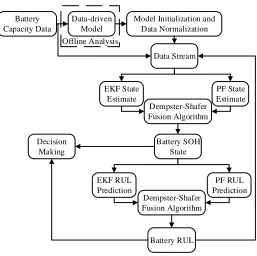
in each state estimator. Figure 3.1 demonstrates the flow chart used in designing
the proposed prognostic system. In our application, we have implemented different
models for EKF and PF, thus demonstrating that our DST fusion technique can
be implemented indepent from state estimation technique and underlying model.
Instead, DST fusion is dependent upon accurate representations of uncertainty
present within the different techniques. In our framework, we could conceivably
fuse any two or more prognostic techniques simultaneously, only being constrained
by the hardware processing capability (e.g. CPU clock speed, parallel computing,
etc.). Thus DST is scalable as necessary to describe the complexities of the unit
under test (UUT).
The nonlinear process model (from cycle k −1 to cycle k) for battery capacity
degradation is described as a hidden Markov model (HMM) by
xk=f(xk−1, uk−1) +wk−1 (3.1)
where xk and xk−1 are the battery capacity state at the current cycle, k, and the
previous cycle, k − 1, f(·) is a nonlinear model describing the battery capacity
degradation, uk−1 is the operating condition, and wk−1 is process noise. The
observation model is
Data-driven Model PF State Estimate EKF State Estimate Dempster-Shafer Fusion Algorithm Model Initialization and
Data Normalization Data Stream Offline Analysis Battery Capacity Data PF RUL Prediction EKF RUL Prediction Dempster-Shafer Fusion Algorithm Battery SOH State Decision Making Battery RUL
Figure 3.1 Fusion prognostics system diagram.
wherezis the observation vector, which in battery capacity degradation application is
the capacity calculated by Coulomb-counting,h(·) is a nonlinear observation function,
and vk+1 is the measurement noise. Note that process noise ω and measurement v
must be Gaussian in EKF while they can be any non-Gaussian noises in PF.
3.1 Extended Kalman Filter
For state estimation, the KF is known as a linear quadratic optimal filter. This
algorithm is a linear, discrete time, finite dimensional time-varying state estimator
that minimizes the mean-squared error (MSE). Capacity degradation of Li-ion
batteries is a nonlinear process, described with respect to charging-discharging cycles,
for which KF is insufficient and necessitates the use of EKF. The EKF expands the
KF to incorporate non-linear dynamics, by linearizing around the current state, as
and correction. Both the prediction and correction steps require the calculation
of the partial derivatives (the Jacobian) of f(·) and h(·), which are used for local
linearization, as shown below:
State Jacobian:
Fk=
∂f ∂x xˆ
k−1|k−1,uk−1
(3.3)
Observation Jacobian:
Hk =
∂h ∂x ˆx
k−1|k−1
(3.4)
The prediction step of EKF comprises the following:
1. Project the a priori state at the next time instant (cycle for battery SOH
application) by using the model
ˆ
xk|k−1 =f(ˆxk−1|k−1, uk) (3.5)
2. Project the prediction error covariance, P, ahead
Pk|k−1 =Fk−1Pk−1|k−1Fk−T 1 +Qk−1 (3.6)
where Q is the process noise covariance matrix.
For the correction step of EKF:
1. Compute the Kalman gain, K
Kk=Pk|k−1HkT
HkPk|k−1HkT +Rk
(3.7)
2. Update error covariance, P
Pk|k = (I−KkHk)Pk|k−1 (3.8)
3. Update the state estimate with measurement
ˆ
xk|k = ˆxk|k−1+Kk−1
zk−1−h(xk|k−1)
Theposteriori estimate provided by Eq. (3.9) provides initial condition for long-term
prediction in RUL calculation. The state models are recursively used to generate
the a priori estimation of battery capacity in all future cycles. These a priori
battery capacity state distributions are compared against the battery capacity failure
threshold to calculate the Time to Failure (TTF) or RUL distribution. Note that since
no measurement available in this long-term prediction, the correction step cannot be
implemented, which will result in increase of uncertainty described in P in 3.6. The
uncertainty must be properly managed to achieve reliable prognosis.
3.2 Particle Filter
One disadvantage of the EKF is that the desired pdf is estimated by a Gaussian,
and as the system under study is not normally distributed, the estimation could
deviate from the actual distribution and diverge [12, 34, 35]. The PF is developed as
a solution for nonlinear random non-Gaussian systems. The algorithm assumes the
process state equations can be effectively modeled as a first-order nonlinear Markov
process in Eqs. (3.1) and (3.2) . The state x and observation z for cycles 1 to k are
defined as
x0:k,{x0, x1, . . . , xk}, z1:k ,{z1, z2, . . . , zk} (3.10)
The PF is also known as a sequential Monte Carlo method for state-space inference.
PF is able to accommodate nonlinearities easily, provided enough particles are used.
The particle filter aims to obtain a set of weighted particles to estimate the battery
capacity based upon a nonlinear model. The algorithm begins with a set ofNparticles
available at cycle k−1 that describe the battery capacity distribution, which is also
the target distribution, denoted as p(x0:k−1|z1:k−1). The objective of filtering is to
obtain a set ofN new particles to approximate the target distribution at cyclek,πk.
To obtain these new particles, a known distribution is chosen by the user to be the
qk (also known as the importance distribution) as shown,
{x(0:i)k}i=1,...,N ∼qk(x
(i)
0:k) (3.11)
and compared against the target distribution. The true distribution is approximated
by a set of N weighted particles, {wk(i), x0:(i)k}i=1,...,N N
X
i=1
w(ki)φk(x(i)) N→∞
−−−→ Z
φk(x0:k)πk(x0:k)dxk (3.12)
where φk is any πk integrable function and the sum of all weights is 1. To
accommodate the difference between importance distribution and target distribution,
importance sampling set the weights of N particles equal to the ratio between them,
i.e.,
˜
w(x(0:i)k) = π(x
(i) 0:k)
qk(x
(i) 0:k)
(3.13)
which is normalized as
w(x(0:i)k) = w˜(x
(i) 0:k)
P ˜
w(x(0:i)k) (3.14)
With this new set of weights, the target distribution can be approximated as:
π(x0:k) = N
X
i=1
wk(i)δ(x0:k−x
(i)
0:k) (3.15)
In a simple case of the particle filter, Bootstrap filter, the importance density function
is set as the a priori pdf,
qk(x0:k|x0:k−1) =p(xk|xk−1) (3.16)
In this setting, the weights for the newly generated particles are proportional to the
likelihood of new observations, i.e.
w(ki) =wk−(i)1·p(z1:k|x
(i) 0:k) =w
(i)
k−1·p(zk|x
(i)
k ) (3.17)
In particle filters, degeneracy is a problem that must be addressed. Degeneracy can
continues to be performed. This leads to a dominance of particles with small weights
describing the distribution. In practice, this results in inaccurate estimation of the
actual state. Degeneracy is addressed by resampling. Resampling effectively replaces
the smaller-weighted particles with larger-weighted particles, so as to describe to true
distribution with higher veracity [36]. Sequential Importance Resampling (SIR) is the
PF implementation chosen for this application due to its robustness. The variance of
the weighted particles generated by the Bootstrap filter is calculated using an effective
sample size:
˜
Neff =
1
PN
i=1(w (i)
k )2
(3.18)
When ˜Neff < Nthreshold, the particles are resampled to eliminate particles with small
weights. The steps in SIR are included in Algorithm 1.
Algorithm 1Sequential Importance Resampling
1: N(i) =jN ·w(ki1)k .Identify best particles 2: N =N−P
N(i) . ResampleN particles 3: Nres=
N·w(ki)−N(i)
N .Resampled particle weights 4: Sres=
n Pi
1N (i) res
o
i=1,...,N .Cumulative sum 5: {u(i)}
i=1,...,N ∼ U[0,1] . Sample from uniform distribution 6: SORT:u(i) s.t. u(i)< u(i+1) .Ascending sequential order
7: fori= 1 :N do .IndexN(i)with resampled particles
8: if u(i)< S(i) res then 9: N(i)=N(i)+ 1
10: end if
11: end for
12:
x(i·N (i))
0:k−1
i=1,...,N
∼qk
x0:k|x (i) 0:k−1
.Resampling
3.3 Dempster-Shafer Combination Theory for Fusion
In DST, the concept of belief variables is introduced [37]. Each belief variable is
characterized by its basic belief assignment (bba), m, which can be described as
A1, . . . , An are the hypotheses, or sets, of interest where each Ai ∈2X, then
m: 2X →[0,1],
n
X
i=1
m(Ai) = 1, m(∅) = 0 (3.19)
Using these bba’s, “Dempster’s Rule” is the fundamental equation governing the
combination of evidence in belief theory [38].
(mi⊕mj)(C) =
P
A∩B=C
mi(A)mj(B)
1−K ; A6=∅ (3.20)
(mi⊕mj)(∅) = 0, (3.21)
K = X
A∩B=∅
mi(A)mj(B), (3.22)
where m is the mass for each hypotheses, i and j are the sources of information,
EKF and PF. C is the output, which is the battery capacity state in the fusion
of diagnosis and battery RUL in the fusion of prognosis. A and B are hypotheses
about the battery capacity and RUL: healthy or faulty. In our application, two other
hypotheses are including to represent the uncertainty.
The sum of the masses in the numerator can be known as the belief measure of
the hypothesis, which is also called the support measure in some literature. The
denominator is called the plausibility measure [39]. The belief and the plausibility
provide confidence bounds, which, when combined as indicated in Eq. (3.20), supply
degrees of belief for the output. Equation (3.21) is the probability mass of the null
set. K represents the mass associated with conflicting evidence. In Bayesian theory,
the resulting probabilities are limited to distribution between the hypotheses, as in
P(A) = 1−P(B). This assumes crisp separation of probabilities between the two
hypotheses, which is not a safe assumption in critical systems. The flexibility of
DST allows for more states to be defined easily. If for instance a Bayesian decision
fusion system is required to utilize two sensors to discern whether a system is healthy
or faulty, and the resulting probabilities are equally divided, the results can be
defined hypotheses or innacurate sensor information. This level of uncertainty is not
acceptable for online decision-making. DST is a quantitative means of representing
uncertainty. In other words, DST allows for the explicit definition of alternative
scenarios. These new proposed states can be various combinations of the original
states. Shafer’s overview of DST in [26] identified the important assumptions when
approaching an appplication of DST:
1. the assigned masses are subjective in nature, not objective,
2. the sources are independent from one another,
3. the uncertainties within the problem are explicitly represented, and
4. the combination rule is carried out computationally.
The probability masses, as explained above, are not actual probabilities. These are
expected to subjective masses from the perspective of the source. It follows then that
DST will produce meaningless results if source i and source j are dependent upon
one another, and are biased in the same manner. This means that DST cannot be
used in cases of common uncertainty. If proposed states are in direct conflict with
one another, which is mathematically represented by disjoint sets, DST produces a
result of 0, per Eq. (3.21). In the event that sources deviate substantially from one
another, DST will not produce confidence bounds. This is intuitive, since directly
contradictory results cannot be combined by averaging or other methods.
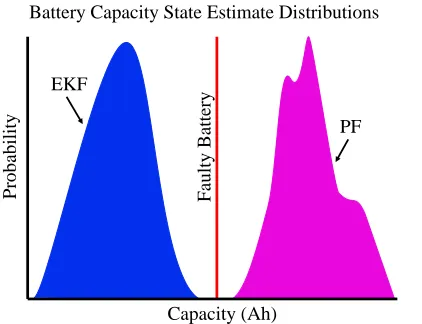
Consider an example using our Li-ion battery system, Fig. 3.2. Notice that
the state estimate pdfs from EKF and PF have no overlap. Considering three
hypotheses, healthy, faulty, or uncertain states, the results from EKF and PF are
directly contradictory. If the below combination rules are applied:
m(F) = mPF(F)mEKF(F)+mPF(F)mEKF(U)+mPF(U)mEKF(F)
1−(mPF(H)mEKF(F)+mPF(F)mEKF(H))
m(U) = mPF(U)mEKF(U)
m(H) = 1−(m(F) +m(U))
The results of fusion would be as follows:
mEKF(F) = 1 mEKF(H) = 0 mEKF(U) = 0
mPF(F) = 0 mPF(H) = 1 mPF(U) = 0
m(F) = 0 m(H) = 1 m(U) = 0
This result is counterintuitive. However, if a methodology for uncertainty could
be incorporated into the measurement, the results would change drastically. By
considering the variance inherent to EKF and PF as its uncertainty the results are
as follows:
mEKF(F) = 0.7 mEKF(H) = 0 mEKF(U) = 0.3
mPF(F) = 0 mPF(H) = 0.75 mPF(U) = 0.25
m(F) = 0.4 m(H) = 0.525 m(U) = 0.075
These results are much improved. In the previous example, DST essentially
ignores the EKF results, however, by incoporating a rudimentary method of
uncertainty representation, the results are more intuitive. Since the PF has a
slightly tighter variance, DST prodcues a result slightly favoring a healthy battery,
but essentially demonstrates that there is not enough information to conclude a
faulty battery. This result also demonstrates the need for more thorough uncertainty
quantification.
However, many researchers have proposed extensions to DST in an effort to
address the problem posed by strongly conflicting evidence, as presented in [40].
They claim that the normalization factor in Eq. (3.22) has the effect of entirely
ignoring conflict, and attributing associated masses to the null set, Eq. (3.21). When
the upper and lower bounds of DST are interpretted probabilistically, inaccurate
and non-intuitive results are possible, as shown in [41, 42]. This is addressed by
using a discounting function, which is mathematically more rigorous [25, 43]. This
Capacity (Ah)
Prob
ab
ilit
y
Battery Capacity State Estimate Distributions
Faulty
Battery PF EKF
Figure 3.2 Disjoint sets for Dempster Shafer Fusion
extended framework, the degree of trust attributed to a particular belief function is
defined as 1−αi, where 0 ≤ αi ≤ 1 and i is the belief function associated with a
particular belief measure.
Belαi(A) = (1−α
i)·Bel(A)
Bel(A) = 1
n(Bel
α1(A) +. . .+Belαn(A))
(3.23)
where:
Belαi(A) is the discounted belief function
Bel(A) is the averaged discounted belief function
This discounting technique has been used to formulate another method for
assessing the reliability of two sources, which is explained further in section 4.2.1.
3.4 Uncertainty Representation
In the previous section, the accurate representation of uncertainty is identified as a
critical step to the proper application of DST. A thorough overview of uncertainty
representation is presented in [44]. Uncertainty can be separated into epistemic
and aleatory uncertainty. Aleatory uncertainty describes the natural, unpredictable,
an estimated magnitude for this uncertainty, but will not reduce it. These are
commonly representated by probability distributions. Whereas, epistemic uncertainty
is a result of incomplete information about a system, its surrounding environment,
or the modeling process. Insufficient experimental data or unmodeled, complex
physical dynamics are examples of epistemic uncertainty. This type of uncertainty
is able to be properly managed. Without sufficiently identifying and modeling
these two categories of uncertainty within an engineered system, this is propagated
throughout the model. This unmodeled uncertainty will yield misleading results.
The DST framework is uniquely able to accomodate and combine both epistemic
and aleatory uncertainty. As uncertainty representation is inherently subjective,
it is important that the designer has sufficient knowledge to distinguish between
the different uncertainty modes, which can involve both qualitative and quantitative
analysis.
3.5 Evaluation Metrics
Different evaluation methods are needed for diagnostics and prognostics. In
this section are presented the different categories of metrics used to validate our
algorithms.
3.5.1 Aging Detection Metrics
The primary goal of fault detection is the early detection of system faults. This
is crucial since the detection of a fault triggers the prognostic algorithm to begin
making predictions. In [33], the TTF metric was used for evaluation. This metric
demonstrates how early the detection algorithm indicates a fault in the system. A
good result is measured by the algorithm which makes earliest fault declaration.
Figure 3.3 The concept of time-to-failure (TTF).
where kD is the time index at which the fault is detected by diagnostic system.
Figure 3.3 illustrates this. Other metrics include sensitivity, selectivity, area under
the receiver operating characteristic (ROC) curve, and others mentioned in [45, 46].
As this work is primarily focused on enhanced prognostics, we limit our diagnostic
metrics to the earliest TTF generated by each algorithm.
3.5.2 Prognostic Metrics
Saxena, et al. introduced several metrics for anlayzing the performance of prognostic
systems [47], and provided further clarifications for using these metrics in [48]. The
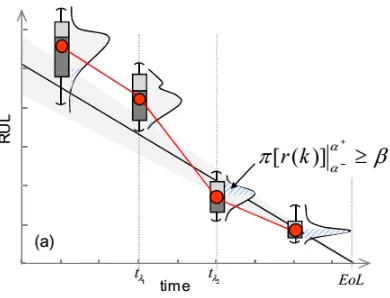
concepts presented are successive tests providing quantitative prediction quality. α-λ
performance describes whether a prediction falls within specified limits at certain
times of the life of the failing system. By requiring the prediction to remain in a
specified cone of accuracy, this metric provides a strict requirement for the prognostic
algorithm. In this implementation, we define α-λ accuracy as follows: α×100% of
the ground truth, or baseline, RUL at specific time instance,kλ, which is a time-step
α = 0.2 and λ = 0.5 would test the prognostic algorithm for 20% accuracy halfway
to EoL after fault detection. This metric can be used to validate both accuracy and
precision performance. This concept is further developed through the use of a β
criterion, as shown in Eq. (3.26). This helps account for the prediction uncertainty,
which is a key factor in this work. The β criterion is defined as the total probability
of RUL predictions being within α bounds at time k. Figure 3.4 shows an example
of α-λ accuracy with β criterion.
(1−α)·r∗(k)≤rl(kλ)≤(1 +α)·r∗(k) (3.25)
where:
l is the lth UUT (i.e. Li-ion battery)
α is an accuracy modifier
λ is a window modifier
kλ =kP +λ(EoL−kP).
π[rl(k)]
α+
α− ≥β
α+ =r∗(k) +α·EoL
α−=r∗(k)−α·EoL
(3.26)
where:
β is total probability in [0,1]
rl(k) is RUL prediction at time k
r∗(k) is baseline RUL prediction at time k.
The output of the metric is binary (Yes or No), stating whether the algorithm
meets the requirement within a specific window. The Relative Accuracy (RA) metrics
provide further means of quantitative comparison, building upon theα-λoutput. RA
measures the tracking (above or below the baseline) that an alogorithm performs for
the chosen λ set. A RA result in the neighborhood of 1 represent a perfect score,
Figure 3.4 The concept of α-λ accuracy [48].
specific λ. Values above or below 1 indicate late or early estimates, respectively. RA
only uses the expected value of the RUL prediction at kλ, so it is used in addition to
the above α-λ metric with β criterion.
Cumulative RA (CRA) demonstrates the change in accuracy over time, in which
predictions made closer to kEoL are weighted higher than those made closer to kP. A
score close to 1 for CRA represents perfect tracking over the entire λ set. RA and
CRA only use the expected value of the RUL prediction at kλ, so they are used in
addition to the above α-λ metric withβ criterion.
RAlλ = 1− |r∗(kλ)−r
l(k λ)|
r∗(kλ)
(3.27)
CRAlλ = 1
|`λ| `λ
X
i=1
w(rl(i))RAlλ (3.28)
where:
w(rl) is a weight factor as a function of RUL at all time indices
`λ is the set of all time indices before kλ when a prediction is made
Chapter 4
Application with Lithium-ion Batteries
In this section, the proposed approach will be demonstrated in a case study
of the capacity degradation of Li-ion batteries. The battery is a safety-critical
component that provides power to system functions including command, control,
communications, computers, and intelligence. Li-ion batteries are widely used due to
the advantages in higher energy density, longer cycle life, no memory effect, and lower
weight [49]. Since the life and state of the batteries are not directly measurable, state
estimation techniques play an important role in estimating the battery state-of-health
and state-of-charge.
In this implementation, the state-of-health of Li-ion batteries with rated capacity
of 1.1 Ah are used to verify the proposed approach. The charge-discharge cycle of
the battery is conducted with the Arbin BT2000 system under room temperature at
a discharge current of 1.1 A. The charging and discharging of the battery are halted
at the given cutoff voltage. The capacity degradation curve versus charge-discharge
cycle is obtained by Coulomb counting. Figure 4.1 shows the battery aging features
for 4 Li-ion battery UUT, denoted as CS2_35 to CS2_38. The EoL of the Li-ion
batteries is chosen to be 0.35 Ah from the data.
4.1 State Estimation Implementation
For each state estimation technique, a model is develped for use in fault diagnostics
and prognostics (FDP). The diagnostic models are configured for one-step-ahead
Figure 4.1 Data from run-to-failure test with four Li-ion batteries.
prognostic estimation. The battery is flagged as “aged” once the state estimate is
below the detection threshold (1.03 Ah). This threshold is calculated using the first
10% of the values as a baseline. There is slight debouncing added to the threshhold
to reduce false alarms. Once the Li-ion battery aging is detected, prognosis algorithm
begin generating RUL pdfs in the methods described below.
4.1.1 EKF FDP Implementation
The battery capacity model for EKF is modified from [50] is defined as:
C(k+ 1) =C(k)−p1 ·(p2+p3·k+p4·k2) (4.1)
where C is battery capacity, k is the time index given by cycle number, and p =
[1×10−5,3.8×10−5,45,0.02] are parameters. The Jacobian is then calculated for
each iteration of new data. As each new data point becomes available, it is analyzed
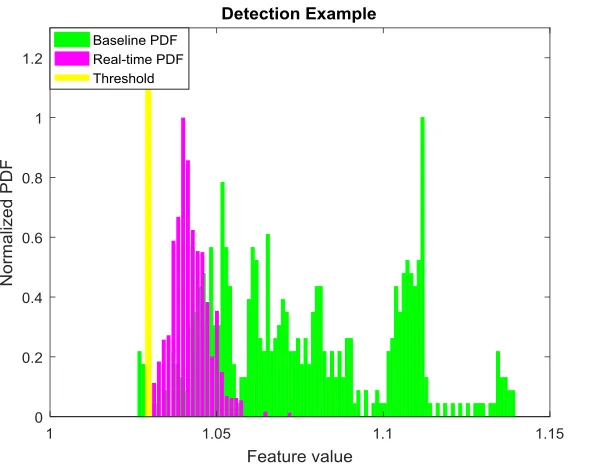
Figure 4.2 Detection is performed by comparing the baseline pdf (healthy battery) and the real-time pdf (based on model and measurement). The threshold is
determined by the probability of false alarm. This figure shows an example of particle filter.
used to adjust the dependence of the state estimate upon the model or upon the
measurements.
Diagnosis
State estimate pdfs are calculated using the EKF linearized mean and the noise
covariances to calculate the spread of the estimate. This pdf is then compared to the
detection threshold, as illustrated in Fig. 4.2. Detection is performed by integrating
from -∞ to the threshold (for a decreasing fault mode like degradation of battery
capacity) or from the threshold to ∞ (for an increasing fault model, such as a crack
growing on a component). Once the probability of detection is greater than or equal
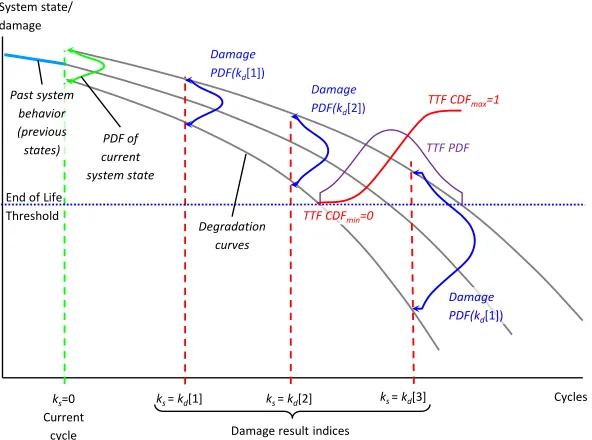
End of Life Threshold
Cycles ks=0
Current cycle Past system behavior (previous states)
ks= kd[1]
Damage result indices
ks= kd[2] ks= kd[3]
System state/ damage Degradation curves TTF PDF Damage PDF(kd[1])
Damage PDF(kd[2])
Damage PDF(kd[1])
PDF of current system state
TTF CDFmax=1
TTF CDFmin=0
Figure 4.3 The fault progression from EKF over time and the generation of RUL
pdfs from state estimate, or “damage”, pdfs with Gaussian distributions. Uncertainty grows in prognosis since there is no correction step.
Prognosis
Once prognosis is triggered, current state estimate is projected into the future using
the model in Eq. (4.1). Figure 4.3 illustrates the process by which state estimate pdfs
are converted to TTF or RUL distributions. The TTF is estimated using a Gaussian
distribution.
CDFTTF(k) =
Ff
Z
−∞
f(xk|µk, σ2k)dx (4.2)
As the state estimate crosses the EoL threshold, Ff, a cumulative distribution
function (cdf) is generated. Then the pdf of TTF can be calculated from the cdf.
4.1.2 PF FDP Implementation
The battery capacity model for PF is developed from empirical data, and is defined
as:
where C is battery capacity, k is the time index given by cycle number, p =
[92.5×10−4,2.9] are parameters, u is an unknown state, and ω is model noise. The
unknown state, u is used to represent dynamics not quantified by the model.
Diagnosis
The PF algorithm uses the model above and performs a one-step-ahead state estimate.
The following model for detection is augmented from the fault dynamic model in Eq.
(4.3).
"
xd,1(k+ 1)
xd,2(k+ 1)
#
=fb
" xd,1(k)
xd,2(k)
#
+n(k) !
xc(k+ 1) = [xc(k)−C(k)]·xd,2(k) +ωk
y(k) =xc(k) +v(k)
where, fb=
[1 0]T, if
x−[1 0]
T ≤
x−[0 1]
T
[0 1]T, else
(4.4)
is a nonlinear mapping, xd,1 and xd,2 are Boolean states that indicate normal and
faulty conditions, respectively, y(k) is the battery capacity from Coulomb counting,
ω(k) and v(k) are noise signals, and n(k) is i.i.d. uniform white noise. When a fault
is detected, xd,2 = 1. The initial condition is given by
h
xd,1(0) xd,2(0) xc(0)
i
= [1 0 0],
wherexc(0) is the initial battery capacity. With this model, a state estimate pdf is
calculated after SIR has been performed to provide the correct weighting. As detailed
in section 4.1.1, the detection algorithm compares this pdf to the detection threshold
and computes the probability of detection.
Prognosis
Similar to EKF prognosis, once prognosis is triggered, the particles in Eq. (3.15) are
projected into the future using the model in Eq. (4.3). Figure 4.4 illustrates how
End of Life Threshold
Cycles ks=0
Current cycle Past system behavior (previous states)
ks= kd[1]
Damage result indices
ks= kd[2] ks= td[3]
System state/
damage Degradation
curves
Damage PDF(kd[3])
Damage PDF(kd[2])
Damage PDF(kd[1])
PDF of current system state
TTF CDFmax=1
TTF CDFmin=0
TTF PDF
Figure 4.4 The fault progression from PF over time and the generation of RUL
pdfs from state estimate, or “damage”, pdfs using particles. Uncertainty grows in prognosis since there is no correction step.
particles less than the EoL damage threshold, Ff.
CDFTTF(k) =
N
X
i=1
wk(i)pfailure|x(ki)< Ff
(4.5)
4.2 Data Fusion
4.2.1 Uncertainty Quantification
In designing the uncertainty representation, the dataset including all of the Li-ion
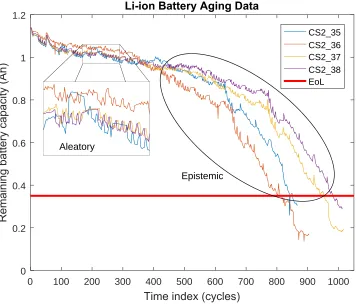
battery trajectories over time are investigated. Figure 4.5 shows how aleatory and
epistemic uncertainty are represented separately. In this case,aleatory uncertainty is
evidenced by the random noise in the battery capacity. In our implementation below,
EKF and PF have “noise terms”, which can be tuned to account for this uncertainty
To quantify this uncertainty, Eq. (4.6) is derived. The spread, S, of the function
is represented by 2·σ2, where σ2 is the variance. If either of the sources exceeds
the spread limit, Smax, its contribution to the DST combination is ignored. Smax is
defined as 0.3 Ah for battery capacity state in diagnosis, and 300 cycles for battery
EoL in prognosis. The aleatory uncertainty,Ual, is represented as
Ual(k) = S Smax
(4.6)
Although our models include an unknown state to account for the variety of
trajectories, they do not capture all possible variation in trajectory. This
unaccounted-for variation in trajectory is classified as epistemic uncertainty.
Beginning at cycle 400, epistemic uncertainty appears to increase with time. This
uncertainty is quantified in our implementation as a time-varying function, Eq. (4.7),
given as
Uepi(k) = (1−Ual,k)·
1 +e−γ·(k−koff) (4.7)
where:
is the maximum uncertainty, [0,1]
γ is the rate-of-change in uncertainty, [0,1]
koff is the offset cycle at whichUepi reaches 2
Equation (4.7) indicates that the uncertainty in a given estimator grows over time,
but does not increase beyond a designated maximum. The modified sigmoid function
provides a nice framework to represent bounded uncertainty with a growth rate that
varies with charge-discharge cycle. Forγ = 0, the epistemic uncertainty is assumed to
be constant for all cycles. Since uncertainties must be independent from one another
(as required by the DST framework, the general uncertainty function is modified for
each state predictor, depending upon the experimental performance of each state
predictor at specific instances, Fig. 4.6, which represents experimental testing. EKF
0 100 200 300 400 500 600 700 800 900 1000 0
0.2 0.4 0.6 0.8 1 1.2
CS2_35 CS2_36 CS2_37 CS2_38 EoL
Aleatory
Epistemic
Figure 4.5 Aleatory and epistemic uncertainty represented for Li-ion battery.
However, as the current cycle k approaches the failure threshold kEoL, both PF and
EKF perform with similar accuracy. This epistemic uncertainty representation can
be improved by performing further experimentation on more Li-ion battery data.
4.2.2 Mass Selection for Healthy and Faulty Battery
Once the uncertainty is properly accounted for, the remaining two states are
considered. The bba for thefaultystate is assigned as shown in Eq. (4.8) for diagnosis
and in Eq. (4.9) for prognosis:
mf(k) =p(failure|xk < η)·(1−Ual,k−Uepi,k) (4.8)
Figure 4.6 Unmodeled uncertainty functions for each RUL prediction alogrithm.
where η is the fault detection threshold, ξ is the failure threshold when the Li-ion
battery has reached EoL, and p(·) is a probablity function. The healthy state bba
is simply mh(k) = 1−(Ual,k+Uepi,k +mf,k), which satisfies the requirement in Eq.
(3.19) for the sum of the bba’s of all sets be equal to 1.
4.2.3 Combination of Masses
Similar to the example described in section 3.3, Table 4.1 shows the developed
combination table using the bba’s for the four states developed in the above sections.
The green color box area represents the contradictory evidence (i.e. where EKF and
PF estimate directly opposing results for the two primary hypotheses: healthy or
faulty battery state). The purple color box, m(F), contains the bba combinations
where EKF and PF agree with one another. Agreement is quantified in two ways:
1. EKF and PF both believe that the battery is faulty (i.e. m1(µ2)·m2(µ2))
2. Either EKF or PF believes the battery is faulty and the other has a degree of
The combined uncertainty is represented by the cyan color box, m(U). Equation
(4.10) is the application-specific DST combination for each prediction cycle.
Observations of faulty states have been combined with each of the uncertain states
in this architecture. The separation of uncertainty into separate categories allows
for interesting results. For instance, even though the prediction spread, described
by aleatory uncertainty, Ual in Eq. (4.6), and µ3 in Table 4.1, tends to decrease for
both EKF and PF as the current cycle k approaches kEoL, it is possible for EKF
and PF to deviate significantly from one another. With the addition of the epistemic
uncertainty of modeling error, described by Uepi in Eq. (4.7), and µ4 in Table 4.1,
DST can compensate its fusion using the experimental performance of EKF and PF.
This also mitigates the problem of disjointed sets. The DST algorithm computes Eq.
(4.10) for each cycle.
m(F) =m(µ2)·m(µ2)+m(µ2)·m(µ3)
+m(µ2)·m(µ4)
m(U) =m(µ3)·m(µ3)+m(µ3)·m(µ4)
+m(µ4)·m(µ4)
PF(k) =
P m(F)
1−P
m(µ1)·m(µ2)
PU(k) =
P m(U)
1−P
m(µ1)·m(µ2)
(4.10)
where PF is the belief that a battery fault is detected (diagnosis) or the belief that
the battery capacity has degraded to the EoL (prognosis), and PU is the belief of
uncertainty. For diagnosis, PF is used directly to assess whether the battery capacity
is sufficiently degraded to trigger prognosis.
For each cycle of prognosis, Eq. (4.10) is calculated recursively until k reaches
kEoL. These results produce a cdf, as shown in Fig. 4.7. Notice that the cdf never
reaches “1”. This is representative of the fundamental difference between probabilities
Table 4.1 The combination of different states within DST framework. m1 and m2
represent mass functions for EKF and PF, respectively. µ1, µ2,µ3, µ4 indciate
healthy state, faulty state, aleatory uncertainty, and epistemic uncertainty, respectively.
PF
Healthy Faulty Uncertaintyal Uncertaintyepi
m2(μ1) m2(μ2) m2(μ3) m2(μ4)
EKF
Healthy m1(μ1) m1(μ1)·m2(μ1) m1(μ1)·m2(μ2) m1(μ1)·m2(μ3) m1(μ1)·m2(μ4)
Faulty m1(μ2) m1(μ2)·m2(μ1) m1(μ2)·m2(μ2) m1(μ2)·m2(μ3) m1(μ2)·m2(μ4)
Uncertaintyal m1(μ3) m1(μ3)·m2(μ1) m1(μ3)·m2(μ2) m1(μ3)·m2(μ3) m1(μ3)·m2(μ4) Uncertaintyepi m1(μ4) m1(μ4)·m2(μ1) m1(μ4)·m2(μ2) m1(μ4)·m2(μ3) m1(μ4)·m2(μ4)
not apply to bba’s. Because of the uncertainty quantification, this belief cdf will never
reach one. The belief density function (bdf) is then derived from the belief cdf. In
order to compare the results from DST to the pdfs generated by the EKF and PF
algorithms in prognosis, the bdf is normalized with its maximum value such that the
integral over the range is equal to one, similar to a pdf. Also shown in Fig. 4.7 is the
uncertainty, PU. The uncertainty increases about the combination point, which in
this application is the EoL, while elsewhere, the uncertainty is flat. This is expected
because at the point of combination the normalization denominator varies as EKF
and PF RUL trajectories cross the EoL threshold. Prior to kP, the uncertainty is
kP EoL
Figure 4.7 The graph depicts the belief distributions generated by DST fusion for
prognosis. PU is the belief uncertainty and PF is the belief that the battery has
Chapter 5
Discussion of Results
5.1 Fault Detection Results
Each algorithm calculates change inprobability of failure (PoF) over time. Figure 5.1
shows the PoF after incorporating each algorithm’s uncertainty into its PoF. The PF
provides earlier indication of fault than EKF, but due to its larger uncertainty, DST
“trusts” EKF more. This normalization is calculated as follows:
PoFnorm =PoF·(1−ζ) (5.1)
where ζ is the uncertainty. Using normalized PoF’s, DST is the clear leader, as its
uncertainty is an order of magnitude lower than that of either PF or EKF, as shown
in Tables 5.2 - 5.5. To minimize false alarms, algorithms must detect fault for 3 cycles
before a fault is declared and prognosis is triggered. These values are calculated at
the point of detection for each algorithm, using a detection threshold of 90%. Even
though the inital PoF for EKF and PF are higher initially, they have a higher degree
of uncertainty. Table 5.1 shows the resulting TTFs for each battery at the point of
detectionfor each algorithm. Even though the margin of detection is is low across the
alogorithms, DST demonstrates increased performance over either algorithm on its
own. In practice, DST is used to trigger prognosis since it detects a fault earlier than
Table 5.1 TTF Comparison
Battery PF EKF DST Longest Window
CS2_35 690 688 694 DST
CS2_36 605 641 657 DST
CS2_37 691 783 793 DST
CS2_38 784 799 814 DST
Table 5.2 PoF and Uncertainty Comparison for CS2_35
Algorithm PoF (%) Uncertainty PoFnorm (%)
EKF 96.5 0.058 90.8
PF 100 0.093 90.7
DST 95.7 0.007 95.0
Table 5.3 PoF and Uncertainty Comparison for CS2_36
Algorithm PoF (%) Uncertainty PoFnorm (%)
EKF 98.3 0.052 93.2
PF 100 0.088 91.2
DST 92.7 0.007 92.0
Table 5.4 PoF and Uncertainty Comparison for CS2_37
Algorithm PoF (%) Uncertainty PoFnorm (%)
EKF 97.3 0.052 92.2
PF 100 0.098 90.2
DST 93.0 0.006 92.3
Table 5.5 PoF and Uncertainty Comparison for CS2_38
Algorithm PoF (%) Uncertainty PoFnorm (%)
EKF 96.2 0.051 91.3
PF 100 0.097 90.3
Detection threshold
Detection threshold
Detection threshold
Detection threshold
Figure 5.1 Probability of failure detection results, after normalizing PoF with
uncertainty.
5.2 Prognostic Results
Prognosis begins at kP, the point at which the detection algorithms above signal
that the Li-ion battery has aged. RUL is calculated based upon the expected and
mean value for PF and EKF, respectively. Figure 5.2 shows how the mean RUL is
calculated for each measurement. Performance metrics of 95% confidence intervals
(C.I.) are used to calculate theprediction spread,m(µ3), in Table 4.1.
Each dataset is tested and results from α-λ tests are shown in Table 5.6. This
effectively compares how well each algorithm remained within the α-bounds over the
k
Figure 5.2 The trajectory of PF and EKF prognosis beginning at kP, shown with
confidence bounds.
Table 5.6 α-λ Results with α = 0.3 & β = 0.85
Battery PF EKF DST
CS2_35 36.2% 60.2% 42.0%
CS2_36 84.7% 71.1% 76.3%
CS2_37 89.7% 96.3% 92.3%
CS2_38 83.7% 83.4% 83.1%
for DST lay in between that of EKF and PF for CS2_35 - CS2_37, and performs on
par with EKF and PF for CS2_38.
Figures 5.3 - 5.6 show the α-λ plots (with uncertainty bounds shown). DST
successfully incoporates the uncertainty within EKF and PF. This is especially
evident when EKF and PF RUL predictions are substantially different. Since EKF
and PF are separated from one another, the total uncertainty spread for DST
incorporates these results and produces a wider bdf, even though the expected value
batteries, RA and CRA are calculated for every cycle, rather than selecting specific
λ’s of interest. As shown in these plots, DST primarily tracks the algorithm with
the highest demonstrated accuracy, which is the desired performance. For battery
CS2_37, this behavior is not observed as prediction are in the neighborhood of the
EoL, kEoL. This can be attributed to the epistemic uncertainty functions. Near
the EoL, PF produces very narrow confidence bounds, though its mean value may
still deviate unacceptably from the baseline, r∗(k). EKF on the other hand does
not produce confidence bounds as tight, and due to the assumption of modeling
uncertainty made in Fig. 4.6, EKF and PF are treated essentially as equals,
with exception to these confidence bounds. Further experimentation may result in
(a)
(b)
(c)
(d)
Figure 5.3 Results for CS2_35 Li-ion battery. The upper and lower bounds for
each algorithm are shown. (a) EKF α-λ plot, (b) PF α-λ plot, (c) DST α-λ plot,
(a)
(b)
(c)
(d)
Figure 5.4 Results for CS2_36 Li-ion battery. The upper and lower bounds for
each algorithm are shown. (a) EKF α-λ plot, (b) PF α-λ plot, (c) DST α-λ plot,
(a)
(b)
(c)
(d)
Figure 5.5 Results for CS2_37 Li-ion battery. The upper and lower bounds for
each algorithm are shown. (a) EKF α-λ plot, (b) PF α-λ plot, (c) DST α-λ plot,
(a)
(b)
(c)
(d)
Figure 5.6 Results for CS2_38 Li-ion battery. The upper and lower bounds for
each algorithm are shown. (a) EKF α-λ plot, (b) PF α-λ plot, (c) DST α-λ plot,