Extractors for Adversarial Sources via Extremal Hypergraphs
Eshan Chattopadhyay∗ Cornell University [email protected]
Jesse Goodman∗ Cornell University [email protected]
Vipul Goyal†
Carnegie Mellon University [email protected] Xin Li‡
Johns Hopkins University [email protected]
December 13, 2019
Abstract
Randomness extraction is a fundamental problem that has been studied for over three decades. A well-studied setting assumes that one has access to multiple independent weak random sources, each with some entropy. However, this assumption is often unrealistic in prac-tice. In real life, natural sources of randomness can produce samples with no entropy at all or with unwanted dependence. Motivated by this and applications from cryptography, we initiate a systematic study of randomness extraction for the class ofadversarial sources defined as follows. A weak sourceXof the formX1, ...,XN, where eachXiis onnbits, is an (N, K, n, k)-source
of localitydif the following hold:
1. Somewhere good sources: at least K of the Xi’s are independent, and each contains
min-entropy at leastk. We call theseXi’sgood sources, and their locations are unknown.
2. Bounded dependence: each remaining (bad) source can depend arbitrarily on at most
dgood sources.
We focus on constructing extractors with negligible error, in the regime where most of the entropy is contained within a few sources instead ofacross many (i.e.,kis at least polynomial in K). In this setting, even for the case of 0-locality, very little is known prior to our work. For d ≥ 1, essentially no previous results are known. We present various new extractors for adversarial sources in a wide range of parameters, and some of our constructions work for localityd=KΩ(1). As an application, we also give improved extractors for small-space sources. The class of adversarial sources generalizes several previously studied classes of sources, and our explicit extractor constructions exploit tools from recent advances in extractor machinery, such as two-source non-malleable extractors and low-error condensers. Thus, our constructions can be viewed as a new application of non-malleable extractors. In addition, our constructions combine the tools from extractor theory in a novel way through various sorts of explicit extremal hypergraphs. These connections leverage recent progress in combinatorics, such as improved bounds on cap sets and explicit constructions of Ramsey graphs, and may be of independent interest.
∗
Supported by NSF grant CCF-1849899. †
Supported in part by NSF grant 1916939, a gift from Ripple, a JP Morgan Faculty Fellowship, and a Cylab seed funding award.
‡
1
Introduction
The use of randomness is widespread in computer science, particularly in areas such as cryptog-raphy, algorithm design, and distributed computing. Randomness is also useful in running Monte Carlo simulations of complex systems and in various sampling tasks. It is often the case that these applications crucially need access to high-quality randomness, i.e., a stream of uniform and indepen-dent bits. For instance, it was shown [DOPS04] that it is impossible to do basic cryptographic tasks such as bit commitment schemes and secret sharing schemes without access to high-quality random bits. This poses a challenging problem since most sources of randomness in nature are typically far from producing pure random bits, and in fact produce a stream of correlated bits containing little or no entropy. In addition, even originally high quality random bits can be compromised adversarially by side channel attacks.
The area of randomness extraction is motivated by the above problem. Informally, a randomness extractor is adeterministic algorithm that purifies a weak random source to produce a distribution that is close to uniform. As is standard in this area, we measure the randomness of a weak source
X using min-entropy, defined as:
H∞(X) := min
x {−log(Pr[X=x])}.
Define an (n, k)-source to be a distribution on{0,1}n with min-entropy at leastk, and the entropy
rate to be k/n. Thus, if Xis an (n, k)-source, then for any x∈ {0,1}n, we have Pr[X=x]≤2−k.
Definition 1.1. Let X be a family of distributions over {0,1}n. We say that a function Ext :
{0,1}n→ {0,1}m is an extractor for X with error if, for allX∈ X,
|Ext(X)−Um| ≤.
Here | · | refers to the standard statistical distance, Um denotes the uniform distribution on
m bits, and is known as the error of the extractor. A folklore result shows that it is impossible to extract even one random bit from a single (n, k)-source. More precisely, there cannot exist an extractor Ext:{0,1}n→ {0,1} such that for any (n, n−1)-source X,|Ext(X)−U
1|<1/2.
Given the above bottleneck, there are two major directions that researchers have explored in randomness extraction over the last 3 decades. The first is to assume access to a short independent uniformseed Udto extract randomness out of a single (n, k)-source X. Such extractors are called
seeded extractors, and from a beautiful line of work we now have constructions with near optimal parameters [LRVW03,GUV09,DKSS13].
The second direction, which is more relevant to this paper, assumes special structures in the weak source X. In particular, the most well studied model assumes that X is of the form
X1,X2, . . . ,XC, where each Xi is an independent (n, k)-source. Indeed, recently there has been
of randomness extraction in the presence of adversarial sources is thus a natural generalization of the well-studied model of independent sources, and may eventually help us build better random number generators for computers. To the best of our knowledge, little work has been done in this setting, and in this paper we seek to initialize a systematic study of this natural question.
1.1 Adversarial sources
To capture the setting discussed above, we generalize the model of independent sources in two non-trivial ways and introduce the class of adversarial sources.
Definition 1.2. Let N, K, n, k, dbe nonnegative integers. A distribution X =X1, . . . ,XN, where each Xi is on n bits, is called an(N, K, n, k)-source of locality d, if the following conditions hold:
1. Somewhere good sources: There is a set S ⊆ [N], |S| ≥ K such that for any i ∈ S,
H∞(Xi)≥k. We call the sources Xi, i∈S good sources and the remaining bad sources.
2. Bounded dependence: The set of good sources are independent, and each bad source can depend arbitrarily on at most dgood sources.
As discussed before, the somewhere good sources condition captures the natural setting where a physical source of randomness (e.g., a Zener diode) outputs a stream of bits, where entropy is localized in certain unknown chunks. The bounded dependence condition captures possible troublesome dependence between chunks of different bits. As it turns out, our model also has natural motivations from cryptography.
In the domain of cryptography, extractors for adversarial sources may allow us to generate a uniform random string with the help of several parties each having an imperfect random source, even if some of these parties are adversarial. As a simple example, consider coin flipping protocols with synchronous channels. If all parties simply broadcast their strings, we get several strings which are good (but imperfect) and some other strings which can be adversarially chosen (though independent of the good strings). By applying an extractor for adversarial sources with 0-locality, one can then obtain a uniform random string. Going to asynchronous channels, the strings of adversarial parties may depend on a set of good strings due to the order of messages in the protocol, and hence extractors for adversarial sources with larger locality can be useful.
As another example, several primitives in cryptography such as non-interactive zero knowledge (NIZK) require a random “common reference string” (CRS). A number of works have investigated the setting where the CRS might be imperfect [CPS07,LPV09] and even the setting where there are multiple CRS and some of them may be adversarially chosen [GK08,GGJS11,GO14] (but the good ones are uniform). Extractors for adversarial sources may allow us to handle the second setting.
1.2 Summary of our results
We will be mainly interested in extracting from (N, K, n, k)-sources of locality din the negligible error setting, motivated by applications in cryptography. Further, we will focus on the setting
k ≥ Kγ, for any constant γ > 0 (i.e., entropy is more concentrated within a few sources, rather
than spread across them; or, roughly, there are a few long sources). Here, our goal is to construct extractors with output and error of the form m = kΩ(1), = 2−kΩ(1)
case of 0-locality, where the work of Kamp et al. [KRVZ06] implies negligible error extractors for (N, K, n, k)-sources, as long asKk≥(N n)1−γ, for some tiny constantγ >0 arising from estimates
in additive combinatorics. For the case ofd-locality withd≥1, to the best of our knowledge there are no known previous results. We discuss other related prior work inSection 1.3.
In our first three main theorems, we construct an explicit extractor for adversarial sources that produces polynomially many bits with negligible error, even if the good sources have just
poly-logarithmic entropy. Several of our extractors use the small parameter RN, which we define below.
Definition 1.3. We let RN denote the smallest number such that there exists an explicit con-struction of bipartite Ramsey graphs over 2N vertices with no bipartite clique nor independent set of size 2RN. Currently, RN = (logN)o(log logN), and this also holds for non-bipartite Ramsey graphs [Li19].
In our first main theorem, we extract from (N, K, n, k)-sources of locality 0, given justK ≥ R2
N
good sources, as long as one extra condition holds:
Theorem 1. There exist universal constantsC, γ >0such that for allN, K, n, k∈Nsatisfyingk≥
logCnand K ≥ R2
N, there exists an explicit extractor Ext: ({0,1}n)N → {0,1}m for (N, K, n, k) -sources of locality 0, with output length m=kΩ(1) and error = 2−kΩ(1), provided N ≤kγ.
Thus, for 0-local sources, we obtain extractors for extremely smallkandK, under the condition that the number of sources is not too large compared to the entropy in the good sources, i.e.,N ≤kγ.
It is natural to ask if we can completely remove this restriction. Our second main theorem does exactly this.
Theorem 2. There exists a universal constant C > 0 such that for all N, K, n, k ∈ N satisfying
k ≥ logCn and K ≥ √N· R
N, there exists an explicit extractor Ext : ({0,1}n)N → {0,1}m for
(N, K, n, k)-sources of locality 0, with output lengthm=kΩ(1) and error= 2−kΩ(1) .
Thus, we see that if we increase the number of good sources from K≥No(1) toK ≥N0.5+o(1),
we are able to remove any restriction betweenN andk. Our third main theorem shows that, in fact, we can extend our constructions to handle polynomial locality. We state an interesting parameter setting of our more general theorem (Theorem 5.1) here:
Theorem 3. There exist universal constants C, γ >0 such that for all N, K, n, k, d∈Nsatisfying
k≥logCnandK ≥N1−γ, andd≤Kγ, there exists an explicit extractorExt: ({0,1}n)N → {0,1}m for (N, K, n, k)-sources of locality d, with output length m =kΩ(1) and error = 2−kΩ(1)
, provided
N ≤kγ.
We also show (non-explicitly) that extractors with negligible error exist for adversarial sources that contain just K=Nα good sources and have locality d=K1−α, for any constant α >0.
Theorem 4. For any constant 0 < γ < 1 there exists a constant α > 0 such that for all
N, K, n, k, d ∈ N satisfying k ≥ (1 +γ) logn and K ≥ Nγ, and d ≤ K1−γ, there exists a
(pos-sibly non-explicit) extractor for (N, K, n, k)-sources of locality d with output length m=kΩ(1) and
The theorem that we prove is actually more general (see Theorem 7.2), and the proof makes use of a more robust variant of seedless non-malleable extractors that we introduce. We also show that it is impossible to construct an extractor for adversarial sources if half of the sources are good, but each bad source can depend on all the good sources. For more details, we refer the reader to
Section 7.
Finally, we show that our constructions also give improved extractors for sources sampled by algorithms that have limited memory, in the negligible error regime. These sources were initially studied by [KRVZ06], and fit into the line of work initiated by [TV00] on extracting from sources that are samplable using limited resources.
Theorem 5. For any fixed γ > 0 and all n, k, s ∈N satisfying k≥n2/3+γ and s ≤(k/n)3+γ·n, there exists an explicit extractor Ext:{0,1}n→ {0,1}m for spaces sources of min-entropyk, with output length m=nΩ(1) and error = 2−nΩ(1)
.
Previously, the best extractor for s-space sources [KRVZ06] with negligible error required min-entropy k≥n1−γ (for some tiny constant γ >0) for about the same space s≤(k/n)3n, and had
error 2−nΩ(1)
. In the same paper, Kamp et al. reduce the entropy requirement tok > n0.81for space
s= 1 sources with an extra restriction. We note thatTheorem 5 reduces the entropy requirement tok > n0.67, and works for large space with no such restrictions.
We present an overview of our techniques and explicit constructions in Section 2, but first we review some relevant prior work.
1.3 Relevant prior work
Relation of adversarial sources to other structured sources Special cases of adversarial sources are studied by works on randomness extraction for some other kinds of sources in prior work. Hence our model of adversarial sources can also be viewed as a generalization of several previous models. We discuss some details below.
• Bit-fixing sources: Oblivious bit-fixing sources correspond to (N, K, n, k)-sources of locality 0, withn=k= 1. Thus, they are distributions on{0,1}N, with some unknownK coordinates
being uniform and independent, while the rest of the bits are fixed and do not depend on the random bits. They are studied in the works [CGH+85,KZ06,GRS06]. The best known
extractors in different regimens of error are the following: (i) Kamp and Zuckerman [KZ06] constructed an extractor that works for any K > 0 with error 1/poly(K), and (ii) Rao [Rao09b] constructed an extractor that works for any K≥poly(logN) with error 2−KΩ(1)
.
Non-oblivious bit-fixing sources allow the non-random bits to arbitrarily depend on the ran-dom bits. Thus, they correspond to (N, K,1,1)-sources of locality K. The best known results [Mek17,CZ19] can handle K ≥N −O N
log2N
, with error 1/NΩ(1). The KKL
theo-rem [KKL88] implies that the best K one could hope for in this setting isN −OlogNN.
there is no non-trivial construction of extractors for non-oblivious symbol-fixing sources other than using known extractors for non-oblivious bit-fixing sources.
• Independent sources: The most well-studied model of seedless extraction assumes that the weak sourceXis of the formX1,X2, . . . ,XC, where eachXi is anindependent (n, k)-source.
Thus, these sources correspond to (C, C, n, k)-sources of locality 0. The probabilistic method provides existential proof of extractors for such sources, called C-source extractors, with strong parameters. In particular, it can be shown that there exists a 2-source extractor with errorfork≥logn+ 2 log(1/) +O(1).
An explicit construction of a 2-source extractor was given by Chor and Goldreich [CG88], but they required min-entropy k > n/2 for both of the sources. The entropy requirement was marginally improved by Bourgain [Bou05] tok >0.499n, and Raz [Raz05] improved the entropy requirement of one of the sources toO(logn) (but required the other source to have entropy> n/2). Recently, an impressive line of work [Coh16b,CL16a,Li16,BADTS17,Coh17,
Li17,Mek17,BDT18,CZ19,Li19] improved the entropy requirement to (logn)1+o(1). However,
the recent progress has a major drawback in terms of the error parameter, and in particular, the best known 2-source extractor construction for error = 1/nω(1) requires min-entropy
(1/2−δ)n, for some small constant δ [Bou05,Lew19].
Assuming access to 3 or more independent sources, a long line of work [BKS+05,BIW06, Rao09a,Li11a,Li13a,Li13b,Li15b,Coh16a] explicitly constructed excellent extractors. In particular, Li [Li15b] constructed an explicit 3-source extractors with k ≥ poly(logn) and error 2−kΩ(1)
.
Also closely related to adversarial sources are total entropy sources. Introduced by Koenig and Maurer [KM05], an (N, n,Γ)-total entropy source consists ofN independent sources of length
n such that the sum of min-entropies across the sources is at least Γ. Thus, an (N, K, n, k )-source of locality 0 is an (N, n, Kk)-total entropy source. Plugging in the best known extractor for total entropy sources in the regime of negligible error [KRVZ06] implies an explicit extractor for (N, K, n, k)-sources of 0-locality with error 2−nΩ(1)
as long as Kk ≥ (N n)1−γ, for some tiny
constantγ that arises from sum-product estimates in additive combinatorics.
Kamp et al. [KRVZ06] constructed total entropy extractors in another extreme setting of pa-rameters, where there are a large number of short sources. Their results imply explicit extractors for (N, K, n, k)-sources of 0-locality, as long as Kk ≥ ω(2n√N n). The error of the extractor is
2Ω(−(Kk)2/(N n22n))
, and the extractor runs in time poly(N,2n). Thus, this gives an explicit
con-struction with negligible error as long as n=o(logN) (i.e., the number of sources is exponential in the length of the sources).
Finally, in the regime of larger error, Chattopadhyay and Li [CL16b] constructed an ex-plicit extractor for (N,2, n,poly(logn))-sources of locality 0. They refer to these sources as (n,poly(logn), N)-somewhere-2 sources, and the error of the extractor in their construction is
= 1/nΩ(1).
Other models of seedless extraction Apart from the models discussed above, other examples of structured sources that have been studied by researchers include affine sources [Bou07,Li11b,
Comparison to SHELA sources Very recently, a work by Aggarwal et. al. [AOR+19]
intro-duced another model that generalizes independent sources by allowing dependence, which they call SHELA (Somewhere Honest Entropic Look Ahead) sources, and studied randomness extraction in this model. Although similar in spirit to our model, there are several important differences.
First, both models can be viewed as a stream of ` sources, where some unknown tsources are good, and the positions of the good sources are selected by an adversary. The rest of the sources are bad and can depend on the good sources. However, in the model of SHELA sources, the dependence is only one-way: any bad source can only depend on good sources that come before it, and hence the name “look-ahead”. In contrast, in our model the dependence of bad sources on good sources can go both ways: a bad source can depend on good sources both before it and after it. In this sense our model is more general than theirs.
Second, [AOR+19] shows that if the fraction of good sources is any constant γ, then it is
impossible to achieve randomness extraction from SHELA sources if the number of blocks ` is a large enough constant depending onγ. Thus, the authors turn to a less ambitious goal: to obtain from such sources a convex combination ofsomewhere random sources. A “T-out-of-L” somewhere random source is a sequence of L sources, where some fixed but unknown T sources are jointly independent and uniformly distributed, while the other sources can have arbitrary dependence on theT sources. Aggarwal et al. show that they can construct efficientsomewhere extractors which output a convex combination of T-out-of-L somewhere random sources with a smallL, when the fraction of good sources γ is any constant. They then show that these somewhere random sources can still be used in several cryptographic applications. In contrast, our results build real randomness extractors for adversarial sources, and thus the outputs in our constructions are truly close to uniform, instead of being only somewhere random. Hence, they can be used in all cryptographic applications universally. Moreover, we give explicit constructions even when the fraction of good sources is sub-constant (e.g., K =N1−γ for some constant γ), as compared to a constant fraction
in [AOR+19]. However, in order to circumvent the impossibility result in [AOR+19], we have to
limit our locality dto be not too large. In this sense, our model and the model in [AOR+19] are
incomparable.
Finally, the entropy requirement on good sources in our work is better than that in [AOR+19].
In [AOR+19] the constructions require the good sources to have linear min-entropy, while all our
constructions work for the case of k≥poly(logn).
Organization First, we provide an overview of our constructions inSection 2. Then, inSection 3, we define several preliminaries that will be important for formalizing these ideas. We present our main extractors for adversarial sources of locality 0 in Section 4. Then, in Section 5, we present our extractors for adversarial sources of polynomial locality. These extractors work best when most of the entropy is contained within the sources, rather than across them; we motivate this setting by giving a simple explicit construction for the complementary setting in Section 6. Next, we put our results in context by providing existential and impossibility results in Section 7. (Our existential results rely on a new generalized seedless non-malleable extractor; in Appendix A, we introduce these objects and prove their existence.) Finally, we show that our explicit constructions give improved extractors for total entropy and small-space sources in Section 8, and in Section 9
2
Overview of our constructions
At a high level, all our constructions use two key ideas. The first idea is to design a well-structured hypergraph around theN sources (represented as vertices), and try to extract separately from each hyperedge. While it is easy to guarantee that some (unknown) hyperedge produces uniform bits, we must produce asingle uniform string. Thus, we must combine the output from each hyperedge and hope that the uniform bits are not destroyed in the process. In all our constructions this is done by computing the XORof the outputs.
This brings us to our second key idea. In order for the XOR to work, we need to break the correlations between the uniform output bits from some hyperedge and the outputs from the other hyperedges. For this purpose we crucially rely on recent constructions ofnon-malleable extractors. We identify and explicitly construct certain classes of extremal hypergraphs with the following goals: to minimize the size of their largest independent set (for some general notion of independent set), while maintaining some sort of limited interaction between their hyperedges. The size of largest independent set controls the number of good sources we need, while the limited interaction will make it easier to break correlations between the random variables produced by the hyperedges, using the property of non-malleable extractors.
2.1 Extracting from 0-locality
Our first goal is to construct negligible-error extractors for (N, K, n, k)-sources of locality 0. As shown in [CL16b], for K = 2 and k = 0.51n, this is straightforward: we may simply call the 2-source Hadamard extractor (Theorem 3.2), Had, over all pairs of sources, and take the bitwise
XORof the results. This works because some call toHadmust use the two good sources (call them
Xand Y), and the remaining calls use at most one of X,Y. If we fix theXORof the calls that use
X but notY, we introduce no correlation between them, and Lemma 3.9tells us that the entropy ofX drops by very little. We can do the same for the calls that useY but not X. This shows that with high probability, the last remaining call to Had outputs near-uniform bits, and they remain uniform after taking their bitwise XORwith the fixed bits.
It is natural to ask if we can extract with negligible error from much smaller k, if we allow larger K. Because there exist explicit constructions of negligible-error three-source extractors for polylogarithmic entropy (Theorem 3.3), the naive idea would be to alter the above construction to call a three-source extractor 3Ext over all triples of sources, and XOR the results. It is true that for just K = 3, some call to 3Ext in this construction is guaranteed to use three good sources. However, it will also be the case that there are other calls that use two of the good sources, and we cannot fix these outputs without introducing correlation between them. Thus, this idea fails.
In order to replace Hadin the above construction with a different extractor (say, 3Ext) that can handle lower entropy, we must do something more clever than just applying3Ext over all triples of sources. The main idea behind our 0-local extractors is that we must carefully select triples over which to call 3Ext, in order to ensure two properties:
1. Activation: givenK good sources, some call to3Extis guaranteed to use three good sources.
If we can accomplish this, then we can reduce the entropy requirement of the good sources from
k= 0.51ntok= logCn, for some universal constantC≥1. This can be easily achieved if we have
K > 2N/3 good sources by simply calling 3Ext over disjoint sets of sources. However, we want to accomplish the above using as few good sources, K, as possible. To do this, we will design a hypergraph over N vertices whose hyperedges will be used to select triples of sources (vertices) on which to call 3Ext.1 The hypergraph will have a structural constraint that will guarantee fragile
correlation, and we seek such a hypergraph with the smallest possible max independent set (for some generalized notion), which roughly corresponds to the number of sources needed foractivation.
TheSTS-extractor To be more concrete, we must answer the following question: what structure must a 3-uniform hypergraph have such that if some hyperedge is activated (contains three good sources), then every other hyperedge makes a call to 3Ext that can be safely fixed without ruining the output of the call to 3Ext from the activated hyperedge? One answer is to enforce that each pair of hyperedges share at most one source. In particular, if the activated hyperedge contains good sources X,Y,Z, then every other hyperedge contains at most one of these. Thus, fixing the outputs of the other hyperedges does not introduce correlation betweenX,Y,Z, and we can again useLemma 3.9 to show that such fixings only decrease their entropy by just a little.
Thus, we can ensure fragile correlation by selecting sources using a hypergraph with the following property: no two hyperedges share more than one vertex. Such hypergraphs are well-studied in combinatorial design theory, and are known aspartial Steiner triple systems(STS’s). Furthermore, recalling that an independent set in a hypergraph is a set of vertices that contains no hyperedge, we see that we can guarantee activation using just K sources if the partial Steiner triple system contains no independent set of size K (equivalently, it should have independence number α < K).
We therefore construct a so-called STS-extractor for (N, K, n, k)-sources of locality 0 as follows. LetH = (V,E) be an STS overN vertices, and define stsExtH : ({0,1}n)N → {0,1}m as:
stsExtH(X) :=
M
(h,i,j)∈E
3Ext(Xh,Xi,Xj).
For a more precise definition, seeDefinition 4.6, and for an illustration, seeFigure 1a.
As per our discussion, this will successfully extract uniform bits as long asKexceeds the size of the largest independent set inH. Furthermore, it inherits thepolylogarithmic entropy requirement of 3Ext (Theorem 3.3), along with itspolynomially large output length and negligible error. Thus, the challenge is to explicitly construct anSTSH= (V,E) overN with smallα. We achieve such an explicit construction by identifyingV withFlog3 N, identifyingEwith the lines inF
logN
3 , and showing
that recent bounds on the cap set problem [CLP17,EG17] immediately imply α ≤O(N0.923). As
a result, instantiatingstsExtwithH yields an explicit extractor for polynomially few good sources (see Theorem 4.1).
It would be nice if we could extract from even fewer good sources. However, lower bounds on the cap set problem [Ede04] show that we cannot use lines in Flog3 N to achieve better than
K ≥ N0.724, and impossibility results on Steiner systems [RˇS94] show that one cannot hope to
achieve K √NlogN using these objects. Thus, we need new ideas if we want to drastically decrease K.
The wedge-extractor Towards this end, we show thatSTS’s actually have more structure than is required for fragile correlation. Indeed, we show that if we replace 3Ext with a more robust
three-source extractor3Ext+, we can extract using a much larger class of hypergraphs, and thereby reduce the size K needed for activation. In particular, in order to construct 3Ext+, we make use of two recent advances in extractor theory. First, we will use a two-source non-malleable extractor,2nmExt, which is a robust variant of a two-source extractor that, given two independent sourcesX,Y, outputs bits2nmExt(X,Y) that look uniformeven conditioned on knowing the value of 2nmExt(f(X), g(Y)) or 2nmExt(g(Y), f(X)), where f, g are so-called tampering functions that have no fixed points (see Definition 3.6 for a formal definition). If the output of 2nmExt looks uniform even conditioned on its output under up totpairs of tampering functions, we say 2nmExt
has degree t. The motivation behind using these objects is as follows: previously, if we fixed any random variables that depended on two of the good sources, we would introduce correlation between them. This will no longer be the case, and thus we have more power to ensure fragile correlation.
Second, we will use a two-source condenser, 2Cond, which is a weaker version of a two-source extractor that only guarantees its output to have high entropy rate. 2Cond will also be strong, in the sense that it will work even conditioned on fixing its second source, with high probability (Theorem 3.4). The motivation here is that2nmExt only works for sources with high entropy, and
2Condis able to condense a source with just polylogarithmic entropy into one (on fewer bits) with almost full entropy. Thus, we can maintain our requirement thatk= logCn. Our new robust three-source extractor is defined as 3Ext+(X1,X2,X3) :=2nmExt(2Cond(X1,X3),2Cond(X2,X3)).2
We again consider the following question, with respect to our robust three-source extractor: what structure must a 3-uniform hypergraph have such that if some hyperedge is activated, then every other hyperedge makes a call to3Ext+ that can be safely fixed without ruining the output of the call to 3Ext+ from the activated hyperedge? We notice that here, each call to 3Ext+ requires us to specify three sources, and indicate one of these to bespecial, in that it will be reused in both calls to 2Cond. One way to encode this information is as a hyperedge A of size 3, containing a hyperedgeB of size 2 (which leaves out the special source; we callB therepresentative edge ofA). Thus, we consider using hypergraphs that have hyperedges of the above form to make calls to
3Ext+. We now argue the following: if we construct such a hypergraph such that the representative edgeB of a hyperedgeA is also the representative edge of any other hyperedge containing both its vertices (call this representative edge agreement), then we can satisfy fragile correlation. Consider such a hypergraph, and suppose it has an activated hyperedgeAthat contains three good sources,
X1,X2,X3, and a representative edge that holds X1,X2. If we fix all sources excluding X1,X2,
we can note a few things: first, by the strength of 2Cond, each of Y1 := 2Cond(X1,X3),Y2 :=
2Cond(X2,X3) are now independent and have high entropy, with high probability. Next, because
of our representative edge agreement property, we know that X1,X2 will never show up together
in a single2Condin any call to3Ext+.
Thus, any call to3Ext+made from a hyperedge outside of the activated hyperedge can fall into one of four categories: (1) it involves neither source X1,X2; (2) it involves X1 but not X2; (3) it
involves X2 but notX1; or (4) it involves bothX1,X2, but by the representative edge agreement
property, they are guaranteed to be in different2Condcalls. To ensure fragile correlation, we want to fix the calls to 3Ext+ from each category without destroying the uniform bits produced by the activated hyperedge. Note that the calls in (1) are already fixed. If we fix the calls to (2), (3),
1
2
3
4
5 6
7
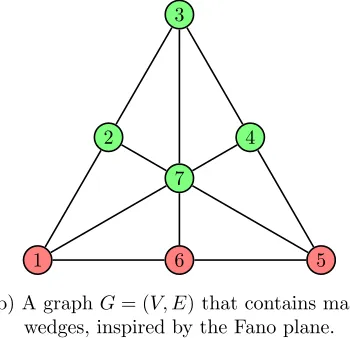
(a) TheFano plane, a 3-uniform hypergraph
H= (V,E) that is a Steiner triple system.
1
2
3
4
5 6
7
(b) A graphG= (V, E) that contains many wedges, inspired by the Fano plane.
Figure 1: Extracting from 0-local adversarial sources using Steiner triple systems and wedges. In
Figures 1a and 1b, sources are represented as nodes of a (hyper)graph. Figure 1a represents our
STS-extractor, stsExtH, and Figure 1bour wedge-extractor, wExtG. In Figure 1a, some hyperedge
is guaranteed to be activated iff at least 5 sources are good (green), while inFigure 1b, some wedge is guaranteed to be activated iff at least 4 sources are good (green).
we know that no correlation is introduced betweenX1,X2, and each loses just a little entropy, by Lemmas 3.9and3.10. Finally, we know that if (4) has no more calls than the degree of2nmExt, we can fix these calls and use the non-malleability of2nmExtto ensure that the bits from our activated hyperedge still look uniform. Observe that the number of calls in (4) is at most the number of hyperedges that share the same representative edge. Thus, because hyperedges have size at most 3, and we assume no hyperedge has more than one copy, we know that the number of calls in (4) is at mostN−2, and thus we can perform these fixings as long asN ≤kγ, for a small constantγ,
by the parameters in Lemma 3.8. Thus, we can ensure fragile correlation.
Is there a nicer way to describe such hypergraphs with hyperedges of size 3, and representative edges of size 2, such that the representative edge agreement property holds? In fact, there is a very natural way to do so: these are exactly the hypergraphs that can be constructed via taking a standard graphG, and selecting some wedges (sets of size 3 that induce a 2-hop-path in G) to turn into hyperedges, where the two non-adjacent vertices of each wedge (the terminals) make up the representative edge. Thus, we are motivated to define a new extractor over the wedges of graphs.
In particular, we construct a so-called wedge-extractor for (N, K, n, k)-sources of locality 0 as follows. Let G be a graph over N vertices, and letW be the collection of sets of size 3 in G that induce a wedge. We order eachW ∈ W as a triple (h, i, j) so thath, i are the terminals ofW, and definewExtG: ({0,1}n)N → {0,1}m as:
wExtG(X) :=
M
(h,i,j)∈W
3Ext+(Xh,Xi,Xj).
For a more precise definition, seeDefinition 4.15, and for an illustration, seeFigure 1b.
As per our discussion, this will successfully extract uniform bits (provided N ≤kγ) as long as
1
2
3 4
5
6
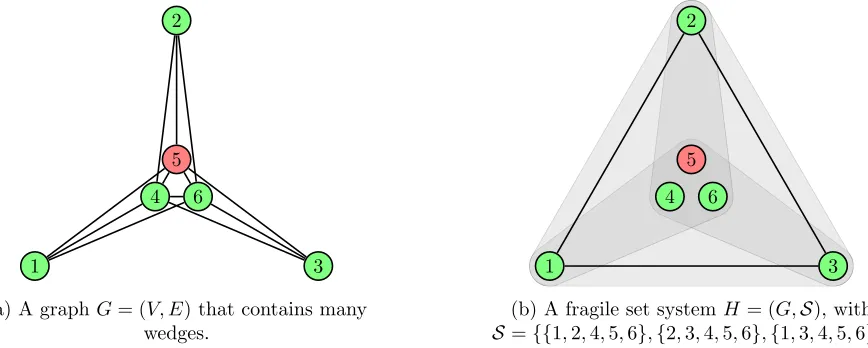
(a) A graphG= (V, E) that contains many wedges.
1
2
3 4
5
6
(b) A fragile set system H = (G,S), with
S={{1,2,4,5,6},{2,3,4,5,6},{1,3,4,5,6}}.
Figure 2: Extracting from 0-local adversarial sources using wedges and fragile set systems. In
Figures 2a and 2b, sources are represented as nodes of a (hyper)graph. Figure 2a represents our wedge-extractor,wExtG, andFigure 2bourFSS-extractor,fssExtH. The activating sets inFigures 2a
and 2bare exactly the same, but each representative edge in Figure 2aappears in 3 wedges, while each representative edge inFigure 2b appears in just 1 fragile set.
entropyrequirement of2Cond(Theorem 3.4), and thepolynomially large output lengthandnegligible error of both2Cond,2nmExt(Theorems 3.4and 3.7). Thus, the challenge is to explicitly construct a graphG= (V, E) such that its largest wedge-independence set has a small sizeαW.
We achieve such a construction by showing that a Ramsey graph with no clique nor independent set of size`actually also has no wedge independent set of size`2(seeLemma 4.17for more details).
To see this, we observe that a set of vertices that covers no wedge must be a disjoint collection of cliques (with no crossing edges), and thus a wedge independent set of size`2 would imply a clique
or independent set of size`(by taking the largest clique, or a single vertex from each clique, in the wedge-independent set). This immediately yieldsTheorem 1.
TheFSS-extractor We note thatTheorem 1extracts from very few good sources with very little entropy, under the condition that N ≤kγ. While this condition is reasonable in many settings, it
would be nice to get rid of it completely. We construct a new extractor that succeeds in doing so, and in fact generalizes all of the constructions we have seen so far. The main idea is the same as with the wedge-extractor, with one small but powerful twist. In particular, recall that our restriction
N ≤kγarises from the observation that up toN−2 hyperedges may share the same representative
edge. If we can reduce this number, then we can relax and even remove this restriction. We achieve this by coming up with a more general hypergraph structure.
In particular, we generalize the previous hypergraph to allow hyperedges of any size greater than 2, such that each hyperedge still contains a representative edge (hyperedge of size 2). Again, we enforce the representative edge agreement property that the representative edge B of a hyperedge
A⊆[N] with representative edgeB ={h, i} identifies a call of the form:
2nmExt(2Cond(Xh,⊕j∈A\BXj),2Cond(Xi,⊕j∈A\BXj)),
and our extractor will take theXORover all hyperedges of these calls. Furthermore, we can redefine
activation to a much more relaxed notion: instead of requiring that some hyperedge contains all
good sources, we simply require that some hyperedge has good sources on the endpoints of its representative edge, and one more good source outside of its representative edge. Then, if some hyperedge is activated by good sources Xh,Xi,Xj, the representative edge agreement property
guarantees that our extractor will work for the same reasons in our analysis of the wedge-extractor. Is there a nicer way to describe our new, more general, hypergraphs? The answer is yes: these are exactly the hypergraphs that can be constructed via taking a standard graphG, selecting some of its so-called fragile sets (sets in G that contain exactly one edge), turning each fragile set into a hyperedge, and turning the edge in the fragile set into its representative edge. We call such a hypergraph (consisting of Gand a collectionS ofsome of its fragile sets) afragile set system. We say the degree of a fragile set systemH, denoted deg(H) is the max number of fragile sets S ∈ S
that contain the same edge. Together with the generality of this new structure, this new parameter will give us fine control over removing the restrictionN ≤kγ, by replacing it with deg(H)−1≤kγ.
Thus, we are motivated to define a new extractor over fragile set systems.
In particular, we construct a so-called FSS-extractor for (N, K, n, k)-sources of locality 0 as follows. LetGbe a graph overN vertices, andSbe a collection of fragile sets inG, thus creating the fragile set systemH = (G,S). We write eachS ∈ S as a triple (u, v, S0) whereu, vare the endpoints
of the edge inS, and S0 are the remaining vertices. We definefssExtH : ({0,1}n)N → {0,1}m as:
fssExtH(X) :=
M
(u,v,S0)∈S
2nmExt(2Cond(Xu,⊕j∈S0Xj),2Cond(Xv,⊕j∈S0Xj)).
For a more precise definition, seeDefinition 4.23, and for an illustration, seeFigure 2.
As per our discussion, this will successfully extract uniform bits (provided deg(H)−1 ≤ kγ)
as long as K good sources are guaranteed to activate some hyperedge; here, this simply means that some fragile set contains three good sources, two of which lie on the endpoints of its edge. Equivalently, we need αFSS < K, where αFSS denotes the FSS-independence number, or the size of
the largest set that activates no hyperedge. Thus, the challenge is to explicitly construct a fragile set system H= (G,S) with small deg(H) and small αFSS.
We achieve such a construction for deg(H)≤1 andαFSS < √
N · RN, which therefore extracts
from K ≥√N · RN =N0.5+o(1) good sources, while completely removing any restriction between
N and kγ, thereby yielding Theorem 2. It is worth noting that given optimal Ramsey graphs,
this would exactly match (up to constant factors) the best result that is existentially possible with partial Steiner triple systems. The construction of such a fragile set system works by placing N
vertices into roughly √N clouds C1, C2, . . . , C√N of size √
N, drawing a bipartite Ramsey graph between each pair of clouds, and addingonefragile set for each edge (and thus, the degree is 1). The fragile set simply includes that edge, considers the endpoint in the smaller-labeled cloud, and adds all non-neighbors of this endpoint that are in the higher-labeled cloud. It is then straightforward to show that givenK =N0.5+o(1)vertices, two clouds must have enough vertices so that if some fragile
2.2 Extracting from polynomial locality
Thus far, we have constructed explicit extractors for the 0-local setting that are quite general, in the sense that each of our extractors can take any hypergraph from a certain class (STS’s, wedges in graphs, and fragile set systems) to instantiate the extractor, and the parameters that can be achieved by that extractor are directly related to the parameters of the hypergraph used to instantiate it. We show that, in fact, we can find hypergraphs to instantiate our extractors so that they succeed in extracting from up to polynomial locality.
Because our FSS-extractor generalizes the other constructions, we show that it can extract from polynomial locality. Indeed, we prove an even stronger result that its specialization as the wedge-extractor can also succeed in doing so. In particular, recall that our wedge-extractor works by explicitly constructing a graph Gover N vertices, identifying the sources with the N vertices, calling 3Ext+ over all triples that identify a wedge in G, and taking the XORof the results.
We use the exact same ideas in the (≥1)-locality setting, except there are additional complica-tions, in particular when establishing fragile correlation. Recall that previously, if some hyperedge (wedge) W was activated by good sources, then we could fix every source but the two sources
X1,X2 in the representative edge of the wedge (i.e., its non-edge), and use Lemmas 3.9 and 3.10
and the non-malleability of2nmExt to fix the output of every other 3Ext+ call, while keeping the output of the3Ext+ call over W near-uniform. But we could only do this because we were in the 0-local setting, since using wedges to select sources guaranteed thatX1,X2 would never show up
together as the arguments to a single 2Condcall.
While it is still true in the (≥1)-local setting thatX1,X2 never show up in a single2Condcall,
it might be the case that random variables (bad sources) correlated to X1,X2 show up together
in a 2Condcall. In this case, we cannot hope to fix the output of the call to 3Ext+ involving this
2Condcall without introducing correlation between X1,X2.
In order to fix this issue, we must prevent this from happening. One way to do this is to note that when using our wedge-extractor, two sources (good or bad) show up together in a call to2Condonly if their corresponding vertices are connected by an edge. Thus, consider the case that some wedge
W is covered by good sources, and the sources on its terminals are X1,X2. Let cloud(X1) denote
the vertices corresponding to sources correlated withX1, andcloud(X2) denote those corresponding
to sources correlated withX2. Observe that if there are no edges betweencloud(X1) andcloud(X2),
and they are disjoint, then we can perform fixings as usual, and guarantee that our extractor works. Using this idea, we tackle the 1-local setting as follows. Analogously to the 0-local setting, given a graphGthat will be used to instantiate the wedge-extractor, we define a new flavor ofactivating set of vertices. As in the 0-local setting, we want this activating set to have the property that if the good sources land on it, then the wedge-extractor is guaranteed to extract uniform bits from the 1-local source.
D2
D7 D8
D11 3
1
2
8
9 10 4 7
5 6
11 14
12 13
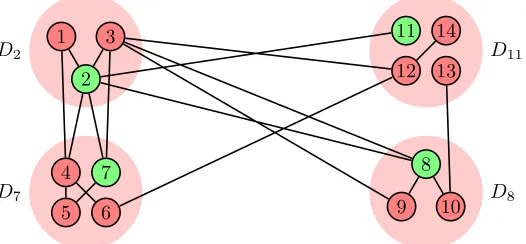
Figure 3: Extracting from 1-local adversarial sources using wedges. As before, a green node repre-sents a good source and a red node reprerepre-sents a bad source. The red clouds D2, D7, D8, D11
rep-resent dependencies: cloudDi contains all sources correlated with good source i. This placement
of good sources and dependencies over our graph induces a cloud-wedge: ({2,7,8},{D2, D7, D8}).
The other good wedges do not induce cloud-wedges due to crossing edges in their terminal clouds.
which good sources. If one can always find a cloud-wedge for a givenK, then the wedge extractor is guaranteed to work for just K good sources (see Lemma 5.6). We refer the reader to Figure 3
for an illustration.
We show that one family of graphs that exhibits the above-desired property are graphs with no cycle of length 4, and with no big independent set. Through some structural lemmas, we show that these two properties ensure that any relatively large set of vertices in such a graph must cover a largestar (complete bipartite graph with 1 vertex on the left), and any big collection of nonempty disjoint subsets in such a graph must have two subsets with no edges crossing between them. It is straightforward to show that, together, these so-called “star-dense” and “anti-cloud-clique” properties ensure that in the aforementioned process, we will always be able to find a cloud-wedge (see Lemma 5.8).
Thus, we reduce the question of constructing extractors for 1-local adversarial sources to that of explicitly constructing C4-free graphs with no big independent set. Fortunately, explicit
con-structions of such objects are known [Alo86], and so we are able to successfully extract from 1-local sources. In order to extract from higher locality, we provide a reduction from d-local sources to 1-local sources, in the spirit of Viola’s reduction from samplable sources to affine sources [Vio14]. By combining this reduction with our extractors for 1-local adversarial sources, we are able to yield
Theorem 3.
2.3 Non-explicit results
As discussed above, the reason behind our choice of hypergraphs is that we need them to carefully control the dependence between different random variables produced in the computation of our extractors. However, this task would become easier if we had sufficiently strong non-malleable extractors to break the dependence. To this end, we introduce the notion of a generalizeds-source non-malleable extractor with tampering degree t. This is a non-malleable extractor that takes as input sindependent weak sources, and is secure against t tampering outputs. In each tampering, the adversary can produce s tampered sources, where each tampered source depends on at most
generalized non-malleable extractors exist with excellent parameters. Given such extractors, it is simple to extract from adversarial sources with high locality: just apply the non-malleable extractor on everys-tuple of sources and compute theXOR. As long as there is a subsetS ofsgood sources such that no bad source depends on all good sources in S, we can fix all good sources outsideS, and all calls to the non-malleable extractor over tuples not equal to S, and the property of the non-malleable extractor guarantees that the output will be close to uniform. By taking s to be a large enough constant, we can handle arbitrary polynomially few good sources andK0.99 locality,
provingTheorem 4. We refer the reader to Section 7and Appendix A for details.
We note that the study of non-malleable extractors where several sources may be tampered together was recently undertaken by Goyal et al. [GSZ19] in the context of designing better non-malleable secret sharing schemes. However, their work only provides a construction for the so-called
cover-free tampering function family, which does not include our setting where any tampered source may be a result of tampering anys−1 (out of s) sources jointly.
3
Preliminaries
Throughout, we use ◦ to denote string concatenation. For two strings x, y∈ {0,1}n, we let x⊕y
denote bitwise XOR. Given a graph G = (V, E) and setS ⊆V, we let G[S] denote the subgraph induced by S.
3.1 Extractors and condensers for independent sources
First, we recall that thestatistical distance of two distributionsD1 and D2 (on the same support)
is given by
|D1−D2|:=
1 2
X
x
|Pr[D1 =x]−Pr[D2 =x]|,
andD1 is-close toD2 if|D1−D2| ≤. Next, we recall the definition of a multi-source extractor:
Definition 3.1. LetC ∈N. We call a functionExt: ({0,1}n)C → {0,1}ma C-source extractorfor entropyk, output lengthm, and errorif, given anyC independent(n, k)-sourcesX1,X2, . . . ,XC,
|Ext(X1,X2, . . . ,XC)−Um| ≤.
We will need the following explicit constructions of multi-source extractors:
Theorem 3.2([CG88,Vaz85]). For every constantδ >0, and for alln, k∈Nwithk≥(1/2 +δ)n, there exists an explicit 2-source extractor Had : {0,1}n× {0,1}n → {0,1}m for entropy k with output length m= Ω(n) and error= 2−Ω(n).
Theorem 3.3 ([Li15c,Coh16a]). For all n, k ∈ N with k ≥ log8n, there exists an explicit 3-source extractor 3Ext : ({0,1}n)3 → {0,1}m for entropy k with output length m = 0.9k and error
= 2−kΩ(1) .
Theorem 3.4 ([BACDTS19]). There exists a constantC ≥1 such that for every n, k, m∈N and
>0 such thatn≥k≥(mlog(n/))C, there exists an explicit function2Cond:{0,1}n× {0,1}n→
{0,1}msuch that for any two independent(n, k)-sourcesX
1,X2, with probability1−overx2∼X2,
the output 2Cond(X1, x2) is2−k/2-close to an (m, m−o(log(1/)))-source, Y.
3.2 Two-source non-malleable extractors
Next, we need a stronger notion of two-source extraction that arises in cryptography and was first defined in [CG14], known as a two-source non-malleable extractor.
Definition 3.5. We call a function 2nmExt : {0,1}n× {0,1}n → {0,1}m a (2, t)-non-malleable
extractor for entropyk, output length m, and error , if, given any two(n, k)-sourcesX1,X2, and
t pairs of tampering functions {(fi, gi)}i∈[t], where each fi, gi : {0,1}n → {0,1}n have no fixed points,
|2nmExt(X1,X2)◦2nmExt(f1(X1), g1(X2))◦ · · · ◦2nmExt(ft(X1), gt(X2)) −Um◦2nmExt(f1(X1), g1(X2))◦ · · · ◦2nmExt(ft(X1), gt(X2))| ≤.
We will in fact need a more robust non-malleable extractor whose output2nmExt(X1,X2) looks
uniform, even if conditioned on tamperings of the form2nmExt(gi(X2), fi(X1)). We define this new
object under the same name, and will only be referring to this robust variant throughout the paper.
Definition 3.6. We call a function 2nmExt : {0,1}n× {0,1}n → {0,1}m a (2, t)-non-malleable
extractor for entropy k, output length m, and error , if the following holds. Let X1,X2 be
any two (n, k)-sources, let {(fi, gi)}i∈[t] be any t pairs of tampering functions where each fi, gi :
{0,1}n → {0,1}n have no fixed points, and let b∈ {0,1}n be any bitstring. Then if we define Y i as (fi(X1), gi(X2)) if the ith bit of b is 0, and we defineYi as(gi(X2), fi(X1))otherwise, then:
|2nmExt(X1,X2)◦2nmExt(Y1)◦ · · · ◦2nmExt(Yt)
−Um◦2nmExt(Y1)◦ · · · ◦2nmExt(Yt)| ≤.
We say that a (2, t)-non-malleable extractor has tampering degree t.
We note that the above extractor is a special case of the more general (s, t)-non-malleable extractor which we define and prove its existence in Appendix A. As it turns out, however, the existing constructions of (2, t)-non-malleable extractors also have this more robust property, as the constructions of these objects use alternating extraction, which is symmetric in the way it deals with sources. Thus, we have:
Theorem 3.7([CGL16]). There exists a constantγ >0such that for all n, k∈Nwithk≥n−nγ, and all t ≤ nγ, there exists an explicit seedless (2, t)-non-malleable extractor 2nmExt : {0,1}n×
{0,1}n→ {0,1}m with output lengthm=nΩ(1) and error = 2−nΩ(1) .
Throughout the paper, we will use the following shared parameter ranges that can be achieved while explicitly constructing two-source condensers and two-source non-malleable extractors.
Lemma 3.8 ([CGL16,BACDTS19]). There exist universal constants C0, γ0 >0 such that for all
• An explicit function 2Cond: ({0,1}n)2 → {0,1}m1 such that for any two independent (n, k) -sourcesX1,X2, with probability 1−1 over x2 ∼X2, the output 2Cond(X1, x2) is 2-close to
an(m1, m1−o(log(1/1)))-source, where m1 =k1/C0, and 1 =2= 2−m
γ0/2 1 .
• For any m2 ≥m1, t≤mγ20, an explicit (2, t)-non-malleable extractor 2nmExt: ({0,1}m2)2 → {0,1}m for entropy at least m
2 −mγ20 with output length m∈ [m1Ω(1), mγ10/2] and error 3 =
2−mΩ(1)2 .
3.3 Conditional min-entropy
Finally, we need the following two lemmas about conditional min-entropy.
Lemma 3.9 ([MW97]). Let X,Y be random variables such that Y takes at most `values. Then:
Pr
y∼Y[H∞(X|Y=y)≥H∞(X)−log`−log(1/)]≥1−.
Lemma 3.10 ([Li15a]). Let X,Y be random variables such that X is -close to a source with min-entropy at least k and Y takes at most ` values. Then:
Pr
y∼Y[(X|Y=y) is 2
1/2-close to a source with min-entropy at least k−log`−log(1/)]≥1−21/2.
4
Extracting from 0-locality
In this section, we construct extractors for adversarial sources of locality 0. In particular, we prove
Theorems 1 and2. As a warm-up, we start off with a construction that has worse parameters, but motivates our more complicated constructions.
4.1 Extractors from Steiner triple systems and cap set bounds
In this section, we prove the following result:
Theorem 4.1. There is a constantC≥1such that for all N, K, n, k∈Nsatisfyingk≥logCnand
K ≥CN0.923, there exists an explicit extractor Ext: ({0,1}n)N → {0,1}m for (N, K, n, k)-sources of locality 0, with output length m= 0.9k and error = 2−kΩ(1)
.
In order to obtain this explicit construction, we will call the three-source extractor from
T heorem 3.3 over certain triples of sources, and take the XOR of the results. We will use the following object from combinatorics to select these triples:
Definition 4.2 (partial Steiner triple system). A partial Steiner triple system over N points, or an STS(N), is a 3-uniform hypergraph over N vertices such that no two hyperedges share more than one vertex.
Remark 4.3. While an STS(N) is unordered, each hyperedge will need to (arbitrarily) order its vertices so that the inputs to each3Extcall is well-defined. One way to do so is by simply identifying the vertices with [N], and having each hyperedge list its vertices in increasing order.
Definition 4.4 (STS-activating set). Let H= (V,E) be anSTS(N). An STS-activating set in H
is a subset S ⊆V that contains at least one hyperedge e∈ E.
Definition 4.5 (STS-independent set). Let H = (V,E) be an STS(N). An STS-independent set
in H is a subset S ⊆V that is not an STS-activating set. The STS-independence number of H is the size of its maxSTS-independent set, and is denoted byαSTS.
Note that an STS-independent set is the same definition as an standard independent set in a 3-uniform hypergraph. We can now formally define our extractor over partial Steiner triple systems.
Definition 4.6 (STS-extractor). Let H = (V,E) be an STS(N), and let 3Ext : ({0,1}n)3 → {0,1}m be the three-source extractor from Theorem 3.3. We define the STS-extractor over H for (N, K, n, k)-sources, stsExtH : ({0,1}n)N → {0,1}m, as:
stsExtH(X) :=
M
(v1,v2,v3)∈E(H)
3Ext(Xv1,Xv2,Xv3).
For an illustration, we refer the reader to Figure 1a. This extractor takes anSTS(N) as advice, and we will prove a general lemma showing that the performance of our extractor will depend on the value ofαSTSforSTS(N). Then, we will explicitly constructSTS(N)’s with smallαSTS, which
will immediately yield Theorem 4.1.
Lemma 4.7. There is a constant C ≥ 1 such that for all N, K, n, k ∈ N satisfying k ≥ logCn, the following holds. If H = (V,E) is an STS(N) with STS-independence number αSTS < K, then
stsExtH : ({0,1}n)N → {0,1}m is an extractor for (N, K, n, k)-sources of locality 0, with output length m= 0.9k and error= 2−kΩ(1)
.
Proof. Identify the vertices of H with [N], and define I := {i ∈ [N] : Xi is a good source.}. We
know that |I| ≥ K, and thus because H has independence number αSTS < K, there exists some
hyperedge F := (v1, v2, v3) ∈ E such that F ⊆I. Now, for each (h, i, j) ∈ E, define the random
variableY(h,i,j) :=3Ext(Xh,Xi,Xj), and note that stsExtH(X) =L(h,i,j)∈EY(h,i,j). Observe that
because H is anSTS(N), we can partitionE \(v1, v2, v3) intoE1,E2,E3,E4 such that the triples in E4have an empty intersection withF, while the triples inE`, for`∈[3], intersect withF at exactly
vi. Thus, if we defineZ`:=
L
(h,i,j)∈E`Y(h,i,j), for each `∈[4], we have:
stsExtH(X) =Y(v1,v2,v3)⊕Z1⊕Z2⊕Z3⊕Z4.
Now, fix all random variablesXi such thati /∈ {v1, v2, v3}. Notice that this fixesZ4. Next, fix Z1.
ByLemma 3.9, the min-entropy ofXv1 is still at leastk−log(2
m)−log(1/) =k−0.9k−0.09k=
0.01kwith probability at least 1−2−0.09k. Furthermore, becauseZ
1 is uncorrelated withXv2,Xv3,
no correlation is introduced betweenXv1,Xv2,Xv3. Next, do the same forZ2andZ3. Xv1,Xv2,Xv3
remain independent, and with probability at least 1−3·2−0.09k, they each have min-entropy at least
0.01k. Thus, as long as 0.01k ≥ log12n, Y
(v1,v2,v3) is 2 −kΩ(1)
-close to Um and the other random
variables are fixed with probability 1−3·2−0.09k, and sostsExt
H(X) is (2−k Ω(1)
+3·2−0.09k) = 2−kΩ(1)
As discussed, in order for Lemma 4.7 to yield an explicit extractor, we need to explicitly construct an STS(N) with a small STS-independence number αSTS. It is known that such objects
exist for α = Θ(√NlogN) [RˇS94], but such upper bounds on αSTS are probabilistic, and there
does not appear to be known explicit constructions. We use a recent result on the cap set problem in order to explicitly construct an STS(N) with no bigSTS-independent set.
Lemma 4.8. There is a constantC≥1such that for allN ∈N, there exists an explicit construction
of an STS(N) with STS-independence number αSTS≤CN0.9228.
Proof. For now, assume thatN is a power of 3. Define a hypergraphH = (V,E) whereV =Flog3 3N,
andE are the lines inFlog3 3N. H is clearly anSTS(N), because no two lines intersect at more than
one point. Furthermore, notice that an independent setS inH is exactly a set of points in Flog3 3N
such that no three are in a line. Such a set is called a cap set, and it is known that a cap set in Flog3 3N has size at most 2.756log3N ≤ N0.9228 [CLP17,EG17]. It is straightforward to extend
this construction to when N is not a power of three, by writing N in base-3, doing the above construction for every component of its base-3 representation, and adding the max cap set sizes from each component.
Combining Lemmas 4.7and 4.8immediately gives usTheorem 4.1.
Remark 4.9. In order to reduce the number of required good sources, the natural idea is to look for better explicit constructions of STS(N)’s with small αSTS. As mentioned, it appears that this area
has not yet been explored. Furthermore, we know that upper bounding the size of cap sets can only get us so far: there exist cap sets in Flog3 3N of size 2.2174log3N [Ede04], so anSTS(N) constructed
in the above manner will haveαSTS ≥N0.724. Thus, even optimal cap set bounds would not allow us
to extract from fewer thanK =N0.724 good sources. Thus, if we want to reachK =O(√NlogN),
the theoretical limit that can be achieved using STS(N)’s, we need significantly new ideas.
In the next section, we present new ideas that, in some settings, allow us to bring down the requirement on the number of good sources, K, to a function that is quasi-polylogarithmic in N. Then, in the next section, we show how to remove any restriction on the setting and extract from justK =√N· RN =N0.5+o(1). In fact, this requirement onKwould become exactlyO(
√
NlogN) if we had access to explicit optimal Ramsey graphs.
4.2 The wedge extractor
In this section, we prove our first main theorem:
Theorem 4.10 (Theorem 1, restated). There exist universal constants C, γ > 0 such that for all N, K, n, k ∈ N satisfying k ≥ logCn and K ≥ R2
N, there exists an explicit extractor Ext :
({0,1}n)N → {0,1}m for (N, K, n, k)-sources of locality 0, with output length m=kΩ(1) and error
= 2−kΩ(1)
, providedN ≤kγ.
In order to obtain this explicit construction, we will construct a more robust three-source extractor, call it over certain triples of sources, and take the XOR of the results. We will use the following type of induced subgraph to select these triples:
Definition 4.11 (wedge). Let G= (V, E) be a graph over N vertices. A wedge is a subset S ⊆V
of size three such that the induced subgraphG[S]is the complete bipartite graphK1,2. The terminals
Remark 4.12. While a wedge is unordered, we will need each wedge to order its vertices so that the inputs to each call of our more robust three-source extractor are well-defined. We order the vertices in each wedge in G by identifying the vertices of G with [N], and having the wedge list its terminals first, where the terminals are listed in increasing order.
We define activating and independent sets with respect to wedges as follows.
Definition 4.13 (wedge-activating set). Let G = (V, E) be a graph over N vertices. A wedge-activator in G is a subset S ⊆V that contains at least one wedge W ⊆V.
Definition 4.14 (wedge-independent set). Let G= (V, E) be a graph over N vertices. A wedge-independent setinGis a subsetS ⊆V that is not a wedge-activating set. The wedge-independence number of G is the size of its max wedge-independent set, and is denoted byαW.
We can now formally define our extractor over the wedges of a graph.
Definition 4.15 (wedge-extractor). Let G= (V, E) be a graph over N vertices and let W be the collection of all wedges in G. Let 2Cond: ({0,1}n)2 → {0,1}m1,2nmExt : ({0,1}m2)2 → {0,1}m be the two-source condenser and two-source non-malleable extractor from Lemma 3.8,
where m2 = m1 + log N3
. Let τ : W → {0,1}log(N3) be a tagging function that assigns a unique label to each wedge. We define the the wedge-extractor overG for (N, K, n, k)-sources,
wExtG: ({0,1}n)N → {0,1}m, as:
wExtG(X) :=
M
W:=(h,i,j)∈W
2nmExt(τ(W)◦2Cond(Xh,Xj), τ(W)◦2Cond(Xi,Xj)).
For an illustration, we refer the reader toFigure 1b. Like theSTS-extractor, the wedge-extractor takes a graph G as advice, and we will prove a general lemma showing that the performance of our extractor will depend on the value ofαW forG. Then, we will explicitly construct graphs with
small αW, which will immediately yield Theorem 4.10.
Lemma 4.16. There exist constantsC, γ >0 such that for allN, K, n, k∈Nsatisfyingk≥logCn
andN ≤kγ, the following holds. IfG= (V, E)is a graph overN vertices with wedge-independence number αW < K, then wExtG : ({0,1}n)N → {0,1}m is an extractor for (N, K, n, k)-sources of locality 0, with output length m=kΩ(1) and error = 2−kΩ(1)
.
Proof. Identify the vertices of G with [N], and define I := {i ∈ [N] : Xi is a good source.}. We
know that |I| ≥ K, and thus because G has wedge-independence number αW < K, there exists
some wedge W := (v1, v2, v3)∈ W such thatW ⊆I.
Next, recall that W holds wedges, and wedges have the property that if one wedge A has terminal vertices that both appear in another wedge B, then they must also be B’s terminal vertices (otherwise, because wedges are induced subgraphs, this would imply one of the wedges has more than one non-edge, contradicting the definition of a wedge). Furthermore, we originally had the wedges order their vertices with terminals appearing first (with the lower number terminal appearing first), and we did not select multiple copies of the same wedge.
Thus, we can partition W \(v1, v2, v3) into W1,W2,W3,W4 such that: the triples in W1 each
hold vertexv1 and v2 as the first two elements of the triple; and the triples in W4 each do not hold
v1 norv2. Note that because a wedge has three vertices, and we do not have multiple copies of the
same wedge,|W3| ≤N −2< N. Next, for each`∈ {1,2,4}, define the random variable
Z`:=
M
B:=(h,i,j)∈W`
2nmExt(τ(B)◦2Cond(Xh,Xj), τ(B)◦2Cond(Xi,Xj)),
and for each A:= (v1, v2, j)∈(W3∪(v1, v2, v3)), define the random variables
YA(1):=τ(A)◦2Cond(Xv1,Xj), YA(2):=τ(A)◦2Cond(Xv2,Xj).
Note that we can now rewrite
wExtG(X) =Z1⊕Z2⊕Z4⊕2nmExt(Y(1)W,Y
(2)
W)⊕
M
B∈W3
2nmExt(YB(1),YB(2)).
We are now ready to do some fixings. First, briefly note that since we are using the
2Cond,2nmExt from Lemma 3.8, we will be importing our parameters for these objects from that lemma. Using these parameters, we set C=C0, γ =γ0/C0.
Now, fix all random variables Xi such thati /∈(v1, v2, v3). Next, fix random variableXv3. As a
result, Z4 is fixed, andYW(1),YW(2) become independent. Furthermore, by the strength of 2Condin
the second source, Y(1)W,Y(2)W both become 2-close to an (log N3
+m1, m1−o(log(1/1)))-source
with probability 1−21.
Next, fix Z1. By Lemma 3.10, Y(1)W is 212/2-close to a source with min-entropy at least k0 :=
m1−o(log(1/1))−m−log(1/2) with probability at least 1−2 1/2
2 . Next, fix Z2, and the same
thing holds for Y(2)W. Note that as per the parameter settings in Lemma 3.8, we have:
k0 :=m1−o(log(1/1))−m−log(1/2)≥m1−o(mγ10/2)−m
γ0/2 1 −m
γ0/2
1 ≥m1−3mγ10/2,
and because we have set N ≤kγ=kγ0/C0 =mγ0
1 , this becomes
k0≥m1−3m1γ0/2≥m1+ log
N
3
−mγ0
1 ≥m2−mγ20.
Finally, recall that |W3| < N and that N ≤ mγ0 1 ≤ m
γ0
2 . So to summarize our fixings thus far: Z1,Z2,Z4 are all fixed,Y(1)W,Y(2)W are independent, and with probability at least 1−(21+ 412/2),
they are each 212/2-close to a source with min-entropy at least k0 ≥ m
2−mγ20. Additionally, we
have |W3|< mγ20. Note also that for eachB ∈ W3, the following holds:
1. YW(1) is correlated with at most one of YB(1) and YB(2), and the same is true forY(2)W.
2. YB(1) is correlated with at most one of YW(1) and YW(2), and the same is true forY(2)B .