New algorithm for the discrete logarithm problem on elliptic
curves
Igor Semaev
Department of Informatics University of Bergen, Norway
e-mail: [email protected] phone: (+47)55584279
fax: (+47)55584199 April 10, 2015
Abstract
A new algorithms for computing discrete logarithms on elliptic curves defined over finite fields is suggested. It is based on a new method to find zeroes of summation polynomials. In binary elliptic curves one is to solve a cubic system of Boolean equa-tions. Under a first fall degree assumption the regularity degree of the system is at most 4. Extensive experimental data which supports the assumption is provided. An heuristic analysis suggests a new asymptotical complexity bound 2c
√
nlnn, c≈1.69 for
computing discrete logarithms on an elliptic curve over a field of size 2n. For several binary elliptic curves recommended by FIPS the new method performs better than Pollard’s. The asymptotical bound is correct under a weaker assumption that the reg-ularity degree is bounded byo(p n
lnn) though the conclusion on the security of FIPS
curves does not generally hold in this case.
Keywords: finite fields, elliptic curves, Gr¨obner basis algorithms, discrete loga-rithms, asymptotical complexity
Mathematics Subject Classification (2010): primary 94A60,11Y16, secondary 13P15, 14G50
1
Introduction
Let E be an elliptic curve defined over a finite field Fq with q elements. The discrete
logarithm problem is givenP, Q∈E(Fq) compute an integer number z such thatQ=zP
in the groupE(Fq). That problem was independently introduced in [17, 14]. A number of
information security standards are now based on the hardness of the problem, see [7] for instance. Two cases are of most importance: q = p is a large prime number and q = 2n,
problem is easy, that was independently discovered by several authors, see [23, 25, 8] and [26, 24, 29]. The more general are Pollard’s methods [18]. They are applicable to compute discrete logarithms in any finite group. In elliptic curve case the time complexity is proportional to q1/2 field operations and the memory requirement is negligible. The method was improved in [22, 9, 30] though the asymptotical complexity bound remained. In [21] a method for efficient parallelization of Pollard type algorithms was provided.
Summation polynomials for elliptic curves were introduced in [27]. It was there sug-gested to construct an index calculus type algorithm for the elliptic curve discrete logarithm problem by decomposing points via computing zeroes of these polynomials. In [10, 3, 12, 6] Gr¨obner basis type algorithms were applied for computing zeroes of summations polyno-mials or their generalisations over extension finite fields. For curves over some such fields the problem was proved to be sub-exponential, [3]. However no improvement for elliptic curves over prime fields or binary fields of prime extension degree was achieved in those papers.
Based on observations in [6], it was shown in [19] that under a first fall degree as-sumption for Boolean equation systems coming from summation polynomials, the time complexity for elliptic curves over F2n is sub-exponential and proportional to 2cn
2/3lnn
, where c = 2ω/3, and 2.376 ≤ ω ≤ 3 is the linear algebra constant. It was there found that forn >2000 the method is better than Pollard’s. The assumption was supported by experiments with computer algebra package MAGMA in [19, 28].
In this work we suggest computing zeroes of summation polynomials by solving a much simpler system of Boolean equations. The system incorporates more variables than previ-ously but has algebraic degree only 3. The first fall degree is proved to be 4. Then a first fall degree assumption says the regularity degreedF4 of the Gr¨obner basis algorithmF4 is
at most 4 as well. The assumption was endorsed by numerous experiments with MAGMA. The new method overcomes strikingly what was achieved in the experiments of [19, 28].
The time and memory complexity of computing summation polynomial zeroes under the assumption is polynomial in n. The overall time complexity of computing discrete logarithms on elliptic curves overF2n becomes proportional to
2c
√
nlnn, (1)
wherec= (2 ln 2)2 1/2 ≈1.69. The asymptotical bound is still correct ifdF4=o(
p n
lnn). The
analysis in this case does not rely on any first fall degree assumption in contrast with [19]. Our analysis suggests a number of FIPS binary elliptic curves in [7] are theoretically broken (in case dF4 ≤ 4) as the new method starts to perform better than Pollard’s for
n >310. The estimate is obviously extendable to elliptic curves over Fpn for fixedp > 2
and growing n, by using first fall degree bounds from [11]. The time complexity is then
pc
√
nlnn,wherec= 2 (2 lnp)1/2.
Tsuyoshi Takagi and Yung-Ju Huang who claimed the idea of splitting one summation polynomial equation into several ones and therefore simplifying the problem was in their unpublished works as well. I got those contributions [15, 13, 20] and acknowledge that is correct. However non of them provides asymptotical analysis of any index calculus algorithm and derives any bound like (1).
The author is grateful to Michiel Kosters for a discussion on the first fall degree as-sumptions.
2
Summation polynomials and index calculus on elliptic curves
LetE be an elliptic curve over a field K in Weierstrass form
Y2+a1XY +a3Y =X3+a2X2+a4X+a6, (2)
For an integerm≥2 them-th summation polynomial is the polynomialSminmvariables
defined by the following property. Letx1, x2, . . . , xmbe any elements from ¯K, the algebraic
closure ofK, then Sm(x1, x2, . . . , xm) = 0 if and only if there existy1, y2, . . . , ym∈K¯ such
that the points (xi, yi) are on E and
(x1, y1) + (x2, y2) +. . .+ (xn, yn) =∞
in the groupE( ¯K), see [27]. It is enough to findS3(x1, x2, x3) then form≥4 in any case
Sm(x1, . . . , xm) = ResX(Sm−r(x1, . . . , xm−r−1, X), Sr+2(xm−r, . . . , xm, X) (3)
where 1 ≤ r ≤ m −3. The polynomial Sm is symmetric for m ≥ 3 and has degree
2m−2 in each its variable. S3 was explicitly constructed in [27] for characteristic ≥5 and
characteristic 2, the latter in case of a so called Koblitz curve. In characteristic≥5 we can assumea1 =a3 =a2 = 0 and denoteA=a4, B=a6. So
S3(x1, x2, x3) = (x1−x2)2x23−2[(x1+x2)(x1x2+A) + 2B]x3+ (x1x2−A)2−4B(x1+x2).
We are mostly concern with characteristic 2 case and the curves recommended by [7]. So we can assumea1 = 1, a3 = 0, a4 = 0 and denoteB =a6. Then
S3(x1, x2, x3) = (x1x2+x1x3+x2x3)2+x1x2x3+B,
see [27, 3].
It was suggested in [27] to construct an index calculus type algorithm for the discrete logarithm problem in E(Fq) via finding zeroes of summation polynomials. For random
integeru, vcompute an affine point R=uP +vQ= (RX, RY). Then solve the equation
for xi ∈ V, where V is a subset of Fq. Each solution provides with a linear
rela-tion(decomposition) which incorporates R and at most m point from a relatively small set of points inE(Fq), whose X-coordinate belongs toV and possibly an order 2 point in
E(Fq). Then linear algebra step finds the unknown logarithm. Two cases were considered
in [27]. First,q is a prime number, thenV is a set of residues moduloq bounded byq1/n+δ
for a smallδ. Second,q = 2n, andf(X) be an irreducible polynomial of degreenoverF2,
and F2n = F2[X]/(f(X)). Then V is a set of all degree < n/m+δ polynomials modulo
f(X). However no algorithm to find the zeros in V of summation polynomials was sug-gested in [27]. In the next Section 3 we suggest producing the decomposition by solving a different equation system. The new system is essentially equivalent to (4). In caseq =pn, wherenis large, after reducing the equations overFq to coordinate equations overFp(Weil
descent) the solution method is a Gr¨obner basis algorithm. In Section 4 forp= 2 we show under a first fall degree assumption that the complexity of a Gr¨obner basis algorithm on such instances is polynomial. The assumption was proved correct in numerous experiments with computer algebra package MAGMA. A similar assumption looks correct for oddptoo but the computations are tedious already forp= 5.
3
New algorithm
LetP be a point of orderrin the groupE(Fq), whereE is an elliptic curve defined overFq.
ThenQ=zP belongs to the subgroup generated byP. The discrete logarithm problem is givenQ and P, find zmodr. In this section an algorithm for computingz is described.
1. Define parameter mand a subset V ofFq of size aroundq1/m.
2. For random integer u, v compute R = uP +vQ. If R = ∞, then compute z from the equation bz+a ≡ 0 modr. Otherwise, R has affine coordinates (RX, RY). If
RX =x1 ∈V, then we have a relation (7) fort= 1. Otherwise
3. fort = 2, . . . , m try to compute x1, . . . , xt ∈V and u1, . . . , ut−2 ∈ Fq until the first
system of the followingt−1 equations is satisfied
S3(u1, x1, x2) = 0,
S3(ui, ui+1, xi+2) = 0, 1≤i≤t−3
S3(ut−2, xt, RX) = 0.
(5)
Fort= 2 the system consists of only one equation S3(x1, x2, RX) = 0. If non of the
systems is satisfied repeat the step with a newR. The solutions to (5) are solutions to
St+1(x1, x2, . . . , xt, RX) = 0. (6)
The experiments in characteristic 2 presented below demonstrate that for t < m
the solving running time with a Gr¨obner basis algorithm drops dramatically and the probability of solving is relatively lower. So it may be more efficient to solve a lot of the systems with t < m for differentR instead of one system for t=m with one
R. One can probably win in efficiency and lose in probability. Though the trade off may be positive, we won’t pursue this approach in the present work as this does not affect the asymptotical running time estimates.
Compute y1, . . . , yt∈Fq2 such that
(x1, y1) + (x2, y2) +. . .+ (xt, yt) +uP +vQ=∞. (7)
If there areyi∈Fq2\Fq, then the sum of all points (xi, yi) in (7), whereyi∈Fq2\Fq,
is a point in E(Fq) of order exactly 2, see Lemma 2. So that is a useful relation
anyway. At most|V|relations (7) are necessary on the average.
4. Solve the linear equations (7) and getzmodr.
4
Analysis
We will show in Lemma 2 that the system (5) is essentially equivalent to (6). Despite the number of variables in (5) is significantly larger, each equation on its own is much simpler. In particular, the algebraic degree of equations (5) in each of the variables is only 2 in contrast to 2t−1 for (6).
4.1 Lemmas
Lemma 1 Let the elliptic curve E be defined over a field Fq. Let x1, . . . , xt ∈ V be a
solution to (6). Then there exist y1, . . . , yt∈Fq2 such that
(x1, y1) + (x2, y2) +. . .+ (xt, yt) +R=∞. (8)
Lemma 2 Let RX ∈/ V. Assume the equations
Si+1(x1, . . . , xi, RX) = 0, x1, . . . , xi ∈V
are not satisfiable for2≤i < tandx1, . . . , xt∈V is a solution toSt+1(x1, . . . , xt, RX) = 0.
Then
1. in (8) assume y1, . . . , ys∈Fq2\Fq and ys+1, . . . , yt∈Fq. Then
H = (x1, y1) +. . .+ (xs, ys)
2. There exist u1, . . . , ut−2 ∈Fq such that
S3(u1, x1, x2) = 0,
S3(ui, ui+1, xi+2) = 0, 1≤i≤t−3
S3(ut−2, xt, RX) = 0.
(9)
Proof Let’s prove the first statement of the lemma. Assumes >0 and let
G= (xs+1, ys+1) +. . .+ (xt, yt)∈E(Fq).
Then H=−R−G∈E(Fq) as well. Let φbe a non-trivial automorphism of Fq2 overFq,
then
φ(H) +H =∞, φ(H) =H,
and so 2H =∞. IfH =∞, then G+R=∞ and soSt−s+1(xs+1, . . . , xt, RX) = 0. That
contradicts the assumption. ThereforeH is a point inE(Fq) of order exactly 2 and s≥2.
Let’s prove the second statement. Assume y1, . . . , ys ∈Fq2 \Fq and ys+1, . . . , yt∈Fq,
wheres= 0 or s≥2. There are pointsP1, . . . , Pt−2 such that
(x1, y1) +(x2, y2) +P1 = ∞,
Pi +(xi+2, yi+2) +Pi+1 = ∞, 1≤i≤t−3
Pt−2 +(xt, yt) +R = ∞.
(10)
By the lemma assumption and the previous statementP1, . . . , Pt−2 6=∞. So Pi = (ui, vi),
whereui ∈Fq. Therefore (10) implies (9). The lemma is proved.
A variation of the first statement of Lemma 2 has already appeared in [27].
4.2 General discussion on complexity
The complexity of solving a linear system of equations (7) is takenO(|V|ω0), whereω0 = 2
as the system is very sparse for any finite fieldFq, see [31].
It is not quite clear how the system (5 may be resolved in case q is a large prime number. However, for q = pn, where n is large, a Gr¨obner basis algorithm is applicable. The approach was already used in [10, 3] for solving (4) after it was reduced to a system of
nmultivariate polynomial equations in aboutnvariables overFp by so called Weil descent,
whereV may be taken any vector space of dimensionk=dn/meoverFp. The problem of
generating such a system and keeping it in computer memory before solving is difficult by itself form≥4 and the difficulties increase rapidly for largerm. In [19] it was shown that the complexity of solving (4) is sub-exponential inn under a first fall degree assumption, see Section 4.4 below. That assumption was supporter by a number of experiments in [19, 28], where the parameterm was taken at most 3.
(m−2)n+km≈(m−1)nvariables inFp. Under a first fall degree assumption, see Section
4.4 and Assumption 1, we show its complexity isO[(n(m−1))4ω], where 2.376≤ω ≤ 3, that is polynomial inn. The assumption was proved correct in numerous experiments with MAGMA, see Section 4.5.1. We were able to solve (5) fort =m and therefore (4) for m
as 5,6 and somenon a common computer. Forn, mas in [19, 28], the solution is up to 50 times faster and takes up to 10 times less memory in comparison with [19, 28]. Similar to [19], one can take the advantage of a block structure of the Boolean system resulted from (5), though that does not affect the asymptotical estimates. By extrapolating running time estimates we find that four binary curves recommended by FIPS PUB 186-4 [7] for
n = 409,571 become theoretically broken as the new method is faster than Pollard’s for
n > 310, see Section 4.5.2. If the block structure of the system is not exploited and we extrapolate the complexity of the default Gr¨obner basis algorithm F4, then only two FIPS curves forn= 571 are broken.
In practical terms an additional effort is required in order to accelerate the decomposi-tion stage by solving (5) and to break the rest of the binary curves in [7]. As the collecting stage still significantly dominates the method running time, see Table 3, one can use almost unbounded parallelisation to get more efficiency. In asymptotical analysis the complexity of generating summation polynomials and computing their zeros to get point decomposi-tion may be neglected as it is polynomial. That significantly improves the asymptotical complexity bound in [19], see Section 4.5.2.
4.3 Success probability
We estimate the probability that
St+1(x1, . . . , xt, RX) = 0, x1, . . . , xt∈V,
where 2≤t≤m, is satisfiable. We adopt the following model. For randomz the mapping
x1, . . . , xt→St+1(x1, . . . , xt, z) is a symmetric random mapping fromVt toFq. Let K be
the number of classes of tuples (x1, . . . , xt) under permuting the entries. Then K ≈ |V|t
t! .
The probability of a solution is the probabilityP(q, m, t,|V|) that the mapping hits 0∈Fq
at least once. So
P(q, m, t,|V|) = 1−(1−1/q)K
≈ 1−(1−1/q)|V|
t
t! ≈1−e−
|V|t
q t! (11)
If |Vq t|!t = o(1), then P(q, m, t,|V|) ≈ |Vq t|!t as in [3, 19]. It is obvious the probability of solving at least one of the first t−1 systems (5) is at least P(q, m, t,|V|). On the other hand, the latter is larger than the probability of solving (5). Therefore, we can assume that the probability of solving (5) is approximatelyP(q, m, t,|V|).
In caseq=pnwe denote the probabilityP(q, m, t,|V|) byP(n, m, t, k), where|V|=pk
4.4 Solving polynomial equations and first fall degree assumption
Let
f1(x1, . . . , xn) = 0,
f2(x1, . . . , xn) = 0,
. . . (12)
fm(x1, . . . , xn) = 0,
be a system of polynomial equations over a fieldK. The system (12) may be solved by first finding a Gr¨obner basisg1, g2, . . . , gs for the ideal generated by polynomialsf1, f2, . . . , fm.
If the ground field K =Fq is a finite field of q elements and we want the solutions with
entries inFq, then the basis is computed for the ideal generated by
f1, f2, . . . , fm, xq1−x1, . . . , xqn−xn.
The solutions togi(x1, . . . , xn) = 0,(1≤i≤s) are solutions to (12) and they are relatively
easy to find due to the properties of the Gr¨obner basis. Several algorithms were designed to construct a Gr¨obner basis. Let degg denote the total degree of the polynomial g =
g(x1, . . . , xn). The first algorithm [2] was based on reducing pairwise
combinations(S-polynomials) of the polynomials from the current basis and augmenting the current basis with their remainders. Equivalently [16], one can triangulate a Macaulay matrixMdwhose
rows are coefficients of the polynomials mifj, where mi are monomials and deg(mi) +
deg(fi) ≤ d for a parameter d. That produces a Gr¨obner basis for some large enough
d = d0. The matrix incorporates at most n+dd−1
< nd columns. So the complexity is
O(nωd0) of the ground field operations, where 2.376≤ω≤3 is the linear algebra constant.
Also one may solve a system of linear equations which comes frommifj = 0,deg(mi) +
deg(fi) ≤ dafter linearisation to get the solutions to (12) without computing a Gr¨obner
basis. The method is called extended linearisation(XL). The matrix of the system is es-sentially Md. For large enough d = d1 the rank of the matrix is close to the number of
variables after linearisation [32]. The complexity isO(nω0d1) of the ground field operations,
where 2≤ω0 ≤3 is a linear algebra constant, which depends on the sparsity of the matrix. It may be thatω0 = 2 for a very sparse matrix in case of solving by extended linearisation. Numerous experiments with solving the equations (5) by computer algebra package MAGMA were done in this work. MAGMA implements an efficient Gr¨obner basis algorithm F4[4]. The algorithm successively constructs Macaulay type matrices of increasing sizes, compute row echelon forms of them, produce some new polynomials and use them in the next step of the construction as well. At some point no new polynomials are generated. Then the current set of polynomials is a Gr¨obner basis. The complexity is characterised by dF4, the maximal total degree of the polynomials occurring before a Gr¨obner basis is
largest step complexity is bounded by
O(nω dF4). (13)
We assume the complexity of the computation is determined by the complexity of the largest step. In the experiments in Section 4.5.1 the ratio between the overall running time and the largest step running time was bounded by ≈ 3 for the number of variables
n≈50. So in the asymptotical analysis below we accept (13) as the complexity of F4. An-other Gr¨obner basis algorithm F5[5] with the maximal total degreedF5 has the complexity
O(nωdF5), see [1]. It was implicitly assumed in [19, 28] that d
F5 =dF4.
We will use the following definition found in [19]. The first fall degree for (12) is the smallest total degreedf f such that there exist polynomialsgi =gi(x1, . . . , xn),(1≤i≤m)
with
maxi(deggi+ degfi) =df f, deg
X
i
gifi < df f
and P
igifi 6= 0. A first fall degree assumption says dF4 ≤ df f and that is a basis for
asymptotical complexity estimates in [19]. Although not generally correct, the assumption appears correct for the polynomial systems coming from (4) and was supported by extensive experiments for relatively small parameters in [19, 28]. This is very likely correct for (5) as well, see sections below.
4.5 Characteristic 2
LetE be determined by
Y2+XY =X3+AX2+B, A, B∈F2n. Therefore,
S3(x1, x2, x3) = (x1x2+x1x3+x2x3)2+x1x2x3+B, (14)
see Section 2. Let f(x) be an irreducible polynomial of degree n over F2 and α its root
inF2n. Then 1, α, . . . , αn−1 is a basis ofF2n over F2. Elements of F2n are represented as
polynomials inα of degree at mostn−1. LetV be a set of all polynomials in αof degree
< k = dn/me. Obviously, that is a vector space over F2 of dimension k. Following [3],
one can defineV as any subspace ofF2n of dimensionk. However it seems that using the
subspace of low degree polynomials significantly reduces the time and space complexity in comparison with a randomly generated subspace and is therefore preferable. We attribute the phenomena to the fact that the set of polynomials to compute a Gr¨obner basis is simpler in the former case.
According to [10, 3] the equation (4), where xi ∈ V, is reducible, by taking
the Boolean equations is at mostm(m−1). Also it was observed in [19] and proved in [11] that the first fall degree of the Boolean equations coming from
Sm+1(x1, . . . , xm, RX) = 0
is at mostm2+ 1.
We consider the case m = 2 in more detail now. First we take the polynomial (14), where allx1, x2, x3 are variables in V orF2n. Following an idea in [19] it is easy to prove
that the first fall degree is 4 in this case. Really, coordinate Boolean functions which representS3(x1, x2, x3) are of total degree 3. We denote that fact
degF2S3(x1, x2, x3) = 3.
However
degF2x1S3(x1, x2, x3) = 3
again because
x1S3(x1, x2, x3) = x1[(x1x2+x1x3+x2x3)2+x1x2x3+B]
= x31x22+x31x23+x1x22x23+x21x2x3+Bx1
despite degF2x1+ degF2S3(x1, x2, x3) = 4. This argument does not work forS3(x1, x2, z),
wherez is a constant from F2n. We have
degF2S3(x1, x2, z) = 2,
degF2x1S3(x1, x2, z) = 3,
and degF2x1 + degF2S3(x1, x2, z) = 3. The first fall degree for such polynomials was
bounded by 5 in [11]. The experiments show it is always 4 again. Anyway at leastt−2 of the equations in (5) have the first fall degree 4. So we come up with the following assumption.
Assumption 1 Let q = 2n and 2 ≤ m < n, k = dn
me. Also let V be a subspace of
dimensionkinF2n. ThendF4 ≤4 for a Boolean equation system equivalent to (5)for any
2≤t≤m.
4.5.1 Experiments
substituted by a random elementzfromF2n. We take the parametersn, t≤m, k=dn/me
from a range of values and solve the system for 100 randomz.
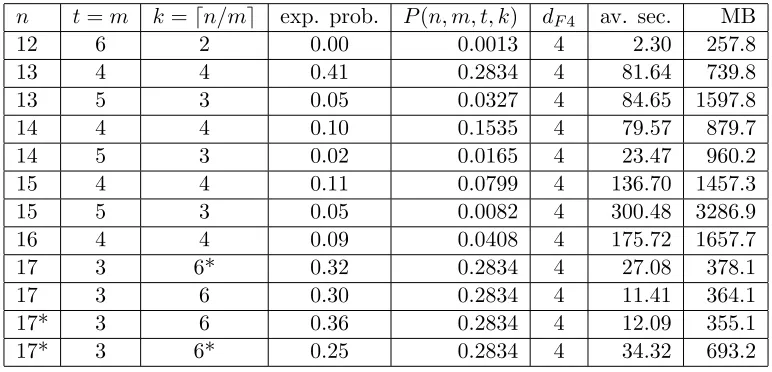
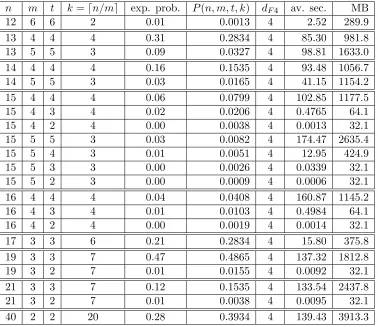
The results, where B = 1 in (14), are presented in Table 1. The results, where B is a randomly generated element from F2n, are presented in Table 2 . In the columns of
the tables the following parameters are shown: n, m, t, k =dn
me, the experimental success
probability, theoretical success probability P(n, m, t, k), maximal degree dF4 of the
poly-nomials generated by F4 before a Gr¨obner basis is computed, average time in seconds for solving one system and overall amount of memory in MB used for solving 100 systems (5). A computer with 2.6GHz Intel Core i7 processor and 16GB 1600MHZ DDR3 of memory was used. The most important of all the parameters isdF4. We use the verbosity
imple-mented in MAGMA for Faug`ere’s F4. The computation by F4 is split into a number of steps, where ”step degree” is the maximal total degree of the polynomials for which a row echelon form is computed. The parameter is available for every step of the algorithm. If the ideal generated by the polynomials is unit, then ”step degree” was always bounded by 4. If not, that is there is a solution, then ”step degree” was bounded by 4 for all the steps before the basis is computed. They were followed by at most three more steps, where ”step degree” was 5,6,7 with the message ”No pairs to reduce”. At this point the computation stops. To fill the tables 2300 Boolean systems each of total degree 3 coming from (5), where
Table 1: Max. degree of polynomials by MAGMA and other parameters,B = 1.
n t=m k=dn/me exp. prob. P(n, m, t, k) dF4 av. sec. MB
12 6 2 0.00 0.0013 4 2.30 257.8
13 4 4 0.41 0.2834 4 81.64 739.8
13 5 3 0.05 0.0327 4 84.65 1597.8
14 4 4 0.10 0.1535 4 79.57 879.7
14 5 3 0.02 0.0165 4 23.47 960.2
15 4 4 0.11 0.0799 4 136.70 1457.3
15 5 3 0.05 0.0082 4 300.48 3286.9
16 4 4 0.09 0.0408 4 175.72 1657.7
17 3 6* 0.32 0.2834 4 27.08 378.1
17 3 6 0.30 0.2834 4 11.41 364.1
17* 3 6 0.36 0.2834 4 12.09 355.1
17* 3 6* 0.25 0.2834 4 34.32 693.2
values ofn, m, t≤m.
The method significantly overcomes what was experimentally achieved in [19, 28]. For instance,n= 21, m= 3, k= 7 the solution in [28] of (4) took 6910 seconds on the average with 27235 MB maximum memory used. With the new method the solution of (5) for
t = m, and therefore (4) as well, takes 133.5 seconds on the average and 2437.8 MB maximum memory on an inferior computer, see Table 2.
Table 2: Max. degree of polynomials by MAGMA and other parameters, randomB.
n m t k=dn/me exp. prob. P(n, m, t, k) dF4 av. sec. MB
12 6 6 2 0.01 0.0013 4 2.52 289.9
13 4 4 4 0.31 0.2834 4 85.30 981.8 13 5 5 3 0.09 0.0327 4 98.81 1633.0 14 4 4 4 0.16 0.1535 4 93.48 1056.7 14 5 5 3 0.03 0.0165 4 41.15 1154.2 15 4 4 4 0.06 0.0799 4 102.85 1177.5 15 4 3 4 0.02 0.0206 4 0.4765 64.1 15 4 2 4 0.00 0.0038 4 0.0013 32.1 15 5 5 3 0.03 0.0082 4 174.47 2635.4 15 5 4 3 0.01 0.0051 4 12.95 424.9 15 5 3 3 0.00 0.0026 4 0.0339 32.1 15 5 2 3 0.00 0.0009 4 0.0006 32.1 16 4 4 4 0.04 0.0408 4 160.87 1145.2 16 4 3 4 0.01 0.0103 4 0.4984 64.1 16 4 2 4 0.00 0.0019 4 0.0014 32.1 17 3 3 6 0.21 0.2834 4 15.80 375.8 19 3 3 7 0.47 0.4865 4 137.32 1812.8 19 3 2 7 0.01 0.0155 4 0.0092 32.1 21 3 3 7 0.12 0.1535 4 133.54 2437.8 21 3 2 7 0.01 0.0038 4 0.0095 32.1 40 2 2 20 0.28 0.3934 4 139.43 3913.3
In the last 4 lines of Table 1 we also take into account the influence of the choice of generating polynomial forF2n and the vector space V. The line with 17∗means a random
irreducible polynomialf(X) of degree 17 for constructing F217 was used in the
computa-tions. Otherwise a default generating polynomial of MAGMA or a sparse polynomial were used. The line with 6∗ means a random subspace of dimension 6 in F217 was used in the
We realise the latter is preferable.
To conclude the section we should mention that the maximal degree(regularity degree) generally exceeds 4 whenk >dn
me though the first fall degree is still 4.
4.5.2 Asymptotical Complexity
In this section an asymptotical complexity estimate for the discrete logarithm problem in
E(F2n) based on Assumption 1 is derived. The algorithm complexity is the sum of the
complexity of two stages. First collecting a system of≤2k, k=dn/melinear relations (7) and then solving them. The probability of producing one linear relation by solving at least one system of multivariate Boolean equations (5) for 2≤t≤mis at leastP(n, m, m, k)≈
2mk−n/m!, see Section 4.3. The complexity of solving by the Gr¨obner basis algorithm F4 is [n(m−1)]4ω. The estimate in [19] was based on using a block structured Gr¨obner basis algorithm, where the block size wask, rather than the standard F4. That reduced the asymptotical complexity of solving (4). We think the same approach is applicable to solve the equations coming from (5) as well, with the block size n. That reduces the complexity of finding the relation ton4ω. We remark that does not affect the asymptotical complexity of the present method anyway as the both estimates are polynomial. Therefore the complexity of the first stage is
2kn4ω P(n, m, m, k) ≈
m! 2mk−n2
kn4ω (15)
operations, where 2.376≤ω ≤3 is the linear algebra constant. Forω = 3 that is at most
m!2mnn12. The complexity of the second stage is
2kω0, (16)
whereω0 = 2 is the sparse linear algebra constant. One equates (15) and (16) to determine the optimal valuem≈
q
(2 ln 2)n
lnn for largen. The overall complexity is
2kω0 ≈2nω
0
m = 2c
√
nlnn, (17)
wherec= (2 ln 2)2 1/2.
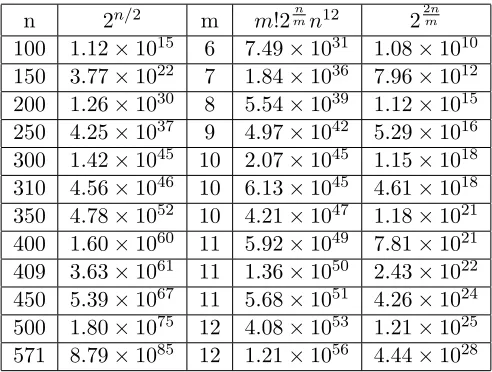
We now compare the values of (15) and (16) for a range of n ≤571 in Table 3. The first stage complexity dominates. For eachnin the range one findsm, where the first stage complexitym!2mnn12 is minimal. The table presents the values of
n, 2n/2, m, m! 2mn n12,22n/m.
broken. If only the default Gr¨obner basis algorithm F4 is used with complexity [n(m−1)]4ω, then two FIPS curves forn= 571 are broken.
The first stage of the algorithm is easy to accomplish with several processors working in parallel. As the first stage complexity is dominating that significantly improves the running time of the method in practical terms.
Table 3: Complexity estimates in characteristic 2.
n 2n/2 m m!2mnn12 2
2n m
100 1.12×10¹⁵ 6 7.49×1031 1.08×10¹⁰ 150 3.77×10²² 7 1.84×1036 7.96×10¹² 200 1.26×1030 8 5.54×1039 1.12×10¹⁵
250 4.25×1037 9 4.97×1042 5.29×10¹⁶ 300 1.42×1045 10 2.07×1045 1.15×10¹⁸ 310 4.56×1046 10 6.13×1045 4.61×10¹⁸ 350 4.78×1052 10 4.21×1047 1.18×10²¹ 400 1.60×1060 11 5.92×1049 7.81×10²¹ 409 3.63×1061 11 1.36×1050 2.43×10²² 450 5.39×1067 11 5.68×1051 4.26×1024 500 1.80×1075 12 4.08×1053 1.21×1025 571 8.79×1085 12 1.21×1056 4.44×1028
4.6 Another assumption
In this section we come up with a different weaker assumption.
Assumption 2 Let q = 2n and m = O(plnnn) for large n, k = dmne. Also let V be a subspace of dimension k in F2n. Then dF4 = o(p n
lnn) for a Boolean equation system
equivalent to (5) for any 2≤t≤m.
Under Assumption 2 the asymptotical bound (17) remains intact. Really, form≈
q
(2 ln 2)n
lnn
the complexity of the first stage of the algorithm is
2kn4ω P(n, m, m, k) ≈
m! 2mk−n2
k(n(m−1))dF4ω ≈m!2k
for largenas the complexity of F4 is
(n(m−1))dF4ω ≈2o(
The complexity of the second stage is again 22k. That implies the bound (17) is true under the Assumption 2 as well. Therefore the asymptotical bound does not depend on any first fall degree assumption. However the complexity estimates in Table 3 will change.
References
[1] M. Bardet, J.-C.Faug´ere, and B. Salvy, Complexity of Gr¨obner basis computation for semi-regular overdetermined sequences over F2 with solutions in F2, Research report
RR–5049, INRIA 2003.
[2] B. Buchberger,Theoretical Basis for the Reduction of Polynomials to Canonical Forms,
SIGSAM Bull. 39(1976), pp. 19–24.
[3] C. Diem, On the discrete logarithm problem in elliptic curves, Compos. Math.,
147(2011), pp. 75–104.
[4] J.-C. Faug`ere, A new efficient algorithm for computing Gr¨obner bases (F4), J.Pure Appl. Algebra, 139 (1999), pp. 61–88.
[5] J.-C. Faug`ere,A new efficient algorithm for computing Gr¨obner bases without reduction to zero (F5),in ISSAC’2002, pp. 75 – 83, ACM Press 2002.
[6] J.-Ch. Faug`ere, L. Perret, Ch. Petit, and G. Renault,Improving the complexity of index calculus algorithms in elliptic curves over binary fields,in EUROCRYPT’2012, LNCS
7237, pp. 27–44, Springer 2012.
[7] Federal Information Processing Standards Publication, Digital Sig-nature Standard(DSS), FIPS PUB 186-4, July, 2013, available at http://nvlpubs.nist.gov/nistpubs/FIPS/NIST.FIPS.186-4.pdf.
[8] G. Frey and H.-G. Ruck,A remark concerning m-divisibility and the discrete logarithm in the divisor class group of curves, Math. Comp.62 (1994), pp. 865–874.
[9] R. Gallant, R. Lambert,and S. Vanstone, Improving the parallelized Pollard lambda search on anomalous binary curves, Math. Comp. 69(2000), pp. 1699–1705.
[10] P. Gaudry, Index calculus for abelian varieties of small dimension and the elliptic curve discrete logarithm problem, J. Symbolic Comput., 44(2009), 1690–1702.
[11] T. Hodges, C. Petit, and J. Schlather,First fall degree and Weil descent,Finite Fields Appl., 30(2014), pp. 155–177.
[12] A. Joux and V. Vitse,Cover and decomposition index calculus on elliptic curves made practical-application to a previously unreachable curve over Fp6, in EROCRYPT’2012,
[13] K. Karabina,Point decomposition problem in binary elliptic curves, preprint, 2015. [14] N. Koblitz, Elliptic curve cryptosystems, Math. Comp.48(1987), pp. 203–209.
[15] M. Kosters,Solving ECDLP without a factor base, presentation slides, 2014.
[16] D. Lazard,Gr¨obner-bases, Gaussian elimination and resolution of systems of algebraic equations, in EUROCAL’1983, pp. 146–156.
[17] V. Miller, Use of elliptic curves in cryptography, in CRYPTO’85, LNCS 218, pp. 417–426, Springer 1986.
[18] J. Pollard, Monte-Carlo methods for index computation mod p, Math.Comp. 32
(1978), pp. 918–924.
[19] C. Petit and J. Quisquater, On polynomial systems arising from a Weil descent, in ASIACRYPT 2012, LNCS 7658, pp. 451–466, Springer 2012.
[20] C. Petit, T. Takagi and Y.J. Huang, On generalised first fall degree assumptions, preprint, 2014.
[21] P.van Oorschot and M.Wiener, Parallel collision search with cryptanalytic applica-tions,J. Cryptology,12 (1999), pp. 1–28.
[22] M.Wiener and R.Zuccherato, Faster attacks on elliptic curve cryptosystems, LNCS
1556, pp. 190–200, Springer 1999.
[23] A. Menezes, S. Vanstone, and T. Okamoto,Reducing elliptic curve logarithms to loga-rithms in a finite field,Proc. 23rd ACM Symp. Theory of Computing, 1991, pp. 80–89.
[24] T. Satoh and K. Araki, Fermat quotients and the polynomial time discrete log algo-rithm for anomalous elliptic curves,Comment. Math. Helv., 47(1998), pp. 81–92.
[25] I. Semaev,Fast algorithm for computing Weil pairing on an elliptic curve(in Russian), Int. Conf. ”Modern Problems in Number Theory”, Russia, Tula, 1993, Abstracts of papers.
[26] I. Semaev, Evaluation of discrete logarithms in a group of p-torsion points in char-acteristic p,Math. Comp., 67(1998), pp. 353–356.
[27] I. Semaev, Summation polynomials and the discrete logarithm problem on elliptic curves, Cryptology ePrint Archive 2004/031, 2004.
[28] M. Shantz and E. Teske, Solving the elliptic curve discrete logarithm problem using Semaev polynomials, Weil descent and Gr¨obner basis methods - an experimental study,
[29] N. Smart, The discrete logarithm problem on elliptic curves of trace one, J. Cryptol-ogy, 12(1999), pp. 193–196.
[30] E. Teske, On Random Walks for Pollard’s Rho Method, Math. Comp.70(2001), pp. 809–825.
[31] D. H. Wiedemann, Solving sparse linear equations over finite fields, IEEE Trans. Inform. Theory,32( 1986), pp. 54–62.