Active Annotation
Andreas Vlachos
William Gates Building Computer Laboratory University of Cambridge
Abstract
This paper introduces a semi-supervised learning framework for creating training material, namely active annotation. The main intuition is that an unsupervised method is used to initially annotate imper-fectly the data and then the errors made are detected automatically and corrected by a human annotator. We applied ac-tive annotation to named entity recogni-tion in the biomedical domain and encour-aging results were obtained. The main advantages over the popular active learn-ing framework are that no seed annotated data is needed and that the reusability of the data is maintained. In addition to the framework, an efficient uncertainty esti-mation for Hidden Markov Models is pre-sented.
1 Introduction
Training material is always an issue when applying machine learning to deal with information extrac-tion tasks. It is generally accepted that increasing the amount of training data used improves perfor-mance. However, training material comes at a cost, since it requires annotation.
As a consequence, when adapting existing meth-ods and techniques to a new domain, researchers and users are faced with the problem of absence of an-notated material that could be used for training. A good example is the biomedical domain, which has
attracted the attention of the NLP community rel-atively recently (Kim et al., 2004). Even though there are plenty of biomedical texts, very little of it is annotated, such as the GENIA corpus (Kim et al., 2003).
A very popular and well investigated framework in order to cope with the lack of training mate-rial is the active learning framework (Cohn et al., 1995; Seung et al., 1992). It has been applied to various NLP/IE tasks, including named entity recognition (Shen et al., 2004) and parse selec-tion (Baldridge and Osborne, 2004) with rather im-pressive results in reducing the amount of anno-tated training data. However, some criticism of ac-tive learning has been expressed recently, concern-ing the reusability of the data (Baldridge and Os-borne, 2004).
This paper presents a framework in order to deal with the lack of training data for NLP tasks. The intuition behind it is that annotated training data is produced by applying an (imperfect) unsupervised method, and then the errors inserted in the annota-tion are detected automatically and reannotated by a human annotator. The main difference compared to active learning is that instead of selecting unla-beled instances for annotation, possible erroneous instances are selected for checking and correction if they are indeed erroneous. We will refer to this framework as “active annotation” in the rest of the paper.
In Section 4 we describe the framework in detail, while Section 5 presents a method for estimating un-certainty for HMMs. Section 6 presents results from applying the active annotation. Section 7 compares the proposed framework to active learning and Sec-tion 8 attempts an analysis of its performance. Fi-nally, Section 9 suggests some future work.
2 Experimental setup
The data used in the experiments that follow are taken from the BioNLP 2004 named entity recog-nition shared task (Kim et al., 2004). The text pas-sages have been annotated with five classes of en-tities, “DNA”, “RNA”, “protein”, “cell type” and “cell line”. In our experiments, following the ex-ample of Dingare et al. (2004), we simplified the an-notation to one entity class, namely “gene”, which includes the DNA, RNA and protein classes. In or-der to evaluate the performance on the task, we used the evaluation script supplied with the data, which computes the F-score (F1 = 2P recision+Recall∗P recision∗Recall) for each entity class. It must be noted that all tokens of an entity must be recognized correctly in order to count as a correct prediction. A partially recognized entity counts both as a precision and recall error. In all the experiments that follow, the official split of the data in training and testing was maintained.
The named entity recognition system used in our experiments is the open source NLP toolkit Ling-pipe1. The named entity recognition module is an HMM model using Witten-Bell smoothing. In our experiments, using the data mentioned earlier it achieved 70.06% F-score.
3 Effect of errors
Noise in the training data is a common issue in train-ing machine learntrain-ing for NLP tasks. It can have sig-nificant effect on the performance, as it was pointed out by Dingare et al. (2004), where the performance of the same system on the same task (named entity recognition in the biomedical domain) was lower when using noisier material. The effect of noise in the data used to train machine learning algorithms for NLP tasks has been explored by Osborne (2002), using the task of shallow parsing as the case study and a variety of learners. The impact of different
1http://www.alias-i.com/lingpipe/
types of noise was explored and learner specific ex-tensions were proposed in order to deal with it.
In our experiments we explored the effect of noise in training the selected named entity recognition sys-tem, keeping in mind that we are going to use an unsupervised method to create the training material. The kind of noise we expect is mislabelled instances. In order to simulate the behavior of a hypothetical unsupervised method, we corrupted the training data artificially using the following models:
• LowRecall: Change tokens labelled as entities to non-entities. It must be noted that in this model, due to the presence of multi-token en-tities precision is reduced too, albeit less than recall.
• LowRecall WholeEntities: Change the label-ing of whole entities to non-entities. In this model, precision is kept intact.
• LowPrecision: Change tokens labelled as non-entities to non-entities.
• Random: Entities and non-entities are changed randomly. It can be viewed alternatively as a random tagger which labels the data with some accuracy.
the hypothetical tagger (F-tag), while in the bottom graph the F-score achieved by Lingpipe (F-ling) is plotted against the number of erroneous classifica-tions made by the hypothetical tagger.
0 0.1 0.2 0.3 0.4 0.5 0.6 0.7 0.8
0 0.2 0.4 0.6 0.8 1
F-ling
F-tag
random lowrecall wholeentities lowprecision
0 0.1 0.2 0.3 0.4 0.5 0.6 0.7 0.8
0 50 100 150 200 250 300 350 400 450 500
F-ling
[image:3.595.79.234.153.386.2]raw errors (in thousands) random lowrecall wholeentities lowprecision
Figure 1: F-score achieved by Lingpipe is plotted against (a) the F-score of the hypothetical tagger in the top graph and (b) the number of errors made by the hypothetical tagger in the bottom graph.
A first observation is that limited noise does not affect the performance significantly, a phenomenon that can be attributed to the capacity of the machine learning method to deal with noise. From the point of view of correcting mistakes in the training data this suggests that not all mistakes need to be cor-rected. Another observation is that while the perfor-mance for all the models follow similar curves when plotted against the F-score of the hypothetical tag-ger, the same does not hold when plotted against the number of errors. While this can be attributed to the unbalanced nature of the task (very few entity to-kens compared to non-entities), it also suggests that the raw number of errors in the training data is not a good indicator for the performance obtained by training on it. However, it represents the effort re-quired to obtain the maximum performance from the data by correcting it.
4 Active Annotation
In this section we present a detailed description of the active annotation framework. Initially, we have a pool of unlabeled data,D, whose instances are an-notated using an unsupervised methodu, which does not need training data. As expected, a significant amount of errors is inserted during this process. A listLis created containing the tokens that have not been checked by a human annotator. Then, a super-vised learner s is used to train a model M on this noisy training material. A query module q, which uses the model created bysdecides which instances of D will be selected to be checked for errors by a human annotator. The selected instances are re-moved from Lso thatq does not select them again in future. The learner sis then trained on this par-tially corrected training data and the sequence is re-peated from the point of applying the querying mod-uleq. The algorithm written in pseudocode appears in Figure 2.
DataD, unsupervised taggeru, supervised learners, query moduleq.
Initialization:
ApplyutoD.
Create list of instancesL.
Loop:
Usingstrain a modelM onD.
UsingqandM select a batch of instancesB
to be checked.
Correct the instances ofBinD. Remove the instances ofBfromL.
Repeat until:
Lis empty or annotator stops.
Figure 2: Active annotation algorithm
paradigm, a baseline for active annotation is random selection of instances to be checked.
There are though some notable differences. Dur-ing initialization, an unsupervised method u is re-quired to provide an initial tagging on the data D. This is an important restriction which is imposed by the lack of any annotated data. Even under this restriction, there are some options available, espe-cially for tasks which have compiled resources. One option is to use an unsupervised learning algorithm, such the one presented by Collins & Singer (1999), where a seed set of rules is used to bootstrap a rule-based named entity recognizer. A different approach could be the use of a dictionary-based tagger, as in Morgan et al. (2003). It must be noted that the unsu-pervised method used to provide the initial tagging does not need to generalize to any data (a common problem for such methods), it only needs to perform well on the data used during active annotation. Gen-eralization on unseen data is an attribute we hope that the supervised learning method swill have af-ter training on the annotated maaf-terial created with active annotation.
The query moduleqis also different from the cor-responding module in active learning. Instead of se-lecting unlabeled informative instances to be anno-tated and added to the training data, its purpose is to identify likely errors in the imperfectly labelled training data, so that they are checked and corrected by the human annotator.
In order to perform error-detection, we chose to adapt the approach of Nakagawa and Mat-sumoto (2002) which resembles uncertainty based sampling for active learning. According to their paradigm, likely errors in the training data are in-stances that are “hard” for the classifier and incon-sistent with the rest of the data. In our case, we used the uncertainty of the classifier as the measure of the “hardness” of an instance. As an indication of in-consistency, we used the disagreement of the label assigned by the classifier with the current label of the instance. Intuitively, if the classifier disagrees with the label of an instance used in its training, it indi-cates that there have been other similar instances in the training data that were labelled differently. Re-turning to the description of active annotation, the query moduleqranks the instances inLfirst by their inconsistency and then by decreasing uncertainty of
the classifier. As a result, instances that are inconsis-tent with the rest of the data and hard for the classi-fier are selected first, then those that are inconsistent but easy for the classifier, then the consistent ones but hard for the classifier and finally the consistent and easy ones.
While this method of detecting errors resembles uncertainty sampling, there are other approaches that could have been used instead and they can be very different. Sj¨obergh and Knutsson (2005) in-serted artificial errors and trained a classifier to rec-ognize them. Dickinson and Meuers (2003) pro-posed methods based on n-grams occurring with dif-ferent labellings in the corpus. Therefore, while it is reasonable to expect some correlation between the selections of active annotation and active learning (hard instances are likely to be erroneously anno-tated by the unsupervised tagger), the task of select-ing hard instances is quite different from detectselect-ing errors. The use of the disagreement between tag-gers for selecting candidates for manual correction is reminiscent of corrected co-training (Pierce and Cardie, 2001). However, the main difference is cor-rected co-training results in a manually annotated corpus, while active annotation allows automatically annotated instances to be kept.
5 HMM uncertainty estimation
In order to perform error detection according to the previous section we need to obtain uncertainty es-timations over each token from the named entity recognition module of Lingpipe. For each token t
and possible labell, Lingpipe estimates the follow-ing Hidden Markov Model from the trainfollow-ing data:
P(t[n], l[n]|l[n−1], t[n−1], t[n−2]) (1)
When annotating a certain text passage, the tokens are fixed and the joint probability of Equation 1 is computed for each possible combination of labels. From Bayes’ rule, we obtain:
P(l[n]|t[n], l[n−1], t[n−1], t[n−2]) =
P(t[n], l[n]|l[n−1], t[n−1], t[n−2])
P(t[n]|l[n−1], t[n−1], t[n−2]) (2)
left part of Equation 2 is a fixed value. Therefore, under these conditions, we can write:
P(l[n]|t[n], l[n−1], t[n−1], t[n−2])∝
P(t[n], l[n]|l[n−1], t[n−1], t[n−2]) (3)
From Equation 3 we obtain an approximation for the conditional distribution of the current label (l[n]) conditioned on the previous label (l[n−1]) for a fixed sequence of tokens. It must be stressed that the later restriction is very important. The result-ing distribution from Equation 3 cannot be com-pared across different token sequences. However, for the purpose of computing the uncertainty over a fixed token sequence it is a reasonable approxi-mation. One way to estimate the uncertainty of the classifier is to calculate the conditional entropy of this distribution. The conditional entropy for a dis-tributionP(X|Y)can be computed as:
H[X|Y] =X y
P(Y =y)X x
logP(X =x|Y =y)
(4) In our case, X is l[n]and Y isl[n−1]. Func-tion 4 can be interpreted as the weighted sum of the entropies of P(l[n]|l[n − 1]) for each value of l[n −1], in our case the weighted sum of en-tropies of the distribution of the current label for each possible previous label. The probabilities for each tag (needed for P(l[n − 1])) are not calcu-lated directly from the model. P(l[n])corresponds toP(l[n]|t[n], t[n−1], t[n−2]), but since we are considering a fixed token sequence, we approxi-mate its distribution using the conditional proba-bility P(l[n]|t[n], l[n−1], t[n− 1], t[n− 2]), by marginalizing overl[n−1].
Again, it must be noted that the above calculations are to be used in estimating uncertainty over a single word. One property of the conditional entropy is that it estimates the uncertainty of the predictions for the current label given knowledge of the previous tag, which is important in our application because we need the uncertainty over each label independently from the rest of the sequence. This is confirmed by the theory, from which we know that for a condi-tional distribution of X given Y the following equa-tion holds, H[X|Y] = H[X, Y]−H[Y], whereH
denotes the entropy.
A different way of obtaining uncertainty estima-tions from HMMs in the framework of active learn-ing has been presented in (Scheffer et al., 2001). There, the uncertainty is estimated by the margin between the two most likely predictions that would result in a different current label, explicitly:
M =maxi,j{P(t[n] =i|t[n−1] =j)} −
maxk,l,k6=i{P(t[n] =k|t[n−1] =l)} (5)
Intuitively, the margin M is the difference be-tween the two highest scored predictions that dis-agree. The lower the margin, the higher the uncer-tainty of the HMM on the token at question. A draw-back of this method is that it doesn’t take into ac-count the distribution of the previous label. It is pos-sible that the two highest scored predictions are ob-tained for two different previous labels. It may also be the case that a highly scored label can be obtained given a very improbable previous label. Finally, an alternative that we did not explore in this work is the Field Confidence Estimation (Culotta and Mc-Callum, 2004), which allows the estimation of con-fidence over sequences of tokens, instead of single-ton tokens only. However, in this work confidence estimation over singleton tokens is sufficient.
6 Experimental Results
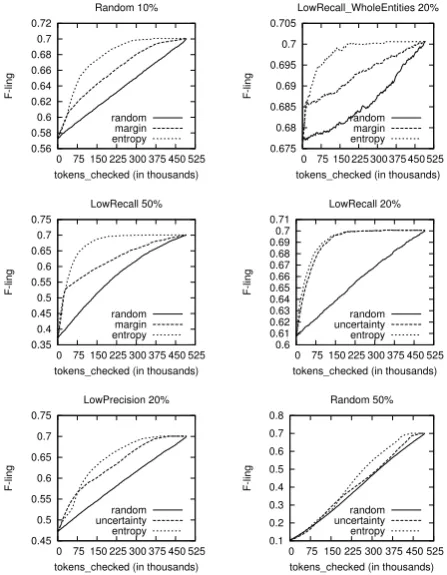
In this section we present results from applying ac-tive annotation to biomedical named entity recogni-tion. Using the noise models described in Section 3, we corrupted the training data and then using Ling-pipe as the supervised learner we applied the algo-rithm of Figure 2. The batch of tokens selected to be checked in each round was 2000 tokens. As a base-line for comparison we used random selection of to-kens to be checked. The results for various noise models and levels are presented in the graphs of Fig-ure 3. In each of these graphs, the performance of Lingpipe trained on the partially corrected material (F-ling) is plotted against the number of checked in-stances, under the label “entropy”.
0.56 0.58 0.6 0.62 0.64 0.66 0.68 0.7 0.72
0 75 150 225 300 375 450 525
F-ling
tokens_checked (in thousands) Random 10% random margin entropy 0.675 0.68 0.685 0.69 0.695 0.7 0.705
0 75 150 225 300 375 450 525
F-ling
tokens_checked (in thousands) LowRecall_WholeEntities 20% random margin entropy 0.35 0.4 0.45 0.5 0.55 0.6 0.65 0.7 0.75
0 75 150 225 300 375 450 525
F-ling
tokens_checked (in thousands) LowRecall 50% random margin entropy 0.6 0.61 0.62 0.63 0.64 0.65 0.66 0.67 0.68 0.69 0.7 0.71
0 75 150 225 300 375 450 525
F-ling
tokens_checked (in thousands) LowRecall 20% random uncertainty entropy 0.45 0.5 0.55 0.6 0.65 0.7 0.75
0 75 150 225 300 375 450 525
F-ling
tokens_checked (in thousands) LowPrecision 20% random uncertainty entropy 0.1 0.2 0.3 0.4 0.5 0.6 0.7 0.8
0 75 150 225 300 375 450 525
F-ling
tokens_checked (in thousands) Random 50%
[image:6.595.79.303.76.364.2]random uncertainty entropy
Figure 3: F-score achieved by Lingpipe is plotted against the number of checked instances for various models and levels of noise.
judgements of the query module on which instances should be checked. After having checked some por-tion of the dataset though, active annotapor-tion started outperforming random selection. In the graphs for the 10% Random, 20% LowRecall WholeEntities and 50% LowRecall noise models, under the la-bel “margin”, appear the performance curves ob-tained using the uncertainty estimation of Scheffer et al. (2001). Even though active annotation us-ing this method performs better than random se-lection, active annotation using conditional entropy performs significantly better. These results provide evidence of the theoretical advantages of conditional entropy described earlier. We also ran experiments using pure uncertainty based sampling (i.e. with-out checking the consistency of the labels) on se-lecting instances to be checked. The performance curves appear under the label “uncertainty” for the 20% LowRecall, 50% Random and 20% LowPreci-sion noise models. The uncertainty was estimated using the method described in Section 5. As
ex-pected, uncertainty based sampling performed rea-sonably well, better than random selection but worse than using labelling consistency, except for the ini-tial stage of 20% LowPrecision.
7 Active Annotation versus Active Learning
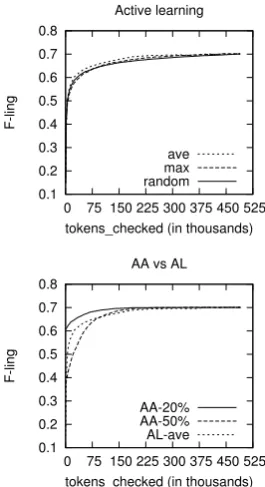
In order to compare active annotation to active learn-ing, we run active learning experiments using the same dataset and software. The paradigm employed was uncertainty based sampling, using the uncer-tainty estimation presented in Sec. 5. HMMs require annotated sequences of tokens, therefore annotating whole sentences seemed as the natural choice, as in (Becker et al., 2005). While token-level selec-tions could be used in combination with EM, (as in (Scheffer et al., 2001)), constructing a corpus of in-dividual tokens would result in a corpus that would be very difficult to be reused, since it would be par-tially labelled. We employed the two standard op-tions of selecting sentences, selecting the sentences with the highest average uncertainty over the tokens or selecting the sentence containing the most uncer-tain token. As cost metric we used the number of tokens, which allows more straightforward compar-ison with active annotation.
In Figure 4 (left graph), each active learning ex-periment is started by selecting a random sentence as seed data, repeating the seed selection 5 times. The random selection is repeated 5 times for each seed selection. As in (Becker et al., 2005), selecting the sentences with the highest average uncertainty (ave) performs better than selecting those with the most uncertain token (max).
0.1 0.2 0.3 0.4 0.5 0.6 0.7 0.8
0 75 150 225 300 375 450 525
F-ling
tokens_checked (in thousands) Active learning
ave max random
0.1 0.2 0.3 0.4 0.5 0.6 0.7 0.8
0 75 150 225 300 375 450 525
F-ling
tokens_checked (in thousands) AA vs AL
[image:7.595.80.213.77.321.2]AA-20% AA-50% AL-ave
Figure 4: Left, comparison among various active learning methods. Right, comparison of active learning and active annotation.
0.88 / 0/78 / 83 with such a method.
These results demonstrate that active annotation, given a reasonable starting point, can achieve reduc-tions in the annotation cost comparable to those of active learning. Furthermore, active annotation pro-duces an actual corpus, albeit noisy. Active learn-ing, as pointed out by Baldridge & Osborne (2004), while it reduces the amount of training material needed, it selects data that might not be useful to train a different learner. In the active annotation framework, it is likely to preserve correct instances that might not be useful to the machine learning method used to create it, but maybe beneficial to a different method. Furthermore, producing an actual corpus can be very important when adding new fea-tures to the model. In the case of biomedical NER, one could consider adding document-level features, such as whether a token has been seen as part of a gene name earlier in the document. With the cor-pus constructed using active learning this is not fea-sible, since it is unlikely that all the sentences of a document are selected for annotation. Also, if one intended to use the same corpus for a different task, such as anaphora resolution, again the imperfectly
annotated corpus constructed using active annota-tion can be used more efficiently than the partially annotated one produced by active learning.
8 Selecting errors
In order to investigate further the behavior of ac-tive annotation, we evaluated the performance of the trained supervised method against the number of er-rors corrected by the human annotator. The aim of this experiment was to verify whether the improve-ment in performance compared to random selection is due to selecting “informative” errors to correct, or due to the efficiency of the error detection technique.
0.56 0.58 0.6 0.62 0.64 0.66 0.68 0.7 0.72
0 5 10 15 20 25 30 35 40 45 50
F-ling
errors corrected (in thousands) random entropy reverse
0 5 10 15 20 25 30 35 40 45 50
0 75 150 225 300 375 450 525
errors corrected (in thousands)
tokens checked (in thousands) random entropy reverse
Figure 5: Left: F-score achieved by Lingpipe is plotted against the number of corrected errors. Right: Errors corrected plotted against the number of checked tokens.
[image:7.595.320.543.267.351.2]are selected first. The fact that errors with high certainty are less informative than those with low un-certainty suggests that active annotation, while be-ing related to active learnbe-ing, it is sufficiently differ-ent. The right graph suggests that the error-detection performance during active annotation is much better than that of random selection. Therefore, the per-formance of active annotation could be improved by preserving the high error-detection performance and selecting more informative errors.
9 Future work
This paper described active annotation, a semi-supervised learning framework that reduces the ef-fort needed to create training material, which is very important in adapting existing trainable meth-ods to new domains. Future work should investi-gate the applicability of the framework in a variety of NLP/IE tasks and settings. We intend to apply this framework to NER for biomedical literature from the FlyBase project for which no annotated datasets exist.
While we have used the number of instances checked by a human annotator to measure the cost of annotation, this might not be representative of the actual cost. The task of checking and possibly cor-recting instances differs from annotating them from scratch. In this direction, experiments in realistic conditions with human annotators should be carried out. We also intend to explore the possibility of grouping similar mistakes detected in a round of ac-tive annotation, so that the human annotator can cor-rect them with less effort. Finally, alternative error-detection methods should be investigated.
Acknowledgments
The author was funded by BBSRC, grant number 38688. I would like to thank Ted Briscoe and Bob Carpenter for their feedback and comments.
References
J. Baldridge and M. Osborne. 2004. Active learning and the total cost of annotation. InProceedings of EMNLP 2004, Barcelona, Spain.
M. Becker, B. Hachey, B. Alex, and C. Grover. 2005. Optimising selective sampling for
bootstrap-ping named entity recognition. InProceedings of the
Workshop on Learning with Multiple Views, ICML.
D. A. Cohn, Z. Ghahramani, and M. I. Jordan. 1995. Active learning with statistical models. In Advances in Neural Information Processing Systems, volume 7.
M. Collins and Y. Singer. 1999. Unsupervised models for named entity classification. InProceedings of the
Joint SIGDAT Conference on EMNLP and VLC.
Aron Culotta and Andrew McCallum. 2004. Confidence estimation for information extraction. InProceedings
of HLT 2004, Boston, MA.
M. Dickinson and W. D. Meurers. 2003. Detecting errors in part-of-speech annotation. InProceedings of EACL 2003, pages 107–114, Budapest, Hungary.
S. Dingare, J. Finkel, M. Nissim, C. Manning, and C. Grover. 2004. A system for identifying named en-tities in biomedical text: How results from two evalua-tions reflect on both the system and the evaluaevalua-tions. In
The 2004 BioLink meeting at ISMB.
J. D. Kim, T. Ohta, Y. Tateisi, and J. Tsujii. 2003. Ge-nia corpus - a semantically annotated corpus for bio-textmining. InISMB (Supplement of Bioinformatics).
J. Kim, T. Ohta, Y. Tsuruoka, Y. Tateisi, and N. Collier, editors. 2004.Proceedings of JNLPBA, Geneva.
A. Morgan, L. Hirschman, A. Yeh, and M. Colosimo. 2003. Gene name extraction using FlyBase resources.
InProceedings of the ACL 2003 Workshop on NLP in
Biomedicine, pages 1–8.
T. Nakagawa and Y. Matsumoto. 2002. Detecting errors in corpora using support vector machines. In
Proceed-ings of COLING 2002.
M. Osborne. 2002. Shallow parsing using noisy and non-stationary training material. J. Mach. Learn. Res., 2:695–719.
D. Pierce and C. Cardie. 2001. Limitations of co-training for natural language learning from large datasets. In
Proceedings of EMNLP 2001, pages 1–9.
T. Scheffer, C. Decomain, and S. Wrobel. 2001. Ac-tive hidden Markov models for information extraction.
Lecture Notes in Computer Science, 2189:309+.
H. S. Seung, M. Opper, and H. Sompolinsky. 1992. Query by committee. InProceedings of COLT 1992.
D. Shen, J. Zhang, J. Su, G. Zhou, and C. L. Tan. 2004. Multi-criteria-based active learning for named entity recongition. InProceedings of ACL 2004, Barcelona.