Automatic Seed Word Selection for Unsupervised Sentiment
Classification of Chinese Text
Taras Zagibalov
John Carroll
University of Sussex
Department of Informatics
Brighton BN1 9QH, UK
{T.Zagibalov,J.A.Carroll}@sussex.ac.uk
Abstract
We describe and evaluate a new method of automatic seed word selection for un-supervised sentiment classification of product reviews in Chinese. The whole method is unsupervised and does not re-quire any annotated training data; it only requires information about commonly oc-curring negations and adverbials. Unsu-pervised techniques are promising for this task since they avoid problems of do-main-dependency typically associated with supervised methods. The results ob-tained are close to those of supervised classifiers and sometimes better, up to an F1 of 92%.
1
Introduction
Automatic classification of document sentiment (and more generally extraction of opinion from text) has recently attracted a lot of interest. One of the main reasons for this is the importance of such information to companies, other organizations, and individuals. Applications include marketing research tools that help a company see market or media reaction towards their brands, products or services, or search engines that help potential purchasers make an informed choice of a product they want to buy. Sentiment classification research has drawn on and contributed to research in text classification, unsupervised machine learning, and cross-domain adaptation.
This paper presents a new, automatic approach to automatic seed word selection as part of senti-ment classification of product reviews written in Chinese, which addresses the problem of
do-© 2008. Licensed under the Creative Commons Attribu-tion-Noncommercial-Share Alike 3.0Unported license (http://creativecommons.org/licenses/by-nc-sa/3.0/). Some rights reserved.
main-dependency of sentiment classification that has been observed in previous work. It may also facilitate building sentiment classification sys-tems in other languages since the approach as-sumes a very small amount of linguistic knowl-edge: the only language-specific information re-quired is a basic description of the most frequent negated adverbial constructions in the language.
The paper is structured as follows. Section 2 surveys related work in sentiment classification, unsupervised machine learning and Chinese language processing. Section 3 motivates our approach, which is described in detail in Section 4. The data used for experiments and baselines, as well as the results of experiments are covered in Section 5. Section 6 discusses the lessons learned and proposes directions for future work.
2
Related Work
2.1 Sentiment Classification
Most work on sentiment classification has used approaches based on supervised machine learn-ing. For example, Pang et al. (2002) collected movie reviews that had been annotated with re-spect to sentiment by the authors of the reviews, and used this data to train supervised classifiers. A number of studies have investigated the impact on classification accuracy of different factors, in-cluding choice of feature set, machine learning algorithm, and pre-selection of the segments of text to be classified. For example, Dave et al. (2003) experiment with the use of linguistic, sta-tistical and n-gram features and measures for fea-ture selection and weighting. Pang and Lee (2004) use a graph-based technique to identify and analyze only subjective parts of texts. Yu and Hatzivassiloglou (2003) use semantically-oriented words for identification of polarity at the sentence level. Most of this work assumes bi-nary classification (positive and negative),
times with the addition of a neutral class (in terms of polarity, representing lack of sentiment).
While supervised systems generally achieve reasonably high accuracy, they do so only on test data that is similar to the training data. To move to another domain one would have to collect an-notated data in the new domain and retrain the classifier. Engström (2004) reports decreased ac-curacy in cross-domain classification since senti-ment in different domains is often expressed in different ways. However, it is impossible in prac-tice to have annotated data for all possible do-mains of interest. Aue and Gamon (2005) at-tempt to solve the problem of the absence of large amounts of labeled data by customizing sentiment classifiers to new domains using train-ing data from other domains. Blitzer et al. (2007) investigate domain adaptation for sentiment clas-sifiers using structural correspondence learning. Read (2005) also observed significant differ-ences between the accuracy of classification of reviews in the same domain but published in dif-ferent time periods.
Recently, there has been a shift of interest to-wards more fine-grained approaches to process-ing of sentiment, in which opinion is extracted at the sentence level, sometimes including informa-tion about different features of a product that are commented on and/or the opinion holder (Hu and Liu, 2004; Ku et al., 2006). But even in such ap-proaches, McDonald et al. (2007) note that infor-mation about the overall sentiment orientation of a document facilitates more accurate extraction of more specific information from the text.
2.2 Unsupervised Approach
One way of tackling the problem of domain de-pendency could be to use an approach that does not rely on annotated data. Turney (2002) de-scribes a method of sentiment classification us-ing two human-selected seed words (the words poor and excellent) in conjunction with a very large text corpus; the semantic orientation of phrases is computed as their association with the seed words (as measured by pointwise mutual in-formation). The sentiment of a document is cal-culated as the average semantic orientation of all such phrases.
Yarowsky (1995) describes a 'semi-unsuper-vised' approach to the problem of sense disam-biguation of words, also using a set of initial seeds, in this case a few high quality sense anno-tations. These annotations are used to start an it-erative process of learning information about the contexts in which senses of words appear, in
each iteration labeling senses of previously unla-beled word tokens using information from the previous iteration.
2.3 Chinese Language Processing
A major issue in processing Chinese text is the fact that words are not delimited in the written language. In many cases, NLP researchers work-ing with Chinese use an initial segmentation module that is intended to break a text into words. Although this can facilitate the use of subsequent computational techniques, there is no a clear definition of what a 'word' is in the mod-ern Chinese language, so the use of such seg-menters is of dubious theoretical status; indeed, good results have been reported from systems which do not assume such pre-processing (Foo and Li, 2004; Xu et al., 2004).
2.4 Seed Word Selection
We are not aware of any sentiment analysis sys-tem that uses unsupervised seed word selection. However, Pang et al. (2002) showed that it is dif-ficult to get good coverage of a target domain from manually selected words, and even simple corpus frequency counts may produce a better list of features for supervised classification: hu-man-created lists resulted in 64% accuracy on a movie review corpus, while a list of frequent words scored 69%. Pang et al. also observed that some words without any significant emotional orientation were quite good features: for exam-ple, the word “still” turned out to be a good indi-cator of positive reviews as it was often used in sentences such as “Still, though, it was worth seeing''.
3
Our Approach
Our initial aim was to investigate ways of im-proving the classifier by automatically finding a better seed, because Zagibalov & Carroll indicate that in different domains they could, by manual trial and error, find a seed other than 好 (good) which produced better results.
To find such a seed automatically, we make two assumptions:
1. Attitude is often expressed through the negation of vocabulary items with the op-posite meaning; for example in Chinese it is more common to say not good than bad (Tan, 2002). Zagibalov & Carroll's system uses this observation to find nega-tive lexical items while nevertheless start-ing only from a positive seed. This leads us to believe that it is possible to find candidate seeds themselves by looking for sequences of characters which are used with negation.
2. The polarity of a candidate seed needs to be determined. To do this we assume we can use the lexical item 好 (good) as a gold standard for positive lexical items and compare the pattern of contexts a candidate seed occurs in to the pattern ex-hibited by the gold standard.
Looking at product review corpora, we observed that good is always more often used without negation in positive texts, while in negative texts it is more often used with negation (e.g. not good). Also, good occurs more often in positive texts than negative, and more frequently without negation than with it. We use the latter observa-tion as the basis for identifying seed lexical items, finding those which occur with negation but more frequently occur without it.
As well as detecting negation1 we also use ad-verbials2 to avoid hypothesizing non-contentful seeds: the characters following the sequence of a negation and an adverbial are in general content-ful units, as opposed to parts of words, function words, etc. In what follows we refer to such con-structions as negated adverbial concon-structions.
1We use only six frequently occurring negations: 不 (bu), 不 会 (buhui), 没有 (meiyou), 摆脱 (baituo), 免去 (mianqu), and 避免 (bimian). We are trying to be as language-inpendent as possible so we take a simplistic approach to de-tecting negation.
2We use five frequently occurring adverbials: 很 (hen), 非常
(feichang), 太 (tai), 最 (zui), and 比较 (bijiao). Similarly to negation, we deliberately take a simplistic approach.
4
Method
We use a similar sentiment classifier and itera-tive retraining technique to the almost-unsuper-vised system of Zagibalov & Carroll (2008), summarized below in Sections 4.2 and 4.3. The main new contributions of this paper are tech-niques for automatically finding the seeds from raw text in a particular domain (Section 4.1), and for detecting when the process should stop (Sec-tion 4.4). This new system therefore differs from that of Zagibalov & Carroll (2008) in being com-pletely unsupervised and not depending on arbi-trary iteration limits. (The evaluation also differs since we focus in this paper on the effects of do-main on sentiment classification accuracy).
4.1 Seed Lexical Item Identification
The first step is to identify suitable positive seeds for the given corpus. The intuition behind the way this is done is outlined above in Section 3. The algorithm is as follows:
1. find all sequences of characters between non-character symbols (i.e. punctuation marks, digits and so on) that contain negation and an adverbial, split the se-quence at the negation, and store the char-acter sequence that follows the negated adverbial construction;
2. count the number of occurrences of each distinct sequence that follows a negated adverbial construction (X);
3. count the number of occurrences of each distinct sequence without the construction (Y);
4. find all sequences with Y– X > 0.
4.2 Sentiment Classification
This approach to Chinese language processing does not use pre-segmentation (in the sense dis-cussed in Section 2.3) or grammatical analysis: the basic unit of processing is the 'lexical item', each of which is a sequence of one or more Chi-nese characters excluding punctuation marks (so a lexical item may actually form part of a word, a whole word or a sequence of words), and 'zones', each of which is a sequence of characters delim-ited by punctuation marks.
where i is either positive or negative) using Equation (1), where Ld is the length in characters
of a matching lexical item (raised to the power of two to increase the significance of longer items which capture more context), Lphrase is the length
of the current zone in characters, Sd is the current
sentiment score of the matching lexical item (ini-tially 1.0), and Nd is a negation check coefficient.
Si= Ld
2
LphraseSdNd (1)
The negation check is a regular expression which determines if the lexical item is preceded by a negation within its enclosing zone. If a negation is found then Nd is set to –1.
The sentiment score of a zone is the sum of sentiment of all the items found in it.
To determine the sentiment orientation of the whole document, the classifier computes the dif-ference between the number of positive and neg-ative zones. If the result is greater than zero the document is classified as positive, and vice ver-sa.
4.3 Iterative Retraining
Iterative retraining is used to enlarge the initial seed vocabulary into a comprehensive vocabu-lary list of sentiment-bearing lexical items. In each iteration, the current version of the classifier is run on the input corpus to classify each docu-ment, resulting in a training subcorpus of posi-tive and a negaposi-tive documents. The subcorpus is used to adjust the scores of existing positive and negative vocabulary items and to find new items to be included in the vocabulary.
Each lexical item that occurs at least twice in the corpus is a candidate for inclusion in the vo-cabulary list. After candidate items are found, the system calculates their relative frequencies in both the positive and negative parts of the current training subcorpus. The system also checks for negation while counting occurrences: if a lexical item is preceded by a negation, its count is re-duced by one.
For all candidate items we compare their rela-tive frequencies in the posirela-tive and negarela-tive doc-uments in the subcorpus using Equation (2).
difference=
∣
Fp− Fn∣
FpFn/2 (2)
If difference < 1, then the frequencies are similar and the item does not have enough distinguishing power, so it is not included in the vocabulary. Otherwise the sentiment score of the item is (re-)calculated – according to Equation (3) for positive items, and analogously for negative items.
Fp−Fn (3)
Finally, the adjusted vocabulary list with the new scores is ready for the next iteration3.
4.4 Iteration Control
To maximize the number of productive iterations while avoiding unnecessary processing and arbi-trary iteration limits, iterative retraining is stopped when there is no change to the classifica-tion of any document over the previous two itera-tions.
5
Experiments
5.1 Data
As our approach is unsupervised, we do not use an annotated training corpus, but run our iterative procedure on the raw data extracted from an an-notated test corpus, and evaluate the final accura-cy of the system with respect to the annotations in that corpus.
Our test corpus is derived from product re-views harvested from the website IT1684. All the reviews were tagged by their authors as either positive or negative overall. Most reviews con-sist of two or three distinct parts: positive opin-ions, negative opinopin-ions, and comments ('other') – although some reviews have only one part. We removed duplicate reviews automatically using approximate matching, giving a corpus of 29531 reviews of which 23122 are positive (78%) and 6409 are negative (22%). The total number of different products in the corpus is 10631, the number of product categories is 255, and most of the reviewed products are either software prod-ucts or consumer electronics. Unfortunately, it appears that some users misuse the sentiment
3An alternative approach might be to use point-wise mutual
information instead of relative frequencies of newly found features in a subcorpus produced in the previous iteration. However, in preliminary experiments, SO-PMI did not pro-duce good corpora from the first iteration. Also, it is not clear how to manage subsequent iterations since PMI would have to be calculated between thousands of new vocabulary items and every newly found sequence of characters, which would be computationally intractable.
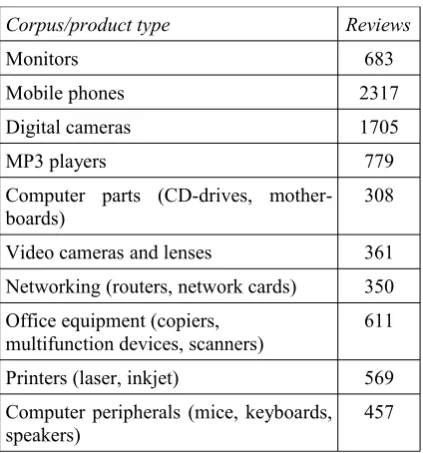
tagging facility on the website so quite a lot of reviews have incorrect tags. However, the parts of the reviews are much more reliably identified as being positive or negative so we used these as the items of the test corpus. In the experiments described below we use 10 subcorpora contain-ing a total of 7982 reviews, distributed between product types as shown in Table 1.
Corpus/product type Reviews
Monitors 683
Mobile phones 2317
Digital cameras 1705
MP3 players 779
Computer parts (CD-drives,
mother-boards) 308
Video cameras and lenses 361
Networking (routers, network cards) 350
Office equipment (copiers,
multifunction devices, scanners) 611
Printers (laser, inkjet) 569
Computer peripherals (mice, keyboards,
speakers) 457
Table 1. Product types and sizes of the test corpora.
We constructed five of the corpora by combing smaller ones of 100–250 reviews each (as in-dicated in parentheses in Table 1) in order to have reasonable amounts of data.
Each corpus has equal numbers of positive and negative reviews so we can derive upper bounds from the corpora (Section 5.2) by applying su-pervised classifiers. We balance the corpora since (at least on this data) these classifiers per-form less well with skewed class distributions5.
5.2 Baseline and Upper Bound
Since the corpora are balanced with respect to sentiment orientation the naïve (unsupervised) baseline is 50%. We also produced an upper bound using Naive Bayes multinomial (NBm) and Support Vector Machine (SVM)6 classifiers with the NTU Sentiment Dictionary (Ku et al., 2006) vocabulary items as the feature set. The dictionary contains 2809 items in the 'positive' part and 8273 items in the 'negative'. We ran 5We have made this corpus publicly available at http://
www.informatics.sussex.ac.uk/users/tz21/coling08.zip
6We used WEKA 3.4.11 (http://www.cs.waikato.ac.nz/˜ml/
weka )
both classifiers in 10-fold stratified cross-valida-tion mode, resulting in the accuracies shown in Table 2. The macroaveraged accuracies across all 10 corpora are 82.78% (NBm) and 80.89% (SVM).
Corpus Nbm
(%)
SVM (%)
Monitors 86.21 83.87
Mobile phones 86.52 84.49
Digital cameras 82.27 82.04
MP3 players 82.64 79.43
Computer parts 81.10 79.47
Video cameras and lenses 83.05 84.16
Networking 77.65 75.35
Office equipment 82.13 80.00
Printers 81.33 79.57
Computer peripherals 84.86 80.48
Table 2. Upper bound accuracies.
We also tried adding the negations and adver-bials specified in Section 3 to the feature set, and this resulted in slightly improved accuracies, of 83.90% (Nbm) and 82.49% (SVM).
An alternative approach would have been to automatically segment the reviews and then de-rive a feature set of a manageable size by setting a threshold on word frequencies; however the ex-tra processing means that this is a less valid up-per bound.
Another possible comparison could be with a version of Turney's (2002) sentiment classifica-tion method applied to Chinese. However, the re-sults would not be comparable since Turney's method would require the additional use of very large text corpus and the manual selection of positive and negative seed words.
5.3 Experiment 1
Corpus Iter P R F1
Monitors 12 86.62 86.24 86.43
Mobile phones 11 90.15 89.68 89.91
Digital cameras 13 81.33 80.23 80.78
MP3 players 13 86.10 85.10 85.60
Computer parts 10 69.10 67.53 68.31
Video cameras and
lenses 10 82.81 81.44 82.12
Networking 11 69.28 68.29 68.78
Office equipment 12 81.83 80.36 81.09
Printers 12 81.04 79.61 80.32
Computer peripherals 10 82.20 81.84 82.02
Macroaverage 81.05 80.03 80.54
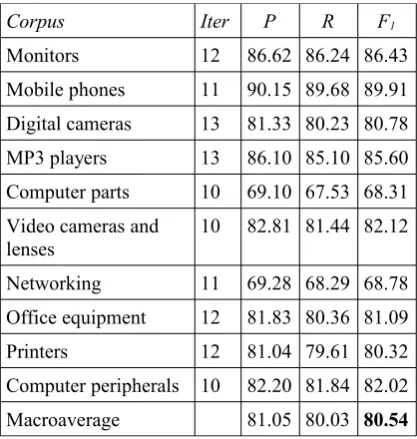
Table 3. Results with the single, manually chosen seed 好 (good) for each corpus.
5.4 Experiment 2
We then ran our full system, including the seed identifier. Appendix A shows that for most of the corpora the algorithm found different (highly do-main-salient) seeds. Table 4 shows the results achieved.
Corpus Iter P R F1
Monitors 11 85.57 85.07 85.32
Mobile phones 10 92.63 92.19 92.41
Digital cameras 13 84.92 83.58 84.24
MP3 players 13 88.69 87.55 88.11
Computer parts 12 77.78 77.27 77.52
Video cameras and lenses
11 83.62 81.99 82.8
Networking 13 72.83 72.00 72.41
Office equipment 10 82.42 81.34 81.88
Printers 12 81.04 79.61 80.32
Computer peripherals 10 82.24 82.06 82.15
Macroaverage 83.17 82.27 82.72
Table 4. Results with the seeds automatically identified for each corpus.
Across all 10 subcorpora, the improvement us-ing automatically identified seed words com-pared with just using the seed good is significant
(paired t-test, P<0.0001), and the F1 measure lies between the two upper bounds.
6
Conclusions and Future Work
The unsupervised approach to seed words selec-tion for sentiment classificaselec-tion presented in this paper produces results which in most cases are close to the results of supervised classifiers and to the previous almost-unsupervised approach: eight out of ten results showed improvement over the human selected seed word and three re-sults outperformed the supervised approach, while three other results were less than 1% infe-rior to the supervised ones.
How does it happen that the chosen seed is usually (in our dataset – always) positive? We think that this happens due to the socially accept-ed norm of behaviour: as a rule one neaccept-eds to be friendly to communicate with others. This in turn defines linguistic means of expressing ideas – they will be at least slightly positive overall. The higher prevalence of positive reviews has been observed previously: for example, in our corpus before we balanced it almost 80% of reviews were positive; Pang et al. (2002) constructed their move review corpus from an original dataset of 1301 positive and 752 negative re-views (63% positive). Ghose et al. (2007) quote typical examples of highly positive language used in the online marketplace. We can make a preliminary conclusion that a relatively high fre-quency of positive words is determined by the usage of language that reflects the social beha-viour of people.
In future work we intend to explore these is-sues of positivity of language use. We will also apply our approach to other genres containing some quantity of evaluative language (for exam-ple newspaper articles), and see if it works equal-ly well for languages other than Chinese. It is also likely we can use a smaller set of negation words and adverbials to produce the seed lists.
Acknowledgements
The first author is supported by the Ford Founda-tion InternaFounda-tional Fellowships Program.
References
Blitzer, John, Mark Dredze, and Fernando Pereira. 2007. Biographies, Bollywood, Boom-boxes and Blenders: Domain Adaptation for Sentiment Clas-sification. In Proceedings of the 45th Annual Meet-ing of the Association of Computational LMeet-inguis- Linguis-tics. 440–447.
Dave, Kushal, Steve Lawrence, and David M. Pen-nock. 2003. Mining the Peanut Gallery: Opinion Extraction and Semantic Classification of Product Reviews. In Proceedings of the Twelfth Interna-tional World Wide Web Conference. 519–528.
Engström, Charlotte. 2004. Topic Dependence in
Sen-timent Classification. Unpublished MPhil Disserta-tion. University of Cambridge.
Foo, Schubert, and Hui Li. 2004. Chinese Word Seg-mentation and Its Effects on Information Retrieval.
Information Processing and Management, 40(1). 161–190.
Ghose, Anindya, Panagiotis Ipeirotis, and Arun Sun-dararajan. 2007. Opinion Mining using
Economet-rics: A Case Study on Reputation Systems. In
Pro-ceedings of the 45th Annual Meeting of the Associ-ation of ComputAssoci-ational Linguistics. 416–423. Hu, Minqing, and Bing Liu. 2004. Mining and
Sum-marizing Customer Reviews. In Proceedings of the
10th ACM SIGKDD International Conference on Knowledge Discovery and Data Mining. 168–177. Ku, Lun-Wei, Yu-Ting Liang, and Hsin-Hsi Chen.
2006. Opinion Extraction, Summarization and
Tracking in News and Blog Corpora. In
Proceed-ings of the AAAI-2006 Spring Symposium on Com-putational Approaches to Analyzing Weblogs.
AAAI Technical Report.
McDonald, Ryan, Kerry Hannan, Tyler Neylon, Mike Wells, and Jeff Reynar. 2007. Structured Models for Fine-to-Coarse Sentiment Analysis. In Pro-ceedings of the 45th Annual Meeting of the Associ-ation of ComputAssoci-ational Linguistics. 432–439. Pang, Bo, and Lillian Lee. 2004. A Sentimental
Edu-cation: Sentiment Analysis Using Subjectivity
Summarization Based on Minimum Cuts. In
Pro-ceedings of the 42nd Annual Meeting of the Associ-ation for ComputAssoci-ational Linguistics. 271–278.
Pang, Bo, Lillian Lee, and Shivakumar Vaithyanathan. 2002. Thumbs up? Sentiment Clas-sification using Machine Learning Techniques. In
Proceedings of the 2002 Conference on Empirical Methods in Natural Language Processing. 79–86. Read, Jonathon. 2005. Using Emoticons to Reduce
Dependency in Machine Learning Techniques for Sentiment Classification. In Proceedings of the ACL Student Research Workshop at ACL-05. 43– 48.
Tan, Aoshuang. 2002. Problemy skrytoj grammatiki. Sintaksis, semantika i pragmatika jazyka izoliru-juščego stroja na primere kitajskogo jazyka [Prob-lems of a hidden grammar. Syntax, semantics and pragmatics of a language of the isolating type, tak-ing the Chinese language as an example]. Jazyki Slavjanskoj Kultury.
Turney, Peter D. 2002. Thumbs Up or Thumbs Down? Semantic Orientation Applied to Unsuper-vised Classification of Reviews. In Proceedings of the 40th Annual Meeting of the Association for Computational Linguistics. 417–424.
Xu, Jia, Richard Zens, and Hermann Ney. 2004. Do We Need Chinese Word Segmentation for Statisti-cal Machine Translation? In Proceedings of the Third SIGHAN Workshop on Chinese Language Learning. 122–128.
Yarowsky, David. 1995. Unsupervised Word Sense Disambiguation Rivaling Supervised Methods. In
Proceedings of the 33rd Annual Meeting of the As-sociation for Computational Linguistics. 189–196. Yu, Hong, and Vasileios Hatzivassiloglou. 2003.
To-wards Answering Opinion Questions: Separating Facts from Opinions and Identifying the Polarity of Opinion Sentences. In Proceedings of the 2003 Conference on Empirical Methods in Natural Lan-guage Processing. 129–136.
Appendix A. Seeds Automatically Identified for each Corpus.
Corpus Seed Corpus Seed
Monitors 好 (good)
便 (convenient; cheap) 清晰 (clear)
直 (straight) 方便 (comfortable) 满 (fill, fulfill) 锐利 (sharp) 舒服 (comfortable)
爽 (cool)
Video cameras and lenses
清晰 (clear – of sound or image) 方便 (comfortable)
实用 (practical) 理想 (perfect) 爽 (cool)
Mobile phones
好 (good)
支持 (support)
便 (convenient; cheap) 方便 (comfortable)
清晰 (clear –of sound or image) 足 (sufficient)
好用 (easy to use) 舒服 (comfortable) 人性化 (user friendly) 流畅 (smooth and easy) 清楚 (distinct)
爽 (cool)
好了 (has become better)
耐用 (durable) 方便的 (comfortable) 满意的 (satisfied)
适应 (fit, suit)
方便了 (has become comfortable)
适用 (applicable) 顺手 (handy)
科学 (science, scientific)
Digital cameras
好 (good)
便 (convenient; cheap) 方便 (comfortable)
清晰 (clear–of sound or image) 专业 (special)
爽 (cool)
满意 (satisfied) 耐用 (durable) 舒服 (comfortable) 理想 (perfect) 真实 (straight) 稳定 (stable)
方便了 (has become comfortable)
客气 (polite) 详细 (detailed)
Networking 稳定 (stable) Printers 好 (good)
MP3 players 好 (good)
便 (convenient; cheap) 方便 (comfortable) 实用 (practical) 灵敏 (sensitive) 舒服 (comfortable) 爽 (cool)
方便了 (has become comfortable)
Computer peripherals
好 (good)
便 (convenient;cheap) 方便 (comfortable) 准 (precise) 舒服 (comfortable) 习惯 (habitual) 流畅 (smooth and easy) 稳定 (stable)
Computer parts
好 (good)
稳定 (stable)
Office equipment
好 (good)