ParaMetric: An Automatic Evaluation Metric for Paraphrasing
Chris Callison-Burch
Center for Speech and Language Processing Johns Hopkins University
3400 N. Charles St. Baltimore, MD 21218
Trevor Cohn Mirella Lapata School of Informatics University of Edinburgh
2 Buccleuch Place Edinburgh, EH8 9LW
Abstract
We present ParaMetric, an automatic eval-uation metric for data-driven approaches to paraphrasing. ParaMetric provides an ob-jective measure of quality using a collec-tion of multiple translacollec-tions whose para-phrases have been manually annotated. ParaMetric calculates precision and recall scores by comparing the paraphrases dis-covered by automatic paraphrasing tech-niques against gold standard alignments of words and phrases within equivalent sen-tences. We report scores for several estab-lished paraphrasing techniques.
1 Introduction
Paraphrasing is useful in a variety of natural lan-guage processing applications including natural language generation, question answering, multi-document summarization and machine translation evaluation. These applications require paraphrases for a wide variety of domains and language us-age. Therefore building hand-crafted lexical re-sources such as WordNet (Miller, 1990) would be far too laborious. As such, a number of data-driven approaches to paraphrasing have been developed (Lin and Pantel, 2001; Barzilay and McKeown, 2001; Barzilay and Lee, 2003; Pang et al., 2003; Quirk et al., 2004; Bannard and Callison-Burch, 2005). Despite this spate of research, no objective evaluation metric has been proposed.
In absence of a repeatable automatic evaluation, the quality of these paraphrasing techniques was gauged using subjective manual evaluations. Sec-tion 2 gives a survey of the various evaluaSec-tion methodologies used in previous research. It has not been possible to directly compare paraphrasing
c
2008. Licensed under the Creative Commons Attribution-Noncommercial-Share Alike 3.0 Unported li-cense (http://creativecommons.org/licenses/by-nc-sa/3.0/). Some rights reserved.
techniques, because each one was evaluated using its own idiosyncratic experimental design. More-over, because these evaluations were performed manually, they are difficult to replicate.
We introduce an automatic evaluation metric, called ParaMetric, which uses paraphrasing tech-niques to be compared and enables an evaluation to be easily repeated in subsequent research. Para-Metric utilizes data sets which have been annotated with paraphrases. ParaMetric compares automatic paraphrases against reference paraphrases.
In this paper we:
• Present a novel automatic evaluation metric for data-driven paraphrasing methods;
• Describe how manual alignments are cre-ated by annotating correspondences between words in multiple translations;
• Show how phrase extraction heuristics from statistical machine translation can be used to enumerate paraphrases from the alignments;
• Report ParaMetric scores for a number of ex-isting paraphrasing methods.
2 Related Work
No consensus has been reached with respect to the proper methodology to use when evaluating para-phrase quality. This section reviews past methods for paraphrase evaluation.
Researchers usually present the quality of their automatic paraphrasing technique in terms of a subjective manual evaluation. These have used a variety of criteria. For example, Barzilay and McKeown (2001) evaluated their paraphrases by asking judges whether paraphrases were “ap-proximately conceptually equivalent.” Ibrahim et al. (2003) asked judges whether their para-phrases were “roughly interchangeable given the genre.” Bannard and Callison-Burch (2005) re-placed phrases with paraphrases in a number of
sentences and asked judges whether the substi-tutions “preserved meaning and remained gram-matical.” These subjective evaluations are rather vaguely defined and not easy to reproduce.
Others evaluate paraphrases in terms of whether they improve performance on particular tasks. Callison-Burch et al. (2006b) measure improve-ments in translation quality in terms of Bleu score (Papineni et al., 2002) and in terms of subjective human evaluation when paraphrases are integrated into a statistical machine translation system. Lin and Pantel (2001) manually judge whether a para-phrase might be used to answer questions from the TREC question-answering track. To date, no one has used task-based evaluation to compare differ-ent paraphrasing methods. Even if such an eval-uation were performed, it is unclear whether the results would hold for a different task. Because of this, we strive for a general evaluation rather than a task-specific one.
Dolan et al. (2004) create a set of manual word alignments between pairs of English sentences. We create a similar type of data, as described in Section 4. Dolan et al. use heuristics to draw pairs of English sentences from a comparable corpus of newswire articles, and treat these as potential paraphrases. In some cases these sentence pairs are good examples of paraphrases, and in some cases they are not. Our data differs because it is drawn from multiple translations of the same foreign sentences. Barzilay (2003) suggested that multiple translations of the same foreign source text were a perfect source for “naturally occur-ring paraphrases” because they are samples of text which convey the same meaning but are produced by different writers. That being said, it may be possible to use Dolan et al’s data toward a similar end. Cohn et al. (to appear) compares the use of the multiple translation corpus with the MSR cor-pus for this task.
The work described here is similar to work in summarization evaluation. For example, in the Pyramid Method (Nenkova et al., 2007) content units that are similar across human-generated sum-maries are hand-aligned. These can have alter-native wordings, and are manually grouped. The idea of capturing these and building a resource for evaluating summaries is in the same spirit as our methodology.
3 Challenges for Evaluating Paraphrases Automatically
There are several problems inherent to automati-cally evaluating paraphrases. First and foremost, developing an exhaustive list of paraphrases for any given phrase is difficult. Lin and Pantel (2001) illustrate the difficulties that people have generat-ing a complete list of paraphrases, reportgenerat-ing that they missed many examples generated by a sys-tem that were subsequently judged to be correct. If a list of reference paraphrases is incomplete, then using it to calculate precision will give inaccurate numbers. Precision will be falsely low if the sys-tem produces correct paraphrases which are not in the reference list. Additionally, recall is indeter-minable because there is no way of knowing how many correct paraphrases exist.
There are further impediments to automatically evaluating paraphrases. Even if we were able to come up with a reasonably exhaustive list of phrases for a phrase, the acceptability of each para-phrase would vary depending on the context of the original phrase (Szpektor et al., 2007). While lexical and phrasal paraphrases can be evaluated by comparing them against a list of known para-phrases (perhaps customized for particular con-texts), this cannot be naturally done for struc-tural paraphrases which may transform whole sen-tences.
We attempt to resolve these problems by hav-ing annotators indicate correspondences in pairs of equivalent sentences. Rather than having peo-ple enumerate paraphrases, we asked that they per-form the simper task of aligning paraphrases. Af-ter developing these manual “gold standard align-ments” we can gauge how well different automatic paraphrases are at aligning paraphrases within equivalent sentences. By evaluating the perfor-mance of paraphrasing techniques at alignment, rather than at matching a list of reference para-phrases, we obviate the need to have a complete set of paraphrases.
and
him
impeach
to
want
some others expect him to step down .
.
some others expect him to step down .
.
some others expect him to step down .
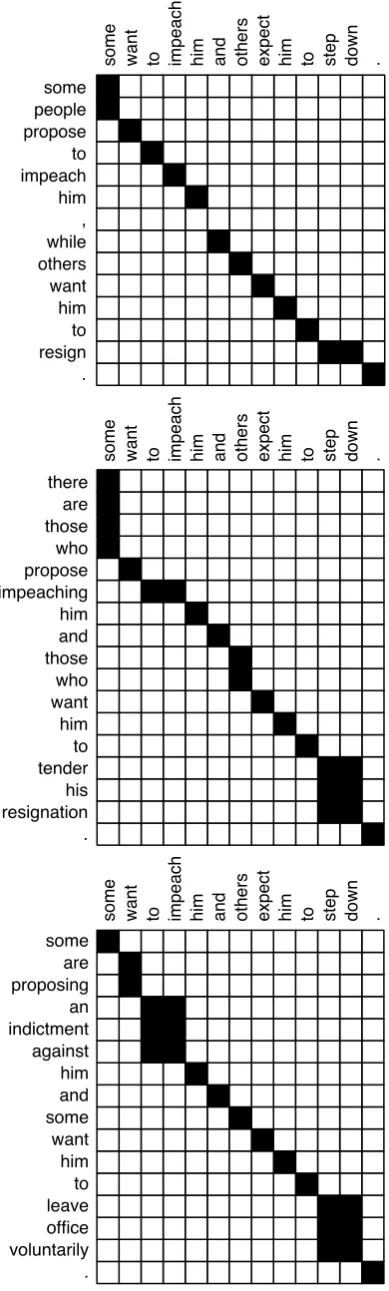
Figure 1: Pairs of English sentences were aligned by hand. Black squares indicate paraphrase corre-spondences.
in this paper.
4 Manually Aligning Paraphrases
We asked monolingual English speakers to align corresponding words and phrases across pairs of equivalent English sentences. The English sen-tences were equivalent because they were transla-tions of the same foreign language text created by different human translators. Our annotators were instructed to align parts of the sentences which had the same meaning. Annotators were asked to prefer smaller one-to-one word alignments, but were allowed to create one-to-many and many-to-many alignments where appropriate. They were given a set of annotation guidelines covering spe-cial cases such as repetition, pronouns, genitives, phrasal verbs and omissions (Callison-Burch et al., 2006a). The manual correspondences are treated asgold standard alignments.
We use a corpus that contains eleven En-glish translations of Chinese newswire documents, which were commissioned from different transla-tion agencies by the Linguistics Data Consortium1.
The data was created for the Bleu machine trans-lation evaluation metric (Papineni et al., 2002), which uses multiple translations as a way of cap-turing allowable variation in translation. Whereas the Bleu metric requires no further information, our method requires a one-off annotation to explic-itly show which parts of the multiple translations constitute paraphrases.
The rationale behind using a corpus with eleven translations was that a greater number of transla-tions would likely result in a greater number of paraphrases for each phrase. Figure 1 shows the alignments that were created between one sen-tence and three of its ten corresponding transla-tions. Table 1 gives a list of non-identical words and phrases that can be paired by way of the word alignments. These are thebasic paraphrases con-tained within the three sentence pairs. Each phrase has up to three paraphrases. The maximum num-ber of paraphrases for a given span in each tence is bounded by the number of equivalent sen-tences that it is paired with.
In addition to these basic paraphrases, longer paraphrases can also be obtained using the heuris-tic presented in Och and Ney (2004) for extract-ing phrase pairs (PP) from word alignmentsA, be-tween a foreign sentencefJ
1 and an English
some some people, there are those who want propose, are proposing
to impeach an indictment against, impeach-ing
and while
others some, those who
expect want
step down resign, leave office voluntarily, tender his resignation
Table 1: Non-identical words and phrases which are identified as being in correspondence by the alignments in Figure 1.
tenceeI
1:
P P(fJ
1, eI1, A) ={(fjj+m, ei+ni ) :
∀(i0, j0)∈A:j≤j0≤j+m↔i≤i0≤i+n
∧∃(i0, j0)∈A:j≤j0≤j+m∧ ↔i≤i0≤i+n} When we apply the phrase extraction heuris-tic to aligned English sentences, we add the con-straint fjj+m 6= eii+n to exclude phrases that are identical. This heuristic would allow “some peo-ple propose to impeach him,” “some are proposing an indictment against him,” and “there are those who propose impeaching him” to be extracted as paraphrases of “some want to impeach him.” The heuristic extracts a total of 142 non-identical phrase pairs from the three sentences given in Fig-ure 1.
For the results reported in this paper, annotators aligned 50 groups of 10 pairs of equivalent sen-tences, for a total of 500 sentence pairs. These were assembled by pairing the first of the LDC translations with the other ten (i.e. 1-2, 1-3, 1-4, ..., 1-11). The choice of pairing one sentence with the others instead of doing all pairwise combina-tions was made simply because the latter would not seem to add much information. However, the choice of using the first translator as the key was arbitrary.
Annotators corrected a set of automatic word alignments that were created using Giza++ (Och and Ney, 2003), which was trained on a total of 109,230 sentence pairs created from all pairwise combinations of the eleven translations of 993 Chi-nese sentences.
The average amount of time spent on each of the sentence pairs was 77 seconds, with just over eleven hours spent to annotate all 500 sentence
pairs. Although each sentence pair in our data set was annotated by a single annotator, Cohn et al. (to appear) analyzed the inter-annotator agree-ment for randomly selected phrase pairs from the same corpus, and found inter-annotator agreement ofCˆ = 0.85over the aligned words andCˆ = 0.63 over the alignments between basic phrase pairs, whereCˆ is measure of inter-rater agreement in the style of Kupper and Hafner (1989).
5 ParaMetric Scores
We can exploit the manually aligned data to com-pute scores in two different fashions. First, we can calculate how well an automatic paraphrasing technique is ableto alignthe paraphrases in a sen-tence pair. Second, we can calculate the lower-bound on precision for a paraphrasing technique and its relative recall by enumerating the para-phrases from each of the sentence groups. The first of these score types does not require groups of sen-tences, only pairs.
We calculate alignment accuracy by comparing the manual alignments for the sentence pairs in the test corpus with the alignments that the automatic paraphrasing techniques produce for the same sentence pairs. We enumerate all non-identical phrase pairs within the manually word-aligned sentence pairs and within the automatically word aligned sentence pairs usingP P. We calculate the precision and recall of the alignments by taking the intersection of the paraphrases extracted from the manual alignments M, and the paraphrases extracted from a system’s alignmentsS:
AlignP rec=
P
<e1,e2P>∈C|P P(e1, e2, S)∩P P(e1, e2, M)|
<e1,e2>∈C|P P(e1, e2, S)|
AlignRecall=
P
<e1,e2P>∈C|P P(e1, e2, S)∩P P(e1, e2, M)|
<e1,e2>∈C|P P(e1, e2, M)|
Wheree1, e2are pairs of English sentence from
the test corpus.
paraphrases that methodM produces for phrasep that occurs in sentence s. We denote this set as paraM(p, s), wheresis an optional argument for
methods that constrain their paraphrases based on context.
Our reference sets of paraphrases are generated in a per group fashion. We enumerate the reference paraphrases for phrasepin sentencesin groupG as
The maximum size of this set is the number of sentence pairs inG. Because this set of reference paraphrases is incomplete, we can only calculate a lower bound on the precision of a paraphrasing method and its recall relative to the reference paraphrases. We call these LB-P recision and Rel-Recalland calculate them as follows:
LB-P recision=
For these metrics we require the test corpus C to be a held-out set and restrict the automatic paraphrasing techniques from drawing paraphrases from it. The idea is instead to see how well these techniques are able to draw paraphrases from the other sources of data which they would normally use.
6 Paraphrasing Techniques
There are a number of established methods for extracting paraphrases from data. We describe the following methods in this section and evaluate them in the next:
• Pang et al. (2003) usedsyntactic alignmentto merge parse trees of multiple translations,
• Quirk et al. (2004) treated paraphrasing as monolingual statistical machine translation,
• Bannard and Callison-Burch (2005) used bilingual parallel corpora to extract para-phrases.
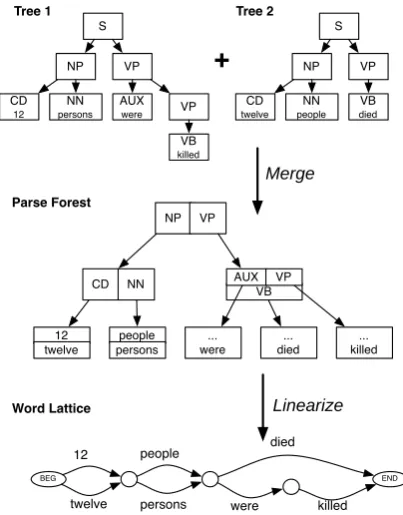
Figure 2: Pang et al. (2003) created word graphs by merging parse trees. Paths with the same start and end nodes are treated as paraphrases.
Pang et al. (2003) use multiple translations to learn paraphrases using a syntax-based alignment algorithm, illustrated in Figure 2. Parse trees were merged into forests by grouping constituents of the same type (for example, the two NPs and two VPs are grouped). Parse forests were mapped onto fi-nite state word graphs by creating alternative paths for every group of merged nodes. Different paths within the resulting word lattice are treated as para-phrases of each other. For example, in the word lat-tice in Figure 2,people were killed,persons died, persons were killed, andpeople diedare all possi-ble paraphrases of each other.
Quirk et al. (2004) treated paraphrasing as “monolingual statistical machine translation.” They created a “parallel corpus” containing pairs of English sentences by drawing sentences with a low edit distance from news articles that were writ-ten about the same topic on the same date, but pub-lished by different newspapers. They formulated the problem of paraphrasing in probabilistic terms in the same way it had been defined in the statisti-cal machine translation literature:
ˆ
e2 = arg maxe
2 p(e2|e1)
= arg maxe
I do not believe in mutilating dead bodies
cadáveres no soy partidaria de mutilar
cadáveres de inmigrantes ilegales ahogados a la playa
tantos arroja
El mar ...
corpses
So many of drowned illegals get washed up on beaches ...
Figure 3: Bannard and Callison-Burch (2005) ex-tracted paraphrases by equating English phrases that share a common translation.
Where p(e1|e2) is estimated by training word
alignment models over the “parallel corpus” as in the IBM Models (Brown et al., 1993), and phrase translations are extracted from word alignments as in the Alignment Template Model (Och, 2002).
Bannard and Callison-Burch (2005) also used techniques from statistical machine translation to identify paraphrases. Rather than drawing pairs of English sentences from a comparable corpus, Bannard and Callison-Burch (2005) used bilingual parallel corpora. They identified English para-phrases by pivoting through para-phrases in another lan-guage. They located foreign language translations of an English phrase, and treated the other En-glish translations of those foreign phrases as poten-tial paraphrases. Figure 3 illustrates how a Span-ish phrase can be used as a point of identifica-tion for English paraphrases in this way. Bannard and Callison-Burch (2005) defined a paraphrase probability p(e2|e1) in terms of the translation
model probabilitiesp(f|e1)andp(e2|f). Sincee1
can translate as multiple foreign language phrases, they sum over f, and since multiple parallel cor-pora can be used they summed over each parallel corpusC:
ˆ
e2 = arg max
e26=e1p(e2|e1)
≈ arg max
e26=e1
X
C
X
f in C
p(f|e1)p(e2|f)
7 Comparing Paraphrasing Techniques with ParaMetric
7.1 Training data for word alignments
In order to calculate AlignP rec and AlignRecall
for the different paraphrasing techniques, we had them automatically align the 500 manually aligned sentence pairs in our test sets.
Parallel Corpora Syntactic Alignment Monolingual SMT
AlignP rec .62 .65 .73
AlignRecall .11 .10 .46
LB-P recision .14 .33 .68
Rel-Recall .07 .03 .01
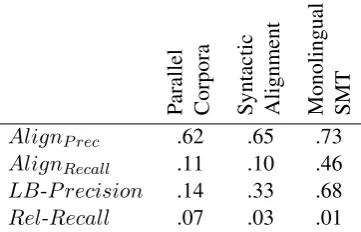
Table 2: Summary results for scoring the different paraphrasing techniques using our proposed auto-matic evaluations.
Bo Pang provided syntactic alignments for the 500 sentence pairs. The word lattices combine the groups of sentences. When measuring alignment quality, we took pains to try to limit the extracted phrase pairs to those which occurred in each sen-tence pair, but we acknowledge that our methodol-ogy may be flawed.
We created training data for the monolingual statistical machine translation method using all pairwise combination of eleven English transla-tions in LDC2002T01. All combinatransla-tions of the eleven translations of the 993 sentences in that corpus resulted in 109,230 sentence pairs with 3,266,769 words on each side. We used this data to train an alignment model, and applied it to the 500 sentence pairs in our test set.
We used the parallel corpus method to align each pair of English sentences by creating interme-diate alignments through their Chinese source sen-tences. The bilingual word alignment model was trained on a Chinese-English parallel corpus from the NIST MT Evaluation consisting of 40 million words. This was used to align the 550 Chinese-English sentence pairs constructed from the test set.
7.2 Training data for precision and recall
gener-ated from the method described in Quirk et al. (2004). For the parallel corpus method, we de-rived paraphrases from the entire Europarl corpus, which contains parallel corpora between English and 10 other languages, with approximately 30 million words per language. We limited both the Quirk et al. (2004) and the Bannard and Callison-Burch (2005) paraphrases to those with a probabil-ity greater than or equal to 1%.
7.3 Results
Table 2 gives a summary of how each of the para-phrasing techniques scored using the four different automatic metrics. The precision of their align-ments was in the same ballpark, with each para-phrasing method reaching above 60%. The mono-lingual SMT method vastly outstripped the others in terms of recall and therefore seems to be the best on the simplified task of aligning paraphrases within pairs of equivalent sentences.
For the task of generating paraphrases from un-restricted resources, the monolingual SMT method again had the highest precision, although time time its recall was quite low. The 500 manually aligned sentence pairs contained 14,078 unique paraphrases for phrases of 5 words or less. The monolingual SMT method only posited 230 para-phrases with 156 of them being correct. By con-trast, the syntactic alignment method posited 1,213 with 399 correct, and the parallel corpus method posited 6,914 with 998 correct. Since the refer-ence lists are incomplete by their very nature, the LB-P recisionscore gives a lower-bound on the precision, and the Rel-Recall gives recall only with respect to the partial list of paraphrases.
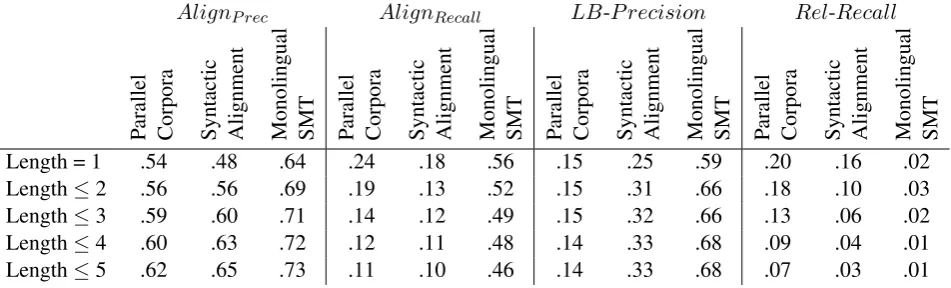
Table 3 gives the performance of the differ-ent paraphrasing techniques for differdiffer-ent phrase lengths.
8 Conclusions
In this paper we defined a number of automatic scores for data-driven approaches to paraphrasing, which we collectively dub “ParaMetric”. We dis-cussed the inherent difficulties in automatically as-sessing paraphrase quality. These are due primar-ily to the fact that it is exceedingly difficult to create an exhaustive list of paraphrases. To ad-dress this problem, we introduce an artificial task of aligning paraphrases within pairs of equivalent English sentences, which guarantees accurate pre-cision and recall numbers. In order to measure alignment quality, we create a set of gold standard
alignments. While the creation of this data does require some effort, it seems to be a manageable amount, and the inter-annotator agreement seems reasonable.
Since alignment is not perfectly matched with what we would like automatic paraphrasing tech-niques to do, we also use the gold standard align-ment data to measure a lower bound on the preci-sion of a method’s paraphrases, as well as its recall relative to the limited set of paraphrases. Future studies should examine how well these scores rank different paraphrasing methods when compared to human judgments. Follow up work should inves-tigate the number of equivalent English sentences that are required for reasonably complete lists of paraphrases. In this work we aligned sets of eleven different English sentences, but we acknowledge that such a data set is rare and might make it dif-ficult to port this method to other domains or lan-guages.
The goal of this work is to develop a set of scores that both allows different paraphrasing tech-niques to be compared objectively and provides an easily repeatable method for automatically evalu-ating paraphrases. This has hitherto not been pos-sible. The availability of an objective, automatic evaluation metric for paraphrasing has the poten-tial to impact research in the area in a number of ways. It not only allows for the comparison of dif-ferent approaches to paraphrasing, as shown in this paper, but also provides a way to tune the parame-ters of a single system in order to optimize its qual-ity.
Acknowledgments
The authors are grateful to Bo Pang for providing the word lattices from her method, to Stefan Rie-zler for his comments on an early draft of this pa-per, and to Michelle Bland for proofreading. This work was supported by the National Science Foun-dation under Grant No. 0713448. The views and findings are the authors’ alone.
References
Bannard, Colin and Chris Callison-Burch. 2005. Para-phrasing with bilingual parallel corpora. In Proceed-ings of the 43rd Annual Meeting of the Association for Computational Linguistics (ACL-2005), Ann Ar-bor, Michigan.
Barzilay, Regina and Lillian Lee. 2003.
us-AlignP rec AlignRecall LB-P recision Rel-Recall
Parallel Corpora Syntactic Alignment Monolingual SMT Parallel Corpora Syntactic Alignment Monolingual SMT Parallel Corpora Syntactic Alignment Monolingual SMT Parallel Corpora Syntactic Alignment Monolingual SMT
Length = 1 .54 .48 .64 .24 .18 .56 .15 .25 .59 .20 .16 .02
Length≤2 .56 .56 .69 .19 .13 .52 .15 .31 .66 .18 .10 .03
Length≤3 .59 .60 .71 .14 .12 .49 .15 .32 .66 .13 .06 .02
Length≤4 .60 .63 .72 .12 .11 .48 .14 .33 .68 .09 .04 .01
Length≤5 .62 .65 .73 .11 .10 .46 .14 .33 .68 .07 .03 .01
Table 3: Results for paraphrases of continuous subphrases of various lengths.
ing multiple-sequence alignment. InProceedings of
HLT/NAACL-2003, Edmonton, Alberta.
Barzilay, Regina and Kathleen McKeown. 2001. Ex-tracting paraphrases from a parallel corpus. In Pro-ceedings of the 39th Annual Meeting of the Associa-tion for ComputaAssocia-tional Linguistics (ACL-2001).
Barzilay, Regina. 2003. Information Fusion for
Mutli-document Summarization: Paraphrasing and Gener-ation. Ph.D. thesis, Columbia University, New York. Brown, Peter, Stephen Della Pietra, Vincent Della Pietra, and Robert Mercer. 1993. The mathematics
of machine translation: Parameter estimation.
Com-putational Linguistics, 19(2):263–311, June. Callison-Burch, Chris, Trevor Cohn, and Mirella
Lap-ata. 2006a. Annotation guidelines for paraphrase alignment. Tech report, University of Edinburgh. Callison-Burch, Chris, Philipp Koehn, and Miles
Os-borne. 2006b. Improved statistical machine
translation using paraphrases. In Proceedings of
HLT/NAACL-2006, New York, New York.
Cohn, Trevor, Chris Callison-Burch, and Mirella Lap-ata. to appear. Constructing corpora for the
develop-ment and evaluation of paraphrase systems.
Compu-tational Linguistics.
Dolan, Bill, Chris Quirk, and Chris Brockett. 2004. Unsupervised construction of large paraphrase cor-pora: Exploiting massively parallel news sources. In
Proceedings of the 20th International Conference on Computational Linguistics.
Ibrahim, Ali, Boris Katz, and Jimmy Lin. 2003. Ex-tracting structural paraphrases from aligned mono-lingual corpora. InProceedings of the Second Inter-national Workshop on Paraphrasing (ACL 2003). Kupper, Lawrence L. and Kerry B. Hafner. 1989. On
assessing interrater agreement for multiple attribute responses. Biometrics, 45(3):957–967.
Lin, Dekang and Patrick Pantel. 2001. Discovery of
inference rules from text. Natural Language
Engi-neering, 7(3):343–360.
Miller, George A. 1990. Wordnet: An on-line lexical database. Special Issue of the International Journal of Lexicography, 3(4).
Nenkova, Ani, Rebecca Passonneau, and Kathleen McKeown. 2007. The pyramid method: incorporat-ing human content selection variation in
summariza-tion evaluasummariza-tion. ACM Transactions on Speech and
Language Processing, 4(2).
Och, Franz Josef and Hermann Ney. 2003. A system-atic comparison of various statistical alignment mod-els. Computational Linguistics, 29(1):19–51. Och, Franz Josef and Hermann Ney. 2004. The
align-ment template approach to statistical machine trans-lation.Computational Linguistics, 30(4):417–449.
Och, Franz Josef. 2002. Statistical Machine
Transla-tion: From Single-Word Models to Alignment Tem-plates. Ph.D. thesis, RWTH Aachen Department of Computer Science, Aachen, Germany.
Pang, Bo, Kevin Knight, and Daniel Marcu. 2003. Syntax-based alignment of multiple translations: Ex-tracting paraphrases and generating new sentences. In Proceedings of HLT/NAACL-2003, Edmonton, Alberta.
Papineni, Kishore, Salim Roukos, Todd Ward, and Wei-Jing Zhu. 2002. Bleu: A method for automatic eval-uation of machine translation. InProceedings of the 40th Annual Meeting of the Association for Compu-tational Linguistics (ACL-2002), Philadelphia, Penn-sylvania.
Quirk, Chris, Chris Brockett, and William Dolan. 2004. Monolingual machine translation for
para-phrase generation. InProceedings of the 2004
Con-ference on Empirical Methods in Natural Language Processing (EMNLP-2004), Barcelona, Spain. Szpektor, Idan, Eyal Shnarch, and Ido Dagan. 2007.
Instance-based evaluation of entailment rule
acquisi-tion. InProceedings of the 45th Annual Meeting of