311
CLINICAL DECISION MAKING USING
ARTIFICIAL NEURAL NETWORK WITH
PARTICLE SWARM OPTIMIZATION
ALGORITHM
Jayashri S.Kolekar
1, Prof. Chhaya Pawar
2 Computer Dept. 1,2Datta Meghe College of Engg., Airoli, Navi Mumbai 1,2 [email protected] 1 , [email protected] 2
ABSTARCT:
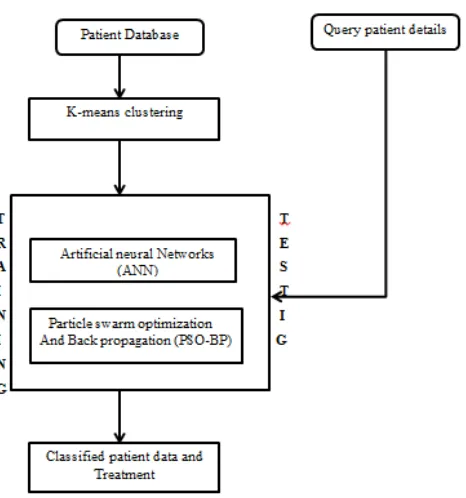
Clinical decision making by health professionals is a more complex process The Clinical decision support system (CDSS) is an interactive decision support system (DSS) Computer Software, which is designed to assist physicians and other health professionals with decision making tasks, such as determining diagnosis of patient data. For this work lot of researcher have proposed many algorithms based on cost, efficiency, time consumption but not in good accuracy. The proposed system based on K-means clustering and Artificial Neural Network using Particle Swarm Optimization Algorithm will maximize the accuracy and efficiency of clinical decision-making with minimizing time consumption & cost. Proposed system having two main operations one is k-means clustering for grouping the patient data according to the symptom and patient details ,second one is the adaptation of network weights using Particle Swarm Optimization (PSO) was proposed as a mechanism to improve the performance of Artificial Neural Network (ANN) in classification of patient dataset. Classification is a machine learning technique used to predict group membership for data instances.
Keywords: Clinical decision making; Clinical Decision Support System; ANN; PSO; Back propagation;
K-mean.
1. INTRODUCTION
Clinical decision making is the process in which the physician determines patient need what and when. For this physician gather all the information of the patient and compare it with the knowledge present with him and prepare the argument for a particular disease state. There may then be no single, right way of applying diagnostic and therapeutic strategies to a particular case. Clinical decision support system (CDSS) is an interactive decision support system (DSS) Computer Software, which is designed to assist physicians and other health professionals with decision making tasks, such as determining diagnosis of patient data. A working definition has been proposed by Robert Hayward of the Centre for Health Evidence; "Clinical Decision Support systems link health observations with health knowledge to influence health choices by clinicians for improved health care". This definition has the advantage of simplifying Clinical Decision Support to a functional concept. It is a major topic of artificial intelligence in medicine.
312
2. LITERATURE SURVEY
A lot of research work is done in the clinical decision making. The systems such as MYCIN, CASNET, PIP and Internist-I are proved that the clinical decision support systems performs better than the manual practices.
CASNET (Causal Associational Networks) was developed in early 1960s is a general tool for building expert system for the diagnosis and treatment of diseases. CASNET major application was the diagnosis and recommendation of treatment for glaucoma.
In the early 1970s MYCIN was developed to diagnose certain antimicrobial infections and recommends drug treatment. It was not actually used in practice but research indicated that it proposed an acceptable therapy in about 69% of cases, which was better than the performance of infectious disease experts who were judged using the same criteria [5].
PIP (Present Illness Program) was developed in 1970s to simulate the behavior of an expert nephrologist in taking the history of the present illness of a patient with underlying renal disease.
The work on Internist-I in early 1980s was concentrated on the investigation of heuristic methods for imposing differential diagnostic task structures on clinical decision making. It was applied in diagnoses of internal medicine. Now a day based on the current needs the CDSS is enhanced. In many systems combination of two techniques are used to improve the performance of the system.
Casey C. Bennett and Kris Hauser [6], has developed a general purpose model for clinical decision making using artificial intelligence framework in which the markov decision process with the dynamic decision making is used. This framework consists of patient agent with the basic information of patient with symptoms and individualized transition model, and physician agent with beliefs about patient status and treatment effects and has decision making capabilities. Based on the individualized transition model the MDP is created. Then the evidences are filtered by the physician. The filtered evidences and the selected data from EHR the MDP search tree is prepared which consists of number of actions and the treatments from that the optimal action is selected belief state is updated and the cost is calculated for the current action. Then this process is repeated till the action is equal to no treatment .Then optimal treatment and cost is calculated. Framework, some of the difficult patient data’s sometimes won’t classify properly and also decision of treatment will maybe wrong so we are improving the decision making algorithm based on k-means and artificial neural networks using particle swam optimization leaning algorithm. It improves the accuracy of giving decision of patient details, efficiency, time consumption and cost of the system.
3. PROPOSED SYSTEM
313
Figure 1: proposed system for clinical decision making
3.1 K-means algorithm
Cluster analysis or clustering is the task of grouping a set of objects in such a way that objects in the same group (called a cluster) are more similar (in some sense or another) to each other than to those in other groups (clusters). It is a main task of exploratory data mining, and a common technique for statistical data analysis, used in many fields, including machine learning, pattern recognition, image analysis, information retrieval, and bioinformatics [7]. K-means [8] (MacQueen, 1967) is one of the simplest unsupervised learning algorithms that solve the well-known clustering problem. The procedure follows a simple and easy way to classify a given data set through a certain number of clusters (assume k clusters) fixed a priori
K-mean algorithm is as follows:
1. Select the k points randomly; the points are nothing but the centroid of groups.
2. Based on the centroid the data is partitioned into k groups, the data which is adjacent to it is assigned to that group.
3. Then recalculate the k centroids after completion of the first partitioning
4. Then iterate the step 2 and 3 till the centroid doesn’t change the location.
314
3.2 ANN (Artificial Neural Network)
Artificial neural network is an efficient information processing system which resembles in characteristics with a biological neural network.in this proposed system we are using feed forward neural network. This type of network has no recurrent connections between the nodes so the activity flows in one direction.
3.3 Particle swarm optimization with back propagation
The PSO–BP is an optimization algorithm combining the Particle swarm optimization with the Backpropogation.[9] The particle swarm optimization (PSO) is an evolutionary computation technique developed by Eberhart and Kennedy in 1995 [10], inspired by social behavior of bird flocking. This technique is used to find global optimal solution. The Backpropogation (BP) algorithm is used to find local optimal solution .the combination of both is nothing but the hybrid algorithm is used to find best global optimal solution.
The PSO–BP algorithm’s [11] searching process is started from initializing a group of random particles.
1. Initialize the positions (weight and bias) and velocities of a group of particles randomly.
2. The PSO-BP is trained using the initial particles position.
3. The learning error produced from BP neural network can be treated as particles fitness value according to initial weight and bias.
4. The learning error at current epoch will be reduced by changing the particles position, which will update the weight and bias of the network.
(i) The “pbest” value (each particle’s lowest learning error so far) and
(ii) The “gbest” value (lowest learning error found in entire learning process so far) are applied to the Velocity update to produce a value for positions adjustment to the best solution or targeted learning error. 5. The new sets of positions (NN weight and bias) are produced by adding the calculated velocity value to the
current position value. Then, the new sets of positions are used to produce new learning error in feed forward NN.
6. This process is repeated until the stopping conditions either minimum learning error or maximum numbers
of iteration are met.
7. The optimization output, which is the solution for the optimization.
4. CONCLUSION
In this paper the proposed system is used to maximize the accuracy of clinical decision by using the feature of the k-means algorithm for partitioning the database within appropriate groups. The time consumption is also reduced by the ANN with PSO-BP which is same like APSO for training testing .The proposed system deal with uncertainty of the clinical decision making and it provides optimal treatment to the patient with complex, chronic illness.
REFERENCES
[1] Bauer MS. A review of quantitative studies of adherence to mental health clinical practices guidelines. Harvard Review of Psychiatry 2002; 10(3):138–53.
[2] McGlynn EA, Asch SM, Adams J, KeeseyJ, Hicks J, DeCristofaro AA, et al. The quality of health care delivered to adults in the United States. New England Journal of Medicine 2003; 348(26):2635-45.
[3] M.M.Abbasi, S.Kashiyarndi.Clinical Decision Support Systems: A discussion on different methodologies used in Health Care.
[4] Y. Kim, Y. Cho, “Correlation of Pain Severity with Thermography,” Engineering in Medicine and biology Society, 1995, IEEE, pages 1699 -1700
[5] Yu, V.L. et al. (1979). "Antimicrobial selection by a computer: a blinded evaluation by infectious disease
experts". Journal of the American Medical Association 242 (12):12791282. Doi:
10.1001/jama.1979.03300120033020.PMID 480542.
[6] Casey C. Bennett and Kris Hauser .Artificial intelligence framework for simulating clinical decision-making: A Markov decision process approach. Artificial Intelligence in Medicine 57(2013)9-19.
[7] R. T. Ng and J. Han. Efficient and Effective Clustering Methods for Spatial Data Mining. Proc. of the 20th Int’l Conf. on Very Large Databases, Santiago, Chile, pages 144–155, 1994.
315
March2013
[10] Kennedy, J.; Eberhart, R. (1995). "Particle Swarm Optimization". Proceedings of IEEE International Conference on Neural Networks.