Review On Learning Orientations
Norazrena Abu Samah ¹, Nor Affandy Yahaya² & Mohamad Bilal Ali²
1
Fakulti Pendidikan, Universiti Teknologi Malaysia 81310 Johor, Malaysia
ABSTRACT: The need has arises towards the consideration of individual difference to let learners engage in and responsible for their own learning, retain information longer, apply the knowledge more effectively, have positive attitudes towards the subject, have more interest in learning materials, score higher and have high intrinsic motivation level. As regard to the importance of individual differences, Martinez (2000) has grounded a new theory, which is Intentional Learning Theory that covered individual aspects of cognitive, intention, social and emotion. This theory hypothesizes that the fundamental of understanding how individual learns, interact with an environment, performs, engages in learning, experiences learning, and assimilate and accommodate the new knowledge is by understanding individual’s fundamental emotions and intentions about how to use learning, why it is important, when the suitable time, and how it can accomplish personal goals and change. The intent of this theory is to focus on emotions and intentions of an individual regarding why, when and how learning goals are organized, processed, and achieved. In conclusion, Learning Orientations introduced by this theory describes the disposition of an individual in approaching, managing and achieving their learning intentionally and differently from others.
Keywords: Learning & Orientations
ABSTRAK : Perbezaan antara individu semakin menjadi keperluan dalam pendidikan kini bagi menggalakkan pelajar melibatkan diri dan bertanggungjawab terhadap pembelajaran mereka, mengekalkan maklumat yang diperolehi lebih lama, mengaplikasikannya dengan lebih efektif, menampilkan sikap yang lebih efektif terhadap subjek yang dipelajari, lebih berminat terhadap bahan pembelajaran, memperolehi markah lebih tinggi dan mempunyai tahap motivasi intrinsik yang tinggi. Berikutan kepentingan perbezaan individu yang perlu diutamakan dalam pembelajaran, Martinez (2000) telah membina teori baru iaitu Teori Pembelajaran Intensional yang merangkumi aspek individu iaitu kognitif, niat, sosial dan emosi. Teori ini menyimpulkan bahawa pemahaman terhadap emosi dan niat seseorang individu terhadap pembelajaran, kepentingan pembelajaran, waktu pembelajaran yang sesuai dan kaedah untuk mencapai matlamat dalam pembelajaran merupakan asas bagi pemahaman tentang bagaimana seseorang individu belajar, berinteraksi dengan persekitaran, melaksanakan aktiviti, terlibat dalam pembelajaran, menghayati pembalajaran serta mengasimilasi dan mengakomodasi pengetahuan baru. Teori ini menumpukan kepada emosi dan niat seseorang individu berkaitan mengapa, bila dan bagaimana matlamat dalam pembelajaran disusun, diproses dan dicapai. Kesimpulannya, orientasi pembelajaran yang diperkenalkan oleh teori ini menjelaskan tentang sifat seseorang individu dalam mendekati, mengurus dan mencapai tujuan mereka dalam pembelajaran yang berbeza daripada individu yang lain.
1.0 LEARNING ORIENTATIONS
In order to ensure learners engage to and take responsibility for their own learning, many researchers (Weber, Martin, & Cayanus, 2005; Aviram et al., 2008; Jung & Graf, 2008; Kim, 2009; Retails et al., 2004) suggested that the differences and distinctiveness of each learners must be taken into account in preparing the learning. The differences of learners include their learning styles, learning orientations, learning rates, cognitive styles, multiple intelligence, talents and many more. All learners will be provided with the necessary challenges and opportunities for self-development and learning if these differences are taken into account (Aviram et al., 2008; Jung & Graf, 2008). In addition, according to Weber, Martin, & Cayanus, (2005), learning is a constructive process. This is supported by the research that has been done by Chapman (2006) that found the learning occurs best when learners understand the relevance and meaningfulness of the learning to them, and also when learners are actively engaged in creating their own idea or knowledge and able to connect what they learned with their prior knowledge and experience.
Lots of approaches have blossomed over the last decade and most of them have primarily cognitive perspectives. For example, according to Lim (2007) learning style as known as cognitive learning style has many dimensions of theories such as Felder-Silvermann Learning Style Theory, Field Independence or Dependence, Honey & Mumford Learning Style, Kolb’s Learning Style Model, Myers-Brigs Type Indicator and so on. Although Keefe (1979) defined learning style as characteristic cognitive, affective, and psychological behaviours that indicates how learners interact with and respond to learning environment, Martinez (1999I), Martinez (1999D), and Martinez (1999A) realized that the approach mostly focusing on cognitive aspect, and demote other factors to secondary or no role. Therefore, there are some contemporary researchers (Martinez, 1999I; Martinez, 1999A; Bentley, 2000; Chapman, 2006; Unfred, 2003; Martinez, 1998; Martinez, 1999D; Martinez & Bunderson, 2000; Tasir, Noor, Harun, & Ismail, 2008; Martinez, 2001) have included important conative or emotions and affective or intention influence to extend their cognitive investigations on learning differences when they recognized the importance of these psychological factors in students’ learning.
Intentional Learning Theory hypothesizes that the fundamental of understanding how individual learns, interact with an environment, performs, engages in learning, experiences learning, and assimilate and accommodate the new knowledge is by understanding individual’s fundamental emotions and intentions about how to use learning, why it is important, when the suitable time, and how it can accomplish personal goals and change events (Martinez & Bunderson, 2000). Learning Orientation Model introduced by this theory is not focusing primarily on cognitive constructs but concerned more on conative, affective and social aspects of how an individual learns and manage their own learning construct (Martinez, 1998; Martinez, 1999; Martinez & Bunderson, 2000). According to Unfred (2003), the intent of this theory is to focus on emotions and intentions of an individual regarding why, when and how learning goals are organized, processed, and achieved. In other words, Learning Orientations describe the disposition of an individual in approaching, managing and achieving their learning intentionally and differently from others.
independence or autonomy (Martinez, 1999D). These attributes refers to the degree that learners plan, engage and effort to accomplish learning. These attributes can also be referred to the individual’s desire and ability to take responsibility, make choices, self-motivate, manage and improve their learning (Martinez, 2001).
Based on the research that has been done by Martinez (1999I), Martinez (1999A), and Martinez (2001), Learning Orientation is rational and useful in providing theoretical foundations using a comprehensive view of learning. Furthermore, from the research, Learning Orientation could help to recognize dominant psychological factors such as conative and affective, that influenced learning, other than just cognitive aspects. The results of the research also recognized the usefulness of Learning Orientation to analyze and differentiate the students regarding what works for each of them, and to guide the design, development, implementation, analysis, and evaluation of learning solution or environment. Moreover, the research found that the matching of Learning Orientations and learning environment has 99% impacted satisfaction and 95% learning efficacy. Thus, these evidences suggest that it is useful to recognize and being sensitive to Learning Orientations in designing the instructional solution and environment. Tasir, Noor, Harun, & Ismail (2008) found that Learning Orientations are considered useful and rational for online students when considering the impact of emotions, intentions, effort to accomplish learning and success, and social factors on learning.
Learning Orientations Questionnaire constructed by Martinez (1999dissertation) is used in categorizing students into four profile of learners based on Learning Orientations Model, which are Transforming Learner, Performing Learner, Conforming Learner, and Resistant Learner (Martinez, 1999I). According to Bentley (2000), Learning Orientations Questionnaire can help in finding new ways to assess and explore the differences in individual learning. The questionnaire also helps Martinez (1999) and Martinez (2001) in determining and identifying the learning design guidelines for each learner. In short, Transforming Learner prefers discovery-oriented, non-linear and mentoring environment, Performing Learner prefers task- or project-oriented, competitive and interactive or hands-on environment, and Conforming Learner prefers simple, scaffolded, structured, facilitated and low-risk environment.
2.0 LEARNING ORIENTATIONS PROFILE
Table 1 below shows conative and affective aspects, strategic planning and committed learning effort, and learning autonomy of each learning orientations profile.
ORIENTATION CONATIVE/AFFECTIVE ASPECTS
STRATEGIC PLANNING AND
COMMITTED LEARNING
EFFORT
LEARNING AUTONOMY
TRANSFORMING LEARNER
(Transformance)
Focus strong passions and intentions on learning. Be an assertive, expert, highly self-motivated learner. Use holistic-thinking and exploratory learning to transform using high, personal standards.
Set and accomplish personal short- and long-term
challenging goals that may or may not align with goals set by others; maximize effort to
innovate and reach personal goals. Commit great effort to discover,
elaborate, and build new knowledge and meaning. Experience frustration if restricted or given little learning autonomy. PERFORMING LEARNER (Performance) Focus emotions/intentions on learning selectively or situationally. Be a self-motivated, focused learner when the content appeals. Meet above-average group standards only when the benefit appeals.
Set and achieve short-term, task-oriented goals that meet average-to-high standards; situationally minimize efforts and standards to reach assigned or negotiated standards.
Selectively commit measured, detailed effort to assimilate and use relevant knowledge and meaning. May situationally assume learning responsibility in areas of interest but willingly give up control in areas of less interest. Prefer coaching and interaction for achieving goals. CONFORMING LEARNER (Conformance)
Focus intentions and emotions cautiously and routinely as directed. Be a low-risk, modestly
effective, extrinsically motivated learner. Use learning to conform to easily achieved group standards.
Follow and try to accomplish simple task-oriented goals assigned and guided by others, then try to please and conform; maximize efforts in supportive
environments with safe standards. Commit careful, measured effort to accept and
reproduce
knowledge to meet external
requirements.
Assume little responsibility, manage
learning as little as possible, be compliant, want continual guidance, and expect reinforcement for achieving short-term goals. RESISTANT LEARNER (Resistance)
Focus on not cooperating. Be an actively or passively resistant learner. Avoid using learning to achieve academic goals assigned by others.
Consider lower standards, fewer academic goals, conflicting personal goals, or no goals; maximize efforts to resist assigned or
expected goals either assertively or passively. Chronically avoid learning (apathetic, frustrated, discouraged, or disobedient). meeting formal learning requirements or expectations.
Situational Performance or Resistance: Learners may situationally improve, perform or resist in reaction to positive or negative learning conditions or situations
Table 1: Learning Orientations Profile (Martinez, 1999; Martinez, 2001)
3.0 DESIGN GUIDELINES
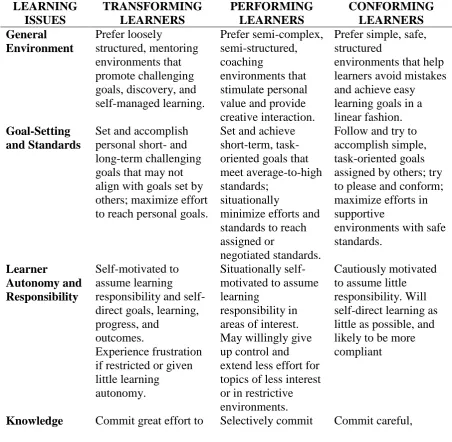
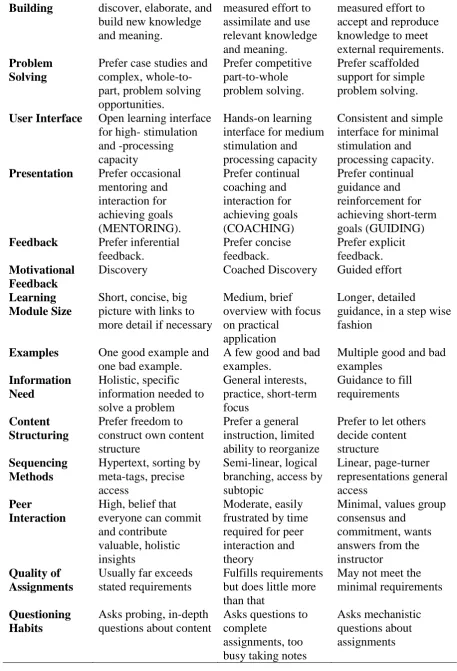
Table 2 below shows learning issues preferred by each learning orientations profile.
LEARNING ISSUES TRANSFORMING LEARNERS PERFORMING LEARNERS CONFORMING LEARNERS General Environment Prefer loosely structured, mentoring environments that promote challenging goals, discovery, and self-managed learning. Prefer semi-complex, semi-structured, coaching environments that stimulate personal value and provide creative interaction.
Prefer simple, safe, structured
environments that help learners avoid mistakes and achieve easy learning goals in a linear fashion.
Goal-Setting and Standards
Set and accomplish personal short- and long-term challenging goals that may not align with goals set by others; maximize effort to reach personal goals.
Set and achieve short-term, task-oriented goals that meet average-to-high standards;
situationally
minimize efforts and standards to reach assigned or
negotiated standards.
Follow and try to accomplish simple, task-oriented goals assigned by others; try to please and conform; maximize efforts in supportive
environments with safe standards. Learner Autonomy and Responsibility Self-motivated to assume learning responsibility and self-direct goals, learning, progress, and
outcomes.
Experience frustration if restricted or given little learning autonomy.
Situationally self-motivated to assume learning
responsibility in areas of interest. May willingly give up control and extend less effort for topics of less interest or in restrictive environments.
Cautiously motivated to assume little responsibility. Will self-direct learning as little as possible, and likely to be more compliant
Building discover, elaborate, and build new knowledge and meaning.
measured effort to assimilate and use relevant knowledge and meaning.
measured effort to accept and reproduce knowledge to meet external requirements.
Problem Solving
Prefer case studies and complex, whole-to-part, problem solving opportunities.
Prefer competitive part-to-whole problem solving.
Prefer scaffolded support for simple problem solving.
User Interface Open learning interface for high- stimulation and -processing capacity
Hands-on learning interface for medium stimulation and processing capacity
Consistent and simple interface for minimal stimulation and processing capacity.
Presentation Prefer occasional mentoring and interaction for achieving goals (MENTORING). Prefer continual coaching and interaction for achieving goals (COACHING) Prefer continual guidance and reinforcement for achieving short-term goals (GUIDING)
Feedback Prefer inferential feedback. Prefer concise feedback. Prefer explicit feedback. Motivational Feedback
Discovery Coached Discovery Guided effort
Learning Module Size
Short, concise, big picture with links to more detail if necessary
Medium, brief overview with focus on practical
application
Longer, detailed
guidance, in a step wise fashion
Examples One good example and one bad example.
A few good and bad examples.
Multiple good and bad examples
Information Need
Holistic, specific information needed to solve a problem
General interests, practice, short-term focus
Guidance to fill requirements
Content Structuring
Prefer freedom to construct own content structure
Prefer a general instruction, limited ability to reorganize
Prefer to let others decide content structure
Sequencing Methods
Hypertext, sorting by meta-tags, precise access
Semi-linear, logical branching, access by subtopic Linear, page-turner representations general access Peer Interaction
High, belief that everyone can commit and contribute
valuable, holistic insights
Moderate, easily frustrated by time required for peer interaction and theory
Minimal, values group consensus and
commitment, wants answers from the instructor
Quality of Assignments
Usually far exceeds stated requirements
Fulfills requirements but does little more than that
May not meet the minimal requirements
Questioning Habits
Asks probing, in-depth questions about content
Asks questions to complete
assignments, too busy taking notes
Asks mechanistic questions about assignments
4.0 CONCLUSION
Learning Orientations categorized learners based on how they choose to plan, set, perform and attain goals, intend to commit and expend effort and also, experience learning and achievement. The Learning Orientations Questionnaire has been proved by Nor Aziah, Haziah & Masitah (2005), Bentley (2000; 2001), Higgins & O'Keeffe (2008) and Own Zang-Yuan Chen & Juin-Rei (2004) as the new way to assess individual differences. This became no doubt in the usage of this questionnaire in today’s education. Therefore, students’ learning orientations need to be taken into account in developing the best learning environment for better learning.
REFERENCE
Altrichter, H., Posch, P. & Somekh, B. (2006). Teachers investigate their work; An introduction to the methods of action research. Routledge. p. 117. (2nd edition). Aviram, A., Ronen, Y., Somekh, S., Winer, A., & Sarid, A. (2008). Self-Regulated
Personalized Learning (SRPL): Developing iClass’s pedagogical model. eLearning Papers.
Bentley, J. P. H. (2000). Learning Orientation Questionnaire Correlation with the Herrmann Brain Dominance Instrument: A Validity Study. Unpublished dissertation, Brigham Young University.
Bogdan, R. C. & Biklen, S. K. (2006). Qualitative research in education: An introduction to theory and methods. Allyn & Bacon.
Brown, T. (2008). Lacan, subjectivity and the task of mathematics education research.
Education Students Mathematics, 68, 227–245.
Brusilovsky, P. (2001). Adaptive hypermedia. User Modeling and User Adapted Interaction, 11 (1/2), 87-110.Bull, G., & Bell, R. L. (2008). Educational Technology in the Science Classroom. In J. G.-N. Randy L. Bell, and Julie Luft (Ed.), Technology in the Secondary Science Classroom (pp. 1-7): National Science Teachers Association. Capuano, N., Gaeta, M., Orciuoli, F., & Ritrovato, P. (2009). On-Demand Construction of
Personalized Learning Experiences Using Semantic Web and Web 2.0 Techniques.
University of Salerno, Fisciano (SA), Italy.
Chapman, D. D. (2006). Learning Orientations, Tactics, Group Desirability, and Success in Online Learning. Paper presented at the Annual Conference on Distance Teaching and Learning.
Cheng, Liying (2005). Changing language teaching through language testing: a washback study. Cambridge University Press. p. 72.
Cohen, L., & Manion, L. (2000). Research methods in education. Routledge. p. 254. (5th edition).
Corno L. & Snow E. (1986). Adapting Teaching to Individual Differences among Learners. In Wittrock M. (ed.) Handbook of Research on Teaching, New-York: Macmillan, 605-29.
Cronbach L. & Snow R. (1977). Aptitudes and Instructional Methods: A Handbook of Research on Interactions, Inrington Publishers.
Dwyer, M. B. (2002). Training strategies for the twenty-first century: Using recent research on learning to enhance training.
Fok, A.W.P, & Ip, H.S.S (2004), Personalized Education (PE) – An Exploratory Study of Learning Pedagogies in Relation to Personalization Technologies, In W. Liu, Y. Shi and Q. Li (eds.) Advances in Web-Based Learning. Lecture Notes in Computer Science, 3143, Springer, Berlin, 407-415.
Gilbert, J. E., & Han, C. Y. (2002). Arthur: A Personalized Instructional System. Journal of Computing in Higher Education, 14(1), 113-129.
Görgün, I., Türker, A., Ozan, Y., & Heller, J. (2005). Learner Modeling to Facilitate Personalized E-Learning Experience. In Kinshuk, D. G. Sampson & P. T. Isaías (Eds.), CELDA'05: Cognition and Exploratory Learning in Digital Age (pp. 231-237): IADIS.
Govindasamy T. (2002) Successful implementation of e-Learning; Pedagogical considerations," The Internet and Higher Education, vol. 4, pp. 287-299.
Graven, O.G and MacKinnon, D. (2005) A Survey of Current state of the art support for lifelong learning. ITHET 6th Annual International Conference, Juan Dolio, Dominican Republic.
Gregson, J. A. (1997) A Critical Response to Grubb, Journal of Vocational Education Research, Vol. 22, pp123-132.
Hansson, H. (2006) The use of Net-Learning in Higher Education in the Nordic Countries. In Pre-information for the presentation, Kyoto, Japan.
Honebein, P. C., Duffy, T. and Fishman, B. (1993) Constructivism and the Design of Learning Environment: Context and Authentic Activities for Learning, Springer-Verlag, New York, pp87-108.
Hu, L., & Webb, M. (2009). Integrating ICT to higher education in China: From the perspective of Activity Theory. Education Information Technology, 14, 143-161. Jung, J., & Graf, S. (2008). An Approach for Personalized Web-based Vocabulary Learning
through Word Association Games*. SAINT, 325-328.
Kilday, C. R., & Kinzie, M. B. (2009). An Analysis of Instruments that Measure the Quality of Mathematics Teaching in Early Childhood. Early Childhood Education Journal, 36, 365–372.
Kim, I.-S. (2009). The Relevance of Multiple Intelligences to CALL Instruction. The Reading Matrix, 9(1), 1-21.
Kinshuk, Suhonen J., Sutinen E. and Goh T. (2003) Mobile Technologies in Support of Distance Learning. Asian Journal of Distance Education, Vol.1 No.1, pp60-68.
Li, X., Luo, Q., & Yuan, J. (2007). Personalized Recommendation Service System in E-Learning Using Web Intelligence. In Computational Science – ICCS 2007 (Vol. 4489/2007, pp. 531–538). Heidelberg: Springer Berlin.
Liu, F. (2007). Personalized Learning Using Adapted Content Modality Design for Science Students. Proceedings of the ECCE 2007 Conference, 293-296.
Lowenthal, P., & Muth, R. (2008). Constructivism. In E. F. Provenzo, Jr. (Ed.), Encyclopedia of the social and cultural foundations of education. Thousand Oaks, CA: Sage.Martinez, M. (1999). Designing Learning Objects to Personalize Learning. Martinez, M. (1999). Intentional Learning in an Intentional World: New Perspectives on
Audience Analysis and Instructional System Design for Successful Learning and Performance. 211-220.
Martinez, M. (2001). Key Design Considerations for Personalized Learning on the Web.
Educational Technology & Society, 4(1), 26-40.
Martinez, M. (2002). Beyond Classroom Solutions: New Design Perspectives for Online Learning Excellence. Educational Technology & Society, 5(2), 1-6.
Martinez, M. A. (1999). An Investigation into Successful Learning: Measuring the Impact of Learning Orientation, A Primary Learner-difference Variable, on Learning.
Unpublished dissertation, Brigham Young University.
Meredith, S and Newton, B. (2003) Models of e-Learning: technology promise vs. learner needs–literature review. In: The International Journal of Management Education
pp43-56.
Meyen, E. L., Tangen, P., and Lian, C. (1999) Developing online instruction: Partnership between instructors and technical developers. Journal of Special Education Technology, Vol.14 No.1, pp18–31.
Miller, P., Walker, J.M. and Aayla, J. (2003) 'Technology integration as a transformative catalyst and tool', International Journal of Learning Vol.10: pp2461– 2480.Muilenburg, L. Y. and Berge, Z. L., (2005) Student Barriers to Online Learning: A factor analytic study. Distance Education Vol. 26, No.1, pp29-48.
Nguyen-Ngoc, A. V. (2007). Activity Theoretical Analysis and Design Model for Web-Based Experimentation. In J. Jacko (Ed.), Human-Computer Interaction (pp. 204–213): Springer-Verlag Berlin Heidelberg.
O'Donoghue, T., Punch K. (2003). Qualitative Educational Research in Action: Doing and Reflecting. Routledge. p.78.
Ou, K.-L., Huang, M.-W., & Wu, M.-Z. (2007). The Online Parallel Test Generator for Teacher Detecting Elementary School Students' Misconceptions about Decimal Fractions. Paper presented at the IADIS International Conference e-Learning 2007. Pavlova, M. (2009). Technology Education as an Effective Way of Providing Vocational
Education Within Secondary Schooling. In Technical and Vocational Education and Training: Issues, Concerns and Prospects: Springer Science+Business Media B.V. Peng, F. S., & Idris, N. (2008). Perwakilan Pecahan Sekolah Rendah: Isu dan Prospek.
Masalah Pendidikan, 31(1), 41-57.
Retalis, S., Paraskeva, F., Tzanavari, A., & Garzotto, F. (2004, September 2004). Learning Styles and Instructional Design as Inputs for Adaptive Educational Hypermedia Material Design. Paper presented at the "Information and Communication Technologies in Education" - Fourth Hellenic Conference with International Participation, Athens, Greece.
Salim, N., & Haron, N. (2006). The Construction of Fuzzy Set and Fuzzy Rule for Mixed Approach in Adaptive Hypermedia Learning System. In Technologies for E-Learning and Digital Entertainment (Vol. 3942/2006, pp. 183–187). Heidelberg: Springer Berlin.
Seppälä, P. and H. Alamäki (2003). "Mobile learning in teacher training." Journal of Computer Assisted Learning 19(3): 330.
Shields, J. & Potfak, A. (2002). A report card on handheld computing. Technology and Learning, 22, 7, 25–36.
Sousa, D.A. (1998, December 16). Is the fuss about brain research justified? Education week, 18 (16), 52, 35.
Stein, D. S., & Wheaton, J. E. On-line Learning Communities and Higher Education: Factors Supporting Collaborative Knowledge-Building.
Sun, L., Lubega, J.T and Williams, S.A. (2004). "Design for a Learner-Oriented Tracking",
Lecture Notes in Computer Science, Springer-Verlag Heidelberg, Vol. 3143, pp155. Tasir, Z., Noor, N. M., Harun, J., & Ismail, N. S. (2008). A survey on online teaching
Where are you in the landscape of educational technology? Proceedings ascilite Melbourne 2008. Melbourne.
Unfred, D. (2003). Comparative Study of Two Electronic Textbook Interface Design Metaphors Relative to Learner Self-Efficacy, Attitudes, and Learning Orientation.
Visscher-Voerman, I., & Gustafson, K. L. (2004). Paradigms in the Theory and Practice of Education and Training Design. ETR&D, 52(2), 69-89.
Wang, S.-K., & Yang, C. (2005). The Interface Design and the Usability Testing of a Fossilization Web-Based Learning Environment. Journal of Science Education and Technology, 14(3), 305-313.
Weber, K., Martin, M. M., & Cayanus, J. L. (2005). Student interest: A two-study re-examination of the concept. Communication Quarterly, 53(1), 71-86.
Wegerif, R. (2007). Technology, Education and Enlightenment. In Dialogic Education and Technology: Expanding the Space of Learning (Vol. 7, pp. 269-299): Springer US. Woodill G. (2008) Building and Fostering Virtual Learning Communities, Brandon Hall