A Study of Design Requirements for Mobile Learning Environments
David Parsons
*, Hokyoung Ryu
**IIMS, Massey University, Auckland, New Zealand
E-mail:
*[email protected],
**[email protected]
Abstract
This paper proposes a conceptual framework for mobile learning applications that provides systematic support for mobile learning experience design. It is based on a combination of a game metaphor and several studies of mobile learning contexts. An account of the Ambient Wood project is used to explore the relationship between the framework and mobile learning design requirements in practice.
1. Introduction
As mobile technologies have become pervasive, many researchers [e.g., 1, 2] have questioned whether they can enhance learning experiences. Arguably, it could be thought that mobile learning (M-learning) is an approach to electronic learning (E-learning) that simply utilises mobile devices, yet it can also be viewed as a quite different learning experience [3]. Indeed, M-learning can only be delivered with an awareness of the special limitations and benefits of mobile devices, so one cannot simply apply known design requirements from E-learning into the mobile learning context.
This paper explores what factors and design requirements are crucial to the M-learning environment, and suggests how M-learning applications can be designed with an understanding of these factors and requirements. In our approach, we develop an M-learning framework for integrating relevant design requirements, grounded in best practices from the literature. The following section reviews the literature, identifying several structural factors and contexts for M-learning design, introducing a framework to develop M-learning applications. Section three analyses an M-learning environment with the framework. The final section provides some conclusions and proposals for further research.
2. Design requirements for M-learning
Portable communication devices are central to M-learning environments, giving access to the M-learning content. The design concerns of M-learning environments in general are thus combined with those of specific M-learning applications. We review these design concerns from four perspectives: generic mobile environment issues, learning contexts, learning experiences, and learning objectives.
2.1. Generic mobile environment issues
The most important feature in the mobile environment is mobility itself. It enables us to be in contact while we are outside the reach of conventional communication spaces. Mobility can be conceptualised in different ways, i.e., mobility of the user, mobility of the device, and mobility of services, and these three aspects should be addressed both technically and contextually.
We should also understand that each user employs their mobile device in a different way. For instance, teens frequently use SMS to communicate, while professionals are more likely to be using corporate email. This feature – different user profiles and their roles in the use of mobile technologies – becomes even more important in an M-learning environment. For instance, the use of SMS in M-learning [e.g., 4] has been identified as an effective tool to enhance both teens’ learning experience and tutors’ instructing experience, yet the requirements of the two parties were quite different in terms of their previous experience of SMS. A simple way of considering user roles and profiles is Löwgren et al.’s classification [5]: core, periphery, and context. Core users are always learning with their mobile devices (e.g., students), and the periphery includes user roles that are not actively incorporated into the learning experience (e.g., tutors). The context is the surrounding user roles and society at large that are not directly involved in the learning experience, but
still influence it in indirect and complex ways (e.g., parents or school). In terms of the different roles and profiles in the learning experience, there is a need to manage these relationships in a way that acknowledges the role of stakeholders, honours the integrity of all involved parties, and leads to a viable design.
Awareness of the constraints of the user interface is also vital. Mobile devices suffer from small screens, poor input methods and limited battery life. Therefore, the interface design for M-learning services must meet users’ needs without overloading them with unnecessary complexity or operating too slowly.
Successful mobile applications tend to employ many rich media objects [6], yet they should not distract from the learner’s experience. One of the commonly stated characteristics of M-learning content is that it should be delivered in short ‘nuggets’ rather than large units of information, which can be supported by appropriate use of different media types. These media types should support content appropriately. For instance, Luchini et al. [7] stress the importance of the user participating in and learning about underlying concepts and processes, perhaps using simulation tools [8], rather than learning by rote. One widely noted feature of mobile technologies is that they afford the possibility of perpetual contact. This sense of communication support tends to contribute to the other possibilities of M-learning in use. As a simple example, communication support has helped to meet the collective learning objective of a field trip [9].
2.2 M-learning contexts
M-learning has been used as a pre and/or post activity to other types of learning [9, 10], complementing the classroom experience. This may make us see the M-learning context as part of the traditional learning context [11]. However, some recent M-learning applications, e.g., the Ambient Wood project [9], reveal that the M-learning context is quite different from traditional learning. In this section, we review the contextual features that can be used to understand M-learning design requirements. We base these on Wang’s six dimensions of the M-learning context: identity, learner, activity, collaboration, spatio-temporal, and facility [12]. The first four of these would establish the situational contexts of M-learning, and the last two would be associated with the environmental context.
Identities of M-learning users (e.g., learners, tutors) are a necessary contextual factor. This would be of
value for the development of personalised learning experiences for individual stakeholders.
Several considerations of the learner should be made, because each user has different psychological properties that relate to their learning experience. For instance, highly self-motivated learners would probably improve their learning experience by using all the features that the system can provide.
The most promising feature of M-learning contexts is that one can collaboratively perform activities. Of course individual learning activities should be addressed in M-learning, but the collective learning experience can be enhanced by mobile systems. Such collaboration can take many forms. It may take place in a classroom or be a remote connection to a ‘live’ tutor [1]. Two-way interactions support the essential characteristics of a shared learning environment, and these virtual learning communities are good for the organisation and the learner [13].
The spatio-temporal dimension means an awareness of time and/or location. Spatial location has been acknowledged as an effective environmental context in many applications, while the temporal context can deal with issues like scheduling collaborative interactions.
The context of facility can impact on the design of M-learning interfaces. Most current M-learning environments employ standard mobile devices using public carrier networks, but more innovative technologies (e.g., the Soundhorn in the Ambient Wood project) can enable a richer facility context.
2.3. Learning experience and objectives
Most literature of M-learning designs tended to simply map between the M-learning contexts above and learning objectives, such as individual learning or collective learning. Yet, as learning activities become a ubiquitous part of our lives, the focus of design and evaluation has turned towards user’s learning experience. Preece et al. [14] claim that system designers should concern themselves with setting not only usability goals for their products, but also user experience goals to assess whether the product is, for example, enjoyable, satisfying and motivating.In developing our M-learning design framework, we noted two useful metaphors, the cinematic metaphor and the game metaphor, that may enable us to both leverage the positive qualities of mobile devices and engage learners by providing a rich experience. In the cinematic metaphor [15], the representation of content embeds narrative or story elements that the learners can easily follow, while the game metaphor helps to engage learners by leveraging the popularity
of games. Schwabe and Göth [16] provide a framework for their game-based M-learning system developed from Prensky’s [17] six structural elements of games, namely (i) rules, (ii) goals and objectives, (iii) outcome and feedback, (iv) conflict, competition, challenge and opposition, (v) interaction and (vi) representation or story. In reviewing M-learning experience, we owe much to these six aspects; but provide some further analysis for M-learning contexts.
We believe that the most basic component of learning experience is that it is an organised delivery of the contents. It may be equivalent to Prensky’s “rules”; yet it is concerned more with the contents than the logic behind the contents. Carefully organised content should enhance the learning experience by making sense of the material, perhaps using a narrative framework. Goals and objectives help the learner to engage. Generally, achieving goals is a big part of what motivates learners, and these goals and objectives could be adapted to match the situations and expertise of the learners. Goals and objectives are measured by outcomes and feedback. Prensky claimed this factor has strong emotional and ego-gratification links, which are a big part of the attraction of games. Similarly in learning, feedback comes when something in the learning changes in response what the learners do. It lets the learners
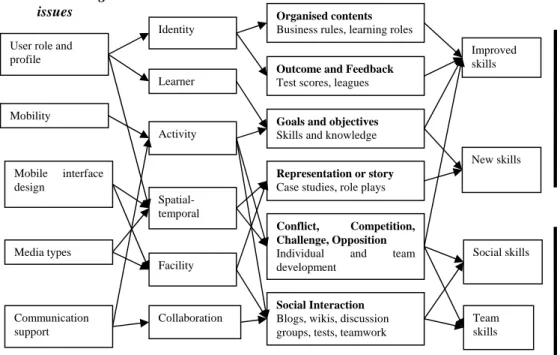
know immediately what they have achieved. The narrative factor in learning experiences can be seen as an important structural factor in developing new skills. A big advantage of narrative is that it can be complex and explorative. Following from Csikszentmihalyi [18], a learning environment that places narrative at the centre can help learners to reflect on what they have learned, enabling a sort of meta-learning, illuminating the very processes by which they learn and providing an organising structure for knowledge. Social interaction means group experiences or establishing some relevant collective learning. This helps the learner to establish appropriate social skills and assists team building in reaching joint learning objectives. Finally, conflict, competition, challenge, and opposition are the problems the learners are trying to solve, either individually or collectively. These factors can engage the learner, facilitating motivation and self-regulation. Figure 1 shows how the four M-learning design requirements; learning objectives, learning experience, M-learning contexts, and generic mobile design issues, interact. As an example of these interactions, consider M-learning for dynamic complex situations, such as rescue services or intensive care. These require the collective learning objectives, particularly developing team skills. This learning objective would be supported by the
Organised contents
Business rules, learning roles
Social Interaction
Blogs, wikis, discussion groups, tests, teamwork
Goals and objectives
Skills and knowledge Mobility
Mobile interface design
User role and profile Team skills Improved skills Social skills Identity Facility Spatial-temporal Activity Learner Collaboration Mobile learning context issues Communication support Media types Representation or story
Case studies, role plays
New skills
Outcome and Feedback
Test scores, leagues
Conflict, Competition, Challenge, Opposition
Individual and team development In d iv id u al learn in g Co ll ective learn ing
Learning experience Learning objectives Generic mobile
environment design issues
learning experiences conflict, competition, challenge, and opposition and social interaction. These learning experiences would require the corresponding M-learning contexts; activity, spatio-temporal, facility and collaboration, which in turn would map to generic mobile design requirements.
3. Applying the framework for
understanding the Ambient Wood project
To test the framework, we applied it to a successful M-learning environment: the Ambient Wood project [9, 19], a part of the EQUATOR project in the U.K., which established a mixed reality space. A playful learning experience was developed where children could explore and reflect upon a physical environment that had been augmented with a medley of digital abstractions. The latter were represented in a number of ambient ways, designed to provoke children to stop, wonder and learn when moving through and interacting with aspects of the physical environment. A variety of devices and multi-modal
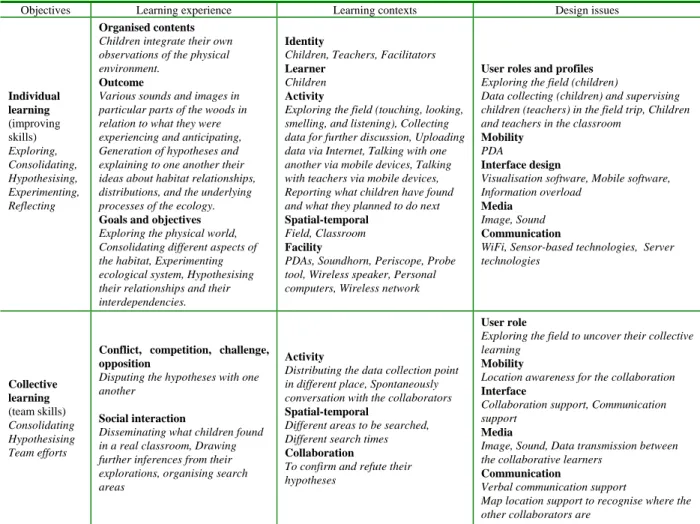
displays were used to trigger and present the 'added' digital information, sometimes caused by the children's automatic exploratory movements, and at other times determined by their intentional actions. To this end, a field trip with 'a difference' was created, where children discover, hypothesise about and experiment with biological processes taking place within a physical environment. From the individual learning perspective, the learning objectives are exploring, consolidating, hypothesising, experimenting, and reflecting the ecological system. Also, for their collective learning, they collaboratively discover a number of aspects about plants and animals living in the various habitats in the wood. Their experiences are later reflected upon in an area where children share their findings with each other and abstract these to hypotheses of what will happen to the wood in the long term under various conditions. Table 1 analyses the application in terms of our framework, revealing how learning objectives relate through learning experience and
Objectives Learning experience Learning contexts Design issues
Individual learning (improving skills) Exploring, Consolidating, Hypothesising, Experimenting, Reflecting Organised contents
Children integrate their own observations of the physical environment.
Outcome
Various sounds and images in particular parts of the woods in relation to what they were experiencing and anticipating, Generation of hypotheses and explaining to one another their ideas about habitat relationships, distributions, and the underlying processes of the ecology.
Goals and objectives
Exploring the physical world, Consolidating different aspects of the habitat, Experimenting ecological system, Hypothesising their relationships and their interdependencies.
Identity
Children, Teachers, Facilitators
Learner
Children
Activity
Exploring the field (touching, looking, smelling, and listening), Collecting data for further discussion, Uploading data via Internet, Talking with one another via mobile devices, Talking with teachers via mobile devices, Reporting what children have found and what they planned to do next
Spatial-temporal
Field, Classroom
Facility
PDAs, Soundhorn, Periscope, Probe tool, Wireless speaker, Personal computers, Wireless network
User roles and profiles
Exploring the field (children)
Data collecting (children) and supervising children (teachers) in the field trip, Children and teachers in the classroom
Mobility
PDA
Interface design
Visualisation software, Mobile software, Information overload
Media
Image, Sound
Communication
WiFi, Sensor-based technologies, Server technologies Collective learning (team skills) Consolidating Hypothesising Team efforts
Conflict, competition, challenge, opposition
Disputing the hypotheses with one another
Social interaction
Disseminating what children found in a real classroom, Drawing further inferences from their explorations, organising search areas
Activity
Distributing the data collection point in different place, Spontaneously conversation with the collaborators
Spatial-temporal
Different areas to be searched, Different search times
Collaboration
To confirm and refute their hypotheses
User role
Exploring the field to uncover their collective learning
Mobility
Location awareness for the collaboration
Interface
Collaboration support, Communication support
Media
Image, Sound, Data transmission between the collaborative learners
Communication
Verbal communication support
Map location support to recognise where the other collaborators are
contexts to the generic mobile environment issues.
4. Conclusion and future work
This paper discussed what design issues and contexts are important to M-learning. It incorporated best practice in M-learning research into a practical framework of M-learning design requirements. It then applied the framework to a successful M-learning system in an effort to provide some validation of the framework. It is of course recognised that the framework has not yet been thoroughly assessed. It would be interesting to apply it in a real design environment and this is something we are seeking to do in the future.
5. References
[1] T. Liu, H. Wang, J. Liang, T. Chan, H. Ko, and Y. J., "Wireless and mobile
technologies to enhance teaching and learning," Journal of Computer Assisted Learning, pp. 371-382, 2003.
[2] J. Massy, "Quality of eLearning Must Improve," vol. 2006: BizMedia Ltd, 2002. [3] A. Kukulska-Hulme and J. Traxler, "Mobile
teaching and learning," in Mobile Learning: A Handbook for Educators and Trainers, A. Kukulska-Hume and J. Traxler, Eds. London: Routledge, 2005.
[4] A. Stone, J. Briggs, and C. Smith, "SMS and Interactivity - Some Results from the Field, and its Implications on Effective Uses of Mobile Technologies in Education," presented at IEEE International Workshop on Wireless and Mobile Technologies in Education (WMTE'02), V?j? Sweden, 2002. [5] J. Löwgren and E. Stolterman, Thoughtful
Interaction Design. Cambridge, MA: The MIT Press, 2005.
[6] M. Uther, "Mobile Internet Usability: What Can 'Mobile Learning' Learn From the Past?" presented at International Workshop on Wireless and Mobile Technologies in Education, 2002.
[7] K. Luchini, C. Quintana, and E. Soloway, "Design Guidelines for Learner-Centered Handheld Tools," presented at Human Factors in Computing Systems, Vienna, Austria, 2004.
[8] Collella, "Participatory simulations: Building collaborative understanding through immersive dynamic modeling," Journal of the Learning Science, vol. 9, pp. 471-500, 2000.
[9] Y. Rogers, S. Price, G. Fitzpatrick, R. Fleck, E. Harris, H. Smith, C. Randell, H. Muller, C. O'Malley, D. Stanton, M. Thompson, and M. Weal, "Ambient Wood: Designing New Forms of Digital Augmentation for Learning Outdoors," presented at IDC 2004, College Park, Maryland, USA, 2004.
[10] L. Colazzo, A. Molinari, M. Ronchetti, and A. Trifonova, "Towards a Multi-Vendor Mobile Learning Management System," presented at World Conference on E-Learning, 2003.
[11] L. Liu and P. Khooshabeh, "Paper or Interactive? A Study of Prototyping Techniques for Ubiquitous Computing Environments," presented at Human Factors in Computing Systems, Ft. Lauderdale, Florida, USA., 2003.
[12] Y. Wang, "Context Awareness and Adaptation in Mobile Learning," presented at 2nd International Workshop on Wireless and Mobile Technologies in Education, 2004.
[13] C. Leung and Y. Chan, "Mobile Learning: A New Paradigm in Electronic Learning," presented at 3rd IEEE International Conference on Advanced Learning Technologies, 2003.
[14] J. Preece, R. Yvonne, and S. Helen, Interaction Design. New York, NY: John Wiley & Sons, Inc, 2002.
[15] K. Walker, "Learning on Location with Cinematic Narratives," presented at 1st Workshop on Story Representation, Mechanism and Context, New York, USA, 2004.
[16] G. Schwabe and C. G?h, "Mobile Learning with a Mobile Game: Design and
Motivational Effects," Journal of Computer Assisted Learning, vol. 21, pp. 204, 2005. [17] M. Prensky, Digital Game-Based Learning.
New York: McGraw-Hill, 2001.
[18] M. Csikszentmihalyi, Flow: The Psychology of Optimal Experience. New York:
HarperCollins, 1990.
[19] W. A. Rogers and E. D. Mynatt, "How can technology contribute to the quality of life of older adults?" in The Technology of Humanity: Can Technology Contribute to the Quality of Life? M. E. Mitchell, Ed., 2003, pp. 22-30.