Light scattering by irregular interplanetary dust particles
Hajime Okamoto1∗and Yu-lin Xu2
1Kashima Space Research Center, Communications Research Laboratory, Japan 2Department of Astronomy, University of Florida, U.S.A.
(Received December 17, 1997; Revised March 13, 1998; Accepted March 24, 1998)
We review recent progresses in light scattering for non-spherical particles. Special attention is paid to cluster of spheres in order to improve our understanding of interplanetary dust particles. For scattering by non-spherical particles the discrete-dipole approximation (DDA) has widely been used in many scientific fields. However mainly due to the requirements of large computing memory and long computing time, the applicability of this theory is practically limited for rather small particle compared with wavelength. In order to overcome this practical problem, i.e., the large particle can not be calculated by the DDA, we recently developed the a1-term method, which is
a modification version of the DDA where the dipole polarizability is determined by the first term of scattering coefficient in Mie theory. Accuracy of this method is tested by comparing the solutions by thea1-term method with
those by modal analysis, which gives the analytical solutions for cluster of spherical monomers. According to the error analysis mentioned above, the applicabilities of thea1-term method are established as follows. The maximum size parameter of the monomer in the cluster is 1 and the total size parameter of the cluster can exceed X ∼100 when the N ∼ 106 dipoles are used. We show the extinction efficiencies and asymmetry factors for cluster of
spheres whose size parameter is larger than the wavelength, e.g., the volume equivalent size parameter Xis larger than 30. Finally we summarize the applicabilities of DDA, T-Matrix, modal analysis and thea1-term method. The
a1-term method can partly fulfill a gap where both DDA and the ray tracing technique based on geometrical optics
can not be applied when the target is cluster. However for the target which has edges remains to be problematic. This would be the topic which should be focused on future research.
1.
Introduction
For homogeneous sphere, there exists analytical method and this, Mie theory, has been widely used in many applica-tions. By this method, it is possible to cover wide range of size distribution of particles. Although this theory is quite useful because of the short computing time for calculations, its applicability is questionable in many astrophysical situ-ations. For example it becomes recognized that the inter-planetary dust particle does not have a spherical shape. This has been proved by air-craft experiments in the stratosphere (e.g., Brownlee, 1978). Actually any particle in nature is not a perfect sphere. Therefore it is highly demanded to develop light scattering theory for non-spherical particle. In 1975 Asano and Yamamoto developed a theory for homogeneous spheroidal particle. In this method the Maxwell’s equations are expressed in terms of the spheroidal coordinate. This method is called separation of variables method. It is also known that the scattering problem for infinite cylinder and sphere with core-mantle structure are also analytically solved by the similar separation of variables techniques. T-Matrix method is very attractive for the particle which has rotation-ally symmetric structure (Mishchenkoet al., 1997). Unfor-tunately it seems there are not many hopes to find analytical
∗This work was mainly done when H. O. was in Center for Climate
System Research, University of Tokyo.
Copy right cThe Society of Geomagnetism and Earth, Planetary and Space Sciences (SGEPSS); The Seismological Society of Japan; The Volcanological Society of Japan; The Geodetic Society of Japan; The Japanese Society for Planetary Sciences.
solutions for particles which do not have any symmetry. If this is true, we have to improve approximate theories for non-spherical particle.
The discrete-dipole approximation (DDA) was originally developed by Purcell and Pennypacker (1973). The DDA has been used in many fields, e.g., astronomy (e.g., Draine, 1988; Kozasaet al., 1992, 1993), planetary sciences (West, 1991; Lumme and Rahola, 1994; Okamotoet al., 1994) and atmo-spheric sciences (e.g., Flatauet al., 1990). The DDA seems to be promising for non-spherical particles since this tech-nique is easily applicable to any target geometries as long as the size parameter of the particle X is less than 10–15. In Section 2, we describe the theoretical basis of thea1-term method which was developed to overcome the practical prob-lem in the DDA (Okamoto, 1995). Explicit expression of the prescription to obtain the dipole polarizability, which is a cru-cial parameter to determine accuracy of the DDA, is given. Since these methods are approximate theories, the accuracy of them should be verified by comparing their solutions with those obtained by an analytical method or with light scatter-ing experiments. Recently substantial efforts have been made to derive rigorous analytic solutions for cluster of spherical monomers (Fuller, 1991; Mackowski, 1991; Xu, 1995). By using this so called modal analysis, we can have a unique opportunity to test the accuracy of thea1-term method. The
results in error analysis are given in Section 3. In Section 4, to see the effect of non-sphericity in the wide range of sizes, we carry out the calculations for randomly oriented clusters by the a1-term method where the size parameter X range
from 1 to 35. In Section 5, applicabilities of several scatter-ing theories for three types of non-spherical particles such as cluster, rotationally symmetric particle and particle with edges are summarized. Difficulties in the calculations of the scattering by the solid target with sharp edge are addressed.
2.
Method
2.1 Theoretical basis of thea1-term method and other types of DDA
The discrete-dipole approximation (DDA) is originally de-veloped by Purcell and Pennypacker in 1973 for the study of the interstellar dust grains and is further developed by Draine (1988). In the DDA the target is approximated byN
sub-volume elements and each element is replaced by a po-larizable element. Each popo-larizable element is characterized by the dipole polarizabilityα where each of the N dipole elements is exposed to the field of incident wave plus the
field generated by the other elements. In the estimation of the latterfields, the retardation effects are fully taken into account. Theoretical basis of this method is given in Draine (1988). The key parameter in the DDA is the prescription of the dipole polarizability which actually determines the accu-racy of DDA. Draine (1988) proposed a Clausius-Mossotti plus radiative reaction correction term (CMRR) to determine the dipole polarizability. The aim of introducing the radiative reaction correction term is to avoid a violation of the optical theorem. Liversay and Chen (1974), Goedecke and O’Brien (1988) and Hage and Greenberg (1990) proposed“Digitized Green’s Function”method or“Volume Integral Equation For-mulation”(hereafter DGF/VIEF). In their derivation of the dipole polarizability, electricfield inside sub-volume element is assumed to be uniform. Finally Draine and Goodman (1993) proposed the Lattice Dispersion Relation (LDR) and this prescription turns to be the best one for the cubic sub-volume element. They numerically showed that LDR is supe-rior to others such as CMRR and DGF/VIEF when the same number of dipoles is used. Note that in the zero frequency limit, all prescriptions are equal to the Clausius-Mossotti re-lation. Therefore when the sub-volume elements are taken to be very small compared to the wavelength of interest, the DDAs with different prescriptions generally give the same accuracy.
One of the problem in the DDA calculations is that it is only applicable for the target with the size parameter<10–15. It means that the target should be smaller than or comparable to the wavelength of interest. This restriction is mainly from the computing time and memory requirements. In order to overcome the practical problem, we recently introduced the
first scattering coefficienta1-term in Mie theory for the
pre-scription of the dipole polarizability. Here we explain the theoretical basis of this method. Scattering target is taken to be the cluster of spherical monomers. Then each monomer is replaced by one dipole and the dipole polarizabilityαis determined by thea1-term (Eq. (1)). This approach is called
thea1-term method.
a1=
mψ1(mxo)ψ1(xo)−ψ1(xo)ψ1(mxo)
mψ1(mxo)ξ1(xo)−ξ1(xo)ψ1(mxo), (1)
whereψ1andξ1 are called thefirst order of Ricatti-Bessel function and represented in Eqs. (2) and (4), respectively.
The size parameter of the monomer xo is 2πro/λ, where ro is the radius of the spherical monomer,λis the vacuum
wavelength andmdenotes the refractive index of the material. The explicit forms forψ1(xo)andξ1(xo)are given in Eqs. (3) and (5) respectively. ψ1(mxo), ξ1(mxo), ψ1(mxo)and
ξ1( mxo)can simply be obtained by replacingxowithmxoin
Eqs. (2), (3), (4), in the order mentioned since the prime in the Eq. (1) indicates differentiation with respect to the argument in parentheses.
From the optical theorem, extinction cross sectionCextis
ex-pressed by using the dipole polarizabilityαin Eq. (6). On the other hand, according to Mie theory,Cextis also given
by thefirst element of the amplitude scattering matrixS1 is
in Eq. (7) (see Bohren and Huffman, 1983). The dipole ap-proximation in Mie theory for sphere leads to the expression ofS1in terms ofa1in Eq. (8).
From Eqs. (6)–(8), the dipole polarizability can be de-rived (Eq. (9)) which is expected to be the best prescription for the spherical monomer in the cluster since the boundary condition of the sphere is already taken into account. The re-lationship between thefirst scattering coefficienta1-term and
electric dipole polarizability isfirst found in Doyle (1985).
α=i 3
2k3 o
a1, (9)
where the wave numberkois 2π/λ.
After the dipole polarizabilityαjis obtained, electromag-netic scattering problem can be solved for the cluster of monomers where each monomer (j =1, . . . ,N) is replaced by a single dipole with polarizabilityαj located at position
rj. A polarizationPjis given byαjEjwhereEjcan be
cal-culated by the sum of incidentfield atrjand the contribution
of each of the other N−1 monomers which is represented withN−1 polarizations. Therefore the scattering problem is converted to the one forfinding theN polarizations which satisfy 3Nlinear equations according to the usual DDA pro-cedure. Once Pj is found, the extinction cross section can
easily be estimated (see Draine, 1988).
It is noted in thea1-term method the target should be the
cluster composed of spherical monomers.
Dungey and Bohren (1991) used this Doyle’s expression as the dipole polarizability in the DDA expressed in Eqs. (1) and (9) but with different definition of complex refractive index. It might be instructive to explain the differences between our approach and theirs. In their approach, scattering target, such as spheroid or hexagonal column, is divided into many sub-volume elements which are spherical dipolar unit and spaced on a cubic lattice. For a given volume of the target, the volume equivalent radius of the targetreffis defined by
Eq. (11). The radius of the spherical dipolar unitrdis defined
by Eq. (12) and the lattice spacing corresponding to the size of the cubic cell,d is defined by Eq. (13).
To obtain the dipole polarizability for this cubic cell, atfirst the spherical dipolar sub unit is embedded in the cubic cell. Thus the volume fraction of the dipolar unit f isπ/6 which can be estimated by Eqs. (11)–(13). Then Maxwell-Garnett effective medium theory (Eq. (14)) is applied to estimate the average complex refractive index for this cubic cell (e.g., Bohren and Huffman, 1983),
whereis the dielectric function of the material and is equal tom2. mis that for the surrounded media, i.e., 1 for
vac-uum. av denotes the average dielectric function. Finally average refractive indexmav, is calculated frommav=
1/2 av
and then inserted into Eq. (1) instead ofmto derive a dipole polarizability of a cubic volume element. Contrary to the approach of Dungey and Bohren, there is no need to use ef-fective medium theory in our approach. We would like to distinguish between the two.
2.2 Modal analysis
Recently there has been substantial progresses to derive rigorous analytical expressions for the cross sections as well as the all elements of scattering matrix by aggregates of an arbitrary number of arbitrarily configurated spheres (Fuller, 1991; Mackowski, 1991; Xu, 1995). These spherical monomers should be isotropic and homogeneous but can have different sizes and chemical compositions. In this ap-proach, the Mie theory is generalized, that is, the incident
field, scattered field and the internal field at the center of an individual sphere in the cluster are expanded in terms of infinite-series of the spherical vector wave functions. Bound-ary conditions for each sphere is incorporated. This leads to a set of coupled linear equations with the unknown interac-tive coefficients. To seek the solutions, translational addition theorem for spherical vector wave functions and asymptotic iteration technique are developed. We call this method modal analysis in this paper. In this approach, multipole intertions between spheres in the cluster are fully taken into ac-count. Note for the case of N = 1, all the formulations
derived by modal analysis are in complete agreement with the Mie theory (Xu, 1995). Since this method provides quite accurate solutions for the cluster of monomers, this can give us a unique opportunity to test the accuracy of thea1-term
method.
3.
Results for Error Analysis:
The
a1-Term
Method versus Modal Analysis for the Cluster
of Spheres
In this section the accuracy of thea1-term method is
nu-merically tested. To calculate the extinction by non-spherical particles, we introduce different definition of extinction effi -ciency from the usual one. Efficiency factorQextis usually
defined as
Qext= Cext
G . (15)
Gdenotes geometrical cross section of the target particle. In following discussions, volume equivalent extinction effi -ciencyQext,vis introduced in order to allow the comparison
between extinction for non-spherical particle and spherical one for the same volume.
Qext,v= Cext πr2
eff
, (16)
wherereff is the volume equivalent effective radius and is
defined in Eq. (11).
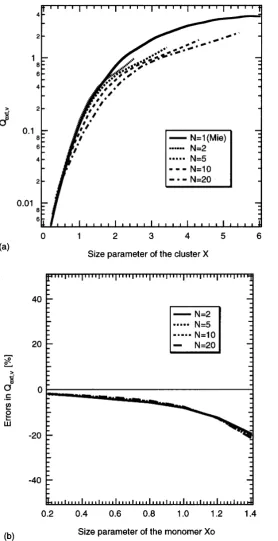
In Fig. 1(a) we use the modal analysis to calculate Qext,v
for cluster of spherical monomers. The complex refractive index used in this paper ism=1.33+0.01i. The shape of the cluster is taken to be a linear-chain, e.g., each monomer is located on a straight line. The incident electromagneticfield is taken to be parallel to the longest axis, i.e. the longest axis of the target. And the size of the monomerXoranges from 0.2
to 2.0. The corresponding volume equivalent size parameter of the cluster X is calculated fromXo. We considered four
different clusters, i.e., the number of monomers N =2, 5, 10 and 20. It is found that extinction by the cluster is smaller than that by sphere for this target geometry. As the number of monomers increases,Qext,vis decreased for the same target
volume. The differences betweenQext,vfor sphere and that
for the clusters are sometimes several factors. This is due to electromagnetic interactions between monomers. By using these results as reference solutions, we performed similar calculations for the same target but by thea1-term method
described above. Then fractional error in Qext,v defined in
Eq. (17) is shown in Fig. 1(b).
Relative Error≡ Qext,v(a1-term)−Qext,v(modal) Qext,v(modal)
×100[%]. (17)
The errors do not change for different number of dipoles when the errors at the same Xoare considered. As long as Xo<1, the error is less than 10%, e.g., the errors are 4% for Xo=0.6, 6% forXo =0.8 and 8% forXo=1. Thea1-term
method always underestimates the efficiencies because in this method the higher order of multipole moments than electric dipole one, such as magnetic dipole and electric quadrupole one, is not taken into account.
Fig. 1. (a) Volume equivalent extinction efficiencyQext,v of cluster of monomers calculated by the modal analysis. Horizontal axis denotes the size
parameter of the cluster. The refractive indexmis 1.33+0.01i.Ndenotes the number of monomers in the cluster. Thea1,k, anderepresent the longest
axis of the cluster, the propagation direction of the incident wave and the direction of the electricfield, respectively. (b) The relative errors in computed
values ofQext,vby thea1-term method. The results are shown as a function of size parameter of the monomerXo.
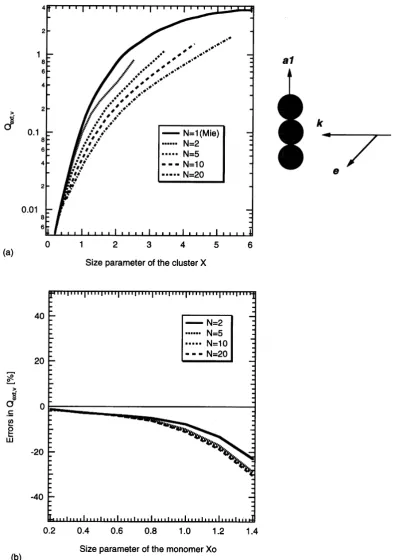
axis of the target as in Fig. 1(a) but electricfield is also per-pendicular to the longest axis of the target. Again, Qext,v
for cluster is smaller than that for sphere and this effect is more pronounced for larger N (in Fig. 2(b)). As long as
Xo <1, the errors is less than 10%, e.g., the errors are 4%
forXo =0.6, 6% forXo=0.8 and 10% forXo=1. When
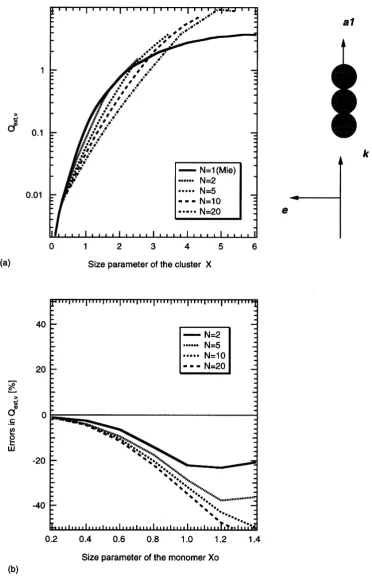
the propagation direction of the incident wave is taken to be parallel, Qext,v for cluster is larger than that for sphere for
large size parameter (in Fig. 3(a)). For small X, Qext,v is
smaller than that of sphere as in the previous cases. For this geometry, the error for the a1-term method is larger
Fig. 2. (a), (b) The same as Fig. 1. (a) except for the direction of the electricfieldebeing perpendicular to thea1axis.
contribution of multipole interactions for this case is more important than for other geometries. The error forN =20 withXo =0.6, that withXo =0.8 and that withXo=1.0
are 10%, 20% and 35%, respectively. As N increases, the error slightly increases. However, the difference between the error forN =20 and that forN =10 is much smaller than those between N = 2 and N = 5. That is, the
er-ror for N is converging. Therefore we expect the error for
N >20 is not significantly different from that forN =20. In conclusion, this method allows treatment of a relatively large sub volume element which is replaced by a dipole, i.e.,
Xo∼1.0. Consequently, when we useN∼106dipoles, the
DDA calculations based on thea1-term method are feasible
Fig. 3. (a), (b) The same as Fig. 1. (a) but for the propagation direction of the incident wavekbeing parallel to the longest axisa1of the target.
by this method the particles withXbetween 10 and 100 can become tractable while the former types of DDA can not be applied. And the great reduction of the computing memory and time can also be achieved. It should be noted that other prescription, e.g., the lattice dispersion relation (LDR) can
not be applied to achieve the same accuracies. The LDR leads to the error of +100% whenN = 2 model with its monomer size parameter Xo = 1 is considered as a target
Fig. 4. “Densely packed”rectangular shaped cluster composed of monomers used in the calculations in Figs. 5 and 6. Thea1denotes the longest direction of the target.
Table 1. The target parameters for the calculations.Ndenotes the number
of monomers in the cluster andn(a1)denotes the number of monomers
along the longest axisa1of the cluster.
N n(a1) n(a2) n(a3) Xo X
2 2 1 1 0.9 1.2
16 4 2 2 0.9 2.3
54 6 3 3 0.9 3.5
128 8 4 4 0.9 4.6
250 10 5 5 0.9 5.8
432 12 6 6 0.9 6.9
2000 20 10 10 0.9 11.5
6750 30 15 15 0.9 17.3
16000 40 20 20 0.9 23.0
54000 60 30 30 0.9 34.5
4.
Extinction Properties of Cluster of Monomers
On the basis of the abovefindings, we have carried out calculations for randomly oriented clusters by thea1-term
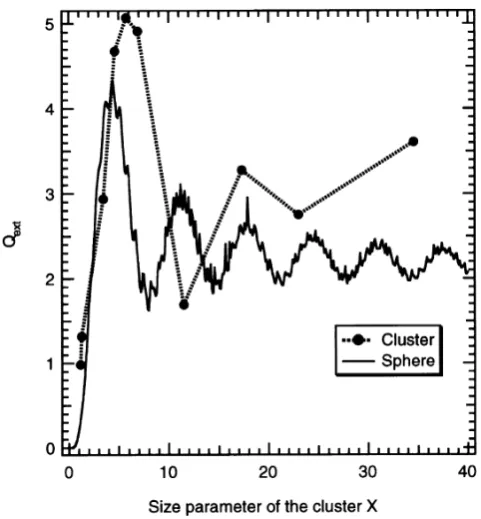
method whose size parameter X ranges from 1 to 35. As far as we know, this is thefirst time to show extinction of non-spherical particles whose size parameter exceeds 30 by DDA approach. The shape of target considered here is rect-angular solids composed of monomers as sketched in Fig. 4. Geometries of the targets such as total numberNin the clus-ter, the number of monomers located on three orthogonal axes and the size parameterXused in these calculations are summarized in Table 1. For all calculations we setXoto be
about 0.9 which corresponds to radius of the monomer of 0.8μm at visible wavelength. The complex refractive index
mis taken to be 1.48+2.6×10⁻⁵, which is silicate’s at this wavelength. This value is chosen to mimic the scattering properties of interplanetary dust particles. In Fig. 5,Qext,v
by these cluster is shown and compared to that for sphere. The position of extinction maximum for the cluster is around
X =6 and is relatively larger than that of sphere, i.e., the maximum is occurred atX =5. And the maximum value in
Qext,vby the cluster is larger than that for sphere. ForX <3,
Fig. 5. Qext,vof the randomly oriented cluster of monomers computed by
thea1-term method as a function ofX. For the comparison,Qext,vof the
sphere is also shown. The target parameters are summarized in Table 1.
The complex refractive indexmis taken to be that of silicate at the visible
wavelength to investigate the extinction by interplanetary dust particles, i.e.,m=1.48+2.6×10⁻⁵.
Qext,vby the cluster is larger than that by sphere for the same X. For 3<X <4, the cluster gives smallerQext,vcompared
with sphere. For the target with largeX, i.e. X >15,Qext,v
by the cluster is generally larger than that by sphere for the same volume. This can be explained as follows. In the geo-metrical optics, i.e., the size of the target is much larger than wavelength, extinction efficiency Qextappears to approach
the limiting value 2. That isCext/Gis 2 in this limit, where
Gis geometrical cross section. For sphereGis the same as
πr2
effwherereffis already defined in Eq. (10). ThereforeQext
is equal to Qext,vwhen the target is sphere. HoweverGof
cluster is not equal toπr2
eff. Although there is no easy way to
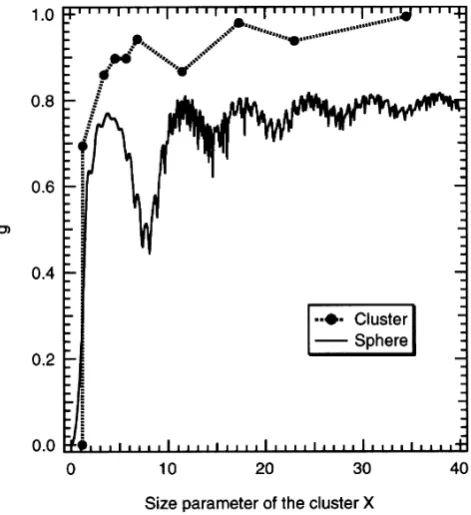
Fig. 6. The asymmetry factorgfor the same targets as in Fig. 5.
expect that the average cross section of the“densely packed”
cluster considered here might be similar to that of rectangular solids which can be easily estimated. Van de Hulst (1981) gave a proof that the average geometrical cross section of a convex particle with random orientation is one-fourth its surface area. ThereforeQext,vof non-spherical particle, by
its definition, tends to be larger than that of sphere when the size is much larger than wavelength. According to this the-orem, G for rectangle whose aspect ratio to be 2, i.e., the longest dimension is twice as large as the minimum dimen-sion, is 1.3×πreff2 . In the case considered here,Qext,v for
cluster can be expected to approach 2.6, which corresponds toQext=2, in the geometrical optics limit according to the
above estimates of the average cross section of the cluster. Since Qext,vfor X =35 is 3.6 in our calculation, X =35
is still not large enough to allow geometrical optics approx-imation for the qualitative estapprox-imations of cross sections.
In Fig. 6 the asymmetry factorg of the cluster is shown. The cluster tends to have largergthan sphere does. Since this value plays a crucial role for the dynamics of interplanetary dust particles, e.g., the radiation pressure calculations (e.g., Mukaiet al., 1992) or for radiative transfer in the planetary atmosphere, it seems necessary to take into account effects of non-sphericity on such scattering calculations.
5.
Applicabilities of Scattering Theories
In this section we summarize the current status of appli-cabilities of several different scattering theories (Table 2). To see performance of each theory, we introduce three kinds of particle shape, i.e., cluster, rotationally symmetric parti-cle, and solid particle with edges. For cluster calculation, as described in Section 3, thea1-term method would be
promis-ing when the size parameter of the monomer fulfills condition
Xo<1. For largerXo, modal analysis would be the best
be-Table 2. (A) The applicabilities of several methods when the cluster of
monomers is considered as a scattering target. For the DDA-LDR, the
maximum size parameter of the monomerXois estimated for the model
where each monomer is replaced by a single dipole. When the monomer is replaced by many dipoles, DDA-LDR can treat large monomer compared with wavelength but on the other hand, it is not possible to treat large
number of monomersN. (B) The same as in A but for rotationally
symmetric particles. (C) The same as in A but for the particle which has edges.
Separation of variables 0<X<30
Ray tracing 100< X
(C) Particle with edge
Method X
DDA-LDR 0<X<10
cause this gives fairly accurate results, though the tractable number of monomer is quite limited, i.e., N ∼ 100. The DDA can also be used for the cluster where Xo >1 (West,
1991; Lumme and Rahola, 1994). Unfortunately, it is not possible to treat the particle withX >15 by this method be-cause each large monomer in the cluster should be replaced by many dipoles and consequently requirements of memory becomes prohibitively large.
For rotational symmetric particle such as spheroid, T-matrix method would be the most promising since the results are fairly accurate and it can be applied very large particle, i.e., X ∼ 100 (Mishchenkoet al., 1997). For the particle with sharp edge, up to now, it is not possible to derive an-alytical solutions. When the particle with edges is small or comparable to the wavelength, DDA with LDR can be ap-plied. Unfortunately, it is necessary to use more number of dipoles than that for the particle with the same volume but without any sharp edge to achieve the same accuracy and consequently the tractable size parameter would be smaller than 10 (Okamotoet al., 1995).
It has been numerically shown the computations of scat-tering matrix elements are more difficult than those of the total cross sections such as extinction efficiencies with equal accuracy for DDA (Okamotoet al., 1995) and for T-matrix method (Wielaard et al., 1997). From these two numeri-cal experiments the accuracy of thea1-term method for the
6.
Summary
The principalfindings of this paper are as follows: 1. Theoretical basis of thea1-term method is reviewed.
This method is suitable for the cluster of spheres. In this method a spherical monomer in the cluster is replaced by a single dipole and the dipole polarizability of the monomer is obtained by thefirst scattering coefficienta1-term in Mie
the-ory. Several prescriptions of the dipole polarizability used in the discrete-dipole approximation (DDA) are also reviewed. 2. The accuracy of thea1-term method is examined by
computing the extinction cross sections for the cluster of spherical monomers by thea1-term method and comparing
the results by this method with those by the modal analysis which gives analytical solutions for the cluster of spheri-cal monomers. The error depends on the target geometry. When the incident wave is taken to be perpendicular to the longest axis of the target, the errors are much smaller than that for the geometry where the incident wave is parallel to the longest axis. Consequently thea1-term method allows to
treat relatively large monomer as a single dipole, i.e. the size parameter of the monomerXois as large as 1. For N∼106
dipoles,Xcan be∼100.
3. The volume equivalent extinction efficienciesQext,vby
randomly oriented cluster of spherical monomers are exam-ined to see the effects of non-sphericity. To do so, we chose silicate as a candidate of the interplanetary particles. The size parameter X of the clusters ranges from about 1 to 35, corresponding toN =2 touching spheres and N =54000 touching spheres, respectively. Xo is fixed to be 0.9. As
an example of cluster, the approximate shape of the densely packed cluster composed of monomers is taken to be rectan-gle with an aspect ratio of 2. The target is randomly oriented in terms of the incident wave. For X > 15, Qext,v of the
cluster is larger than that of sphere with the same volume. This can be explained partly due to the fact that the aver-age geometrical cross sectionGfor non-spherical particle is larger than that for sphere with the same volume but partly due to the mutual interaction between each monomer in the rectangle. It turns out the geometrical optics approximation can not be applied to calculate extinction by the cluster with
X =35. This is because the expectedQext,vfor the
rectan-gle in the geometrical optics limit is 1.3 times larger than the limited value (Qext=2) and it is smaller than 3.6 which is
the computedQext,vforX =35. The asymmetry factorgis
also investigated for the cluster and it turns out to be higher than that of sphere.
4. We summarize the applicabilities of several scattering theories. For cluster with small monomer but withN >100 monomers, thea1-term method is suitable. For cluster with
large monomer, modal analysis can be applied. For rotational symmetric particle, T-matrix method is the best. For particle with edge, there is no analytical solutions. DDA can be applied for this shape but its applicability seems to be very limited, i.e.,X <10. We should pay attention to this problem in future research.
Acknowledgments. Authors thank two anonymous reviewers for useful comments, B. T. Draine who provides the original code of the DDA.
We thank T. Mukai who organizes the Zodiacal Clouds Sciences meeting held in Kobe university. Special thanks go to H. Kimura and R. Nakamura for discussions of scattering problems.
References
Asano, S. and G. Yamamoto, Light scattering by a spheroidal particle,Appl.
Opt.,14, 29–49, 1975.
Bohren, C. F. and D. R. Huffman,Absorption and Scattering of Light by
Small Particles, 530pp., John Wiley and Sons, New York, 1983.
Brownlee, D. E., Micro particle studies by sampling techniques, inCosmic
Dust, edited by A. M. McDonell, 295pp., John Wiley and Sons, New
York, 1978.
Doyle, W. T., Electrodynamics response of metal spheres,J. Opt. Soc. Am.
A,2, 1031–1034, 1985.
Draine, B. T., The discrete-dipole approximation and its application to
in-terstellar graphite grains,Astrophys. J.,333, 848–872, 1988.
Draine, B. T. and J. J. Goodman, Beyond Clausius-Mossotti: wave propaga-tion on a polarizable point lattice and the discrete dipole approximapropaga-tion, Astrophys. J.,405, 685–697, 1993.
Dungey, C. E. and C. F. Bohren, Light scattering by nonspherical particles:
a refinement to the coupled-dipole method,J. Opt. Soc. Am. A,8, 81–87,
1991.
Flatau, P. J., G. L. Stephens, and B. T. Draine, Light scattering by rectangular solids in the discrete-dipole approximation: a new algorithm exploiting
the Block-Toeplitz structure,J. Opt. Soc. Am. A,7, 593–600, 1990.
Fuller, K. W., Optical resonances and two-sphere systems,Appl. Opt.,30,
4716–4731, 1991.
Goedecke, G. H. and S. G. O’Brien, Scattering by irregular inhomogeneous
particles via the digitized Green’s function algorithm,Appl. Opt.,28,
2431–2438, 1988.
Hage, J. I. and J. M. Greenberg, A model for the optical properties of porous
grains,Astrophys. J.,361, 260–274, 1990.
Kozasa, T., J. Blum, and T. Mukai, Optical properties of dust aggregates I.
Wavelength dependence,Astron. Astrophys.,263, 423–432, 1992.
Kozasa, T., J. Blum, H. Okamoto, and T. Mukai, Optical properties of dust
aggregates II. Angular dependence of scattered light,Astron. Astrophys.,
276, 278–288, 1993.
Liversay, D. E. and K. Chen, Electromagneticfields induced inside
arbi-trarily shaped biological bodies,IEEE Trans. Microwave Theory Tech.,
MTT-22, 1273–1280, 1974.
Lumme, K. and J. Rahola, Light scattering by porous dust particles in the
discrete-dipole approximation,Astrophys. J.,425, 653–667, 1994.
Mackowski, D. W., Analysis of radiative scattering for multiple sphere
con-figurations,Proc. R. Soc. London Ser. A,433, 599–614, 1991.
Mishchenko, M. I., L. D. Travis, and D. W. Mackowski, T-matrix
compu-tations of light scattering by nonspherical particles: a review,J. Quant.
Spectrosc. Radiat. Transfer,57, 767–794, 1997.
Mukai, T., H. Ishimoto, T. Kozasa, J. Blum, and J. M. Greenberg, Radiation
pressure forces offluffy porous grains,Astron. Astrophys.,262, 315–320,
1992.
Okamoto, H., Light scattering by clusters: thea1-term method,Opt. Rev.,
2, 407–412, 1995.
Okamoto, H., T. Mukai, and T. Kozasa, The 10μm-feature of aggregates in
comets,Planet. Space Sci.,42, 643–649, 1994.
Okamoto, H., A. Macke, M. Quante, and E. Raschke, Modeling of backscat-tering by non-spherical ice particles for the interpretation of cloud radar
signals at 94 GHz. An error analysis,Beitr. Phys. Atmosph.,68, 319–334,
1995.
Purcell, E. M. and C. R. Pennypacker, Scattering and absorption of light by
nonspherical dielectric grains,Astrophys. J.,186, 705–714, 1973.
Van de Hulst, H. C.,Light Scattering by Small Particles, 470pp., Dover,
New York, 1981.
West, R. A., Optical properties of aggregate particles whose outer diameter
is comparable to the wavelength,Appl. Opt.,30, 5316–5324, 1991.
Wielaard, D. J., M. I. Mishchenko, A. Macke, and B. E. Carlson, Improved T-matrix computations for large, nonabsorbing and weakly absorbing nonspherical particles and comparison with geometric optics
approxima-tion,Appl. Opt.,36, 4305–4313, 1997.
Xu, Y., Electromagnetic scattering by an aggregate of spheres,Appl. Opt.,
34, 4573–4588, 1995.