Clean intermittent catheterization: Single use vs. reuse
Seyed Hossein Saadat1; Shaun Shepherd1; Brandon Van Asseldonk2; Dean S. Elterman1 1
Division of Urology, Department of Surgery, University Health Network, Toronto, ON; 2Faculty of Medicine, University of Toronto, Toronto, ON; Canada
Cite as: Can Urol Assoc J 2018 July 31; Epub ahead of print. http://dx.doi.org/10.5489/cuaj.5357
Published online July 31, 2018
***
Abstract
Introduction: Intermittent catheterization (IC) is one of the fundamental aspects of managing patients with chronic urinary retention. Although reuse of catheters has been allowed to be chosen as the first option for IC, the optimal method of IC and the type of catheter has been a long-standing debate. We conducted a literature review regarding risk of urinary tract infection (UTI) and the costs associated with different methods and catheters.
Methods: A MEDLINE search via PubMed, EMBASE, and EBSCO host was conducted in March 2018. The date of publication was limited to 2014 to present/current.
Results: Single use of catheters (hydrophilic-coated [HC] or uncoated [UC]) was considered to impose a lower risk of UTI in all studies, except in one study that included children, but did not test their dexterity to handle HC catheters. Cost-effectiveness of single-use catheters was confirmed by all studies during this period.
Conclusions: Reuse of catheters exposes the patient to a plethora of possible cleaning techniques and duration of catheter use. Patient adherence to cleaning method cannot be
predicted and this further amplifies the risk of complications and their burden on the healthcare system. We recommend a patient-centred approach to consider HC catheters as the first option while considering the patient’s/caregiver’s ability to accommodate the usage technique. Single-use UC catheters and finally reSingle-use of catheters are considered as next options if HC catheters are found difficult to handle (especially in children doing self-catheterization). Larger trials
Introduction
Intermittent Catheterization (IC) is the recommended technique for bladder drainage in patients with chronic retention, resulting from different causes such as neurogenic bladder (NB).1 Ever since the landmark paper was published by Lapides et al. 2 showing that clean intermittent catheterization (CIC) was possible, it has been widely used and preferred to an indwelling catheter.
For those electing to perform IC, there are two main options: either the traditional reuse of catheters with a form of cleaning between uses or single-use catheterization. Single-use catheters can be either uncoated (UC), such as those made of polyvinyl chloride (PVC), or they can be coated with hydrophilic or gel coverings.3 The main arguments in choosing between these options are risk of urinary tract infections (UTIs), uncertain cleaning methods, social issues and finally the cost and quality of life (QOL).1,4
Although single-use catheters have been introduced to decrease the risk of urethral trauma and UTI,5-8 comparing their outcomes with those of reusable catheters can be challenging. The difficulty in making a proper comparison between different methods of catheterization results from inconsistency of the literature regarding study population, UTI definition, type of catheter, cleaning methods and frequency of catheterization per day.
Furthermore, lack of long term follow-up makes the decision making to be more challenging. 4,9-11
All these uncertainties have led many physicians and patients to reuse catheters.12
In 2014, a Cochrane systematic review was published by Prieto et al. and supported the reuse of catheters. The authors concluded that multiple uses of a catheter does not impose a higher risk of UTI compared to single use.13 Since then, not only has more data become
available but also the above mentioned Cochrane review was withdrawn from publication due to an independent appraisal, which identified crucial discrepancies within this publication.14,15 In order to draw a conclusion on whether reuse of catheters can still be considered the first option for CIC or not, this literature review was conducted on different IC methods regarding their risk of UTI and their associated costs.
Methods
A MEDLINE search via PubMed, EMBASE AND EBSCOhost was conducted in March 2018. The following keywords were used: [("intermittent catheterization*") AND (reuse* OR re-use OR single-use)] or [("intermittent catheterisation*") AND (reuse* OR re-use OR single-use)] or [("intermittent catheter*") AND (reuse* OR re-use)] or [("intermittent catheterization*") AND (coated OR uncoated)] or [("intermittent catheterisation*") AND (coated OR uncoated)] or [("intermittent catheter*") AND (coated OR uncoated)]. The date of publication was limited to 2014-present/current.
Results
Risk of UTI
Before discussing the risk of UTI, it is important to emphasize the difference between
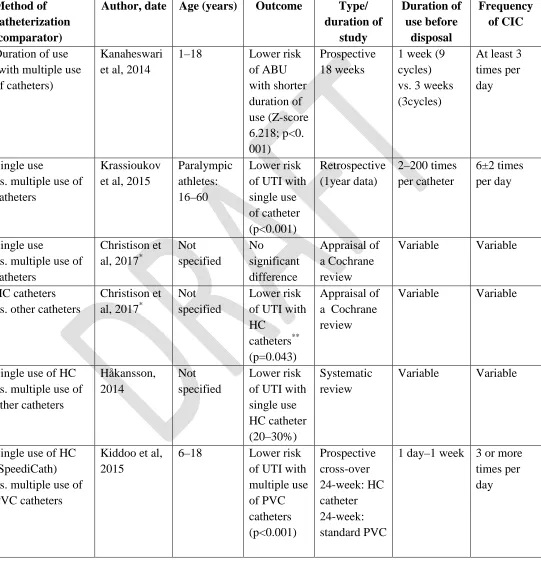
asymptomatic bacteriuria (ABU) and UTI. The former is defined as the presence of bacteria in the urine culture without any urinary tract symptoms while the latter is a positive bacterial culture accompanied by urinary tract symptoms.16 Table-1 provides a breakdown of the articles on the risk of UTI associated with different methods of catheterization.
Kanaheswari et al. (2014) conducted a prospective cross-over study among the children with neurogenic bladder (n = 40), and concluded that a longer duration of catheter reuse resulted in an increased prevalence of ABU, without changing the incidence of UTI. In this study, a comparison was made between weekly and triweekly catheter replacement over 9 week intervals. The 65% ABU noted at baseline increased to 74.2% during the triweekly CIC. This percentage plummeted to 34.2% when the catheter was changed on a weekly basis. There were no
symptomatic UTIs over the 18 weeks of study in either group. However, the authors suggested that adherence to the cleaning technique might have been unusually high among the participants, impacting their findings. No comparison to single-use of catheters was made.17
A retrospective study by Krassioukov et al.18 (2015) surveyed athletes with spinal cord injuries (n = 61); they found that those who reused the catheters experienced 4±3 UTIs per year while the figures for single-users stood at only 1±1 UTI per year. This association between catheter reuse and UTI was statistically significant (p < .001). Athletes from developing
countries experienced higher UTI frequency compared to athletes from other countries (p= .027). This was justified by the fact that 73% of those from developing countries reused their catheter, while this was the method in only 17% of those from developed countries. The study also showed that, catheterization frequency per day did not impact the UTI frequency. Compared to the previous study, by Kanaheswari et al. (2014),17 this study might be better accounted for the actual adherence to cleaning practices, simply due to its retrospective design.18
In the same year (2014), a narrative review of the complications associated with single or multiple-use catheters was published. This review revealed that single-use HC catheters can reduce the risk of UTI by about 20-30%.3 Based on the observational studies, this review estimated the risk of UTI to be about 70-80% in those who reused their catheter, while the estimated risk with single-use catheters was about 40-60%, based on review of randomized controlled trials.3
Recently, more data on HC catheters, comparing them to other catheters, has become available. A prospective cross-over trial conducted by Kiddoo et al. compared single-use HC catheters and multiple-use PVC catheters in a pediatric and young adult population with
neurogenic bladders.19 Each treatment period was 24 weeks, for a total duration of 48. The study showed that, the risk of UTI was higher with the single-use HC catheters as opposed to multiple-use PVC catheters (person-weeks of urinary tract infection was 3.42 ± 4.67 and 2.20 ± 3.23 respectively, p <0.001) The fact that 52% of the children in this study were self-catheterizing, along with challenges in learning how to use hydrophilic catheters might explain the increased person-weeks of UTIs in the HC group and indicates the importance of catheter handling. Additionally, that the primary outcomes of this study was not based on a standard definition of UTI and UTI was defined as positive leukocytes plus UTI symptoms (instead of positive bacterial culture).19
Comparing single usage of HC catheters with reuse of PVC catheters was also addressed in a recently published systematic review by Rognoni and Tarricone (2017), in an adult of adolescent population. The frequency of UTI was shown to be lower with HC catheters
(RR = 0.84; 95% CI, 0.75–0.94; p = 0.003 for both analyses) and the estimated risk reduction with HC catheters was found to be 16%.20 The mean age in all of the studies included in this review was above 37 years which can justify the different results observed by Kiddo et al. (mean age=10.6 ± 6.2 years ).19
A prospective randomized control trial, published in 2017, compared the advantage of HC catheters against single use of UC catheters for a duration of one year.21 Interestingly, children were chosen as the target population but the differences between this cohort and the population in Kiddoo et al. study.19 is that dexterity testing of both hands was performed in this trial (if the child was self-catheterizing). It was illustrated that HC catheters were associated with a lower risk of UTI, even if the UC catheter was used only once and then discarded (9.1% versus 51.5% UTIs per person-year, p=0.003). Comparing the UTI rates during the year prior to the study, with the rates during the study year showed that, HC group had witness a drop from 16% to 5%; although this was not statistically significant. Although the number of times that a UC catheter was used before being discarded is not clear in this study, the authors stated: “In our practice, uncoated catheters are “one-time” use only and patients are never advised to wash and reuse their catheters”.21
95% CI, 0.75–0.94; p = 0.003 for both analyses) with the estimated risk reduction found to be 16%.20
Cleaning methods
If reusable urinary catheters are to be used for IC, the method for sanitation of becomes
particularly important. Several methods have been reported in the literature including: cleaning with antibacterial soap and water, alcohol sterilization, using aseptic solutions such as
chlorhexidine 1.5% and cetrimide 15%, microwave sterilization, simply rinsing with water and combinations of these methods.22-25
A literature review in 2014 could not recommend a standardized method for cleaning reusable catheters3 and to our knowledge, no randomized controlled trials have compared the efficacy of different cleaning methods since then. Although a systematic review which was published in 2017 referred to 2 articles which recommended a sterile (aseptic) technique,26 neither this review nor the Cochrane review provided any statistically significant
recommendation on cleaning standards.13,15
Cost
The cost of single-use catheters has been one of their main drawbacks for a long time. From the perspective of the public payer, the out-of-pocket cost for these catheters can only be justified if it can offer good value regarding complications, expected life-years and QOL. It should be emphasized that the QOL is affected by several health-related and nonhealth-related factors such as UTI, pain, discomfort, time spent on catheterization and social factors accompanied by
catheterization. As cost-effectiveness and cost-utility are among the fundamental aspects of health economics, several authors have looked into this matter to assist both patients and policy makers with their decisions.27-33
A cost-comparison analysis by Neovius K et al. showed that the catheter cost for single-use types, was more than that of reusable types (2188 euros versus 817 euros, per year and per patient). However, the annual cost imposed by catheter complications was lower in the single-use group. With the single-single-use catheters, complications such as UTI, antibiotic resistant UTI, bacteremia, strictures and bladder stones resulted in an annual cost of 1243 euros, while the figures for reusable catheters stood at 2067 euros, per patient. In other words, 60% of the extra cost of single-use catheters was compensated.33
Watanabe et al. 29 studied the cos-effectiveness of HC catheters for bladder management in spinal cord injury (SCI) patients in Japan. They used a modified Markov decision model and
addressed direct medical costs, quality‐adjusted life years (QALYs) and life years gained (LYG).
In contrast to UC catheters, HC catheters resulted in 0.334 QALYs and 0.781 LYG at an
incremental cost of 1 279 886 yen (US$ 10,578 at an exchange rate of US$ 1 = 121 yen) for HC
catheters per SCI patient. The incremental cost‐effectiveness ratio (ICER) of hydrophilic‐coated
catheters vs. uncoated catheters was US$ 31,623/QALY gained and US$ 13,550/LYG.
model health states. Their model predicted the life expectancy of a 36-year-old SCI patient who used HC catheters to be 1.4 years longer compared to those using uncoated single-use catheters (on average, another 23.9 years with HC catheters and 22.5 years with uncoated types). When the increased cost of HC catheters was factored in, the ICER was a gain of 6100£ for each QALY. This cost is well within the threshold for the National Institute of Clinical Excellence (NICE) in the United Kingdom.32
Using a modified version of the model developed in the previous study,32 cost-effectiveness of HC catheters was addressed in Canada.27 This model predicted that in a 50-year-old patient with SCI, using HC catheters would lead to living 0.78 years longer and to the gain of an additional 0.72 QALYs compared to using UC. The incremental cost and ICER for this gain was $48,016 and $66,634/QALY respectively. Moreover, the lifetime risk of
developing UTI in these patients was estimated to be 11% less with HC catheters compared to UC types. The authors concluded that reimbursement of HCIC catheters should be considered in these settings.
A similar study in Brazil analyzed and the results were presented as cost per LYG, cost per QALY and cost per number of avoided UTIs. The results revealed cost-effectiveness of HC catheters compared to uncoated PVC catheters per LYG (57,432 Brazilian Reais (BRL), equal to 17,773 USD, at an exchange rate of 0.31) and per QALY (122,330 BRL, equal to 37,857 USD). HC catheters showed the potential to reduce the lifetime number of UTIs by 6% at the cost of 31,240 BRL (9,817 USD).30
Cost-effectiveness of HC catheters has also been evaluated from the perspective of Italian Healthcare Service system. The base-case Incremental cost-effectiveness and cost-utility ratios (ICER and ICUR) which were associated with HC catheters were €20,761 and €24,405, respectively. This implies that HC catheters are likely to be cost-effective in comparison to uncoated ones, as the proposed Italian threshold values range is between €25,000 and €66,400.31
Discussion
Reuse of catheters for the purpose of IC has been popular and widely used. Although this has been more common in developing countries,18 it has been reported to be practiced by more than 35% of patients in North America.3 Despite this common use, the evidence on the prevalence of UTIs associated with repeated use of a catheter is conflicting.9,10,12,34 Aside from questionable cleaning methods, it is unclear how long a multiple-use catheter can be reused. With the level of variation observed across clinical trials, it is likely that similar, if not more, variation can be expected in public use. The lack of evidence-based recommendations are sure to confuse the general public and alter their adherence to cleaning methods.23,24 These facts suggest single use of catheters as a potential remedy. It is also important to consider the effects that cleaning and repetitive uses can have on catheters.18,22-25
that allow for use of a new catheter several times per day. This is consistent with the results of many health-economic studies indicating the cost-effectiveness and improved QOL accompanied by using single use catheters.30-33
The European Association of Urology (EAU) recommends aseptic IC for patients with NB. Their definition of aseptic IC refers to genital disinfection and using sterile catheters, instruments and gloves.1 Given the difficulty of completely sterilizing catheters at home, and considering the challenge of keeping the sterility with reusable catheters, specifically for neurologically impaired patients, single-use catheters remain as the only realistic option.
The Society of Urologic Nurses and Associates (SUNA) specifically recommends that a new catheter be used for each catheterization.35 The European Association of Urology Nurses (EAUN) states that the gold standard remains a single use sterile catheter and highlights concerns about the cleaning efficacy and compliance associated with multiple use catheters.36
The current Canadian Urological Association (CUA) recommendations for male and female CIC are to use a catheter for a week or until physical damage is noticed. The wording specifically used for female clean intermittent catheterization specifies that “a catheter can be reused and cleaned for about a week or so”. This language is vague and leaves much to patient interpretation, the result of which could be unsafe practices. The recommended CUA cleaning protocol is to clean the catheter immediately after use with hand or dish soap and air dry.37,38 The CUA stands out with recommendations that specifically support the multiple use of intermittent catheters in direct contradiction with what is supported by other North American and European organizations. The recommendation for reuse of single-use catheters also contravenes the Health Canada labeling for single use of these catheters. Considering the emergence of new evidence supporting single-use catheters, the CUA stands alone with the position on multiple catheter use.
Conclusion
Reuse of catheters exposes the patient to a plethora of possible cleaning techniques and duration of catheter use. Patient adherence to cleaning method cannot be predicted and this further
amplifies the risk of complications and their burden on the healthcare system. Given the benefits of single-use catheters and all the uncertainties with reuse, we believe that repeated use of catheters should not be the preferred method for long-term bladder management.
References
1. Blok B, Pannek J, Castro-Diaz D, et al. EAU guidelines on neuro-urology. 2017: [52 p.]. https://uroweb.org/wp-content/uploads/15-Neuro-Urology_2017_web.pdf. Accessed January 28, 2018.
2. Lapides J, Diokno AC, Silber SJ, et al. Clean, intermittent self-catheterization in the treatment of urinary tract disease. J Urol 1972;107:458-61.
3. Hakansson MA. Reuse versus single-use catheters for intermittent catheterization: What is safe and preferred? Review of current status. Spinal Cord 2014;52:511-6. 2014/05/28. 4. Averch Td SJ, Goldman Hb, Et Al. AUA white paper on catheter associated urinary tract
infections: Definitions and significance in the urological patient. Urol Pract 2015;2:321-8.
5. Vapnek JM, Maynard FM, Kim J. A prospective randomized trial of the lofric
hydrophilic coated catheter versus conventional plastic catheter for clean intermittent catheterization. J Urol 2003;169:994-8. 2003/02/11.
6. Stensballe J, Looms D, Nielsen PN, et al. Hydrophilic-coated catheters for intermittent catheterisation reduce urethral micro trauma: A prospective, randomised, participant-blinded, crossover study of three different types of catheters. Eur Urol 2005;48:978-83. 2005/08/30.
7. Cardenas DD, Hoffman JM. Hydrophilic catheters versus noncoated catheters for reducing the incidence of urinary tract infections: A randomized controlled trial. Arch Phys Med Rehabil 2009;90:1668-71. 2009/10/06.
8. Cardenas DD, Moore KN, Dannels-Mcclure A, et al. Intermittent catheterization with a hydrophilic-coated catheter delays urinary tract infections in acute spinal cord injury: A prospective, randomized, multicenter trial. PM R 2011;3:408-17. 2011/05/17.
9. Woodbury MG, Hayes KC, Askes HK. Intermittent catheterization practices following spinal cord injury: A national survey. Can J Urol 2008;15:4065-71. 2008/06/24. 10. Ercole FF, Macieira TG, Wenceslau LC, et al. Integrative review: Evidences on the
practice of intermittent/indwelling urinary catheterization. Rev Lat Am Enfermagem 2013;21:459-68. 2013/04/03.
11. Wyndaele JJ, Brauner A, Geerlings SE, et al. Clean intermittent catheterization and urinary tract infection: Review and guide for future research. BJU Int 2012;110:E910-7. 2012/10/06.
12. Bermingham SL, Hodgkinson S, Wright S, et al. Intermittent self catheterisation with hydrophilic, gel reservoir, and non-coated catheters: A systematic review and cost effectiveness analysis. BMJ 2013;346:e8639. 2013/01/11.
13. Prieto J, Murphy CL, Moore KN, et al. Intermittent catheterisation for long-term bladder management. Cochrane Database Syst Rev 2014:CD006008. 2014/09/11.
15. Christison K, Walter M, Wyndaele JJM, et al. Intermittent catheterization: The devil is in the details. J Neurotrauma 2018;35:985-9. Epub 2018 Apr 01.
16. Hooton TM, Bradley SF, Cardenas DD, et al. Diagnosis, prevention, and treatment of catheter-associated urinary tract infection in adults: 2009 international clinical practice guidelines from the infectious diseases society of america. Clin Infect Dis 2010;50:625-63. 2010/02/23.
17. Kanaheswari Y, Kavitha R, Rizal AM. Urinary tract infection and bacteriuria in children performing clean intermittent catheterization with reused catheters. Spinal Cord
2015;53:209-12.
18. Krassioukov A, Cragg JJ, West C, et al. The good, the bad and the ugly of catheterization practices among elite athletes with spinal cord injury: A global perspective. Spinal Cord 2015;53:78-82. 2014/11/26.
19. Kiddoo D, Sawatzky B, Bascu CD, et al. Randomized crossover trial of single use hydrophilic coated vs multiple use polyvinylchloride catheters for intermittent catheterization to determine incidence of urinary infection. J Urol 2015;194:174-9. 2015/01/15.
20. Rognoni C, Tarricone R. Intermittent catheterisation with hydrophilic and
non-hydrophilic urinary catheters: Systematic literature review and meta-analyses. BMC Urol 2017;17:4. 2017/01/12.
21. Defoor W, Reddy P, Reed M, et al. Results of a prospective randomized control trial comparing hydrophilic to uncoated catheters in children with neurogenic bladder. J Pediatr Urol 2017;13:373 e1- e5. 2017/07/18.
22. Bogaert GA, Goeman L, De Ridder D, et al. The physical and antimicrobial effects of microwave heating and alcohol immersion on catheters that are reused for clean intermittent catheterisation. Eur Urol 2004;46:641-6. 2004/10/12.
23. Chan JL, Cooney TE, Schober JM. Adequacy of sanitization and storage of catheters for intermittent use after washing and microwave sterilization. J Urol 2009;182:2085-9. 2009/08/22.
24. Sherbondy AL, Cooper CS, Kalinowski SE, et al. Variability in catheter microwave sterilization techniques in a single clinic population. J Urol 2002;168:562-4. 2002/07/20. 25. Kovindha A, Mai WN, Madersbacher H. Reused silicone catheter for clean intermittent
catheterization (cic): Is it safe for spinal cord-injured (sci) men? Spinal Cord 2004;42:638-42. 2004/08/04.
26. Shamout S, Biardeau X, Corcos J, et al. Outcome comparison of different approaches to self-intermittent catheterization in neurogenic patients: A systematic review. Spinal Cord 2017;55:629-43. 2017/01/25.
27. Welk B, Isaranuwatchai W, Krassioukov A, et al. Cost-effectiveness of hydrophilic-coated intermittent catheters compared with unhydrophilic-coated catheters in Canada: A public payer perspective. J Med Econ [serial on the internet]. 2018 March:[1-10.].
28. Pinder B, Lloyd AJ, Nafees B, et al. Patient preferences and willingness to pay for innovations in intermittent self-catheters. Patient Prefer Adherence 2015;9:381-8. 2015/04/04.
29. Watanabe T, Yamamoto S, Gotoh M, et al. Cost-effectiveness analysis of long-term intermittent self-catheterization with hydrophilic-coated and uncoated catheters in patients with spinal cord injury in japan. Low Urin Tract Symptoms 2017;9:142-50. 2017/09/05.
30. Truzzi JC, Teich V, Pepe C. Can hydrophilic coated catheters be beneficial for the public healthcare system in brazil? - a cost-effectiveness analysis in patients with spinal cord injuries. International braz j urol 2018;44:121-31.
31. Rognoni C, Tarricone R. Healthcare resource consumption for intermittent urinary catheterisation: Cost-effectiveness of hydrophilic catheters and budget impact analyses. BMJ Open 2017;7:e012360. 2017/01/18.
32. Clark JF, Mealing SJ, Scott DA, et al. A cost-effectiveness analysis of long-term intermittent catheterisation with hydrophilic and uncoated catheters. Spinal Cord 2016;54:73-7. 2015/07/22.
33. Neovius K, Hakansson M, Lundqvist T. Cost consequences of single-use and re-use of urinary catheters among patients performing daily intermittent catheterization. Value Health 2015;18:A351-2. 2015/11/05.
34. Hill TC, Baverstock R, Carlson KV, et al. Best practices for the treatment and prevention of urinary tract infection in the spinal cord injured population: The Alberta context. Can Urol Assoc J 2013;7:122-30. 2013/05/15.
35. Bortel K, Hensley DL, Kliever EM, et al. Adult intermittent self-catheterization patient fact sheet. https://www.suna.org/download/members/selfCatheterization.pdf. Accessed February 3, 2018.
36. European Association of Urology Nurses. Evidence-based guidelines for best practice in urological health care catheterisation urethral intermittent in adults.
http://patients.uroweb.org/wp-content/uploads/Catheterisation-Urethral-Intermittent-in-adults-Lr_DEF.pdf. Accessed February 3, 2018.
37. Canadian Urological Association. Clean intermittent self-catheterization for women.
https://www.cua.org/themes/web/assets/files/patient_info/secured/en/2e-self-catherization_s.pdf. Accessed February 3, 2018.
Figures and Tables
Table 1. Different methods of intermittent catheterization and associated UTI risk
Method of
vs. multiple use of catheters
Single-use of HC vs. multiple use of PVC catheters
Variable 4–5 times per day