THE UBERCRYPT FRAMEWORK: A NEW APPROACH IN CRYPTOSYSTEMS
JOE CHIARELLA
Colloid LLC, Harrisburg, PA
GREG MOSHER
Colloid LLC, Atlanta, GA
J. ROBERT BUCHANAN
Department of Mathematics, Millersville University, P.O. Box 1002, Millersville, PA 17551
Abstract. This article describes a novel and unique cryptosystem making use of a small set of private security parameters and public initialization values to produce a pseudorandom byte stream with large period. The byte stream can be used as a one-time stream cipher for securing communication between parties and for data archival. The cryptosystem makes use of geometry and number theory to generate a set of large prime integers and then from the primes a column-periodic matrix of bytes from which further calculation produces a pseudorandom, long period byte stream. The cryptosystem is extensible in that additional private user-supplied security parameters can supplement the private geometric security parameters while adding strength in the process. The article discusses the design and operation of the system and lists many potential questions of interest to the community of mathematical and cryptological researchers. Foremost among these questions are determining the most appropriate method for assessing the cryptographic strength of the algorithm and determining any weaknesses in the security of the algorithm.
Keywords: secret-key cryptography, stream ciphers, geometry, number theory, primes, irrationals
E-mail addresses:[email protected].
Date: October 29, 2014.
1. Introduction
The need for secure communication between parties and for securing data from unauthorized access is increasingly important in areas such as email, banking, data archival, entertainment, and others. In the past cryptosystems such as the Data Encryption Standard (DES, [16]) and Content Scramble System (CSS [2]) have served with varying degrees of success. At present the RSA [12] algorithm and the Advanced Encryption Standard (AES [9]) are well received among practitioners of cryptology, government, private industry, and the general public. RSA is computationally intensive for the communication or protection of large volumes of data and has a number of known vulnerabilities including timing attacks [5]. AES has been successfully implemented in modern computer CPUs. This article describes a novel cryptosystem which includes aspects of geometry and number theory in order to create a key stream which can be used as a one-time stream cipher for cryptographic purposes.
The remainder of this article includes a high-level description of the generation of the pseudorandom byte stream. The development of a key stream which serves as a one-time stream cipher can be divided into three basic steps. The first is the creation of a list of large prime integers from private user-supplied security parameters and a three-dimensional geometric figure which is constructed from a set of private geometric security parameters and public initialization values (Sec. 2). The second is generation of a sorted list of truncated approximations to irrational numbers from the prime integers. The approximations are partitioned into bytes to form a pair column periodic matrices with a large period (Sec. 3). The third step is the calculation of a pseudorandom key stream from the matrix entries (Sec. 4). Due to the novel nature of this cryptosystem, the authors have included several lists of questions and conjectures about the mathematical and cryptographic properties of the system. It is hoped that by familiarizing the cryptological community with this innovative algorithm, experts will provide answers or insight into these questions and conjectures. Each of the remaining sections ends with a list of relevant questions and conjectures for the cryptological community to consider. Sec. 5 outlines some attempts at measures of the strength of this cryptosystem and summarizes some of the challenges faced by an eavesdropper on communications secured by this cryptosystem. The discourse in Sec. 6 concludes the article with some discussion of ways in which the cryptosystem could be generalized further so as to defeat any successful attacks on its current form.
The current design of this cryptosystem and its choices of parameter ranges is the result of experimentation and analysis. Many parameters could be modified without changing the fundamental principles of operation of the system. The parameters and algorithmic steps to be outlined in the upcoming sections represent what the cryptosystem architects believe is an efficient, extensible, and secure method of protecting private information. The cryptosystem designers also believe that the system has potentials in authentication, digital signing and more. This cryptosystem has been successfully implemented in computer code across a variety of computer operating systems. Readers interested in testing the computer program or in seeing its output should visit the URL at the end of this article. Comments on the cryptographic design and its mathematical and cryptanalytic open questions are welcomed at the blog mentioned there as well.
2. Generation of Prime Numbers
In this section the process used to generate a list of prime numbers from a set of private geometric security parameters and a public initialization value will be described. The set of parameters is small; at its simplest consisting of an ordered triple of three private geometric security parameters and a single public initialization value. From the private geometric security parameters a two-dimensional geometric figure is derived. The public initialization value derives a three-dimensional figure from the two-dimensional figure. From the geometry of the three-dimensional figure, a list of prime numbers will be generated. The list of primes thus generated will be used in Sec. 4 to create a key stream which can be used for encryption or decryption. The remainder of this section describes the process of prime integer generation in more detail and ends with a subsection enumerating open questions about the mapping of the three-dimensional geometric figure to the primes and properties of the primes generated.
2.1. Private Geometric Security Parameters and the 2D Geometrical Form. Consider two parties, referred to here as Alice and Bob, who wish to communicate privately with one another. They have securely exchanged an ordered triple of numbers denoted (c, α, m). The first component is an integer for which 2256 ≤ c ≤ 21160. The second and third components are real numbers where π/12 ≤ α ≤ 5π/12 and
4 ≤m ≤ 65535. The first componentc is an integer where (c)2 (the binary representation of c) contains
between 256 and 1160 binary digits. This range of values was chosen so that the system has at least as many bits of secret state as AES. The angle αis a real number which will be represented on a digital computer as a floating point number. The number of bits involved in the representation ofα will depend upon the floating point format in use. Sinceπ/12≤α≤5π/12 then if the IEEE-754 double precision (64 bits) format [22] is used, the significand occupies 52 bits and two bits of the exponent field may change over the range of allowedαvalues. Thus a total of 54 binary digits are involved in the representation ofα. If an extended precision format or custom format is used, then more bits may be involved. The multipliermis also a real number where 4≤m≤65535. Thus in IEEE-754 double precision format, a total of 56 bits may be involved in the representation ofm. Therefore the ordered triple (c, α, m) of private geometric security parameters has a size in bits of
1160 + 54 + 56 = 1270.
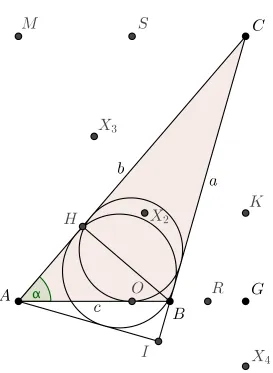
The parameterc can be interpreted as the length of an edge of a triangle whileα is the included angle between the edge of length c and an edge of length b =c m. From these three private geometric security parameters the two parties will each create the same triangle in the Euclidean plane. In the following explanation line segments joining distinct pointsP1andP2will be denotedP1P2. The length of line segment
P1P2 will be denoted askP1P2kand will be calculated as the usual Euclidean distance between the points. Without loss of generality the edge of lengthc will be parallel to the x-axis in the plane and its endpoints will be denoted A and B. The adjacent side of length b will have one endpoint at A, make an angle of
αwith AB, and will have its other endpoint at C. For the sake of simplicity define a =kBCk. Figure 1 illustrates 4ABC. The lower bound of 4 for m was chosen so that 4ABC must be an obtuse scalene triangle. The upper bound formwas chosen arbitrarily but larger values carry a heavier computational load and thus decrease system throughput. Several other points in the plane of4ABC will become important to the derivation. Various triangle centers will be mentioned and will be denoted using the nomenclature of Kimberling [13]. Let point X2 be the centroid (intersection of the three triangle medians, [14]) of 4ABC. Let pointX3 be the center of the circumcircle (unique circle passing through the vertices, [11]) of 4ABC. Finally letX4 be the orthocenter (intersection of the three triangle altitudes, [7]) of4ABC. The height of 4ABC considering AC as its base is represented in Fig. 1 as BH. Using Heron’s formula [6] to calculate the area ∆ABC of4ABC, then
2=kBHk=
2∆ABC kACk .
As a property of the orthocenter,AX4is perpendicular toBC. Define pointIto be the intersection of the
line through points B and C with line segmentAX4. As a consequence4ACI is a right triangle. Letting
sACI represent the semiperimeter of4ACI and ∆ACI its area, the diameter of the incircle (circle tangent to each of the sides, [19]) of4ACI is
3=
2∆ACI
sACI
.
Figure 1 also illustrates the incircle of4ABC. IfsABC represents the semiperimeter [8, pp. 113–132] of 4ABC then the diameter of the the incircle is
4=
2∆ABC
sABC
.
Let line segmentAGbe the projection ofACalongAB. The point labeledM is located at the intersection of the line throughAperpendicular toABwith the line throughCparallel toAB. PointS is the midpoint of the line segment joiningC and M. Let points O and R be the midpoints ofAG and BG respectively. PointK is the intersection of the line through X2 parallel toABwith the line segment CG. Consequently Alice and Bob having the same ordered triple (c, α, m), construct the same geometric figure.
2.2. Public Initialization Values and the 3D Geometrical Form. The public initialization value is an integern with 108 ≤n <109. When operated upon to produce several values, it is combined with the
two-dimensional geometrical object described in Sec. 2.2 to create a three-dimensional geometrical object. If the private geometric security parameters remain the same and a public initialization valuenis used twice, the same key stream will be generated. Thus the range ofn specified allows only 9×10⁸+ 1 uses of the
Figure 1. The two-dimensional geometric form constructed from the private geometric
security parameters.
private geometric security parameters before they must be changed. The upper limit onncould be set higher to decrease the frequency with which the private geometric security parameters must be changed. In this section the operations performed onnand the construction of the three-dimensional object are described.
The sequence of digits of an irrational number will frequently be calculated and the following functions are defined to describe how these digits are determined. For any prime integerq, define
(1) f(q) =√q− b√qc.
Note thatf(q)∈(0,1) and since the square root of a prime integer is an irrational number, f(q) is always irrational. Function f is also a nonlinear function of q. From such an irrational number an integer with
a prescribed length (number of hexadecimal digits) must be extracted. If f(q) is expressed in a mantissa-exponent format of the form
f(q) = 0.d1d2d3· · · ×10−b0
whered16= 0 andb0≥0, then define function F(q;N) forqprime and N ∈Nas
(2) F(q;N) =bf(q)×10b0+bNlog 16cc=d1d2d3· · ·d
bNlog 16c. FunctionF is likewise a nonlinear function ofqas a result of its dependency onf.
For the sake of notation letdxePdenote the smallest prime number greater than real numberx. Referring to 4ABC, letq1=dbePand then letp=dq1/neP. As constructed,q1is a prime in excess of 2258≈4.6×1077. Using Eq. (2) define integer d = F(p; 4050). Since the hexadecimal representation of d will be used so frequently, let the notation (d)16 denotedin base-16, where
(3) (d)16= (F(p; 4050))16=h1h2, h3h4, h5h6,· · ·, h4049h4050
where in Eq. (3) the hexadecimal digits have been grouped into pairs separated by commas for convenience. The paired digits will be used to populate a 45×45 matrix, H (which should not be confused with point
H located on AC). Matrix H is filled starting at its center (the (23,23) entry) in clockwise fashion (the transpose of the Ulam spiral [20]). The choices of the dimensions ofH are arbitrary but sufficient to derive the necessary algorithmic values needed to complete the generation of the key stream.
(4) H =
h3873h3874 · · · h3961h3962
. .. . ..
h33h34 h35h36 h37h38 h39h40 h41h42 h31h32 h9h10 h11h12 h13h14 h43h44 ..
. h29h30 h7h8 h1h2 h15h16 h45h46 ... h27h28 h5h6 h3h4 h17h18 h47h48
h25h26 h23h24 h21h22 h19h20 h49h50
. .. . ..
h3785h3786 · · · h4049h4050
When convenient, each entry of matrix H can be thought of as a nonnegative integer less than 256. Let
s = 1 + [d1d2d3d4d5 (mod 45)] and t = 1 + [d6d7d8d9d10 (mod 45)] where dj refers to the jth digit of
d=F(p; 4050). Hs,tis the entry in the sth row andtth column of matrix H. IfHs,t is even then letk be the integer represented by the concatenation of the five entries on row sof matrix H beginning in column
t (wrapping around the matrix if necessary). Otherwise if Hs,t is odd let k be the integer represented by the concatenation of the five entries in columntof matrixH beginning in rows(again, wrapping around if necessary). For example ifs= 22 andt= 21 and if H22,21is even then
(k)16=h31h32, h9h10, h11h12, h13h14, h43h44
while ifH22,21is odd then
(k)16=h31h32, h29h30, h27h28, h25h26, h59h60.
Define the real numberm2as
m2= 15×106+k (mod 70×106)×10−8.
Now letting s= 1 + [d11d12d13d14d15 (mod 45)] and t= 1 + [d16d17d18d19d20 (mod 45)] and following the
same procedure as just described, determine real number m3. Finally letting s = 1 + [d21d22d23d24d25
(mod 45)] andt= 1 + [d26d27d28d29d30 (mod 45)] determine m4. The three real numbersm2, m3, andm4
will lie in the unit interval.
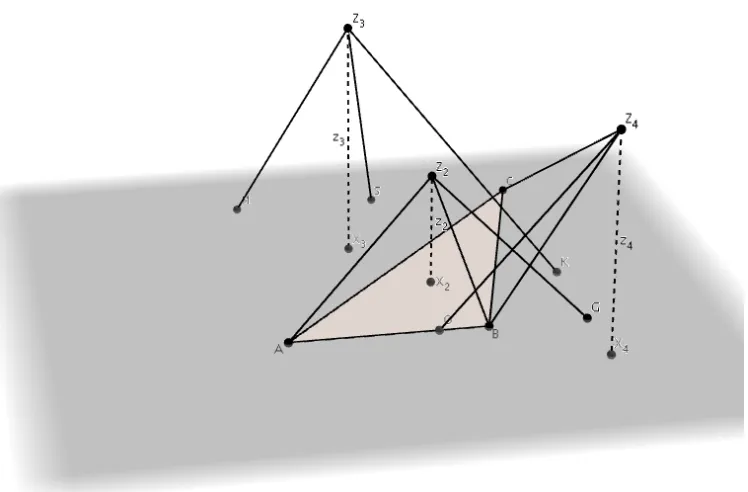
With the three real number multipliers just generated from the public initialization value, a three-dimensional geometrical object can be constructed. See Fig. 2. Assuming4ABC and its associated points described in Sec. 2.1 lies in the z = 0 plane of R3, let Z2 be the point directly above X2 at altitude
z2 =m22. LikewiseZ3 will be the point directly aboveX3 at height z3=m33 andZ4 will be directly
Figure 2. The three-dimensional geometric form constructed from the private geometric security parameters and the public initialization value. The altitudes and hypotenuses of several right triangles perpendicular to the plane of4ABC are illustrated, though not all of the hypotenuses mentioned in Sec. 2.3 are shown.
Bob use the same private geometric security parameters and public initialization value, they construct the same three-dimensional geometric figure.
2.3. Mapping the 3D Geometrical Form to Primes. Once the three-dimensional geometric form is constructed, the procedure described in this section is used to generate a set of fifteen prime integers.
The smallest primes greater than the distance from pointZ2 to pointsA,B,C,G, andX3 form the first set of five primes. The smallest primes greater than the distance from pointZ3 to pointsC,K,M, S, and
X4 form the next five primes. The final set of five primes are the smallest primes greater than the distance from pointZ4to pointsB, C, M,O, andX2. Using the notation developed earlier,
pA,Z2=
kAZ2k P
would be the smallest prime greater than the Euclidean distance from pointA to pointZ2. Thus from the
private geometric security parameters and public initialization value, ultimately Alice and Bob derive the same fifteen primes summarized below.
p1 p2 p3 p4 p5 p6 p7 p8 p9 p10 p11 p12 p13 p14 p15
=
kAZ2k
P
kBZ2k
P
kCZ2k
P
kGZ2k
P
kX3Z2k
P
kCZ3k P
kKZ3k P
kM Z3k P
kSZ3k P
kX4Z3k P
kBZ4k P
kCZ4k P
kM Z4k P
kOZ4k P
kX2Z4k P
The choice of fifteen primes generated in this way is arbitrary but is informed by testing and experimentation. The endpoint pairings for the line segments used to generate the primes were determined from a large sample of random geometries. From the primes generated in the sample, endpoint pairs were selected so that an approximately uniform distribution of primes is generated (uniform with respect to the smallest and largest possible prime the geometric method can output). The pseudorandomness of the generated key stream improves the more primes are calculated, but the rate of improvement beyond the use of fifteen primes
declines. The process could generate more prime integers by calculating additional line segment lengths, or fewer primes by omitting some lengths listed above, or different planar points and circle centers could be used.
2.4. Generalizations and Extensions. In this section three generalizations of the derivation of the set of prime integers will be described. The first generalization, which will be called iteration, enables the generation of additional sets of fifteen prime numbers (or any other desired increment) in a manner similar to that described in Sec. 2.2. The second method of generalization, namedtranslation, involves a modification of the location of pointsXj andZj forj= 2,3,4. The two forms of generalization in the construction of the three-dimensional geometric figure can be used individually or in concert. The third generalization involves the use of private user-supplied security parametersto generate prime integers. Private user-supplied security parameters are any source of information which can be mapped to a number.
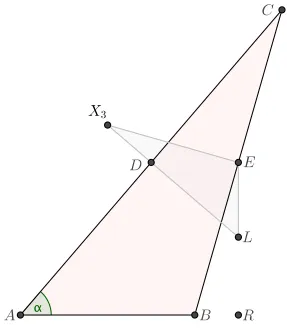
The process called iteration is carried out by constructing one or more triangles similar to 4ABC (in the same plane as that triangle). In Fig. 3 the additional triangle is4LEX3 and is constructed as follows. PointsDandEare the midpoints ofACandBCrespectively. PointRis the intersection of the line through pointsAandB with the perpendicular line through pointE. Finally pointL is the intersection of the line through the circumcenterX3 and pointD with the line through pointsE andR.
Claim. 4LEX3∼ 4ABC.
Proof. The perpendicular bisectors of a triangle intersect at the triangle’s circumcenter. Thus LX3 ⊥AC
andEX3⊥BC. Consequently∠X3LE is congruent to∠CAB. Likewise, sinceAB⊥ELthen ∠LEX3 is
congruent to∠ABC. Therefore4LEX3is similar to 4ABC.
4LEX3 possesses its own centroid, circumcenter, orthocenter, and other points corresponding to those associated with 4ABC and described in Sec. 2.1. Following the procedure for constructing the three-dimensional geometric figure described in Sec. 2.2 an additional set of fifteen primes can be generated using 4LEX3. To continue generating more prime integers, this process can be repeated by constructing a similar triangle based on 4LEX3. Therefore if the set of private geometric security parameters is thought of as
((c, α, m), i) where i ∈ Z∗ specifies the number of repetitions of prime integer generation procedure, then 15(i+ 1) primes can be produced.
The method called translation adjusts the locations of the points Xj and Zj for j = 2,3,4. To avoid confusion, the adjusted points will be denotedXj0 andZj0 and the original (un-primed) symbols will refer to the points described in Sections 2.1 and 2.2.
Two additional private geometric security parameters, denoted (r, xs), are used to locate the points Xj0 andZj0 wherej = 2,3,4. These values are real numbers satisfying the inequality 0< xs< r <
√
2/2. Define
nj,x =
j
xs×107
nj,y =
1 +100mj
r
LetXj0 be the point in the plane of 4ABC which is displaced from pointXj by the vector
uj =
D
(−1)nj,xx
szj,(−1)nj,yzj(r2−x2s)
1/2E.
Since 0< xs< r the components of vectoruj are real. PointZj0 lies above the point Xj0 at an altitude of
zj(1−r2)1/2. Once positioned, pointsXj0 andZj0 are used in place ofXj andZj to calculate a set of fifteen prime numbers as described in Sec. 2.3.
Incorporating both of these generalizations requires private geometric security parameters of the form ((c, α, m), i,(r, xs)). The original ordered triple of private geometric security parameters (c, α, m) can be thought of as the special case ((c, α, m),0,(0,0)). Iteration without adjusting the points Xj and Zj is specified by private geometric security parameters of the form ((c, α, m), i,(0,0)), while repositioning the pointsXj andZj without iteration is specified by ((c, α, m),0,(r, xs)).
The third extension of the process for generating prime numbers involves private user-supplied security parameters. A simple example of a private user-supplied security parameter is a passphrase or password.
Figure 3. 4LEX3is similar to 4ABC constructed from the private geometric security parameters.
Other private user-supplied security parameters may include a file resident on a computer, the media access control (MAC, [1]) address of a computer, global positioning system (GPS) coordinates, and others. For each of these private user-supplied security parameters the process by which a prime integer is generated is the same and will be outlined for the case in which the private geometric parameteri(the iteration counter) is zero. Generalization to the cases in whichi >0 are straightforward. Referring to the three-dimensional geometric form described in Sec. 2.2 the following fifteen integers (not necessarily prime) can be found.
j1 j2 j3 j4 j5 j6 j7 j8 j9 j10 j11 j12 j13 j14 j15
=
kAZ2k
kBZ2k
kCZ2k
kGZ2k
kX3Z2k
kCZ3k
kKZ3k
kM Z3k
kSZ3k
kX4Z3k
kBZ4k
kCZ4k
kM Z4k
kOZ4k
kX2Z4k
Ifxrepresents SHA-256 digest of the value or contents of the private user-supplied security parameter, then an additional prime associated with the security parameter is
ˆ
p=
&
F(dxe
P,900) (mod $P15
s=1js 10
%
)
'
P
.
The prime ˆpgenerated is of the same order of magnitude as the geometrically generated primes{p1, p2, . . . , p15}. Use of the SHA-256 digest of the private user-supplied security parameter and calculating modulob1
10
P15
s=1jsc makes inverting the function producing ˆpdifficult and thus the process may be considered a one-way func-tion. Consequently trying to recover the value or contents of the private user-supplied security parameter from knowledge of ˆpwill be difficult.
The set of geometrically determined prime integers is augmented by one or more prime integers derived from the private user-supplied security parameters and the process described in Sec. 4 is used to generate a pseudorandom byte stream which now depends on the private user-supplied security parameters. An eavesdropper on the communication between Alice and Bob would require not only the private geometric security parameters ((c, α, m), i,(r, xs)), but also the private user-supplied security parameters in use. The maximum possible number of such private user-supplied security parameters is (2400−900)−15 = 1485.
2.5. Number Theoretic Issues and Questions. The method of selecting prime integers related to the dimensions of a three-dimensional geometric form is novel. Its use raises several questions about the primes selected and about the possibility of reconstructing the three-dimensional figure from knowledge of the primes only. Some of the questions identified as important are outlined below.
(1) Is function F from Eq. (2) a one-way function? Given the value of N is F(q, N) invertible? Is functionf from Eq. (1) invertible?
(2) Function f defined in Eq. (1) maps prime numbers (a countable set) into the irrational numbers (an uncountable set). Can the set of all possible prime numbers which may be generated by the procedure outlined in Sec. 2 be determined by an attacker so that the set of all possible irrational numbers used in the construction of the key stream can be known as well?
(3) It is possible to select private geometric security parameters and a public initialization value which produce the minimum and maximum prime integers which can result from this cryptographic al-gorithm. A question of some mathematical interest is whether there are private geometric security parameters and public initialization values which yield all the primes between these minimum and maximum primes.
(4) Is function f a one-to-one or many-to-one function?
(5) Are the prime numbers generated by this procedure uniformly distributed among the set of prime integers? Is uniformity of distribution important to the security of the system?
(6) Thinking of the process of generating prime numbers as a function whose domain is the Cartesian product of the set of all permissible private geometric security parameters with the set of all possible public initialization values and whose codomain is a set of all possible sets of fifteen prime integers, is this function an injection, a many-to-one mapping, a surjection, or a bijection?
(7) Given private geometric security parameters ((c, α, m), i,(r, xs)) and a public initialization value n, is there an open set (in some non-trivial topology) containing these values such that the image of the open set consists only of a single set of prime integers?
(8) Are the fifteen prime integers generated by the procedure described above, necessarily pairwise distinct?
(9) Is the procedure which generates the fifteen primes integers a one-way function? In other words, given only the set of fifteen prime integers, can the private geometric security parameters be deduced?
3. Generation of the Matrices
Earlier in Sec. 2.2 a geometrically based method for determining 15(i+ 1) prime integers was described (recall that i is the private geometric security parameter specifying the number of iterations of the two-dimensional geometric figure to construct). In Sec. 2.4 a procedure by which private user-supplied security parameters were used to produce additional prime integers was described. From this point forward the total number of constructed primes will be assumed to be k≥15 and the primes will be treated the same
regardless of the manner in which they were found. In this section those primes will be used to construct a matrix withkrows from which a key stream will be generated.
Given the set of primes{p1, p2, . . . , pk}, the members of this set can be sorted by their SHA-256 hashes [18]. Without loss of generality we may assume their sorted arrangement is still{p1, p2, . . . , pk}.
3.1. Generation of Periodic Sequences. Calculation of the geometrically derived 15(i+1) prime integers has used the left-most 30(i+ 1) digits of d =F(p; 4050). To generate a periodic sequence from the first SHA-256-ordered prime, lets= 1 + [d30i+31· · ·d30i+35 (mod 45)] andt= 1 + [d30i+36· · ·d30i+40 (mod 45)].
IfHs,tof matrixH given in Eq. (4) is even then let (k)16 be the integer represented by the concatenation of
the four entries on rowsof matrixH beginning in columnt. Otherwise ifHs,tis odd let (k)16be the integer
represented by the concatenation of the four entries in columnt of matrixH beginning in row s. Treating
kas a base-10 integer, calculate
l1= 900 + [k (mod 1500)].
Using functionF described in Eq. (2), determine the integerv1=F(p1;l1) which will possessl1hexadecimal
digits. By concatenating v1 with itself repeatedly, an l1-periodic sequence denoted v1 is created. When convenientv1 can be thought of as a sequence of two-digit hexadecimal integer elements.
(5) v1=x1x2, x3x4, . . . , xl1−1xl1, x1x2, x3x4, . . . , xl1−1xl1, . . .
The example format illustrated in Eq. (5) assumes l1 is even. A similar example can be created when l1
is odd. While the byte elements of v1 are not guaranteed to be pseudorandom, they possess a degree of randomness which will be used later to generate a pseudorandom byte stream. It is important to note that l1 can take on any value in{900,901, . . . ,2399}depending on the public initialization value used, and thus both the period and integer elements of v1 are variable even when the underlying prime p1 remains the same. The upper and lower bounds used forl1 were determined by testing many different choices and determining the range which ultimately produced a key stream with sufficiently large period and randomness while maintaining as small a computer memory footprint as reasonable.
The remainder of the set of prime integers is used in the same manner with the requirement that the hexadecimal integer lengths {l1, l2, . . . , lk} are all distinct. Suppose sequences v1, v2, . . . , vν have been determined. To this point, the left-most 30(i+ν+ 1) digits of d=F(p; 4050) have been used. To generate sequence vν+1, let s = 1 + [d30(i+ν)+31· · ·d30(i+ν)+35 (mod 45)] and t = 1 + [d30(i+ν)+36· · ·d30(i+ν)+40
(mod 45)]. Determine integerkas described above from matrixHand calculatelν+1= 900+[k (mod 1500)].
Iflν+1∈ {l1, l2, . . . , lν}, it is re-calculated using the next ten digits ofF(p; 4050) until a unique value is found. Thelν+1-periodic sequencevν+1 is found by concatenatingF(pν+1, lν+1) with itself repeatedly. In this way
periodic sequences{v1,v2, . . . ,vk}each having a unique fundamental period are determined from the prime integers found in Sec. 2.2. The irrational numbers computed by Eq. (1) and used in Eqs. (2) and (5) to generate the periodic sequences are linearly independent overQ[4].
3.2. Generation of Periodic Matrices. From the sequences {v1,v2, . . . ,vk} the matrix, M (not to be confused with pointM in Fig. 1) is formed where the jth row of M isvj. Since rowj ofM is lj-periodic, matrixM is column-periodic with fundamental period lcm(l1, l2, . . . , lk). The fundamental column period can be large. For example if i = 0 the column period can be as small as approximately 5.354×10¹¹ and
as large as approximately 4.399×1050, while when i = 1 the lower bound for the period is 2.214×10²²
and the upper bound for the period is approximately 1.18×10101. As was done for the sequencev
j, when convenient, columns of M will be merged pairwise to form a matrix whose entries will be thought of as two-digit hexadecimal integers. For the remainder of this description matrix M will be thought of as a column periodic matrix whose entries are two-digit hexadecimal integers.
M =
m1,1 m1,2 m1,3 m1,4 · · · m2,1 m2,3 m2,3 m2,4 · · · m3,1 m3,2 m3,3 m3,4 · · ·
..
. ... ... ...
mk−1,1 mk−1,2 mk−1,3 mk−1,4 · · · mk,1 mk,2 mk,3 mk,4 · · ·
Another matrix will be used in concert with matrix M to produce a pseudorandom byte stream. This matrix is constructed in a similar way to M having the same number and length of periodic sequences as matrixM but based on a different distinct set of derived primes. The new set of primes {ˆp1,pˆ2, . . . ,pˆk} is determined from the primes generated by the method described in Sec. 2.2 by calculating
ˆ
pj =
&
p2j (mod k
X
s=1 ps)
'
P
forj= 1,2, . . . , k. Sorting the primes{ˆp1,pˆ2, . . . ,pˆk}by the SHA-256 hash indices of primes{p1, p2, . . . , pk}, then for eachjthe integer ˆvj =F(ˆpj, lj) withljhexadecimal digits is calculated. This integer is concatenated with itself to produce anlj-periodic sequence ˆvj. Just as for matrixM a new matrixLis created where the
jth row of Lis the sequence ˆvj. Matrices Land M have the same number of rows and for both matrices thejth row is periodic with periodlj. Just as for matrix M, pairs of columns ofLcan be grouped so that
Lis thought of as having entries which are non-negative integers less than 256.
L=
l1,1 l1,2 l1,3 l1,4 · · · l2,1 l2,3 l2,3 l2,4 · · · l3,1 l3,2 l3,3 l3,4 · · ·
..
. ... ... ... lk−1,1 lk−1,2 lk−1,3 lk−1,4 · · ·
lk,1 lk,2 lk,3 lk,4 · · ·
3.3. Issues and Questions Relating to the Matrices. The availability of a set of geometrically con-structed prime integers enables the generation of two column periodic matrices. In the next section entries of these matrices will be combined to produce a key stream. The process by which the matrices are constructed raises several questions listed below.
(1) The mantissa of the output of functionf is converted into an integer having between 900 and 2399 hexadecimal digits. From a knowledge of those limited number of digits, is it possible to determine the prime integer used as input to f? Recall that there are 1500 unique mantissa hexadecimal expressions for every prime number.
(2) The mantissas are of the output function f are linearly independent over the rationals, but the mantissas are truncated to between 900 and 2399 hexadecimal digits. Do the rows of matricesLand
M retain linear independence?
(3) The periods of the sequences which make up matrix M are determined by a combination of the private geometric security parameters and the public initialization value. Does knowledge of these periods impart any information about these quantities?
(4) The SHA-256 algorithm used to sort the input set of primes is a one-way function. Changing one prime in the input set would change rows in matricesLandMat an unpredictable location - as would inserting a new prime. This change would alter all the key stream bytes output by the algorithm. What are the implications to the security of the system vis-a-vis attacks on the private user-supplied security parameters?
4. Generation of the Key Stream
A pseudorandom offset intoLandM is used to begin construction of the byte stream. Referring once again to d=F(p; 4050), take the next five digitsdjdj+1dj+2dj+3dj+4 and calculates= 1 + [djdj+1dj+2dj+3dj+4
(mod 45)] and likewise with the following five digits find t = 1 + [dj+5dj+6dj+7dj+8dj+9 (mod 45)]. The
particular indexj will depend on the number of digits of dused in earlier calculations. From matrix H in Eq. (4) ifHs,t is even then let (w)16be the integer represented by the concatenation of the three entries on
rows of matrix H beginning in column t (wrapping around the matrix if necessary). Otherwise ifHs,t is odd let (w)16 be the integer represented by the concatenation of the three entries in column tof matrixH
beginning in rows(again, wrapping around if necessary). Note that 0≤w <224. The entries ofM used to generate the byte stream will start in the (s0, t0) position where
(6) (s0, t0) =g(w)≡1 + [w (modk)],1 +jw
k
k
The first byte of the key stream is then calculated as
(7) b1=G(s0, t0)≡
k
M
j=s0 mj,t0
⊕
s0
M
j=1 mj,t0+1
⊕ls0,t0+1.
where ⊕ denotes the bitwise XOR operation. Thusb1depends on a single entry fromLand on a value from
each row ofM and in the case of rows0, two values. Thejth byte of the key stream bj, for j∈Nis found in a similar fashion usingbj =G(g(w+j−1)) from Eq. (6) in the right-hand side of Eq. (7). In this way a sequence{bj}∞j=1 of pseudorandom bytes (or integers in{0,1, . . . ,255}) is generated. The key stream thus
produced is periodic with a period at least as large as the lcm(l1, l2, . . . , lk). Alice and Bob each generate the same sequence since they use the same private geometric security parameters and public initialization value. This pseudorandom byte sequence can serve as a one-time stream cipher for cryptographic purposes. This section completed the description of the generation of a cryptographic key stream from a set of private geometric security parameters, a public initialization value, and possibly other private user-supplied security parameters. The procedures described in Sections 2–4 have been implemented in computer code in order to test the randomness of the generated key stream. The randomness of the key stream was assessed according to the NIST Statistical Test Suite [17] and was found to score favorably when compared with the true random source at the Australian National University [10, 21].
The method of construction of the key stream requires further discussion and poses questions. Chief among these issues is the question of determining the probability that the key stream used to encrypt some number of bytes can be distinguished from a true random key stream. Insight into this question may be gathered through an approach similar to that taken in [3] about the notion of “real-or-random indistinguishability”. Modifications to the analytical approach of Bellare,et al. or application of their approach to this algorithm operating in block cipher mode may reveal the likelihood of an adversary gaining an advantage over the cryptosystem as a function of their number of attack queries (of either plaintext or ciphertext type) and the adversary’s computational resources. Empirical testing of the cryptographic algorithm and comparison with the random source at ANU suggests the generated key stream possesses a high degree of randomness. However, an appropriate mathematical description or an upper bound for this probability has not yet been determined. Other issues and questions are outlined in the list below.
(1) Calculation of each byte of the key stream depends on entries from each row of matrix M and for each byte two entries from one row are used. Modification (including addition or deletion) of a row of
M will alter the entire generated key stream. Differential bit analysis testing finds that any given bit of key stream has equal probability of changing or remaining the same. What are the implications of this to the security of the system?
(2) Would interception of a finite segment of the key stream enable an attacker to reconstruct matrix
M or matrixL?
(3) Does possession of a portion of the key stream enable an attacker to determine the dimensions of matrixM or matrixL?
5. Encryption Strength and Security
The cryptographic method described above for generating a pseudorandom key stream is novel and as such, it is difficult to determine the appropriate metric of its cryptographic strength. The strength of many cryptographic algorithms is dependent on the size of the cryptographic keys (for this algorithm, the key can be thought of as the private geometric security parameters values ((c, α, m), i,(r, xs))) and on the algorithms’ resistance to cryptanalytic attacks. However, due to the use of the periodic, pseudorandom key stream by this algorithm, the cryptographic strength may lie in the pseudorandom key stream. In this section, the size of the key space will be described, possible cryptanalytic attacks will be set forth, and issues and questions related to the security of this algorithm will be delineated.
5.1. Key Length. The private geometric security parameters ((c, α, m), i,(r, xs)) function as a key for the cryptographic process. If the basic form of the cryptographic procedure is used (without iteration or translation) the size of the key space (c, α, m) in bits is 1270 as outlined in Sec. 2.1. The iteration extension (nonnegative integeri) controls the number of rows in matrices L andM and in many usage cases is kept
small so as to reduce the computer memory requirements of storing them. Thus the iteration count does not significantly increase the size of the private geometric security parameter key space.
The translation extension involves two additional real numbers (r, xs). Since 0< xs < r < √
2/2 then specification of each of these real numbers involves modifications of up to 62 binary digits, again assuming the IEEE-754 double precision format. Thus if iteration and translation is employed in the cryptographic algorithm, the size of the private geometric security parameter space is at least
1160 + 54 + 56 + 62 + 62 = 1394 bits.
Each private user-supplied security parameter as described in Sec. 2.4 increases the size of the key space by 256 bits, while use of a passphrase (see Appendix A) increases the key space by 512 bits. Thus the flexibility of the design of this cryptosystem allows the key space to be much larger than that of 1394 bits provided by the geometric foundation.
The cryptographic strength of the algorithm can be considered the number of bits on the key space, provided there is no cryptanalytic attack requiring the search of a smaller space.
5.2. Key Stream. An eavesdropper in possession of the key stream can decrypt a ciphertext encrypted with the same key stream. A question of concern in this section is whether an eavesdropper in possession of a sample of the key stream can generate the remainder of the key stream from the sample. Since the key stream will be periodic, then possession of a complete period of the key stream is sufficient to decrypt a ciphertext. The minimum period of the key stream is great enough to encrypt approximately one million average length books before repeating. Each generated byte bj of the pseudorandom key stream depends onk+ 1 bytes found in matrix M and a byte from matrix L. Thus given bj there are 28(k+1) bit patterns which can producebj. Fork= 15 this corresponds to 2128≈3.403×1038bit patterns. The next byte of key stream depends on some of the same matrix entries as did bj. One byte (an entry ofM) is dropped from the calculation while a new byte comes into use. Similarly one entry ofLis retired from the calculation and a new entry takes its place. Thus givenbj andbj+1 there are 216bit patterns which can be XORed withbj to producebj+1. Each new byte of the key stream would also require a search of 216 bits to determine.
Perhaps the most interesting question related to this cryptographic procedure is that of determining the most appropriate measure of its cryptographic strength. A perhaps na¨ıve estimate based on the comments made in the previous paragraph would suggest that the first byte of key stream (in the case ofk=15) requires a search of 2128 bytes while each additional byte of key stream requires a search of 216 bytes. A segment of 220 bytes from a key stream encrypts/decrypts a megabyte of plaintext/ciphertext. Thus an attacker attempting a brute force search must consider
2128 2162 20
≈105050484
possible solutions. The authors expect other mathematicians and cryptology experts to refine the idea of the correct measure of the cryptographic strength of this algorithm.
5.3. Cryptanalytic Attacks. The vulnerabilities of a two-time pad are well known [15]. Since the key stream generated by the algorithm under discussion is periodic, there exists the possibility that different segments of a single ciphertext may be encrypted with the same key stream segment (offset by a multiple of the period). There are reasons this vulnerability may be difficult to exploit in practice. First, the period of the key stream is typically large and can be made even larger by the use of the iteration valueiand the private user-supplied security parameters discussed in Sec. 2.4. Thus except for lengthy communications, less than one period of the key stream may be used during encryption. Second, an eavesdropper does not know the period of the key stream and has potentially as many as 15(1500i+1)
possibilities for the period. Third, determination of the key stream from a single ciphertext enables an attacker to recover only a single plaintext. Following best cryptologic practices, Alice and Bob would use a different public initialization value
n(Sec. 2.2) for their next communication, which would result in a new key stream.
In order to learn the private geometric security parameters ((c, α, m), i,(r, xs)) in use by Alice and Bob, an eavesdropper in possession of an intercepted ciphertext (assumed to be of sufficient quantity that a period of the key stream may be deduced) would have to achieve the following goals.
(1) Determine the dimensions of matricesLandM (in essence the number of rows in each).
(2) Determine the period of each row of L or M. This challenge is linked to that of determining the order of the rows in L andM. The period of the key stream is unchanged by a reordering of the rows in these matrices, but the contents of the key stream is changed by a reordering.
(3) Determine the entries of matrices L and M from a byte of the key stream. Issues related to this challenge were outlined in Sec. 5.2.
(4) From a row of matrix M (which represents a periodic, truncated approximation to an irrational number) determine the prime integer pj which produced this row. Similarly from a row of matrix
L determine the prime ˆpj which produces this row. This touches on the questions raised about functionsf andF raised in Sec. 2.5.
(5) Assuming no private user-supplied security parameters are in use, then from the list of prime inte-gers{p1, p2, . . . , p15(i+1)}determine theisets of line segment lengths{kAZ2k,kBZ2k, . . . ,kX2Z4k}.
Recall that the primes are all strictly greater than the line segment lengths.
(6) Determine the two-dimensional geometric form described in Sec. 2.1 from the line segment lengths {kAZ2k,kBZ2k, . . . ,kX2Z4k}.
(7) Determine the private geometric security parameters ((c, α, m), i,(r, xs)) from the two-dimensional geometric form.
Only the last two of the challenges in this list would seem to have solution procedures. The other challenges listed provide ample opportunity for cryptanalytic and mathematical research.
6. Concluding Remarks
The designers of this cryptosystem, like those of every other cryptosystem, were faced with a number of architectural choices, some of which were decided arbitrarily. Other choices were made as a result of real or perceived vulnerabilities in earlier iterations of the design. The overall operation of the algorithm remains largely unchanged if modifications are made to some of its design elements. For example, the choice of deriving fifteen prime integers from each triangle in the xy-plane was driven by the need for speedy execution of the code on modern personal computers. This number could easily be changed. The choice of a triangle as the basic geometrical building block of the algorithm is arbitrary. Other geometrical figures such as quadrilaterals, ellipses, or cones could be used as well. There is no necessity for the two-dimensional figure derived from the private geometric security parameters to lie in thexy-plane. The boundary values of the private geometric security parameters and public initialization value are easily changed. The primes which generate matrixM are sorted by their SHA-256 digests, which is yet another arbitrary choice. Alternatives to expanding the public initialization value as described in Sec. 2.2 are also possible. These and other design elements of the cryptosystem could be modified and the algorithm still allows secure communication between Alice and Bob so long as they agree to use the same set of modifications.
The authors hope that the research community will analyze this cryptosystem and answer some of the questions raised in this article. Should any weaknesses be found, it is possible that one of the design changes mentioned in the previous paragraph may mitigate them.
The designers have filed three US patents with regard to this system. One patent, US 8767954 B2, was issued in July 2014 while two more are still pending.
Appendix A. Passphrase Encryption
The normal mode of operation for this cryptographic algorithm requires Alice and Bob to exchange private geometric security parameters ((c, α, m), i,(r, xs)) and optional private security parameters. The creation of the private geometric security parameters can be simplified by generating them from another piece of information shared (only) by Alice and Bob. In this section the process by which the private geometric security parameters are generated from a shared passphrase will be outlined. Other generation procedures are certainly possible.
Letxbe the passphrase shared by Alice and Bob and letsbe the SHA-512 digest ofx. The digestscan be represented in hexadecimal as
The digest is bisected between the 256th and 257th digits and a prime numberp0 is calculated from it.
p0=ddh1h2· · ·h255h256e
P⊕ dh257h258· · ·h511h512ePeP
From p0 an integer q0 with 2800 hexadecimal digits (which implies approximately 3372 decimal digits) is found using functionF of Eq. (2).
q0 =F(p0,2800) =d1d2d3d4· · ·d3372
In order to generate the private geometric security parameterc let l = 79 + (d1d2d3d4) (mod 60).
Conse-quently 79≤l <139 and let
c=d5d6· · ·dl+4,
that is, c is an integer consisting of the nextl decimal digits of q0. Since q0 is formed from the truncated mantissa of an irrational number, the digits of q0 and thus the integer c should be pseudorandom. The multipliermis calculated as
m= (dl+5dl+6· · ·dl+14)×10−8
providedm≥4 (by construction this choice ofm≤65535). If not increaselin steps of one until an appropri-atemis determined. Similar toc, the value ofmshould be pseudorandom. The remaining components of the private geometric security parameters are arbitrarily set so that the complete private geometric security pa-rameter is ((c, π/6, m),2,(0,0)). From this set of private geometric security parameters the two-dimensional geometric form is created as outlined in Sec. 2.1.
References
[1] IEEE Standard for Local and Metropolitan Area Networks: Overview and Architecture.IEEE Std 802-2014 (Revision to IEEE Std 802-2001), pages 1–74, June 2014.
[2] M. Becker and A. Desoky. A study of the DVD content scrambling system (CSS) algorithm. In Signal Processing and Information Technology, 2004. Proceedings of the Fourth IEEE International Symposium on, pages 353–356, Dec 2004. [3] M. Bellare, A. Desai, E. Jokipii, and P. Rogaway. A concrete security treatment of symmetric encryption. InFoundations
of Computer Science, 1997. Proceedings., 38th Annual Symposium on, pages 394–403, Oct 1997.
[4] A.S. Besicovitch. On the linear independence of fractional powers of integers.Journal of the London Mathematical Society, s1-15(1):3–6, 1940.
[5] David Brumley and Dan Boneh. Remote timing attacks are practical.Computer Networks, 48(5):701 – 716, 2005. Web Security.
[6] H.S.M. Coxeter.Introduction to Geometry. Wiley Classics Library. Wiley, 1989.
[7] H.S.M. Coxeter and S.L. Greitzer.Geometry Revisited. New Mathematical Library. Mathematical Association of America, 1967.
[8] W. Dunham.Journey Through Genius: the Great Theorems of Mathematics. Wiley science editions. Penguin Books, 1991. [9] Morris J. Dworkin, Elaine B. Barker, James R. Nechvatal, James Foti, Lawrence E. Bassham, E Roback, and James F. Dray
Jr.FIPS PUB 197: Advanced Encryption Standard (AES). November 2001.
[10] Secure Quantum Communication group. ANU quantum random number server.http://qrng.anu.edu.au/NIST.php. Ac-cessed: 2014-09-23.
[11] R.A. Johnson and J.W. Young. Modern Geometry: An Elementary Treatise on the Geometry of the Triangle and the Circle. Houghton, Mifflin Company, 1929.
[12] J. Jonsson and B. Kaliski. Public-Key Cryptography Standards (PKCS) #1: RSA Cryptography Specifications Version 2.1, 2003.
[13] C. Kimberling. Encyclopedia of triangle centers.http://faculty.evansville.edu/ck6/encyclopedia/ETC.html. Accessed: 2014-07-14.
[14] C. Kimberling. Central points and central lines in the plane of a triangle.Mathematics Magazine, 67(3):pp. 163–187, 1994. [15] Joshua Mason, Kathryn Watkins, Jason Eisner, and Adam Stubblefield. A natural language approach to automated cryptanalysis of two-time pads. InProceedings of the 13th ACM Conference on Computer and Communications Security, CCS ’06, pages 235–244, New York, NY, USA, 2006. ACM.
[16] National Institute of Standards and Technology.FIPS PUB 46-3: Data Encryption Standard (DES). March 1999. [17] National Institute of Standards and Technology.SP 800-22 Rev. 1a: A Statistical Test Suite for Random and
Pseudoran-dom Number Generators for Cryptographic Applications. April 2010.
[18] National Institute of Standards and Technology.FIPS PUB 180-4: Secure Hash Standard (SHS). March 2012.
[19] D. Pedoe.Circles, a Mathematical View. International series of monographs on pure and applied mathematics. Dover Publications, 1957.
[20] M. L. Stein, S. M. Ulam, and M. B. Wells. A visual display of some properties of the distribution of primes.The American Mathematical Monthly, 71(5):pp. 516–520, 1964.
[21] T. Symul, S. M. Assad, and P. K. Lam. Real time demonstration of high bitrate quantum random number generation with coherent laser light.Applied Physics Letters, 98(23), 2011.
[22] D. Zuras et al. IEEE Standard for Floating-Point Arithmetic.754-2008: IEEE Standard for Floating-Point Arithmetic, pages 1–70, 2008.
URL:www.UberCrypt.com URL:www.UberCrypt.com/blog