
Scalable Zero Knowledge via Cycles of Elliptic Curves
(extended version)
Eli Ben-Sasson
[email protected] Technion
Alessandro Chiesa
Eran Tromer
[email protected] Tel Aviv University
Madars Virza
September 18, 2016
Abstract
Non-interactive zero-knowledge proofs of knowledge for general NP statements are a powerful cryptographic primitive, both in theory and in practical applications. Recently, much research has focused on achieving an additional property,succinctness, requiring the proof to be very short and easy to verify. Such proof systems are known aszero-knowledge succinct non-interactive arguments of knowledge (zk-SNARKs), and are desired when communication is expensive, or the verifier is computationally weak. Existing zk-SNARK implementations have severe scalability limitations, in terms of space complexity as a function of the size of the computation being proved (e.g., running time of the NP statement’s decision program). First, the size of the proving key is quasilinear in the upper bound on the computation size. Second, producing a proof requires “writing down” all intermediate values of the entire computation, and then conducting global operations such as FFTs.
The bootstrapping technique of Bitansky et al. (STOC ’13), following Valiant (TCC ’08), offers an approach to scalability, by recursively composing proofs: proving statements about acceptance of the proof system’s own verifier (and correctness of the program’s latest step). Alas, recursive composition of known zk-SNARKs has never been realized in practice, due to enormous computational cost.
Using new elliptic-curve cryptographic techniques, and methods for exploiting the proof systems’ field structure and nondeterminism, we achieve the first zk-SNARK implementation that practically achieves recursive proof composition. Our zk-SNARK implementation runs random-access machine programs and produces proofs of their correct execution, on today’s hardware, for any program running time. It takes constant time to generate the keys that supportallcomputation sizes. Subsequently, the proving process only incurs a constant multiplicative overhead compared to the original computation’s time, and an essentially-constant additive overhead in memory. Thus, our zk-SNARK implementation is the first to have a well-defined, albeit low, clock rate of “verified instructions per second”.
Contents
1 Introduction 3
1.1 Scalability limitations of prior zk-SNARK implementations . . . 3
1.2 What we know from theory . . . 4
1.3 Contributions . . . 4
1.4 Summary of challenges and techniques . . . 5
1.5 Follow-up work . . . 7
1.6 Roadmap . . . 7
2 Preliminaries 7 2.1 Preprocessing zk-SNARKs for arithmetic circuits . . . 7
2.2 Proof-carrying data . . . 7
2.3 The bootstrapping approach . . . 8
3 PCD-friendly preprocessing zk-SNARKs 9 3.1 PCD-friendly cycles of elliptic curves . . . 9
3.2 Two-cycles based on MNT curves . . . 10
3.3 A matched pair of preprocessing zk-SNARKs . . . 12
3.4 A higher-security2-cycle . . . 13
4 Proof-carrying data from PCD-friendly zk-SNARKs 14 4.1 Intuition . . . 14
4.2 Construction . . . 16
4.3 Security . . . 17
5 Constructions of arithmetic circuits 19 5.1 Arithmetic circuits for zk-SNARK verifiers . . . 19
5.2 Arithmetic circuits for collision-resistant hashing . . . 20
6 Scalable zk-SNARKs 21 6.1 Specifying a machine . . . 21
6.2 Construction summary . . . 22
6.3 Arithmetic circuits for secure loads and stores . . . 23
6.4 The RAM compliance predicate . . . 24
6.5 The new zk-SNARK construction . . . 27
7 Evaluation onvnTinyRAM 29 8 Open problems 31 Acknowledgments 31 A Computation models 32 A.1 Arithmetic circuits . . . 32
A.2 Random-access machines . . . 32
A.3 The architecturevnTinyRAM . . . 33
B Pairings and elliptic curves 34 B.1 Pairings . . . 34
B.2 Elliptic curves . . . 34
C Preprocessing zk-SNARKs for arithmetic circuit satisfiability 36 C.1 Known constructions and security . . . 37
C.2 Instantiations via elliptic curves . . . 37
C.3 The zk-SNARK verifier protocol . . . 38
1
Introduction
Non-interactive zero-knowledge proofs of knowledge [BFM88, NY90, BDSMP91] are a powerful tool, studied extensively both in theoretical and applied cryptography. Recently, much research has focused on achieving an additional property,succinctness, that requires the proof to be very short and easy to verify. A proof system with this additional property is called azero-knowledge Succinct Non-interactive ARgument of Knowledge(zk-SNARK). Because succinctness is a desirable, sometimes critical, property in numerous security applications, prior work has investigated zk-SNARK implementations. Unfortunately, all implemen-tations to date suffer from severe scalability limiimplemen-tations, due to high space complexity, as we now explain.
1.1 Scalability limitations of prior zk-SNARK implementations
Expensive preprocessing. As in any non-interactive zero-knowledge proof, a zk-SNARK requires a
one-time trusted setup of public parameters: akey generatorsamples a proving key (used to generate proofs) and a verification key (used to check proofs); the key pair is then published as the proof system’s parameters.
Most zk-SNARK constructions [Gro10, Lip12, BCIOP13, GGPR13, PGHR13, BCGTV13a, Lip13, BCTV14, Lip14, KPPS+14, ZPK14, DFGK14, WSRBW15, BBFR15], including published implemen-tations [PGHR13, BCGTV13a, BCTV14, KPPS+14, ZPK14, WSRBW15, BBFR15], requireexpensive preprocessingduring key generation. The key generator takes as input an upper bound on the computation size, e.g., an explicitNPdecision circuitCoutput by acircuit generator; then, the key generator’s space complexity, as well as the size of the output proving key, depends at least linearly on this upper bound. Essentially, the circuitCis explicitly laid out and encoded so as to produce the proof system’s parameters.
One way to mitigate the costs of expensive preprocessing is to makeCuniversal, i.e., designCso that it can handle more than one choice of program [BCTV14]. Yet,C stilldepends on upper bounds on the program size and number of execution steps. Moreover, even if key generation is carried out only once per circuitC, the resulting large proving key must be stored, and accessed,each time a proof is generated. Prior implementations of zk-SNARKs quickly become space-bound already for modest computation sizes, e.g., with proving keys of over4 GBfor circuits of only16million gates [BCTV14].1
Thus, expensive preprocessing severely limits scalability of a zk-SNARK.
Space-intensive proof generation. Related in part to the aforementioned expensive preprocessing, the
prover in all published zk-SNARK implementations has large space complexity. Essentially, the proving process requires writing down theentirecomputation (e.g., the evaluation of the circuitC) all at once, and then conduct a global computation (such as Fast Fourier transforms, or multi-exponentiations) based on it. In particular, ifCexpresses the execution of a program, then proving requires writing down the full trace of intermediate states throughout the program execution.
Tradeoffs are possible, using block-wise versions of the global algorithms, and repeating the computation to reproduce segments of the trace. These decrease the prover’s space complexity but significantly increase its time complexity, and thus do not adequately address scalability.
Remark 1.1. Even when relaxing the goal (allowing interaction, “theorem batching”, or non-zero-knowledge proofs), all published implementations of proof systems for outsourcingNPcomputations [SBW11, SMBW12, SVPB+12, SBVB+13, BFRS+13] also suffer from both of the above scalability limitations. (In con-trast, when outsourcing P computations, there are implementations without expensive preprocessing: [CMT12, TRMP12, Tha13] consider low-depth circuits, and [CRR11] consider outsourcing to multiple provers at least one of which is honest.)
1
Even worse, the reported numbers are for “data at rest”: the proving key consists of a list of elliptic-curve points, which are
1.2 What we know from theory
Ideally, we would like to implement a zk-SNARK that does not suffer from either of the scalability limitations mentioned in the previous section, i.e., a zk-SNARK where:
• Key generation ischeap(i.e., its running time only depends on the security parameter) andsuffices for all computations(of polynomial size). Such a zk-SNARK is calledfully succinct.
• Proof generation is carried outincrementally, alongside the original computation, by updating, at each step, a proof of correctness of the computation so far. Such a zk-SNARK is calledincrementally computable. Work in cryptography tells us that the above properties can be achieved in theoretical zk-SNARK constructions. Namely, building on the work of Valiant on incrementally-verifiable computation [Val08] and the work of Chiesa and Tromer on proof-carrying data [CT10, CT12], Bitansky et al. [BCCT13] showed how to construct zk-SNARKs that are fully-succinct and incrementally-computable.
Concretely, the approach of [BCCT13] consists of a transformation that takes as input apreprocessing
zk-SNARK (such as one from existing implementations), andbootstrapsit, via recursive proof composition, into a new zk-SNARK that is fully-succinct and incrementally-computable. In recursive proof composition, a prover produces a proof about an NPstatement that, among other checks, also ensures the accepting computation of the proof system’s own verifier. In a zk-SNARK, proof verification is asymptotically cheaper than merely verifying the correspondingNPstatement; so recursive proof composition is viable, in theory. In practice, however, this step introduces concretely enormous costs: even if zk-SNARK verifiers can be executed in just a few milliseconds on a modern desktop [PGHR13, BCTV14], zk-SNARK verifiers still take millions of machine cycles to execute. Hence, known zk-SNARK implementations cannot achieveeven one stepof recursive proof composition in practical time. Thus, whether recursive proof composition can be realized in practice, with any reasonable efficiency, has so far remained an intriguing open question.
Remark 1.2(PCPs). Suitably instantiating Micali’s “computationally-sound proofs” [Mic00] yields fully-succinct zk-SNARKs. However, it is not known how to also achieve incremental computation with this approach (without also invoking the aforementioned approach of Bitansky et al. [BCCT13]). Indeed, [Mic00] requires probabilistically-checkable proofs (PCPs) [BFLS91], where one can achieve a prover that runs in quasilinear-time [BCGT13b], but only by requiring space-intensive computations — again due to the need to write down the entire computation and conducting global operations on it.
1.3 Contributions
We present the first prototype implementation that practically achieves recursive composition of zk-SNARKs. This enables us to achieve the following results:
(i) Scalable zk-SNARKs. We present the first implementation of a zk-SNARK that is fully succinct and
incrementally computable. Our implementation follows the approach of Bitansky et al. [BCCT13].
(ii) Proof-carrying data. The main tool in [BCCT13]’s approach isproof-carrying data(PCD) [CT10, CT12], a cryptographic primitive that encapsulates the security guarantees provided by recursive proof composition. Thus, as a stepping stone towards the aforementioned zk-SNARK implementation, we also achieve the first implementation of PCD, for arithmetic circuits.
(iii) Evaluation on vnTinyRAM. We evaluate our zk-SNARK on a specific choice of random-access
machine: vnTinyRAM, a simple RISC von Neumann architecture that is supported by the most recent preprocessing zk-SNARK implementation [BCTV14]. The evaluation confirms our expectations that our approach is slower for small computations but achieves scalability to large computations.
We evaluated our prototype on16-bit and32-bitvnTinyRAMwith16registers (as in [BCTV14]). For instance, for32-bitvnTinyRAM, our prototype incrementally proves correct program execution at the cost of
26.2seconds per program step, using a55 MBproving key and993 MBof additional memory. In contrast, for aT-step program, the system of [BCTV14] requires roughly0.05·T seconds,provided that roughly
3.1·TMBof main memory are available. Thus forT >321our system is more space-efficient, and the savings in space continue to grow asT increases. (These numbers are for an80-bit security level.)
The road ahead. Obtaining scalable zk-SNARKs is but one application of PCD. More generally, PCD
enables efficient “distributed theorem proving”, which has applications ranging from securing the IT supply chain, to information flow control, and to distributed programming-language semantics [CT10, CT12, CTV13]. Now that a first prototype of PCD has been achieved, these applications are waiting to be explored in practice.
Remark 1.3(parametrization). In this work we describe a concrete implementation of a cryptographic system, whose efficiency scales with the security parameter and other quantities (e.g., wordsize of a machine, size of random-access memory, and so on). Since we make several concrete choices (e.g., fixing the security level at80bits, fixingvnTinyRAM’s wordsize to16or32bits as in [BCTV14]) many asymptotic dependencies “collapse” to constants. We focus on scalability as a function of the computation size, i.e., the number of steps
and amount of memory in the original program’s execution on the concrete random-access machine.
1.4 Summary of challenges and techniques
As we recall in Section 2, bootstrapping zk-SNARKs involves two main ingredients: a collision-resistant hash function and a preprocessing zk-SNARK. Practical implementations of both ingredients exist. So one may conclude that “practical bootstrapping” is merely a matter of stitching together implementations of these two ingredients. As we now explain, this conclusion is mistaken, because bootstrapping a zk-SNARK in practice poses several challenges that must be tackled in order to obtain any reasonable efficiency.
Common theme: leverage field structure. The techniques that we employ to overcome efficiency barriers
leverage the fact that the “native”NPlanguage whose membership is proved/verified by the zk-SNARK is the satisfiability ofF-arithmetic circuits, for a certain finite fieldF. While anyNPstatement can be reduced to F-arithmetic circuits, the proof system is most efficient for statements expressible asF-arithmetic circuits of
small size. Prior work only partially leveraged this fact, by using circuits that conduct large-integer arithmetic or “pack” bits into field elements for non-bitwise checks (e.g., equality) [PGHR13, BCGTV13a, BFRS+13, BCTV14]. In this paper, we go further and, for improved efficiency, use circuits that conductfield operations.
1.4.1 Challenge: how to efficiently “close the loop”?
By far the most prominent challenge is efficiently “closing the loop”. In the bootstrapping approach, each step requires proving a statement that (i) verifies the validity of previous zk-SNARK proofs; and (ii) checks another execution step. For recursive composition, this statement needs to be expressed as anF-arithmetic
circuitCpcd, so that it can be proved using the very same zk-SNARK. In particular, we need toimplement
In principle, constructingCV is possible, because circuits are a universal model of computation. And not just in principle: much research has been devoted to improve the efficiency and functionality of circuit gener-ators in practice [SVPB+12, BCGT13a, SBVB+13, PGHR13, BCGTV13a, BCTV14]. Hence, a reasonable approach to constructCV is to apply a suitable circuit generator to a suitable software implementation ofV.
However, such an approach is likely to be inefficient. Circuit generators strive to support complex program computations, by providing ways to efficiently handle data-dependent control flow, memory accesses, and so on. Instead, verifiers in preprocessing zk-SNARK constructions are “circuit-like” programs, consisting of few pairing-based arithmetic checks that do not use complex data-dependent control flow or memory accesses.
Thus, we want to avoid circuit generators, and somehow directly constructCV so that its size is not huge. As we shall explain (see Section 3), this is not merely a programmatic difficulty, but there aremathematical obstructionsto constructingCV efficiently.
Main technique: PCD-friendly cycles of elliptic curves. In our underlying preprocessing zk-SNARK,
the verifierV consists mainly of operations in an elliptic curve over a fieldF0, and is thus expressed, most
efficiently, as aF0-arithmetic circuit. We observe that if this fieldF0is the same as the aforementioned native
fieldFof the zk-SNARK’s statement, then recursive composition can be orders of magnitude more efficient
than otherwise. Unfortunately, as we shall explain, the “field matching”F=F0 is mathematically impossible.
In contrast, we show how to circumvent this obstruction by using multiple, suitably-chosen elliptic curves, that lie on aPCD-friendly cycle. For example, a PCD-friendly 2-cycle consists of two curves such that the (prime) size of the base field of one curve equals the group order of the other curve, and vice versa. Our implementation uses a PCD-friendly cycle of elliptic curves (found at a great computational expense) to attain zk-SNARKs that aretailoredfor recursive proof composition.
Additional technique: nondeterministic verification of pairings. The zk-SNARK verifier involves, more
specifically, several pairing-based checks over its elliptic curve. Yet, each pairing evaluation is very expensive, if not carefully performed. To further improve efficiency, we exploit the fact that the zk-SNARK supportsNP statements, and provide a hand-optimized circuit implementation of the zk-SNARK verifier that leverages nondeterminism for improved efficiency. For instance, in our construction, we make heavy use ofaffine
coordinates for both curve arithmetic and divisor evaluations [LMN10], because these are particularly efficient toverify(as opposed tocomputing, for which projective or Jacobian coordinates are known to be faster).
1.4.2 Challenge: how to efficiently verify collision-resistant hashing?
Bootstrapping zk-SNARKs uses, at multiple places, a collision-resistant hash functionHand an arithmetic circuitCH for verifying computations ofH. If not performed efficiently, this would be another bottleneck.
For instance, the aforementioned circuitCpcd, besides verifying prior zk-SNARK proofs, is also tasked with verifying one step of machine execution. This involves not only checking the CPU execution but also the validity of loads and stores to random-access memory, done via memory-checking techniques based on Merkle trees [BEGKN91, BCGT13a]. ThusCpcdalso needs to have a subcircuit to check Merkle-tree authentication paths. Constructing such circuits is straightforward, given a circuitCH for verifying computations ofH. But the main question here is how to pickHso thatCH can be small. Indeed, if random-access memory consists ofAaddresses, then checking an authentication path requires at leastdlogAe · |CH|gates. IfCH is large, this subcircuitdwarfsthe CPU, and “wastes” most of the size ofCpcdfor a single load/store.
Merely picking some standard choice of hash functionH(e.g., SHA-256 or Keccak) yieldsCH with tens of thousands of gates [PGHR13, BCGG+14], making hash verifications very expensive. Is this inherent?
of our collision-resistant hashing on suitable subset sums, and thereby greatly reduce the burden of hashing.2
1.5 Follow-up work
Since the publication of the conference version of this work in CRYPTO 2014, there has been follow-up research building on it. Chiesa et al. [CTV15] extend and then apply PCD to construct zero-knowledge proofs for a class of cluster computations in which the proving process is itself a cluster computation. Costello et al. [CFHK+15] build on our idea of obtaining bounded recursive proof composition, using PCD-friendly
chainsof elliptic curves found via the Cocks–Pinch method (see Remark 3.2 and Footnote 8), in order to construct a zk-SNARK that is inbetween a preprocessing zk-SNARK and a fully-succinct one.
1.6 Roadmap
The rest of this paper is organized as follows. In Section 2 we recall the main ideas of [BCCT13]’s approach. Then we discuss our construction in more detail, in the following three steps:
PCD-friendly preprocessing zk-SNARKs
(Section 3)
⇒
proof-carrying data
(Sections 4 and 5)
⇒
scalable zk-SNARKs (Section 6)
In Section 7, we evaluate our system on the machinevnTinyRAM. In Section 8, we discuss open problems.
2
Preliminaries
We give here the essential definitions needed for the technical discussions in the body of the paper; more de-tailed definitions can be found in the appendices (where some definitions are taken verbatim from [BCTV14]). We denote byFa field, and byFnthe field of sizen. Throughout, we assume familiarity with finite fields; for background on these, see the book of Lidl and Niederreiter [LN97].
2.1 Preprocessing zk-SNARKs for arithmetic circuits
Given a fieldF, thecircuit satisfaction problemof anF-arithmetic circuitC:Fn×Fh →Flis defined by the
re-lationRC ={(x, a)∈Fn×Fh :C(x, a) = 0l}; its language isLC ={x∈Fn:∃a∈Fh, C(x, a) = 0l}.
Apreprocessing zk-SNARKforF-arithmetic circuit satisfiability (see, e.g., [BCIOP13]) is a triple of
polynomial-time algorithms(G, P, V), calledkey generator, prover, andverifier. The key generatorG, given a security parameterλand anF-arithmetic circuitC:Fn×Fh →Fl, samples aproving keypkand a verification keyvk; these are the proof system’s public parameters, which need to be generated only once per circuit. After that, anyone can usepkto generate non-interactive proofs for the languageLC, and anyone can use thevkto check these proofs. Namely, givenpkand any(x, a)∈ RC, the honest proverP(pk, x, a) produces a proofπattesting thatx∈ LC; the verifierV(vk, x, π)checks thatπis a valid proof forx∈ LC. A proofπis a proof of knowledge, as well as a (statistical) zero-knowledge proof. The succinctness property requires thatπhas lengthOλ(1)andV runs in timeOλ(|x|), whereOλhides a (fixed) polynomial inλ.
See Appendix C for details.
2.2 Proof-carrying data
Proof-carrying data (PCD) [CT10, CT12] is a cryptographic primitive that encapsulates the security guarantees obtainable via recursive composition of proofs. Since recursive proof composition naturally involves multiple (physical or virtual) parties, PCD is phrased in the language of a dynamically-evolvingdistributed computation
2We note that subset-sum functions were also used in [BFRS+13], but, crucially, they were
among mutually-untrusting computing nodes, who perform local computations, based on local data and previous messages, and then produce output messages. Given acompliance predicateΠto express local checks, the goal of PCD is to ensure that any given messagezin the distributed computation isΠ-compliant, i.e., is consistent with a history in which each node’s local computation satisfiesΠ. This formulation includes as special cases incrementally-verifiable computation [Val08] and targeted malleability [BSW12].
Concretely, a proof-carrying data (PCD) system is a triple of polynomial-time algorithms (G,P,V),
calledkey generator,prover, andverifier. The key generatorGis given as input a predicateΠ(specified as
an arithmetic circuit), and outputs a proving keypkand a verification keyvk; these keys allow anyone to prove/verify that a piece of datazisΠ-compliant. This is achieved by attaching a short and easy-to-verify proof to each piece of data. Namely, givenpk, received messages~zinwith proofs~πin, local datazloc, and a claimed outgoing messagez,Pcomputes a new proofπto attach toz, which attests thatzisΠ-compliant; the
verifierV(vk, z, π)verifies thatzisΠ-compliant. A proofπis a proof of knowledge, as well as a (statistical) zero-knowledge proof; succinctness requires thatπhas lengthOλ(1)andVruns in timeOλ(|z|).
Finally, note that sinceΠis expressed as anF-arithmetic circuit for a given fieldF, the size of messages
and local data are fixed; we denote these sizes bynmsg, nloc ∈N. Similarly, the number of input messages is
also fixed; we call this thearity, and denote it bys∈N. Moreover, for convenience,Πalso takes as input a
flagbbase∈ {0,1}denoting whether the node has no predecessors (i.e.,bbaseis a “base-case” flag). Overall,
Πtakes an input(z, zloc, ~zin, bbase)∈Fnmsg ×Fnloc×Fs·nmsg×F.
See Appendix D for details.
2.3 The bootstrapping approach
Our implementation follows [BCCT13], which we now review. The approach consists of a transformation that, on input a preprocessing zk-SNARK and a collision-resistant hash function, outputs a scalable zk-SNARK. Thus, the input zk-SNARK isbootstrappedinto one with improved scalability properties.
So fix a preprocessing zk-SNARK(G, P, V)and collision-resistant functionH. The goal is to construct a fully-succinct incrementally-computable zk-SNARK(G?, P?, V?)for proving/verifying the correct execution on a given random-access machineM. Informally, we describe the transformation in four steps.
Step 1: from zk-SNARKs to PCD. The first step, independent ofM, is to construct a PCD system(G,P,V),
by using the zk-SNARK(G, P, V). This step involves recursive composition of zk-SNARK proofs.
Step 2: delegate the machine’s memory. The second step is to reduce the footprint of the machineM, by
delegating its random-access memory to an untrusted storage, via standard memory-checking techniques based on Merkle trees [BEGKN91, BCGT13a]. We thus modifyMso that its “CPU” receives values loaded from memory as nondeterministic guesses, along with corresponding authentication paths that are checked against the root of a Merkle tree based on the hash functionH. Thus, the entire state ofMonly consists of a (short) CPU state, and a (short) root of the Merkle tree that “summarizes” memory.3
Step 3: design a predicateΠM,H for step-wise verification. The third step is to design a compliance
predicateΠM,H that ensures that the onlyΠM,H-compliant messageszare the ones that result from the correct execution of the (modified) machine M, one step at a time; this is analogous to the notion of incremental computation [Val08]. Crucially, becauseΠM,H is only asked to verify one step of execution at a time, we can implementΠM,H’s requisite checks with a circuit of merely constant size.
Step 4: construct new proof system. The new zk-SNARK(G?, P?, V?)is constructed as follows. The new key generatorG? is set to the PCD generator
Ginvoked onΠM,H. The new proverP?uses the PCD proverPto prove correct execution ofM, one step at a time and conducting the incremental distributed
3
computation “in his head”. The new verifierV?simply uses the PCD verifier
Vto verifyΠM,H-compliance. In sum, sinceΠM,H is small and suffices for all computations, the new zk-SNARK is scalable: it is fully succinct; moreover, because the new prover computes a proof for each new step based on the previous one, it is also incrementally computable. (See Appendix E for definitions of these properties.)
Our goal is to realize the above approach in a practical implementation.
Security of recursive proof composition. Security in [BCCT13] is proved by using theproof-of-knowledge propertyof zk-SNARKs; we refer the interested reader to [BCCT13] for details. One aspect that must be addressed from a theoretical standpoint is thedepthof composition. Depending on assumption strength, one may have to recursively compose proofs in “proof trees above the message chain”, rather than along the chain. From a practical perspective we make the heuristic assumption that depth of composition does not affect security of the zk-SNARK, because no evidence suggests otherwise for the constructions that we use.
3
PCD-friendly preprocessing zk-SNARKs
We first construct preprocessing zk-SNARKs that are tailored for efficient recursive composition of proofs. Later, in Section 5, we discuss how we use such zk-SNARKs to construct a PCD system.
3.1 PCD-friendly cycles of elliptic curves
LetFbe a finite field, and(G, P, V)a preprocessing zk-SNARK forF-arithmetic satisfiability. The idea
of recursive proof composition is to prove/verify satisfiability of anF-arithmetic circuitCpcdthat checks the validity of previous proofs (among other things). Thus, we need to implement the verifierV as an
F-arithmetic circuitCV, to be used as a sub-circuit ofCpcd.
How to writeCV depends on the algorithm ofV, which in turn depends on which elliptic curve is used to instantiate the pairing-based zk-SNARK. For primer, in order to prove statements aboutFr-arithmetic circuit satisfiability, one instantiates(G, P, V)using an elliptic curveEdefined over some finite fieldFq, where the groupE(Fq)ofFq-rational points has orderr= #E(Fq)(or, more generally,rdivides#E(Fq)). Then, all ofV’s arithmetic computations are overFq, or extensions ofFqup to degreek, wherekis the embedding degree ofEwith respect tor(i.e., the smallest integerksuch thatrdividesqk−1). (See Appendix C.2.)
We motivate our approach by first describing two “failed attempts”.
Attempt #1: pick curve withq =r. Ideally, we would like to select a curveEwithq =r, so thatV’s arithmetic is over thesame fieldfor whichV’s nativeNPlanguage is defined. Unfortunately, this cannot happen: the condition thatEhas embedding degreekwith respect torimplies thatrdividesqk−1, which implies thatq6=r. The same implication holds even ifE(Fq)has a non-prime ordernand the primer(with respect to whichkis defined) only dividesn. So, while appealing, this idea cannot even be instantiated.4
Attempt #2: long arithmetic. Since we are stuck withq 6=r, we may consider doing “long arithmetic”:
simulatingFqoperations viaFroperations, by working with bit chunks to perform integer arithmetic, and modding out byqwhen needed. Alas, having to work at the “bit level” implies a blowup on the order oflogq compared to native arithmetic. So, while this approach can at least be instantiated, it is very expensive.5
Our approach: cycle through multiple curves. We formulate, and instantiate, a new property for elliptic curves that enables us to completely circumvent long arithmetic, even withq6=r. In short, our idea is to base recursive proof composition, not on a single zk-SNARK, but onmultiplezk-SNARKs, each instantiated on a different elliptic curve, thatjointlysatisfy a special property.
4Besides, the conditionq= #E(
Fq)is undesirable even when not ruled out (e.g., whenk=∞): on such curves, known as
anomalous, discrete logarithms can be computed in polynomial time via the SSSA attack [Sem98, Sma99, SA98].
5Showing that it is
For the simplest case, suppose we have two primesqαandqβ, and elliptic curvesEα/FqαandEβ/Fqβ
such thatqα= #Eβ(Fqβ)andqβ = #Eα(Fqα), i.e., the size of the base field of one curve equals the group
order of the other curve, and vice versa. We then construct two preprocessing zk-SNARKs(Gα, Pα, Vα)and (Gβ, Pβ, Vβ), respectively instantiated on the two curvesEα/Fqα andEβ/Fqβ.
Now note that(Gα, Pα, Vα) works for Fqβ-arithmetic circuit satisfiability, but all of Vα’s arithmetic
computations are overFqα (or extensions thereof); while(Gβ, Pβ, Vβ)works forFqα-arithmetic circuits, but
Vβ’s arithmetic computations are overFqβ (or extensions thereof). Instead of having each zk-SNARK handle
statements about itsownverifier, as in the prior attempts (i.e., writingVαas aFqβ-arithmetic circuit, orVβ as
aFqα-arithmetic circuit), we instead let each zk-SNARK handle statements about the verifier of theother
zk-SNARK. That is, we writeVαas aFqα-arithmetic circuitCVα, andVβ as aFqβ-arithmetic circuitCVβ.
We can then perform recursive proof composition byalternatingbetween the two proof systems. Roughly, one can usePαto prove successful verification of a proof byCVβ and, conversely,Pβto prove successful
verification of a proof byCVα. Doing so in alternation ensures that fields “match up”, and no long arithmetic
is needed. (This sketch omits key technical details; see Section 4.)
SinceEαandEβ facilitate constructing PCD, we say that(Eα, Eβ)is aPCD-friendly 2-cycle of elliptic
curves. More generally, the idea extends to cycling through`curves satisfying this definition:
Definition 3.1. Let E0, . . . , E`−1 be elliptic curves, respectively defined over finite fieldsFq0, . . . ,Fq`−1,
with eachqia prime. We say that(E0, . . . , E`−1)is aPCD-friendly cycleof length`if eachEiis pairing
friendly and, moreover,∀i∈ {0, . . . , `−1}, qi= #Ei+1 mod`(Fqi+1 mod`) .
To our knowledge this notion has not been explicitly sought before.6 Though, fortunately, a family that satisfies this notion is already known, as discussed in the next subsection.
Remark 3.2(relaxation). One can relax Definition 3.1 to require a weaker, but still useful, condition: for eachi∈ {0, . . . , `−1},qidivides#E(Fi+1 mod`). Even if weaker, this condition isstillvery strong. For instance, it implies that each curveEihasρ-value≈1, i.e., that eachEihas near-prime order.7 Constructing pairing-friendly curves with such goodρ-values is challenging even without the cycle condition!
Hence, generic methods such as Cocks–Pinch [CP01] and Dupont–Enge–Morain [DEM05], which yield (with high probability) curves withρ-values>1(specifically,≈2), cannot be used to construct PCD-friendly cycles.8 This also applies to generalizations of the Cocks–Pinch method [BLS03, BW05, SB06] that improve theρ-value to be1< ρ <2. In this work we do not investigate the above relaxation because, we can fulfill Definition 3.1 with`= 2, the minimal length possible.
3.2 Two-cycles based on MNT curves
We construct pairs of elliptic curves,E4 andE6, that form PCD-friendly 2-cycles(E4, E6). These are MNT
curves [MNT01] of embedding degrees4and6. Our construction also ensures thatE4andE6are sufficiently
2-adic(see below), a desirable property for efficient implementations of preprocessing zk-SNARKs.
6Definition 3.1 is reminiscent, but different from, the notion of analiquot cycleof elliptic curves by Silverman and Stange [SS11].
An aliquot cycle considers asinglecurve (overQ) reduced at`primes, rather than`curves, and does not require pairing-friendliness.
7For eachi∈ {0, . . . , `−1}, the condition thatq
i−1divides#E(Fi)implies, via the Hasse bound, thathiqi−1≤qi·(1+2/
√ qi)
for some cofactorhi ∈ N; hencelogqi−1 ≤ logqi+ log(1 + 2/
√
qi)−loghi, and thus
logqi−1
logqi ≤ 1 +
log(1+2/√qi) logqi ≤ 1 +√ 2
qilogqi = 1 +aiforai:= 2
√
qilogqi. Note that eachaiis exponentially small. Therefore, for eachi∈ {0, . . . , `−1}, we can upper bound theρ-value ofEi, equal tologlogqqi
i−1, as follows:
logqi logqi−1 =
Q
j6=i
logqj−1
logqj ≤
Q
j6=i(1 +aj) = 1+Pj6=iaj+Qj6=iaj.
In sum, theρ-value ofEiis upper bounded by1 +i, where the quantityi:=Pj6=iaj+
Q
j6=iajis exponentially small.
8At best, such methods can be used to construct PCD-friendly “chains”, which can be used to reduce the space complexity of
MNT curves and the KT correspondence. Miyaji, Nakabayashi, and Takano [MNT01] characterized prime-order elliptic curves with embedding degreesk= 3,4,6; such curves are now known asMNT curves. Given an elliptic curveEdefined over a prime fieldFq, they gave necessary and sufficient conditions on the pair(q, t), wheretis thetraceofE overFq, forEto have embedding degreek= 3,4,6. We refer to an MNT curve with embedding degreekas an MNTkcurve. Karabina and Teske [KT08] proved an explicit 1-to-1 correspondence between MNT4 and MNT6 curves:
Theorem 3.3([KT08]). Letr, q >64be primes. Then the following two conditions are equivalent: 1. randqrepresent an elliptic curveE4/Fqwith embedding degreek= 4andr= #E(Fq);
2. randqrepresent an elliptic curveE6/Frwith embedding degreek= 6andq= #E(Fr).
PCD-friendly 2-cycles on MNT curves. The above theorem implies that:
Each MNT6 curve lies on a PCD-friendly 2-cycle with the corresponding MNT4 curve (and vice versa).
Thus, a PCD-friendly 2-cycle can be obtained by constructing an MNT4 curve and its corresponding MNT6 curve. Next, we explain at high level how this can be done.
Constructing PCD-friendly 2-cycles. First, we recall the only known method to construct MNTkcurves
[MNT01]. It consists of two steps:
• Step I:curve discovery. Find suitable(q, t)∈N2 such that there exists an ordinary elliptic curveE/Fqof prime orderr :=q+ 1−tand embedding degreek.
• Step II:curve construction. Starting from(q, t), use theComplex-Multiplication method(CM method) [AM93] to compute the equation ofEoverFq.
The complexity of Step II depends on thediscriminantDofE, which is the square-free part of4q−t2. At
present, the CM method is feasible for discriminantsDup to size1016[Sut12]. Thus, Step I is conducted in a
way that results in candidate parameters(q, t)inducing relatively-small discriminants, to aid Step II. (Instead, “most”(q, t)induce a discriminantDof size√q, which is too large to handle.) Concretely, [MNT01] derived, fork∈ {3,4,6}and discriminantD, Pell-type equations whose solutions yield candidate parameters(q, t)
for MNTkcurvesE/Fqof tracetand discriminantD. So Step I can be performed by iteratively solving the
MNTkPell-type equation, for increasing discriminant size, until a suitable(q, t)is found.
The above strategy can be extended, in a straightforward way, to construct PCD-friendly 2-cycles. First perform Step I to obtain suitable parameters(q4, t4)for an MNT4 curveE4/Fq4; the parameters(q6, t6)for
the corresponding MNT6 curveE6/Fq6 areq6 :=q4+ 1−t4 andt6 := 2−t4. Then perform Step II for
(q4, t4)to compute the equation ofE4, and then also for(q6, t6)to compute that ofE6. The complexity in
both cases is the same: one can verify thatE4andE6have the same discriminant. The two curvesE4andE6
form a PCD-friendly 2-cycle(E4, E6).
Suitable cycle parameters. We now explain what “suitable(q4, t4)” means in our context, by specifying a
list of additional properties that we wish a PCD-friendly cycle to satisfy.
• Bit lengths.In a 2-cycle(E4, E6), the curveE4is “less secure” thanE6, becauseE4has embedding degree
4whileE6 has embedding degree6. Thus, we useE4 to set lower bounds on bit lengths. Since we aim at
a security level of80bits, we needr4 ≥2160andq4≥2240(so that√r4≥280andq44 ≥2960[FST10]).
Sincelogr4 ≈logq4for MNT4 curves, we only need to ensure thatq4has at least240bits.9
• Towering friendliness. We restrict our focus to moduliq4andq6that aretowering friendly(i.e., congruent
to1modulo6) [BS10]; this improves the efficiency of arithmetic inF4q4 andF 6
q6 (and their subfields). 9
Alas, sinceE4has a low embedding degree, the ECDLP inE(Fq4)and DLP inF
4
• 2-adicity. As discussed in [BCGTV13a, BCTV14], if a pairing-based preprocessing zk-SNARK(G, P, V)
is instantiated with an elliptic curveE/Fq of prime orderr(or with#E(Fq)divisible by a primer), it is important, for efficiency reasons, thatr−1is divisible by a large power of 2, i.e.,ν2(r−1)is large.
(Recall thatν2(n), the2-adic order ofn, is the largest power of2dividingn.) Concretely, ifGis invoked
on anFr-arithmetic circuitC, it is important thatν2(r−1)≥ dlog|C|e. We callν2(r−1)the2-adic
order ofE, or the2-adicity ofE. (See Appendix C.2 for more details.)
So let`4 and`6 be the target values forν2(r4−1)andν2(r6−1). One can verify that, for any
MNT-based PCD-friendly 2-cycle (E4, E6), it holds that ν2(r4 −1) = 2 ·ν2(r6 −1); in other words, E4
is always “twice as 2-adic” as E6. Thus, to achieve the target 2-adic orders, it suffices to ensure that
ν2(r4−1)≥max{`4,2`6}(where, as before,r4:=q4+ 1−t4). As we shall see (in Section 5), in this
paper it will suffice to takeν2(r4−1)≥34.
Of the above properties, the most restrictive one is 2-adicity, because it requires seeing enough curves until, “by sheer statistics”, one finds(q4, t4)with a high-enough value forν2(r4−1). Collecting enough samples is
costly because, as discriminant size increases, the density of MNT curves decreases: empirically, one finds that the number MNT curves with discriminantD≤N is (approximately) less than√N [KT08].
An extensive computation for a suitable cycle. Overall, finding and constructing a suitable cycle required a substantial computational effort.
• Cycle discovery.In order to find suitable parameters for a cycle, we explored a large space: all discriminants up to1.1·1015, requiring about610,000core-hours on a large cluster of modern x86 servers. Our search
algorithm is a modification of [KT08, Algorithm 3]. Among all the 2-cycles that we found, we selected parameters(q4, t4)and(q6, t6)for a 2-cycle(E4, E6)of curves such that: (i)q4, q6each have298bits;
(ii)q4, q6are towering friendly; and (iii)ν2(r4−1) = 34andν2(r6−1) = 17. The bit length ofq4, q6is
higher than the lower bound of240; we entail this cost so to pick a rare cycle with high 2-adicity, which helps the zk-SNARK’s efficiency more than the slowdown incurred by the higher bit length.
• Cycle construction. BothE4andE6have discriminant614144978799019, whose size requires
state-of-the-art techniques in the CM method [Sut11, ES10, Sut12] in order to explicitly construct the curves.10 Below, we report the parameters and equations for the 2-cycle(E4, E6)that we selected.
E4/Fq4 :y
2 =x3+A
4x+B4where
A4= 2,
B4= 423894536526684178289416011533888240029318103673896002803341544124054745019340795360841685,
q4= 475922286169261325753349249653048451545124879242694725395555128576210262817955800483758081.
E6/Fq6 :y
2 =x3+A
6x+B6where
A6= 11,
B6= 106700080510851735677967319632585352256454251201367587890185989362936000262606668469523074,
q6= 475922286169261325753349249653048451545124878552823515553267735739164647307408490559963137.
Security. One may wonder if curves lying on PCD-friendly cycles are weak (e.g., in terms of DL hardness). Yet, MNT4 and MNT6 curves of suitable parameters are widely believed to be secure, and theyallfall in PCD-friendly 2-cycles. The additional requirement of high 2-adicity is not known to cause weakness either.
3.3 A matched pair of preprocessing zk-SNARKs
Based on the PCD-friendly cycle(E4, E6), we designed and constructed two preprocessing zk-SNARKs for
arithmetic circuit satisfiability:(G4, P4, V4)based on the curveE4, and(G6, P6, V6)onE6. The software 10
implementation follows [BCTV14], the fastest preprocessing zk-SNARK implementation for circuits at the time of writing. We thus adapt the techniques in [BCTV14] to our algebraic setting, which consists of the two MNT curvesE4andE6, and achieve efficient implementations of(G4, P4, V4)and(G6, P6, V6).
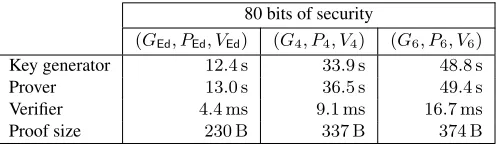
The implementation itself entails many algorithmic and engineering details, and we refer the reader to [BCTV14] for a discussion of these techniques. We only provide a high-level efficiency comparison between the preprocessing zk-SNARK of [BCTV14] based on Edwards curves (also at 80-bit security), and our implementations of(G4, P4, V4)and(G6, P6, V6); see Figure 1. Our implementation is slower, because
of two main reasons: (i) MNT curves do not enjoy advantageous properties that Edwards curves do; and (ii) the modulus sizes are larger (298bits in our case vs.180bits in [BCTV14]). On the other hand, the fact that MNT curves lie on a PCD-friendly 2-cycle is crucial for the PCD construction described next.
80 bits of security
(GEd, PEd, VEd) (G4, P4, V4) (G6, P6, V6)
Key generator 12.4 s 33.9 s 48.8 s
Prover 13.0 s 36.5 s 49.4 s
Verifier 4.4 ms 9.1 ms 16.7 ms
Proof size 230 B 337 B 374 B
Figure 1: Comparison of(GEd, PEd, VEd),(G4, P4, V4), and(G6, P6, V6), on a circuitCwith217gates and inputs
of10field elements. The size ofCwas chosen so that the2-adicity of each zk-SNARK’s curve is high enough (i.e., ν2(ri−1)≥17fori=Ed,4,6). The experiment was conducted on our benchmarking machine (described in
Section 7), running in single-thread mode.(The reported times are the average of 10 experiments, with standard deviation less than1%.)
3.4 A higher-security2-cycle
We also found and constructed a2-cycle with higher security, by (significantly) increasing the modulus. This
2-cycle can be used in place of the previous2-cycle, albeit with moderate performance overheads.
E4/Fq4 :y
2 =x3+A
4x+B4where
A4= 2,
B4 = 0x01373684A8C9DCAE7A016AC5D7748D3313CD8E39051C596560835DF0C9E50A5B59B882A92C78
DC537E51A16703EC9855C77F C3D8BB21C8D68BB8CF B9DB4B8C8F BA773111C36C8B1B4E8F1ECE
940EF9EAAD265458E06372009C9A0491678EF4,
q4= 0x01C4C62D92C41110229022EEE2CDADB7F997505B8F AF ED5EB7E8F96C97D87307F DB925E8A 0ED8D99D124D9A15AF79DB117E776F218059DB80F0DA5CB537E38685ACCE9767254A4638810719AC4 25F0E39D54522CDD119F5E9063DE245E8001.
E6/Fq6 :y
2 =x3+A
6x+B6where
A6= 11,
B6 = 0x7DA285E70863C79D56446237CE2E1468D14AE9BB64B2BB01B10E60A5D5DF E0A25714B798599 3F62F03B22A9A3C737A1A1E0F CF2C43D7BF847957C34CCA1E3585F9A80A95F401867C4E80F4747F D E5ABA7505BA6F CF2485540B13DF C8468A,
q6= 0x01C4C62D92C41110229022EEE2CDADB7F997505B8F AF ED5EB7E8F96C97D87307F DB925E8A 0ED8D99D124D9A15AF79DB26C5C28C859A99B3EEBCA9429212636B9DF F97634993AA4D6C381BC3F
4
Proof-carrying data from PCD-friendly zk-SNARKs
In Section 3 we formulated, and instantiated, PCD-friendly cycles of elliptic curves (see Definition 3.1); this notion was motivated by efficiency considerations arising when recursively composing zk-SNARK proofs. Roughly, given two zk-SNARKs based on elliptic curves forming a PCD-friendly 2-cycle, one can alternate between the two proof systems, and the 2-cycle property ensures that fields “match up” at each recursive verification, allowing for an efficient circuit implementation of the verifier of both proof systems.
The discussion so far, however, is only a sketch of the approach and omits key technical details. We now spell out these by describing how to construct a PCD system, given the two zk-SNARKs. So let(Eα, Eβ) be a PCD-friendly 2-cycle of elliptic curves, and let(Gα, Pα, Vα)and(Gβ, Pβ, Vβ)be two preprocessing zk-SNARKs respectively instantiated with the two elliptic curvesEα/Fqα andEβ/Fqβ. Note that:
• (Gα, Pα, Vα)works forFrα-arithmetic circuit satisfiability, whileVα’s computations are overFqα; and • (Gβ, Pβ, Vβ)works forFrβ-arithmetic circuit satisfiability, whileVβ’s computations are overFqβ.
Due to the 2-cycle property,Frα equalsFqβ, andFrβ equalsFqα. Our goal is to use(Gα, Pα, Vα)and(Gβ,
Pβ, Vβ), along with other ingredients, to construct a PCD system(G,P,V).
Remark 4.1(longer cycles). As we have PCD-friendly cycles of length ` = 2, the PCD construction
described in this section (including our code) is specialized to this case. One can extend the construction to work with (preprocessing zk-SNARKs based on) PCD-friendly cycles of length` >2.
4.1 Intuition
We begin by giving the intuition behind our construction of the PCD generatorG, proverP, and verifierV.
For simplicity, for now, we focus on the case where each node receives a single input message (i.e., the special case of “message chains” having aritys= 1).
Starting point. A natural first attempt is to construct two arithmetic circuits,Cpcd,αoverFrα andCpcd,β
overFrβ, that, for a given compliance predicateΠ, work as follows.
Cpcd,α(x, a)
1. Parse the inputxas(vkα,vkβ, z).
2. Parse the witnessaas(zloc, zin, πin). 3. Ifπin= 0(base case), setbbase:= 1. 4. Ifπin6= 0(not base case), setbbase:= 0and
check thatVβ vkβ,(vkα,vkβ, zin), πinaccepts. 5. Check thatΠ(z, zloc, zin, bbase) = 0.
Cpcd,β(x, a)
1. Parse the inputxas(vkα,vkβ, z).
2. Parse the witnessaas(zloc, zin, πin). 3. Ifπin= 0(base case), setbbase:= 1. 4. Ifπin6= 0(not base case), setbbase:= 0and
check thatVα vkα,(vkα,vkβ, zin), πinaccepts. 5. Check thatΠ(z, zloc, zin, bbase) = 0.
In other words,Cpcd,αchecksΠ-compliance at a node and also verifies a previous proof, relative toVβ; while Cpcd,β does the same, but verifies a previous proof relative toVα. Also note that the inputx, but not the witnessa(over which we have no control), specifies the choice of verification keys.
More precisely, on input Π, the PCD generator Gwould work as follows: (i) construct Cpcd,α and Cpcd,β fromΠ; (ii) sample two key pairs,(pkα,vkα) ← G4(Cpcd,α)and(pkβ,vkβ) ← G6(Cpcd,β); and (iii) outputpk:= (pkα,pkβ,vkα,vkβ)andvk:= (vkα,vkβ). On input proving keypk, outgoing messagez, local datazloc, and incoming messagezin, the PCD proverPwould invokePα(pkα, x, a)ifπinis relative toVβorPβ(pkβ, x, a)ifπinis relative toVα, wherex:= (vkα,vkβ, z)anda:= (zloc, zin, πin). Finally, on input verification keyvk, messagez, and proofπ, the PCD verifierVwould either invokeVα(vkα, x, π)or Vβ(vkβ, x, π), wherex:= (vkα,vkβ, z).
However, the above simple sketch suffers from two main problems, which we now describe.
Problem #1. The compliance predicateΠis an arithmetic circuit. However, shouldΠbe defined overFrα
orFrβ? IfΠis defined overFrα, then theFrβ-arithmetic circuitCpcd,βwill be very inefficient, because it has
Problem #2. In known preprocessing zk-SNARK constructions, including the one underlying(Gα, Pα, Vα) and(Gβ, Pβ, Vβ), a verification key has length`(n)> n, wherenis the size of the input to the circuit with respect to which the key was created. Thus, it is not possible to obtain eithervkαorvkβ that works for inputs of the formx= (vkα,vkβ, z).
Our solution (at high level). To address the first problem, we simply “pick one side”: only one ofCpcd,α andCpcd,βevaluatesΠ, while the other circuit merely enables the PCD prover to translate a proof relative to one zk-SNARK verifier to one relative to the other zk-SNARK verifier. Arbitrarily, we pickCpcd,αto be the one that evaluatesΠ; in particular,Πwill be anFrα-arithmetic circuit.
11 (The choice ofC
pcd,αis without loss of generality, since we can always relabel: if(Eα, Eβ)is PCD-friendly 2-cycle, so is(Eβ, Eα).)
To address the second problem, the ideal solution is to simply hardcodevkβinCpcd,αandvkαinCpcd,β (and let an inputxconsist only of a messagez). However, this is not possible:vkβ depends onCpcd,β, while
vkαdepends onCpcd,α(i.e., there is a circular dependency). We thus proceed as follows. We hardcodevkαin Cpcd,β. Then, forvkβ, we rely on collision-resistant hashing. Namely, inputsxhave the form(χβ, z)where, allegedly,χβ is the hash ofvkβ. We modifyCpcd,αto check that this holds: Cpcd,α’s witness is extended to (allegedly) containvkβ and thenCpcd,αchecks thatHα(vkβ) =χβ, whereHα:{0,1}mH,α →FdrαH,αis a
suitable collision-resistant hash function.
The above modifications toCpcd,αandCpcd,β yield the following construction.
Cpcd,α(x, a)
1. Parse the inputxas(χβ, z).
2. Parse the witnessaas(vkβ, zloc, zin, πin). 3. Check thatHα(vkβ) =χβ.
4. Ifπin= 0(base case), setbbase:= 1. 5. Ifπin6= 0(not base case), setbbase:= 0and
check thatVβ vkβ,(χβ, zin), πinaccepts. 6. Check thatΠ(z, zloc, zin, bbase) = 0.
Cpcd,β(x, a)
1. Parse the inputxas(χβ, z).
2. Parse the witnessaas(πα).
3. Check thatVα vkα,(χβ, z), πα
accepts.
Unfortunately, while the above two fixes makeCpcd,αandCpcd,βwell-defined, the use of hashing makes Cpcd,αlarge, as we now explain. The verification keyvkβ consists of various points on the elliptic curve Eβ/Fqβ (or a twist of it). Recalling thatFqβ equalsFrα (the field of definition ofCpcd,α), we representvkβ
as a list of elements ofFqβ, because the (circuit implementing the) verifierVβ usesvkβ for computations
inFqβ. Unfortunately,Hα only accepts binary strings as input, and the translation fromvkβ to its binary
representation incurs alogqβ blow up — a nontrivial cost. We do not know how to eliminate this cost.12 Thus, instead, we further modifyCpcd,αandCpcd,βto shortenvkβ. Indeed, ifCpcd,βaccepts inputs ofn elements inFrβ, thenvkβ consists of`vk,β(n)elements inFqβ; hence, we seek to reducen. To do so, instead
of working with messages of the formx= (χβ, z), we work with messages of the formx= (χβ), by also hashingzalong withvkβ(both of which are now supplied in the witness), as follows.
Cpcd,α(x, a)
1. Parse the inputxas(χβ).
2. Parse the witnessaas(vkβ, z, zloc, zin, πin). 3. Check thatHα(vkβkz) =χβ.
4. Ifπin= 0(base case), setbbase:= 1.
5. If πin 6= 0(not base case), setbbase := 0and check thatVβ vkβ, Hα(vkβkzin), πinaccepts. 6. Check thatΠ(z, zloc, zin, bbase) = 0.
Cpcd,β(x, a)
1. Parse the inputxas(χβ).
2. Parse the witnessaas a zk-SNARK proofπα.
3. Check thatVα(vkα, χβ, πα)accepts.
11
Alternatively, we could restrictΠto be a boolean circuit, so that it can be easily evaluated byCpcd,αandCpcd,β. But this foregoes
Π’s ability to conduct field operations in large prime fields. Thus, it is more efficient to “give up” onCpcd,β, and only letCpcd,α
evaluateΠ, and retain the expressive power of arithmetic circuits. (Other alternatives are possible, but we do not explore them.)
12As explained in Section 5.2, we are not aware of a collision-resistant hash functionH
Further details. The above discussion omits various technical details and optimizations.
For instance, thus far we have ignored the fact that, whileCpcd,αexpects inputs overFrα,Cpcd,βexpects
inputs overFrβ. Sincex=χβlies inF
dH,α
rα (as it is the output ofHα), we cannot use the same representation
of it for bothCpcd,αandCpcd,β; instead, we need two representations:xα∈FrnααforCpcd,α, andxβ ∈F
nβ
rβ
forCpcd,β. Naturally, for the first, we can setnα:=dH,α, and letxα:=χβ. For the second, merely letting xβ be the list ofnα· dlogrαebits inχβ isnotefficient: it would causevkβto have length`vk,β(nα· dlogrαe). Instead, we letxβstore these bits into as few elements ofFrβ as possible; specifically,nβ :=d
nα·dlogrαe
blogrβc eof
them. So let:
• Sα→β:Fnrαα →F
nβ·dlogrβe
rα denote the function that mapsxαto (the binary representation of)xβ; and • Sα←β:Fnrββ →F
nα·dlogrαe
rβ denote the function that mapsxβback to (the binary representation of)xα.
The above implies that we need to further modifyCpcd,αandCpcd,β, and include explicit subcircuitsCS,α→β andCS,α←β to carry out these “type conversions”; both of these circuits are simple to construct, and have size|CS,α→β|=|CS,α←β|=nα· dlogrαe.
Moreover, we leverage precomputation techniques [BCTV14]. A zk-SNARK verifierV can be viewed as two functions: an “offline” function Voffline that, given the verification keyvk, computes a
processed verification keypvk; and an “online” functionVonlinethat, givenpvk, an inputx, and proofπ, computes the
decision bit. (I.e.,V(vk, x, π) :=Vonline Voffline(vk), x, π).) Precomputation offers a tradeoff: whileVonline
is cheaper to compute thanV,pvkis larger thanvk(in each case, the difference is an additive constant). In our setting, it turns out that it pays off to use precomputation techniques only inCpcd,βbut not inCpcd,α.
We address all the details in the next subsection, where we give the construction of the PCD system.
4.2 Construction
We now describe in more detail our construction of the PCD generatorG, proverP, and verifierV. Throughout,
we fix a message sizenmsg∈N, local-data sizenloc ∈N, and aritys∈N. The construction will then work
forFrα-arithmetic compliance predicatesΠ :F
nmsg
rα ×Fnrαloc×F
s·nmsg
rα ×Frα → F
l
rα (i.e., for message size
nmsg, local-data sizenloc, aritys, and some output sizel∈N). In terms of ingredients, we make use of the
following arithmetic circuits:
• An Frα-arithmetic circuitCH,α, implementing a collision-resistant functionHα: {0,1}
mH,α → FdrαH,α
such thatmH,α ≥ `vk,β(nβ) +nmsg· dlogrαe, wherenα:=dH,αandnβ :=dnαb·dloglogrβrcαee. • AnFrα-arithmetic circuitCS,α→β, implementingSα→β:F
nα
rα →F
nβ·dlogrβe
rα .
• AnFrβ-arithmetic circuitCS,α←β, implementingSα←β:F
nβ
rβ →F
nα·dlogrαe
rβ .
• AnFrβ-arithmetic circuitC
online
V,α , implementingV
online
α for inputs ofnαelements inFrα; an inputxα∈F
nα
rα
is given toConline
V,α as a string ofnα· dlogrαeelements inFrβ, each carrying a bit ofxα.
• AnFrα-arithmetic circuitCV,β, implementingVβfor inputs ofnβelements inFrβ; an inputxβ ∈F
nβ
rβ is
given toCV,βas a string ofnβ· dlogrβeelements inFrα, each carrying a bit ofxβ.
For now we take the above circuits as given; later, in Section 5 we discuss our concrete instantiations of them. Also, we generically denote bybitsαa function that, given an inputyinF`rα (for some`), outputsy’s binary
representation; the correspondingFrα-arithmetic circuit is denotedCbits,α, and has`· dlogrαegates.
13
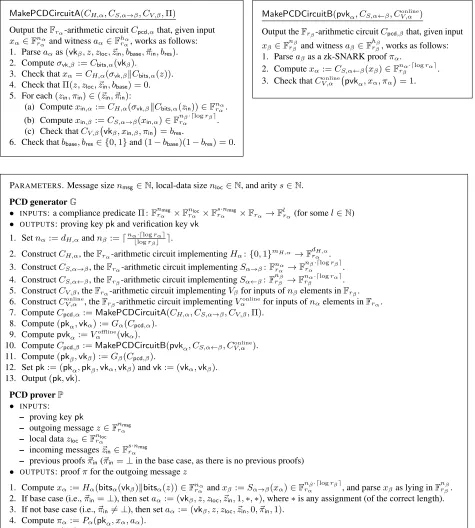
For reference, pseudocode for the triple(G,P,V)is given in Figure 2.
13
More precisely, for eachFrα-elementyiin the vectory,bitsαoutputs bitsb1, . . . , bdlogrαesuch that
Pdlogrαe−1
j=0 bj2
j=y i,
where arithmetic is conducted overFrα. Due to wrap around, some elements inFrαhavetwosuch representations; if so,bitsαoutputs the lexicographically-first one. None the less, we constructCbits,αto only check for either of these two representations, because:
(i) discriminating between representations costs an additional`· dlogrαegates; and (ii) doing so does not affect completeness or
The PCD generator. The PCD generator Gtakes as input anFrα-arithmetic compliance predicate Π,
and outputs a key pair(pk,vk)for proving/verifyingΠ-compliance. The PCD generator works as follows: (i) it usesCH,α, CS,α→β, CV,β,Πto construct the circuitCpcd,α; (ii) it samples a key pair,(pkα,vkα) ← G4(Cpcd,α); (iii) it usesvkα, CS,α←β, CV,αonlineto construct the other circuitCpcd,β; (iv) it samples another key pair,(pkβ,vkβ)←G6(Cpcd,β); and (v) it outputspk:= (pkα,pkβ,vkα,vkβ)andvk:= (vkα,vkβ).
We now describe Cpcd,αandCpcd,β. The circuitCpcd,β acts as a “proof converter”: it takes an input xβ ∈ Fnrββ and a witnessaβ ∈ F
hβ
rβ, parses aβ as a zk-SNARK proofπα forVα, and simply checks that
Conline
V,α vkα, CS,α←β(xβ), πα
= 1. (The verification keyvkαis hardcoded inCpcd,β.)
In contrast, the circuitCpcd,αverifiesΠ-compliance: it takes an inputxα ∈Fnrαα and a witnessaα ∈F
hα
rα,
parses aα as (vkβ, z, zloc, ~zin, bbase, ~πin, bres), and verifies that xα = CH,α(Cbits,α(vkβ)kCbits,α(z)) and thatΠ(z, zloc, ~zin, bbase) = 0. Moreover, ifbbase = 0(not the base case),Cpcd,αalso recursively verifies Π-compliance of previous messages: for each corresponding pair (zin, πin) in (~zin, ~πin), it verifies that CV,β vkβ, xin,β, πin
= 1wherexin,β =CS,α→β(CH,α(Cbits,α(vkβ)kCbits,α(zin))). See Figure 2 for details. Overall, the two circuits have the following sizes:
|Cpcd,α| ≈ `vk,β(nβ) + (1 +s)nmsg
· dlogrαe+|CH,α|+|Π|+s· |CH,α|+|CS,α→β|+|CV,β|
,
|Cpcd,β| ≈ |CS,α←β|+|CV,αonline| .
(1)
The PCD prover. The PCD proverPtakes as input a proving keypk, outgoing messagez, local datazloc, and incoming messages~zin; when not in the base case, it also takes as input proofs~πin, each attesting that a message in~zinisΠ-compliant. The PCD prover outputs a proofπattesting to the fact thatzisΠ-compliant.
At high level, the PCD prover performs not one, but two, steps of recursive composition, “going around the PCD-friendly 2-cycle”. The first step is relative toCpcd,αand checksΠ-compliance; the second step is relative toCpcd,β and merely converts the proof produced by the first step to the other verifier. More precisely, the PCD prover constructsxα:= Hα(bitsα(vkβ)kbitsα(z))∈Fnrαα and then usesPαto produce
a proofπαattesting thatxα ∈ LCpcd,α. In the base case,Cpcd,αonly verifies thatΠ(z, zloc, ~zin,1) = 0; but,
when previous proofs~πinare supplied,Cpcd,αverifies instead thatΠ(z, zloc, ~zin,0) = 0and, for each pair
(zin, πin), thatVβ vkβ, xβ,in, πin
= 1wherexβ,in:=Sα→β(Hα(bitsα(vkβ)kbitsα(zin)))∈Fnrββ. Next, the
PCD prover usesPβ to convertπαinto a proofπattesting thatxβ ∈ LCpcd,β, wherexβ :=Sα→β(xα)∈F
nβ
rβ;
this is merely a translation becauseCpcd,β only verifies thatπαis valid. The proofπisP’s output.
The PCD verifier. The PCD verifierVtakes as input a verification keyvk, messagez, and proofπ. Proofs
relative to(Gα, Pα, Vα)are never “seen” outside the PCD prover, because the prover converts them to proofs relative to(Gβ, Pβ, Vβ). Hence, the proofπis relative to(Gβ, Pβ, Vβ), and the PCD verifier checks thatzis Π-compliant by checking thatVβ(vkβ, xβ, π) = 1, wherexβ :=Sα→β(Hα(bitsα(vkβ)kbitsα(z)))∈Fnrββ.
4.3 Security
The intuition for the security of(G,P,V)is straightforward. Suppose that a malicious polynomial-size prover ˜
P outputs a messagezand proofπthat are accepted by the PCD verifierV. Our goal is to deduce thatz
isΠ-compliant. By construction ofV, we deduce thatSα→β(Hα(bitsα(vkβ)kbitsα(z)))∈ LCpcd,β. In turn,
by construction ofCpcd,β, we deduce thatHα(bitsα(vkβ)kbitsα(z))∈ LCpcd,α. In turn, by construction of
Cpcd,α, we deduce that there is local datazlocand previous messages~zinsuch that one of the following holds: (i)Π(z, zloc, ~zin,1) = 0, which is the base case; or (ii)Π(z, zloc, ~zin,0) = 0and, for each incoming message zin,Sα→β(Hα(bitsα(vkβ)kbitsα(zin)))∈ LCpcd,β(and thus, by induction, that eachzinisΠ-compliant). In
either case, we conclude thatzisΠ-compliant.
MakePCDCircuitA(CH,α, CS,α→β, CV,β,Π)
Output theFrα-arithmetic circuitCpcd,αthat, given input
xα∈Fnrααand witnessaα∈F
hα
rα, works as follows: 1. Parseaαas(vkβ, z, zloc, ~zin, bbase, ~πin, bres). 2. Computeσvk,β:=Cbits,α(vkβ).
3. Check thatxα=CH,α(σvk,βkCbits,α(z)).
4. Check thatΠ(z, zloc, ~zin, bbase) = 0. 5. For each(zin, πin)∈(~zin, ~πin):
(a) Computexin,α:=CH,α(σvk,βkCbits,α(zin))∈Fnrαα. (b) Computexin,β:=CS,α→β(xin,α)∈Fnβ
·dlogrβe
rα . (c) Check thatCV,β vkβ, xin,β, πin
=bres.
6. Check thatbbase, bres∈ {0,1}and(1−bbase)(1−bres) = 0.
MakePCDCircuitB(pvkα, CS,α←β, CV,αonline)
Output theFrβ-arithmetic circuitCpcd,βthat, given input
xβ∈Fnrββand witnessaβ∈F
hβ
rβ, works as follows: 1. Parseaβas a zk-SNARK proofπα.
2. Computexα:=CS,α←β(xβ)∈Fnrβα·dlogrαe. 3. Check thatConline
V,α pvkα, xα, πα
= 1.
PARAMETERS. Message sizenmsg∈N, local-data sizenloc∈N, and aritys∈N. PCD generatorG
• INPUTS: a compliance predicateΠ :Fnrαmsg×F
nloc
rα ×F
s·nmsg
rα ×Frα→F
l
rα(for somel∈N) • OUTPUTS: proving keypkand verification keyvk
1. Setnα:=dH,αandnβ:=dnαb·dloglogrrαe
βc e.
2. ConstructCH,α, theFrα-arithmetic circuit implementingHα:{0,1}
mH,α→
FdrH,αα . 3. ConstructCS,α→β, theFrα-arithmetic circuit implementingSα→β:Fnrαα→F
nβ·dlogrβe
rα . 4. ConstructCS,α←β, theFrβ-arithmetic circuit implementingSα←β:F
nβ
rβ →F
nα·dlogrαe
rβ . 5. ConstructCV,β, theFrα-arithmetic circuit implementingVβfor inputs ofnβelements inFrβ. 6. ConstructConline
V,α , theFrβ-arithmetic circuit implementingV
online
α for inputs ofnαelements inFrα. 7. ComputeCpcd,α:=MakePCDCircuitA(CH,α, CS,α→β, CV,β,Π).
8. Compute(pkα,vkα) :=Gα(Cpcd,α).
9. Computepvkα:=Voffline
α (vkα).
10. ComputeCpcd,β:=MakePCDCircuitB(pvkα, CS,α←β, CV,αonline).
11. Compute(pkβ,vkβ) :=Gβ(Cpcd,β).
12. Setpk:= (pkα,pkβ,vkα,vkβ)andvk:= (vkα,vkβ).
13. Output(pk,vk).
PCD proverP • INPUTS:
– proving keypk
– outgoing messagez∈Fnrαmsg – local datazloc∈Fnrαloc
– incoming messages~zin∈Fsr·αnmsg
– previous proofs~πin(~πin=⊥in the base case, as there is no previous proofs) • OUTPUTS: proofπfor the outgoing messagez
1. Computexα:=Hα(bitsα(vkβ)kbitsα(z))∈Fnrααandxβ:=Sα→β(xα)∈F
nβ·dlogrβe
rα , and parsexβas lying inFnrββ. 2. If base case (i.e.,~πin=⊥), then setaα:= (vkβ, z, zloc, ~zin,1,∗,∗), where∗is any assignment (of the correct length). 3. If not base case (i.e.,~πin6=⊥), then setaα:= (vkβ, z, zloc, ~zin,0, ~πin,1).
4. Computeπα:=Pα(pkα, xα, aα).
5. Setaβ:= (πα).
6. Computeπ:=Pβ(pkβ, xβ, aβ).
7. Outputπ.
PCD verifierV
• INPUTS: verification keyvk, messagez∈Fnrαmsg, and proofπ • OUTPUTS: decision bit
1. Computexα:=Hα(bitsα(vkβ)kbitsα(z))∈Fnrααandxβ:=Sα→β(xα)∈F
nβ·dlogrβe
rα , and parsexβas lying inF
nβ
rβ. 2. Computeb:=Vβ(vkβ, xβ, π)and outputb.
5
Constructions of arithmetic circuits
In Section 4 we gave a construction of a PCD system(G,P,V)in terms of two preprocessing zk-SNARKs,
based on a PCD-friendly 2-cycle (Eα, Eβ), and various arithmetic circuits. We now discuss concrete implementations of these arithmetic circuits, which determine the sizes ofCpcd,αandCpcd,β(see Equation 1).
In our code implementation, (Eα, Eβ) equals(E4, E6), a specific 2-cycle based on MNT curves of
embedding degree4and6, selected to have high 2-adicity (see Section 3.2). Thus, in the text below, “α= 4
andβ= 6”.14 We obtain the following efficiency for the two circuitsCpcd,4andCpcd,6.
Lemma 5.1(informal). Let Π :Fnr4msg ×F
nloc r4 ×F
s·nmsg
r4 ×Fr4 → F
l
r4 be anFr4-arithmetic compliance
predicate for message sizenmsg, local-data sizenloc, aritys(and some output sizel). TheFr4-arithmetic
circuitCpcd,4and theFr6-arithmetic circuitCpcd,6have the following number of gates.
Gate count forCpcd,4
booleanity checks 11920 + (1 +s)·nmsg·298 (1 +s)copies ofCH,6 (1 +s)×1
scopies ofCS,4←6 s×298
scopies ofCV,6forn6= 2 s×89113
Π |Π|
misc. 4
Total |Π|+s·89412
+(1 +s)·nmsg·298 + 11925
Gate count forCpcd,6
CS,4←6 298
Conline
V,4 forn4= 1 31729
Total 32027
Next, we discuss the various subcircuits: for the zk-SNARK verifiers and for collision-resistant hashing.
Remark 5.2. We selected the PCD-friendly 2-cycle(E4, E6)to have high 2-adicity: it hasν2(r4−1) = 34
andν2(r6−1) = 17. These values are not accidental, but were chosen so that the 2-cycle(E4, E6)suffices
for “essentially all practical uses” of our PCD system. Specifically, recall that we would like, for efficiency reasons, that (i) ν2(r4 −1) ≥ dlog|Cpcd,4|e and (ii) ν2(r6 −1) ≥ dlog|Cpcd,6|e(see Section 3.2 and
Appendix C.2). First, sincedlog|Cpcd,6|e= 15, Condition (ii) holds always. As for Condition (i), it depends
onΠ; however, sinceν2(r4−1) = 34is so large, it is not a limitation for practically-feasible choices ofΠ.15
5.1 Arithmetic circuits for zk-SNARK verifiers
We seek arithmetic circuits for the two zk-SNARK verifiers: anFr6-arithmetic circuitCV,4implementingV4
and anFr4-arithmetic circuitCV,6implementingV6. Note the field characteristics:V4’s arithmetic operations
are overFq4 (which is equal toFr6) andV6’s operations are overFq6 (which is equal toFr4).
We design and constructCV,4andCV,6, each consisting of two subcircuits for the “offline” and “online”
parts of the verifier (see Section 4.1), and achieve the following efficiency:
Lemma 5.3(informal). Letn, l∈N.
• There is anFq4-arithmetic circuitCV,4 with size
(10·l−4)·n+ 43,767
that implementsV4for all inputsx∈Fnr4 such that eachxihas at mostlbits. (Naturally,l≤ dlogr4e.)
Moreover,CV,4consists of two subcircuits,CV,offline4 andCV,online4 , implementingV4offlineandV4online, with sizes
12270 and (10·l−4)·n+ 31,497 .
14The choice(E
α, Eβ) = (E4, E6), rather than(Eα, Eβ) = (E6, E4), is intentional. We expectCpcd,αto be larger thanCpcd,β
(due to a larger number of checks), so thatEαshould be the curve with the higher 2-adicity. In this case,E4is twice as 2-adic asE6. 15More precisely, if we take|Π|+s·89412to be the leading terms in|C

![Figure 8: Comparison between [BCTV14]’s preprocessing zk-SNARK and our scalable zk-SNARK.](https://thumb-us.123doks.com/thumbv2/123dok_us/7911036.1313536/30.612.174.442.130.404/figure-comparison-bctv-preprocessing-zk-snark-scalable-snark.webp)
