Independent Pixel Block (IPB) Method Based
Binary Matrix Recovery
Nirlap Kaur 1, Sumanpreet Kaur 2
Research Scholar, Department of Computer Science, CGC Technical Campus, Jhanjeri, Mohali, India 1
Assistant Professor, Department of Computer Science, CGC Technical Campus, Jhanjeri, Mohali, India 2
ABSTRACT: The binary images are utilized in the various kinds of the medical or non-medical applications. The efficient preservation mechanisms are applied for the storage of the binary data over the computing resources, but the computing resources always carries the probability of crashing and the critical data losses. Such data losses require the efficient data recovery from the storage disk resources, which certainly not possible in some of the cases. The binary image projection data can be preserved in almost 10% total memory of the original image data, which can be easily kept over the multiple internet storage resources. Then, the binary image regeneration methods are required to recreate the appropriate original binary image to reconstruct the data in order to recover the lost data. The proposed model is based upon the Independent Pixel Block (IPB) Method based binary matrix recovery. The IPB method uses the neighbor entity factoring for the recovery of the certain pixels, which do not meet the conditions. The proposed model aimed at the development of the robust binary image reconstruction method, which has been realized using the IPB method. The experimental results have shown the improvement of almost 7-8% than the optimization solution and initial solutions. Hence, it can be easily declared that the proposed model have improved the results significantly under this experiment for the binary matrix regeneration.
KEYWORDS: Binary matrix regeneration, matrix recovery, image recovery, pixel based recovery.
I. INTRODUCTION
Binary Image Reconstruction outlines the technique of reproducing an image from the traced image. [1] This traced image is acquired in the structure of projections such as diagonal, vertical and horizontal. [2] These projections are absolutely based on the type of an image that may be 2-D or 3-D image. [5, 7] This involves the concept of binary image reconstruction. A binary image is a digitalized image containing on white and black pixels where white pixels corresponds to binary value 1 &black pixels corresponds to binary value 0. [4, 6]
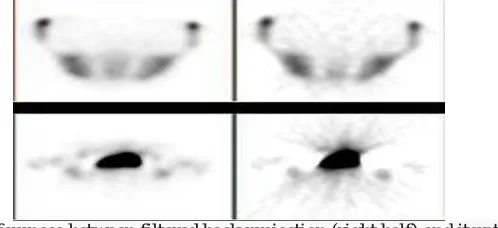
Figure 1: Example showing differences between filtered back projection (right half) and iterative reconstruction method (left half)
In binary images, Image reconstruction is a mathematical process that produces images from Horizontal-Vertical projection data derived from the different angles. [8] Image reconstruction has a major influence on image quality also on radiation noise.For a radiation dose it is necesary to reconstruct images with the lower noise without sacrificing spatial resolution and image quality. [3] Reconstructions methods that improve image quality can be converted into a decrease of radiation dose as images of acceptable quality can be reconstructed at lower dose. [9, 13]
i.) Analytical Reconstruction or Filtered back projections(FBP). [10] ii.) Iterative reconstruction. [10]
Analytical Reconstruction constructs an image in a single step. [17] The widest use of this projection is in the field of clinical binary image scanners. [18] The major reason behind its use is its numerical stability and computation efficiency whereas Iterative Reconstruction constructs an image in multiple steps but provides a complete solution which leads to efficient reconstruction of an image as compared to filtered back projection. [19-20] Also it decreases the image artifacts like beam hardening and metal artifacts. [11]
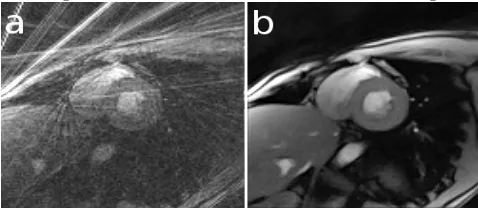
Figure 3: Reconstruction example over the MRI images
The existing work is done on simulated annealing that uses the two level solution for reproducing an image. [8] The simulated annealing inhibits the concept of metallurgy where it is enforced on glass or metal. [19] This provides the excellent strength in glass with accurate flexibility. In this, there are more chances of occurring error while reconstruction phase. As a result of which there is a need of single efficient initial solution algorithm that will produce more accurate results. [13]This paper emphasizes on iterative reconstruction of binary images from HV projections analyzed from different angles. [14, 15, 16] It also emphasizes on obtaining the more efficient results as the solution of optimization problem or to a set of equations which are concluded in a iterative loop. [12]
Figure 2: A single frame from a Real-time MRI movie of a human heart. a) direct reconstruction b) iterative (nonlinear -inverse) reconstruction
II. RELATED WORK
technique. In [3] authors have been centered upon the reconstruction of hv-convex sets by their coordinate X-ray functions. the fundamental result [28] is that the generalized conic operate associated to a compact tabular set determines the coordinate X-rays and the other way around.In [4] authors have worked on reconstruction of binary pictures from 2 orthogonal projections. Reconstruction of binary pictures (or matrix) with 2 projections has been mentioned wide in literature and every one the reconstruction algorithms with 2 projections either use horizontal and vertical projections or horizontal and diagonal projections.In [5] authors have concentrated on the combination of two rules named as simulated hardening and genetic rule for the reconstruction of HV convex binary matrices. In this paper, the authors have worked upon the row and column sums of umbellate binary matrices i.e. Horizontal and vertical. The major concept is the NP-Complete which is a replacement hybrid genetic rule with use of simulated hardening and is project to conclude the most approximate conclusion or answer.In [6] authors have worked on the individualismin the conclusion for the reconstruction of HV-convex polyominoes from the morphological skeleton and H-V projections. In this authors focused on the distinctiveness of the reconstruction of a H-V convex picture.
III.EXPERIMENTAL DESIGN
In this section some definition are given which explain the movement of chromosomes in Genetic programming process.
3.1 Adjacent cells and adjacent points
Any two cells ( , ) and ( ′, ′) in X are said to be adjacent if either = ′ and − ′ = 1 or − ′ = 1 and = ′.
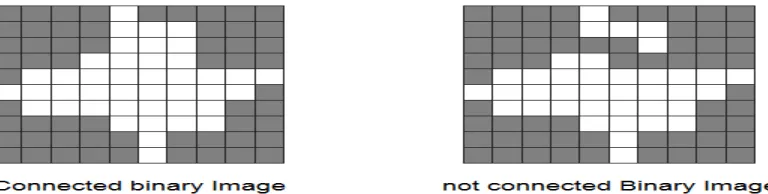
3.2 Adjacent points of binary image or connected image
If = ( ( , )) and = ( (′, ′)) both have value 1 and cells ( , ) and (′, ′) are adjacent then these points of
binary image are said to be connected. If all the points of binary image F are connected then it is called connected image.
Figure 3.2: Connected binary image and not connected binary image
3.3 Boundary of a binary image
The binary image says that it contains 1’s at some cell (i, j) and 0’s at other cells in discrete set , here after by an image we will refer the cells having value of as 1 i.e ( , ) = = 1 and the cell or point (I,j) of X will be said to be a point of binary image , i.e. = 1⟹( , )∈ .
The set of all cells (points) (i, j) in which separate 1’s from 0’s will be called the boundary of , thus the boundary of is represented as
= {( , )∈ :∃ (′, ′)∉ } (3.1)
In the similar manner boundary is defined in [202].
3.2 Boundary point
The element ( , )∈ will be called the boundary point. Thus boundary point can be defined alternatively: A point (cell) ( , )∈ will be called boundary point if at least one of following four properties is satisfied
(i) , = 0 = 1
(ii) , = 0 = 1
(iii) , = 0 =
Based on this alternative definition boundary points can be categorized in following categories:
If a boundary point satisfies only one property it will be called type 1 boundary point, if any boundary point satisfies any two properties only it will be called type 2 boundary points, if any boundary point satisfies any 3 properties only then it will be called type 3 boundary point. A boundary point satisfying all four properties will be an isolated point of image and will be called type 4 boundary point.
Algorithm 1: Independent Pixel Block (IPB) Method based binary matrix recovery Input: {Original Image, HV-Projections}
Output: {Regenerated output}
1. Perform the Projection data acquisition
2. Run the projection data using the initial solution
3. Produce the initial level solution
4. Apply the optimization over the initial solution matrix
5. Return the fixed matrix with optimized value
6. Run the iteration for each block of 3x3 in the overlapping manner
7. Perform the Independent Pixel Block (IPB) Method over each 3x3 block matrix
a. Acquire the block (3x3) from the optimized image matrix b. Store the value of center pixel to Ci
c. Check the matching pixels in the neighboring elements d. Return the density of the matching pixels
e. If the matching pixels are observed higher than three i. Return the reconstructed binary matrix f. Otherwise
i. Keep the current matrix ii. Go to next iteration
8. Compute the final results
9. Return the final matrix
IV.RESULT ANALYSIS
The proposed model results have been observed in the form of the various steps altogether. The proposed model has been analyzed to study the level of improvement in the reconstruction of the binary matrix data. The binary matrix data has been reconstructed using the hybrid solution in the proposed model, where the multi-layered architecture has been deployed on the work for the efficient recovery of the binary matrix from the projection data. The significant improvement has been recorded on all of the steps under the proposed model. The matrix recovery begins with the incorporation of the initial solution method, which helps to recreate the initial solution in the form of the binary image matrix, which is further processed using the high order optimization algorithm.
The figure 4.1 shows the Original Binary Image.The binary images are the 1-bit images which contain only two types of combinations or 1 and 0. This image is used for image reconstruction process.
Figure 4.2 shows Resized image matrix
The Figure 4.2 shows Resized image matrix. It is resized for the quick response regeneration. This Figure 4.2 is resized from the original image and then it is used to obtained the initial solution. The chang's algorithm applied on figure 4.2 to obtained the initial solution projections which contained the horizontal
,
vertical and diagonal projections.
Figure 4.3 shows the Result obtained from the initial solution method
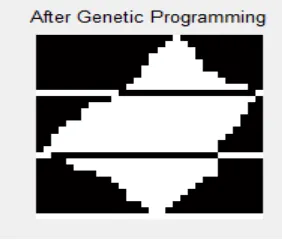
The Figure 4.3 shows the Result obtained from the initial solution method. The binary image reconstruction is based upon the initial solution which computes the initial combinations to satisfy the projection data. The projection data is utilized to recreate the projected binary image in the iterative context which runs the whole programs and computes the various combinations to recreate the initial image matrix. The matrix result obtained from the initial solution is then passed on to the genetic algorithm for the matrix optimization.
The Figure 4.4 shows Response of image matrix regeneration after the optimization algorithm.The GA is responsible for returning the optimal solution with best combination available according to the projection data.
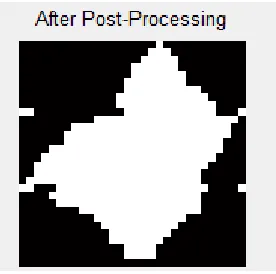
Figure 4.5 shows Independent Pixel Block (IPB) Method based binary matrix
The Figure 4.5 shows Independent Pixel Block (IPB) Method based binary matrix recovery
.
This shows the results obtained from the binary image matrix. This image shows the reconstructed image which is obtained from the original image after the application of the reconstruction solution.METHOD CHANGE IN PIXEL COUNT PERCENTAGE OF CHANGE Chang’s Initial Solution 128 14.22
Genetic Programming 90 10 PROPOSED 21 2.33
The table 4.1 shows the results obtained from the proposed model
The table 4.1 shows the results obtained from the proposed model. It shows the significant recovery in the terms of percentage of change after the final reconstruction of the matrix, when applied on the binary image matrix.
As per the result evaluation of the proposed model, the matrix recovery shows the significant recovery in the terms of percentage of change after the final recreation of the matrix, when applied over the binary matrix size of 30x30 or 40x40. The proposed model has returned the stronger results for the efficient proposed binary matrix recovery model under out experimental evaluation section.
V. CONCLUSION AND FUTURE WORK
Future Scope
In the future the proposed model can be improved for the time complexity and can be reproduced by designing the quick response genetic algorithm model. Also the better model than the genetic algorithm can be produced to improve the performance of the proposed image reconstruction method
.
REFERENCES
1. Patel, Divyesh, and Tanuja Srivastava. "Reconstructing h-convex binary images from its horizontal and vertical projections by simulated
annealing." In Contemporary Computing (IC3), 2015 IEEE Transactions on Eighth International Conference , pp. 117-121. , 2015.
2. Verma, Shiv Kumar, Tanuja Shrivastava, and Divyesh Patel. "Efficient Approach for Reconstruction of Convex Binary Images Branch
and Bound Method." In Springer , Proceedings of the Third International Conference on Soft Computing for Problem Solving, pp.
183-193.
3. Nagy, Ábris, and Csaba Vincze. "Reconstruction of hv-convex sets by their coordinate X-ray functions." Journal of mathematical imaging
and vision 49, no. 3: 569-582 (2014).
4. Srivastava, Tanuja, Shiv Kumar Verma, and Divyesh Patel. "Reconstruction of binary images from two orthogonal projections." IJTS 21,
no. 2: 105-114 (2012).
5. Mohamed, Hadded, and Hasni Hamadi. "Combining Genetic Algorithm and Simulated Annealing Methods for Reconstructing
HV-Convex Binary Matrices." In Hybrid Metaheuristics, Springer Berlin Heidelberg, pp. 78-91, 2013.
6. Hantos, Norbert, and Péter Balázs. "A uniqueness result for reconstructing hv-convex polyominoes from horizontal and vertical
projections and morphological skeleton." In Image and Signal Processing and Analysis (ISPA), 2013 IEEE 8th International Symposium
on, pp. 795-800, 2013.
7. Ozsvár, Zoltán, and Péter Balázs. "An Empirical Study of Reconstructing hv-Convex Binary Matrices from Horizontal and Vertical
Projections." Acta Cybern. 21, no. 1: 149-163, 2013.
8. Patel, Divyesh, and Tanuja Srivastava. "Reconstruction of binary matrices satisfying neighborhood constraints by simulated
annealing." World Academy of Science, Engineering and Technology 8, no. 5: 760-763,2014.
9. Hantos, Norbert, and Péter Balázs. "A Fast Algorithm for Reconstructing hv-Convex Binary Images from Their Horizontal Projection."
In Advances in Visual Computing, Springer International Publishing, pp. 789-798, 2014.
10. Kashuk, Sina, and Magued Iskander. "Reconstruction of three dimensional convex zones using images at model boundaries." Computers
& Geosciences 78 : 96-109,2015.
11. Moscariello, Antonio, Richard AP Takx, U. Joseph Schoepf, Matthias Renker, Peter L. Zwerner, Terrence X. O’Brien, Thomas
Allmendinger et al. "Coronary CT angiography: image quality, diagnostic accuracy, and potential for radiation dose reduction using a novel iterative image reconstruction technique—comparison with traditional filtered back projection." European radiology 21, no. 10 : 2130-2138 ,2011.
12. Leipsic, Jonathon, Giang Nguyen, Jaqueline Brown, Don Sin, and John R. Mayo. "A prospective evaluation of dose reduction and image
quality in chest CT using adaptive statistical iterative reconstruction." American Journal of Roentgenology 195, no. 5 : 1095-1099,2010.
13. Pontana, François, Alain Duhamel, Julien Pagniez, Thomas Flohr, Jean-Baptiste Faivre, Anne-Lise Hachulla, Jacques Remy, and Martine
Remy-Jardin. "Chest computed tomography using iterative reconstruction vs filtered back projection (Part 2): image quality of low-dose CT examinations in 80 patients." European radiology 21, no. 3 : 636-643,2011.
14. Amandeep Kaur, Karamjeet Singh , “Speckle Noise Reduction By Using Wavelets”, NCCI -National Conference On Computational
Instrumentation Chandigarh, India,2010.
15. Abhishek Kesharwani Sumit Agrawal Mukesh Kumar Dhariwal ,“An Improved Decision based Asymmetric Trimmed Median Filter for
Removal of High Density Salt and Pepper Noise”, International Journal of Computer Applications (0975 – 8887) Volume 84 – No 8,
2013.
16. Chandra Sekhar Panda, and Prof. (Dr.) SrikantaPatnaik “Filtering Corrupted Image and Edge Detection in Restored Grayscale Image
Using Derivative Filters”,International Journal of Information Processing,Volume (3): Issue (3), 2010.
17. Chanchal Srivastava, Saurabh Kumar And O.P. Singh , “performance comparison of various filters and wavelet transform for image
de-noising” IOSR Journal of computer Engineering (IOSR-JCE), p-ISSN: 2278-8727 Vol. 10,Issue. 1, 2013.
18. Er. Nancy, Er. Sumandeep Kaur , “Comparative Analysis and Implementation of Image Enhancement Techniques Using MATLAB”
International Journal of Computer Science and Mobile Computing, Vol. 2, Issue.4, 2013.
19. Irphan Ali Shaik, 2Mirza shafi shahsavar, 3K.J.Silva Lorraine, 4Ajesh kumar vishwanadham ,“Impulse Noise Detection and Filtering
Based on Adaptive Weighted Median Filter” ISSN: 2278-4721, Vol. 1, Issue 8, 2012.
20. J.Harikiran, B.Saichandana, and B.Divakar , “Impulse Noise Removal in Digital Images”,International Journal of Communication
Systems, Volume 10– No.8, 39-42, 2010.
21. Mrs. C. Mythili and Dr. V. Kavitha , “Efficient Technique for Color Image Noise Reduction”, TRBJ ACM - ISWSA; ISSN: 2078-7952
(print); 2078-7960 (online), 2011.
22. Mr. Salem Saleh Al-amri, Dr. N.V. Kalyankarand Dr.Khamitkar S.D , “A Comparative Study of Removal Noise from Remote Sensing
Image” IJCSI International Journal of Computer Science Issues, Vol. 7, Issue. 1, No. 1, 2010.
23. Om Prakash Verma and Shweta Singh ,“A Fuzzy Impulse Noise Filter Based on Boundary Discriminative Noise Detection”, Journal of
Information Process System, Vol.9, No.1, 2013.
24. Orlando.J, Tobias “Image segmentation by histogram thresholding using fuzzy sets” ,IEEE transaction on image processing, Vol.11,
No.12, 2004.
25. Patidar and Manoj Gupta , “Image De-noising by Various Filters for Different Noise”, International Journal of Computer Applications
26. P.E.Ng and K.K.Ma,‟Aswitching median filter with boundary discriminative noise detection for exteremely corrupted image,”IEEE Trans. Image process, vol.15,no.6,PP.1506-1516, 2006.
27. Priyanka Kamboj and Versha Rani , “A Brief Study Of Various Noise Model And Filtering Techniques”, Journal of Global Research in
Computer Science, Volume 4, No. 4,2013.
28. Ravinder Singh Balwinder Singh and Harmandeep Singh , “Removal of High Density Salt & Pepper Noise in Noisy color Images using
Proposed Median Filter” International Journal of Advanced Research in Computer Science and Electronics Engineering (IJARCSEE)
Volume 2, Issue 2, 2013.
29. Sanjeev Kumar, Asutosh Kar and Mahesh Chandra ,“SVM Based Adaptive Median Filter Design for Face Detection in Noisy Images”,
International Conference on Signal Processing and Integrated Networks (SPIN),2014.
30. S.Gopi Krishna, T. Sreenivasulu Reddy andG.K.Rajini , “Removal of High Density Salt and Pepper Noise Through Modified Decision
Based Unsymmetric Trimmed Median Filter” International Journal of Engineering Research and Applications (IJERA) Vol. 2, Issue
1,2012.
BIOGRAPHY
Nirlap Kaur is pursuing M.Tech in Computer Science from CGC Technical Campus, Jhanjeri, Mohali (affiliated to PTU). She received the B.Tech degree from Punjab Technical University, Punjab, India in 2014.