SHEIKH MUHAMMAD HAFIZ FAHAMI BIN ZAINAL
SHEIKH MUHAMMAD HAFIZ FAHAMI BIN ZAINAL
A thesis submitted in fulfilment of the requirements for the award of the degree of
Doctor of Philosophy
UTM Razak School of Engineering and Advanced Technology Universiti Teknologi Malaysia
ACKNOWLEDGEMENT
ABSTRACT
ABSTRAK
TABLE OF CONTENTS
CHAPTER TITLE PAGE
DECLARATION ii
DEDICATION iii
ACKNOWLEDGEMENT iv
ABSTRACT v
ABSTRAK vi
TABLE OF CONTENTS vii
LIST OF TABLES x
LIST OF FIGURES xii
LIST OF ABBREVIATIONS xv
LIST OF SYMBOLS xvii
LIST OF APPENDICES xx
1 INTRODUCTION 1
1.1 The overview of Steer by Wire (SBW) system 1
1.2 Background of Research 3
1.3 Problem Statement 4
1.4 Research Objectives 5
1.5 Limitation and Scope of Study 5
1.6 Significance of Study 5
1.7 Methodology 6
1.8 Thesis Contribution 9
1.8.1 The Force feedback for torque estimation
and control algorithm 9
1.8.2 The Variable Steering Ratio (VSR) 10
1.9 Thesis Outline 10
1.10 Published Works, Patent and Awards 11
2 LITERATURE REVIEW 13
2.2 Variable Steering Ratio 15 2.3 Force feedback for torque estimation and control
algorithm 18
2.4 Literature Review Gap 28
2.5 Summary 28
3 MODELING OF VEHICLE STEER BY WIRE (SBW)
SYSTEM 29
3.1 Introduction 29
3.2 Steering Wheel System 30
3.2.1 Analysis of the Steering Wheel System 31
3.3 Front Wheel System 33
3.3.1 Analysis of Front Axle System 36
3.4 Linear Vehicle Model 38
3.4.1 Single Track - Linear Vehicle Model 39
3.5 Electric Power Steering (EPS) System 42
3.6 Summary 45
4 THE STEER BY WIRE (SBW) SYSTEM CONTROL
ALGORITHM 46
4.1 Wheel Synchronization Control Algorithm 46 4.1.1 The Proportional, Integral and Derivative
(PID) controller 47
4.1.2 The Linear Quadratic Regulator (LQR)
controller 48
4.2 Variable Steering Ratio (VSR) algorithm 50
4.2.1 VSR with Hyperbolic Tangent 51
4.2.2 VSR with Linear equation 54
4.3 The Force Feedback for Torque Estimation and
Control algorithm 59
4.3.1 Force feedback for Torque Estimation and
Control with PID+Fuzzy 60
4.3.2 Reference Model 62
4.4 A PID and PID+Fuzzy controller to control a force
feedback 64
4.4.1 The Proportional, Integral and Derivative
(PID) controller 64
4.4.3 A Force Feedback for Torque Estimation
and Control with Torque Map 69
4.5 The LQR controller and LQR+GS to control a force
feedback 73
4.5.1 The LQR controller 74
4.5.2 The LQR controller with Gain Scheduling 74
4.6 Summary 80
5 THE DESIGN OF STEERING WHEEL RIG, MODEL
VALIDATION AND THE EXPERIMENTAL RESULT 83
5.1 Introduction 83
5.2 Design and Construction of the Steering Wheel Rig 84
5.2.1 Mechanical Construction 84
5.2.2 Sensor and Actuator 85
5.3 Noise Filtering 87
5.4 Model Validation 88
5.5 Experimental Setup and the Result 90
5.6 Force Feedback for Torque Estimation Control with
PID controller+Fuzzy 91
5.6.1 Medium Speed 91
5.6.2 High Speed 92
5.6.3 Low Speed Maneuver 93
5.7 Force Feedback for Torque Estimation Control with
LQR controller + GS 94
5.7.1 Effect on Compensation torque 94
5.7.2 Medium Speed Maneuver 95
5.7.3 High Speed Maneuver 95
5.7.4 Low Speed Maneuver 96
5.8 Summary 97
6 CONCLUSION AND FUTURE WORK 100
6.1 Introduction 100
6.2 Conclusion 100
6.3 Future Work 103
REFERENCES 104
LIST OF TABLES
TABLE NO. TITLE PAGE
2.1 Review of Wheel Synchronization 23
2.2 Review of Variable Steering Ratio 24
2.3 Review of Force feedback Torque 25
2.4 Review of Force Feedback Torque 26
2.5 Review of Force Feedback Torque 27
3.1 Steering Wheel Model Parameter 31
3.2 Routh Hurwitz table for steering wheel system 32
3.3 Front Axle Model Parameter 34
3.4 Routh Hurwitz table for the front axle motor 36
3.5 Linear Vehicle Model Parameter [1] 39
4.1 Numerical Analysis Controller Performance 49
4.2 The Percentage Comparison between the conventional steering ratio, hyperbolic tangent and Linear Equation for
VSR at different speed 59
4.3 Parameter gain for PID controller 64
4.4 Fuzzy Logic Rules 66
4.5 Comparison RMS torque values for PID and PID+Fuzzy
controller 67
4.6 Steering Torque RMS values at 80km/h 67
4.7 Steering Torque RMS values at 120km/h 68
4.8 Steering Torque RMS values at 10km/h 69
4.9 Parameter gain of LQR controller to control force feedback 74
4.10 The LQR and adjustable feel gain parameter 75
4.11 Comparison RMS torque values of LQR and LQR+GS
controller 76
4.12 RMS values of Steering Torque response at 80km/h 79
4.13 Steering Torque RMS at 120km/h 79
4.14 Steering Torque RMS at 10km/h 80
5.1 Steering Wheel DC Motor Parameter 88
5.3 RMS values of Steering Torque response at 80km/h 92 5.4 RMS values of Steering Torque response at 120km/h 92 5.5 RMS values of Steering Torque response at 10km/h 94 5.6 RMS values of Steering Torque response at 80km/h 95 5.7 RMS values of Steering Torque response at 120km/h 96 5.8 RMS values of Steering Torque response at 10km/h 97
A.1 Steering Wheel System Parameter 117
A.2 Front Axle System Parameter 117
A.3 Linear Vehicle Model Parameter 118
A.4 Parameter of Electric Power Steering (EPS)system 118
LIST OF FIGURES
FIGURE NO. TITLE PAGE
1.1 Different between Steer by Wire (SBW) and Conventional
steering system 2
1.2 Flow Chart - Research Methodology 7
2.1 Front Axle Feedback Control System 14
2.2 Wheel synchronization using CNF controller for SBW system
[2] 15
2.3 Variable Steering Ratio with Front Axle System [78] 16
2.4 Planetary gear and electric motor [3] 16
2.5 Force Feedback using Torque Map for Steer by Wire (SBW)
system [4] 18
2.6 Control block diagram Force Feedback for SBW system [5] 19 2.7 Motor based Steering Wheel Control System [6] 21 2.8 Reactive torque control with feedback of vehicle dynamic
parameter [7] 21
3.1 Block diagram of SBW system with Linear Vehicle Model 29 3.2 System diagram:(a) Steering Wheel System (b) Front Axle
System 30
3.3 Steering Wheel System 32
3.4 S-Plane and Step Response of Steering Wheel Motor) system 33
3.5 Front Axle Subsytem 34
3.6 S-Plane Map and Step Response of Front Axle Motor 36 3.7 S-Plane Map and Step Response of Rack and Pinion system 37 3.8 S-Plane Map and Step Response Tire Dynamics system 38
3.9 Single Track - Linear Vehicle Model [1] 39
3.10 S-Plane Map for Yaw rate and Vehicle Body Slip Angle 41 3.11 Yaw rate and Vehicle Slip Angle response at varies speed 41 3.12 Electric Power Steering (EPS) system type (a) Column type
3.15 S-Plane for the EPS system 44 4.1 Control block diagram for wheel synchronization 47
4.2 Step function - Front Tire Angle (degree) 49
4.3 Front Tire Angle with road contact effect (a) step function (b)
Sinewave 50
4.4 Variable Steering Ratio in Steer by Wire system 50
4.5 Hyperbolic Tangent graph 51
4.6 Comparison between VSR and Fixed steering ratio 52 4.7 (a)Steering Wheel Angle (b) Front Tire Angle at 10km/h 53 4.8 Front Tire Angle response at (a) 80km/h (b) 120km/h 53
4.9 Vehicle speed against adjustable gain ratio 55
4.10 New target Steering Wheel Angle against Vehicle Speed 55 4.11 3D surfaces of proposed VSR using linear equation 56 4.12 Response with and without VSR algorithm at 120km/h 57 4.13 Response with and without VSR algorithm at 10km/h 58 4.14 Response with and without VSR algorithm at 80km/h 58 4.15 Basic block diagram force feedback torque in SBW system 60 4.16 Overview of feedback torque control algorithm for SBW
system 60
4.17 Model of Ideal Steering System 62
4.18 Steering return response with different steering stiffness with
step function 63
4.19 Input and Output Membership function 65
4.20 Steering Torque at 80km/h 66
4.21 Steering Torque against Steering Wheel Angle at 80km/h 67 4.22 Steering Torque against Steering Wheel Angle at 120km/h 68 4.23 Steering Torque against Steering Wheel Angle at 10km/h 69 4.24 Overview of Force Feedback Torque control strategy for
SBW system. 70
4.25 Steering torque based on torque map concept at different
vehicle speed 71
4.26 Steering Wheel Motor torque at 80km/h 73
4.27 Compensation Torque 74
4.28 Effect on steering torque without and with the compensation
torque 75
4.29 Input Steering Wheel Angle at 80km/h 76
4.30 Comparison LQR and LQR + Gain Scheduling 76
4.31 Different LQR gain and fixed steering feel gain at different
4.32 Adjustment of steering feel gain at vehicle speed of 120km/h 78 4.33 Steering Torque against Steering Wheel Angle at 80km/h 78 4.34 Steering Torque against Steering Wheel Angle at 120km/h 79 4.35 Steering Torque against Steering Wheel Angle at 10km/h 80
5.1 Steering Wheel System - Hardware overview 83
5.2 3D dimensional view of steering wheel using Solidwork
software 84
5.3 Exploded view of the steering wheel rig 85
5.4 Steering Wheel Rig (HIL) - Drive Transmission 85 5.5 Current sensor connection in series to DC Motor 86
5.6 Low Pass Filter for current sensor 87
5.7 Steering Wheel Model 88
5.8 Model Validation: Comparison between Measurement and
Simulation 89
5.9 Block diagram of the Steering Wheel Rig - Interface using
XPC target 90
5.10 Steering Torque and Steering Wheel Angle response at
80km/h 91
5.11 Steering Torque and Steering Wheel Angle response at
120km/h 92
5.12 Steering Torque and Steering Wheel Angle response at
10km/h 93
5.13 Comparison without and with compensation torque 94 5.14 Steering Torque and Steering Wheel Angle response at
80km/h 96
5.15 Steering Torque and Steering Wheel Angle response at
120km/h 97
5.16 Steering Torque and Steering Wheel Angle response at
10km/h 98
6.1 Final: The control algorithm for vehicle SBW system. 101 B.1 Force Feedback Torque with Torque Map Control Algorithm
Simulink - XPC Target 120
B.2 Force Feedback Torque with Fuzzy Decision Module Control
Algorithm Simulink - XPC Target 121
C.1 Steering Wheel Rig - Detail Transmission View 123
C.2 Steering Wheel Rig - Exploded View 124
LIST OF ABBREVIATIONS
PID – Proportional - Integral - Derivative PI – Proportional - Integral
PD – Proportional - Derivative SMC – Sliding Mode Controller
SMLC – Sliding Mode Learning Controller ADRC – Active Disturbance Rejection Control ECU – Electronic Controller Unit
EPS – Electric Power Steering LQR – Linear Quadratic Regulator VSR – Variable Steering Ratio
SBW – Steer by Wire
PC – Personal Computer
RMS – Root Mean Square
DC – Direct Current
PCI – Peripheral Component Interconnect XPC – Action Replay Saved Code
KF – Kalman Filter
HIL – Hardware in the Loop
VS – Very Soft
MS – Medium Soft
SF – Stiff
C.O.G – Center of Gravity
ABS – Anti lock Braking System ESC – Electronic Stability Control HPAS – Hydraulic Power Assist Steering
DOF – Degree of Freedom
CNF – Composite Nonlinear Feedback GPS – Global Position System
GPI – General Proportional Integral ESO – Extended State Observer
NLF – Nonlinear Feedback
TD – Tracking Differentiator
LIST OF SYMBOLS
δf – Front Tire Angle
δsw – Steering Wheel Angle
δm1 – Steering Wheel Motor Angle δm2 – Front Axle Motor Angle
β – Vehicle Body Slip Angle
r – Yaw Rate
bm1 – Steering wheel motor damping Jm1 – Motor inertia of steering wheel motor ksm – Steering Wheel motor constant
ks1,s2 – Lumped torque sensor stiffness ia1 – Current steering Wheel motor
δm1 – Angular displacement Steering Motor Vs1 – Voltage Steering wheel Motor
R1 – Resistance Steering wheel Motor L1 – Inductance Steering wheel Motor R2 – Resistance Front axle motor
L2 – Inductance Front axle motor bm2 – Front axle motor damping Jm2 – Motor inertia Front axle motor kf m – Front axle motor constant
ia2 – Current Front axle motor
δm2 – Angular displacement Front axle motor Vs2 – Voltage Front axle Motor
Mrackf – Rack Lumped Mass
yrack – Rack lateral displacement
klf – Tie rod compliance
Brackf – Rack damping coefficient
rL – Offset king ping axis
Bkpf – King ping damping coefficient
If – Lumped front wheel inertia
Is – Vehicle Moment Inertia
Cf – Front Cornering Stiffness
Cr – Rear Cornering Stiffness
Lf – Length front center tire to C.O.G Vehicle
Lr – Length rear center tire to C.O.G Vehicle(m)
Fyf – Front Tire Lateral Force
Fyr – Rear Tire Lateral Force
αf – Front Tire Slip Angle
αr – Rear Tire Slip Angle
m – Mass of vehicle
δswnew – New target Steering Wheel Angle
Fyf – Vehicle Lateral Force
αf – Front Tire Slip Angle
tp – Pneumatic trail
tm – Mechanical trail
β – Vehicle Body Slip Angle
r – Yaw Rate
τa – Self Aligning Torque
V – Vehicle Speed
klne – Adjustable gain ratio
ks – Steering Stiffness
Cs – Steering viscous coefficient
Is – Steering moment inertia
N5 – Negative Very Large
N4 – Negative Large
N3 – Negative Very Medium
N2 – Negative Medium
N1 – Negative Normal
S – Small
P1 – Positive Normal
P2 – Positive Medium
P4 – Positive Large
P4 – Positive Large
P5 – Positive Very Large
V S – Very Soft
M S – Medium Soft
SF – Very Stiff
τtotalf eedback – total feedback torque
δshaf t – Column Shaft Angle
Vs3 – Voltage Assist Motor - Electric Power Steering R3 – Resistance Assist Motor - Electric Power Steering L3 – Inductance Assist Motor - Electric Power Steering Im3 – Steering Wheel Inertia - Electric Power Steering δm3 – Assist Motor Angle - Electric Power Steering Keps – Lumped torque stiffness - Electric Power Steering
Kb3 – Assist motor constant - Electric Power Steering
Bshaf t – Steering shaft damping coefficient - Electric Power Steering
LIST OF APPENDICES
APPENDIX TITLE PAGE
A Steer by wire and Electric Power Steering (EPS) system
Parameter 117
B Simulink Block Diagram - Matlab XPC Target 119
INTRODUCTION
1.1 The overview of Steer by Wire (SBW) system
Since the last decade, the aspects of automotive engineering safety features such as vehicle traction control, anti-lock braking (ABS) system, and electronic stability control (ESC) have been used by implementing the benefit of using electronic control system. The advantages of applying the electronic technology have been proven to enhance the vehicle dynamic performance and safety [1–8]. However, despite these major advancements, the implementation of electronic control in the steering system is quite rare. The Hydraulic Power Assisted Steering (HPAS) system was first introduced in 1950 followed by Electric Power Steering (EPS) system that has become a standard parts in a modern steering system. The EPS has eliminated the needs of valves, hoses and pump which allows a simpler packaging [9–11] and leads to a more reliable system [12–16]. Moreover, since the torque assist is used only when required, the reduced driver steering effort feature does not significantly degrade the fuel efficiency [17, 18].
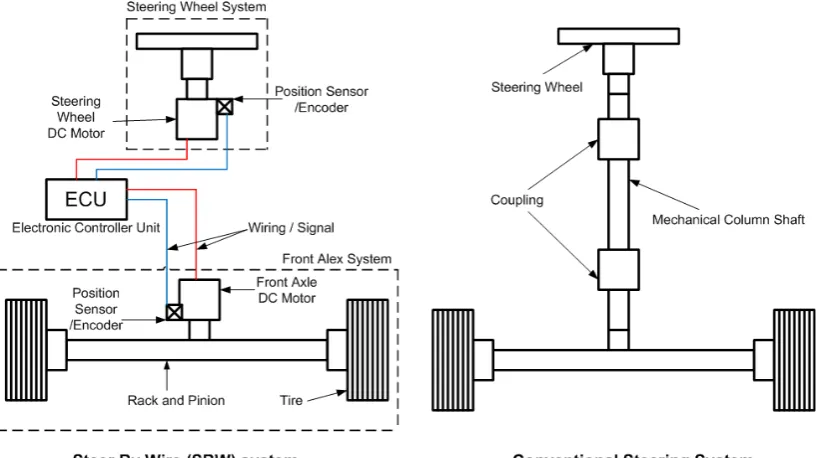
Figure 1.1:Different between Steer by Wire (SBW) and Conventional steering system
compartment. The most significant benefit of SBW system is the ease of integration with the active steering control and suspension system [43,44] which allows significant enhancement of vehicle stability, rollover and maneuverability [45–56]. Furthermore, the transmission delay between steering wheel and front tires potential to be controlled [57]. There are several main characteristics of steering function requirements in a SBW system:
Wheel Synchronization
Wheel Synchronization, also knowns as directional control, is the basic requirement in vehicle steering function of SBW systems. that requires the front tires to follow the driver input command without bias and time delay [58–61].
Variable Steering Ratio (VSR)
Steering Wheel Returnability
A steering wheel should return automatically to the center position once the driver released their hand off the steering wheel [62, 63]. The return rates of steering wheel centering position may vary depending on the vehicle parameters [64].
Steering Feel
In a conventional steering system, the driver directly senses the steering feel when driving. The steering feel is generated from the mechanical contact between the front tire and road surfaces that is transmitted to the driver through the mechanical column shaft. Thus, the driver is able to sense the variations of feel depending on road conditions. The steering feel becomes important to the driver during driving, not only to maintain vehicle directional control but also to the vehicle stability [65]. In an SBW system that has no mechanical column shaft, ot is required to emulate a force feedback similar to a conventional steering system which can be enhanced to the variable steering feel.
1.2 Background of Research
1.3 Problem Statement
In a conventional steering system, the driver directly senses the steering feel during maneuver. This is due to the force feedback generated from the contact between the tire and road surface directly transmited through a mechanical column shaft to the driver. However, since the mechanical column shaft is eliminated in the SBW system, it is necessary to generate a force feedback with torque control for the driver steering feel. This allows the driver to sense stiffness and softness on the steering wheel in order to ensure that the driver has more confidence level when driving. Furthermore, the force feedback is used to make the steering wheel return to center position when drivers release their hand from the steering wheel.
Several researchers have studied several methods to create the force feedback with torque control. Typically, the torque sensor is attached to the rack and pinion system directly measures the torque. However, since the torque sensor is an expensive component and has high maintenance cost, several studies have proposed torque control method using an observer to estimate the force feedback. Unfortunately, the development of an observer requires the exact model of the vehicle steering system, which is difficult. Thus, it is a challenge to generate a robust force feedback method in a torque control system with lower cost and has similar performance as using the force feedback with a torque sensor.
1.4 Research Objectives
The primary objectives of this studies are described the following:
1. To develop the force feedback for torque estimation control algorithm, variable steering ratio and wheel synchronization in a vehicle SBW system.
2. To study, analyze and investigate the performance of the proposed control algorithm and compare with a conventional steering system.
3. To validate the effectiveness of the proposed control algorithm using HIL methodology.
1.5 Limitation and Scope of Study
The limitation and scope of research covers the following activities:
• The focus is given on generate a force feedback with torque control.
• A current measurement technique is used to estimate the torque at steering wheel and front axle motor.
• The steering wheel rig is designed and constructed to verify the effectiveness of the propose force feedback with torque control algorithm.
1.6 Significance of Study
The driver steering feel is generated by a force feedback whereby it is an important role for driver steering feel during manoeuvres. It does not only maintain the steering directional control but also provides more confidence level for drivers during manoeuvre. Therefore, in an SBW system, it is necessary to generate the force feedback with torque control that is able to counteract an external disturbance for a driver steering feel.
a few studies focused on controlling the torque at various speeds with disturbance. Furthermore, most of the researches used a complex mathematical model to generate a force feedback whereby it has increased the potential on increase the number of faults happening due to the high processing and a limited ECU capacity.
The finding of this studies will contribute to the development of a force feedback system with torque control using current measurement method for a driver steering feel in SBW systems. For the automotive manufacturers, the use of the current measurement will reduce the complexity to generate the force feedback as well as reducing the cost and for assembly and a testing process. For the researches, this study will help them recover the critical area and gains knowledge to improve the control technique. Therefore, this study is deemed significant to generate the force feedback for SBW system with the following reasons:
• Current Sensor
The method of direct current measurement is used to generate a force feedback control with torque estimation instead of using a torque sensor.
• Torque control
An appropriate torque control algorithm is used to adequately control the steering torque response at various speed with a disturbance that will improve the driver steering feel.
• Complex mathematical model
A complex mathematical model will be simplified to reduce a number of complexities and provides a diverse control algorithm.
1.7 Methodology
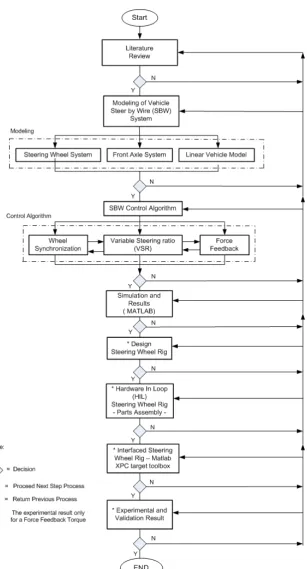
The flow of the research methodology conducted in this thesis is shown in Figure 1.2.
Then, the SBW system subsystem is modeled whereby it is composed of steering wheel system, front axle system and single track linear vehicle model. The steering wheel system contains the steering wheel motor, while the front axle system is related to the front axle motor, rack pinion system and steering linkage system. Furthermore, the single tracks linear vehicle model is modeled based on two degree of freedom (DOF) which is a yaw rate and body slip angle. On the other hand, the stability characteristic of each subsystem is defined using pole- zero map function to investigate the stability response. This is done using Matlab tools software.
After the SBW subsystem is modeled, the control algorithm of each steering function is proposed. For wheel synchronization, two methods are proposed which is using a PID and LQR controllers. Both controllers then are compared to analyze a better steering response. Meanwhile, for VSR function to improve a vehicle manoeuvre at low and high speed, two methods are proposed, which is the hyperbolic tangent and linear equation. Both method are based on the steering wheel angle and vehicle speed function. Meanwhile, for the force feedback with torque estimation control, two methods are proposed. The first method is based on the PID with Fuzzy (PID+Fuzzy) system and the second method is based on LQR with a gain scheduling (LQR+GS). The potential elements to generate a force feedback are taken into account for both methods to provide a realistic driver steering feel with appropriate torque control technique applied. Then, the effectiveness of the proposed control algorithm is simulated using Matlab tools software and the results are compared with EPS system and torque map for force feedback response. The analyses with justification for each proposed control methods are defined.
1.8 Thesis Contribution
The outcome of this study can be summarized into two major contributions and two minor contributions in a vehicle steer by wire (SBW) system which is a force feedback with torque estimation control and a variable steering ratio.
1.8.1 The Force feedback for torque estimation and control algorithm
A Force Feedback using PID + Fuzzy system
The force feedback is based on the element from the torque of front axle motor and the estimation of self aligning torque. The torque of front axle motor is measured using direct current measurement technique. Meanwhile, the self aligning torque is estimated based on the vehicle dynamics response which is yaw rate and body slip angle. By using these elements, it is able to generate a force feedback for realistic driver steering feel. Meanwhile, the reference model is used to improve the centering steering wheel position based on steering stiffness parameter. In order to control the torque and able to counteract external disturbances, PID controllers with fuzzy system are used. The fuzzy system consisted of steering wheel angle and vehicle speed. The control algorithm is validated using hardware in the loop (HIL) methodology using Matlab software tools and the responses are compared with Electric Power Steering(EPS) system.
A Force Feedback using LQR + Gain Scheduling
1.8.2 The Variable Steering Ratio (VSR)
Variable steering ratio using hyperbolic tangent
The main function of VSR is to improve vehicle maneuver at lower and high speed maneuver. The hyperbolic tangent concept achieves the VSR function only at low speed maneuver. While, at medium and high speed it acts as fixed steering ratio. The concept is based on vehicle speed parameter with the gain of the hyperbolic function fixed.
Variable steering ratio using linear equation
For an approach using a linear equation, it achieves the function of VSR whereby it improves vehicle maneuver at low and high speeds. The concept is based on the steering wheel angle and vehicle speed parameter. The gain can be designed for a better response. The gain is increased at high speed to increase a steering ratio and is decreased to reduce a steering ratio at low speed. These improve vehicle stability at high speed and reduce driver burden at low speed especially during parking.
1.9 Thesis Outline
This thesis is organized as follows:
• Chapter 1 is the introduction. Then, it follows up with a problem statement, research objectives, scopes of the study, methodology of research, contributions and the overall outline of the thesis.
• Chapter 2 explains the detail and work from previous literature review that involved the wheel synchronization, variable steering ratio and the force feedback and torque estimation control algorithm for the SBW system
• Chapter 3 explains and models the SBW subsystem which consists of steering wheel system, front axle system and single track linear vehicle model. The stability of each subsystem is defined and discussed.
• Chapter 5 explains the designed and constructed steering wheel rig to validate the effectiveness of the proposed force feedback control algorithm. This is done by interfacing using Matlab - XPC target software. The experimental result is analyzed discussed and compared to EPS system.
• Chapter 6 describes the conclusion of the overall thesis which consists of literature review, control algorithm, simulation and experiment results. The final decisions of each control algorithm are defined and discussed. Further works are also discussed in this chapter.
1.10 Published Works, Patent and Awards
The following related research works that have been published in this thesis:
S.M.H. Fahami, H Zamuri and S.A. Mazlan Development of Estimation Force Feedback Torque Control Algorithm for Driver Steering Feel in Vehicle Steer by Wire System : Hardware in the Loop, International Journal of Vehicular Technology, vol 2015, Article ID 314597, 17 pages, 2015.
S.M.H. Fahami, H Zamuri, S.A. Mazlan and Sarah Atifah Saruchi The Variable Steering Ratio for Vehicle Steer by Wire System Using Hyperbolic Tangent Method, Journal of Applied Mechanics and Materials, Vol.575, pp.781-784, June 2014
S.M.H. Fahami, H Zamuri, S.A. Mazlan and N. Zulkarnain The Design of Vehicle Active Front Steering Based on Steer by Wire System, Journal of Advanced Science Letters, Vol.19, pp.61-65. Jan.2013.
S.M.H. Fahami, H Zamuri, S.A. Mazlan and Zakaria, M.A.Modeling and Simulation of Vehicle Steer by Wire System, IEEE Symposium Science Humanities and Engineering Research(SHUSER), Malaysia, DOI: 10.1109/SHUSER 2012.6268992 pp.765-770, 2012.
Sheikh Muhammad Hafiz Fahami, Hairi Zamzuri, Saiful Amri Mazlan, Wira Jazair “A Method for Controlling Vehicle Steer by Wire system ” Patent No: P12014700692, September 2014.
Bronze Medal “The Virtual Force Feedback Torque Control for Vehicle Steer by Wire (SBW) system in Industrial Arts and Technology Exhibition (INATEX ) 2013 on Sustainable Commercialization Through Innovative Research and Development 2013
1. Fahami, S. M. H., Zamzuri, H. and Mazlan, S. A. Development of Estimation Force Feedback Torque Control Algorithm for Driver Steering Feel in Vehicle Steer by Wire System: Hardware in the Loop. International Journal of Vehicular Technology, 2015. 2015(Article ID 314597): 17pages.
2. Sarah, A. S., Zamzuri, H., Mazlan, S. A., Fahami, S. M. H. and Zulkarnain, N. Wheel Synchronization Control in Steer-by-Wire Using Composite Nonlinear Feedback. Journal of Applied Mechanics and Materials, 2014. 575: pp.762–765.
3. Philip, K. and Eckrich, M. Active Steering - The BMW Approach Toward Modern Steering Technology. SAE Technical Paper Series, 2004-01-1105. 4. Se-Wook.OH, Chae, H. C., Yun, S. C. and Han, C. S. The Design of a
Controller for the Steer by Wire System. JSME International Journal Series, 2004. Vol.47(3): pp.896–905.
5. Shoji, A., Hiroshi, K. and Takeuchi, S. Development of SBW system with force Feedback using a disturbance observer. Steering & Suspension Technology Symposium:Steering, SAE Technical Paper Series 2004 World Congress, Detroit, Michigan, 2004. 01-1100.
6. Yixin, Y. Vehicle Steer by Wire System Control. SAE Technical Paper, 2006. 01-1175.
7. S.Kimura, M.Segawa, T.Kada and S.Nakano. Research on Steering Wheel Control Strategy as Man Machine interfaced for steer by wires system. Koyo Engineering Journal English Edition, 2005. 166E: pp.29–33.
8. Segawa.M, Kada.T.S and Nakona. A study of reactive torque control for steer by wire system. In Proceedings of the International Symposium on Advanced Vehicle Control (AVEC), Hiroshime, Japan, 2002: pp.653–658.
9. Sven, Johannes and Sasol. Modelling and Control of a Steer-By-Wire Vehicle. Vehicle System Dynamics: International Journal of Vehicle Mechanics and Mobility, 2007: pp.114–142.
system using bond graph. IEEE International Conference on Vehicular Electronics and Safety, Xian, China, 2005: 7–11.
11. Hai.W, Man, Z., Kong, H. and Shen, W. Terminal sliding mode control for steer-by-wire system in electric vehicles. 7th IEEE Conference on Industrial Electronics and Applications (ICIEA), Holiday Inn, Singapore, 2012: 919– 924.
12. T.Kaufmann, S.Milsap, B.Murray and J.Petrowski. Development Experience with Steer by Wire. SAE Technical Paper Series, 2001-01-2479.
13. Abhjit, B., R.Wagner, J., Darren M.Dawson, D. B. and Setlur, P. An On Adjustable Steer by Wire Haptic Interface Tracking Controller for Ground Vehicles. IEEE Transaction Vehicular Technology, 2009. 58: pp.546–554. 14. Haggag, S., Alstrom, D., Cetinkunt, S. and Egelja, A. Modeling, control, and
validation of an electro-hydraulic steer-by-wire system for articulated vehicle applications. Mechatronics, IEEE/ASME Transactions, 2005. 10(6): pp.688 – 692.
15. Peter, D. and Gerhard, R. Electric Power Steering - The First Step on the Way to Steer by Wire. SAE Technical Paper Series, 1999-01-0401.
16. Rath, M., Kelly, M., Kober, K. and Gulati, A. Optimum Design of a Steer by Wire System using Systematic System Engineering Approach.SAE Technical Paper Series, 2008-01-1452.
17. Kumar, E. and Kamble, D. D. N. An Overview of Active Front Steering System. International Journal of Scientific Engineering Research, 2012. Vol.3, Issue 6.
18. Zhang, L., Wang, L. and Liao, C. Reliability Research for Steer-by-Wire System of Electric Vehicle. Power and Energy Engineering Conference, APPEEC 2009. Asia-Pacific, Wuhan, China, 2009: pp.1–4.
19. Arasan, S. T., Midhun, V. and V. Subburaj, a. P. J. Design of Controller for Fundamental Steer-by-wire system. SAE Technical Paper, 2003-28-0013. 20. Yu, Q., Zaimin, Z., Xinjian, W. and Xinbo, C. Research on
Steer-by-wire principle and the realization of Steer-by-wire system. International Conference on Electric Information and Control Engineering (ICEICE),Wuhan, China, 2011. 2: pp.5269–5272.
22. Bertoluzzo, M., Buja, G., Menis, R. and Sulligoi, G. Approach to steer-by-wire system design. IEEE International Conference on Industrial Technology,(ICIT), Hong Kong, China, 2005: pp.443–447.
23. Bertoluzzo, M., Buja, G. and Menis, R. Control schemes for steer-by-wire systems. Industrial Electronics Magazine, IEEE, 2007. 1(1): pp.20–27. 24. Verschuren, R. and Duringhof, H. Design of a Steer-by-Wire Prototype. SAE
Technical Paper, 2006-01-1497.
25. Heitzer, D. and Seewald, A. Development of a Fault Tolerant Steer-By-Wire Steering System. SAE Technical Paper, 2004-21-0046.
26. S.Feick, M.Pandit, Zimmer, M. and Uhler, R. Steer-by-Wire as a Mechatronic Implementation. SAE Technical Paper, 2000-01-0823.
27. Pimentel, J. An Architecture for a Safety-Critical Steer-by-Wire System.SAE Technical Paper, 2004-01-0714.
28. D., W. Steer-by-wire system based on FlexRay protocol.Applied Electronics, AE 2009, 2009: pp.269–272.
29. Daher, N. and Ivantysynova, M. A Steer-by-Wire System that Enables Remote and Autonomous Operation. SAE Technical Paper, 2014. 01(2404). 30. Ukaew, A. Model Based System Design of Conceptual Drive-by-Wire ECU
Functions for Electric Vehicle Conversion.SAE Int.J.Passeng.Cars Electron. Electr.Syst., 2013-01-0426.
31. Guvenc, B. and Guvenc, L. Robust steer-by-wire control based on the model regulator. Proceedings of the 2002 International Conference on Control Applications, Glasgow, UK, 2002. 1: pp.435 – 440.
32. Zanten, A. Evolution of electronic control system for improving the vehicle dynamic behaviour. In Proceedings of the International Symposium on Advanced Vehicle Control (AVEC), 2002.
33. Wang, H., Kong, H., Man, Z., Tuan, D. M., Cao, Z. and Shen, W. Sliding Mode Control for Steer-by-Wire Systems With AC Motors in Road Vehicles. IEEE Transactions on Industrial Electronics, 2013. 61(3): pp.1596–1611.
34. Fahami, S. M. H., Zamzuri, H., Mazlan, S. A. and Zakaria, M. A. Modeling and Simulation of Vehicle Steer by Wire System. IEEE Symposium Science Humanities and Engineering Research (SHUSER), Kuala Lumpur, Malaysia, 2012: pp.765–770.
Methodology for Steer by Wire Systems. SAE Technical Paper Series, 2004-01-1106.
36. Y.Shengbing. Study on Control Strategy of Steer by Wire System. Wuhan University of Technology, 2008.
37. Jang, S.-H., Park, T.-J. and Han, C.-S. A control of vehicle using steer-by-wire system with hardware-in-the-loop-simulation system. IEEE/ASME International Conference on Advanced Intelligent Mechatronics, Kobe, Japan, 2003. 1: pp.389–394.
38. Oncu, S., Guvenc, L., Ersolmaz, S., Ozturk, N., S. Kilic and M., S. Steer-by-Wire Control of a Light Commercial Vehicle Using a Hardware-in-the-Loop Test Setup. SAE Technical Paper, 2007-01-4198.
39. Harter, W., Pfeiffer, W., Dominke, P., Ruck, G. and Blessing, P. Future Electrical Steering Systems : Realizations with Safety Requirements. SAE Technical Paper Series, 2006-01-0822.
40. Chaaban, R. N. B. B., K. and Saudrais, S. Model-based development of an embedded steering-by-wire system. 8th International Symposium on Mechatronics and its Applications (ISMA),American University of Sharjah Sharjah, UAE, 2012: 1–6.
41. Langenwalter, J. Embedded automotive system development process - steer-by-wire system. Proceedings Design, Automation and Test in Europe, Munich, German, 2005. 1: 538–539.
42. Chen. Xinbo, Y., Li.Nie and Duonian, Q. The independent steer-by-wire system of the omni-directional EV and its Fault-Response-System. International Conference on Electric Information and Control Engineering (ICEICE), Wuhan, China, 2011: 5507–5509.
43. Samin, P. M., Jamaluddin, H., Rahman, R. A., Hudha, K. and Abu Bakar, S. A. Semi-Active Suspension Control to Improve Ride and Handling with Magnetorheological(MR)Damper.International Journal of Engineering Systems Modelling and Simulation, 2011. Vol.3(3): pp.99–111.
44. yan, Y. L. and li, Y. P. Motor motion control of automobile Steer-by-Wire system in electric vehicles. IEEE Vehicle Power and Propulsion Conference, Michigan, USA, 2009: pp.1502–1505.
46. Seda, P. O. Modeling and Simulation of Active front Steering System. Academic Journal Scientific Research and Essays, 2012. 7(41): pp.3479– 3486.
47. Fahami, S. M. H., Zamzuri, H., Mazlan, S. A. and Noraishikin. The Active Front Steering System based on Vehicle Steer by Wire system. Journal of Advance Science Letter, 2013. 19(1): pp.61–65.
48. Wei, Y., Fu, R., Guo, Y. and Zhu, Y. Simulation and Optimization of Angle Characteristics Model for Steer by Wire system. Seventh International Conference on Fuzzy System and Knowledge Discovery, Shandong, China, 2010.
49. Hosaka, M. and Murakami, T. Yaw rate control of electric vehicle using steer-by-wire system. The 8th IEEE International Workshop on Advanced Motion Control, Kawasaki, Japan, 2004: pp.31 – 34.
50. Cesiel, D., C.Gaunt, M. and Daugherty, B. Development of a Steer-by-Wire System for the GM Sequel. SAE Technical Paper, 2006-01-1173.
51. Hac, A., Doman, D. and Oppenheimer, M. Unified Control of Brake- and Steer-by-Wire Systems Using Optimal Control Allocation Methods. SAE Technical Paper, 2006-01-0924.
52. Park, Y. and Jung, I. Semi-Active Steering Wheel for Steer-By-Wire System. SAE Technical Paper, 2001-01-3306.
53. Janbakhsh, A. A. and Kazemi, R. A new approach to enhance vehicle maneuverability performance using SBW system. Proceeding of ISIE 2009 IEEE International Symposium on Industrial Electronics, Seoul, Korea, 2009.
54. Janbakhsh, A. A. and Kazemi, R. A New approach for simultaneous vehicle handling and path tracking improvement through SBW system. Proceeding of International Conference ASME, Phoenix, Arizona, USA, 2010.
55. M.B., B., S.P., S. and M., R. Investigations on vehicle rollover prevention using steer-by-wire system. International Conference on Control Communication and Computing (ICCC),Thiruvananthapuram, India, 2013: pp.378–383.
56. Fankema, S. and Mllerb, S. A new model to compute the desired steering torque for steer-by-wire vehicles and driving simulators. Journal of Mechanical Science and Technology, 2014: pp.251–271.
2012. URL http://www.reuters.com/article/2012/10/17/ us-nissan-technology-idUSBRE89G03A20121017.
58. Wang, H., Man, Z., Kong, H. and Shen, W. Terminal sliding mode control for steer-by-wire system in electric vehicles. 7th IEEE Conference on Industrial Electronics and Applications (ICIEA), Holiday Inn Singapore Orchard City Centre Singapore., 2012: pp.919–924.
59. Chen, H., Yu, Q., Zhu, L. and Chen, G. Study on Steering by WireController Based on Improved H Algorithm. International Journal of Computer Science,, 2013. 10(2: pp.375–380.
60. Jang, S. H., Park, T. J. and Han, C. S. A control of vehicle using steer-by-wire system with hardware-in-the-loop-simulation system. IEEE/ASME International Conference on Advanced Intelligent Mechatronics, Kobe, Japan, 2003. 1: pp.389–394.
61. Y, Y. and T, M. Adaptive Control for Virtual Steering Characteristics on Electric Vehicle Using Steer-by-Wire System. IEEE Transactions on Industrial Electronics, 2009. 56(5): pp.1585–1594.
62. Hong, T. and Park, K. A New Steering Wheel Returnability Control Strategy for On-Center Handling Performance.SAE Technical Paper Series, 2011-28-0079.
63. Jang, B., Yi, K., Jung, C., Lee, J., Cha, Y. J., Park, J. and Park, J. Correlation of Subjective and Objective Measures of On-Center Handling.SAE Technical Paper Series, 2014-01-0128.
64. Heathershaw, A. Developments in On-Centre Steering Evaluation and Testing. SAE Technical Paper Series, 2006-01-0796.
65. A, O., Messaoudene, K. and Mammar, S. Dynamic model of steer-by-wire system for driver handwheel feedback. 10th IEEE International Conference on Networking, Sensing and Control (ICNSC),Evry University, France, 2013: pp.780–785.
66. Nissan, M. C. Nissan Pioneer First - Ever Independent Control Steering Technology, 2012. URL http://www.nissan-global.com/EN/ NEWS/2012/_STORY/121017-02-e.html.
67. Downtown, N. Nissan’s Steer-by-Wire Technology Due for 2013 Infiniti Production, 2013. URLhttp://www.nissandowntown.ca/about_ us/news_and_events/nissans_steerbywire_technology_
68. Hiroki, O. and Murakami, T. A stability Control by Active Angle Control of Front Wheel in a Vehicle System. IEEE Transaction on Industrial Electronics, 2008. 55(3): pp.1277–1285.
69. Reza, K., Mousavinejad, I., Rafat, M. and Khaknejad, M. B. Yaw Moment Control of the Passenger Car via Steer by Wire System. Proceedings of the International Mechanical Engineering Congress Exposition ASME 2011, Colorado, USA, 2011. (62474): pp.1–9.
70. Yih, P. and Gerdes, J. Modification of vehicle handling characteristics via steer by wire. IEEE Transaction on Control System Technology, 2005. 13(6): pp.965–976.
71. Manh, T. D., Man, Z., Zhang, C., Wang, H. and Tay, F. S. Robust Sliding Mode-Based Learning Control for Steer-by-Wire Systems in Modern Vehicles. IEEE TRANSACTIONS ON VEHICULAR TECHNOLOGY, 2014. 63: pp.580–590.
72. Z.Man, S.Khoo, X.Yu and J.Jin. A new sliding mode-based learning control scheme. Industrial Electronics and Applications (ICIEA), 6th IEEE Conference, Beijing, China, 2011: pp.1906191.
73. Emre, A., Adli, M., Barkana, D. E. and HalukKucuk. Compliant Control of Steer-by-Wire Systems. IEEE/ASME International Conference on Advanced Intelligent Mechatronics Suntec Convention and Exhibition Center, Singapore, 2009: pp.636–643.
74. A.E.Cetin, M.A.Adli, D.E.Barkana and H.Kucuk. Compliant control of steer by wire system. In Proceedings IEEE/ASME Int. Conf. Adv.Intell. Mechatronics,Singapore, 2009: pp.636–643.
75. Zou, F., Song, D. and abd Bin Yuan, Q. L. A New Intelligent Technology of Steering-by-Wire System by Variable Structure Control with Sliding Mode. JCAI,International Joint Conference on Artificial Intelligence, California, USA, 2009: pp.857–860.
76. Wei, J., Shi, G. and Lin, Y. Design of new variable steering ratio for mechanical active steering system. IEEE International Conference on Vehicular Electronics and Safety (ICVES),Dongguan, China, 2013: pp.27– 30.
77. Azzalini, M., Gissinger, G., Boussouar, V. and Coutant, P. Computation of a variable steering ratio with a fuzzy logic method. IEEE Intelligent Vehicle Symposium, Versailles, France, 2002: pp.259 – 267.
Steering Ratio for Vehicle Steer by Wire System Using Hyperbolic Tangent Method. Journal of Applied Mechanics and Materials, 2014. 575: pp.781– 784.
79. Geng, S. F., Feng, P. Q. and Fang, W. L. The Research of Steer by Wire System based on Fuzzy Logic Control. Journal of Applied Mechanics and Materials, 2011. 55-57: pp.780–784.
80. Jiang-Yun, Y., Feng, K. and Fang-Yuan, W. Control Strategy for Front Wheel Angle of Steer by Wire based on Variable Steering Ratio. IEEE 2011 International Conference on Computer Science and Network Technology, Harbin,China, 2011: pp.852–856.
81. Yuan, W., Fu, R., Guo, Y. and Zhu, Y. Simulation and Optimization of Angle Characteristics Model for Steer by Wire System. 2010 Seventh International Conference on Fuzzy System and Knowledge Discovery,Shandong,China, 2010: pp.931–935.
82. Yasuo, S., Kawai, T. and Yuzuriha, J. Improvement in Driver-Vehicle System Performance by Varying Steering Gain with Speed and Steering Angle: VGS (Variable Gear-ratio Steering System). SAE Technical Paper Series 1999-01-0395, 1999-01-0395. 01.
83. Seda, P. O. Modeling and Simulation of Active Front Steering System. Academic Journal of Scientific Research and Essays, 2012. 7(41): pp.3479 – 3486.
84. Feng, T. Vehicle Lateral Control for Driver Assistance and Automated Driving. Phd thesis University of California, Mechanical Engineering, 2000. 85. Jenq, H. S. and Chang, I. H. Design of variable transmission of Steering system. 19th Conference on Mechanical Engineering, Tehran, Iran, 2002: pp.1159 –1166.
86. Kim, C., Jang, J.-H., Oh, S.-K., Lee, J. and Hedrick, J. K. Development of a control algorithm for rack actuating steer by wire system using road information feedback. Journal of Automobile Engineering, 2008. 222: pp.1559–1571.
87. Dirk, O., Bunte, T., Heitzer, H.-D. and Eicker, C. How to make Steer by Wire Feel like Power Steering. Proceedings of 15th IFAC World Congress Barcelona, Spain, 2002.
89. Hsiaohsiang, N., Zong, C. and Hu, D. Investigations on Cornering Control Algorithm Design and Road Feeling Optimization for a Steer-by-Wire Vehicle. Proceedings of the 2009 IEEE International Conference on Mechatronics and Automation,Changchun,China, 2009: pp.3246–3251.
90. C.Zong, L.Mai, D.Wang and Y.Li. Study on steering effort preference of drivers based on driving simulator. Chinese Journal of Mechanical, 2007. 18(8): pp.10011005.
91. Joshua, P., Rossetter, E. J., A.Coe, I. and Gerdes, J. HandWheel Force Feedback for Lane Keeping Assistance: Combined Dynamics and Stability. ASME Journal of Dynamic Systems, Measurement and Control, 2006. 128: pp.532–542.
92. Yao.Y.X, Darouch.M and Schaefers.J. Robust H-infinity estimator Design for linear uncertain system.Journal of Automobile Engineering, 1994: pp.3568– 3569.
93. N.Bajcinca, R.Cortesao, M.Hauschild, J.Bals and G.Hirzinger. Haptic Control for Steer by Wire Systems. Intelligent Robots and Systems,(IROS 2003). Proceedings IEEE/RSJ International Conference, Las Vegas, USA, 2003. 2: pp.2004–2009.
94. Zheng, B., Altemare.C and Anwar.S. Fault tolerant steer by wire road wheel control system. American Control Conference, Proceedings, St.Louis, Missour, 2005. 3: pp.1619–1624.
95. Ryo, M., Hoshino, H. and Hori, Y. Ergonomic Verification of Reactive Torque Control Based on Driver Sensitivity Characteristics for Active Front Steering. IEEE Vehicle Power and Propulsion Conference, 2009: pp.160– 164.
96. Ba, H. N. and Ryu, J. H. Direct Current Measurement Based Steer by Wire System for Realistic Driving Feeling. IEEE International Symposium on Industrial Electronics (ISIE),Seoul, Korea, 2009: pp.1023–1028.
97. Ruriko, K., Kurata, F. and Yamamoto, M. Experimental Study of Lateral Acceleration Feedback Control with Steer by Wire System. SAE Technical Paper Series, 2010. 01(0996).
98. Toshihiro, H., Nishihara, O. and Kumamoto, H. Steering Reactive Torque Presentation Method for a Steer-By-Wire Vehicle -Feedback of a Lateral Acceleration at a Center of Percussion with Respect to Rear Wheels. Review of Automotive Engineering, 2008. 29: pp.287–294.
Cristina, I. and Fabio, T. Design of an Adaptive Feedback Based Steering Wheel.Ergonomics and Health Aspects of Work with Computers, 2007. 4566: pp.180–188.
100. Pei, S. H. Control Concepts for lateral vehicle Guidance Including HMI Properties. IEEE International Conference on Systems, Man and Cybernetics, Hague, Netherlands, 2004. 1: pp.1–6.
101. A.Rodriguez, A., H.Sira-Ramirez and J.A.Garcia-Antonio. A Vehicle Haptic Steering by Wire System Based on High Gain GPI Observers. Mathematical Problems in Engineering, 2014: 14 pages.
102. J.Han. From the PID to Active Disturbance Rejection Control. IEEE Transaction on Industrial Electronics, 2009. 56(3): pp.900–906.
103. Guangzheng, G., Chen, H., Lou, L. and Nakano, S. Torque Feedback Control for the Hand-Wheel Actuator of SBW Based on Active Disturbance Rejection Controller. Proceedings of the FISITA 2012 World Automotive Congress, China, 2012. 198: pp.391–403.
104. Ryouhei, H., Kawaharaa, S., Nakanoa, S. and Kumamotob, H. Resistance torque control for steer-by-wire system to improve humanmachine interface. Journal of Vehicle System Dynamics, 2010. 48,No.9: pp.10651075.
105. Shengbing, Y., Chunan, D., Xuewu, J. and Kuiyuan, C. Research on Road Feeling Control Strategy of Steer-by-Wire. SAE Technical Paper Series, 2007-01-3652.
106. C.T.Lee and B.Y.Moon. Study on the damping performance characteristics analysis of shock absorber of vehicle by considering fluid force. Journal of Mechanical Science and Technology, 2005. Vol.19(-): 520–528.
107. Jianmin, D., Ran, W. and Yongchuan, Y. Research on Control Strategies of Steer-by-Wire System. International Conference on Computation Technology and Automation (ICICTA), Changsha, China, 2010. 2: pp.1122– 1125.
108. Fukuda, Y. Slip-Angle Estimation for Vehicle Stability Control. Vehicle System Dynamics: International Journal of Vehicle Mechanics and Mobility, 1999. 32(4-5): pp.375–388.
110. Minghui, L., Yongsheng, Z., Liang, C., Wenruo, W., Jianwei, C. and Lei, Z. Design of Body Slip Angle Observer for Vehicle Stability Control. The 2nd International Conference on Electronic Mechanical Engineering and Information Technology (EMEIT), Liaoning, China, 2012: pp.2357–2361.
111. S.Sahoo, S.C.Subramanian and Srivastava, S. Design and implementation of a controller for navigating an autonomous ground vehicle. In Proceedings of the 2nd International Conference on Power, Control and Embedded Systems (ICPCES 12),IEEE, Allahabad, India, 2012. -(-): 1–6.
112. T.D.Gillespie. Fundamentals of Vehicle Dynamics. Society of Automotive Engineers, 1992. -(-): –.
113. Santosh, A., Baviskar, A., R.Wagner, J. and M.Dawson, D. Ground Vehicle Steering system; modeling control and analysis of hydraulic,electric and steer by wire Configure. International Journal of Vehicle Design, 2007. Vol.44(1/2): pp.188–208.
114. Yasuo, S., Kawai, T. and Yuzuriha, J. Improvement in Driver-Vehicle System Performance by Varying Steering Gain with Vehicle Soeed and Steering Angle: VGS (Variable Gear Ratio Steering System). SAE Technical Paper Series, 1999-01-0395.
115. Yao, J.-Y., Feng, K., Fang, W. and Yuan. Control Strategy for Front Wheel Angle of Steer by Wire Based on Variable Steering Ratio. International Conference on Computer Science and Network Technology (ICCSNT), Harbin, China, 2011.
116. Tajima, J., Yuhara, N., Sano, S. and Takimoto, S. Effects of Steering System Characteristics on Control Performance from the Viewpoint of Steer-by-Wire System Design. SAE Technical Paper, 1999-01-0821.
117. Klier, W., Reimann, G. and Reinelt, W. Concept and Functionality of the Active Front Steering System. SAE Technical Paper, 2004. 2004-21-0073. 118. Zhai, P., Du, H. and Li, Z. Bilateral control of vehicle Steer-by-Wire system
with variable gear-ratio. 8th IEEE Conference on Industrial Electronics and Applications (ICIEA), Melbourne, Australia, 2013: 811–815.
119. Serarslana, B. New approaches to enhance active steering system functionalities: preliminary results. Journal Vehicle System Dynamics, 2014. 52(9): pp.1153–1170.
121. Oufroukh, A., Messaoudene, N. and S., M. Dynamic model of steer-by-wire system for driver handwheel feedback. 10th IEEE International Conference on Networking, Sensing and Control(ICNSC), Evry, France, 2013: 780–785.
122. Groll, M. V., Mueller, S., Meister, T. and Tracht, R. Disturbance compensation with a torque controllable steering system. Journal Vehicle System Dynamics, 2007. 44(4): pp.327–338.
123. Ozaki, I. J., F, M. and S., K. Design of steer-by-wire system with bilateral control method using disturbance observer. IEEE/ASME international conference on Advanced intelligent Mechatronics,Zurich, Switzerland, 2007: 1–6.
124. Roland, P., A.Naya, M., A.Perez, J. and Cuadrado, J. Geared PM coreless motor Modeling for driver force feedback in steer by wire system. Journal of Mechatronics, 2011: pp.1043–1054.
125. Zamzuri, H., Zolotas, A. and Goodall, R. Intelligent control approaches for tilting railway vehicles. Vehicle System Dynamics, 2006. 44(S1): pp.834– 843.
126. Zhou, Y., shan Liu, M., shuang Hu, L. and da. Zhang, Z. Application of fuzzy five states control system base on phase plane in steer by wire system of loader.International Conference on Fuzzy Systems and Knowledge Discovery (FSKD),Yantai, China, 2010. 2: pp.649–653.
127. Man, H. L., ha, S. K., Choi, J. Y. and Yoon, K. S. Improvement of the Steering Feel of an Electric Power Steering by Torque Map Modification. Journal of Mechanical Science and Technology, 2005. 19: pp.792–801.
128. Tong, J. P., Han, C. S. and Lee, S. H. Development of the electronic control unit for the rack-actuating steer by wire using the hardware in the loop simulation system. Journal of Mechatronics, 2005. 8: pp.899918.
129. Yandong, H., He, L., XiangWang and Zong, C. Research on Torque Ratio Based on the Steering Wheel Torque Characteristic for Steer-by-Wire System. Journal of Applied Mathematics, 2014. 2014: pp.1–7.
130. Xiang, W., Zong, C., Xiang, H., Hu, R. and Xie, X. Bilateral Control Method of Torque Driver/Angle Feedback Used for Steer by Wire System. SAE Technical Paper Series, 2012. 01(0792): pp.479485.
132. Fankema, S. and Mllerb, S. A new model to compute the desired steering torque for steer-by-wire vehicles and driving simulators. Journal Vehicle System Dynamics, 2014. 52: pp.251–271.
133. Chai, Y. W., Abe, Y., Kano, Y. and Abe, M. A study on adaptation of SBW parameters to individual drivers steer characteristics for improved drivervehicle system performance. Journal Vehicle System Dynamics, 2007. 44: pp.874–882.
134. Kim, N. and J.Cole, D. A model of driver steering control incorporating the driver’s sensing of steering torque. Journal Vehicle System Dynamics, 2011. 49(10): pp.1575–1596.
135. Zhang, X., Xin, Z., Guobiao, S. and Yi, L. Steering Feel Study on the Performance of EPS. IEEE Vehicle Power and Propulsion Conference (VPPC), Harbin, China, 2008. 2004-21-0073: 1–5.
136. Ba-Hai, N. and Ryu, J.-H. Direct Current Measurement Based Steer by Wire system for realistic Driving Feeling. IEEE International Symposium on Industrial Electronics (ISIE), Seoul, Korea, 2009: 1023–1028.
137. Roland, P., A.Naya, M., A.Perez, J. and Cuadrado, J. Geared PM coreless motor Modeling for driver force feedback in steer by wire system. Journal of Mechatronics, 2011. 21: pp.1043 1054.
138. Hope.L.L. A fast Gaussian method for a Fourier transform evaluation. Proceedings of the IEEE, 2005. 63(9): pp.1353–1354.
139. Delic, S. and Juric, Z. Some improvements of the Gaussian elimination method for solving simultaneous linear equations. The 36th International Convention on Information Communication Technology Electronics Microelectronics, Croatia, 2013: pp.96–101.
140. Mangoubi, R., Desai, M. and Sammak, P. Non-Gaussian methods in biomedical imaging. The 37th IEEE Applied Imagery Pattern Recognition Workshop, AIPR ’08, Washington,USA, 2008: pp.1–6.
141. Yang, Z., Guangyu, Z., Yonghong, S., Wei, W. and Xuerong, G. Test Parameters Optimization Based on Newton-Gaussian Method in Analog Signature Analysis. Measuring Technology and Mechatronics Automation (ICMTMA), 2013 Fifth International Conference, Hong Kong, China, 2013: pp.1120 – 1124.