Using Spatio-Temporal Features
by
Adrian Keith Davison
A thesis submitted in partial fulfillment for the
degree of Doctor of Philosophy
Supervised by Dr. Moi Hoon Yap, Mr. Cliff Lansley, Dr. Nicholas
Costen and Dr. Kevin Tan
Faculty of Science and Engineering
School of Computing, Mathematics and Digital Technology
MANCHESTER METROPOLITAN UNIVERSITY
Micro-facial expressions are fast, subtle movements of facial muscles that occur when someone is attempting to conceal their true emotion. Detecting these move-ments for a human is difficult, as the movement could appear and disappear within half of a second. Recently, research into detecting micro-facial movements using computer vision and other techniques has emerged with the aim of outperforming a human. The motivation behind a lot of this research is the potential applica-tions in security, healthcare and emotional-based training. The research has also introduced some ethical concerns on whether it is okay to detect micro-movements when people do not know they are showing them.
The main aim of this thesis is to investigate and develop novel ways of detect-ing micro-facial movements usdetect-ing features based in the spatial and temporal do-mains. The contributions towards this aim are: an extended feature descriptor to describe micro-facial movement namely Local Binary Patterns on Three Orthog-onal Planes (LBP-TOP) combined with Gaussian Derivatives (GD); a dataset of spontaneously induced micro-facial movements, namely Spontaneous Activ-ity of Micro-Movements (SAMM); an individualised baseline method for micro-movement detection that forms an Adaptive Baseline Threshold (ABT); Facial Action Coding System (FACS)-based regions are proposed to focus on the local movement of relevant facial areas.
The LBP-TOP with GD feature was developed to improve on an established feature and use the GD to enhance the facial features. Using machine learning, the method performs well achieving an accuracy of 92.6%. Next a new dataset,
SAMM, was introduced that improved on the limitations of previous sets, includ-ing a wider demographic, increased resolution and comprehensively FACS coded. An individualised baseline method was the introduced and tested using the new dataset. Using feature difference instead of machine learning, the performance in-creased with a recall of 0.8429 on the maximum thresholding and a further increase of the recall to 0.9125 when using the ABT. To increase the relevance of what is being processed on the face, FACS-based regions were created. By focusing on local regions and individualised baselines, this method outperformed similar state-of-the-art with an Area Under Curve (AUC) of 0.7513.
The research into detecting micro-movements is still in it’s infancy, and much more can be done to advance this field. While machine learning can find patterns in normal facial expressions, it is the feature difference methods that perform the best when detecting the subtle changes of the face. By using this and comparing the movement against a person’s baseline, the micro-movements can finally be accurately detected.
Throughout my research and preparation of this thesis, many people have guided my understanding and knowledge that allowed me to form the work presented. Firstly, I would like to thank my Director of Studies, Dr. Moi Hoon Yap, for her kindness, patience and overall confidence in my abilities from the very beginning. I also want to express my utmost gratitude to my other supervisors Mr. Cliff Lansley, Dr. Nicholas Costen and Dr. Kevin Tan, who all provided their own unique perspective in different aspects of my work and contributing greatly when I was in need.
I have received help and advice, directly or indirectly, from my peers and colleagues throughout my study. These people motivated me to share ideas and build relationships to further expand my knowledge. From the Emotional Intel-ligence Academy, Mr. Harry Lansley and Mr. Jordan Lansley. From MMU, Dr. Daniel Leightley, Dr. Choon Ching Ng, Mr. Brett Hewitt, Mr. Ezak Fadzrin, Mr. Connah Kendrick, Ms. Gemma Stringer, Mr. Nadim Baharum and everyone who kindly agreed to participate in my emotional inducement experiment to form the
SAMM dataset. I would also like to thank all the FACS coders who contributed their efforts to code the ground truth for this dataset.
In my first year of study, the administration on my study at MMU was over-looked by Ms. Rita Kenny, who I thank for always being attentive a busy role. Later, the research administration roles were taken over by Ms. Megan Schofield, Ms. Francesca Robinson and Ms. Kristina Ganchenko. As well as always being available to help with a multitude of requests, they were key to helping with the success of the Science and Engineering Research Symposium 2015. Thanks should also go to Dr. Mike Dempsey and Dr. Sam Illingworth for guidance with leading this event.
I would like to thank my friends Ms. Laura Bennett, Ms. Abbie Bywater and Miss. Bethany Woodcock for always being there whenever I needed advice through the high and low points. I would also like to thank Ms. Beth Scott for always
when I was in need.
My most sincere thanks goes to my family, for always believing I could suc-ceed, even when I did not. To my Grandparents, Mr. Keith Butterworth and Mrs. Hazel Butterworth, who have always been available if I need them, and always help me to think positively. To my Mother, Ms. Julie Davison, I am un-able to express how much I want to thank her for always listening and defending me. For always making me laugh, through the difficult times we both have had in the past. Finally, I would like to thank my Father, Mr. Garry Davison, who passed away before he could see me begin this journey, for inspiring me to focus my interest in technology.
I am grateful for MMU for providing the studentship for me to complete this thesis, and provide valuable experience in teaching at a university level.
Abstract i
Acknowledgements ii
List of Figures ix
List of Tables xi
List of Abbreviations xii
List of Publications xv 1 Introduction 1 1.1 Background . . . 1 1.2 Motivation . . . 4 1.3 Problem Statement . . . 5 1.4 Objectives . . . 6 1.5 Contributions . . . 7 1.6 Thesis Organisation . . . 8 2 Literature Review 10 2.1 Introduction . . . 10
2.2 Physiology of the Face and Facial Expressions . . . 11
2.2.1 Face Anatomy . . . 12
2.2.2 The Human Visual System . . . 13
2.3 Universality of Emotion . . . 13
2.3.1 The Facial Action Coding System . . . 14
2.4 Micro-Facial Expressions . . . 16
2.5 Cultural Influences . . . 17
2.6 Analysing Facial Expressions with Computer Vision . . . 17
2.6.1 Facial Expression Analysis . . . 18
2.6.2 Face Acquisition and Preprocessing . . . 19
2.6.3.3 Hybrid Methods . . . 22
2.6.4 Facial Expression Recognition . . . 22
2.6.5 Micro-Facial Expression Analysis . . . 23
2.6.5.1 Face Regions . . . 24
2.6.5.2 State of the Art Micro-Expression Recognition Meth-ods. . . 25
2.7 Micro-Movement Detection. . . 28
2.8 Current Benchmark Datasets . . . 31
2.8.1 Polikovsky Dataset . . . 31 2.8.2 USF-HD . . . 32 2.8.3 YorkDDT . . . 32 2.8.4 SMIC . . . 33 2.8.5 CASME . . . 34 2.8.6 CASME II . . . 35 2.9 Real-World Applications . . . 35 2.10 Research Direction . . . 37 2.11 Summary . . . 38
3 Theories and Techniques 39 3.1 Face Alignment . . . 39
3.1.1 Face Detection . . . 39
3.1.2 Facial Landmark Detection . . . 40
3.1.3 Affine Transformation . . . 42
3.1.4 Piecewise Affine Warping. . . 44
3.1.5 Subpixel Image Alignment via Fast Fourier Transform. . . . 47
3.2 De-noising . . . 49
3.2.1 Smoothing . . . 49
3.2.2 Temporal Noise Reduction . . . 50
3.3 Feature Descriptors . . . 51
3.3.1 Local Binary Patterns . . . 51
3.3.2 Histogram of Oriented Gradients . . . 54
3.3.3 Optical Flow . . . 55
3.3.3.1 Horn-Schunck . . . 56
3.3.3.2 Lucas-Kanade. . . 58
3.3.4 Histogram of Oriented Optical Flow. . . 58
3.3.5 Optical Strain . . . 59
3.4 Methods of Classification . . . 61
3.4.1 Support Vector Machines. . . 62
3.4.2 Random Forests . . . 65
3.5 Feature Difference Measures . . . 66
3.5.1 Sum of Squared Differences . . . 66
3.6 Performance Measures . . . 70
3.6.1 Precision and Recall . . . 71
3.6.2 F-Measure . . . 71
3.6.3 Matthews Correlation Coefficient . . . 71
3.7 Summary . . . 72
4 Micro-Movement Detection: Preliminary Studies 73 4.1 Introduction . . . 73
4.2 Preliminary Investigations . . . 74
4.2.1 Optical Strain . . . 75
4.2.2 Feature Difference Using Sum of Squares . . . 76
4.2.3 3D HOG . . . 78
4.2.4 3D HOG with TIM . . . 79
4.2.5 LBP-TOP with TIM . . . 80
4.3 LBP-TOP with Gaussian Derivative Feature . . . 81
4.3.1 Normalisation . . . 82
4.3.2 Processing Images. . . 83
4.4 Experimental Results and Discussion . . . 84
4.5 Summary . . . 90
5 Spontaneous Activity of Micro-Movements Dataset 92 5.1 Introduction . . . 92
5.2 Experimental Protocol . . . 93
5.2.1 Emotion Inducement Procedure . . . 93
5.2.2 Ethics . . . 94
5.2.3 Equipment and Experimental Set-Up . . . 94
5.2.3.1 Camera . . . 95
5.2.3.2 Lighting . . . 96
5.2.3.3 High-Speed Data Capture . . . 96
5.2.4 Image Noise Considerations . . . 97
5.2.5 Inducement Stimuli . . . 97
5.2.6 Questionnaire . . . 98
5.2.7 FACS Coding - Ground Truth . . . 99
5.3 Dataset Analysis . . . 100
5.3.1 Demographic Breakdown . . . 101
5.3.2 Statistical Analysis . . . 102
5.4 Dataset Validation Tests . . . 104
5.4.1 Results Methodology . . . 104
5.4.2 Results. . . 105
5.5 Comparison with Current Datasets . . . 105
5.5.1 Polikovsky Dataset . . . 106
5.5.5 CASME and CASME II . . . 108
5.6 Summary . . . 108
6 Micro-Movement Detection: Feature Difference Approach 110 6.1 Introduction . . . 110
6.2 Feature Difference. . . 111
6.2.1 Preprocessing . . . 111
6.2.2 Difference Analysis . . . 112
6.3 Individualised Baseline Analysis . . . 113
6.4 Adaptive Baseline Threshold . . . 113
6.5 Experimental Results . . . 115 6.5.1 Measures of Performance . . . 115 6.5.2 Peak Detection . . . 116 6.5.3 Method Comparisons . . . 116 6.5.4 ABT Results . . . 118 6.6 Discussion . . . 119 6.7 Summary . . . 120
7 Local Feature Analysis with FACS-Based Regions 121 7.1 Introduction . . . 121
7.2 FACS-Based Regions . . . 122
7.3 Micro-Movement Region Localisation . . . 125
7.4 Micro-Facial Movement Detection . . . 127
7.5 Experimental Results . . . 129
7.6 Applications . . . 133
7.6.1 Frame Rate Sub-Sampling . . . 133
7.6.2 Movement Localisation . . . 134 7.7 Summary . . . 135 8 Conclusion 137 8.1 Introduction . . . 137 8.2 Research Findings. . . 138 8.3 Future Work . . . 142 8.3.1 Cross-Cultural Analysis . . . 142 8.3.2 Dataset Improvements . . . 142
8.3.3 Real-Time Micro-Movement Detection . . . 143
8.4 Concluding Remarks . . . 143
A Haar Feature Calculation 144
1.1 Thesis structure. . . 7
2.1 Facial muscle anatomy. . . 12
2.2 Posed universal facial expressions. . . 15
2.3 Facial Expression Analysis Pipeline. . . 18
2.4 SMIC Dataset Example. . . 33
2.5 CASME II Dataset Example. . . 35
3.1 Haar eye-based face alignment. . . 40
3.2 83 points detected using Face++. . . 42
3.3 Piecewise affine warping. . . 46
3.4 Gaussian smoothing on an image. . . 49
3.5 LBP image. . . 52
3.6 LBP code calculation. . . 53
3.7 LBP-TOP histogram. . . 53
3.8 HOG feature visualisation. . . 54
3.9 Horn-Schunck Averaging Kernel.. . . 57
3.10 Vector stitching.. . . 60
3.11 Optical strain map. . . 62
3.12 SVM Hyperplane. . . 63
3.13 Temporal phases of peaks. . . 70
4.1 LBP-TOP with GD system summary. . . 74
4.2 Optical strain pattern - AU7. . . 76
4.3 Optical strain plot - AU7. . . 76
4.4 Sum of square results - Eq.1. . . 77
4.5 Sum of square results - Eq.2. . . 78
4.6 LBP visualisation of the mouth. . . 80
4.7 Face split into 9×8 blocks. . . 84
4.8 Random Forest classification accuracy. . . 89
4.9 Weka 3D HOG feature visualisation. . . 90
5.1 Emotion inducement experiment pipeline. . . 94
5.2 Experiment laboratory . . . 95
5.3 High-speed camera. . . 96
6.3 Histogram distance baseline and movement feature. . . 114
6.4 Micro-movement threshold comparison. . . 117
6.5 Baseline feature test. . . 118
7.1 FACS-based region method pipeline. . . 122
7.2 FACS-based region mask. . . 123
7.3 PWA of FACS-based regions. . . 124
7.4 Region mask mapped to a face. . . 125
7.5 Face mapped to region mask. . . 126
7.6 Video cubes and three orthogonal planes. . . 126
7.7 ROC curves for SAMM. . . 131
7.8 ROC curves for CASME II. . . 131
7.9 Micro-movement highlighting. . . 135
A.1 Haar features. . . 144
A.2 Summed area table or Integral Image.. . . 145
2.1 The seven universal emotions. . . 14
2.2 FACS AU groupings. . . 16
2.3 Facial recognition methods. . . 23
4.1 LBP-TOP with TIM confusion matrix (RF trees = 100) . . . 81
4.2 LBP-TOP with TIM confusion matrix (RF trees = 70) . . . 81
4.3 SVM results for micro-expression recognition. . . 86
4.4 RF results for micro-expression recognition. . . 87
4.5 SVM results for only LBP-TOP micro-expression recognition. . . . 88
4.6 RF results for only LBP-TOP micro-expression recognition. . . 88
5.1 Tailored Stimuli Used to Induce Emotions . . . 98
5.2 Experiment questionnaire. . . 99
5.3 Participant Age Distribution . . . 101
5.4 Ethnicity/Race of Participants . . . 101
5.5 SAMM AU occurrence frequency. . . 102
5.6 SAMM reliable AU occurrence frequency. . . 103
5.7 Dataset validation results - LBP-TOP . . . 106
5.8 Dataset validation results - HOG based . . . 106
5.9 Micro-movement dataset summary. . . 106
6.1 Spatial feature difference results. . . 116
6.2 Adaptive Baseline Threshold results. . . 118
7.1 FACS-based region breakdown. . . 124
7.2 FACS region method results. . . 130
7.3 AUC results . . . 130
7.4 Micro-movement method comparison. . . 132
2D 2-Dimensional
3D 3-Dimensional
AAM Active Appearance Model
ABT Adaptive Baseline Threshold
ASM Active Shape Model
AU Action Unit
AUC Area Under Curve
CASME Chinese Academy of Science Micro-Expressions
df Degrees of Freedom
DFT Discrete Fourier Transform
DPM Deformable Part Models
EMFACS EmotionFACS
FACS Facial Action Coding System
fps Frames per Second
FP False Positive
FPR False Positive Rate
FN False Negative
3D HOG 3D Histogram of Oriented Gradients
HOOF Histogram of Oriented Optical Flow
JACFEE Japanese and Caucasian Facial Expressions of Emotion
LBP Local Binary Patterns
LBP-TOP Local Binary Patterns on Three Orthogonal Planes
LED Light Emitting Diode
MDMO Main Directional Mean Optical-flow
METT Micro-Expression Training Tool
MCC Matthew’s Correlation Coefficient
OOB out of bag
PWA Piecewise Affine
SAM Self-Assessment Manikins
SAMM Spontaneous Activity of Micro-Movements
SAT Summed Area Table
SD Standard Deviation
SMIC Spontaneous Micro-Expression Corpus
SVM Support Vector Machines
TIM Temporal Interpolation Model
TP True Positive
TPR True Positive Rate
TN True Negative
RF Random Forests
USF-HD University of South Florida-High Definition]
VBM3D Video Block Matching and 3D filtering
This thesis is based on material from the following publications:
1. Adrian K. Davison, Moi Hoon Yap, Nicholas Costen, Kevin Tan, Cliff Lans-ley, Daniel Leightley (2014), “Micro-facial Movements: An Investigation on Spatio-Temporal Descriptors”, Computer Vision - ECCV 2014 Workshops, Lecture Notes in Computer Science Volume 8926, 2015, pp 111-123.
2. Adrian K. Davison, Moi Hoon Yap, Cliff Lansley (2015), “Micro-Facial Move-ment Detection Using Individualised Baselines and Histogram-Based De-scriptors”, Systems, Man, and Cybernetics (SMC), 2015 IEEE International Conference on, 2015, pp 1864-1869.
3. Adrian K. Davison, Moi Hoon Yap, Nicholas Costen, Cliff Lansley, Kevin Tan (2016), “SAMM: A Spontaneous Micro-Facial Movement Dataset”, IEEE Transactions on Affective Computing. Status: Accepted.
Introduction
This Chapter introduces the research and terms described in the anal-ysis and detection of micro-facial movements. The main terminology used throughout this thesis is defined alongside the problem statement, thesis contributions and the thesis structure.
1.1
Background
Facial image analysis is a well established research area that has produced many novel works in areas such as face detection, facial expression analysis, gender iden-tification, face age estimation and blink recognition [1–4]. Micro-facial movement research is relatively new [5–9] when compared with facial expression analysis. Al-though loosely related due to the facial expression aspect, these two topics should be looked upon as different research problems. The main example of why this is true is facial expressions tend to be large and distinct, whereas micro-facial movements are very quick and subtle muscle movements. Throughout this thesis, many terms are used from previous literature and some new terms to help explain this work are defined. The term micro-facial expressions (and some similar vari-ations) is used in most current work to globally describe the movements from its origins in psychology [10]. Although this term is used in this thesis, it specifically is meant to describe the movement when being related to emotions. For example, if a method uses machine learning to classify the micro-expressions into distinct classes. To follow a more objective approach, the terms micro-facial movements
the face, with no emotional interpretation. This approach treats all movements as their basic muscle activations to avoid assumptions and bias where possible.
The research interest for this work is detecting micro-facial movements. Cur-rent literature has focused on two interpretations of this problem, the first being micro-expression recognition, where machine learning is trained using (limited) micro-expression datasets and then tested to see how well the micro-expression are assigned to emotion-based categories. These usually form simple classes such as positive and negative, or into specific emotion categories like happiness and sur-prise. The second method takes a more objective approach by not using machine learning to determine specific micro-movement patterns. Instead the difference changes in features is calculated, where an increased magnitude of change indicates a movement. The larger the magnitude, the bigger the movement will be. This ap-proach usually forms a binary classification of movement and non-movement, with non-movement being equivalent to the person not activating any facial muscles. This method does not assume any emotional link with the movements, limiting the possibility of automatic interpretation. However, in a real-world environment, people perform micro-movements in so many different ways that modelling each into distinct classes would be unrealistic. Starting with a detection foundation would be beneficial to provide an initial point from which further interpretation can follow.
Although the potential for micro-movement analysis in computer vision is huge, core aspects of development need to be greatly improved to get accuracy rates to match facial expression analysis. Challenges facing this field can include the lack of available datasets, the speed and subtlety of micro-movements and the noise that occurs through digital capture devices, especially through high-speed cameras that are used to capture more information for analysis. Other points are extremely difficult to control, such as head movements being interpreted as micro-movements, consistent lighting and a wide enough demographic of participants in datasets. Finally, all datasets currently available induced participants in a laboratory, as there is currently no ethical procedure to induce micro-movements outside of these controlled conditions.
The current most popular method is to recognise micro-facial expressions using machine learning algorithms. Simple feature descriptors using histogram of oriented gradients [11] and clustering is used to represent Action Unit (AU)
categories, however there is limited data used (13 movements) and posed micro-expressions are used. Other methods use classification learning algorithms, mainly Support Vector Machines (SVM) [12], by extracting features of the face and train-ing based on the output. Another common processtrain-ing method is to split the face into blocks or regions [6,8,9], where local feature are the prime source in extract-ing the features rather than usextract-ing the whole face. Global representations such as these are less suitable for subtle movements occurring in a small portion of the face.
This thesis investigates methods to detect micro-facial movements, in an ob-jective manner, with the potential to be applied into real-world problems. As hu-mans find it difficult to spot micro-movements consistently [13], using computer vision can increase user’s ability to spot through training, or as an aid during situations where a human would struggle to multi-task. Already in security the research behind these hidden signal have been used [14], so applying a system to automatically find these movements would be highly beneficial. Even though most recent application possibilities have been aimed towards security, other areas include studying and improving the lives of people with health problems. Depres-sion can be very debilitating to the point of suicide, and many people who have the illness do not, or cannot, share their feelings. Finding hidden emotions that are involuntarily shown can improve the understanding of health professionals in each individual case. Similarly, a system that detects these movements can train others in how to spot more effectively, and how to better understand people from an emotional point of view.
One of the biggest challenges facing micro-movement detection is the lack of available datasets for validating the algorithms. Current datasets [15–17] have limitations such as a limited demographic (i.e. only using one ethnicity), not many movement examples compared to the facial expression counterpart, and the difficulty to induce micro-facial movements naturally and spontaneously. The fi-nal point is the most difficult to solve. In a real-world environment, micro-facial movements occur when someone attempts to hide their true emotion. Often a high-stakes scenario is required to induce effectively, and only particular triggers for each individual will induce a genuine response. All datasets have been created in a laboratory scenario, where stimuli (usually video clips) are shown to partic-ipants and they are told to only show a neutral face (i.e. do not show a facial expression). Immediately the environment is not natural, and can affect how the
participant reacts to the stimulus. Ideally, people should be filmed without them knowing, and inducement attempted without them realising. Unfortunately, this is constrained by ethical issues on recording people without their knowledge and trying to psychologically manipulate emotions to how you want. Even if this could be done, micro-movements are not guaranteed without the person knowing they have to hide their true feelings. Further, certain emotions, such as anger, are very hard to ethically induce as the consequences of genuinely angering someone could be disastrous.
This Chapter is organised as follows: the current Section and Section 1.2
provide the background and motivation behind this work; Section1.3describes the issues surrounding the work and provides a overall problem statement; Section1.4
states the aim and objectives of this work; Section1.5lists the contributions made by this thesis; finally, Section 1.6 summarises the structure of the thesis.
1.2
Motivation
The fast-growing research area of micro-facial expression analysis is largely driven by the potential of deploying these algorithms to real-world environments. Re-search behind the psychology of micro-expressions has focused on the ability of humans to detect them and then decipher what and why a person felt they needed to try and hide their true feelings. However, humans still struggle to detect micro-expressions in real-world situations where being able to see, remember and inter-pret all micro-expressions would be challenging.
Using a system that can detect micro-expressions or movements would aid the user in reviewing detected micro-movements and help with interpretation. Unfor-tunately, even though a computer assisted system would be better at processing movements, it takes more steps to differentiate between noise and a real micro-movement. Many recent systems try to recognise using machine learning or by using computationally expensive image processing techniques, both of which would not be suitable for applying the system to a real-world environment.
The following points summarise the motivation behind creating an accurate micro-movement detection algorithm:
1. These quick movements have been found to occur when someone is trying to hide their true emotion [10, 18]. When a person attempts to hide their feelings, showing micro-movements cannot be stopped in many cases. Being able to extract this information would be useful for applications in security and deception detection [13,19, 20].
2. It has the potential to help people with health problems such as depres-sion [21] and neurological disorders such as facial paresis [22]. These appli-cations aim to help others who cannot readily identify the problems they are facing day to day.
3. For training humans to understand micro-expressions better by combin-ing technology and previous techniques to allow for improved integration of cross-discipline research [23–25].
1.3
Problem Statement
The nature of an emerging field means that research is limited and tends to be exploratory rather than focused on already established work. In Chapter 2, current methods and algorithms for recognising, classifying and detecting micro-movements are discussed. Many different feature descriptors are used to describe micro-movements in the spatial or temporal domain, and ways of determining if a movement has occurred include machine learning and feature difference analysis.
The main problem faced in the analysis of micro-movements, is how to de-tect a movement that is extremely subtle and fast moving. Many obstacles occur during processing, such as small head movements being mistaken for real micro-movements and the speed being difficult to capture with a typical frame rate of 30 Frames per Second (fps). Further, the amount of datasets, especially compared with normal facial expressions, is very limited due to the difficulty of sponta-neously inducing micro-expressions in a laboratory environment. The lack of a standardised emotional inducement protocol is also a limitation of being able to create these datasets easily.
The logical progression of developing methods of detecting micro-facial expressions or movements is to use techniques already established in fa-cial analysis. Unfortunately, different feature representations have not
produced similar results for micro-analysis compared with normal facial expression analysis. Machine learning techniques also struggle, as they look for a pattern that exists. Larger facial movements may be quite dis-tinct in their representation in feature space, but the sparsity of micro-movements reduces the classification accuracy of even well-established learning algorithms. A way of objectifying the micro-movements of the face is required, where they are treated as basic facial muscle move-ments, with further interpretation, done by a user afterwards. This thesis investigates machine learning methods common in current re-search. Moreover, novel techniques of representing micro-movements are discussed with detection completed by taking into account a person’s individual expression baseline.
1.4
Objectives
The primary aim of this research is to test and evaluate established feature extrac-tion methods, learning algorithms and feature difference methods on high-speed video to develop a novel way of detecting micro-facial movements. This will help humans find and interpret emotion based on these movements. To achieve this aim, the following objectives have been established:
1. To investigate the potential of being able to recognise micro-movements from non-movements using temporal features and machine learning algorithms.
2. To create a new spontaneous micro-movement dataset by conducting an emotional inducement experiment.
3. To explore and compare different feature descriptors that best represent micro-movements for accurate detection.
4. To propose an objective method of detecting micro-facial movements using localised features.
5. To evaluate the performance of the proposed methods against benchmark algorithms and datasets.
Figure 1.1: The organisational structure for this thesis. The first three
Chap-ters introduce the research to be presented as well as a thorough literature review on previous work and techniques. The next four Chapters are the contributions
made in this thesis and the final Chapter concludes this work.
1.5
Contributions
The main contributions of this thesis are as follows:
1. An extended feature representation using Local Binary Patterns on Three Orthogonal Planes (LBP-TOP) combined with Gaussian Derivatives (GD) is created for micro-movement recognition
2. A new dataset (SAMM) is collected and FACS-coded using a new design of emotional inducement protocol
3. An individualised baseline micro-movement detection method using Histogram of Oriented Gradients (HOG) features and a temporal difference method is proposed
4. A novel micro-movement detection method based on FACS-based regions and individualised baselines with 3D HOG features is introduced.
5. Evaluation of the proposed methods and benchmark algorithms on SAMM
1.6
Thesis Organisation
As shown in Fig. 1.1, this thesis is split into two main sections: introductory chapters and contribution chapters. The first section consists of three Chapters, the first of which is the current Chapter introducing the work presented in the thesis and outlining what to expect from the research.
Chapter 2 presents fundamental knowledge and a review of the literature relating to micro-movement detection. Given the nature of the field, some psy-chological research is included to form a foundation on which a micro-movement detection system should be based.
Chapter 3 provide the technical information on the techniques explored for micro-movement detection. This includes feature extraction methods, machine learning approaches, feature difference methods and automatic detection of micro-movements using defined thresholds.
The second section includes four contribution chapters. Chapter4investigates the recognition of micro-movements using a temporal feature descriptor named
LBP-TOP with GD. The classification is then completed using SVM [12] and Random Forests (RF) [26] to test two different machine learning methods.
Chapter 5 introduces a new spontaneous micro-movement dataset created to address the limitations of current benchmark micro-movement datasets [15–
17]. Further, emotional inducement protocols were designed with replication in mind and the data would allow for the advancement of research into micro-facial movements in computer vision and the psychological communities.
Chapter6moves towards the more objective micro-movement detection by us-ing a feature difference method, the process would treat the movements as muscle activations and model peaks when the magnitude of temporal frame differences were analysed. Further, an ABT is introduced based on the non-movement se-quence.
The last of the contribution chapters, Chapter 7, presents newly developed localFACS-based regions that focus on areas of the face relevant to facial muscle movements. Each of the 26 regions correspond to a different part of the face, meaning all local changes in that area can be described. Micro-movements can be detected using individualised baselines, feature difference on each region to localise
important changes and finally automatic peak detection to find the onset, apex and offset. To test the robustness of this method, it is validated on the two most recent micro-movement datasets: SAMM and CASME II.
Finally, Chapter8concludes this thesis with a summary of contributions, the limitations faced in the field of micro-movement analysis and the future research direction.
Literature Review
This Chapter presents a review to the background of micro-facial move-ments and the current state-of-the-art methods in recognising and de-tecting the movements using computer vision and machine learning. The current benchmark micro-movement datasets are also explored, focusing on how they contribute to the field and the limitations.
2.1
Introduction
In this chapter, an overview of the current literature surrounding emotion, facial expressions and micro-facial expressions is presented. There is a large amount of study around the psychology of emotion, dating back to 1872, and the discussion around this is not exhaustive but allows for the context behind the contributions of this thesis. A more in depth analysis of this area can be found in various psychology based papers [10, 27–29]. To fully understand the complexity of facial muscles, a brief overview of face physiology is also discussed.
Facial expressions, or movements that we typically do on the face to express emotion, pain and other factors, can be analysed using a computer quite easily due to there large distinct movements. An introduction to some literature in this field is discussed to highlight the differences between this field and micro-movement analysis. The focus of this thesis is to study and develop novel ways of detecting micro-facial movements on the face, attempting to overcome the challenges faced by the current state of the art method described.
In contrast to facial expression datasets such as the Cohn-Kanade original and extended versions [30, 31] and the MMI dataset [32], micro-movement datasets are quite scarce and only a few are publicly available for research purposes. The current datasets that have been used in research, whether they are available or not, are described to highlight the large differences between datasets and what are the limitations of the ones in use.
Finally, some real-world problems are discussed with the psychological study of cultures and how they suppress their emotions in different ways and how this can relate to micro-movements. The applications where this research has not yet fully integrated, due to being in it’s infancy, but would greatly benefit organisations involved with security, health and animation. The potential areas and application types are discussed
An outline of this Chapter is as follows: Section2.2 introduces the physiology of the facial muscles and how activation of these muscle create facial expressions. The study of facial expressions are also discussed. In Section2.3the universal emo-tion theory is summarised and why it is important for informing computer vision algorithms. Section2.6 and 2.7discusses current methods of facial expression and micro-facial expression analysis respectively. The benchmark datasets containing micro-facial expression videos are described in Section2.8. Real-world applications of micro-facial expression detection are discussed in Section 2.9, which focuses on security, deception detection and the development of emotional intelligence. The final sections focus on the research direction and a summary of this chapter.
2.2
Physiology of the Face and Facial
Expres-sions
Facial expressions appear from neurological signals produced by the brain to ac-tivate facial muscles and cause the skin to be distorted into what is commonly accepted as a meaningful expression of emotion [34].
Figure 2.1: Each facial muscle is attached to the skull and contract towards the bone it is fixed to. The profile is used here as the facial muscles are ’mirrored’ on the other side of the face. This diagram is reproduced from Gray’s analysis
of anatomy [33].
2.2.1
Face Anatomy
The face itself comprises of a complex system of skeletal muscles that contract and pull the skin of the face to deform it from a relaxed state. As can be seen in Fig. 2.1, the many different muscles have particular roles to move parts of the face. For example, the obicularis oculi is a circular shaped muscle around the eye socket that makes the eyes squint. The zygomaticus major pulls the corners of the mouth upwards and is activated when a person smiles.
Facial muscles are made up of fast moving fibres that can contract and relax in less than 20 ms including a latency period where the muscle has to receive instruction from the central nervous system [35].
2.2.2
The Human Visual System
Human visual perception depends on many factors such as light intensity, distance from and size of the object. The human visual system can form, transmit and analyse 10-12 images per second [36]. Light intensity pooling lasts around 15 ms and samples images from the retina as spikes in activity. This suggests that rapid movements,such as 1/25th of a second, are on the limits of human perception, and can be difficult to interpret if seen.
2.3
Universality of Emotion
Facial expression research accelerated through the 1970s, and this modern theory on ‘basic’ emotions has generated more research than any other in the psychology of emotion [37].
Facial expressions have strong scientific evidence suggesting they are universal rather than culturally defined or learned. Charles Darwin first proposed that there were a specific set of expressions that he had observed and studied that were universal [29]. Later, Tomkins [38] expanded on Darwin’s studies with Affect Theory, emphasising the importance of the face conceiving emotion in terms of eight discrete, quite different affects, rather than two or three affective dimensions.
These studies helped Ekman [10] first conclude facial expression were innate with experiments in Papa New Guinea, where local tribes, who had very little contact with outsiders, especially Westernised culture. These pre-literate people were able to recognise the facial expressions and related emotions in images created by Darwin and Tomkins.
During his time with a tribesman, Ekman asked the man to show what his face would look like if:
• Friends had come
• His child had just died
• He was about to fight
Table 2.1: The seven universal emotions and universal triggers [10].
Emotion Universal Trigger
Happiness Pleasure
Sadness Loss of a valued object or person Anger Interference with goals
Fear The threat of harm
Surprise A sudden and unexpected event Disgust Offensive in nature
Contempt Immoral action
These questions corresponded to a particular emotion that was expected as a response. In order of the question list, the emotions were happiness, sadness, anger and disgust. Posed examples of the facial expressions given by a Papa New Guinea tribesman, in order from left to right, can be seen in the top row of Fig.2.2. Due to image copyright, the original images of the tribesman are available in [10].
When an emotional episode is triggered, there is an impulse that cannot be controlled which may induce one of the 7 universal facial expressions (happy, sad, anger, fear, surprise, disgust or contempt). Table 2.1 describes each of the seven emotions and the universal trigger for each emotion and Fig. 2.2 shows posed facial expressions of these emotions. While the trigger for the emotion is fixed, how people are triggered will vary person to person. For example, someone may be fearful of heights whereas another find pleasure in bungee jumping.
2.3.1
The Facial Action Coding System
The Facial Action Coding System (FACS) was first published by Ekman and Friesen [39] as a research tool to measure any facial expression that a human can perform. It was designed to objectively understand the facial muscle movements with no inference to emotion i.e., how muscular action is related to facial appear-ances.
Each observable component of facial movement is called an Action Unit (AU) and all facial expressions can be broken down into their constituent AUs. FACS
describes the criteria for observing and coding eachAU, along with a description of how the AUs appear in combinations [39, 40]. Even though there is specific
Figure 2.2: The 7 universal facial expressions defined by Ekman [10,28]. Top,
left to right: happy, sad, anger and disgust. Bottom, left to right: fear, surprise and contempt.
descriptions on how the movements are performed, the exact appearance changes will change from one person to another. For example, bone structure, facial mus-cles, fat deposits and permanent wrinkles will all change how a movement looks visibly to another person or computer system. However, the underlying muscle structures remain the same.
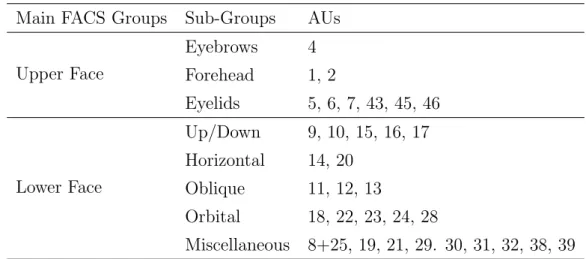
The AUs in the FACS manual are presented in two main groups: upper face and lower face actions. Each main group is then split into sub-groups. A breakdown of the groupings andAUs belonging to that group is shown in Table2.2. When training to become a FACS coder, a person would usually begin with the upper face, and then move on to the lower face actions. There are also head and eye movement descriptor codes, however these have not been included for simplicity.
As with all muscles in the human body, the facial muscle can be contracted in varying strengths. In FACS, these variations are classed as intensity scores, and are termed A, B, C, D and E to refer to how strong the action is. A is barely detectable or the lowest intensity, and E is the maximum strength possible and therefore the highest intensity. For the work in this thesis, the intensity scoring is rarely used, however in later Chapters, the temporal phase is described. This refers to the onset, apex and offset of a movement, with the apex being the highest intensity during the movement’s temporal sequence.
Table 2.2: FACS AUs defined as two main groups and split into sub-groups
based on their location and movement style.
Main FACS Groups Sub-Groups AUs
Upper Face Eyebrows 4 Forehead 1, 2 Eyelids 5, 6, 7, 43, 45, 46 Lower Face Up/Down 9, 10, 15, 16, 17 Horizontal 14, 20 Oblique 11, 12, 13 Orbital 18, 22, 23, 24, 28 Miscellaneous 8+25, 19, 21, 29. 30, 31, 32, 38, 39
2.4
Micro-Facial Expressions
When a person consciously realises that a facial expression is occurring, the person may try to suppress the facial expression because showing the emotion may not be appropriate or could be due to a cultural display rule [23]. Once the suppression has occurred, the person will mask over the original FE and cause a transient facial change referred to as a micro-facial expression [10, 41]. In a high-stakes environment, micro-facial expressions tend to become more likely as there is more risk to showing the emotion.
The duration of a micro-expression is very short and is considered the main feature that distinguishes them from a facial expression [42], with the general standard being a duration of no more than 500 ms [43]. Other definitions of speed that have been studied show micro-expressions to last less than 250 ms [18], less than 330 ms [44] and less than half a second [13]. Following Ekman and Friesen as first to define a micro-expression [45], a usual duration considered is less than 200 ms.
Experiments by Matsumoto and Hwang [46] summarise a micro-expression to be less than half a second with these experiments looking into whether training humans in detecting micro-facial expressions was effective. The findings showed that training improved the ability of reading micro-expressions and the skill was retained a few weeks after the initial training. Training humans can be time consuming and expensive, so looking into ways of aiding a person when detecting subtle movements would make training more accessible.
For humans, detecting micro-facial expressions can be difficult and usually re-quires a lot of specialist training. The spotting accuracy of humans peaks around 40% [13], and so analysis using computer algorithms incorporating machine learn-ing and computer vision can be employed to aid in the detection of micro-facial expressions.
2.5
Cultural Influences
A topic of debate in Psychological literature is Emotion regulation, which has grown in popularity since the 1990s. Emotional suppression across cultures has been comprehensively analysed [23, 47–52]. In East Asian cultures, emotional suppression is encouraged as value is placed on adjustment of behaviour to the interpersonal context. In contrast, Western cultures do not encourage suppression and value autonomy and the expression of one’s true abilities [24].
Biehl et al. [53] found that there were cultural differences between different nationalities when recognising emotions and rating the intensities. Subjects from Hungary, Japan, Poland, Sumatra, United States, and Vietnam viewed an image set named the Japanese and Caucasian Facial Expressions of Emotion (JACFEE), which contained emotional expressions of an equal number of people who were Caucasian and Japanese. A high agreement was obtained between participants on what emotion they were looking at, however difference across nations were found for the photos of anger, contempt, disgust, fear, sadness, and surprise. A similar results was found for the intensity ratings. A study into how well people from different nations could spot micro-facial movements from varying countries would help determine if there are cross-cultural differences in micro-movements, or if they are similarly universal.
2.6
Analysing Facial Expressions with Computer
Vision
Understanding context and how powerful human emotions are, is fundamental to developing an effective detection system using a computer. Studies into people posing facial expressions, under the self-perception theory in Psychology, have
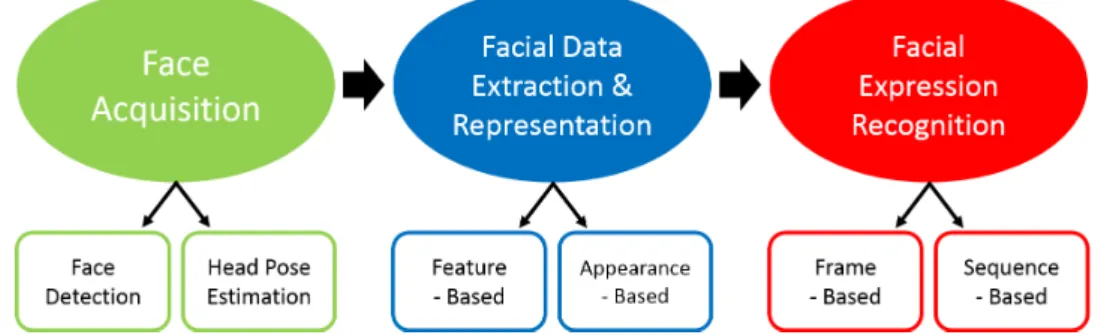
Figure 2.3: The general pipeline of a facial expression analysis system. Image
reproduced from Tian et al. [56].
found that regions of the brain that associated with enjoyment activate when a person voluntarily smiles [54] and more recently experiments with a large number of participants (170) [55] found that voluntarily smiling under stressful situations helped reduce heart rate compared with participants who kept a neutral expres-sion.
2.6.1
Facial Expression Analysis
Automatic facial expression analysis typically refers to a computer system that can take visual information and automatically analyse the facial motions and fea-tures to recognise particular facial expressions. It is an active research area and has applications in human-computer interaction, computer generated avatars and emotion classification [2]. Due to the rich amount of research in this area, it is im-possible to discuss every method, and so important developments and techniques are discussed. More in-depth analysis can be found in [2,56, 57].
The pipeline of facial expression analysis can be generalised into three stages: face acquisition, where the face is detected and preprocessed; facial data extraction, where the facial expression images are typically processed using a feature-based or appearance-based method; and recognition, where the expression is classified by machine learning. Fig. 2.3 summarises this pipeline.
Any facial expression analysis system needs to be able to analyse facial actions regardless of a person’s gender, age, ethnicity or culture. Humans with normal facial muscle structures exhibit the same movements, so modelling a general move-ment pattern is possible. For micro-movemove-ment analysis, discussed in Section 2.7, the same requirement of person independent analysis is set.
2.6.2
Face Acquisition and Preprocessing
Firstly the face needs to be identified using a face detector. Viola and Jones [58] developed a robust real-time face detector based on a set of rectangle Haar features, which was later expanded by Lienhart et al. [59] to include more features for better performance. Many face detectors could only detect frontal faces, as these were the features they were trained on. For most facial expression problems, frontal face detectors are adequate, however for face detection ‘in the wild’, detectors need to be robust to changing head pose [60,61].
After detecting the face preprocessing is applied and can include aligning faces, normalisation, converting images to grey-scale, histogram equalisation (to even lighting) and masks that can remove unnecessary pixel data such as hair or ears.
To address spatial differences of detected face regions, faces should be nor-malised by using alignment techniques. Alignment can be done by manually mark-ing feature points, such as the eyes, on faces and alignmark-ing all faces to these feature points. Doing this can be very time-consuming and may be inaccurately aligned. Using this fully supervised method means that points must carefully be chosen based on the specific object class, and then select many example image patches of these points. Therefore, to apply this to a new object class would require the manual collection of data points to be repeated [62].
Unsupervised approaches of alignment are described by common features of the face that can be identified by using different techniques such as Active Appear-ance Models (AAMs) [63], Haar feature detectors [58] and congealing methods [62]. Pfister et al. [64] used a combination of an Active Shape Model (ASM) [65] and Haar eye detection techniques as alignment methods to further improve normali-sation. The final step of normalisation involves mapping the feature points of the face to the model face and outputting a result that is consistent with the position of the model face.
Shan et al. [66] outlines the problems with alignment. Faces being mis-aligned can cause recognition problems due to faces being of different shapes, sizes and orientations. Other mis-alignment issues can be down to the user assuming that the input images and features being used have been accurately localised.
By using a deformable Lucas-Kanade algorithm, Zhu et al. [67] fit a mesh to faces that is automatically generated from a frontal face image based on the detected eye corners and the distance between the eyes. This template is then mapped onto the reference frame and the mesh is aligned to the input image with the help of the previous eye corner detectors. The face image is then rectified by mapping it onto the reference frame and can then be compared to the initial image and rectified image for differences.
This method has the limitation of producing some distorted faces due to the input face being at an odd angle or turned so far that when a mesh is fitted, the face becomes stretched and skewed. If looking for subtle changes in the face then this method could potentially make analysis of images inaccurate due to distortion to track the movements accurately. For normal facial detection, this method could still work by learning the overall feature map of a typical face.
2.6.3
Facial Data Extraction and Representation
There are two main areas of feature extraction used for facial expression analysis: feature-based and appearance-based. Geometric feature-based methods extract facial components or facial feature points and form a feature vector to represent the geometry of the face. These features map the shape and location of things such as the nose, eyebrows and mouth.
Appearance-based methods are designed to extract the appearance (skin tex-ture) changes of the face, such as wrinkles and furrows. These features can be extracted on either the whole-face or specific regions in a face image.
2.6.3.1 Feature-Based Methods
By modelling the skin and muscle structure, Essa and Pentland [1] are able to use optical flow to estimate the muscle control variables that then classify facial expressions. This method also allows for an avatar-like representation of the face showing individual muscle group activation. By modelling temporal changes, this early work on facial expression recognition and representation did not require machine learning, but was able to plot several muscle movements into groups describing the onset, apex and offset of the expression.
Not all methods attempt to recognise expressions, AUs or emotion classes. Cohn et al. [21] proposed an AAM [63] based facial action measurement system to detect depression compared with clinical diagnosis. Manual FACS annotation and pitch analysis were also incorporated into the study. The automatic AAM
system and manual FACS used leave-one-out validation with an SVM classifier and achieved 88% and 79% accuracy respectively. Logistic regression was used for determining vocal patterns of participants and achieved an accuracy of 79%. As this method shows, facial expression recognition has valid clinical applications, even against the normal tests performed.
Li et al. [68] proposed the use a hierarchical framework based on a Dynamic Bayesian Network to recognise facial expressions. Using facial point tracking, expressions are able to be modelled to best represent a particular facial movement. This method is able to recognise AUs and six of the basic expressions (excluding contempt).
2.6.3.2 Appearance-Based Methods
Littlewort et al. [69] proposed a fully automatic system for the real-time recog-nition of basic emotional expressions (neutral, anger, disgust, fear, joy, sadness, surprise) from posed expression video sequences [30]. The system codes each frame into one of the seven emotions (and neutral) by preprocessing using a bank of Ga-bor filters. A two-stage classification process is then used to solve the problem of unbalanced datasets. Stage one used SVM and trained on every possible pair of emotions. The goal of the second stage is to convert the first stage representation into a probability distribution over 7 expression categories. Multinomial logistic ridge regression (MLR) was used to complete this stage.
Instead of using posed facial expressions, Bartlett et al. [70] employed a user independent fully automatic system for real time recognition of FACS AUs from the RU-FACS dataset [71]. Each frame is coded in respect to 20 AUs with results obtained by selecting a subset of Gabor filters [72] using AdaBoost and then training SVM on the outputs of the filters selected by AdaBoost. Detecting and recognising spontaneous facial expressions is more useful for real-time application, as they represent genuine feelings of emotion.
Fan and Tjahjadi [73] expand pyramid histogram of gradients (PHOG) [74] into three orthogonal planes (PHOG-TOP), which leads to a facial expression recognition framework that uses dynamic information. The fusion of dense optical flow and PHOG-TOP is then implemented to detect facial movement in four sub-regions (forehead, mouth, eyebrow and nose). The datasets used was the extended Cohn-Kadade dataset [31] and MMI dataset [32].
2.6.3.3 Hybrid Methods
Tian et al. [75] use facial feature tracking and convert the results to detailed parametric descriptions of the facial features. With these features as the inputs, 11 lower faceAUs and 7 upper faceAUs are recognized by a neural network (NN) algorithm. The proposed method takes an objective approach to recognising facial expressions by not classifying into the prototypic emotions, but usingFACS-based muscle movements to model the wrinkles and furrows that occur when a person exhibits facial expressions.
Facial surfaces usually contain person-dependent details such as facial hair, permanent wrinkles, scars and freckles. Appearance features alone can be depen-dent on these details for classification. Wen et al. [76] capture subtle facial motions in 3-Dimensional (3D) non-rigid face tracking to remove this dependence and can adapt recognition models to fit new people using individualised exemplars. The adaptive method is completed using an online Expectation-Maximization (EM)-based algorithm and classified using a Gaussian Mixture Model. Seven exemplars are used and represent six of the basic emotions (anger, disgust, fear, happiness, sadness, and surprise) and neutral using videos from posed expression data [30].
2.6.4
Facial Expression Recognition
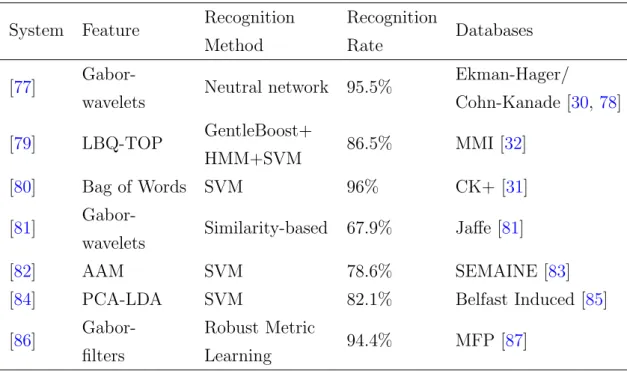
The recognition problem for facial expressions is usually split into two categories: frame-based and sequence-based. To summarise, the first does not use temporal information and the latter does. A summary of techniques and results can be seen in Table 2.3, where recent recognition methods are outlined using different publicly available datasets. Although not exhaustive, this list was chosen to show a variety of approaches for feature extraction, recognition methods and use of facial expression datasets.
Table 2.3: A summary of some facial expression recognition methods with the
corresponding feature, accuracy and dataset used.
System Feature Recognition Method
Recognition
Rate Databases
[77]
Gabor-wavelets Neutral network 95.5%
Ekman-Hager/ Cohn-Kanade [30, 78] [79] LBQ-TOP GentleBoost+ HMM+SVM 86.5% MMI [32] [80] Bag of Words SVM 96% CK+ [31] [81]
Gabor-wavelets Similarity-based 67.9% Jaffe [81]
[82] AAM SVM 78.6% SEMAINE [83]
[84] PCA-LDA SVM 82.1% Belfast Induced [85] [86]
Gabor-filters
Robust Metric
Learning 94.4% MFP [87]
For macro-facial expressions, the usual method of classification is machine learning. Methods that have been applied include neural networks (NN),SVM[12], linear discriminant analysis (LDA), K-nearest neighbor [88], multinomial logistic ridge regression (MLR) and hidden Markov models (HMM) [89].
Frame-based methods use the information from the current input frame with or without a reference frame. The reference frame is commonly a neutral face to recognise the facial expression has occurred. Some frame-based methods include [69,75–77,90,91]. By not using temporal information to inform about the person, the systems do not rely on an individual’s neutral face.
By using temporal information, sequence-based approaches aim to recognise facial expressions in one or more frames. Some examples of sequence-based meth-ods can be found in [3, 70, 92], with some being able to tackle the problem of recognising spontaneous expressions instead of posed.
2.6.5
Micro-Facial Expression Analysis
Unlike normal facial expressions, micro-facial expression analysis is less estab-lished, but is growing in popularity in recent years. This area has even been popularised to the general public with television series ‘Lie to Me’ and feature
film ‘Inside Out’. Being able to detect these expressions with similar accuracy to state-of-the-art facial expression recognition methods is the one of the biggest challenges facing this field.
Micro-facial movements are difficult to spot for humans, so computer vision is used to try and detect the subtle changes we might miss. Unfortunately, unlike the large movements of macro-expression, micro-movements can be so small that computer vision systems can find it difficult to differentiate a true expression and noise (head movement, lighting changes).
The pipeline of detecting or recognising micro-movements is very similar to facial expression analysis in terms of acquisition and, if applicable, machine learn-ing classification. However, geometric feature-based methods are rarely used as tracking feature points on a face that barely moves will not produce good re-sults. Instead, appearance-based features are primarily used to attempt to de-scribe the micro-movement or train machine learning to classify micro-expressions into classes.
2.6.5.1 Face Regions
Recent work on the recognition of micro-facial expressions have provided promising results on successful detection techniques, however there is room for improvement. To begin detection, current approaches follow methods of extracting local feature information of the face by splitting the face into regions.
Shreve et al. [93] split the face into 4 quadrants and analyse each quarter as individual temporal sequences. The advantage of this method is that it is simple to analyse larger regions, however the information to retrieve from the areas are restricted to whether there was some form of movement in a more global area.
Another method is to split the face into a specific number of blocks [17, 94]. The movement on the face is analysed locally, rather than a global representation of the whole face, and can focus on small changes in very specific temporal blocks. A disadvantage to this method is that it is computationally expensive to process the whole images as m×n blocks. It can also include features around the edge of the face, including hair, that do not relate to movement but could still effect the final feature vector.
Delaunay triangulation has been used to form regions on just the face and can exclude hair and neck [95], however this approach can still extract areas of the face that would not be useful as a feature and adds further computational expense.
A more recent and less researched approach is to use defined Regions of Inter-est (ROI) to correspond with one or more FACS AUs [96,97]. These regions have more focus on local parts of the face that move due to muscle activation. Unfor-tunately, currently defined regions do not cover allAUs and miss some potentially important movements such asAU5 (Upper Lid Raiser),AU23 (Lip Tightener) and
AU31 (Jaw Clencher).
2.6.5.2 State of the Art Micro-Expression Recognition Methods
Pfister et al. [64] used a Temporal Interpolation Model (TIM) based on a Laplacian matrix to normalise frame numbers in spontaneous micro-expression clips. Local Binary Patterns on Three Orthogonal Planes (LBP-TOP) [94] is then used to extract the temporal features. This method produces decent results and compares the existing York Deception Detection Test (YorkDDT) dataset to their own. This comparison is not directly comparable due to the datasets being very different, for example, the frame rate varied and resolution was low compared to the 640×480 of the Spontaneous Micro-Expression Corpus (SMIC) dataset. Statistically, the
TIM model is able to make results of very short expression stable, however using interpolation, by adding frames that did not exist, could skew the already sensitive micro-expression data.
HOGfeatures [11] was originally created for human detection in 2-Dimensional (2D) images and used the pixel orientation values, weighted by its magnitude, to calculate features for describing a human as an object. Polikovsky et al. [5, 98] used a3Dgradient histogram descriptor to recognise micro-facial expressions from high-speed videos. The paper used manually marked up areas that are relevant to
FACS[39] based movement so that unnecessary parts of the face are left out. This does means that the method of classifying movement in these subjectively selected areas is time-consuming and would not suit a real-time application like interroga-tion. The spatio-temporal domain is explored highlighting the importance of the temporal plane in micro-expressions, however the bin selection for the XY plane is 8 and the XT, YT planes have been set to 12. The 8 bins in the XY planes was said to represent the different directions of movement, however the authors
do not justify the temporal bin selection. An improvement on this would be to gradually increase bin size to find the ideal size for this purpose using 3Dgradient descriptors.
Wu et al. [99] use Gabor filters to automatically detect when recognising a micro-expression and spotting when they occur. However the training data used was 48 videos from Micro-Expression Training Tool (METT) [100] which flashes an expression very quickly to the user, but is classed as a posed expression. These changes may be quick but frame by frame analysis should be able to pick up these unnatural movements easily. The use of non-spontaneous micro-expression can explain how the recognition accuracy reached 95.8%.
Micro-expressions may be able to be used to help detect deception [41,101], so Owayjan et al. [102] developed a system designed to directly detect lies with a re-ported accuracy of 85%. The system is designed and implemented using labVIEW and an embedded vision system that captures participant’s interviews. By compar-ing with trained templates of specific expressions, the system finds the distances between features found on the participant’s face to determine if they are lying after being asked some interview questions. The system makes large conclusions to what they deem to be a lie detection system, as even 100% detected micro-expression in isolation would not be truly accurate. Also, the system was only tested on 4 participants and as the system tried to find subtle distance changes in facial expressions, participants would be answering questions and therefore making their faces move considerably.
Song et al. [103] attempt to learn a ‘codebook’ of micro-expressions from local space-time features and obtain a sparse representation of these features. After the codebook is obtained, a prediction model, namely support vector regression, is used to infer an emotional state. The features used are spatio-temporal interest points (STIP) that find local feature patches in a temporal sequence using HOG/HOOF features. The dataset used in experiments was not a micro-expression dataset, but contained emotional sequences that were used to obtain the face features that were deemed to be micro-expressions. As the method does not go into detail about the data, it is assumed the movements were not FACS coded.
A simple method is proposed by Guo et al. [104] uses LBP-TOP and the nearest neighbour algorithm for classification. Using the SMIC [15] dataset, the method extracts features using the whole face, and does not split the images into
smaller blocks or regions. The amount of sequences used was 70 negative and 51 positive. After splitting the sequences into testing and training sets, the Euclidean distance is calculated between various ratios of testing and training data to get a recognition accuracy. with a ratio of 5:1 (training:testing) the method achieved 63% accuracy. The accuracy score reflects similarly for other methods, and shows the difficult nature of recognising micro-expressions. Also, by not splitting the face into more local regions, micro-expressions are harder to distinguish.
Wang et al. [96, 105] used grey-scale videos clips in the 3rd-order tensor and used discriminant tensor subspace analysis. Further, they use a tensor independent color space (TICS) model to show performance of micro-expression recognition in a different colour space compared with RGB and grey-scale. Both papers normalises the face to a model with an active shape model and is effective in making the shape and location of faces consistent, however deforming faces to a model face could interfere with micro-expression recognition and potentially remove subtle movements. The recognition methodology used a cut-down version of Pfister et al. [64] by only using LBP-TOP features to a selective image block size of 5×5 and 8×8. No justification was given to why these block sizes were selected. In addition, the second paper (using TICS) contributes a novel colour representation of micro-expressions rather than grey-scale or RGB values. Unfortunately, the highest results from this colour space representation are 58.64%, which is only a few percent better than the RGB (56.09%) and grey-scale (56.91%).
A newly proposed feature, Main Directional Mean Optical-flow (MDMO), has been developed by Liu et al. [8] for micro-facial expression recognition using SVM
as a classifier. The method of detection also uses 36 regions, partitioned using 66 facial points on the face, to isolate local areas for analysis, but keeping the feature vector small for computational efficiency. The best result on theCASMEII dataset was 67.37% using leave-one-subject-out cross validation, which performed better than the LBP-TOP and Histogram of Oriented Optical Flow (HOOF) features. The results are similar to previous methods, but none yet have achieved over 90% accuracy seen in macro-facial expression analysis methods. Further, as theMDMO
feature uses SVM for classification, the vector must be normalised and therefore loses the frame-based temporal attributes that would be useful for detecting onset, apex and offset frames.
Wang et al. [106] proposed two feature extraction approaches, and then used
first feature was an expansion to the LBP-TOP spatio-temporal feature, where they removed computed neighbour points from the three orthogonal planes by considering only six unique intersection points on the three intersecting lines of the three orthogonal planes. The second feature computed the mean image of each video volume stack of orthogonal planes, therefore only deriving three mean images for each video correspond to the XY, XT and YT planes. The features were compared on theSMIC[15] andCASMEII [17] datasets. One of the highest results was 66.40% on a ‘leave-one-video-out’ approach, using an RBF kernel, using the six intersection points and tested on the CASME II dataset. Unfortunately, the results do not go higher than around 70%, and the six intersecting points feature took around 15 seconds to extract each feature.
Lu et al. [95] proposed a Delaunay-based temporal coding model, which recog-nises micro-expressions by encoding texture variations and relating them to mus-cle movements. By using Delaunay triangulation, participants in a dataset can be normalised to reduce the influence of personal appearance. The use of triangula-tion allows for regions to be defined and used to calculate the magnitudes within the regions to select features that are related to micro-expressions. The experi-ments used theSVM and RFalgorithms for classification, but the best result was achieved when trying to separate micro-expressions and non-movements with an accuracy of 88.89%. By using local regions, subtle movements in small areas can be localised. However, by using Delaunay triangulation across the whole face the features may still include irrelevant information in the final feature vector, similar to block-based approaches [16, 17].
2.7
Micro-Movement Detection
Research into detecting movements rather than the recognition of micro-expressions using machine learning is very limited. The focus on recognition ap-proaches, as discussed in Section2.6.5.2, is a result of assuming the task of putting micro-expressions into categories is trivial. The results from many of these stud-ies show very few achieving higher than chance, including studstud-ies way below 50% accuracy. Going against the machine learning approach can be controversial, but objectifying micro-movements as skin deformations of the face could lead to better detection methods and finally a better understanding of micro-facial movements.
![Figure 2.2: The 7 universal facial expressions defined by Ekman [ 10, 28]. Top, left to right: happy, sad, anger and disgust](https://thumb-us.123doks.com/thumbv2/123dok_us/10202222.2923203/32.893.204.743.120.475/figure-universal-facial-expressions-defined-ekman-right-disgust.webp)