ISSN(Online): 2320-9801
ISSN (Print) : 2320-9798
I
nternational
J
ournal of
I
nnovative
R
esearch in
C
omputer
and
C
ommunication
E
ngineering
(An ISO 3297: 2007 Certified Organization)
Vol. 4, Issue 3, March 2016
An Efficient Technique for Illumination
Adjustment Using CLAHE Algorithm
V.Vembuselvi, T.Murugan
M.E Student (VLSI Design), Department of ECE, Adhiyamaan College of Engineering, Hosur, Tamilnadu, India Assistant Professor, Department of ECE, Adhiyamaan College of Engineering, Hosur, Tamilnadu, India
ABSTRACT : For real time applications in intelligent transportation system processing an image at high speed is essential and must be considered. In this paper we propose an low complexity efficient technique for illumination adjustment based on Retinex theory and CLAHE algorithm. From the experimental results we can conclude that the proposed method achieved comparable good visual quality than the other enhancement methods. This method can process one pixel per clock cycle, for an image with a resolution of QSXGA (2560 × 2048), it requires about 25 ms to process one frame that is suitable for real-time applications. In some low-cost intelligent imaging systems, the processing rate can be slowed down.
I.INTRODUCTION
Nowadays, requirement of cameras gets increased in applications such as intelligent surveillance systems to monitor the public and private sections. In Intelligent Transport Systems, cameras monitor the situation about traffic, vehicle crashes and accidents and they record each and every minute. But poor visibility because of the weather or poor atmospheric light will lead to the Intelligent systems to give poor performance. There are many image processing techniques to overcome this issue such as illumination adjustment, scaling, de noising etc. In ITS pre-processing the image at high speed is necessary. In this paper we focus on image enhancement using CLAHE algorithm technique.
II.RELATED WORK
ISSN(Online): 2320-9801
ISSN (Print) : 2320-9798
I
nternational
J
ournal of
I
nnovative
R
esearch in
C
omputer
and
C
ommunication
E
ngineering
(An ISO 3297: 2007 Certified Organization)
Vol. 4, Issue 3, March 2016
III.RETINEX THEORY
Retinex theory was developed by Land and McCann in the year 1971. It explains about the visual perception. According to the Retinex theory, the intensity of light that reaches the camera or eye depends on the Product of two factors namely illumination and reflectance.
Illumination indicates the ray of light from the source such as sun. Reflectance indicates ratio of total amount of radiation reflected by a surface to the total amount of radiation incident on the surface. Illuminance is defined as the amount of luminous flux per unit area. By the Retinex theory, image observed can be written as,
I(U,V) = L(U,V) X R(U,V)
Where I(U,V) indicates the pixel of an observed image that is located in the (U,V) co-ordinate, L(U,V) indicates the illumination and R(U,V) indicates the reflectance of the object.
Illumination is first estimated by using Retinex theory and it is denoted as L[u,v] and is reflectiance that is estimated is represented as R[u,v]. To increase the visual quality of the image estimated illumination L.
IV.PROPOSED IMAGE ENHANCEMENT TECHNIQUE
The flow diagram of Proposed Image enhancement method is shown in Figure below. First, an image in RGB colour space is changed into HSV domain. The reason for choosing HSV domain is, it is intuitive to humans. Next, average envelope is found as illumination plane which is denoted as L. By using CLAHE algorithm illumination component L is adjusted to get good visual quality in high and low luminence regions. At last enhanced image that is represented in HSV colour domain is again converted into RGB colour space. The procedure followed in FIEEMD is explained as follows.
Step1 - Estimate the local median and local maximum points of intensity layer of the image. In empirical mode decomposition technique local maximum and local minimum points are calculated. But in FIEEMD technique local median point is calculated instead of local minimum points since it produces smooth illumination output and it results in a increased contrasting reflectance.
Step2 - By connecting all the local maximum and local median points, upper and lower envelopes can be estimated respectively.
Step3 - The first average envelope is calculated by averaging the lower envelope and upper envelope values that is calculated in Step 2 and it is denoted as EA. It results in estimated illumination plane. To get enhanced image, illumination adjustment must be done using CLAHE algorithm.
ISSN(Online): 2320-9801
ISSN (Print) : 2320-9798
I
nternational
J
ournal of
I
nnovative
R
esearch in
C
omputer
and
C
ommunication
E
ngineering
(An ISO 3297: 2007 Certified Organization)
Vol. 4, Issue 3, March 2016
Fig.1 Flow diagram
The only difference between regular AHE and CLAHE is that there is one extra step to clip the histogram before the computation of its CDF as the mapping function is performed. Hence CLAHE is implemented in the same function tiled AHE in ahe.cpp. The program "ahe" takes an additional optional parameter which specifies the level at which to clip the histogram.
Steps followed in CLAHE algorithm
1. Calculate a grid size based on the maximum dimension of the image. The minimum grid size is 32 pixels square.
2. If a window size is not specified chose the grid size as the default window size.
3. Identify grid points on the image, starting from top-left corner. Each grid point is separated by grid size pixels. 4. For each grid point calculate the histogram of the region around it, having area equal to window size and
centered at the grid point.
5. If a clipping level is specified clip the histogram computed above to that level and then use the new histogram to calculate the CDF.
ISSN(Online): 2320-9801
ISSN (Print) : 2320-9798
I
nternational
J
ournal of
I
nnovative
R
esearch in
C
omputer
and
C
ommunication
E
ngineering
(An ISO 3297: 2007 Certified Organization)
Vol. 4, Issue 3, March 2016
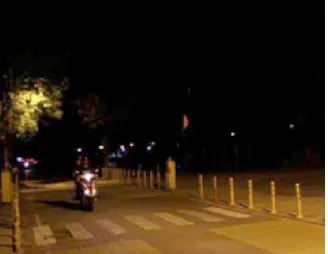
Fig.2 – Input Image.
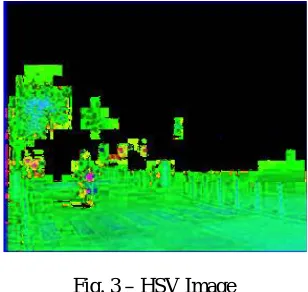
The RGB format of the input image is converted into HSV and is shown in Fig.3. The reason for converting RGB to HSV is that it is more intuitive to human beings.
Fig. 3 – HSV Image
The below Fig.4 shows the output of FIEEMD, which is used to estimate the illumination of an image.
Fig.4 – Local Median Filter
ISSN(Online): 2320-9801
ISSN (Print) : 2320-9798
I
nternational
J
ournal of
I
nnovative
R
esearch in
C
omputer
and
C
ommunication
E
ngineering
(An ISO 3297: 2007 Certified Organization)
Vol. 4, Issue 3, March 2016
Fig. 5 – Illumination Adjustment
The overall output of the algorithm using Retinex theory is shown below. From the figure, it can be clearly seen that Haze removal is achieved using CLAHE algorithm. This results in better quality images.
Fig.6 – Enhanced Output Image
VI.RESULTS AND CONCLUSIONS
Our method can efficiently enhance the details of the image to obtain the comparable results as compared with other methods, particularly in the low- and high-luminance regions. The design meets the requirement of real-time image/video applications and is suitable to be employed in end-user camera equipment. In the future the illumination adjustment may be used to get the enhanced image in video. The experimental results demonstrate that our design requires the least computation load and achieves comparable performance in objective metrics and subjective image quality as compared with other image enhancement methods.
REFERENCES
1. S. C. Huang, F. C. Cheng, and Y. S. Chiu, “Efficient contrast enhancement using adaptive gamma correction with weighting distribution,”IEEE Trans. Image Process., vol. 9, no. 1, pp. 1032–1041, Mar. 2014.
2. F. C. Cheng and S. C. Huang, “Efficient histogram modification using bilateral Bézier curve for the contrast enhancement,” J. Display Technology, vol. 9, no. 1, pp. 44–50, Jan. 2013.
3. T. Celik and T. Tjahjadi, “Automatic image equalization and contrast enhancement using Gaussian mixture modeling,” IEEE Trans. Image Process., vol. 21, no. 1, pp. 145–156, Jan. 2012.
4. S. Marsi and G. Ramponi, “A flexible FPGA implementation for illuminance–reflectance video enhancement,” J. Real-Time Image Process., vol. 8, no. 1, pp. 81–93, Mar. 2011.
ISSN(Online): 2320-9801
ISSN (Print) : 2320-9798
I
nternational
J
ournal of
I
nnovative
R
esearch in
C
omputer
and
C
ommunication
E
ngineering
(An ISO 3297: 2007 Certified Organization)
Vol. 4, Issue 3, March 2016
7. C.-T. Shen and W.-L. Hwang, “Color image enhancement using retinex with robust envelope,” in Proc. 16th IEEE Int. Conf. Image Process., pp. 3141–3144.sep 2009
8. Y. Lu and M. Dai, “Sort optimization algorithm of median filtering based on FPGA,” in Proc. Int. Conf. Mach. Vis. Human-mach. Interface, 2010, pp. 250–253.,july 2008.
9. S. Saponara, L. Fanucci, S. Marsi and G. Ramponi, “Algorithmic and architectural design for real-time and power efficient retinex image / video processing”, J.Real-Time Image Process, Vol.1, No.4, pp.267-283, July 2007.
10. T. Arici, S. Dikbas, and Y. Altunbasak, “A histogram modification framework and its application for image contrast enhancement,” IEEE Trans. Image Process., vol. 18, no. 9, pp. 1921–1935, Sep. 2007.
11. S. Susstrunk and S. Winkler, “Color image quality on the internet,” in Proc. IS&T/SPIE Electron. Imag., Internet Imagi. V, 2004, pp. 118–131. 12. R. C. Gonzalez and R. E. Woods, Digital Image Processing. Englewood Cliffs, NJ, USA: Prentice-Hall, 2006.
13. J. C. Nunes, S. Guyot, and E. Delechelle, “Texture analysis based on local analysis of the bidimensional empirical mode decomposition,”
Mach. Vis. Appl., vol. 16, no. 3, pp. 177–188, May 2005.
14. Z. Liu and S. Peng, “Boundary processing of bidimensional EMD using texture synthesis,” IEEE Signal Process. Lett., vol. 12, no. 1, pp. 33– 36, Jan. 2005.
15. J. C. Nunes, Y. Bouaoune, E. Delechelle, O. Niang, and Ph. Bunel, “Image analysis by bidimensional empirical mode decomposition,” Image
Vis. Comput., vol. 21, no. 12, pp. 1019–1026, Nov. 2003.
16. D. J. Jobson, Z. Rahman, and G. A.Woodell, “Properties and performance of a center/surround retinex,” IEEE Trans. Image Proces., vol. 6, no. 3, pp. 451–462, Mar. 1997.
17. R. Fattal, D. Lischinski, and M.Werman, “Gradient domain high dynamic range compression,” in Proc. SIGGRAPH, 2002, pp. 249–256.