Review Paper on Optimization Wireless Sensor
Network using Fuzzy System
Prabhu Dayal, Prof. Shubha Dubey
M. Tech. Scholar, Deprtment of Computer Science and Engineering, Radharaman Institute of Technology and Science, Bhopal, India
Assistant Professor, Deprtment of Computer Science and Engineering, Radharaman Institute of Technology and Science, Bhopal, India
ABSTRACT: This paper review for routing analysis in wireless sensor networks utilizing a fuzzy logic system at each node to determine its capability to transfer data based on its relative packet delivery ratio, throughput and delay to maximize the lifetime of the sensor networks. The fuzzy logic system helps in the selection of node to forward packets to the destination. The use of fuzzy logic in WSNs is shown to be a promising technique since it allows combining and evaluating diverse parameters in an efficient manner. Fuzzy logic is a good approach due to the execution requirements can be easily supported by sensor nodes, while it is able to improve the overall network performance.
KEYWORDS: Wireless Sensor Network, Fuzzy Logic System, Capability, Packet Delivery Ratio
I. INTRODUCTION
A wireless sensor network is a collection of sensor nodes with limited power supplyand constrained computational and transmission capability. Due to the limited transmission and computational ability, and high density of sensor nodes, forwarding of data packets takes place in multi-hop data transmission. Therefore routing in wireless sensor networks has been an important area of research in the past few years.
The sensor nodes run on non-rechargeable batteries, so along with efficient routing the network should be energy efficient with efficient utilization of the resources and hence this is an important research concern. Advances in wireless technologies and evolution of low cost sensor nodes have led to introduction of low power wireless sensor networks. Due to multiple functions and ease of deployment of the sensor nodes it can be used in various applications such as target tracking, environment monitoring , health care, forest fire detection, inventory control, energy management, surveillance and reconnaissance, and so on [1]. The main responsibility of the sensor nodes in a network is to forward the collected information from the source to the sink for further operations, but the resource limitations [2], unreliable links between the sensor nodes in combination with the various application demands of different applications make it a difficult task to design an efficient routing algorithm in wireless sensor networks [3, 4].
multiple paths established between the source and the destination through which the data can reach the destination [6]. Now how these links are used are totally based on the individual routing strategy. Some routing algorithms use the best path to send the data, keeping the other alternate paths as a backup and use it if the primary path fails, some use all the paths concurrently to send data and so on.
In the past few years multi-path routing approach is extensively used for different network management purposes, such as providing a fault tolerant routing, improving transmission reliability, congestion control and Quality of Service(QoS) support in the wired and wireless networks, but the unique features of the wireless sensornetworks and the characteristics of the short range radio communications introducea new challenges that should be addressed in designing the multi-path routingprotocols.
II. LITERATURE SURVEY
M. Bheemalingaiah et al. [1], since 2000, Mobile Ad Hoc Networks are treated as the emerging filed in the wireless communication. They comprise only mobile nodes that use wireless transmission and can be set anywhere and anytime because they eliminate complexity of infrastructure and central admission. The Mobile Ad Hoc Networks are extensively used in different fields such as emergency situations, military applications and mobile communications. The routing is the major issue in the field of MANET due to the mobility nature and lack of infrastructure of the network. The different routing protocols have been proposed to address the routing issue. The development of multipath routing for mobile ad hoc network by considering the performance metrics with standard simulator is an important research area. Hence in this paper, we have chosen Power-aware Node-disjoint Multipath Source Routing (PNDMSR) to implement and analyze its performance with respective to Multipath Dynamic Source Routing (MDSR) by using various quantitative performance metrics like, routing control overhead, throughput, packet delivery ratio, packet loss and energy efficiency by varying various parameters like network's size, mobility of node, pause time, data rate and load. The main objective of the PNDMSR is selecting energy aware node-disjoint multipath from source to destination by optimizing the overhead using node's cost and it increases the network of lifetime.
Dogan Yildiz et al. [2],intersection of hyperbolic curves defined by the Time Difference of Arrival (TDOA) is often used in Wireless Sensor Networks (WSNs) to estimate the location of sensors. This paper proposes a new algorithm of this type. The hyperbolic parametric equation and the rotation matrix are used to estimate the location of the target node and rotation, translation and intersection operations are applied. MATLAB simulations on Uniform, Beta, Weibull and Gamma distributed networks showed the optimum combinations of distribution, constant range and anchor percentage.
Alexandros Ladas et al. [3], this paper presents Multipath-ChaMeLeon (MCML) as an update of the existing ChaMeLeon (CML) routing protocol. CML is a hybrid and adaptive protocol designed for Mobile Ad-Hoc Networks (MANETs), supporting emergency communications. M-CML adopts the attributes of the proactive Optimized Link State Protocol (OLSR) and extends it so as to implement a multipath routing approach based on the Expected Transmission Count (ETX). The paper substantiates the efficiency of the protocol through a simulation scenario within a MANET using the NS-3 simulator. The acquired results indicate that M-CML routing approach combined with an intelligent link metric such as the ETX reduces the effects of link instabilities and enhances the network performance in terms of resiliency and scalability.
F. De Rango et al. [5], this papers presents a 2D reservation scheme in WLAN environment. A two-dimensional wireless mobility model called smooth random mobility model (SRMM) has been considered, because it makes the movement of users smoother and more realistic than well-known in literature random mobility models. A general prediction technique based both on the analysis of cell stay time and on the direction probabilities of hand-in and hand-out events of mobile nodes from wireless cells is outlined.
F. De Rango et al. [6], this paper presents a novel call admission control (CAC) algorithm based on the statistical multiplexing of VBR traffic. The proposed algorithm is called statistical multiplexing based on discrete bandwidth levels of GOP rate (SMDB) because the solution is based on the discretisation of the GOP rate in a set of bandwidth levels and on the time characteristics of discrete bandwidth levels of MPEG sources. SMDB is compared with another statistical CAC based on the normal/lognormal distribution of the GOP rate (SMND).
Park S. Y. et al. [7], Minimum Cost Forwarding Algorithm (MCFA) is another routing protocol for Wireless Sensor Network that exploits the fact that the direction of routing is always known and it is towards the fixed external Base Station. The sensor nodes need not have a unique ID or they do not need to maintain routing tables. Each sensor node maintains the least cost estimate from itself in order to reach the Base Station. Whenever a sensor node has packets to forward to the Base Station, it broadcasts to its neighbors. After a node receives the packet, it checks if it is on the least cost route between the source sensor node and the Base Station. If it is so, the receiving node rebroadcasts the packet to its neighbors.
Osama Ennasr et al. [8], LEACH is one of the first hierarchical cluster based routing approach for wireless sensor network with static sensor nodes and static Base Station. The entire sensor field is logically divided into clusters and approximately 5% of the total deployed sensor nodes act as the cluster head. The cluster head nodes are elected with a probability based on the amount of energy left in the nodes. The cluster head does data aggregation upon collection of data from its cluster members and removes redundancy in the sensed data and finally forwards the aggregated data towards the Base Station. This saves lot of energy by minimizing the volume of data to be transmitted.
III. MULTIPATH ROUTING IN WIRELESS SENSOR NETWORKS
The restricted capacity and transmission capability of multi hop path and highdynamics of wireless links single path approach is not able to provide efficient data
rate in transmission in Wireless Sensor Networks. To overcome these issues now a days multi-path approach is used extensively [8]. As mentioned before multi-path routing has demonstrated its efficiency to improve the performance of wireless sensor and ad-hoc networks. In the following,we review the gain in performance,thatcan be achieved by using multi-path approach.
Routing in sensor networks involves finding the optimal transmission path for the energy constrained sensor nodes to the destination in order to prolong the network lifetime. From the aforementioned literatures [9-10], we find some criterion to lengthen the lifetime of the sensor networks as follows:
Small multiple hops: As the energy consumed for the transmission is proportional to the square of the distance from sender to receiver, multiple short hops is preferable instead of a single large hop [11].
Shortest path: Shortest path from the sender to receiver is the straight line connecting the nodes. Forwarding packets along this line is more efficient than a detour.
Traffic load: In case, concentration of events in some particular areas is more than that of other areas, using shortest path will cause implosion along the path. Therefore, the traffic load in the nodes will effect the lifetime of the networks [12, 13].
Energy: Nodes having greater remaining energy participates more than the nodes having small amount of power can extent the network lifetime [14].
IV. PERFORMANCE PARAMETER
Throughput (Kbps) analysis:To measure the protocol performance, throughput servesas the better parameter. The throughput is defined as theratio of number of packets received to the number ofpackets transmitted [15] and it is indirectly proportional tothe overhead.The throughput is calculated by using the equation 1.
(1)
Where x is number of bytes received and t is simulation time
Analysis of Packet Delivery Ratio (PDR):-To find the efficiency of the protocols, PDR is one of theimportant qualitative metrics. It is defined as the ratio ofdata packets received and packet sent, it is calculate as follows
PDR = × 100 (2)
Where x is the total number of packets received and y is the total number of packets sent at end of the simulation time.
Delay:-
Delay = × 100(3)
V. FUZZY SYSTEM
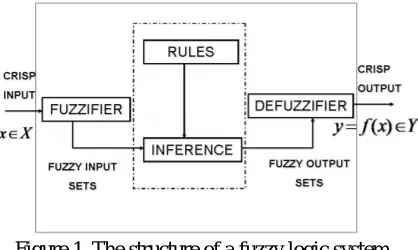
distributions. In this paper, we apply fuzzy logic system to optimize the routing process by some criterion. The main goal is designing the algorithm to use Fuzzy Logic Systems to lengthen the lifetime of the sensor networks.
Figure 1. The structure of a fuzzy logic system
VI. CONCLUSION
In this paper, the studyof an energy efficient multipath routing protocol for WSN. This protocol is designed to decrease the routing overhead, improve the latency and packet delivery ratio and through discovering multiple paths from the source to the destination. It has a sink initiated Route Discovery process with the location information of the source known to the sink. There are two types of nodes whichare used here one is primary and the other is alternate. At the end of the route formation one primary path and multiple alternate paths are built and all nodes except the primary paths nodes are put to sleep mode which helps us to save energy and generate a collision free environment, the primary path is used to transmit the data from source to the sink and if the route disrupts, the next best alternate routeis used for the purpose and if no path exists between the source and destination thenthe route discovery algorithm calls.
REFERENCES
[1] M. Bheemalingaiah and M. M. Naidu, “Performance Analysis of Power -aware Node-disjoint Multipath Source Routing in Mobile Ad Hoc Networks”, IEEE 7th International Advance Computing Conference, PP. No. 361-371, IEEE 2017.
[2] Dogan Yildiz, Serap Karagol and Okan Ozgonenel, “A Hyperbolic Location Algorithm for Various Distributions of a Wireless Sensor Networks, Smart Grid and Cities Congress and Fair (ICSG), 5th International Istanbul, PP. No. 451-459, IEEE 2016.
[3] Alexandros Ladas, Nikolaos Pavlatos, Nuwan Weerasinghe and Christos Politis, “Multipath Routing Approach to Enhance Resiliency and Scalability in Ad-hoc Networks, Ad-hoc and Sensor Networking Symposium, PP. No. 01-06, IEEE 2016.
[4] P. Fazio, M. Tropea, S. Marano, “A distributed hand-over management and pattern prediction algorithm for wireless networks with mobile hosts,” 9th International Wireless Communications and Mobile Computing Conference, IWCMC, pp. 294-298, IEEE 2013.
[5] F. De Rango, P. Fazio, S. Marano, “Mobility Prediction and Resource Reservation in WLAN Networks under a 2D Mobility Models,” 63rd Vehicular Technology Conference (VTC Fall), PP. No. 783-789, IEEE 2006.
[6] F. De Rango, M. Tropea, P. Fazio, S. Marano, “Call admission control with statistical multiplexing for aggregate MPEG traffic in a DVB-RCS satellite network,” GLOBECOM – IEEE Global Telecommunications Conference, pp. 3231-3236, IEEE 2005.
[7] F. De Rango, M. Tropea, P. Fazio, S. Marano, “Call admission control for aggregate MPEG-2 traffic over multimedia geo-satellite networks,” IEEE Transactions on Broadcasting, vol. 54, No. 3, pp. 612-622, 2008.
[8] X. Fu, S. Henning, A. Bader, D. Hogrefe, “NSIS: a new extensible IP signaling protocol suite,” IEEE Communications Magazine, vol. 43, No. 10, PP. No. 45-53, 2005.
[9] Ghaboosi, N., & Haghighat, A. T., “Tabu search based algorithms for bandwidth-delay-constrained least-cost multicast routing”, Telecommunication Systems, Vol. 34, No. 3, PP. No. 147–166, IEEE 2007.
[10] Semchedine, F., Bouallouche-Medjkoune, L., Bennacer, L., Aber, N., & Aı¨ssani, D., “Routing protocol based on Tabu search for wireless sensor networks. Wireless Personal Communications”, Vol. 67, No. 2, PP. No. 105–112, IEEE 2012.
[11] El Rhazi, A., & Pierre, S., “A Tabu search algorithm for cluster building in wireless sensor networks. Mobile Computing, IEEE Transactions on, Vol. 8, No. 4, PP. No. 433–444, 2009.
[12] Heinzelman, W. R., Chandrakasan, A., & Balakrishnan, H, “Energy-efficient communication protocol for wireless microsensor networks”, In System sciences, 2000. Proceedings of the 33rd annual Hawaii international conference, PP. No. 01-06, IEEE 2000.
[13] N. Priyantha, H. Balakrishnan, E. Demaine, and S. Teller. Anchor-freedistributed localization in sensor networks. Technical Report TR-892,MIT LCS, Apr. 2003.
[14] S. R. Drake, K. Dogancay, "Geolocation by time difference of arrivalusing hyperbolic asymptotes", in Proc. IEEE InternationalConference on Acoustics, Speech, and Signal Processing, vol. 2, pp.361 – 364, 2004.