Vol. 5, Issue 3, March 2017
Attendance System Based on Face Recognition
HemavatiSabu
1, Madhumala Sonawane
2, Jayashri Patil
3, Pradnya Vikhar
4B.E. Student, Computer Department, KCES’s College of Engineering and Information Technology, Jalgaon
Maharashtra, India123
Asst. Prof., Computer Department, KCES’s College of Engineering and Information Technology, Jalgaon
Maharashtra, India4
ABSTRACT: Daily attendance marking is a common and important activity in schools and colleges for checking the performance of students. Manual Attendance maintaining is difficult process, especially for large group of students. Some automated systems developed to overcome these difficulties, have drawbacks like cost, fake attendance, accuracy, intrusiveness. To overcome these drawbacks, there is need of smart and automated attendance system. This paper describes the attendance system implementation using face recognition. Since face is unique identity of person, the issue of fake attendance and proxies can be solved. The system uses Eigenface face recognition technique as it is fast, simple and has greater success rate. Also, it has provision to deal with intensity of light problem and head pose problem which makes it effective. This smart system can be an effective way to maintain the attendance records of students and to reduce fake attendance.
KEYWORDS: Attendance System, Face Detection, Face Recognition, Eigenface Method, Viola and Jones Algorithm
I. INTRODUCTION
The Face Recognition technique is one of the most efficient biometric techniques for identification of people. It can be utilized in the field of education for managing the attendanceof students. There are a lot of colleges and schools in which thousands of students are taking education. To maintain the attendance and records of these many numbers of students is a very difficult task. To avoid these difficulties, there is a need of anautomated system which provides accurate attendance reducing chances of fake attendance. It can beachieved using face recognition approach.
In this paper, we propose an attendance system that captures image using a camera and recognizes student using eigenface recognition technique. Viola and Jones face detection algorithm is applied before actual recognition task. The attendance of the student is then marked in the attendance log. The system also provides attendance percentage on monthly basis and reminds the teacher of the defaulter students, if any. The proposed system is aimed to design and implement uniquely identifiable face detection and recognition system which can be easily implemented and operated for markingattendance. The aim is to automate the attendance marking system which is efficient andaccurate. This will help to reduce hard-work and time and also reduce possibilities of proxy attendance.
II. RELATED WORK
We all know that today’s attendance marking system is completely manual where teacher calls student’s name and relies on his/her reply to mark the attendance. This is very tedious task especially when there is large group of people. There are efforts by various researchers towards automating this task. Different technologies have been tried and implemented for implementing such an automated system which is highly efficient in terms of accuracy, speed and cost.
Michael Dobson, Douglas Ahlers, Bernie DiDario [1] proposed the concept of Automated Attendance System in 2006. The system includes identification tags, with wirelesscommunication capabilities, for each potential attendee. There are scanners for detecting the attendees' tags as they enter a given room, at least one server in communication with thescanners. This study provided a way to get rid of tedious workofmarking and recordingattendance.
These systems tend to depend on external devices and tags which are to be externally possessed by students/attendees. One can easily handover these to others and hence there is high probability of fake attendances. For this, biometric based attendance is a good solution. O. Shoewu and O.A. Idowu [4] proposed the concept of Development of AttendanceManagement System using Biometrics in 2012. The system takes attendance electronically with the help of a finger print device and the records of the attendance are storedin a database. Attendance is marked after student identification.
Some system implementations have been tried based on face recognition techniques as well. Face is unique identity of a person and helps identify persons accurately. Face recognition has been widely studied subject from way long back in 1964.
During 1964 and 1965, Bledsoe, along with Helen Chan and Charles Bisson, worked onusing computer to recognize human faces [5]. These operators could process about 40 pictures an hour.After Bledsoe, this work was continued at the Stanford Research Institute by Peter Hart. In experiments performed on a database of over 2000 photographs,the computer consistently outperformed humans when presented with the same recognition tasks [5]. This clearly indicates the face recognition capability of computers.
Matthew Turk and Alex Pentland [6] proposed the concept of Face RecognitionUsing EigenFace Method in 1991. This method tracks a subject's head and then recognizes the person by comparing characteristics of the face to those of known individuals.Initially, a principle component factor “eigenvector” is determined using PCA then theset of characteristic feature image "eigenface" are found. This method is simple and fast as it is an unsupervised method.
Paul Viola, Michael J. Jones [7] proposed the concept of Robust Real Time FaceRecognition in 2004. They defined a face detection framework that is capable of processing images extremely rapidly while achieving high detection rates. NirmalyaKar, and DwijenRudra Pal [8] proposed the concept of implementing automated attendance system using Face Recognition Technique in 2012. They showedthat the system will record the attendance of the students inclassroom automaticallyusing face recognition approach. Each student is identified by face and the attendance ismarked.
AjinkyaPatil, MrudangShukla [9] proposed the concept of implementation of class-room attendance system based on face recognition in 2014. In this approach, they usedface detection and face recognition system. The face detection differentiates face parts fromnon-face parts and is therefore essential for accurate attendance. The face recognition formarking the student's attendance uses supervised method LDA. The Raspberry pi module is used for face detection recognition.
III. SYSTEM OVERVIEW
Fig. 1 shows the overall system architecture of proposed system. The complete system is divided into different small independent modules.
Image Acquisition-
This module is initial part of the system. Logitech C270 (3MP) is used for imageacquisition. The acquired images are converted to grayscale image. All further operations are performed on this image.
Face Detection-
After capturing the image, the image is given to face detection module. This module detects the image regions which are likely to be human. The Violaand Jones Algorithm, also known asthe Ada-Boost algorithm for face detection, is used for face detection purposes. The detected face regions are cropped andscaled to 200x200 resolution and then used for further recognition task.
Face Recognition-
Face recognition is the next step after face detection. The faces cropped from the image are compared with the stored images in the face database. Here,Eigenface method is used for face recognition.
Face recognition involves following two steps-
1. Feature Extraction-
After the face detection, face image is given as input to the feature extraction module to find the key features that will be used for classification.The module composes a very short feature vector that is well enough to represent the faceimage. Here, it is done with PCA (principal component analysis) method.
Classification-With the help of a pattern classifier, the extracted featuresof face image are compared with the ones stored in the face database. The faceimage is then classified as either known or unknown. If the image face is known, corresponding student is identified.
Fig1 Block Diagram for System
Attendance
Recording-After the verification of faces and successful recognitionis done, the attendance of the student is marked in front of his/her roll number. If the faceis not recognized, an error page is displayed.
Attendance Calculation-
It involves the attendance report generation. The module takes student information and daily attendance status from student database. The attendance is calculated as per requirement. There are options for calculating day-wise, student-wise and class-student-wise attendance. The attendance reports are generated and saved in a file.
Database-
Databases maintained in this system are student information database,face database and attendance database. Student information database consists of roll number, name and class of student. Attendance database includes attendance status of student for every day. The face database consists of face images of students accordingto their roll numbers.
IV. FACE DETECTION AND RECOGNITION MODULES IMPLEMENTATION
Viola and Jones Face Detection Algorithm: Steps for viola and jones algorithm:
It secondly uses an integral image representation to increase speed of computations. These features are used with a classifier trained on face and non-face images.
In third step, the cascade classifier is used which involves strong decision about face/non-face for all the sub-windows in the image. It is a simple and efficient classifier to select a small number of critical visual features from a very large set of potential features.
The fourthstepis to combine classifier in a “cascade”.It allows background regions of the image to be quickly discarded while spending more computation on promising face-like regions.
MATLAB provides a face/non-face classifier which is pre-trained on large face database using viola and jones algorithm. We take benefit of these trained features to detect face regions from our data through step function of CascadeObjectDetector.
Eigenface method implementation steps:
1) Acquire an initial set of face images, the training set. This is a characteristic face image database which includes
a number of images for each student. Here, we taken 30 students and face images for each student are 4. Hence our database includes 120 faces.
2) Calculate average face of all the images in training set, say F1,F2,…Fn, using formula:
N i iF
N
AF
11
3) Calculate difference face corresponding to each face image in the training set. This is also called the normalized
training set of images
AF
F
D
i
i
4) Find out Covariance Matrix, C:
N i T i iD
D
N
C
11
5) Calculate the eigenvalues and eigenvectors for the covariance matrix, C.
6) Choose the N’ eigenvectors with the highest associated eigenvalues.
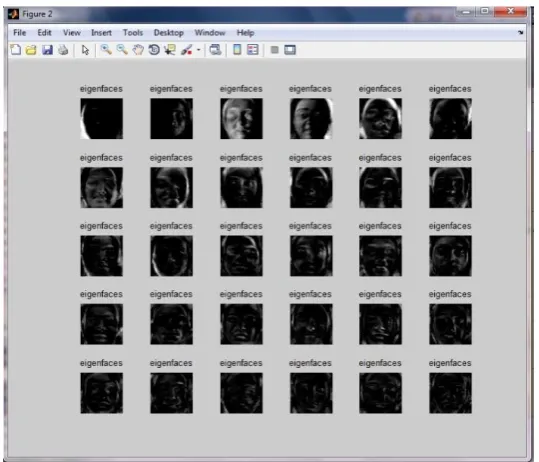
7) Calculate the (N’=30) eigenfaces by multiplying difference faces and eigen vectors.
8) For each individual in database, calculate class vector W, by averaging the eigenface pattern vectors calculated
from original (Say, 4) images of the individual.
9) Input image I1 is transformed into its eigenface component using equation:
)
(
I
1AF
u
w
T
10) Calculate difference between
w
for test image and for each training person's eigenface one by one.11) Choose a threshold value,
, (We considered it as 110000000). It defines the maximum allowable distance fromany face class.
12) The image having error value above threshold is classified as unknown.
V. EXPERIMENTAL RESULTS
Fig. 2 a) The cropped face part of input image, avergae face for the student and the corresponding recognised image. The recognised person’s roll number is indicated in message box
Fig. 2 c) Monthly attendance report of a student indicated using pie chart.
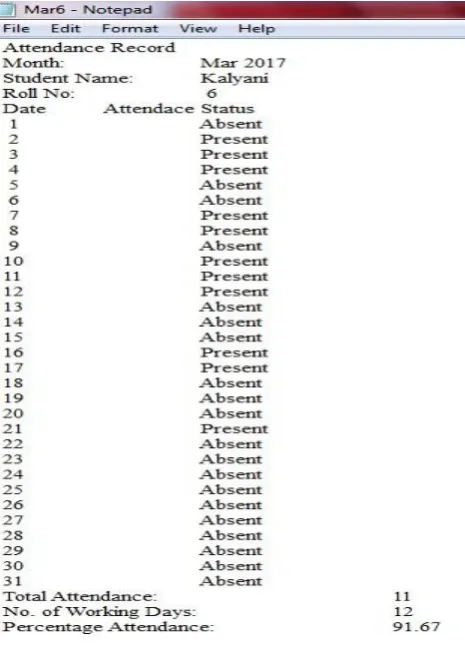
Fig. 2 d) Monthly attendance report of a student as recorded in a file.
Table 1 Results
VI. DISCUSSION
The proposed system can be used at any places where attendance is taken and one need to maintain its record e.g, colleges, offices, etc. The project as a system of face recognition, can have applications such as: Information Security, Surveillance, Access Control, Identification System.
The complete system is very simple to implement and takes very less time to run. Fast execution and non-intrusive nature along with the reduction in fake attendance makes the system very effective.
However, the system is not 100 percent accurate. Face detection can hardly cope with 45° face rotation both around the vertical and horizontal axis.It is ssensitive to lighting conditions and performs badly in dark or shadowy environment. While detecting face parts, we might get multiple face detections in an image even though only one face exists. This face detection problem leads to false recognition and hence inaccurate attendance marking.
VII. CONCLUSION AND FUTURE SCOPE
As face provides a unique identity of a person, it can be used to identify a person and verify his/her identity. Face recognition provides non-intrusive way to recognize a person. By using this system, the chances of fake attendance and proxies can be reduced. The facerecognition using eigenface method helps overcome problems related to lightning issues and head pose problems in some cases.However, the system accuracy is still not up to the mark owing especially to the face detection method sensitive to head tilt problems. We need to look for some robust face detection method. Other supervised methods may tend to be quite useful in the system.
Besides, we can simplify the system and make more efficient by taking advantage of multiple face detections to mark attendance of all the visible faces in single attempt. This will be economical and more efficient use of face recognition for attendance marking. We also consider to develop an android application for this system in near future.
REFERENCES
[1] Michael Dobson, Douglas Ahlers, Bernie DiDario, “Attendance Tracking System", United States Patent Application Publication, Pub. No.: US 2006/0035205 A1, Feb.16, 2006
[2] Vishal Bhalla, TapodhanSingla, AnkitGahlot, Vijay Gupta, “Bluetooth Based Attendance Management System", International Journal of Innovations in Engineering and Technology (IJIET), Vol. 3 Issue 1, pp.227-233, October 2013.
[3] SumitaNainan, Romin Parekh, Tanvi Shah, “RFID Technology Based Attendance Management System”,IJCSI International Journal of Computer Science Issues, Vol.10, Issue 1, No 1, pp.516-521, January 2013.
[4] O. Shoewu and O.A. Idowu, “Development of Attendance Management System using Biometrics ", The Pacific Journal of Science and Technology, Vol. 13, Number1, pp.300-307, May 2012 (Spring).
[5] Dr.S.B.Thorat, S.K.Nayak, Miss.JyotiP.Dandale, “Facial Recognition Technology: An analysis with scope in India", (IJCSIS) International Journal of Computer Science and Information Security,Vol. 8, No. 1, pp.325-330, 2010
[6] M. A. Turk and A. P. Pentland, “Eigenfaces for Recognition", Journal of Cognitive Neuroscience, Vol.3, No.1, pp. 71-86, 1991. [7] Paul Viola and Michael J. Jones, “Robust Real-Time Face Detection", International Journal of Computer Vision, pp.137-154, 2004
[8] NirmalyaKar, MrinalKantiDebbarma, AshimSaha, and DwijenRudraPal , “Studyof Implementing Automated Attendance System Using Face Recognition Technique", International Journal of Computer and Communication Engineering, Vol. 1, No. 2, pp.100-103, July 2012.
[9] AjinkyaPatil, MrudangShukla, “Implementation of classroom Attendance System Based on Face Recognition in Class", International Journal of Advances in Engineering & Technology, Vol. 7, Issue 3, pp. 974-979, July, 2014.
[10] Naveed Khan Balcoh, M. HaroonYousaf, Waqar Ahmad and M. IramBaig, “Algorithm for Efficient Attendance Management: Face Recognition based approach”, IJCSI International Journal of Computer Science Issues, Vol. 9, Issue 4, No 1, pp.146-150, July 2012.