Manual Annotation and Automatic Image Processing of Multimodal Emotional
Behaviours: Validating the Annotation of TV Interviews
J.-C. Martin
1, G. Caridakis
2, L. Devillers
1, K. Karpouzis
2, S. Abrilian
11 LIMSI-CNRS, BP 133, 91403 Orsay Cedex, France {martin, devil, abrilian}@limsi.fr
2 Image, Video and Multimedia Systems Lab, National Technical University of Athens, Iroon Polytechniou 9, GR-157 80 Athens, Greece,
{kkarpou, gcari}@image.ece.ntua.gr Abstract
There has been a lot of psychological researches on emotion and nonverbal communication. Yet, these studies were based mostly on acted basic emotions. This paper explores how manual annotation and image processing can cooperate towards the representation of spontaneous emotional behaviour in low resolution videos from TV. We describe a corpus of TV interviews and the manual annotations that have been defined. We explain the image processing algorithms that have been designed for the automatic estimation of movement quantity. Finally, we explore how image processing can be used for the validation of manual annotations.
1.
2.
Introduction
There has been a lot of psychological researches on emotion and nonverbal communication of facial expressions of emotions (Ekman, 1999), and on expressive body movements (Boone & Cunningham, 1998; DeMeijer, 1989; Newlove, 1993; Wallbott, 1998). Yet, these psychological studies were based mostly on acted basic emotions: anger, disgust, fear, joy, sadness, surprise. In the area of affective computing, recent studies of non-verbal behaviour during emotions are also limited with respect to the number of modalities or the spontaneity of the emotion : markers on body to recognise four acted basic emotions (Kapur et al., 2005), motion capture of static postures during acting of two nuances of four basic emotions (De Silva et al., 2005), video processing of facial expressions and upper body gestures during six acted emotional behaviours (Gunes & Piccardi, 2005).
Most of these studies are dealing with basic acted emotions, and real-life multimodal corpora are very few despite the general agreement that it is necessary to collect audio-visual databases that highlight naturalistic expressions of emotions (Douglas-Cowie et al., 2003).
Indeed, building a multimodal corpus of real-life emotions is challenging since it involves subjective perception and requires time consuming manual annotations of emotion at several levels. This manual annotation might benefit from image processing via the automatic detection of emotionally relevant video segments. Estimation of movement quantity by automatic image processing might validate the manual annotations of movements during the time-based annotation of the video, and also of emotional activation at the level of the whole video. Finally automatic annotation might ease the manual annotation process by providing movement segmentation and precise values of expressive parameters such as the speed, the spatial expansion or the fluidity of a gesture. Yet, manual annotation and image processing provide information at different levels of abstraction and their integration is not straightforward. Furthermore, most of the work in image processing of emotional behaviour has been done on high quality videos recorded in
laboratory situations where emotions might be less spontaneous than during non staged TV interviews.
The goals of this paper are to explore 1) the applicability of image processing techniques to low resolution videos from TV, and 2) how image processing might be used for the validation of manual annotation of spontaneous emotional behaviour.
Section 2 describes the corpus of TV interviews that has been collected and the manual annotations that have been defined. Section 3 explains the image processing algorithms that have been designed for the automatic estimation of movement quantity. A preliminary study with 3 videos was already presented in (Martin et al., 2006). Section 4 explores several ways to compare the manual annotations and the results of image processing with the illustration of 10 videos.
Manual annotation of multimodal
emotional behaviours
The EmoTV corpus features 50 video samples of emotional TV interviews (Abrilian et al., 2005). The videos are encoded in Cinepak Codec by CTi (720x576, 25 images/sec). The goal of the EmoTV corpus is to provide knowledge on the coordination between modalities during non-acted emotionally rich behaviours. Thus, a multilevel coding scheme has been designed and enables the representation of emotion at several levels of temporality and abstraction (Devillers et al., 2005). At the global level there is the annotation of emotion (categorical and dimensional including global activation). Similar annotations are available at the level of emotional segments of the video.
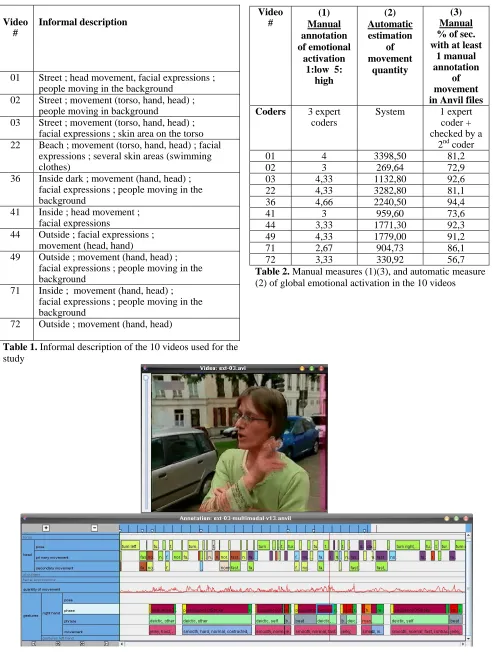
Video #
Informal description
01 Street ; head movement, facial expressions ; people moving in the background
02 Street ; movement (torso, hand, head) ; people moving in background
03 Street ; movement (torso, hand, head) ; facial expressions ; skin area on the torso 22 Beach ; movement (torso, hand, head) ; facial
expressions ; several skin areas (swimming clothes)
36 Inside dark ; movement (hand, head) ; facial expressions ; people moving in the background
41 Inside ; head movement ; facial expressions
44 Outside ; facial expressions ; movement (head, hand)
49 Outside ; movement (hand, head) ; facial expressions ; people moving in the background
71 Inside ; movement (hand, head) ; facial expressions ; people moving in the background
72 Outside ; movement (hand, head)
Video #
(1) Manual annotation of emotional
activation 1:low 5:
high
(2) Automatic estimation
of movement
quantity
(3) Manual % of sec. with at least
1 manual annotation
of movement in Anvil files Coders 3 expert
coders
System 1 expert
coder + checked by a
2nd coder
01 4 3398,50 81,2
02 3 269,64 72,9 03 4,33 1132,80 92,6 22 4,33 3282,80 81,1 36 4,66 2240,50 94,4 41 3 959,60 73,6 44 3,33 1771,30 92,3 49 4,33 1779,00 91,2 71 2,67 904,73 86,1 72 3,33 330,92 56,7 Table 2. Manual measures (1)(3), and automatic measure (2) of global emotional activation in the 10 videos
Table 1. Informal description of the 10 videos used for the study
finally the inclusion of torso annotation in the union of movement annotation only if it includes a skin area.
The study described in this paper may have several applications. For example, designing affective Human Computer-Interfaces such as Embodied Conversational Agents which requires modelling the relations between spontaneous emotions and behaviours in several modalities (Martin, Abrilian, Devillers et al., 2005).
Acknowledgement
This work was partly funded by the FP6 IST HUMAINE Network of Excellence (http://emotion-research.net).
6.
References
Abrilian, S., Devillers, L., Buisine, S., & Martin, J.-C. (2005). EmoTV1: Annotation of Real-life Emotions for the Specification of Multimodal Affective Interfaces. 11th International Conference on Human-Computer Interaction (HCII'2005), Las Vegas, Nevada, USA, 22 - 27 July.
Boone, R. T., & Cunningham, J. G. (1998). Children's decoding of emotion in expressive body movement: The development of cue attunement. Developmental Psychology, 34(5), 1007-1016.
De Silva, P. R., Kleinsmith, A., & Bianchi-Berthouze, N. (2005). Towards unsupervised detection of affective body posture nuances. 1st International Conference on Affective Computing and Intelligent Interaction (ACII'2005), Beijing, China, 22-24 october.
DeMeijer, M. (1989). The contribution of general features of body movement to the attribution of emotions.
Journal of Nonverbal Behavior(13), 247 - 268. Devillers, L., Abrilian, S., & Martin, J.-C. (2005).
Representing real life emotions in audiovisual data with non basic emotional patterns and context features. First International Conference on Affective Computing & Intelligent Interaction (ACII'2005), Beijing, China, October 22-24.
Douglas-Cowie, E., Campbell, N., Cowie, R., & Roach, P. (2003). Emotional speech; Towards a new generation of databases. Speech Communication(40). Ekman, P. (1999). Basic emotions. In T. Dalgleish & M. J. Power (Eds.), Handbook of Cognition & Emotion
(pp. 301–320). New York: John Wiley.
Gunes, H., & Piccardi, M. (2005). Fusing Face and Body Display for Bi-modal Emotion Recognition: Single Frame Analysis and Multi-Frame Post Integration.
1st International Conference on Affective Computing and Intelligent Interaction (ACII'2005), Beijing, China, 22-24 october.
Hartmann, B., Mancini, M., & Pelachaud, C. (2005).
Implementing Expressive Gesture Synthesis for
Embodied Conversational Agents. Gesture
Workshop (GW'2005), Vannes, France, May. Kapur, A., Kapur, A., Virji-Babul, N., Tzanetakis, G., &
Driessen, P. F. (2005). Gesture-Based Affective
Computing on Motion Capture Data. 1st
International Conference on Affective Computing and Intelligent Interaction (ACII'2005), Beijing, China, 22-24 october.
Kipp, M. (2004). Gesture Generation by Imitation. From Human Behavior to Computer Character Animation.
Florida: Boca Raton, Dissertation.com.
Martin, J.-C., Abrilian, S., & Devillers, L. (2005).
Annotating Multimodal Behaviors Occurring during Non Basic Emotions. 1st International Conference on Affective Computing & Intelligent Interaction (ACII'2005), Beijing, China, October 22-24.
Martin, J.-C., Abrilian, S., Devillers, L., Lamolle, M., Mancini, M., & Pelachaud, C. (2005). Levels of Representation in the Annotation of Emotion for the Specification of Expressivity in ECAs. 5th International Working Conference On Intelligent Virtual Agents (IVA'2005), Kos, Greece, September 12-14.
Martin, J.-C., Caridakis, G., Devillers, L., Karpouzis, K., & Abrilian, S. (2006). Manual Annotation and Automatic Image Processing of Multimodal Emotional Behaviors in TV Interviews. 3rd IFIP Conference on Artificial Intelligence Applications & Innovations (AIAI'2006), Athens, Greece, 7-9 June. McNeill, D. (1992). Hand and mind - what gestures reveal
about thoughts: University of Chicago Press, IL. Newlove, J. (1993). Laban for actors and dancers. New
York: Routledge.
Wallbott, H. G. (1998). Bodily expression of emotion.