A Comparison of Channel Assignment Techniques
with Power Control in Ad Hoc Networks
S. Amaar Ahmad, Juan Deaton, Umesh Shukla, Ryan Irwin, Luiz. A. DaSilva and Allen B. MacKenzie
Wireless @ Virginia TechBradley Department of Electrical & Computer Engineering Virginia Polytechnic Institute & State University
Blacksburg, VA 24060
Email:{saahmad, deatjd, ushukla, reirwin, ldasilva, mackenab}@vt.edu
Abstract—Multi-channel operation in an ad hoc network can improve robustness and reliability by efficiently managing interference and reducing contention. In this paper, we model four dynamic channel assignment techniques under the same set of assumptions, comparing the efficiency of their power and channel allocations. As the number of channels increases, the differences in the performance of the four techniques become more pronounced. Among the techniques studied, the conflict graph-based technique achieves the highest number of feasible links and the lowest average power consumption.
I. INTRODUCTION
The advent of spectrum-agile radios that can self-organize into a cognitive network opens the possibility of topology con-trol that relies on both channel and transmit power allocation. Links in the network can be established simultaneously on different channels, and network nodes are sometimes equipped with multiple transceivers. The recent impetus towards exploit-ing underused bands or channels through dynamic spectrum access (DSA) has made it difficult to have an infrastructure-based management of channel assignment. Hence there is a growing need for efficient spectrum usage in the context of ad hoc networks.
Improving the performance of such multi-channel wireless networks depends on a dynamic channel assignment (DCA) mechanism to perform the most efficient allocation of chan-nels to currently active links. Several DCA techniques have been proposed to improve capacity by reusing channels more flexibly in a multihop network [1]-[18]. A link is considered feasible if it satisfies some criterion for reliable communica-tions. The fundamental objectives of these DCA techniques are to: (1) increase the number of feasible links and hence increase the aggregate network capacity and/or (2) reduce the total transmit power in the network, hence increasing its lifetime when nodes’ battery life is limited.
This paper presents a comparative study of four DCA mech-anisms proposed in the literature ([1]-[4]). We model these techniques under the same set of assumptions and compare
This work is partially supported by a Bradley Fellowship and by DARPA through Air Force Research Laboratory (AFRL) Contract FA8750-07-C-0169. The views and conclusions contained in this document are those of the authors and should not be interpreted as representing the official policies, either expressed or implied, of the Defense Advanced Research Projects Agency or the U.S.Government.
their performance in terms of the efficiency of their channel and power allocations.
System models for evaluating DCA algorithms can be broadly categorized as disk model or signal to interference and noise (SINR) based. Most research work [6]-[18] on DCA in wireless networks explores this topic from a protocol-oriented and graph theoretic perspective, in which the primary cause of performance degradation is collisions. The basic idea behind this approach is that there is an effective communication range for each transmitting node. Within this disk region, another node will successfully receive any message from the transmitter, provided no collisions occur. Conversely, if another node within the disk simultaneously transmits, then there will be a collision. Besides the disk model, which simply uses a common radius for communication and collision range, double disk models have also been studied ([8] and references therein). Double disk models reflect the fact that the interference or collision range of a transmitter is much larger than its communication range. The inner disk represents the communication region, while the outer disk represents the interference region. A collision occurs if a receiving node lies within the outer ring of an interfering node.
Hence, the protocol-oriented approach treats wireless links as operating in binary states and reduces the channel assign-ment problem to a graph coloring problem. The coloring of a graphG(V, E)is an assignment of colors to the vertex setV
(nodes) at the edges E (communications links) such that no two adjacent vertices have the same color.
While such an approach simplifies the channel assignment problem, it oversimplifies the characteristics of wireless com-munications. There are two causes for this: fading channels and aggregate interference. Even if the endpoints of a link are well within the transmit radius of each other, there is a positive probability of a frame loss due to a deep fade. Secondly, even if all interferers lie well outside the collision region of a node, the cumulative effect of the interferers in a neighborhood might be enough to make a link infeasible for communication.
Therefore, the SINR-based approach is a more realistic model. Examples of SINR-based channel assignment tech-niques in ad hoc networks include [1]-[5]. These works adopt different assumptions regarding the channel model (Rayleigh versus lognormal fading, etc.), and whether interferers’
tion information can be fed back to each user. Typically a channel assignment technique improves channel reuse for links that do not cause excessive mutual interference. Additionally, channel assignment is considered in conjunction with power control.
The first contribution of the paper is to provide a frame-work for comparing different channel assignment techniques that employ power control. Secondly, using this framework, we evaluate and compare the performance of some of the techniques proposed in literature.
This paper is organized as follows: in Section II we present the system model, followed by Section III in which we summarize the various approaches to channel assignment that we compare in this paper. Section IV reviews methods for transmit power control. Section V deals with the simula-tion methodology and the comparative results of the channel assignment techniques under study. Finally, we present our conclusions and discuss avenues for future research in Section VI.
II. SYSTEMMODEL
Consider K point-to-point links, comprising a group of nodes that are transmitting and a group of equal number that are receiving. Each link represents a one-to-one mapping between a transmitting node and a receiving node. The set of all the links is represented byL={1,2, ..., K}. The distance and the path loss between the transmitting node of linkiand the receiving node of link j are di,j and Gi,j = (di,j)−α
respectively, where αis the path loss exponent.
We assume that there are N channels in all. The instanta-neous fading gain between the transmitting node of linkiand the receiving node of linkjisγi,j. Independent and identically
distributed (i.i.d.) Rayleigh block fading is assumed on all channels. After a fixed duration of time, the fading changes to a new realization of γi,j.
Suppose that a subset of the K linksLm⊆ Lis operating on channel m. Then the SINR of linkk∈ Lmis determined
by
SIN Rk = γk,kGk,kPk
No+j∈Lm,j= kγk,jGk,jPj (1)
The variablePk denotes the transmitter’s power of linkksuch
that 0 ≤Pk ≤Pmax, where Pmax is the maximum transmit
power for all nodes. The variable No denotes the
double-sided noise spectral density, assumed constant for all receiving nodes.
We can define an indicator functionZkfor each linkksuch
that the function is equal to 1 if the SINR is greater than or equal to some threshold β. Thus a link k with Zk = 0 is
considered unserviceable, otherwise it is a feasible link. The total number of feasible links KF is
KF = K
k=1
Zk. (2)
Note that a channel assignment technique could prevent a link
k that is causing excessive interference to other links from
being active on any channel. Therefore the transmit power of link k would be set to zero (i.e.Pk = 0) which would also lead toZk = 0. Therefore, more cochannel links could achieve
the requisite SINR and consequentlyKF would increase.
A typical metric in DCA research ([1], [6] etc. and refer-ences therein) is the ‘blocking probability’ which measures the chances that a link is denied access to a channel. While it is similar to the notion of how many links are deemed unserviceable, ‘blocking probability’ assumes a connection-oriented model where new links are denied service with some probability. In our approach, a channel assignment algorithm runs for each fading block where the concept of connection or call does not apply. Furthermore, since this paper compares the relative performance and merits of channel assignment techniques, the more appropriate metric is the number of successfully assigned links given the number of channels.
Another metric relevant to ad hoc networks is the overall consumed power. By employing a power control mechanism (discussed in Section IV), transmitting nodes reduce their power consumption and cause less interference. The average transmit powerPF of the feasible links is
PF =
K
k=1Pk
KF . (3)
Note that the values of KF and PF correspond to one
instantiation of the location of nodes and the cross-link fading coefficients. To estimate the overall performance of a channel assignment and power control technique in terms of these two variables, a large number of such instantiations is needed (further discussed in Section V).
III. CHANNELASSIGNMENTTECHNIQUES
Channel assignment techniques that appear in the literature differ in their underlying constraints as well as in how they approach the problem. They can be broadly categorized as either centralized (such as [3], [4]) or decentralized (such as [1], [2]). In the following discussion, the salient features of these techniques are presented.
A. Technique 1: Interference-based Channel Assignment
In [1], which is a decentralized approach, a new link is assigned the channel that exhibits the least interference. This assignment also requires that the interference be below some threshold. The link begins transmission with a predetermined initial power. If the SINR is belowβ, the transmitter increases its power proportionally to the ratio SINRβ . Clearly, this could cause disruption to other cochannel links if their SINR falls below the threshold, leading them to increase their transmit powers as well.
To mitigate this problem, [1] proposes that each link in-crease its power not just by the ratioSINRβ but also by the ratio of its initial observed interference and some predetermined interference threshold IT H. If any link cannot satisfy its
performance sensitive to the initial power as well as the interference threshold.
B. Technique 2: Distance-based Channel Assignment In [2], multiaccess interference for a link is handled in a two step process; firstly by scheduling out strong interferers, followed by adjusting the transmit power of nodes such that links are admissible (i.e. the SINR constraint is met). While [2] considers TDMA (time division multiple access) based schemes, we follow the underlying resource allocation strategy to multiple frequency channels. Hence we generalize the notion of time slots to ‘channels’ due to the analogy between scheduling and channel assignment. Following the approach in [2], links are admitted sequentially to a network and are assigned the first available channel. Note that this approach is also decentralized.
A new link is assigned a channel such that its transmitting node does not lie within a distance D of a receiving node that is already receiving on that channel. In the second phase, the cochannel links employ transmit power control to mitigate interference [2]. A simple heuristic approach adapted from [19] is deployed where the link with the worst SINR is blocked from transmitting, thereby allowing either more admissible links or faster convergence to the desired transmit powers. The frequency reuse distance D can play a significant role in determining overall network performance. In our simulations we setDto be twice the maximum separation between a pair of transmitter-receiver nodes. Essentially, this is analoguous to using a2-hop disk model where a channel can be reused after two hops.
C. Technique 3: Conflict Graph-based Channel Assignment The work in [3] uses a centralized approach to maximize the number of links on a given channel by creating a binary conflict graph. For a pair of links, a conflict occurs if either one creates excessive interference for the other.
A new link is assigned a channel so that it does not cause the SINR of any other cochannel link to drop below β. [3] uses integer programming to determine the maximum number of links that can be supported on a given channel without violating the requisite SINR.
Note that [3] does not use power control to minimize aggregate transmit power or reduce interference, although its suggests using the distributed power control mechanism in [20] to save transmit power after the channel assignment phase. In our simulations of this technique, the initial transmit power of all links isPmax. Once the links have been allocated channels, we use the suggested power control. Additionally, [3] assumes that the fading on all the channels is the same. In our implementation of this technique, however, we have considered independent fading on all channels.
D. Technique 4: Minimum Power Re-adjustment based Chan-nel Assignment
In [4] two centralized algorithms, theMinimum Incremental Power Algorithmand theLeast Interference Algorithmare
pre-sented, which consider links with disparate rate requirements. Both algorithms are found to exhibit similar performance, and we consider the first algorithm in our evaluation. Both use transmit power control to increase the number of links that can be supported on a channel. Adding a link to a channel causes other links to adjust their transmit powers to maintain the requisite SINR.
A new link is assigned a channel such that the adjusted aggregate transmit power of its cochannel links is smaller than that of links on any other channel. However, if this channel assignment were to result in any of the previous links failing to meet their SINR requirement or exceeding their maximum transmit power, then the new link is deemed infeasible. If no other channel can support such a link then the link is blocked. This channel assignment technique tries to minimize the overall transmit power consumed across the network.
IV. POWERCONTROLTECHNIQUES
Since channel assignment is often performed in conjunction with power control, this section analyzes how transmit power control (TPC) can enhance performance by reducing the network’s aggregate interference and transmit power. While TPC is not a channel assignment technique per se, it can lead to increased channel reuse. The transmit powers can be determined through centralized or decentralized approaches.
A. Centralized
In a centralized scheme, global knowledge of cross-user gains is used to determine an assignment solution by a central entity and is then distributed to the nodes. A centralized power control algorithm seeks a feasible power allocation for the
M links on channel m. The power control mechanism in [4] (Technique 4) is based on the following development.
The cross-user gains for the M links within a block are represented by theM×M matrixG. We can define anM×M
matrixGsuch that its ithrow andjth column is
G(i, j) =
βγi,jGi,j
γi,iGi,i ifi=j
0 ifi=j. (4)
According to the Perron-Frobenius theorem [21], a power vectorPm= [P1, P2, . . . , PM]exists that meets the following
inequality
[I−G]PT
m≥UT (5)
where (·)T is the transpose, I is theM×M identity matrix andUis the 1×M vector
U=
βNo
γ1,1G1,1, βNo
γ2,2G2,2, . . . ,
βNo
γM,MGM,M
.
If the maximum eigenvalue of [I−G] is less than one then there exists a possible solution of transmit powers for allM
links such that they can coexist on the channel while satisfying the minimum SINR constraint β. The transmit power vector
Pmis then
If the maximum eigenvalue criterion is not met, some of the
M links can be assigned to another channel so as to permit a feasible power vector on channel m.
B. Decentralized
When no global knowledge or centralized control exists to influence a transmiting node’s behavior, it has to iteratively adjust its transmit power such that its receiving node is able to achieve an SINR aboveβ. In [20], the decentralized power control algorithm executed by a linkk∈ Lmconverges to the
optimal solution determined in (6) by the following iteration rule:
Pk(j+ 1) = min
Pmax, β
SIN RkPk(j)
(7)
subject to0≤Pk(j)≤Pmax wherej represents the iteration
number. The power control mechanism in [2] (Technique 2) and [3] (Technique 3) uses the above distributed approach.
Technique 1 [1] uses a different decentralized scheme to update the transmit powers of links. This is a one-step increment (i.e.j ≤2) in transmit power that is applied only if a link’s SINR is below β. Inferring from [1], the powers are updated according to
Pk(j+ 1) = min
Pmax, β SIN Rk
IT H
I
Pk(j)
2
(8)
where I =i∈Lm,i=kγk,iGk,iPi(j) is the total interference power and has to be less thanIT H (interference threshold) for a link to be set up. The initial transmit power of each link
Pk(1)is set to a constantPref.
In a distributed or decentralized approach, each transmitter adjusts its power with a feedback mechanism until all the links reach a steady state. To compare this fairly with the centralized approach, we assume that once a given number of iterations have been executed, a linkkis considered good ifSIN Rk≥
β with the converged solution ofPk used to calculatePF.
V. SIMULATIONSTUDY
In our simulations, we randomly place nodes in a square region of area dmax × dmax m2 according to a uniform distribution. The maximum separation between any of the K
point-to-point links isdrwith a path lossα= 4that is typical
for urban environments. Other relevant simulation parameters are tabulated in Table 1.
In a centralized algorithm, the knowlege about the location of the nodes and fading gains can be used to optimize channel assignment to achieve some global objective which may not be possible in a distributed algorithm. With the technique used in [3], all the links start transmitting on their assigned channels simultaneously and are jointly admitted. In the other techniques [1], [2] and [4], the links are admitted sequentially and prior links that have already been assigned channels are not re-assigned channels.
For each topology, according to the Rayleigh block fading assumption, we generate fading gains drawn from an exponen-tial distribution for each of theN channels. Based on the path
TABLE I SIMULATIONPARAMTERS
dmax 1000m
dr 200m
D 400m
β 10dB
α 4
No −110dBm
Pmax 30dBm
IT H −100dBm
Pref 5dBm
loss among nodes and the fading gains, we run the Channel Assignment and Transmit Power Control(CA-TPC) technique to obtain transmit power and channel allocation for each link. The CA-TPC algorithms are based on the techniques discussed in Sections III and IV. The process is then repeated as the topology is rearranged randomly on the square plane.
When the number of trials is large, the sample mean ofKF
(2) and PF (3) approaches the average number of feasible
links and their average transmit power, respectively for each CA-TPC algorithm. By varying K and N, we obtain the performance of the four techniques as a function of the number of links and channels. In our MATLAB-based simulations, a total of3000 trials were conducted for each value ofK and
N.
A. Results
The average number of feasible links for each of the four techniques for N = 2,4,8 channels is shown in Fig. 1, 2 and 3 respectively. The average number of feasible linksKF
increases asymptotically to a value which is the maximum number of links that can be supported within the constrained area. The higher the number of channels, the larger the maximum number of feasible links is. With two channels, the system is heavily loaded and the performance of all techniques is quite similar. It is only when the number of channels increases that the load becomes moderate and the performance differences among the techniques become apparent.
We should also reiterate that Techniques 3 and 4 are centralized whereas Techniques 1 and 2 are distributed. Note that Techniques 1, 3 and 4 exploit knowledge of interfer-ence to perform channel assignment. Technique 2 exhibits less flexibility since it makes assignment decisions based on the frequency reuse distance D. New transmitting nodes are inhibited from operating on a channel within a distance D
of pre-existing receiving nodes, therefore resulting in a large number of unfeasible links. On the other hand, Technique 1 assigns each link the channel with the least interference and therefore fares much better. In fact, it performs quite close to the centralized techniques. Technique 3 goes one step further by creating a conflict-graph of all interfering links and making a globally optimum assignment. Technique 4 uses the information about mutual interference to reduce overall power consumption.
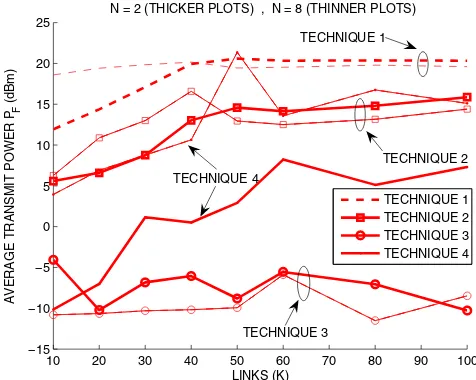
In Fig. 4 the average transmit power of feasible linksPF for
10 20 30 40 50 60 70 80 90 100 5
10 15 20
LINKS (K)
FEASIBLE LINKS (K
F
)
CHANNELS N = 2
[image:5.612.62.296.58.251.2]TECHNIQUE 1 TECHNIQUE 2 TECHNIQUE 3 TECHNIQUE 4
Fig. 1. With a mereN= 2channels, the performance of Techniques 1, 3 and 4 is statistically indistinguishable.
10 20 30 40 50 60 70 80 90 100 5
10 15 20 25 30 35
LINKS (K)
FEASIBLE LINKS (K
F
)
CHANNELS N = 4
TECHNIQUE 1 TECHNIQUE 2 TECHNIQUE 3 TECHNIQUE 4
Fig. 2. As expected, a doubling of channels to N = 4 leads to an improvement inKF.
over the other three, in terms both of number of links that can be supported and average power consumption.
We can see that for higher node densities (i.e.K >50), the average transmit power of a feasible link is approximately the same with both N = 2 and N = 8 channels for Techniques 1, 2 and 3. The average transmit power of these techniques show weak correlation with node density irrespective of the number of channels.
On the other hand, with Technique 4, we see a decline inPF
asN increases. This is because Technique 4 tries to minimize the incremental increase in transmit power when new links are admitted by appropriate channel assignment. As the number of channel increases, the technique can make better power-saving channel allocations which results in a lower PF.
10 20 30 40 50 60 70 80 90 100 0
10 20 30 40 50 60 70
LINKS (K)
FEASIBLE LINKS (K
F
)
CHANNELS N = 8
[image:5.612.325.558.59.251.2]TECHNIQUE 1 TECHNIQUE 2 TECHNIQUE 3 TECHNIQUE 4
Fig. 3. With N = 8 channels, the performance improves substantially particularly for lower values ofK, where almost a linear increase inKF can be observed.
10 20 30 40 50 60 70 80 90 100 −15
−10 −5 0 5 10 15 20 25
LINKS (K)
AVERAGE TRANSMIT POWER P
F
(dBm)
N = 2 (THICKER PLOTS) , N = 8 (THINNER PLOTS)
TECHNIQUE 1 TECHNIQUE 2 TECHNIQUE 3 TECHNIQUE 4 TECHNIQUE 1
TECHNIQUE 2
TECHNIQUE 3 TECHNIQUE 4
Fig. 4. The average transmit powerPFof the techniques. With a high node density,PF becomes insensitive to the number of available channelsN for all the techniques except Technique 4.
VI. CONCLUSIONS
[image:5.612.62.296.304.495.2] [image:5.612.320.558.307.497.2]In our future work we will consider how graph-theoretic channel assignment techniques fare under more realistic SINR-based models. If the cost of channel reassignment is high, pre-sumably we would not want to assign channels too frequently as the fade coefficients change. We will explore how robust the allocations are to fading conditions. Our results provide a comparison of the techniques for point-to-point links. We plan to extend this work to joint routing and channel assignment approaches and perhaps consider mobility issues. This will allow us to examine the cross-layer effects of topology control.
REFERENCES
[1] D. Grace, T. C. Tozer and A. G. Burr, “Reducing Call Dropping in Distributed Dynamic Channel Assignment Algorithms by Incorporating Power Control in Wireless Ad Hoc Networks,”IEEE J. Select. Area Commun., vol. 18, no. 11, Nov. 2000.
[2] T. Elbatt and A. Ephremides, “Joint Scheduling and Power Control for Wireless Ad Hoc Networks,” IEEE Trans. Wireless Commun., vol. 3, No. 1, Jan. 2004.
[3] C. M. Chin, M. L. Sim and Sverrir Olafsson, “A Dynamic Channel Assignment Startegy via Power Control for Ad-Hoc Network Systems,” Proc. IEEE Conf. Veh. Tech. (VTC), Apr. 2007.
[4] G. Kulkarni and M. Srivasta, “A Channel Assignment Scheme for FDMA based Wireless Ad Hoc Networks in Rayleigh Fading Environ-ments,”Proc. IEEE Vehicular Tech. Conf. (VTC), Oct. 2002.
[5] C. K. Tan, M. L. Sim and T. C. Chuah, “Game Theoretic Approach for Channel Assignment and Power Control with No-Internal-Regret Learning in Wireless Ad Hoc Networks,”IET Commun., vol. 2, no. 9, Mar 2008.
[6] M. Zafer and E. Modiano, “Blocking Probability and Channel Assign-ment in Wireless Networks,”IEEE Trans. Wireless Commun., vol. 5, no. 4, Apr. 2006.
[7] W. Li, P. Fan and K.B. Letaif, “A Combination of Topology Control and Channel Assignment in Wireless Ad Hoc Networks,”Proc. IEEE Global Telecommun. Conf. (GLOBECOM), 2007.
[8] M. Cheng, S. Huang and W Wu, “New Graph Model for Channel Assignment in Ad Hoc Wireless Networks,”Proc. IEE Commun., Dec. 2005.
[9] G. Kim, Q. Li and R. Negi, “A graph-based Algorithm for Schedul-ing with Sum-Interference in Wireless Networks,”Proc. IEEE Global Telecommun. Conf. (GLOBECOM), 2007.
[10] C. Barrett, G. Istrate, V. Kumar, M. Marathe, S. Thite, S. Thulasidasan, “Strong Edge Coloring for Channel Assignment in Wireless Radio Networks,” www.win.tue.nl/ sthite/pubs/d2ec-fawn06.pdf.
[11] “Conflict-Free Channel Assignment in Wireless Ad Hoc Networks”, www.cs.nctu.edu.tw/ yi/Courses/WirelessOPT/LectureNotes/lecture09.pdf. [12] T. Hou, C. Wu and M. Chan, “Dynamic Channel Assignment in
Clustered Multihop CDMA/TDMA Ad Hoc Networks,”Proc. IEEE Int. Symp. on Personal, Indoor, & Mobile Radio Commun. (PIMRC), Sep. 2004.
[13] A. Sangwan, G. Dass, P. De, H. Saran, “Throughput Enhancement through Efficient Channel Assignment in Multi-radio Ad Hoc Net-works,”Int. Sym. Telecommun. Net. Strategy Planning, Nov. 2006. [14] K. Chowdhury, P. Chanda, D. Agrawal and Q. Zeng, “DCA- A
Dis-tributed Channel Allocation Scheme for Wireless Sensor Network,” Proc. IEEE Int. Symp. on Personal, Indoor, & Mobile Radio Commun. (PIMRC), Sep. 2005.
[15] K. Bian and J. Park, “Segment-Based Channel Assignment in Cognitive Radio Ad Hoc Networks,”Proc. Int. Conf. Cognitive Radio Oriented Wireless Net. Commun. (CrownCom), Orlando FL., Aug. 2007. [16] M. X. Gong, S. Midkiff, S. Mao, “Design Principles for Distributed
Channel Assignment in Wireless Ad Hoc Networks,”Proc. IEEE Int. Conf. on Commun. (ICC), May 2005.
[17] R. Irwin and L. A. DaSilva, “Channel Assignment based on Routing Decisions (CARD): Traffic-Dependent Topology Control for Multi-Channel Networks,” accepted forIEEE Conf. Cognitive Wireless Net. & Systems (CogNets), to be held Jun. 2009.
[18] H. S. Chiu, K. L. Yeung and L. King-Shan, “On Optimization of Joint Channel Assignment and Routing in Mobile Ad Hoc Networks,”Proc. IEEE Global Telecommun. Conf. (GLOBECOM), Nov. 2007.
[19] J. Zander, “Performance of Optimum Transmitter Power Control in Cellular Radio Systems,” IEEE Trans. Veh. Technol., vol. 41, no. 1, Feb 1992.
[20] G. Foschini and Z. Miljanic,“A simple distributed autonomous power control algorithm and its convergence,”IEEE Trans. Veh. Technol., vol. 42, pp. 641 646, Nov. 1993.