DOI : https://doi.org/10.32628/CSEIT195633
Initial Ontology-Based Model for Workers Portfolio Resources
Desi Ramayanti
Faculty of Computer Science, Universitas Mercu Buana, Jakarta Barat, Indonesia
ABSTRACT
The development of electronic portfolio leads to the increase of the amount of data rapidly, scattered in many types of portfolio systems and represented in an unstructured manner. Those data cannot be reused because there are no structured-standard to manage and integrate them well. Many researchers have been developed ontology-based model for various resource domain and purpose. There is not much focus on the integration of other ontology domain like education, work histories and so forth. This paper will focus on how the competency representation and related ontology domain is modeled as initial comprehensive model for representing worker’s
portfolio resources. This study employed the Preferred Reporting Items for Systematic Reviews and Meta-Analyses (PRISMA) for complete this study. The study is including Systematic Literature Review (SLR) to find out and review relevant literature of research object. As the result, we proposed model ontology that contains 4 classes with its subclass. Class of competence have sub class competency evaluation, proficiency level, domain and attitude. Class of artefact have subclass supplementary, training, indirect and direct. Class of Organization Entities have subclass tasks, projects and departments. Class of personal network have subclass group and network.
Keywords: Ontology, E-Portfolio, PRISMA, Systematic Literature Review
I. INTRODUCTION
In recent years, the growth of information technology leads to business and private company to utilize
workers’ electronic portfolio [1]. This phenomenon has been introduced since 1980, in which electronic portfolio represented in simple and small-sized document format [2]. The use of electronic portfolio is important to connect workers to suitable open position in job market easily.
After many decades of electronic portfolio, the amount of data has been increased rapidly, scattered in many types of portfolio systems and represented in an unstructured manner [3]–[6]. Those data cannot be reused because there are no structured-standard to manage and integrate them well. According to [7], the
scattered data can be integrated into a central repository by changing structure and data format into ontology-based which is annotated using controlled vocabulary.
Many researchers have been developed ontology-based model for various resource domain and purpose. For example, ontology-based model for marine data [8], health [9][10], and many more [11]–[14].
There is not much focus on the integration of other ontology domain like education, work histories and so forth. This paper will focus on how the competency representation and related ontology domain is modeled as initial comprehensive model for representing workers portfolio resources.
The further study of this research is to build ontology-based model for workers portfolio resources in Indonesia based on the initial model as result of this paper. The initial model will be reconstructed and validated by experts by following the phase of socio-technical ontology engineering methodology.
The rest of this paper is structured as follows: In section 2, the overview of related works about similar domain of workers portfolio will be presented. In Section 3, the result of study as initial ontology-based model is explained and described. Finally, section 4 concludes this paper by summarizing key point of research studies.
II. RELATED WORK
A.Ontology Model of Fenza et al.
The ontology model of [17] has four components, including competence, employee profiles, organizational entities and employee network [17] as elaborated below.
1) The Competence Model (the inventory of competences that are relevant for an Organization) is represented by a set of individuals (competences).
2) Employees’ profiles, competences and evidences. 3) Organizational entities: Tasks, projects and
departments in Organizations
4) Employees’ Network: The property has been also
specialized in order to model work relationships between two employees.
B. Ontology Model of Nguyen&Ikeda
Ontology-based model of self-regulated learning is expressed the awareness of self-regulated learners about their knowledge and skills and proactive to conduct learning process [18]. Although the use of this model for education domain, however, it has relation
with worker’s portfolio domain. Both of them can used
to assess and monitor competencies and achievement.
We can describe the ontology by [19] as follows. The ontological model has four ontology components. The first one is person that described about learner or teacher. Learners as person do perform activity of learning that has required competencies and outcome
competencies in order to achieve competencies. The
second component is activity that has resources or
output artifact. Then, competency component has a
domain, proficiency level and competency evaluation.
The last component is artifact that may be a resource
for learning activity, an output of activity, or an
evidence of learner competencies.
Figure 2. The upper level ontology of Nguyen & Ikeda model
B. Ontology Model of Rezgui et al.
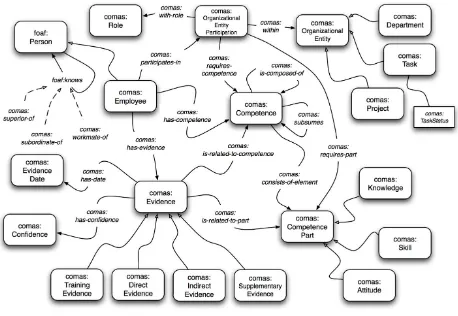
This ontology development is to for supporting lifelong competency assessment and development
name e-Portfolios. This ontology developed based on four categories that depicted on Figure below.
Figure 1. Category of e-Portofolios [20]
III.METHODOLOGY
This study employed the Preferred Reporting Items for Systematic Reviews and Meta-Analyses (PRISMA) for complete this study. The study is including Systematic Literature Review (SLR) to find out and review relevant literature of research object [21].
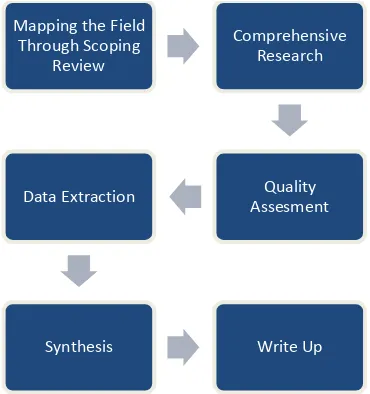
This research will be completed through five phases, i.e. mapping, comprehensive research, quality assessment, data extraction, synthesis and write up as can be seen in Figure below.
Figure 3. Research methodology
The first phase has been done by reviewing scope of study and define keyword to find out relevant literature. The second phase is conducting the research based defined keyword. The third phase is to ensure that the papers are suitable with research object. The three last phase is extraction of review result, synthesis the result, and write up all result to research paper.
IV.RESULT
Based on literature, we define ontology model that classify into five categories including Competence,
Organizational Entities, Personal Network, Artefacts. This ontology development is to for supporting development e-Portfolios ontology.
Figure 4. Proposed structure of ontology model
Based figure above we proposed model ontology that contains 4 classes with its subclass. Class of competence have sub class competency evaluation, proficiency level, domain and attitude. Class of artefact have subclass supplementary, training, indirect and direct. Class of Organization Entities have subclass Tasks, Projects and Departments. Class of Personal Network have subclass Group and Network.
V.CONCLUSION
We have conducted research to development of ontology and get conclusion that the proposed model ontology that contains 4 classes with its subclass. Class of competence have sub class competency evaluation, Mapping the Field
Through Scoping Review
Comprehensive Research
Quality Assesment Data Extraction
proficiency level, domain and attitude. Class of artefact have subclass supplementary, training, indirect and direct. Class of Organization Entities have subclass tasks, projects and departments. Class of personal network have subclass group and network.
VI. ACKNOWLEDGEMENT
This research has been funded by an internal research grant (named penelitian internal) from Universitas Mercu Buana.
Lukman, “Metadata Development for
Ethnophytomedicine Resources Using Metadata
Analysis Approach,” in The 2016 8th
International Conference on Information Technology and Electrical Engineering (ICITEE 2016), 2016.
[4]. T. Sakalo, “Ontology Modeling and Supporting Software System Implementation for the Informnation Sharing Processes within Labour
Market,” pp. 103–104, 2006.
[5]. L. B. Carrasco, M. Thaller, and J. R. Carvalho,
“Information Integration: Mapping Cultural Heritage Metadata into CIDOC CRM,” in Anais do Congresso Brasileiro de Biblioteconomia, Documentação e Ciência da Informação - FEBAB, 2013.
[6]. T. Waheed, A. M. Martinez-enriquez, and S.
Amjad, “Development of Upper Domain
Ontologies for Knowledge Preservation of
Unani Medicines,” Res. Comput. Sci., vol. 68, pp. 115–125, 2013.
[7]. S. Mustaffa et al., “Herbal Medicine Knowledge Base System,” 2013.
[8]. D. Park, H.-C. H.-C. Kwon, and S. Park,
“Ontology for semantic representation of marine metadata,” 7th Int. Conf. Ubiquitous Inf. Manag.
Commun. ICUIMC 2013, pp. 1–7, 2013.
[9]. M. Sadikin and I. Wasito, “Toward object
interaction mining by starting with object
extraction based on pattern learning method,”
Proceedings of the Pattern Learning Method Asia-Pacific Materials Science and Information Technology Conference (APMSIT’14), 2014. .
[10]. R. O. Angole, P. Jehopio, and G. Maiga,
“Ontology model: Towards bridging the gap
between African traditional medicine and
conventional medicine,” Int. J. Knowledge -based Intell. Eng. Syst., vol. 17, pp. 37–43, 2013. [11]. W. Tungkwampian, A. Theerarungchaisri, and
M. Buranarach, “Development of Thai herbal
medicine knowledge base using ontology
technique,” Thai J. Pharm. Sci., vol. 39, no. May,
pp. 102–109, 2015.
[12]. M.-A. Sicilia, “Metadata, semantics, and
ontology: providing meaning to information
resources,” Int. J. Metadata, Semant. Ontol., vol.
1, no. 1, p. 83, 2006.
[13]. Q. Chong, A. Marwadi, K. Supekar, and Y. Lee,
“in Medical Domains,” J. Res. Pract. Inf.
Technol., vol. 35, no. 2, pp. 139–154, 2003. [14]. Y.-J. Chen, “Development of a method for
ontology-based empirical knowledge
representation and reasoning,” Decis. Support
Syst., vol. 50, no. 1, pp. 1–20, 2010.
[15]. A. Macris, E. Papadimitriou, and G.
Vassilacopoulos, “An ontology-based competency model for workflow activity
assignment policies,” 2014.
[16]. S. Miranda, F. Orciuoli, V. Loia, and D. Sampson,
“Data & Knowledge Engineering An ontology
-based model for competence management,” Data
[17]. G. Fenza, G. R. Mangione, P. Ritrovato, M.
Gaeta, and F. Orciuoli, “A Semantic Approach
for Improving Competence Assessment in
Organizations,” pp. 85–87, 2012.
[18]. P. C. Abrami, C. A. Wade, V. Pillay, O. Aslan, E.
M. Bures, and C. Bentley, “Encouraging self-regulated learning through electronic
portfolios,” Can. J. Learn. Technol., vol. 34, no.
3, 2008.
[19]. L. T. Nguyën and M. Ikeda, “ePortfolio system
design based on ontological model of
self-regulated learning,” in The 3rd International
Conference on Advanced Applied Informatics, 2014, pp. 301–306.
[20]. K. Rezgui, H. Mhiri, and K. Ghédira, “Ontology -based e-Portfolio modeling for supporting lifelong competency assessment and
development,” Procedia Comput. Sci., vol. 112,
pp. 397–406, 2017.
[21]. J. K. Jesson, L. Matheson, and F. M. Lacey, Doing Your Literature Traditional and Systematic Techniques. London: SAGE, 2011.
Cite this article as :
Desi Ramayanti, "Initial Ontology-Based Model for Workers Portfolio Resources", International Journal of Scientific Research in Computer Science, Engineering and Information Technology (IJSRCSEIT), ISSN : 2456-3307, Volume 5 Issue 6, pp. 231-236, November-December 2019. Available at doi : https://doi.org/10.32628/CSEIT195633
![Figure 1. Category of e-Portofolios [20]](https://thumb-us.123doks.com/thumbv2/123dok_us/1050069.1131365/3.595.330.527.406.734/figure-category-of-e-portofolios.webp)